Abdominal Incisions
Dr. Kaushik Patel, MPT
Assistant Professor
SPB Physiotherapy College
•Surgical Incision is a cut made through the skin to
facilitate an operation or procedure.
•It should be the aim of the surgeon to employ the
type of incision considered to be the most suitable
for that particular operation to be performed.
•In doing so, three essentials should be achieved:
1.Accessibility
2.Extensibility
3.A reliable closure
Principles
 Adequate exposure for easy accessibility of organ
 It should be muscle splitting rather than cutting
- Except for the RM which can be cut transversely
because of its rich blood supply
 Nerve should not be divided
 Incision should extensible
Principles
 Least interference with the function of the
abdominal wall
 Insert DT through a separate incision
 Close the wound layer by layer
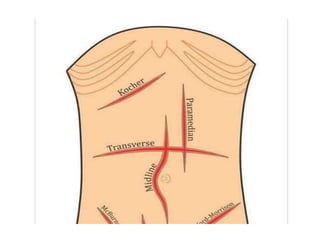
 Classification
 Vertical incision
 Transverse incision
 Oblique incision
 Others
Vertical incision
 MEDIAN
Supra-umbilical
Infra-umbilical
 PARA-MEDIAN
Upper (Rt/Lt)
Lower (Rt/Lt)
 OBLIQUE
 Mc Burney's
 Kocher (sub costal)
 Sir Rutherford
 Postrolateral
 TRANSVERSE
 Lanz
 Pfannensteil’s
 Mid abdominal
 Rt.upper
 Maylard Transverse
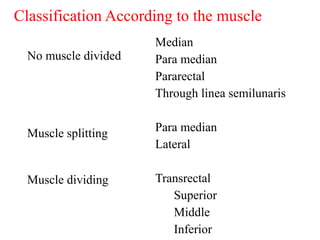
Classification According to the muscle
No muscle divided
Muscle splitting
Muscle dividing
Median
Para median
Pararectal
Through linea semilunaris
Para median
Lateral
Transrectal
Superior
Middle
Inferior
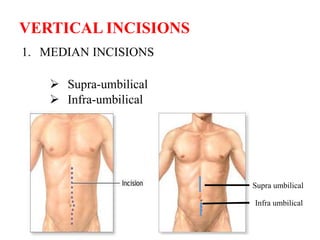
1. MEDIAN INCISIONS
 Supra-umbilical
 Infra-umbilical
VERTICAL INCISIONS
Supra umbilical
Infra umbilical
• SIGNIFICANCE-it is favoured In diagnostic laparotomy,
as it allows wide access to abdominal Cavity.
• ACCESS
Supra umbilical- stomach,duodenum,gall bladder, liver,
bile duct, and pancreas
Infra umbilical- intestine, appendix, urinary bladder,
prostate, rupture and ectopic Pregnancy
Mid lines - small and large bowel
Advantages
 Quick and good access for emergency surgery
 Almost bloodless
 Very quick to make as well as to close
 No muscle fibers are divided
 No nerves are injured
 Good access to upper abdominal viscera and both
side of abd. Can be reached
 Can be extended full length of abdomen curving
around umbilical scar.
 Supra umbilical part heals well as it is thick, strong,
and hold suture well
Disadvantage
 Healing in infraumblical region is bad as linea alba is
thin and weak there for complication of burst
abdomen and incision hernia
 Injury to the falciform ligament
 Midline scar
 Bladder injury
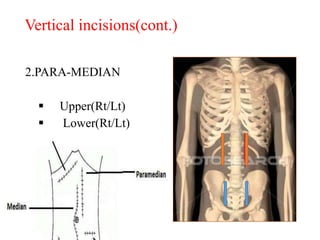
2.PARA-MEDIAN
 Upper(Rt/Lt)
 Lower(Rt/Lt)
Vertical incisions(cont.)
•Placed 2 to 5 cm lateral to midline over median aspect
of bulging transverse convexity of rectus muscle
•Rectus retracted 1inch from the midline on either side
Access
Rt.upper paramedian
stomach, duodenum, gallbladder, head of pancreas and
Rt.lobe of liver
Lt.upper paramedian
oesophagus, cardia of stomach, spleen, left lobe of
liver
Rt.lower parmedian
Appendix, female genital organs
Lt.lower paramedian
sigmoid and descending colon
Mid paramedian
Exploratory laprotomy
Pathology is not known
Multiple and extensive pathology
Advantage
 Access and extend up and down
 Provides access to lateral structures
 Closer is secure specially in muscle retracting type as
muscle comes over it
 Less chances of incisional hernia
Disadvantage
 Cosmetically bad
 Tension
 Hernia
 More blood loss
 More time consuming
 Other quadrant accessibility is less
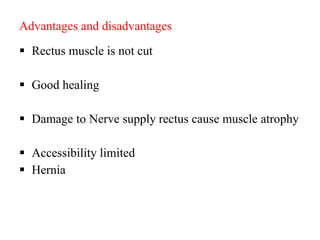
Para rectal (Battle’s incision)
 Median to outer border of rectus muscle
 Muscle retracted medially
Features
 Perpendicular to midline 1/3 of spino umbilical
line
 1/3 above and 2/3 below the line
Access
Appendix
Pelvic with extension
Colon with extension
Advantages and disadvantages
 Rectus muscle is not cut
 Good healing
 Damage to Nerve supply rectus cause muscle atrophy
 Accessibility limited
 Hernia
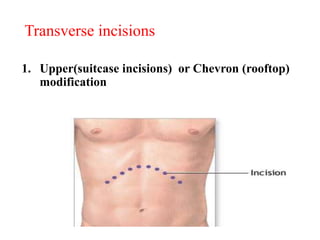
1. Upper(suitcase incisions) or Chevron (rooftop)
modification
Transverse incisions
•The incision may be continued across the midline into
double kocher’s incision or rooftop appearance which
provide excellent access to upper abdomen particularly
in those with broad costal margin
•Here both recti are cut transversely
•Uses-
•Total gastrectomy
• Total oesophagectomy
• Extensive hepatic resection
• Bilateral adrenectomy
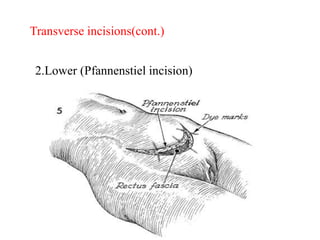
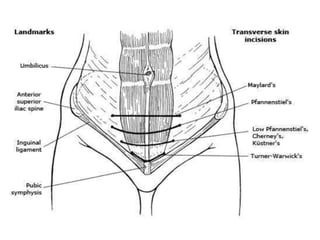
2.Lower (Pfannenstiel incision)
Transverse incisions(cont.)
• Used frequently by gynaecologist and urologist for access
to pelvic organ, bladder, prostate and for c- section.
• Is usually 12 cm long and is made in skin fold
approximately 5 cm above symphysis pubis.
• Here rectus sheath and skin is cut transversely along the
lower abdominal skin crease, However, rectus muscle are
separated in the middle and laterally.
 This is employed specially for approach to bladder and
uterus.
Transverse incisions(cont.)
3.Maylard Transverse Muscle Cutting Incision
•Gives excellent exposure to pelvic organ
•Skin incision is placed above but parallel to
traditional placement of pfannenstiel incision
Transverse incisions(cont.)
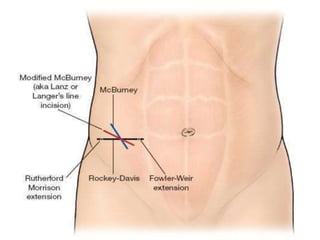
4. Lanz incision
•It is a variation of McBurneys incision that is made
the same point but in transverse plane.
•It gives cosmetically good scar
Transverse incisions(cont.)
5. Transverse Muscle dividing(mid abdomen)
•In newborn and infants, this incision is preferred bcs
more abdominal exposure is gained per length of
incision than with vertical exposure
•Because infants’ abdomen longer transverse than
vertical girth.
•Also true of short, obese adult
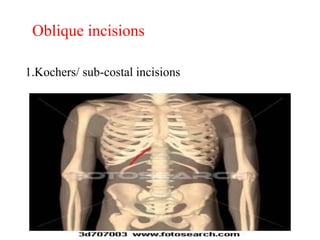
1.Kochers/ sub-costal incisions
Oblique incisions
•It affords excellent exposure to gall bladder and biliary
tract and can be made on left side to afford access to
spleen.
Oblique incision From 1 cm below the xiphoid process
to down wards to Rt.and parallel to costal margin and 2
finger breaths below it. 10- 12 cm long
Access-
 Lt.spleen and Rt.liver, gall bladder
Advantage & Disadvantage–
Good exposure to liver and gall
bladder(cholecystectomy)
Muscle and nerve cutting - chances of hernia
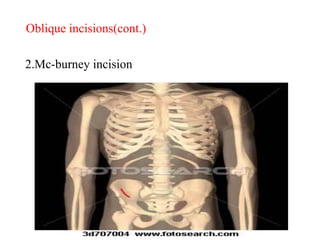
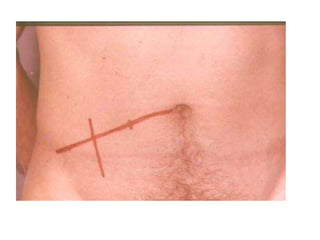
2.Mc-burney incision
Oblique incisions(cont.)
 Perpendicular to spinoumbilical line
 At the junction of lateral 1/3 and medial 2/3 of line,
and 1/3 above and 2/3 below the line
Access-
 Rt. Appendix, caecum, colostomy,
Advantage disadvantage
 Muscle splitting – no post operative hernia
 No damage to muscle and nerve
 Direct approach to appendix
 Abdomen can not be explored
 Difficulty in dealing with appendix which is not
easily found
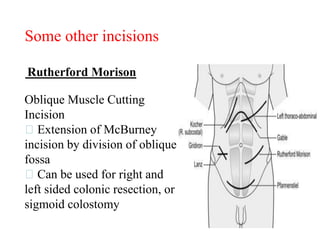
Rutherford Morison
Oblique Muscle Cutting
Incision
Extension of McBurney
incision by division of oblique
fossa
Can be used for right and
left sided colonic resection, or
sigmoid colostomy
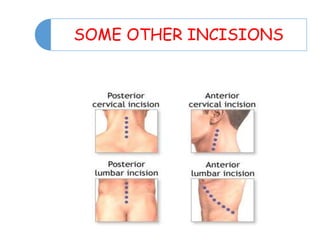
Some other incisions
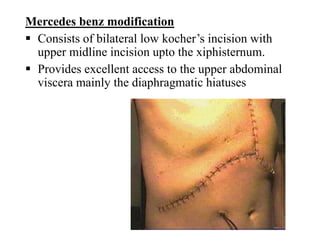
Mercedes benz modification
 Consists of bilateral low kocher’s incision with
upper midline incision upto the xiphisternum.
 Provides excellent access to the upper abdominal
viscera mainly the diaphragmatic hiatuses
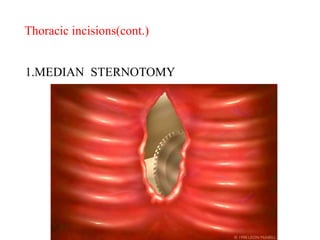
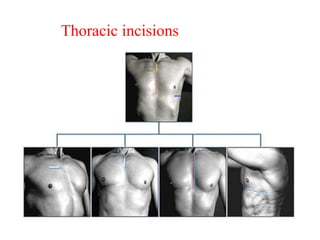
Thoracic incisions
1.MEDIAN STERNOTOMY
Thoracic incisions(cont.)
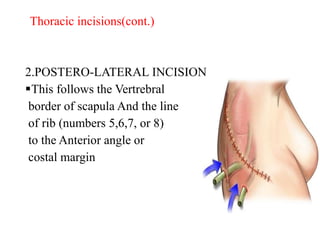
2.POSTERO-LATERAL INCISION
This follows the Vertrebral
border of scapula And the line
of rib (numbers 5,6,7, or 8)
to the Anterior angle or
costal margin
Thoracic incisions(cont.)
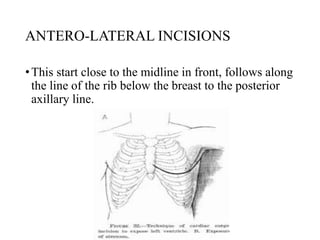
ANTERO-LATERAL INCISIONS
•This start close to the midline in front, follows along
the line of the rib below the breast to the posterior
axillary line.
SOME OTHER INCISIONS
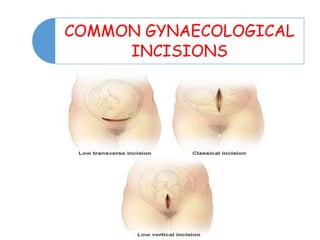
COMMON GYNAECOLOGICAL
INCISIONS
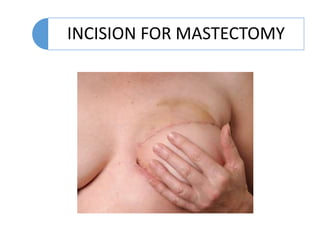
INCISION FOR MASTECTOMY
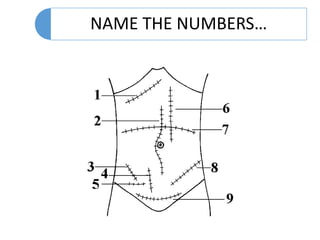
NAME THE NUMBERS…
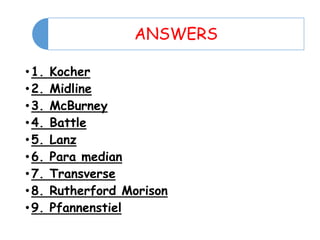
ANSWERS
•1. Kocher
•2. Midline
•3. McBurney
•4. Battle
•5. Lanz
•6. Para median
•7. Transverse
•8. Rutherford Morison
•9. Pfannenstiel
Incisions  kk

Incisions kk

  • 1.
    Abdominal Incisions Dr. KaushikPatel, MPT Assistant Professor SPB Physiotherapy College
  • 2.
    •Surgical Incision isa cut made through the skin to facilitate an operation or procedure. •It should be the aim of the surgeon to employ the type of incision considered to be the most suitable for that particular operation to be performed. •In doing so, three essentials should be achieved: 1.Accessibility 2.Extensibility 3.A reliable closure
  • 3.
    Principles  Adequate exposurefor easy accessibility of organ  It should be muscle splitting rather than cutting - Except for the RM which can be cut transversely because of its rich blood supply  Nerve should not be divided  Incision should extensible
  • 4.
    Principles  Least interferencewith the function of the abdominal wall  Insert DT through a separate incision  Close the wound layer by layer
  • 5.
     Classification  Verticalincision  Transverse incision  Oblique incision  Others
  • 6.
  • 7.
     OBLIQUE  McBurney's  Kocher (sub costal)  Sir Rutherford  Postrolateral
  • 8.
     TRANSVERSE  Lanz Pfannensteil’s  Mid abdominal  Rt.upper  Maylard Transverse
  • 9.
    Classification According tothe muscle No muscle divided Muscle splitting Muscle dividing Median Para median Pararectal Through linea semilunaris Para median Lateral Transrectal Superior Middle Inferior
  • 10.
    1. MEDIAN INCISIONS Supra-umbilical  Infra-umbilical VERTICAL INCISIONS Supra umbilical Infra umbilical
  • 11.
    • SIGNIFICANCE-it isfavoured In diagnostic laparotomy, as it allows wide access to abdominal Cavity. • ACCESS Supra umbilical- stomach,duodenum,gall bladder, liver, bile duct, and pancreas Infra umbilical- intestine, appendix, urinary bladder, prostate, rupture and ectopic Pregnancy Mid lines - small and large bowel
  • 12.
    Advantages  Quick andgood access for emergency surgery  Almost bloodless  Very quick to make as well as to close  No muscle fibers are divided  No nerves are injured  Good access to upper abdominal viscera and both side of abd. Can be reached  Can be extended full length of abdomen curving around umbilical scar.  Supra umbilical part heals well as it is thick, strong, and hold suture well
  • 13.
    Disadvantage  Healing ininfraumblical region is bad as linea alba is thin and weak there for complication of burst abdomen and incision hernia  Injury to the falciform ligament  Midline scar  Bladder injury
  • 14.
  • 15.
    •Placed 2 to5 cm lateral to midline over median aspect of bulging transverse convexity of rectus muscle •Rectus retracted 1inch from the midline on either side Access Rt.upper paramedian stomach, duodenum, gallbladder, head of pancreas and Rt.lobe of liver Lt.upper paramedian oesophagus, cardia of stomach, spleen, left lobe of liver
  • 16.
    Rt.lower parmedian Appendix, femalegenital organs Lt.lower paramedian sigmoid and descending colon Mid paramedian Exploratory laprotomy Pathology is not known Multiple and extensive pathology
  • 17.
    Advantage  Access andextend up and down  Provides access to lateral structures  Closer is secure specially in muscle retracting type as muscle comes over it  Less chances of incisional hernia
  • 18.
    Disadvantage  Cosmetically bad Tension  Hernia  More blood loss  More time consuming  Other quadrant accessibility is less
  • 19.
    Para rectal (Battle’sincision)  Median to outer border of rectus muscle  Muscle retracted medially Features  Perpendicular to midline 1/3 of spino umbilical line  1/3 above and 2/3 below the line Access Appendix Pelvic with extension Colon with extension
  • 20.
    Advantages and disadvantages Rectus muscle is not cut  Good healing  Damage to Nerve supply rectus cause muscle atrophy  Accessibility limited  Hernia
  • 21.
    1. Upper(suitcase incisions)or Chevron (rooftop) modification Transverse incisions
  • 22.
    •The incision maybe continued across the midline into double kocher’s incision or rooftop appearance which provide excellent access to upper abdomen particularly in those with broad costal margin •Here both recti are cut transversely •Uses- •Total gastrectomy • Total oesophagectomy • Extensive hepatic resection • Bilateral adrenectomy
  • 23.
  • 24.
    • Used frequentlyby gynaecologist and urologist for access to pelvic organ, bladder, prostate and for c- section. • Is usually 12 cm long and is made in skin fold approximately 5 cm above symphysis pubis. • Here rectus sheath and skin is cut transversely along the lower abdominal skin crease, However, rectus muscle are separated in the middle and laterally.  This is employed specially for approach to bladder and uterus.
  • 25.
    Transverse incisions(cont.) 3.Maylard TransverseMuscle Cutting Incision •Gives excellent exposure to pelvic organ •Skin incision is placed above but parallel to traditional placement of pfannenstiel incision
  • 27.
    Transverse incisions(cont.) 4. Lanzincision •It is a variation of McBurneys incision that is made the same point but in transverse plane. •It gives cosmetically good scar
  • 29.
    Transverse incisions(cont.) 5. TransverseMuscle dividing(mid abdomen) •In newborn and infants, this incision is preferred bcs more abdominal exposure is gained per length of incision than with vertical exposure •Because infants’ abdomen longer transverse than vertical girth. •Also true of short, obese adult
  • 31.
  • 32.
    •It affords excellentexposure to gall bladder and biliary tract and can be made on left side to afford access to spleen. Oblique incision From 1 cm below the xiphoid process to down wards to Rt.and parallel to costal margin and 2 finger breaths below it. 10- 12 cm long Access-  Lt.spleen and Rt.liver, gall bladder Advantage & Disadvantage– Good exposure to liver and gall bladder(cholecystectomy) Muscle and nerve cutting - chances of hernia
  • 33.
  • 35.
     Perpendicular tospinoumbilical line  At the junction of lateral 1/3 and medial 2/3 of line, and 1/3 above and 2/3 below the line Access-  Rt. Appendix, caecum, colostomy, Advantage disadvantage  Muscle splitting – no post operative hernia  No damage to muscle and nerve  Direct approach to appendix  Abdomen can not be explored  Difficulty in dealing with appendix which is not easily found
  • 36.
    Rutherford Morison Oblique MuscleCutting Incision Extension of McBurney incision by division of oblique fossa Can be used for right and left sided colonic resection, or sigmoid colostomy Some other incisions
  • 37.
    Mercedes benz modification Consists of bilateral low kocher’s incision with upper midline incision upto the xiphisternum.  Provides excellent access to the upper abdominal viscera mainly the diaphragmatic hiatuses
  • 38.
  • 39.
  • 40.
    2.POSTERO-LATERAL INCISION This followsthe Vertrebral border of scapula And the line of rib (numbers 5,6,7, or 8) to the Anterior angle or costal margin Thoracic incisions(cont.)
  • 41.
    ANTERO-LATERAL INCISIONS •This startclose to the midline in front, follows along the line of the rib below the breast to the posterior axillary line.
  • 42.
  • 43.
  • 44.
  • 45.
  • 46.
    ANSWERS •1. Kocher •2. Midline •3.McBurney •4. Battle •5. Lanz •6. Para median •7. Transverse •8. Rutherford Morison •9. Pfannenstiel