ACTIVE
MOVEMENTS
Presented by- Dr. Rutvi Raualji (PT)
Table of Contents
Introduction
Definition of voluntary movement
Classification
Introduction to free exercise
Advantages
Disadvantages
Precautions
Classification of free exercises
Techniques
Effects and its uses
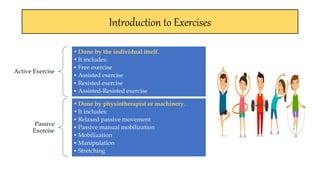
Introduction to Exercises
Active Exercise
•Done by the individual itself.
•It includes:
• Free exercise
• Assisted exercise
• Resisted exercise
• Assisted-Resisted exercise
Passive
Exercise
•Done by physiotherapist or machinery.
•It includes:
• Relaxed passive movement
• Passive manual mobilization
• Mobilization
• Manipulation
• Stretching
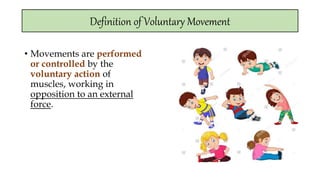
Definition of Voluntary Movement
• Movements are performed
or controlled by the
voluntary action of
muscles, working in
opposition to an external
force.
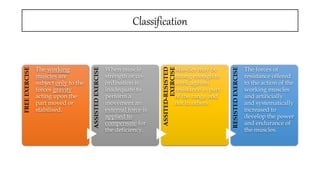
Classification
FREE
EXERCISE
The working
muscles are
subject only to the
forces gravity
acting upon the
part moved or
stabilised.
ASSISTED
EXERCISE
When muscle
strength or co-
ordination is
inadequate to
perform a
movement an
external force is
applied to
compensate for
the deficiency.
ASSITED-RESISTED
EXERCISE
Muscles may be
strong enough to
work against
resistance in part
of the range and
not in others
RESISTED
EXERCISE
The forces of
resistance offered
to the action of the
working muscles
and artificially
and systematically
increased to
develop the power
and endurance of
the muscles.
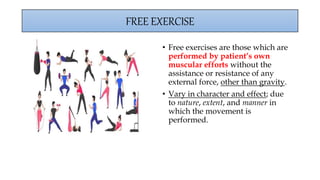
FREE EXERCISE
• Free exercises are those which are
performed by patient’s own
muscular efforts without the
assistance or resistance of any
external force, other than gravity.
• Vary in character and effect; due
to nature, extent, and manner in
which the movement is
performed.
• Free exercises are used to obtain :
1. Relaxation because of rhythmical or pendular nature of exercise
2. Muscle tone maintenance
3. Power is increased according to speed, leverage and duration of exercise
and the relationship of the part moved to gravity
4. Coordinates natural pattern
5. Confidence to perform and control movement pattern
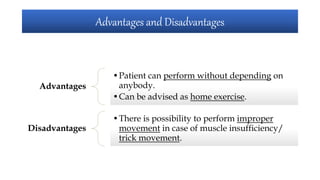
Advantages and Disadvantages
Advantages
•Patient can perform without depending on
anybody.
•Can be advised as home exercise.
Disadvantages
•There is possibility to perform improper
movement in case of muscle insufficiency/
trick movement.
Precautions
 Proper supervision
 Proper guidance to the patient
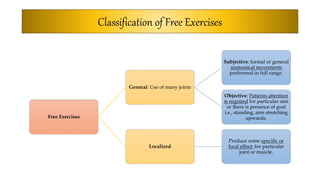
Classification of Free Exercises
Free Exercises
General: Use of many joints
Subjective: formal or general
anatomical movements
preformed in full range.
Objective: Patients attention
is required for particular aim
or there is presence of goal
i.e., standing, arm stretching
upwards.
Localized
Produce some specific or
local effect; for particular
joint or muscle.
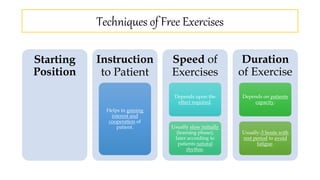
Techniques of Free Exercises
Starting
Position
Instruction
to Patient
Helps in gaining
interest and
cooperation of
patient.
Speed of
Exercises
Depends upon the
effect required.
Usually slow initially
(learning phase);
later according to
patients natural
rhythm.
Duration
of Exercise
Depends on patients
capacity.
Usually-3 bouts with
rest period to avoid
fatigue.
Effects and Uses
1. Provides relaxation; example: hypertonic
muscle- free exercise or pendular exercise will
help in normalizing tone.
2. Increases the joint mobility as well as ROM
3. Increases the muscle power and endurance
4. Improves neuro-muscular coordination
5. Increases confidence
6. Improves respiratory capacity, local body
and lymphatic circulation
Reference Desk
1. The Principles of Exercise Therapy- M. Dena Gardiner
2. Textbook of Therapeutic Exercises- Lakshmi Narayana
That’s all Folks.

Active Exercises.pptx

  • 1.
  • 2.
    Table of Contents Introduction Definitionof voluntary movement Classification Introduction to free exercise Advantages Disadvantages Precautions Classification of free exercises Techniques Effects and its uses
  • 3.
    Introduction to Exercises ActiveExercise •Done by the individual itself. •It includes: • Free exercise • Assisted exercise • Resisted exercise • Assisted-Resisted exercise Passive Exercise •Done by physiotherapist or machinery. •It includes: • Relaxed passive movement • Passive manual mobilization • Mobilization • Manipulation • Stretching
  • 4.
    Definition of VoluntaryMovement • Movements are performed or controlled by the voluntary action of muscles, working in opposition to an external force.
  • 5.
    Classification FREE EXERCISE The working muscles are subjectonly to the forces gravity acting upon the part moved or stabilised. ASSISTED EXERCISE When muscle strength or co- ordination is inadequate to perform a movement an external force is applied to compensate for the deficiency. ASSITED-RESISTED EXERCISE Muscles may be strong enough to work against resistance in part of the range and not in others RESISTED EXERCISE The forces of resistance offered to the action of the working muscles and artificially and systematically increased to develop the power and endurance of the muscles.
  • 6.
    FREE EXERCISE • Freeexercises are those which are performed by patient’s own muscular efforts without the assistance or resistance of any external force, other than gravity. • Vary in character and effect; due to nature, extent, and manner in which the movement is performed.
  • 7.
    • Free exercisesare used to obtain : 1. Relaxation because of rhythmical or pendular nature of exercise 2. Muscle tone maintenance 3. Power is increased according to speed, leverage and duration of exercise and the relationship of the part moved to gravity 4. Coordinates natural pattern 5. Confidence to perform and control movement pattern
  • 8.
    Advantages and Disadvantages Advantages •Patientcan perform without depending on anybody. •Can be advised as home exercise. Disadvantages •There is possibility to perform improper movement in case of muscle insufficiency/ trick movement.
  • 9.
    Precautions  Proper supervision Proper guidance to the patient
  • 10.
    Classification of FreeExercises Free Exercises General: Use of many joints Subjective: formal or general anatomical movements preformed in full range. Objective: Patients attention is required for particular aim or there is presence of goal i.e., standing, arm stretching upwards. Localized Produce some specific or local effect; for particular joint or muscle.
  • 11.
    Techniques of FreeExercises Starting Position Instruction to Patient Helps in gaining interest and cooperation of patient. Speed of Exercises Depends upon the effect required. Usually slow initially (learning phase); later according to patients natural rhythm. Duration of Exercise Depends on patients capacity. Usually-3 bouts with rest period to avoid fatigue.
  • 12.
    Effects and Uses 1.Provides relaxation; example: hypertonic muscle- free exercise or pendular exercise will help in normalizing tone. 2. Increases the joint mobility as well as ROM 3. Increases the muscle power and endurance 4. Improves neuro-muscular coordination 5. Increases confidence 6. Improves respiratory capacity, local body and lymphatic circulation
  • 13.
    Reference Desk 1. ThePrinciples of Exercise Therapy- M. Dena Gardiner 2. Textbook of Therapeutic Exercises- Lakshmi Narayana
  • 14.