MENSTRUAL
CYCLE
Contents
Introduction
• The cyclic event that takes place
in a rhythmic fashion during the
reproductive period of women’s
life is called menstrual cycle.
• Starts at age of 12-15 years-
known as MENARCHE.
• It permanently ceases at age of
45-50 years- known as
MENOPAUSE.
• Duration of menstrual cycle: 28
days, varies from 20-40 days.
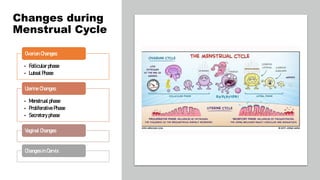
Changes during
Menstrual Cycle
• Follicular phase
• Luteal Phase
Ovarian Changes:
• Menstrual phase
• Proliferative Phase
• Secretory phase
Uterine Changes:
Vaginal Changes
Changes in Cervix
OVARIAN
CHANGES
Follicular
Phase
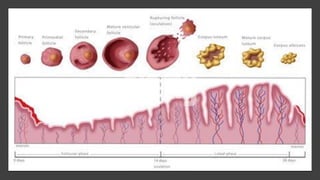
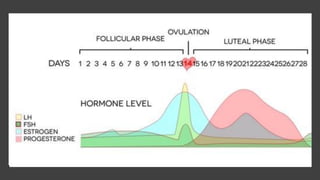
• From 5th day until time of ovulation (14th
day).
• Maturation of ovum and development of
ovarian follicle takes place.
• Stages:
I. Primordial follicle
II. Primary follicle
III. Vesicular follicle
IV. Graafian follicle
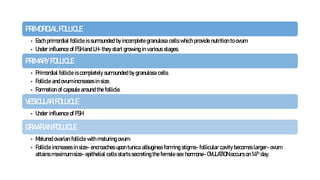
PRIMORDIAL FOLLICLE
• Each primordial follicle is surrounded by incomplete granulosa cells which provide nutrition to ovum.
• Under influence of FSH and LH- they start growing in various stages.
PRIMARY FOLLICLE
• Primordial follicle is completely surrounded by granulosa cells
• Follicle and ovum increases in size.
• Formation of capsule around the follicle.
VESICULAR FOLLICLE
• Under influence of FSH.
GRAAFIAN FOLLICLE
• Matured ovarian follicle with maturing ovum.
• Follicle increases in size- encroaches upon tunica albuginea forming stigma- follicular cavity becomes larger- ovum
attains maximum size- epithelial cells starts secreting the female sex hormone- OVULATION occurs on 14th day.
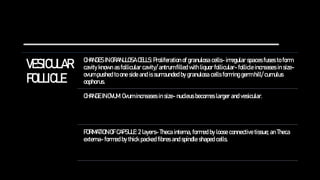
VESICULAR
FOLLICLE
CHANGES IN GRANULOSA CELLS: Proliferation of granulosa cells- irregular spaces fuses to form
cavity known as follicular cavity/ antrum filled with liquor follicular- follicle increases in size-
ovum pushed to one side and is surrounded by granulosa cells forming germ hill/ cumulus
oophorus.
CHANGE IN OVUM: Ovum increases in size- nucleus becomes larger and vesicular.
FORMATION OF CAPSULE: 2 layers- Theca interna, formed by loose connective tissue; an Theca
externa- formed by thick packed fibres and spindle shaped cells.
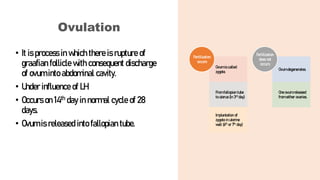
Ovulation
• It is process in which there is rupture of
graafian follicle with consequent discharge
of ovum into abdominal cavity.
• Under influence of LH.
• Occurs on 14th day in normal cycle of 28
days.
• Ovum is released into fallopian tube.
Ovum is called
zygote.
From fallopian tube
to uterus (in 3rd day)
Implantation of
zygote in uterine
wall (6th or 7th day)
Fertilization
occurs
Ovum degenerates.
One ovum released
from either ovaries.
Fertilization
does not
occurs
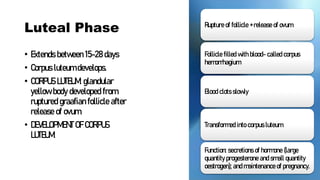
Luteal Phase
• Extends between 15-28 days
• Corpus luteum develops.
• CORPUS LUTEUM: glandular
yellow body developed from
ruptured graafian follicle after
release of ovum.
• DEVELOPMENT OF CORPUS
LUTEUM:
Rupture of follicle + release of ovum
Follicle filled with blood- called corpus
hemorrhagium
Blood clots slowly
Transformed into corpus luteum
Function: secretions of hormone (large
quantity progesterone and small quantity
oestrogen); and maintenance of pregnancy.
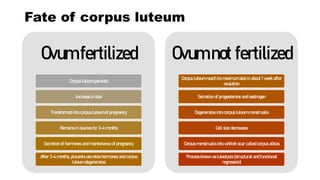
Fate of corpus luteum
Ovum fertilized
Corpus luteum persists
Increase in size
Transformed into corpus luteum of pregnancy
Remains in ovaries for 3-4 months
Secretion of hormones and maintenance of pregnancy
After 3-4 months, placenta secretes hormones and corpus
luteum degenerates
Ovum not fertilized
Corpus luteum reach its maximum size in about 1 week after
ovulation
Secretion of progesterone and oestrogen
Degenerates into corpus luteum menstrualis
Cell size decreases
Corpus menstrualis into whitish scar called corpus albias
Process known as luteolysis (structural and functional
regression)
UTERINE CHANGES
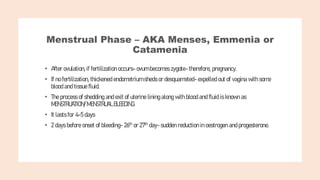
Menstrual Phase – AKA Menses, Emmenia or
Catamenia
• After ovulation, if fertilization occurs- ovum becomes zygote- therefore, pregnancy.
• If no fertilization, thickened endometrium sheds or desquamated- expelled out of vagina with some
blood and tissue fluid.
• The process of shedding and exit of uterine lining along with blood and fluid is known as
MENSTRUATION/ MENSTRUAL BLEEDING.
• It lasts for 4-5 days
• 2 days before onset of bleeding- 26th or 27th day- sudden reduction in oestrogen and progesterone.
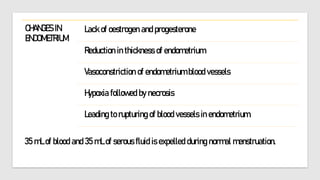
35 mL of blood and 35 mL of serous fluid is expelled during normal menstruation.
CHANGES IN
ENDOMETRIUM
Lack of oestrogen and progesterone
Reduction in thickness of endometrium
Vasoconstriction of endometrium blood vessels
Hypoxia followed by necrosis
Leading to rupturing of blood vessels in endometrium.
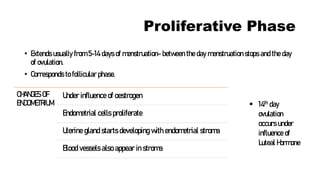
Proliferative Phase
• Extends usually from 5-14 days of menstruation- between the day menstruation stops and the day
of ovulation.
• Corresponds to follicular phase.
CHANGES OF
ENDOMETRIUM
Under influence of oestrogen
Endometrial cells proliferate
Uterine gland starts developing with endometrial stroma
Blood vessels also appear in stroma
▪ 14th day
ovulation
occurs under
influence of
Luteal Hormone
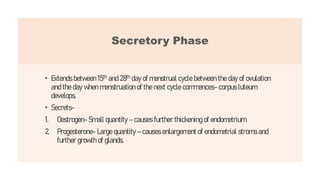
Secretory Phase
• Extends between 15th and 28th day of menstrual cycle between the day of ovulation
and the day when menstruation of the next cycle commences- corpus luteum
develops.
• Secrets-
1. Oestrogen- Small quantity – causes further thickening of endometrium
2. Progesterone- Large quantity – causes enlargement of endometrial stroma and
further growth of glands.
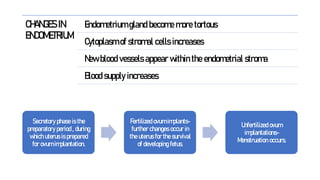
CHANGES IN
ENDOMETRIUM
Endometrium gland become more tortous
Cytoplasm of stromal cells increases
New blood vessels appear within the endometrial stroma
Blood supply increases
Secretory phase is the
preparatory period , during
which uterus is prepared
for ovum implantation.
Fertilized ovum implants-
further changes occur in
the uterus for the survival
of developing fetus.
Unfertilized ovum
implantations-
Menstruation occurs.
CHANGES IN CERVIX
AND VAGINA DURING
MENSTRUATION
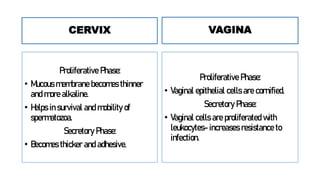
CERVIX
Proliferative Phase:
• Mucous membrane becomes thinner
and more alkaline.
• Helps in survival and mobility of
spermatozoa.
Secretory Phase:
• Becomes thicker and adhesive.
VAGINA
Proliferative Phase:
• Vaginal epithelial cells are cornified.
Secretory Phase:
• Vaginal cells are proliferated with
leukocytes- increases resistance to
infection.
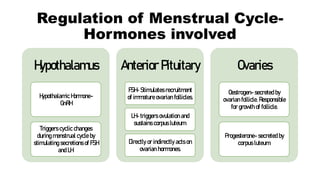
Regulation of Menstrual Cycle-
Hormones involved
Hypothalamus
Hypothalamic Hormone-
GnRH
Triggers cyclic changes
during menstrual cycle by
stimulating secretions of FSH
and LH.
Anterior Pituitary
FSH- Stimulates recruitment
of immature ovarian follicles.
LH- triggers ovulation and
sustains corpus luteum.
Directly or indirectly acts on
ovarian hormones.
Ovaries
Oestrogen- secreted by
ovarian follicle. Responsible
for growth of follicle.
Progesterone- secreted by
corpus luteum.
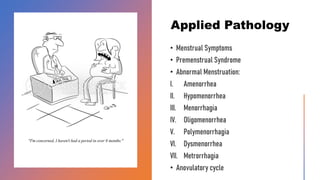
Applied Pathology
Thank
You.

MENSTRUAL CYCLE.pdf

  • 1.
  • 2.
  • 3.
    Introduction • The cyclicevent that takes place in a rhythmic fashion during the reproductive period of women’s life is called menstrual cycle. • Starts at age of 12-15 years- known as MENARCHE. • It permanently ceases at age of 45-50 years- known as MENOPAUSE. • Duration of menstrual cycle: 28 days, varies from 20-40 days.
  • 4.
    Changes during Menstrual Cycle •Follicular phase • Luteal Phase Ovarian Changes: • Menstrual phase • Proliferative Phase • Secretory phase Uterine Changes: Vaginal Changes Changes in Cervix
  • 5.
  • 6.
    Follicular Phase • From 5thday until time of ovulation (14th day). • Maturation of ovum and development of ovarian follicle takes place. • Stages: I. Primordial follicle II. Primary follicle III. Vesicular follicle IV. Graafian follicle
  • 7.
    PRIMORDIAL FOLLICLE • Eachprimordial follicle is surrounded by incomplete granulosa cells which provide nutrition to ovum. • Under influence of FSH and LH- they start growing in various stages. PRIMARY FOLLICLE • Primordial follicle is completely surrounded by granulosa cells • Follicle and ovum increases in size. • Formation of capsule around the follicle. VESICULAR FOLLICLE • Under influence of FSH. GRAAFIAN FOLLICLE • Matured ovarian follicle with maturing ovum. • Follicle increases in size- encroaches upon tunica albuginea forming stigma- follicular cavity becomes larger- ovum attains maximum size- epithelial cells starts secreting the female sex hormone- OVULATION occurs on 14th day.
  • 8.
    VESICULAR FOLLICLE CHANGES IN GRANULOSACELLS: Proliferation of granulosa cells- irregular spaces fuses to form cavity known as follicular cavity/ antrum filled with liquor follicular- follicle increases in size- ovum pushed to one side and is surrounded by granulosa cells forming germ hill/ cumulus oophorus. CHANGE IN OVUM: Ovum increases in size- nucleus becomes larger and vesicular. FORMATION OF CAPSULE: 2 layers- Theca interna, formed by loose connective tissue; an Theca externa- formed by thick packed fibres and spindle shaped cells.
  • 9.
    Ovulation • It isprocess in which there is rupture of graafian follicle with consequent discharge of ovum into abdominal cavity. • Under influence of LH. • Occurs on 14th day in normal cycle of 28 days. • Ovum is released into fallopian tube. Ovum is called zygote. From fallopian tube to uterus (in 3rd day) Implantation of zygote in uterine wall (6th or 7th day) Fertilization occurs Ovum degenerates. One ovum released from either ovaries. Fertilization does not occurs
  • 10.
    Luteal Phase • Extendsbetween 15-28 days • Corpus luteum develops. • CORPUS LUTEUM: glandular yellow body developed from ruptured graafian follicle after release of ovum. • DEVELOPMENT OF CORPUS LUTEUM: Rupture of follicle + release of ovum Follicle filled with blood- called corpus hemorrhagium Blood clots slowly Transformed into corpus luteum Function: secretions of hormone (large quantity progesterone and small quantity oestrogen); and maintenance of pregnancy.
  • 11.
    Fate of corpusluteum Ovum fertilized Corpus luteum persists Increase in size Transformed into corpus luteum of pregnancy Remains in ovaries for 3-4 months Secretion of hormones and maintenance of pregnancy After 3-4 months, placenta secretes hormones and corpus luteum degenerates Ovum not fertilized Corpus luteum reach its maximum size in about 1 week after ovulation Secretion of progesterone and oestrogen Degenerates into corpus luteum menstrualis Cell size decreases Corpus menstrualis into whitish scar called corpus albias Process known as luteolysis (structural and functional regression)
  • 12.
  • 13.
    Menstrual Phase –AKA Menses, Emmenia or Catamenia • After ovulation, if fertilization occurs- ovum becomes zygote- therefore, pregnancy. • If no fertilization, thickened endometrium sheds or desquamated- expelled out of vagina with some blood and tissue fluid. • The process of shedding and exit of uterine lining along with blood and fluid is known as MENSTRUATION/ MENSTRUAL BLEEDING. • It lasts for 4-5 days • 2 days before onset of bleeding- 26th or 27th day- sudden reduction in oestrogen and progesterone.
  • 14.
    35 mL ofblood and 35 mL of serous fluid is expelled during normal menstruation. CHANGES IN ENDOMETRIUM Lack of oestrogen and progesterone Reduction in thickness of endometrium Vasoconstriction of endometrium blood vessels Hypoxia followed by necrosis Leading to rupturing of blood vessels in endometrium.
  • 15.
    Proliferative Phase • Extendsusually from 5-14 days of menstruation- between the day menstruation stops and the day of ovulation. • Corresponds to follicular phase. CHANGES OF ENDOMETRIUM Under influence of oestrogen Endometrial cells proliferate Uterine gland starts developing with endometrial stroma Blood vessels also appear in stroma ▪ 14th day ovulation occurs under influence of Luteal Hormone
  • 16.
    Secretory Phase • Extendsbetween 15th and 28th day of menstrual cycle between the day of ovulation and the day when menstruation of the next cycle commences- corpus luteum develops. • Secrets- 1. Oestrogen- Small quantity – causes further thickening of endometrium 2. Progesterone- Large quantity – causes enlargement of endometrial stroma and further growth of glands.
  • 17.
    CHANGES IN ENDOMETRIUM Endometrium glandbecome more tortous Cytoplasm of stromal cells increases New blood vessels appear within the endometrial stroma Blood supply increases Secretory phase is the preparatory period , during which uterus is prepared for ovum implantation. Fertilized ovum implants- further changes occur in the uterus for the survival of developing fetus. Unfertilized ovum implantations- Menstruation occurs.
  • 19.
    CHANGES IN CERVIX ANDVAGINA DURING MENSTRUATION
  • 20.
    CERVIX Proliferative Phase: • Mucousmembrane becomes thinner and more alkaline. • Helps in survival and mobility of spermatozoa. Secretory Phase: • Becomes thicker and adhesive. VAGINA Proliferative Phase: • Vaginal epithelial cells are cornified. Secretory Phase: • Vaginal cells are proliferated with leukocytes- increases resistance to infection.
  • 21.
    Regulation of MenstrualCycle- Hormones involved Hypothalamus Hypothalamic Hormone- GnRH Triggers cyclic changes during menstrual cycle by stimulating secretions of FSH and LH. Anterior Pituitary FSH- Stimulates recruitment of immature ovarian follicles. LH- triggers ovulation and sustains corpus luteum. Directly or indirectly acts on ovarian hormones. Ovaries Oestrogen- secreted by ovarian follicle. Responsible for growth of follicle. Progesterone- secreted by corpus luteum.
  • 23.
  • 24.