Abdominal Incisions
Abdominal Incision
• It should be the aim of the surgeon to employ the type of
incision considered to be the most suitable for that particular
operation to be performed. In doing so, three essentials
should be achieved (Zinner et al, 1997):
1. Accessibility
2. Extensibility
3. Security
Reasons for Surgery
• To remove diseased tissue (use suffix-ectomy) eg: gatrectomy
• For Purposes of repair (use suffix- orraphy or plasty) eg: herniorraphy
or arthroplasty
• To produce an artificial opening ( use suffix-otomy or ostomy) eg:
Gastrotomy, tracheostomy
• For inspection (use suffix – oscopy)
• Cystoscopy – inspection of bladder
• Gastroscopy- inspection of stomach
• Sigmoidoscopy- inspection of sigmoid
Types of Anaesthesia
• General- Inhalation or IV
• Local-
• Spinal – injection into suarachnoid space surrounding cauda
equina
• Regional – by nerve plexus
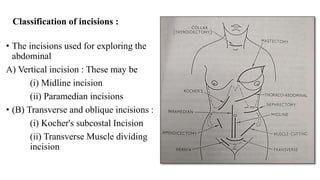
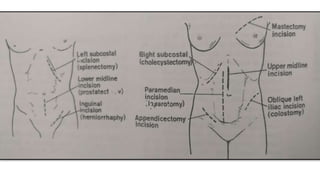
Classification of incisions :
• The incisions used for exploring the
abdominal
A) Vertical incision : These may be
(i) Midline incision
(ii) Paramedian incisions
• (B) Transverse and oblique incisions :
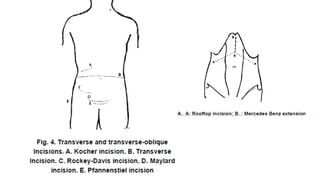
(i) Kocher's subcostal Incision
(ii) Transverse Muscle dividing
incision
(iii) Mc Burney’s Grid iron or muscle spliting incision
(iv) Oblique Muscle cutting incision
(v) Pfannenstiel incision
(vi) Maylard Transverse Muscle cutting Incision
(C) Abdominothoracic incisions
Kocher's subcostal Incision
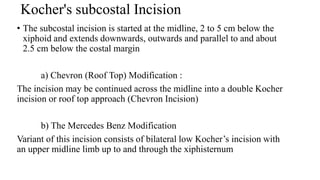
• The subcostal incision is started at the midline, 2 to 5 cm below the
xiphoid and extends downwards, outwards and parallel to and about
2.5 cm below the costal margin
a) Chevron (Roof Top) Modification :
The incision may be continued across the midline into a double Kocher
incision or roof top approach (Chevron Incision)
b) The Mercedes Benz Modification
Variant of this incision consists of bilateral low Kocher’s incision with
an upper midline limb up to and through the xiphisternum
McBurney Grid iron
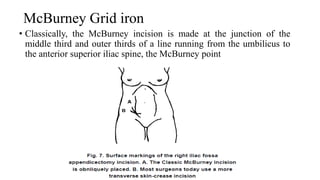
• Classically, the McBurney incision is made at the junction of the
middle third and outer thirds of a line running from the umbilicus to
the anterior superior iliac spine, the McBurney point

abdominal incision.pptx

  • 1.
  • 2.
    Abdominal Incision • Itshould be the aim of the surgeon to employ the type of incision considered to be the most suitable for that particular operation to be performed. In doing so, three essentials should be achieved (Zinner et al, 1997): 1. Accessibility 2. Extensibility 3. Security
  • 3.
    Reasons for Surgery •To remove diseased tissue (use suffix-ectomy) eg: gatrectomy • For Purposes of repair (use suffix- orraphy or plasty) eg: herniorraphy or arthroplasty • To produce an artificial opening ( use suffix-otomy or ostomy) eg: Gastrotomy, tracheostomy • For inspection (use suffix – oscopy) • Cystoscopy – inspection of bladder • Gastroscopy- inspection of stomach • Sigmoidoscopy- inspection of sigmoid
  • 4.
    Types of Anaesthesia •General- Inhalation or IV • Local- • Spinal – injection into suarachnoid space surrounding cauda equina • Regional – by nerve plexus
  • 5.
    Classification of incisions: • The incisions used for exploring the abdominal A) Vertical incision : These may be (i) Midline incision (ii) Paramedian incisions • (B) Transverse and oblique incisions : (i) Kocher's subcostal Incision (ii) Transverse Muscle dividing incision
  • 6.
    (iii) Mc Burney’sGrid iron or muscle spliting incision (iv) Oblique Muscle cutting incision (v) Pfannenstiel incision (vi) Maylard Transverse Muscle cutting Incision (C) Abdominothoracic incisions
  • 8.
    Kocher's subcostal Incision •The subcostal incision is started at the midline, 2 to 5 cm below the xiphoid and extends downwards, outwards and parallel to and about 2.5 cm below the costal margin a) Chevron (Roof Top) Modification : The incision may be continued across the midline into a double Kocher incision or roof top approach (Chevron Incision) b) The Mercedes Benz Modification Variant of this incision consists of bilateral low Kocher’s incision with an upper midline limb up to and through the xiphisternum
  • 10.
    McBurney Grid iron •Classically, the McBurney incision is made at the junction of the middle third and outer thirds of a line running from the umbilicus to the anterior superior iliac spine, the McBurney point