Dr Phillipo Leo Chalya MD, M.Med (Surg)
Senior Lecturer – Department of Surgery
CUHAS-Bugando
COLOSTOMY
Leaning objectives
 Definition
 Indications
 Classifications
 Colostomy formation
 Colostomy care
 Colostomy closure
 Complications of colostomy and its
closure
 Conclusion
DEFINITION
 A colostomy is a surgical procedure that
brings a portion of the large intestine through
the anterior abdominal wall to divert faeces
and flatus to the exterior, where it can be
collected in an external appliance (colostomy
bag)
INDICATIONS
 Congenital diseases
 Acquired diseases
Congenital diseases
 Ano-rectal malformations (ARM)
 Hirschsprung ‘s disease
 Intestinal Atresia, Stenosis and Webs
 Meconium ileus
 Intestinal malrotation
Acquired diseases
 Traumatic
 Neoplastic
 Inflammatory
 Mechanical
 Vascular
 Surgical
 Others
Traumatic
 Penetrating
colonic or ano-
rectal injuries
Neoplastic
 Colorectal cancer
 Anal cancer
Inflammatory
 Inflammatory bowel diseases
 Necrotizing Enterocolitis
 Diverticular disease
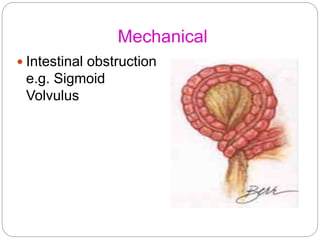
Mechanical
 Intestinal obstruction
e.g. Sigmoid
Volvulus
Vascular
 Gangrene of part of colon due to strangulation
or interference with its blood supply
Surgical
 Protecting an anastomosis after bowel
resection
Other indications
 High fistula in ano
CLASSIFICATION
 According to the purpose
 According to the function
 According to the site/location
 According to the type of colostomy
 According to the nature of operation
According to the purpose
 Temporary colostomy
 Permanent colostomy
Temporary colostomy
 Temporary colostomies are created to divert
stool from injured or diseased portions of the
large intestine, allowing rest and healing and
later closed to maintain the bowel continuity
 Commonly loop or double barrel colostomies
Permanent colostomy
 Permanent colostomies are performed when the distal
bowel (at the farthest distance) must be removed or is
blocked and inoperable
 Permanent colostomy are usually formed after
resection of the rectum for a carcinoma by the
abdominoperineal technique [APR]
 They are usually end colostomy
According to the function
 Decompressing colostomy
 Defunctioning /diverting colostomy
Decompressing colostomy
 Intended to decompress the colon
 It does not completely defunction the bowel as
some faeces can travel into the distal loop
 It is inadequate in conditions in which
defunctioning is essential
 Example of this is a loop colostomy
Defunctioning /diverting colostomy
 Intended to defunction or to divert the colon i.e.
to prevent faecal material traveling into the
distal segment
 In this case the bowel is transected and the
two ends [proximal and distal ends] need to be
separated
 Include end , spectacle or double-barrel
colostomy
According to the site/location
 Transverse
colostomy
 Sigmoid colostomy
 Caecostomy
According to the type
 Loop colostomy
 Double – barrel colostomy
 End colostomy
 Spectacle colostomy
Loop colostomy
 This colostomy is created
by bringing a loop of bowel
through an incision in the
abdominal wall
 A loop colostomy is made
by bringing a loop of colon
to the surface, where it is
held in place by a plastic
bridge passed through the
mesentery
Double – barrel colostomy
 The bowel is transected
and the two ends are
brought together through
one incision
 The proximal end is the
functional end that is
connected to the upper GI
and will drain stool; the
distal stoma, connected to
the rectum and also called
a mucous fistula, drains
small amounts of mucus
material
End colostomy
 The functioning
proximal end of the
intestine is brought out
onto the surface of the
abdomen, forming the
stoma (colostomy)
 The distal portion of
bowel (now connected
only to the rectum) may
be removed, or sutured
closed and left in the
abdomen
Spectacles colostomy
 The proximal and distal limbs are
separated by small bridge of skin
 The two limbs are opened
through a separate skin incision
 With the introduction of end
colostomy with Hatmann
procedure, spectacles colostomy
is no longer performed
According to the nature of operation
 Emergency colostomy
 Elective colostomy
CLOSTOMY FORMATION
 Principles of colostomy formation
 Pre-operative care
 Intra-operative care
 Post-operative care
Principles of colostomy formation
 The colostomy site should be selected to avoid fat
folds, scars, umbilicus and bony prominences
 The colostomy should be brought through a separate
skin incision and not through a laparotomy incision
 Tension on the mesentery should be avoided during
construction of a colostomy i.e. the bowel should be
mobile enough to be brought through the abdominal
wall
Pre-operative care
 Colostomies are created in both elective and
emergency settings
 Pre-operative care in involves:-
 Counseling
 Correction of intercurent infections, anemia and other co-
morbid conditions
 Bowel preparation
 Pre-anesthetic visit
 Signing of a written informed consent
 Enterostomal therapist visit
Counseling
 Colostomy is a frightening procedure and exposes the
patient and her/his family to psychosocial trauma
 Adequate counseling should be part and parcel of the entire
management strategy to enable the patient and his/her
family to cope with the stress and to adjust their life styles
 A physician, enterostomal therapist, or nurse specialist
should counsel the patient undergoing elective colostomy
as well as their families
 This psychological preparation reduces their anxiety and
makes postoperative management easier
 The patient should be counseled properly on how to live
with a colostomy and how to take care of it
Correction of associated disease conditions
 Intercurent infections [e.g. chest infections,
diarrhoea], anemia and other pre-existing
conditions should be controlled before surgery
Bowel preparation
 Preoperative bowel preparation is important to avoid
colostomy-related complications
 This include:-
 Mechanical bowel preparation
 Enema
 Nasogastric tube on the day of operation or intraoperatively to
remove gastric secretions and prevent nausea and vomiting
 Dietary management
 Low residue diet for several days prior to surgery
 A liquid diet may be ordered for at least the day before surgery,
with nothing by mouth after midnight
 Pharmacological management
 Oral anti-infectives (neomycin, erythromycin, or kanamycin
sulfate) may be ordered to decrease bacteria in the intestine
and help prevent postoperative infection
Pre-anesthetic visit
 This should be done to be able to assess the
patient’s general condition and fitness for
surgery and anesthesia
Written informed consent
 As with any surgical procedure, the patient
will be required to sign a consent form after
the procedure is explained thoroughly
Enterostomal therapist visit
 If possible, the patient should visit an enterostomal
therapist, who will mark an appropriate place on the
abdomen for the stoma and offer preoperative
education on colostomy management
Intra-operative care
 This depends on the pathology, purpose,
site/location and type of the colostomy
Post-operative care
 Like in any major surgery postoperative care for the patient
with a new colostomy, involves:-
 Fluids and electrolytes are infused intravenously until the
patient's diet can gradually be resumed, beginning with liquids
[usually up to 72 hrs]
 The nasogastric tube will remain in place, until bowel activity
resumes
 For the first 24–48 hours after surgery, the colostomy will drain
bloody mucus
 Analgesics to relieve pain
 Antibiotics given parenterally
 Monitoring of blood pressure, pulse, respirations, and
temperature [vital signs]
 A colostomy pouch will generally have been placed on the
patient's abdomen around the stoma during surgery
COLOSTOMY CARE
 Psychological care
 Mechanical care
 Dietary care
 Gas and odor care
 Peristomal skin care
 Pharmacological care
Psychological care
 Counseling should continue during treatment
and follow up to enable the patient to cope to
their life style
 Often, an enterostomal therapist will visit the
patient in the hospital or at home after
discharge to provide counseling and to help
the patient with stoma care
Mechanical care
 Use of colostomy bags [pouches]
 Colostomy irrigation [i.e. putting a fluid into the stoma
to empty the bowel]also called colostomy enema
Dietary care
 Dietary counseling is necessary for the patient to
maintain normal bowel function and to avoid
constipation, impaction, and other discomforts
 Need to avoid foods that cause gas and odor e.g.
fish, onions, garlic, broccoli, asparagus, and cabbage
produce odor
Gas and odor care
 Limit foods such as broccoli, cabbage,onions, fish, and
garlic in diet to help reduce odor
 Each time you empty your pouch, carefully clean the
opening of the pouch, both inside and outside, with
toilet paper
 Rinse your pouch one or two times daily after you
empty it
 Add deodorant (such as Super Banish or Nullo) to your
pouch.
 Use air deodorizers in your bathroom
Care of peristomal skin
 Local irritation, skin excoriation, and yeast infections can
be treated with appropriate topical medication and skin
care
 Protect skin from effluent using:-
 Wafers eg Duoderm, Coloplast
 Pastes eg Karaya, Softpaste
 Lotions eg Cavilon,Dansac- use as spray or spread
 Powders e.g. Orahesive- removes fluid from moist skin
 Stoma bags
Pharmacological care
 Once the colostomy has been established
no pharmacological treatment is required
 Pharmacological care is reserved in case of
complications e.g. colostomy diarrhoea,
wound infections, constipation etc
COLOSTOMY CLOSURE
 Prerequisites of colostomy closure
 Timing of colostomy closure
 Preoperative preparation
 Types of colostomy closure
 Post operative care
Prerequisites of colostomy closure
 The following must be taken into account before
closing a colostomy:-
 The original reason for the colostomy
 Whether the patient is able to undergo more surgery
 Patient’s general condition
 The presence of stoma-related complications
 Colostomy closure should be performed when the
patient has recovered from original operation, his
general condition is good and his colostomy wound is
healthy
Timing of colostomy closure
 Timing of colostomy closure depends on factors such
as:-
 the underlying disease
 the general medical condition of the patient
 the presence of colostomy-related complications
 The state of the colostomy wound
 Understanding the anatomy prior to colostomy closure
is crucial
 Colostomy closure usually done in 2-6 weeks when
the colostomy wound is healthy and the patient has
recovered from his original operation
Preoperative preparation
 The patient should be prepared as for any other major
surgery
 The general condition of the patient and his colostomy
wound should be assessed for fitness to surgery
 Enema to his proximal and distal ends for 2-3 days before
surgery to washout his gut
  Magnesium sulphate to help empty his proximal gut and
to make sure that the next feces he passes is soft
 Neomycin, metranidazole may be given perioperativelly
Types of colostomy closure
 Extraperitoneal colostomy closure
 Intraperitoneal colostomy closure
Extraperitoneal colostomy closure
 Colostomy closure without need to open the
abdomen
 It is easy and avoids the risk of contaminating
the peritoneal cavity
 Only applied to loop and double-barrel
colostomies
Intraperitoneal colostomy closure
 The colostomy is closed by opening the
peritoneal cavity
 Difficulty procedure as laparotomy is needed
in order to close the colostomy
 It has high risk of contaminating the
peritoneal cavity
COLOSTOMY COMPLICATIONS
 Complications related to colostomy
formation
 Complications related to colostomy closure
Complications of colostomy formation
 Skin irritation
 Colostomy necrosis
 Colostomy bleeding
 Colostomy prolapse
 Colostomy retraction
 Colostomy stenosis
 Parastomal hernia
 Intestinal obstruction
Skin irritation
 Skin irritation and infection are the
most common complications with
colostomy
 Excoriation from stoma effluent,
candidal infection and dermatitis
are frequent
 Improper location or construction
of the stoma and poor stoma care
are often responsible
 Local wound care and patient or
caretaker education often corrects
the problem
Colostomy necrosis
 This is death of the
colostomy tissue
 Caused by inadequate
blood supply, this
complication is usually
visible 12–24 hours after
the operation
 Usually requires
additional surgery
Colostomy bleeding
 Minor bleeding can occur with overly vigorous stomal
cleansing
 Major bleeding from the stoma itself is uncommon and
usually indicates either a stomal laceration from a poorly
fitting appliance or the development of peristomal varices in
the patient with portal hypertension
 Initial management of stomal bleeding involves direct
pressure and AgNO3 cauterization or suturing of the
bleeder if required
 Definitive management depends upon the etiology of the
bleeding.
Colostomy prolapse
 Both proximal and distal bowel
segments can protrude many
centimeters
 Colostomy prolapse commonly occurs in
end or loop colostomies
 Most often results from an overly large
opening in the abdominal wall or
inadequate fixation of the bowel to the
abdominal wall
 Colostomy prolapse can occur in
patients with elevated intraabdominal
pressure, especially if there was
inadequate fixation of the bowel to the
internal abdominal wall
 Surgical correction is required when
blood supply is compromised and in
case of obstruction, ulceration, or
chronic bleeding
Colostomy retraction
 In this case the colostomy is drawn
back into the abdomen
 Caused by insufficient stomal length,
this complication may be managed
by use of special pouching supplies
 Retraction of a loop colostomy
results in a blowhole configuration
that allows proximal contents to spill
into the distal segment
 Revision may be required if distal
diversion is necessary
 Permanent colostomy that have
retracted may require surgical
revision
Colostomy strictures /stenosis
 Colostomy strictures can occur
at the skin and/or fascial levels
 Often associated with infection
around the colostomy or
scarring
 Mild stenosis can be removed
under local anesthesia
 Severe stenosis may require
surgery for reshaping the stoma
 Attempts at dilating the
colostomy are usually
unsuccessful and may cause
intestinal perforation
Parastomal hernia
 Protrusion of viscus in the
abdominal wall next to the
colostomy wound
 Predisposing factors
 Weak abdominal wall
 Large stoma aperture
 Obesity
 Prior abdominal incisions
 Malnutrition
 Wound infection
 Parastomal hernias usually
require surgical intervention
 If severe, the defect in the
abdominal wall should be
repaired and the stoma moved to
another location
Intestinal obstruction
 Can occur due to adhesion, volvulus, stricture or internal
hernia
 Obstruction is usually obvious, and the diagnosis is based on
the patient's history and findings at physical examination and
on plain radiography
 In all patients with a bowel obstruction, a nasogastric tube
should be placed for decompression and the patient should
receive intravenous hydration
 Prompt surgical exploration is required in patients with
suspected ischemic or gangrenous bowel, clinical
deterioration, or obstruction that does not rapidly resolve with
nonsurgical therapy
Complications of colostomy closure
 Enterocutaneous fistula
 Intestinal obstruction
 Adhesions
 Wound-related complications – surgical site
infection, separation, dehiscence
CONCLUSION
 In the last century, there have been dramatic improvements
in surgical techniques for the creation of colostomy
 Life with a colostomy has also changed dramatically
 The development of enterostomal therapy and the
improvement of colostomy management systems have made
life with a stoma nearly as routine as life with an anus.
 “care and expertise are important in creating intestinal
stomas because some patients must live with the technical
result for the rest of their lives”
COLOSTOMY.ppt
COLOSTOMY.ppt
COLOSTOMY.ppt

COLOSTOMY.ppt

  • 1.
    Dr Phillipo LeoChalya MD, M.Med (Surg) Senior Lecturer – Department of Surgery CUHAS-Bugando COLOSTOMY
  • 2.
    Leaning objectives  Definition Indications  Classifications  Colostomy formation  Colostomy care  Colostomy closure  Complications of colostomy and its closure  Conclusion
  • 3.
    DEFINITION  A colostomyis a surgical procedure that brings a portion of the large intestine through the anterior abdominal wall to divert faeces and flatus to the exterior, where it can be collected in an external appliance (colostomy bag)
  • 4.
  • 5.
    Congenital diseases  Ano-rectalmalformations (ARM)  Hirschsprung ‘s disease  Intestinal Atresia, Stenosis and Webs  Meconium ileus  Intestinal malrotation
  • 6.
    Acquired diseases  Traumatic Neoplastic  Inflammatory  Mechanical  Vascular  Surgical  Others
  • 7.
  • 8.
  • 9.
    Inflammatory  Inflammatory boweldiseases  Necrotizing Enterocolitis  Diverticular disease
  • 10.
  • 11.
    Vascular  Gangrene ofpart of colon due to strangulation or interference with its blood supply
  • 12.
    Surgical  Protecting ananastomosis after bowel resection
  • 13.
  • 14.
    CLASSIFICATION  According tothe purpose  According to the function  According to the site/location  According to the type of colostomy  According to the nature of operation
  • 15.
    According to thepurpose  Temporary colostomy  Permanent colostomy
  • 16.
    Temporary colostomy  Temporarycolostomies are created to divert stool from injured or diseased portions of the large intestine, allowing rest and healing and later closed to maintain the bowel continuity  Commonly loop or double barrel colostomies
  • 17.
    Permanent colostomy  Permanentcolostomies are performed when the distal bowel (at the farthest distance) must be removed or is blocked and inoperable  Permanent colostomy are usually formed after resection of the rectum for a carcinoma by the abdominoperineal technique [APR]  They are usually end colostomy
  • 18.
    According to thefunction  Decompressing colostomy  Defunctioning /diverting colostomy
  • 19.
    Decompressing colostomy  Intendedto decompress the colon  It does not completely defunction the bowel as some faeces can travel into the distal loop  It is inadequate in conditions in which defunctioning is essential  Example of this is a loop colostomy
  • 20.
    Defunctioning /diverting colostomy Intended to defunction or to divert the colon i.e. to prevent faecal material traveling into the distal segment  In this case the bowel is transected and the two ends [proximal and distal ends] need to be separated  Include end , spectacle or double-barrel colostomy
  • 21.
    According to thesite/location  Transverse colostomy  Sigmoid colostomy  Caecostomy
  • 22.
    According to thetype  Loop colostomy  Double – barrel colostomy  End colostomy  Spectacle colostomy
  • 23.
    Loop colostomy  Thiscolostomy is created by bringing a loop of bowel through an incision in the abdominal wall  A loop colostomy is made by bringing a loop of colon to the surface, where it is held in place by a plastic bridge passed through the mesentery
  • 24.
    Double – barrelcolostomy  The bowel is transected and the two ends are brought together through one incision  The proximal end is the functional end that is connected to the upper GI and will drain stool; the distal stoma, connected to the rectum and also called a mucous fistula, drains small amounts of mucus material
  • 25.
    End colostomy  Thefunctioning proximal end of the intestine is brought out onto the surface of the abdomen, forming the stoma (colostomy)  The distal portion of bowel (now connected only to the rectum) may be removed, or sutured closed and left in the abdomen
  • 26.
    Spectacles colostomy  Theproximal and distal limbs are separated by small bridge of skin  The two limbs are opened through a separate skin incision  With the introduction of end colostomy with Hatmann procedure, spectacles colostomy is no longer performed
  • 27.
    According to thenature of operation  Emergency colostomy  Elective colostomy
  • 28.
    CLOSTOMY FORMATION  Principlesof colostomy formation  Pre-operative care  Intra-operative care  Post-operative care
  • 29.
    Principles of colostomyformation  The colostomy site should be selected to avoid fat folds, scars, umbilicus and bony prominences  The colostomy should be brought through a separate skin incision and not through a laparotomy incision  Tension on the mesentery should be avoided during construction of a colostomy i.e. the bowel should be mobile enough to be brought through the abdominal wall
  • 30.
    Pre-operative care  Colostomiesare created in both elective and emergency settings  Pre-operative care in involves:-  Counseling  Correction of intercurent infections, anemia and other co- morbid conditions  Bowel preparation  Pre-anesthetic visit  Signing of a written informed consent  Enterostomal therapist visit
  • 31.
    Counseling  Colostomy isa frightening procedure and exposes the patient and her/his family to psychosocial trauma  Adequate counseling should be part and parcel of the entire management strategy to enable the patient and his/her family to cope with the stress and to adjust their life styles  A physician, enterostomal therapist, or nurse specialist should counsel the patient undergoing elective colostomy as well as their families  This psychological preparation reduces their anxiety and makes postoperative management easier  The patient should be counseled properly on how to live with a colostomy and how to take care of it
  • 32.
    Correction of associateddisease conditions  Intercurent infections [e.g. chest infections, diarrhoea], anemia and other pre-existing conditions should be controlled before surgery
  • 33.
    Bowel preparation  Preoperativebowel preparation is important to avoid colostomy-related complications  This include:-  Mechanical bowel preparation  Enema  Nasogastric tube on the day of operation or intraoperatively to remove gastric secretions and prevent nausea and vomiting  Dietary management  Low residue diet for several days prior to surgery  A liquid diet may be ordered for at least the day before surgery, with nothing by mouth after midnight  Pharmacological management  Oral anti-infectives (neomycin, erythromycin, or kanamycin sulfate) may be ordered to decrease bacteria in the intestine and help prevent postoperative infection
  • 34.
    Pre-anesthetic visit  Thisshould be done to be able to assess the patient’s general condition and fitness for surgery and anesthesia
  • 35.
    Written informed consent As with any surgical procedure, the patient will be required to sign a consent form after the procedure is explained thoroughly
  • 36.
    Enterostomal therapist visit If possible, the patient should visit an enterostomal therapist, who will mark an appropriate place on the abdomen for the stoma and offer preoperative education on colostomy management
  • 37.
    Intra-operative care  Thisdepends on the pathology, purpose, site/location and type of the colostomy
  • 38.
    Post-operative care  Likein any major surgery postoperative care for the patient with a new colostomy, involves:-  Fluids and electrolytes are infused intravenously until the patient's diet can gradually be resumed, beginning with liquids [usually up to 72 hrs]  The nasogastric tube will remain in place, until bowel activity resumes  For the first 24–48 hours after surgery, the colostomy will drain bloody mucus  Analgesics to relieve pain  Antibiotics given parenterally  Monitoring of blood pressure, pulse, respirations, and temperature [vital signs]  A colostomy pouch will generally have been placed on the patient's abdomen around the stoma during surgery
  • 39.
    COLOSTOMY CARE  Psychologicalcare  Mechanical care  Dietary care  Gas and odor care  Peristomal skin care  Pharmacological care
  • 40.
    Psychological care  Counselingshould continue during treatment and follow up to enable the patient to cope to their life style  Often, an enterostomal therapist will visit the patient in the hospital or at home after discharge to provide counseling and to help the patient with stoma care
  • 41.
    Mechanical care  Useof colostomy bags [pouches]  Colostomy irrigation [i.e. putting a fluid into the stoma to empty the bowel]also called colostomy enema
  • 42.
    Dietary care  Dietarycounseling is necessary for the patient to maintain normal bowel function and to avoid constipation, impaction, and other discomforts  Need to avoid foods that cause gas and odor e.g. fish, onions, garlic, broccoli, asparagus, and cabbage produce odor
  • 43.
    Gas and odorcare  Limit foods such as broccoli, cabbage,onions, fish, and garlic in diet to help reduce odor  Each time you empty your pouch, carefully clean the opening of the pouch, both inside and outside, with toilet paper  Rinse your pouch one or two times daily after you empty it  Add deodorant (such as Super Banish or Nullo) to your pouch.  Use air deodorizers in your bathroom
  • 44.
    Care of peristomalskin  Local irritation, skin excoriation, and yeast infections can be treated with appropriate topical medication and skin care  Protect skin from effluent using:-  Wafers eg Duoderm, Coloplast  Pastes eg Karaya, Softpaste  Lotions eg Cavilon,Dansac- use as spray or spread  Powders e.g. Orahesive- removes fluid from moist skin  Stoma bags
  • 45.
    Pharmacological care  Oncethe colostomy has been established no pharmacological treatment is required  Pharmacological care is reserved in case of complications e.g. colostomy diarrhoea, wound infections, constipation etc
  • 46.
    COLOSTOMY CLOSURE  Prerequisitesof colostomy closure  Timing of colostomy closure  Preoperative preparation  Types of colostomy closure  Post operative care
  • 47.
    Prerequisites of colostomyclosure  The following must be taken into account before closing a colostomy:-  The original reason for the colostomy  Whether the patient is able to undergo more surgery  Patient’s general condition  The presence of stoma-related complications  Colostomy closure should be performed when the patient has recovered from original operation, his general condition is good and his colostomy wound is healthy
  • 48.
    Timing of colostomyclosure  Timing of colostomy closure depends on factors such as:-  the underlying disease  the general medical condition of the patient  the presence of colostomy-related complications  The state of the colostomy wound  Understanding the anatomy prior to colostomy closure is crucial  Colostomy closure usually done in 2-6 weeks when the colostomy wound is healthy and the patient has recovered from his original operation
  • 49.
    Preoperative preparation  Thepatient should be prepared as for any other major surgery  The general condition of the patient and his colostomy wound should be assessed for fitness to surgery  Enema to his proximal and distal ends for 2-3 days before surgery to washout his gut   Magnesium sulphate to help empty his proximal gut and to make sure that the next feces he passes is soft  Neomycin, metranidazole may be given perioperativelly
  • 50.
    Types of colostomyclosure  Extraperitoneal colostomy closure  Intraperitoneal colostomy closure
  • 51.
    Extraperitoneal colostomy closure Colostomy closure without need to open the abdomen  It is easy and avoids the risk of contaminating the peritoneal cavity  Only applied to loop and double-barrel colostomies
  • 52.
    Intraperitoneal colostomy closure The colostomy is closed by opening the peritoneal cavity  Difficulty procedure as laparotomy is needed in order to close the colostomy  It has high risk of contaminating the peritoneal cavity
  • 53.
    COLOSTOMY COMPLICATIONS  Complicationsrelated to colostomy formation  Complications related to colostomy closure
  • 54.
    Complications of colostomyformation  Skin irritation  Colostomy necrosis  Colostomy bleeding  Colostomy prolapse  Colostomy retraction  Colostomy stenosis  Parastomal hernia  Intestinal obstruction
  • 55.
    Skin irritation  Skinirritation and infection are the most common complications with colostomy  Excoriation from stoma effluent, candidal infection and dermatitis are frequent  Improper location or construction of the stoma and poor stoma care are often responsible  Local wound care and patient or caretaker education often corrects the problem
  • 56.
    Colostomy necrosis  Thisis death of the colostomy tissue  Caused by inadequate blood supply, this complication is usually visible 12–24 hours after the operation  Usually requires additional surgery
  • 57.
    Colostomy bleeding  Minorbleeding can occur with overly vigorous stomal cleansing  Major bleeding from the stoma itself is uncommon and usually indicates either a stomal laceration from a poorly fitting appliance or the development of peristomal varices in the patient with portal hypertension  Initial management of stomal bleeding involves direct pressure and AgNO3 cauterization or suturing of the bleeder if required  Definitive management depends upon the etiology of the bleeding.
  • 58.
    Colostomy prolapse  Bothproximal and distal bowel segments can protrude many centimeters  Colostomy prolapse commonly occurs in end or loop colostomies  Most often results from an overly large opening in the abdominal wall or inadequate fixation of the bowel to the abdominal wall  Colostomy prolapse can occur in patients with elevated intraabdominal pressure, especially if there was inadequate fixation of the bowel to the internal abdominal wall  Surgical correction is required when blood supply is compromised and in case of obstruction, ulceration, or chronic bleeding
  • 59.
    Colostomy retraction  Inthis case the colostomy is drawn back into the abdomen  Caused by insufficient stomal length, this complication may be managed by use of special pouching supplies  Retraction of a loop colostomy results in a blowhole configuration that allows proximal contents to spill into the distal segment  Revision may be required if distal diversion is necessary  Permanent colostomy that have retracted may require surgical revision
  • 60.
    Colostomy strictures /stenosis Colostomy strictures can occur at the skin and/or fascial levels  Often associated with infection around the colostomy or scarring  Mild stenosis can be removed under local anesthesia  Severe stenosis may require surgery for reshaping the stoma  Attempts at dilating the colostomy are usually unsuccessful and may cause intestinal perforation
  • 61.
    Parastomal hernia  Protrusionof viscus in the abdominal wall next to the colostomy wound  Predisposing factors  Weak abdominal wall  Large stoma aperture  Obesity  Prior abdominal incisions  Malnutrition  Wound infection  Parastomal hernias usually require surgical intervention  If severe, the defect in the abdominal wall should be repaired and the stoma moved to another location
  • 62.
    Intestinal obstruction  Canoccur due to adhesion, volvulus, stricture or internal hernia  Obstruction is usually obvious, and the diagnosis is based on the patient's history and findings at physical examination and on plain radiography  In all patients with a bowel obstruction, a nasogastric tube should be placed for decompression and the patient should receive intravenous hydration  Prompt surgical exploration is required in patients with suspected ischemic or gangrenous bowel, clinical deterioration, or obstruction that does not rapidly resolve with nonsurgical therapy
  • 63.
    Complications of colostomyclosure  Enterocutaneous fistula  Intestinal obstruction  Adhesions  Wound-related complications – surgical site infection, separation, dehiscence
  • 64.
    CONCLUSION  In thelast century, there have been dramatic improvements in surgical techniques for the creation of colostomy  Life with a colostomy has also changed dramatically  The development of enterostomal therapy and the improvement of colostomy management systems have made life with a stoma nearly as routine as life with an anus.  “care and expertise are important in creating intestinal stomas because some patients must live with the technical result for the rest of their lives”