MASTECTOMY
Content:
 INTRODUCTION
 INDICATIONS
 TYPES OF MASTECTOMY
 TRATEMENT
 SURGERY
 POST OPERATIVE RADIOTHERAPY
 TYPES OF SURGERY
 TYPES OF INCISIONS
 COMPLICATIONS
INTRODUCTION:
 Mastectomy is the medical term for the surgical removal of one or both breasts,
partially or completely. A mastectomy is usually carried out to treat breast cancer.
In some cases, people believed to be at high risk of breast cancer have the
operation prophylactically, that is, as a preventive measure.
INDICATIONS:
 1) Large cancer tissue
 2) centrally located tumors
 3) lobular or multi centeric carcinoma
 4) risk of invasive cancer
 5) suspicious calcification
 6) recurrent carcinoma
 7) primary tumors following surgery
 8) Patient's choice
 9) family history - prophylactic mastectomy
TYPES OF MASTECTOMY
 Simple or Total Mastectomy
 Double Mastectomy
 Skin Sparing Mastectomy
 Nipple Spearing Mastectomy
 Modified Radical Mastectomy
 Radical Mastectomy
Treatment:
I. POSTOPERATIVE RADIOTHERAPY
II. SURGERY
AIM OF TRATMENT:
 to achive a cure
 if, possible conserve the breast
 to achieve locoregional control
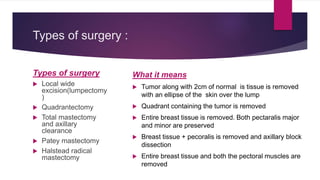
Types of surgery :
Types of surgery
 Local wide
excision(lumpectomy
)
 Quadrantectomy
 Total mastectomy
and axillary
clearance
 Patey mastectomy
 Halstead radical
mastectomy
What it means
 Tumor along with 2cm of normal is tissue is removed
with an ellipse of the skin over the lump
 Quadrant containing the tumor is removed
 Entire breast tissue is removed. Both pectaralis major
and minor are preserved
 Breast tissue + pecoralis is removed and axillary block
dissection
 Entire breast tissue and both the pectoral muscles are
removed
Wide local excision (lumpectomy)
 It is indicated in tumors less than 4 cm in size and with well differentiated histology . It
includes removal of the tumor plus a rim of at least 1cm of normal breast tissue .if the
nodes are palpable and enlarged , this is combined with axillary block dissection, using a
separate incision currently ,this procedure has become more popular and it is commonly
known as breast conservative therapy (BCT)
 CONTRAINDICATIONS :
 MULTIFOCAL DISEASE
 PREGNANCY
 CENTRAL QUADRANT TUMOR
 PRIOR RADIOTHERAPY TO THE BREAST
 PRIOR CHEST IRRADIATION
Simple mastectomy with axillary
clearance :
 It is equally good ( good retraction of pectoralis minor facilitates axillary
dissection – Aadimelon modification )
PATEY MASTECTOMY :
This is the most accetable and widely practiced surgery . It is also called as modified
radical mastectomy .
In this, the entire breast including nipple and areola( simple mastectomy ) are
removed with pectoralis minor followed by axillary block dissection . A complete
axillary block dissection should include node clearance upto level III
LEVEL-I :extends from axillary tail to the lateral border of pectoralis minor
LEVEL-II : extends from lateral border of pectoralis minor to medial border of
pectoralis minor
LEVEL-III :up to the apex of axilla
QUART THERAPY BY VERONASI :
 It includes quadrectomy (the entire segment of the breast containing the tumor is
removed ) axillary block dissection and radiotherapy to the breast or axilla
 Howerver , it gives rise to poorer cosmetic result
Radical mastectomy :
In this operation , following structures are removed.
 Entire breast including nipple and areola with skin overlying the tumor along with the
fat , fascia and lymphatics
 Axillary block dissection ,including complete learance of axillary fat up to level III
nodes clearance
 Sternocoastal portion of pectoralis minor , few fibers and aponeurosis of internal
oblique , serratus amterior , lattismus dorsi and subscapularis
 Three important structures should be preserved
1. Axillary vein
2. bell`s nerve
3. Cephalic vein
Disadvantages of radical mastectomy
Mutilating surgery
Poor cosmetic results
Lymphoedema of arm
II. POST OPERATIVE
RADIOTHERAPY
Indication for post operative radiotherapy
1. Tumor margin is positive
2. Pectoralis major is involved
3. Inner quadrant tumor
4. Axillary clearance not satisfactory
5. Breast conservative surgery
6. Tumor size more than 5cms
INCISIONS
superolateral radial incision
inferolateral radial incision
superior circumareolar incision
periareolar incision
inframammary fold incision
COMPLICATIONS:
 Lymphedema
 Nerve damage
 Hematoma
 Seroma
 Lymphadenoma
 Chronic pain
 Blood loss
 Infection
 Adverse drug reaction
Thank you

Mastectomy

  • 1.
  • 2.
    Content:  INTRODUCTION  INDICATIONS TYPES OF MASTECTOMY  TRATEMENT  SURGERY  POST OPERATIVE RADIOTHERAPY  TYPES OF SURGERY  TYPES OF INCISIONS  COMPLICATIONS
  • 3.
    INTRODUCTION:  Mastectomy isthe medical term for the surgical removal of one or both breasts, partially or completely. A mastectomy is usually carried out to treat breast cancer. In some cases, people believed to be at high risk of breast cancer have the operation prophylactically, that is, as a preventive measure.
  • 4.
    INDICATIONS:  1) Largecancer tissue  2) centrally located tumors  3) lobular or multi centeric carcinoma  4) risk of invasive cancer  5) suspicious calcification  6) recurrent carcinoma  7) primary tumors following surgery  8) Patient's choice  9) family history - prophylactic mastectomy
  • 5.
    TYPES OF MASTECTOMY Simple or Total Mastectomy  Double Mastectomy  Skin Sparing Mastectomy  Nipple Spearing Mastectomy  Modified Radical Mastectomy  Radical Mastectomy
  • 6.
    Treatment: I. POSTOPERATIVE RADIOTHERAPY II.SURGERY AIM OF TRATMENT:  to achive a cure  if, possible conserve the breast  to achieve locoregional control
  • 7.
    Types of surgery: Types of surgery  Local wide excision(lumpectomy )  Quadrantectomy  Total mastectomy and axillary clearance  Patey mastectomy  Halstead radical mastectomy What it means  Tumor along with 2cm of normal is tissue is removed with an ellipse of the skin over the lump  Quadrant containing the tumor is removed  Entire breast tissue is removed. Both pectaralis major and minor are preserved  Breast tissue + pecoralis is removed and axillary block dissection  Entire breast tissue and both the pectoral muscles are removed
  • 8.
    Wide local excision(lumpectomy)  It is indicated in tumors less than 4 cm in size and with well differentiated histology . It includes removal of the tumor plus a rim of at least 1cm of normal breast tissue .if the nodes are palpable and enlarged , this is combined with axillary block dissection, using a separate incision currently ,this procedure has become more popular and it is commonly known as breast conservative therapy (BCT)  CONTRAINDICATIONS :  MULTIFOCAL DISEASE  PREGNANCY  CENTRAL QUADRANT TUMOR  PRIOR RADIOTHERAPY TO THE BREAST  PRIOR CHEST IRRADIATION
  • 9.
    Simple mastectomy withaxillary clearance :  It is equally good ( good retraction of pectoralis minor facilitates axillary dissection – Aadimelon modification )
  • 10.
    PATEY MASTECTOMY : Thisis the most accetable and widely practiced surgery . It is also called as modified radical mastectomy . In this, the entire breast including nipple and areola( simple mastectomy ) are removed with pectoralis minor followed by axillary block dissection . A complete axillary block dissection should include node clearance upto level III LEVEL-I :extends from axillary tail to the lateral border of pectoralis minor LEVEL-II : extends from lateral border of pectoralis minor to medial border of pectoralis minor LEVEL-III :up to the apex of axilla
  • 11.
    QUART THERAPY BYVERONASI :  It includes quadrectomy (the entire segment of the breast containing the tumor is removed ) axillary block dissection and radiotherapy to the breast or axilla  Howerver , it gives rise to poorer cosmetic result
  • 12.
    Radical mastectomy : Inthis operation , following structures are removed.  Entire breast including nipple and areola with skin overlying the tumor along with the fat , fascia and lymphatics  Axillary block dissection ,including complete learance of axillary fat up to level III nodes clearance  Sternocoastal portion of pectoralis minor , few fibers and aponeurosis of internal oblique , serratus amterior , lattismus dorsi and subscapularis  Three important structures should be preserved 1. Axillary vein 2. bell`s nerve 3. Cephalic vein
  • 13.
    Disadvantages of radicalmastectomy Mutilating surgery Poor cosmetic results Lymphoedema of arm
  • 14.
    II. POST OPERATIVE RADIOTHERAPY Indicationfor post operative radiotherapy 1. Tumor margin is positive 2. Pectoralis major is involved 3. Inner quadrant tumor 4. Axillary clearance not satisfactory 5. Breast conservative surgery 6. Tumor size more than 5cms
  • 15.
    INCISIONS superolateral radial incision inferolateralradial incision superior circumareolar incision periareolar incision inframammary fold incision
  • 16.
    COMPLICATIONS:  Lymphedema  Nervedamage  Hematoma  Seroma  Lymphadenoma  Chronic pain  Blood loss  Infection  Adverse drug reaction
  • 17.