Presentor:
Dr. Mohammad Masoom Parwez
PG Student
AIIMS Bhopal
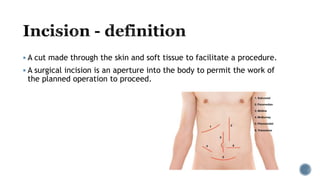
 A cut made through the skin and soft tissue to facilitate a procedure.
 A surgical incision is an aperture into the body to permit the work of
the planned operation to proceed.
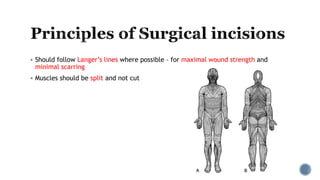
 Should follow Langer’s lines where possible – for maximal wound strength and
minimal scarring
 Muscles should be split and not cut
 An ideal incision should achieve three essentials:
 ACCESSIBILITY
 EXTENSIBILITY
 SECURITY
- Zinner et al, 1997
 surgical field is prepared with antiseptic solution and draped in order to reduce skin
bacterial counts and the likelihood of subsequent wound infection
 Shaving prior to operation has been associated with an increased rate of SSI and
should, therefore, be avoided
 If hair at the surgical site will interfere with accurate wound closure, use of clippers
is preferred to a razor
 Antiseptic solutions are commonly used to prepare the skin, include povidone-
iodine, alcohol, and chlorhexidine
 According to NYHUS and BAKER, following factors must be taken into consideration:
 Preoperative diagnosis
 Elective or Emergency
 Habitus of patient
 Previous abdominal operations
 Potential placement of stomas
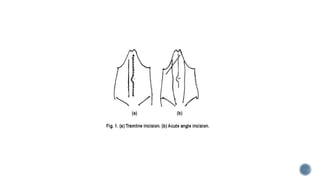
 Tramline / Acute angled incisions should be avoided
 Incision should be kept at a fair distance from proposed stoma site
 Good cosmesis helps patient morale
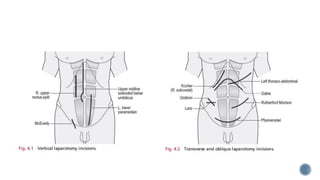
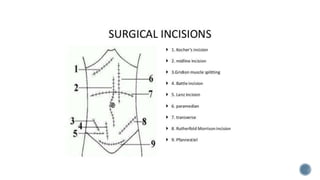
 VERTICAL INCISIONS:
 MIDLINE
 PARAMEDIAN
 TRANSVERSE/OBLIQUE INCISIONS:
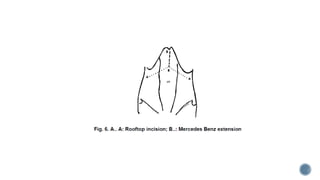
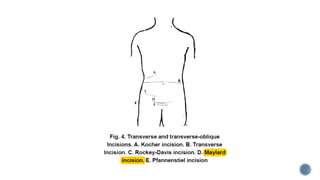
 KOCHERS SUBCOSTAL- CHEVRON MODIFICATION
MERCEDES BENZ MODIFICATION
 TRANSVERSE MUSCLE DIVIDING INCISION
 MC BURNEYS MUSCLE SPLITTING INCISION {GRID IRON}
 OBLIQUE MUSCLE CUTTING INCISION
 PFANNENSTIEL INCISION
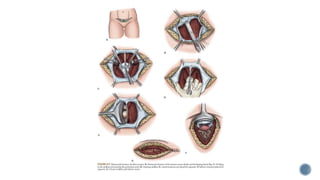
 MAYLARD TRANSVERSE MUSCLE CUTTING INCISION
 ABDOMINOTHORACIC INCISIONS
 Vertical incisions include
 midline incision
 paramedian incision
 Mayo-Robson extension of the paramedian incision
 Advantages:
(a) It is almost bloodless,
(b) no muscle fibres are divided,
(c) no nerves are injured,
(d) it affords goods access to the upper abdominal viscera,
(e) It is very quick to make as well as to close; it is unsurpassed when speed is
essential(Clarke, 1989)
(f) a midline epigastric incision also can be extended the full length of the
abdomen curving around the umbilical scar
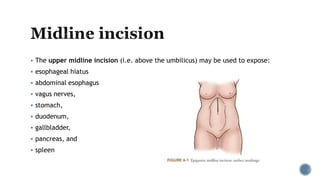
 The upper midline incision (i.e. above the umbilicus) may be used to expose:
 esophageal hiatus
 abdominal esophagus
 vagus nerves,
 stomach,
 duodenum,
 gallbladder,
 pancreas, and
 spleen
 The lower midline incision (ie, below the umbilicus) provides exposure of lower
abdominal and pelvic organs
 When broad exposure is required, as in an exploration for trauma, the midline
incision can be extended to the xiphoid process superiorly and to the pubic
symphysis inferiorly.
 In creating a midline incision,
 the operating surgeon and assistant apply opposing traction to the skin on both sides of
the abdomen
 The skin is then incised with a scalpel.
 Gauze pads are applied to the skin edges to tamponade bleeding from cutaneous vessels
and lateral traction is placed on the subcutaneous fat on both sides of the incision.
 The incision is then carried down to the linea alba using either electrocautery or a
scalpel
 the decussation of fascial fibers in the upper abdomen serves as an important landmark
for the midline.
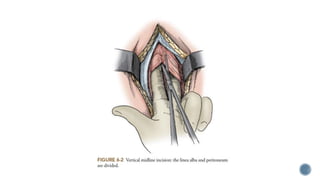
 The linea alba, extraperitoneal fat, and peritoneum are then divided sequentially.
 If exposure of both the upper and lower peritoneal cavities is required, the incision
is carried around the umbilicus in a curvilinear fashion.
 The peritoneum itself is best divided with scissors or scalpel to avoid coagulation
injury to underlying intraabdominal organs.
 Additionally,
 safe entry may be facilitated by picking up a fold of peritoneum, palpating it to
ensure that no bowel has been drawn up, and sharply incising the raised fold.
 To avoid injuries to the bladder, the peritoneum is entered in the upper portion of
the incision.
 After a small opening is created in the midline,
 it is enlarged to accommodate two fingers that are then used to protect the
underlying viscera as the peritoneum is further divided along the length of the
wound
 Advantages:
(a) it offsets the vertical incision to the right or left, providing access to the
lateral structures such as the spleen or the kidney
(b) closure is theoretically more secure because the rectus muscle can act as
a buttress between the reapproximated posterior and anterior fascial
planes
(Cox et al, 1986)
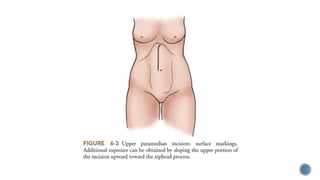
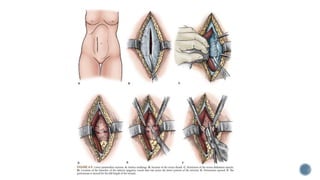
 The skin incision is placed 2 to 5 cm lateral to the midline over the medial aspect of
the bulging transverse convexity of the rectus muscle.
 Extra access can be obtained by sloping the upper extremity of the incision upwards
to the xiphoid
(Didolkar et al, 1995)
 Skin and subcutaneous fat are divided along the length of the wound.
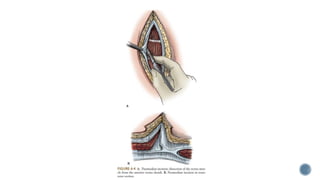
 The anterior rectus sheath is exposed and incised, and its medial edge is grasped
and lifted up with hemostatic forceps
 The medial portion of the rectus sheath then is dissected from the rectus muscle, to
which the anterior sheath adheres
 Segmental blood vessels encountered during the dissection should be coagulated.
 Once the rectus muscle is free of the anterior sheath it can be retracted laterally
because the posterior sheath is not adherent to the rectus muscle.
 The posterior sheath and the peritoneum which are adherent to each other, are
excised vertically in the same plane as the anterior fascial plane
(Brennan et al, 1987)
 The deep inferior epigastric vessels are encountered below the umbilicus and
require ligation and division if they course medially along the line of the incision
(Chuter et al, 1992)
 Disadvantages :
1. It tends to weaken and strip off the muscles from its lateral vascular and nerve
supply resulting in atrophy of the muscle medial to the incision.
2. The incision is laborious and difficult to extend superiorly as is limited by costal
margin.
3. It doesn’t give good access to contralateral structures
 The vertical muscle-splitting incision is made in much the same way as the
traditional paramedian incision
 except that the rectus muscle is split, rather than retracted laterally.
 This wound can be opened and closed quickly
 particular value in reopening a previous paramedian incision where dissection of the
rectus muscle away from the rectus sheath can be difficult.
 Longer incisions should be avoided
 more bleeding
 sacrifice of nerves
 lead to weakening of the corresponding area of the abdominal wall.
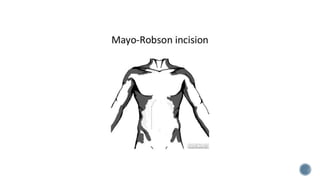
 Mayo-Robson extension of the paramedian incision is accomplished by
 curving the skin incision towards the xiphoid process.
 Incision of the fascial planes is continued in the same direction to obtain a larger
fascial opening
(Pollock, 1981)
 ADVANTAGES:
1. generally follow Langer’s lines of tension and
2. usually allow a more cosmetic closure than do vertical incisions
3. the rectus muscle has a segmental nerve supply derived from intercostal nerves,
which enter the rectus sheath laterally. Transverse or slightly oblique incisions
through the rectus most often spare these nerves.
 DISADVANTAGES:
1. they may be limiting when pathology is located in both the upper and lower
abdomen
 right subcostal incision - exposure of the gallbladder and biliary tree
 left-sided subcostal incision is used less often, mainly for splenectomy
 A bilateral subcostal incision provides excellent exposure of the upper abdomen and
can be employed for hepatic resections, liver transplantation, total gastrectomy,
and for anterior access to both adrenal glands.
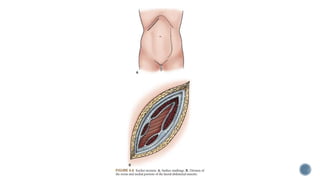
 The standard subcostal incision begins at the midline, two finger breadths below the
xiphoid process and is extended laterally and inferiorly parallel to the costal margin
 The incision should not be placed too far superiorly as sufficient fascia must be
preserved to allow a secure abdominal closure.
 Following incision of the rectus sheath along the plane of the skin incision, the
rectus muscle is divided using electrocautery or ligatures to control branches of the
superior epigastric artery.
 The peritoneum is then divided in the plane of the skin incision
 The incision can be extended beyond the lateral aspect of the rectus muscle if
necessary to facilitate exposure
 The incision may be continued across the midline into a double Kocher incision or roof
top approach (Chevron Incision)
 provides excellent access to the upper abdomen particularly in those with a broad costal
margin
(Chute et al, 1968; Brooks et al, 1999).
 useful in carrying out total gastrectomy,
 operations for renovascular hypertension,
 Total oesophagectomy,
 liver transplantation,
 Extensive hepatic resections,
 and bilateral adrenalectomy
(Chino & Thomas, 1985; Pinson et al, 1995; Miyazaki et al, 2001).
 Variant of this incision consists of bilateral low Kocher’s incision with an upper
midline limb up to and through the xiphi-sternum
(Sato et al, 2000).
 This gives excellent access to the upper abdominal viscera and, in particular to all
the diaphragmatic hiatuses
(Yoshinaga, 1969; Motsay et al, 1973; Brooks et al, 1999).
 The operative technique used to make such an incision is similar to that for the
Kocher incision.
 In newborns and infants, this incision is preferred, because more abdominal
exposure is gained per length of the incision than with vertical exposure
 As infant’s abdomen has a longer transverse than vertical girth
(Gauderer, 1981).
 This is also true of short, obese adults, in whom transverse incision often affords a
better exposure
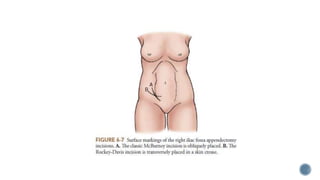
 First described in 1894 by Charles McBurney is the incision of choice for most
appendicectomies (McBurney, 1894).
 The level and the length of the incision will vary according to the thickness of the
abdominal wall and the suspected position of the appendix
(Jelenko & Davis 1973; Watts & Perrone, 1997).
 Classically, the McBurney incision is made at the junction of the middle third and outer
thirds of a line running from the umbilicus to the anterior superior iliac spine, the
McBurney point
(Watts,1991).
 However, if palpation reveals a mass, the incision can be placed directly over the
mass.
 McBurney originally placed the incision obliquely, from above laterally to below
medially.
 However, the skin incision can be placed in a skin crease transversely [Rockey-Davis
Incision or Lanz Incision or Bikini Incision]
 It provides a better cosmetic result
(Delany & Carnevale, 1976; Pleterski & Temple, 1990)
Otherwise, the two incisions are similar.
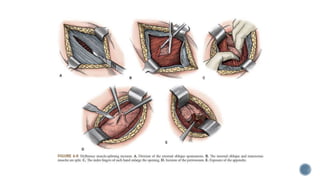
 After the skin and subcutaneous tissue are divided, the external oblique aponeurosis
is divided in the direction of its fibres
 exposing the underlying internal oblique muscle.
 A small incision is then made in this muscle adjacent to the outer border of the
rectus sheath.
 The opening is enlarged to permit introduction of two index fingers between the
muscle fibres so that internal oblique and transversus can be retracted with a
minimal amount of damage.
 The peritoneum is then grasped with a thumb forceps, elevated and opened
 This incision also may be used in the left lower quadrant to deal with certain lesions
of the sigmoid colon, such as drainage of a diverticular abscess.
 The ilioinguinal and ilio-hypogastric nerves cross the incision for appendectomy and
their accidental injury can predispose the patient to inguinal hernia formation in the
postoperative period
(Mandelkow & Loeweneck, 1988).
 This incision bears the eponym of the Rutherford-Morrison incision
(Talwar et al, 1997)
 This is extension of the McBurney incision by division of the oblique fossa and can be
used for :
 right or left sided colonic resection,
 caecostomy or sigmoid colostomy.
 The Pfannenstiel incision is used frequently by gynaecologists and urologists for
access to the pelvis organs, bladder, prostate and for caesarean section
(Ayers & Morley, 1987; Mendez et al, 1999; Hendrix et al, 2000)
 The skin incision is usually 12 cm long and is made in a skin fold approximately 5 cm
above symphysis pubis.
 The incision is deepened through fat and superficial fascia to expose both anterior
rectus sheaths, which are divided along the entire length of the incision.
 The sheath is then separated widely, above and below from the underlying rectus
muscle. It is necessary to separate the aponeurosis in an upward direction, almost
to the umbilicus and downwards to the pubis.
 The rectus muscles are then retracted laterally and the peritoneum opened
vertically in the midline, with care being taken not to injure the bladder at the
lower end.
 Many surgeons prefer this incision because it gives excellent exposure of the pelvic
organs
(Helmkamp & Kreb, 1990;Brand,1991)
 The skin incision is placed above but parallel to the traditional placement of
Pfannenstiel incision.
 The rectus fascia and muscle are then cut transversely, and the incision is continued
laterally as far as necessary, dividing external and internal oblique muscles; the
transverses abdominis and transversalis fascia are opened in the direction of their
fibres.
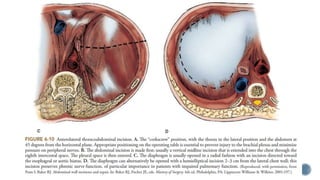
 The thoracoabdominal incision provides enhanced exposure of upper abdominal
organs
 A left thoracoabdominal incision is useful for access to
 left hemidiaphragm,
 Gastroesophageal junction,
 gastric cardia and stomach,
 distal pancreas and spleen,
 left kidney and adrenal gland,
 and aorta.
 A right thoracoabdominal incision can be used to expose
 right hemidiaphragm,
 oesophagus,
 liver,
 portal triad,
 inferior vena cava,
 right kidney,
 right adrenal gland,
 and proximal pancreas.
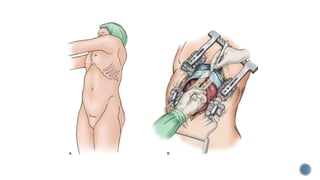
 The patient is placed in the “corkscrew” position on the operating room table to
enhance access to both the abdominal and thoracic cavities.
 The abdomen is tilted approximately 45 degrees from the horizontal plane and the
thorax is oriented in full lateral position
 Positioning is aided by the use of a bean bag.
 The abdominal part of the incision may consist of a midline or
upper paramedian incision, which allows exploration of the
abdomen
 The incision is extended obliquely along the line of the
eighth interspace just beneath the inferior pole of the scapula
 After entry into the peritoneal cavity through the abdominal portion of the incision,
the incision is extended onto the chest wall and the latissimus dorsi and serratus
anterior muscles,
 and then the external oblique muscle and aponeurosis are divided.
 The intercostal muscles of the eighth interspace are divided to allow entry into the
chest cavity and the incision is extended across the costal margin
 The diaphragm is either incised radially toward the esophageal or aortic hiatus, or in
a curvilinear fashion
 This incision also preserves phrenic nerve function and is useful for patients with
pulmonary compromise
 At the completion of the operation, chest tubes placed in the pleural cavity are
brought out through the chest or upper abdominal wall through separate incisions.
 The diaphragm is repaired in two layers using non resorbable sutures.
 Peri costal sutures are placed to reapproximate the ribs.
 The chest muscles and abdominal wall are then closed in layers.
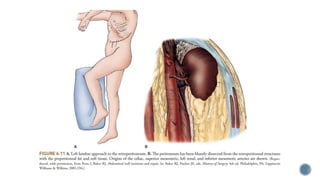
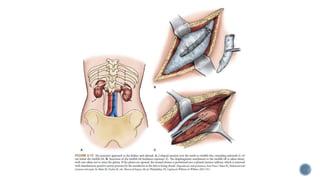
 Advantages over trans-peritoneal exposures:
 Manipulation and retraction of intraabdominal viscera are limited and postoperative
ileus is reduced
 Hemorrhage is more likely to be tamponaded in the retroperitoneum
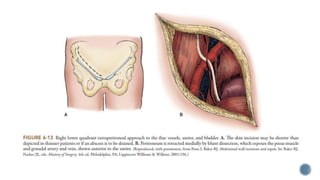
 used for operations on the
 kidney, ureter, adrenal gland, bladder,
 splenic artery and vein,
 vena cava, abdominal aorta, iliac vessels,
 lumbar sympathetic chain and on groin hernias
 Maingot’s Abdominal Operations- 12th edition
 ABDOMINAL INCISIONS IN GENERAL SURGERY: A REVIEW
 J Anat. Soc. India 50(2) 170-178 (2001) Surgical Incisions—Their Anatomical Basis Part IV-
Abdomen*Patnaik, V.V.G.; **Singla, Rajan K.; ***Bansal V.K..
 Askew, A.R. (1975) : The Fowler-Weir approach to appendicectomy. British Journal of Surgery, 62(4):
303-4.
 Burnand, K.G., Young, A.E.: The New Aird’s Companion in Surgical Studies. Churchil Livingstone
Edinburgh (1992).
 Clarke, J.M. (1989): Case for midline incisions. Lancet, Mar 18; 1 (8638): 622.
 Dudley, H.: Robe and Smith’s Operative Surgery. In: Alimentary Tract and abdominal wall. Volume 1
General Principles, 4th edn. Butterworths London: (1983).
 McBurney, C. (1894): The incision made in the abdominal wall in cases of appendicitis, with a
description of a new method of operating. Annals of Surgery, 20: 38.
 Nyhus, L.M. & Baker, R.J. : Mastery of Surgery In :Abdominal Wall Incisions. 2nd Edn Little Brown & Co.
Boston. : 444-452 (1992).
 Telfer, J.R., Canning, G., Galloway, D.J. (1993): Comparative study of abdominal incision techniques.
British Journal of Surgery, Feb; 80(2): 233-5.
Abdominal Incisions.pptx

Abdominal Incisions.pptx

  • 1.
    Presentor: Dr. Mohammad MasoomParwez PG Student AIIMS Bhopal
  • 2.
     A cutmade through the skin and soft tissue to facilitate a procedure.  A surgical incision is an aperture into the body to permit the work of the planned operation to proceed.
  • 3.
     Should followLanger’s lines where possible – for maximal wound strength and minimal scarring  Muscles should be split and not cut
  • 4.
     An idealincision should achieve three essentials:  ACCESSIBILITY  EXTENSIBILITY  SECURITY - Zinner et al, 1997
  • 5.
     surgical fieldis prepared with antiseptic solution and draped in order to reduce skin bacterial counts and the likelihood of subsequent wound infection  Shaving prior to operation has been associated with an increased rate of SSI and should, therefore, be avoided  If hair at the surgical site will interfere with accurate wound closure, use of clippers is preferred to a razor  Antiseptic solutions are commonly used to prepare the skin, include povidone- iodine, alcohol, and chlorhexidine
  • 6.
     According toNYHUS and BAKER, following factors must be taken into consideration:  Preoperative diagnosis  Elective or Emergency  Habitus of patient  Previous abdominal operations  Potential placement of stomas  Tramline / Acute angled incisions should be avoided  Incision should be kept at a fair distance from proposed stoma site  Good cosmesis helps patient morale
  • 8.
     VERTICAL INCISIONS: MIDLINE  PARAMEDIAN  TRANSVERSE/OBLIQUE INCISIONS:  KOCHERS SUBCOSTAL- CHEVRON MODIFICATION MERCEDES BENZ MODIFICATION  TRANSVERSE MUSCLE DIVIDING INCISION  MC BURNEYS MUSCLE SPLITTING INCISION {GRID IRON}  OBLIQUE MUSCLE CUTTING INCISION  PFANNENSTIEL INCISION  MAYLARD TRANSVERSE MUSCLE CUTTING INCISION  ABDOMINOTHORACIC INCISIONS
  • 11.
     Vertical incisionsinclude  midline incision  paramedian incision  Mayo-Robson extension of the paramedian incision
  • 12.
     Advantages: (a) Itis almost bloodless, (b) no muscle fibres are divided, (c) no nerves are injured, (d) it affords goods access to the upper abdominal viscera, (e) It is very quick to make as well as to close; it is unsurpassed when speed is essential(Clarke, 1989) (f) a midline epigastric incision also can be extended the full length of the abdomen curving around the umbilical scar
  • 13.
     The uppermidline incision (i.e. above the umbilicus) may be used to expose:  esophageal hiatus  abdominal esophagus  vagus nerves,  stomach,  duodenum,  gallbladder,  pancreas, and  spleen
  • 14.
     The lowermidline incision (ie, below the umbilicus) provides exposure of lower abdominal and pelvic organs  When broad exposure is required, as in an exploration for trauma, the midline incision can be extended to the xiphoid process superiorly and to the pubic symphysis inferiorly.
  • 15.
     In creatinga midline incision,  the operating surgeon and assistant apply opposing traction to the skin on both sides of the abdomen  The skin is then incised with a scalpel.  Gauze pads are applied to the skin edges to tamponade bleeding from cutaneous vessels and lateral traction is placed on the subcutaneous fat on both sides of the incision.  The incision is then carried down to the linea alba using either electrocautery or a scalpel  the decussation of fascial fibers in the upper abdomen serves as an important landmark for the midline.
  • 16.
     The lineaalba, extraperitoneal fat, and peritoneum are then divided sequentially.  If exposure of both the upper and lower peritoneal cavities is required, the incision is carried around the umbilicus in a curvilinear fashion.  The peritoneum itself is best divided with scissors or scalpel to avoid coagulation injury to underlying intraabdominal organs.  Additionally,  safe entry may be facilitated by picking up a fold of peritoneum, palpating it to ensure that no bowel has been drawn up, and sharply incising the raised fold.
  • 17.
     To avoidinjuries to the bladder, the peritoneum is entered in the upper portion of the incision.  After a small opening is created in the midline,  it is enlarged to accommodate two fingers that are then used to protect the underlying viscera as the peritoneum is further divided along the length of the wound
  • 19.
     Advantages: (a) itoffsets the vertical incision to the right or left, providing access to the lateral structures such as the spleen or the kidney (b) closure is theoretically more secure because the rectus muscle can act as a buttress between the reapproximated posterior and anterior fascial planes (Cox et al, 1986)
  • 20.
     The skinincision is placed 2 to 5 cm lateral to the midline over the medial aspect of the bulging transverse convexity of the rectus muscle.  Extra access can be obtained by sloping the upper extremity of the incision upwards to the xiphoid (Didolkar et al, 1995)  Skin and subcutaneous fat are divided along the length of the wound.  The anterior rectus sheath is exposed and incised, and its medial edge is grasped and lifted up with hemostatic forceps  The medial portion of the rectus sheath then is dissected from the rectus muscle, to which the anterior sheath adheres
  • 21.
     Segmental bloodvessels encountered during the dissection should be coagulated.  Once the rectus muscle is free of the anterior sheath it can be retracted laterally because the posterior sheath is not adherent to the rectus muscle.  The posterior sheath and the peritoneum which are adherent to each other, are excised vertically in the same plane as the anterior fascial plane (Brennan et al, 1987)  The deep inferior epigastric vessels are encountered below the umbilicus and require ligation and division if they course medially along the line of the incision (Chuter et al, 1992)
  • 22.
     Disadvantages : 1.It tends to weaken and strip off the muscles from its lateral vascular and nerve supply resulting in atrophy of the muscle medial to the incision. 2. The incision is laborious and difficult to extend superiorly as is limited by costal margin. 3. It doesn’t give good access to contralateral structures
  • 26.
     The verticalmuscle-splitting incision is made in much the same way as the traditional paramedian incision  except that the rectus muscle is split, rather than retracted laterally.  This wound can be opened and closed quickly  particular value in reopening a previous paramedian incision where dissection of the rectus muscle away from the rectus sheath can be difficult.  Longer incisions should be avoided  more bleeding  sacrifice of nerves  lead to weakening of the corresponding area of the abdominal wall.
  • 27.
     Mayo-Robson extensionof the paramedian incision is accomplished by  curving the skin incision towards the xiphoid process.  Incision of the fascial planes is continued in the same direction to obtain a larger fascial opening (Pollock, 1981)
  • 29.
     ADVANTAGES: 1. generallyfollow Langer’s lines of tension and 2. usually allow a more cosmetic closure than do vertical incisions 3. the rectus muscle has a segmental nerve supply derived from intercostal nerves, which enter the rectus sheath laterally. Transverse or slightly oblique incisions through the rectus most often spare these nerves.  DISADVANTAGES: 1. they may be limiting when pathology is located in both the upper and lower abdomen
  • 30.
     right subcostalincision - exposure of the gallbladder and biliary tree  left-sided subcostal incision is used less often, mainly for splenectomy  A bilateral subcostal incision provides excellent exposure of the upper abdomen and can be employed for hepatic resections, liver transplantation, total gastrectomy, and for anterior access to both adrenal glands.  The standard subcostal incision begins at the midline, two finger breadths below the xiphoid process and is extended laterally and inferiorly parallel to the costal margin
  • 31.
     The incisionshould not be placed too far superiorly as sufficient fascia must be preserved to allow a secure abdominal closure.  Following incision of the rectus sheath along the plane of the skin incision, the rectus muscle is divided using electrocautery or ligatures to control branches of the superior epigastric artery.  The peritoneum is then divided in the plane of the skin incision  The incision can be extended beyond the lateral aspect of the rectus muscle if necessary to facilitate exposure
  • 33.
     The incisionmay be continued across the midline into a double Kocher incision or roof top approach (Chevron Incision)  provides excellent access to the upper abdomen particularly in those with a broad costal margin (Chute et al, 1968; Brooks et al, 1999).  useful in carrying out total gastrectomy,  operations for renovascular hypertension,  Total oesophagectomy,  liver transplantation,  Extensive hepatic resections,  and bilateral adrenalectomy (Chino & Thomas, 1985; Pinson et al, 1995; Miyazaki et al, 2001).
  • 34.
     Variant ofthis incision consists of bilateral low Kocher’s incision with an upper midline limb up to and through the xiphi-sternum (Sato et al, 2000).  This gives excellent access to the upper abdominal viscera and, in particular to all the diaphragmatic hiatuses (Yoshinaga, 1969; Motsay et al, 1973; Brooks et al, 1999).
  • 36.
     The operativetechnique used to make such an incision is similar to that for the Kocher incision.  In newborns and infants, this incision is preferred, because more abdominal exposure is gained per length of the incision than with vertical exposure  As infant’s abdomen has a longer transverse than vertical girth (Gauderer, 1981).  This is also true of short, obese adults, in whom transverse incision often affords a better exposure
  • 37.
     First describedin 1894 by Charles McBurney is the incision of choice for most appendicectomies (McBurney, 1894).  The level and the length of the incision will vary according to the thickness of the abdominal wall and the suspected position of the appendix (Jelenko & Davis 1973; Watts & Perrone, 1997).  Classically, the McBurney incision is made at the junction of the middle third and outer thirds of a line running from the umbilicus to the anterior superior iliac spine, the McBurney point (Watts,1991).
  • 38.
     However, ifpalpation reveals a mass, the incision can be placed directly over the mass.  McBurney originally placed the incision obliquely, from above laterally to below medially.  However, the skin incision can be placed in a skin crease transversely [Rockey-Davis Incision or Lanz Incision or Bikini Incision]  It provides a better cosmetic result (Delany & Carnevale, 1976; Pleterski & Temple, 1990) Otherwise, the two incisions are similar.
  • 39.
     After theskin and subcutaneous tissue are divided, the external oblique aponeurosis is divided in the direction of its fibres  exposing the underlying internal oblique muscle.  A small incision is then made in this muscle adjacent to the outer border of the rectus sheath.  The opening is enlarged to permit introduction of two index fingers between the muscle fibres so that internal oblique and transversus can be retracted with a minimal amount of damage.  The peritoneum is then grasped with a thumb forceps, elevated and opened
  • 40.
     This incisionalso may be used in the left lower quadrant to deal with certain lesions of the sigmoid colon, such as drainage of a diverticular abscess.  The ilioinguinal and ilio-hypogastric nerves cross the incision for appendectomy and their accidental injury can predispose the patient to inguinal hernia formation in the postoperative period (Mandelkow & Loeweneck, 1988).
  • 43.
     This incisionbears the eponym of the Rutherford-Morrison incision (Talwar et al, 1997)  This is extension of the McBurney incision by division of the oblique fossa and can be used for :  right or left sided colonic resection,  caecostomy or sigmoid colostomy.
  • 44.
     The Pfannenstielincision is used frequently by gynaecologists and urologists for access to the pelvis organs, bladder, prostate and for caesarean section (Ayers & Morley, 1987; Mendez et al, 1999; Hendrix et al, 2000)  The skin incision is usually 12 cm long and is made in a skin fold approximately 5 cm above symphysis pubis.  The incision is deepened through fat and superficial fascia to expose both anterior rectus sheaths, which are divided along the entire length of the incision.  The sheath is then separated widely, above and below from the underlying rectus muscle. It is necessary to separate the aponeurosis in an upward direction, almost to the umbilicus and downwards to the pubis.  The rectus muscles are then retracted laterally and the peritoneum opened vertically in the midline, with care being taken not to injure the bladder at the lower end.
  • 46.
     Many surgeonsprefer this incision because it gives excellent exposure of the pelvic organs (Helmkamp & Kreb, 1990;Brand,1991)  The skin incision is placed above but parallel to the traditional placement of Pfannenstiel incision.  The rectus fascia and muscle are then cut transversely, and the incision is continued laterally as far as necessary, dividing external and internal oblique muscles; the transverses abdominis and transversalis fascia are opened in the direction of their fibres.
  • 48.
     The thoracoabdominalincision provides enhanced exposure of upper abdominal organs  A left thoracoabdominal incision is useful for access to  left hemidiaphragm,  Gastroesophageal junction,  gastric cardia and stomach,  distal pancreas and spleen,  left kidney and adrenal gland,  and aorta.
  • 49.
     A rightthoracoabdominal incision can be used to expose  right hemidiaphragm,  oesophagus,  liver,  portal triad,  inferior vena cava,  right kidney,  right adrenal gland,  and proximal pancreas.
  • 50.
     The patientis placed in the “corkscrew” position on the operating room table to enhance access to both the abdominal and thoracic cavities.  The abdomen is tilted approximately 45 degrees from the horizontal plane and the thorax is oriented in full lateral position  Positioning is aided by the use of a bean bag.  The abdominal part of the incision may consist of a midline or upper paramedian incision, which allows exploration of the abdomen  The incision is extended obliquely along the line of the eighth interspace just beneath the inferior pole of the scapula
  • 51.
     After entryinto the peritoneal cavity through the abdominal portion of the incision, the incision is extended onto the chest wall and the latissimus dorsi and serratus anterior muscles,  and then the external oblique muscle and aponeurosis are divided.  The intercostal muscles of the eighth interspace are divided to allow entry into the chest cavity and the incision is extended across the costal margin  The diaphragm is either incised radially toward the esophageal or aortic hiatus, or in a curvilinear fashion  This incision also preserves phrenic nerve function and is useful for patients with pulmonary compromise
  • 52.
     At thecompletion of the operation, chest tubes placed in the pleural cavity are brought out through the chest or upper abdominal wall through separate incisions.  The diaphragm is repaired in two layers using non resorbable sutures.  Peri costal sutures are placed to reapproximate the ribs.  The chest muscles and abdominal wall are then closed in layers.
  • 56.
     Advantages overtrans-peritoneal exposures:  Manipulation and retraction of intraabdominal viscera are limited and postoperative ileus is reduced  Hemorrhage is more likely to be tamponaded in the retroperitoneum  used for operations on the  kidney, ureter, adrenal gland, bladder,  splenic artery and vein,  vena cava, abdominal aorta, iliac vessels,  lumbar sympathetic chain and on groin hernias
  • 59.
     Maingot’s AbdominalOperations- 12th edition  ABDOMINAL INCISIONS IN GENERAL SURGERY: A REVIEW  J Anat. Soc. India 50(2) 170-178 (2001) Surgical Incisions—Their Anatomical Basis Part IV- Abdomen*Patnaik, V.V.G.; **Singla, Rajan K.; ***Bansal V.K..  Askew, A.R. (1975) : The Fowler-Weir approach to appendicectomy. British Journal of Surgery, 62(4): 303-4.  Burnand, K.G., Young, A.E.: The New Aird’s Companion in Surgical Studies. Churchil Livingstone Edinburgh (1992).  Clarke, J.M. (1989): Case for midline incisions. Lancet, Mar 18; 1 (8638): 622.  Dudley, H.: Robe and Smith’s Operative Surgery. In: Alimentary Tract and abdominal wall. Volume 1 General Principles, 4th edn. Butterworths London: (1983).  McBurney, C. (1894): The incision made in the abdominal wall in cases of appendicitis, with a description of a new method of operating. Annals of Surgery, 20: 38.  Nyhus, L.M. & Baker, R.J. : Mastery of Surgery In :Abdominal Wall Incisions. 2nd Edn Little Brown & Co. Boston. : 444-452 (1992).  Telfer, J.R., Canning, G., Galloway, D.J. (1993): Comparative study of abdominal incision techniques. British Journal of Surgery, Feb; 80(2): 233-5.