Misbah Azher
13901039
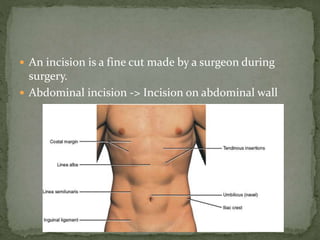
 An incision is a fine cut made by a surgeon during
surgery.
 Abdominal incision -> Incision on abdominal wall
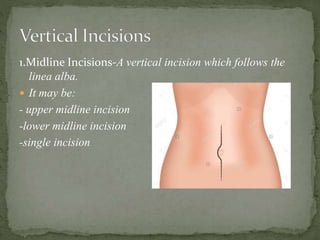
1.Midline Incisions-A vertical incision which follows the
linea alba.
 It may be:
- upper midline incision
-lower midline incision
-single incision
 Advantages-
-almost bloodless
-no muscle fibers are divided
-no nerves are injured
-good access to upper abdominal viscera
-very quick to make as well as to close
-can be extended full lenght of abdomen curving around umblical scar
 Disadvantages-
-Cosmetically not approved
 Used in surgeries like Like in perforated appendix, twisted ovarian
cyst, ileal perforation.
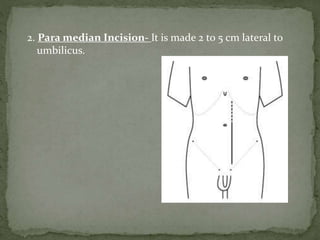
2. Para median Incision- It is made 2 to 5 cm lateral to
umbilicus.
 Advantages-
-vertical incision to right or left,provides access to lateral str. such as
spleen or kidney.
-closure is theoretically more secure because rectus muscle can act as
a buttress between reapproximated posterior and anterior fascial
planes
 Disadvantages-
- It tends to weaken and strip off the muscles from its lateral vascular
and nerve supply resulting in atrophy of the muscle medial to the
incision.
-The incision is laborious and difficult to extend superiorly as is
limited by costal margins.
-It doesn’t give good access to contralateral structures.
- Comparatively more bleeding
 Advantages:
- best cosmetic results
- less painful
-faster healing postoperative
- greater strength
 Disadvantages:
-more time-consuming
-more haemorrhagic
- compromised ability to explore upper abdominal cavity
- division of multiple layers of fascia and muscle and nerves,
may result with haematoma or seroma in potential spaces.
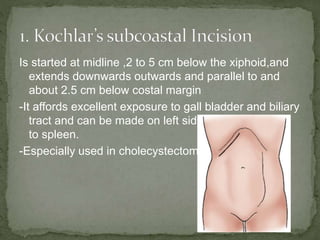
Is started at midline ,2 to 5 cm below the xiphoid,and
extends downwards outwards and parallel to and
about 2.5 cm below costal margin
-It affords excellent exposure to gall bladder and biliary
tract and can be made on left side to afford access
to spleen.
-Especially used in cholecystectomy
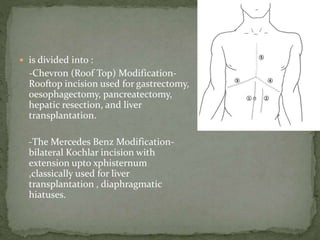
 is divided into :
-Chevron (Roof Top) Modification-
Rooftop incision used for gastrectomy,
oesophagectomy, pancreatectomy,
hepatic resection, and liver
transplantation.
-The Mercedes Benz Modification-
bilateral Kochlar incision with
extension upto xphisternum
,classically used for liver
transplantation , diaphragmatic
hiatuses.
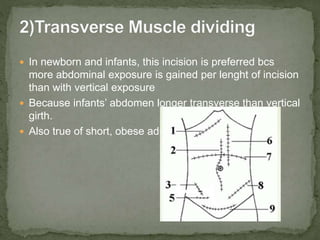
 In newborn and infants, this incision is preferred bcs
more abdominal exposure is gained per lenght of incision
than with vertical exposure
 Because infants’ abdomen longer transverse than vertical
girth.
 Also true of short, obese adult
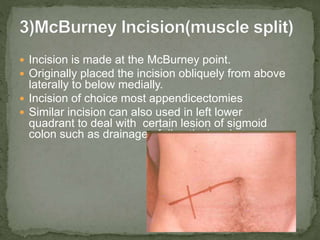
 Incision is made at the McBurney point.
 Originally placed the incision obliquely from above
laterally to below medially.
 Incision of choice most appendicectomies
 Similar incision can also used in left lower
quadrant to deal with certain lesion of sigmoid
colon such as drainage of diverticular abscess
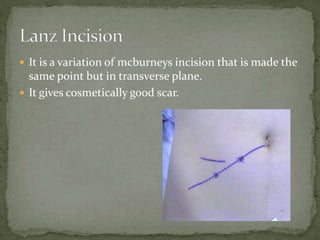
 It is a variation of mcburneys incision that is made the
same point but in transverse plane.
 It gives cosmetically good scar.
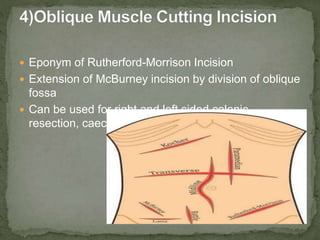
 Eponym of Rutherford-Morrison Incision
 Extension of McBurney incision by division of oblique
fossa
 Can be used for right and left sided colonic
resection, caecostomy or sigmoid colostomy
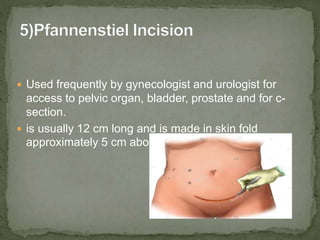
 Used frequently by gynecologist and urologist for
access to pelvic organ, bladder, prostate and for c-
section.
 is usually 12 cm long and is made in skin fold
approximately 5 cm above symphysis pubis
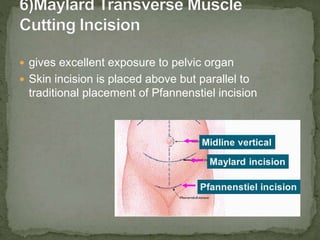
 gives excellent exposure to pelvic organ
 Skin incision is placed above but parallel to
traditional placement of Pfannenstiel incision
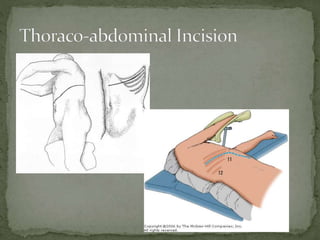
 Either right or left
 Converts pleural and peritoneal cavities into one
common cavity
 Thereby gives excellent exposure
 Right incision may be particularly useful in elective
and emergency hepatic resections
 Left incision may be used in resection of lower end
of esophagus and proximal portion of stomach.
 Incision is extended along line of 8th intercostal
space,the space immediately distal to inferior pole of
scapula.
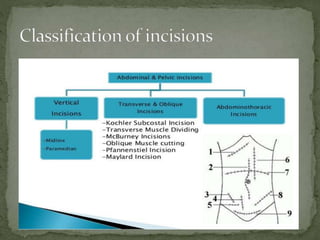
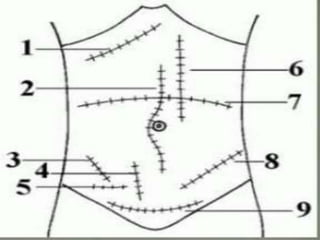
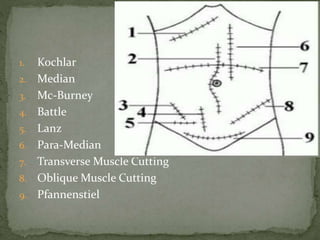
1. Kochlar
2. Median
3. Mc-Burney
4. Battle
5. Lanz
6. Para-Median
7. Transverse Muscle Cutting
8. Oblique Muscle Cutting
9. Pfannenstiel
Abdominal incisions

Abdominal incisions

  • 1.
  • 2.
     An incisionis a fine cut made by a surgeon during surgery.  Abdominal incision -> Incision on abdominal wall
  • 4.
    1.Midline Incisions-A verticalincision which follows the linea alba.  It may be: - upper midline incision -lower midline incision -single incision
  • 5.
     Advantages- -almost bloodless -nomuscle fibers are divided -no nerves are injured -good access to upper abdominal viscera -very quick to make as well as to close -can be extended full lenght of abdomen curving around umblical scar  Disadvantages- -Cosmetically not approved  Used in surgeries like Like in perforated appendix, twisted ovarian cyst, ileal perforation.
  • 6.
    2. Para medianIncision- It is made 2 to 5 cm lateral to umbilicus.
  • 7.
     Advantages- -vertical incisionto right or left,provides access to lateral str. such as spleen or kidney. -closure is theoretically more secure because rectus muscle can act as a buttress between reapproximated posterior and anterior fascial planes  Disadvantages- - It tends to weaken and strip off the muscles from its lateral vascular and nerve supply resulting in atrophy of the muscle medial to the incision. -The incision is laborious and difficult to extend superiorly as is limited by costal margins. -It doesn’t give good access to contralateral structures. - Comparatively more bleeding
  • 8.
     Advantages: - bestcosmetic results - less painful -faster healing postoperative - greater strength  Disadvantages: -more time-consuming -more haemorrhagic - compromised ability to explore upper abdominal cavity - division of multiple layers of fascia and muscle and nerves, may result with haematoma or seroma in potential spaces.
  • 9.
    Is started atmidline ,2 to 5 cm below the xiphoid,and extends downwards outwards and parallel to and about 2.5 cm below costal margin -It affords excellent exposure to gall bladder and biliary tract and can be made on left side to afford access to spleen. -Especially used in cholecystectomy
  • 10.
     is dividedinto : -Chevron (Roof Top) Modification- Rooftop incision used for gastrectomy, oesophagectomy, pancreatectomy, hepatic resection, and liver transplantation. -The Mercedes Benz Modification- bilateral Kochlar incision with extension upto xphisternum ,classically used for liver transplantation , diaphragmatic hiatuses.
  • 11.
     In newbornand infants, this incision is preferred bcs more abdominal exposure is gained per lenght of incision than with vertical exposure  Because infants’ abdomen longer transverse than vertical girth.  Also true of short, obese adult
  • 12.
     Incision ismade at the McBurney point.  Originally placed the incision obliquely from above laterally to below medially.  Incision of choice most appendicectomies  Similar incision can also used in left lower quadrant to deal with certain lesion of sigmoid colon such as drainage of diverticular abscess
  • 13.
     It isa variation of mcburneys incision that is made the same point but in transverse plane.  It gives cosmetically good scar.
  • 14.
     Eponym ofRutherford-Morrison Incision  Extension of McBurney incision by division of oblique fossa  Can be used for right and left sided colonic resection, caecostomy or sigmoid colostomy
  • 15.
     Used frequentlyby gynecologist and urologist for access to pelvic organ, bladder, prostate and for c- section.  is usually 12 cm long and is made in skin fold approximately 5 cm above symphysis pubis
  • 16.
     gives excellentexposure to pelvic organ  Skin incision is placed above but parallel to traditional placement of Pfannenstiel incision
  • 17.
     Either rightor left  Converts pleural and peritoneal cavities into one common cavity  Thereby gives excellent exposure  Right incision may be particularly useful in elective and emergency hepatic resections  Left incision may be used in resection of lower end of esophagus and proximal portion of stomach.  Incision is extended along line of 8th intercostal space,the space immediately distal to inferior pole of scapula.
  • 20.
    1. Kochlar 2. Median 3.Mc-Burney 4. Battle 5. Lanz 6. Para-Median 7. Transverse Muscle Cutting 8. Oblique Muscle Cutting 9. Pfannenstiel