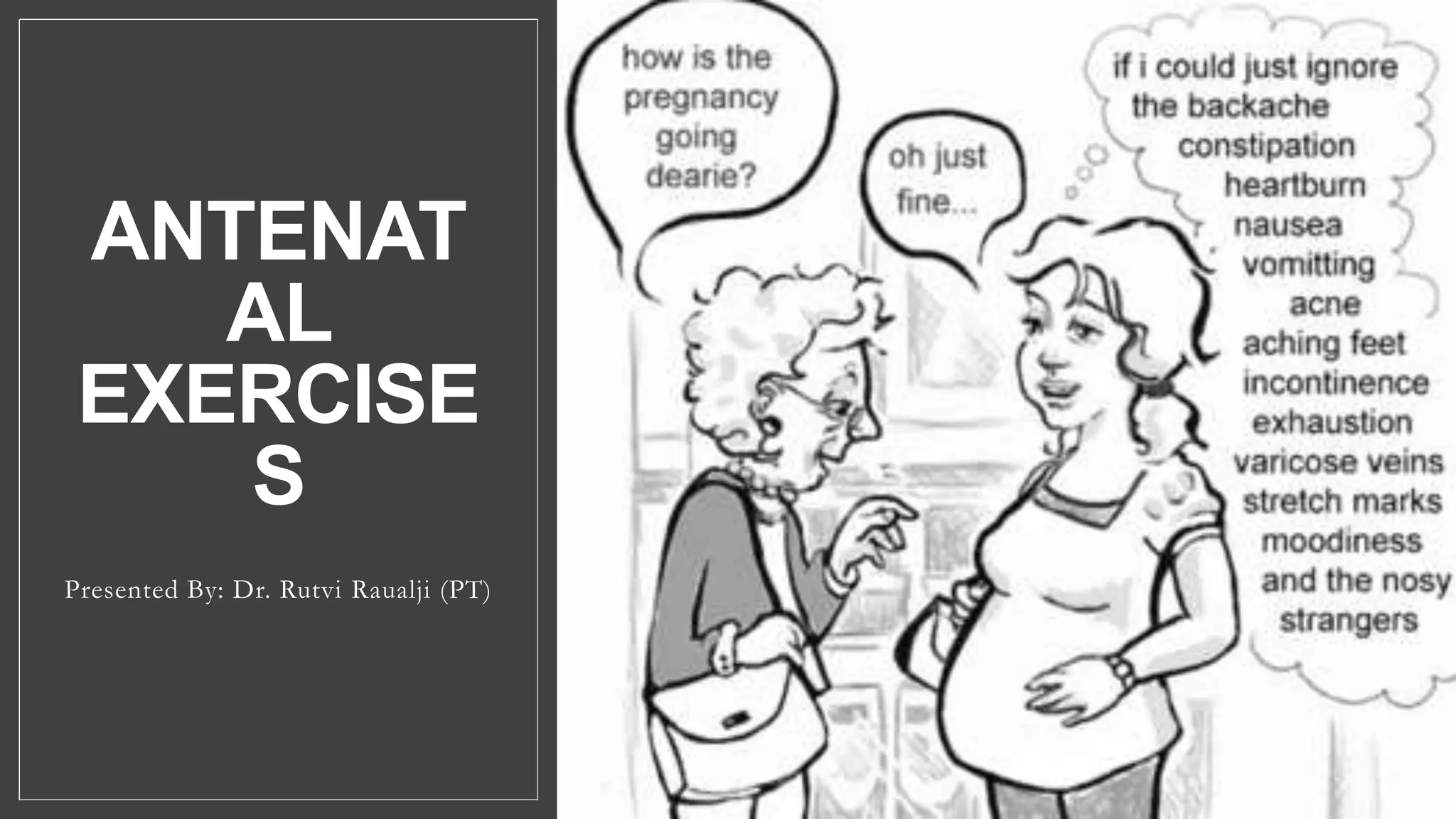
ANTENAT
AL
EXERCISE
S
Presented By: Dr. Rutvi Raualji (PT)
• Antenatal Care
• Potential Structural and Functional Impairments
• Merits
• Assessment
• Contraindications
• Exercises for Uncomplicated Pregnancy and Post-partum
• Pelvic Floor Awareness, Training, and Strengthening
• Exercises for Circulation and Cramps
• Education
• Guidelines/ Dosage
• Warning Signs
• References
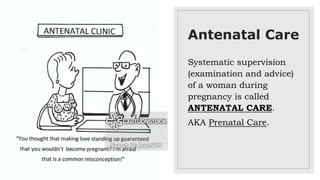
Antenatal Care
Systematic supervision
(examination and advice)
of a woman during
pregnancy is called
ANTENATAL CARE.
AKA Prenatal Care.
POTENTIAL STRUCTURAL
AND FUNCTIONAL
IMPAIRMENTS
MSK pain and muscle imbalances from faulty postures.
Poor body mechanics (lack of knowledge, changing body size
and physical demands of child care)
LE oedema and discomfort from altered circulation and
varicose veins.
Pelvic floor dysfunction, including urinary/ fecal incontinence;
organ prolapse; hypertonus; poor episiotomy healing,
poor proprioceptive awareness and disuse atrophy.
Abdominal muscle stretch, trauma, and diastasis recti
Potential decrease in cardiovascular fitness
Lack of knowledge of body changes and safe exercises
to use during and after pregnancy
Lack of physical preparation necessary for labour and
delivery
Lack of knowledge of appropriate positioning for
optimal comfort in labour and delivery
Lack of adequate post-partum rehabilitation
1. Maintains cardiovascular fitness
2. Improves posture
3. Decreases physical problems or
minor complaints of pregnancy,
e.g. backache
4. Maintains muscle length and
flexibility
5. Assists in maintenance of
healthy weight range
6. Increases body awareness and
control
7. Improves circulation
8. Reinforces principles of relaxation
9. Improves physical well-being and therefore decreases fatigue
10. Reduces stress and anxiety
11. Increases endurance and stamina
12. Provides social interaction
13. Assists post-natal recovery
ASSESSMENT
 History- obstetric (gestation, previous complications such as threatened
premature labor or miscarriages);
 Concurrent medical condition;
 Current and previous level of activity;
 Musculoskeletal problems;
 Abdominal strength and presence and absence of diastasis recti
 Posture;
 Doctor's consent
ABSOLUTE
CONTRAINDICATIONS
1. Cardiovascular disease
2. Acute infection
3. A history of recurrent spontaneous abortion/ miscarriage/ pre-term
labour
4. Multiple pregnancy
5. Bleeding or ruptured membranes
6. Severe hypertension
7. Suspected IUGR or fetal distress
8. Thrombophlebitis or pulmonary embolism
RELATIVE
CONTRAINDICATIONS
1. Women unused to high levels of exertion
2. Blood disorders such as sickle-cell disease and anaemia
3. Thyroid disease
4. Diabetes
5. Extreme maternal overweight or underweight
6. Breech presentation during the third trimester
EXERCISES FOR
UNCOMPLICATED
PREGNANCYAND
POST-PARTUM
Abdominal
Indrawing Maneuver
◦ Instructions- Slowly draw the
umbilicus towards the spine (to
gain the contraction of
transverses abdominis)
◦ NOTE: Normal Breathing
should encouraged in every
exercise.
Exercise for
Diastasis Recti
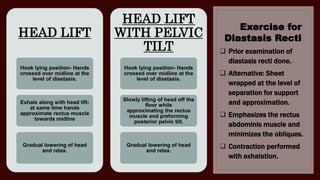
HEAD LIFT
Hook lying position- Hands
crossed over midline at the
level of diastasis.
Exhale along with head lift-
at same time hands
approximate rectus muscle
towards midline
Gradual lowering of head
and relax.
HEAD LIFT
WITH PELVIC
TILT
Hook lying position- Hands
crossed over midline at the
level of diastasis.
Slowly lifting of head off the
floor while
approximating the rectus
muscle and preforming
posterior pelvic tilt.
Gradual lowering of head
and relax.
 Prior examination of
diastasis recti done.
 Alternative: Sheet
wrapped at the level of
separation for support
and approximation.
 Emphasizes the rectus
abdominis muscle and
minimizes the obliques.
 Contraction performed
with exhalation.
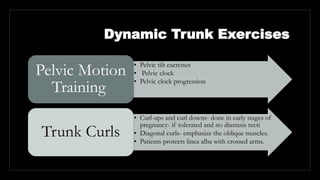
Dynamic Trunk Exercises
• Pelvic tilt exercises
• Pelvic clock
• Pelvic clock progression
Pelvic Motion
Training
• Curl-ups and curl downs- done in early stages of
pregnancy- if tolerated and no diastasis recti
• Diagonal curls- emphasize the oblique muscles.
• Patients protects linea alba with crossed arms.
Trunk Curls
Pelvic Motion Training (back pain; proprioceptive
awareness; lumbar, pelvic and hip mobility)
PELVIC TILT
EXERCISE: Quadruped
Position- posterior pelvic
tilt- isometric contraction of
lower abdominals- hold-
release and anterior pelvic
tilt.
PELVIC CLOCK: Hook
lying position- Umbilicus
[12] and pubic symphysis
[6]- gentle movements back
and forth [12-6] (basic pelvic
tilts)- then weight
shift to left hip and right hip
[3-6]- later, move in
clockwise and anti-clockwise.
PELVIC CLOCK
PROGRESSIONS: Cut the
clock in half [right-left/ up-
down]- move the pelvic in
arc on one side and back
through the middle. Later
counterclockwise motions
done.
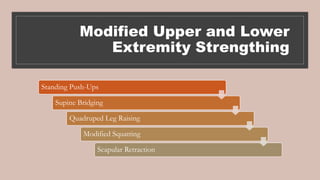
Modified Upper and Lower
Extremity Strengthing
Standing Push-Ups
Supine Bridging
Quadruped Leg Raising
Modified Squatting
Scapular Retraction
STANDING
PUSH-UPS
Standing, facing wall, feet
pointed straight forward,
shoulder-width apart, arm
length away from wall-
palms placed at shoulder
height- woman slowly bends
the elbow, bring upper body
close to the wall (trunk and
pelvis stable), and heels on
the floor. Slowly pushes
with arm back to her
original position.
SUPINE
BRIDGING
Supine in hook
lying position –
posterior pelvic tilt
and then lifting
pelvis off the floor
Proression- holding
the position and
alternatly flexing
and extending
upper extremeties.
Emphasizes
stabilization of hip
extentors and trunk
musculature.
QUADRUPED
LEG
RAISING
Patient on hands and
knees- posterior pelvic
tilt and raising one LE
at the level no higher
than pelvis- slowly
lowering that leg and
repeating same on
opposite side.[NOTE:
Discontinue if pain
over SI joint]
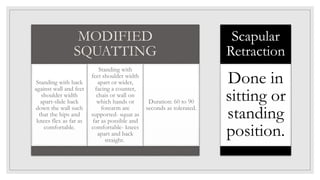
MODIFIED
SQUATTING
Standing with back
against wall and feet
shoulder width
apart-slide back
down the wall such
that the hips and
knees flex as far as
comfortable.
Standing with
feet shoulder width
apart or wider,
facing a counter,
chais or wall on
which hands or
forearm are
supported- squat as
far as possible and
comfortable- knees
apart and back
straight.
Duration: 60 to 90
seconds as tolerated.
Scapular
Retraction
Done in
sitting or
standing
position.
Perineum and Adductor
Flexibility
Supine/ side-lying- woman
abduct the hips and pull the
knees toward the sides of her
chest and hold the position as
long as comfortable.
Sitting on short stool with hips
abducted as far as possible and
feet flat on the floor- forward
flexion at hip with back straight
or gently press knees outward
with her hands for addition
stretch.
PELVIC FLOOR
AWARNESS, TRAINING,
AND STRENGTHING
Begin pelvic floor
exercise training with an
empty bladder- gravity
assisted position (hips
higher than the heart,
such as supported
bridging or
elbows/knees position)-
in women with extreme
weakness and
proprioceptive deficits.
Contract-Relax
Quick Contractions
"Elevator" Exercise
Pelvic Floor
Contract-
Relax
 Instruct woman to tighten the pelvic floor muscles
(Instruction- as if she is trying to stop the flow of
urine or holding back gas)- hold for 3 to 5
seconds- relax for same duration of time.
 Repeat for as many as 10 time (if performed with
proper technique)
 Substitution can occur with glutes, adductors and
abdominals.
 For improving proprioception and motor learning-
isolate contraction of pelvic floor is required.
 Avoid Valsalva's Maneuver- woman can count out
loud and maintaining normal breathing pattern.
Quick
Contraction
Quick, repeated contraction of pelvic
floor muscle while maintaining a normal
breathing rate keeping accessory
muscles relaxed.
15- 20 repetitions per set.
Elevator
Exercise
§Imagine riding in an elevator-
elevator goes up from one floor to
another- PFM's contract a little more.
§Later on, to increase difficulty
relax the muscles gradually, as if
elevator were descending down
(ECCENTRIC muscle work required).
Pelvic
Floor
Relaxation
§Contract pelvic floor muscle- allow total
voluntary release and relax pelvic floor.
§Pelvic floor relaxation is
linked with effective breathing and relaxation
of facial muscles- therefore, slow-deep breathing
is emphasized.
§Relaxation of pelvic floor is
extremely important in stage 2 of labour and
vaginal delivery.
§Chronic inability to relax the pelvic
floor muscles may lead to impairments such
as hypertonus, voiding dysfunction, or pain
in intercourse- thus, should be referred
to doctor ASAP.
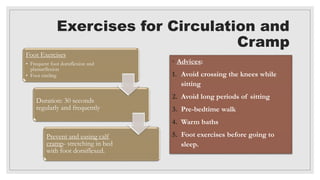
Exercises for Circulation and
Cramp
Foot Exercises
• Frequent foot dorsiflexion and
plantarflexion
• Foot circling
Duration: 30 seconds
regularly and frequently
Prevent and easing calf
cramp- stretching in bed
with foot dorsiflexed.
◦ Advices:
1. Avoid crossing the knees while
sitting
2. Avoid long periods of sitting
3. Pre-bedtime walk
4. Warm baths
5. Foot exercises before going to
sleep.
Education
1. Avoid overheating and exercising in hot condition.
2. Maintain adequate fluid intake and avoid
dehydration.
3. Do not exercise with a febrile condition.
4. Adequate warm up and cool down.
5. Avoid exercising in supine after end of fourth month.
6. Avoid contact sports after 16 weeks gestation.
7. Avoid ballistic bounce with stretches.
8. Do not stretch extreme ranges of movement.
9. Low-impact exercise preferred.
10.Full flexion/ hyperextension avoided.
11. Avoid Valsalva manoeuvres activities.
14. Increase calorie intake to account exercise needs.
Guidelines/ Dosage
§Medical Consent
§Gradually increase exercise if previously sedentary
§Frequency- 3 times a week
§Intensity- 25 to 30% of maximum heart rate [HRmax= 220- age (in years)]
§Type- Warm up, Conditioning (Moderate exercise) and Cool down
§Time- 30 to 45 mins ( 20 mins conditioning duration)
WARNING SIGNS
1. Tachycardia
2. Palpitations
3. Shortness of breath
4. Dizziness
5. Faintness
6. Vaginal fluid loss
7. Pain
1. Textbook of Obstetrics- D
C Dutta
2. Therapeutic
Exercise Foundation and
Techniques- Carolyn Kisner,
Lynn Allen Colby- Sixth Edition
3. Women's Health- A Textbook for
Physiotherapists-
Ruth Sapsford, Joanne Bullock-
Saxton, Sue Markwell
4. Physiotherapy in Obstetrics and
Gynaecology- Margaret Polden,
Jill Mantle
Antenatal Execrises.pptx

Antenatal Execrises.pptx

  • 1.
  • 2.
    • Antenatal Care •Potential Structural and Functional Impairments • Merits • Assessment • Contraindications • Exercises for Uncomplicated Pregnancy and Post-partum • Pelvic Floor Awareness, Training, and Strengthening • Exercises for Circulation and Cramps • Education • Guidelines/ Dosage • Warning Signs • References
  • 3.
    Antenatal Care Systematic supervision (examinationand advice) of a woman during pregnancy is called ANTENATAL CARE. AKA Prenatal Care.
  • 4.
    POTENTIAL STRUCTURAL AND FUNCTIONAL IMPAIRMENTS MSKpain and muscle imbalances from faulty postures. Poor body mechanics (lack of knowledge, changing body size and physical demands of child care) LE oedema and discomfort from altered circulation and varicose veins. Pelvic floor dysfunction, including urinary/ fecal incontinence; organ prolapse; hypertonus; poor episiotomy healing, poor proprioceptive awareness and disuse atrophy.
  • 5.
    Abdominal muscle stretch,trauma, and diastasis recti Potential decrease in cardiovascular fitness Lack of knowledge of body changes and safe exercises to use during and after pregnancy Lack of physical preparation necessary for labour and delivery Lack of knowledge of appropriate positioning for optimal comfort in labour and delivery Lack of adequate post-partum rehabilitation
  • 6.
    1. Maintains cardiovascularfitness 2. Improves posture 3. Decreases physical problems or minor complaints of pregnancy, e.g. backache 4. Maintains muscle length and flexibility 5. Assists in maintenance of healthy weight range 6. Increases body awareness and control 7. Improves circulation
  • 7.
    8. Reinforces principlesof relaxation 9. Improves physical well-being and therefore decreases fatigue 10. Reduces stress and anxiety 11. Increases endurance and stamina 12. Provides social interaction 13. Assists post-natal recovery
  • 8.
    ASSESSMENT  History- obstetric(gestation, previous complications such as threatened premature labor or miscarriages);  Concurrent medical condition;  Current and previous level of activity;  Musculoskeletal problems;  Abdominal strength and presence and absence of diastasis recti  Posture;  Doctor's consent
  • 9.
    ABSOLUTE CONTRAINDICATIONS 1. Cardiovascular disease 2.Acute infection 3. A history of recurrent spontaneous abortion/ miscarriage/ pre-term labour 4. Multiple pregnancy 5. Bleeding or ruptured membranes 6. Severe hypertension 7. Suspected IUGR or fetal distress 8. Thrombophlebitis or pulmonary embolism
  • 10.
    RELATIVE CONTRAINDICATIONS 1. Women unusedto high levels of exertion 2. Blood disorders such as sickle-cell disease and anaemia 3. Thyroid disease 4. Diabetes 5. Extreme maternal overweight or underweight 6. Breech presentation during the third trimester
  • 11.
  • 12.
    Abdominal Indrawing Maneuver ◦ Instructions-Slowly draw the umbilicus towards the spine (to gain the contraction of transverses abdominis) ◦ NOTE: Normal Breathing should encouraged in every exercise.
  • 13.
    Exercise for Diastasis Recti HEADLIFT Hook lying position- Hands crossed over midline at the level of diastasis. Exhale along with head lift- at same time hands approximate rectus muscle towards midline Gradual lowering of head and relax. HEAD LIFT WITH PELVIC TILT Hook lying position- Hands crossed over midline at the level of diastasis. Slowly lifting of head off the floor while approximating the rectus muscle and preforming posterior pelvic tilt. Gradual lowering of head and relax.  Prior examination of diastasis recti done.  Alternative: Sheet wrapped at the level of separation for support and approximation.  Emphasizes the rectus abdominis muscle and minimizes the obliques.  Contraction performed with exhalation.
  • 14.
    Dynamic Trunk Exercises •Pelvic tilt exercises • Pelvic clock • Pelvic clock progression Pelvic Motion Training • Curl-ups and curl downs- done in early stages of pregnancy- if tolerated and no diastasis recti • Diagonal curls- emphasize the oblique muscles. • Patients protects linea alba with crossed arms. Trunk Curls
  • 15.
    Pelvic Motion Training(back pain; proprioceptive awareness; lumbar, pelvic and hip mobility) PELVIC TILT EXERCISE: Quadruped Position- posterior pelvic tilt- isometric contraction of lower abdominals- hold- release and anterior pelvic tilt. PELVIC CLOCK: Hook lying position- Umbilicus [12] and pubic symphysis [6]- gentle movements back and forth [12-6] (basic pelvic tilts)- then weight shift to left hip and right hip [3-6]- later, move in clockwise and anti-clockwise. PELVIC CLOCK PROGRESSIONS: Cut the clock in half [right-left/ up- down]- move the pelvic in arc on one side and back through the middle. Later counterclockwise motions done.
  • 16.
    Modified Upper andLower Extremity Strengthing Standing Push-Ups Supine Bridging Quadruped Leg Raising Modified Squatting Scapular Retraction
  • 17.
    STANDING PUSH-UPS Standing, facing wall,feet pointed straight forward, shoulder-width apart, arm length away from wall- palms placed at shoulder height- woman slowly bends the elbow, bring upper body close to the wall (trunk and pelvis stable), and heels on the floor. Slowly pushes with arm back to her original position. SUPINE BRIDGING Supine in hook lying position – posterior pelvic tilt and then lifting pelvis off the floor Proression- holding the position and alternatly flexing and extending upper extremeties. Emphasizes stabilization of hip extentors and trunk musculature. QUADRUPED LEG RAISING Patient on hands and knees- posterior pelvic tilt and raising one LE at the level no higher than pelvis- slowly lowering that leg and repeating same on opposite side.[NOTE: Discontinue if pain over SI joint]
  • 18.
    MODIFIED SQUATTING Standing with back againstwall and feet shoulder width apart-slide back down the wall such that the hips and knees flex as far as comfortable. Standing with feet shoulder width apart or wider, facing a counter, chais or wall on which hands or forearm are supported- squat as far as possible and comfortable- knees apart and back straight. Duration: 60 to 90 seconds as tolerated. Scapular Retraction Done in sitting or standing position.
  • 19.
    Perineum and Adductor Flexibility Supine/side-lying- woman abduct the hips and pull the knees toward the sides of her chest and hold the position as long as comfortable. Sitting on short stool with hips abducted as far as possible and feet flat on the floor- forward flexion at hip with back straight or gently press knees outward with her hands for addition stretch.
  • 20.
  • 21.
    Begin pelvic floor exercisetraining with an empty bladder- gravity assisted position (hips higher than the heart, such as supported bridging or elbows/knees position)- in women with extreme weakness and proprioceptive deficits. Contract-Relax Quick Contractions "Elevator" Exercise Pelvic Floor
  • 22.
    Contract- Relax  Instruct womanto tighten the pelvic floor muscles (Instruction- as if she is trying to stop the flow of urine or holding back gas)- hold for 3 to 5 seconds- relax for same duration of time.  Repeat for as many as 10 time (if performed with proper technique)  Substitution can occur with glutes, adductors and abdominals.  For improving proprioception and motor learning- isolate contraction of pelvic floor is required.  Avoid Valsalva's Maneuver- woman can count out loud and maintaining normal breathing pattern.
  • 23.
    Quick Contraction Quick, repeated contractionof pelvic floor muscle while maintaining a normal breathing rate keeping accessory muscles relaxed. 15- 20 repetitions per set.
  • 24.
    Elevator Exercise §Imagine riding inan elevator- elevator goes up from one floor to another- PFM's contract a little more. §Later on, to increase difficulty relax the muscles gradually, as if elevator were descending down (ECCENTRIC muscle work required).
  • 25.
    Pelvic Floor Relaxation §Contract pelvic floormuscle- allow total voluntary release and relax pelvic floor. §Pelvic floor relaxation is linked with effective breathing and relaxation of facial muscles- therefore, slow-deep breathing is emphasized. §Relaxation of pelvic floor is extremely important in stage 2 of labour and vaginal delivery. §Chronic inability to relax the pelvic floor muscles may lead to impairments such as hypertonus, voiding dysfunction, or pain in intercourse- thus, should be referred to doctor ASAP.
  • 26.
    Exercises for Circulationand Cramp Foot Exercises • Frequent foot dorsiflexion and plantarflexion • Foot circling Duration: 30 seconds regularly and frequently Prevent and easing calf cramp- stretching in bed with foot dorsiflexed. ◦ Advices: 1. Avoid crossing the knees while sitting 2. Avoid long periods of sitting 3. Pre-bedtime walk 4. Warm baths 5. Foot exercises before going to sleep.
  • 27.
    Education 1. Avoid overheatingand exercising in hot condition. 2. Maintain adequate fluid intake and avoid dehydration. 3. Do not exercise with a febrile condition. 4. Adequate warm up and cool down. 5. Avoid exercising in supine after end of fourth month. 6. Avoid contact sports after 16 weeks gestation. 7. Avoid ballistic bounce with stretches. 8. Do not stretch extreme ranges of movement.
  • 28.
    9. Low-impact exercisepreferred. 10.Full flexion/ hyperextension avoided. 11. Avoid Valsalva manoeuvres activities. 14. Increase calorie intake to account exercise needs.
  • 29.
    Guidelines/ Dosage §Medical Consent §Graduallyincrease exercise if previously sedentary §Frequency- 3 times a week §Intensity- 25 to 30% of maximum heart rate [HRmax= 220- age (in years)] §Type- Warm up, Conditioning (Moderate exercise) and Cool down §Time- 30 to 45 mins ( 20 mins conditioning duration)
  • 30.
    WARNING SIGNS 1. Tachycardia 2.Palpitations 3. Shortness of breath 4. Dizziness 5. Faintness 6. Vaginal fluid loss 7. Pain
  • 31.
    1. Textbook ofObstetrics- D C Dutta 2. Therapeutic Exercise Foundation and Techniques- Carolyn Kisner, Lynn Allen Colby- Sixth Edition 3. Women's Health- A Textbook for Physiotherapists- Ruth Sapsford, Joanne Bullock- Saxton, Sue Markwell 4. Physiotherapy in Obstetrics and Gynaecology- Margaret Polden, Jill Mantle