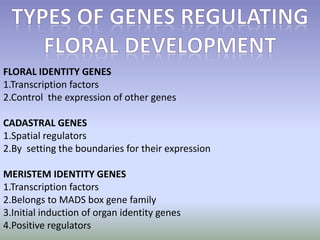
FLORAL IDENTITY GENES 
1.Transcription factors 
2.Control the expression of other genes 
CADASTRAL GENES 
1.Spatial regulators 
2.By setting the boundaries for their expression 
MERISTEM IDENTITY GENES 
1.Transcription factors 
2.Belongs to MADS box gene family 
3.Initial induction of organ identity genes 
4.Positive regulators
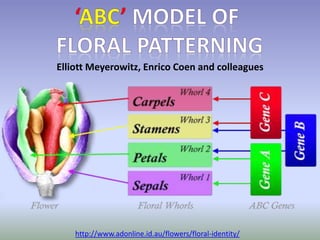
Elliott Meyerowitz, Enrico Coen and colleagues 
http://www.adonline.id.au/flowers/floral-identity/
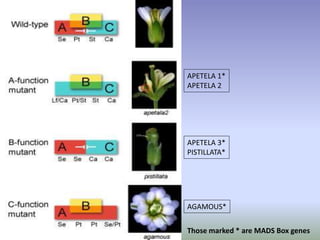
APETELA 1* 
APETELA 2 
APETELA 3* 
PISTILLATA* 
AGAMOUS* 
Those marked * are MADS Box genes
http://www.adonline.id.au/flowers/floral-identity/
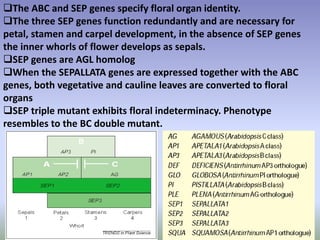
The ABC and SEP genes specify floral organ identity. 
The three SEP genes function redundantly and are necessary for 
petal, stamen and carpel development, in the absence of SEP genes 
the inner whorls of flower develops as sepals. 
SEP genes are AGL homolog 
When the SEPALLATA genes are expressed together with the ABC 
genes, both vegetative and cauline leaves are converted to floral 
organs 
SEP triple mutant exhibits floral indeterminacy. Phenotype 
resembles to the BC double mutant.
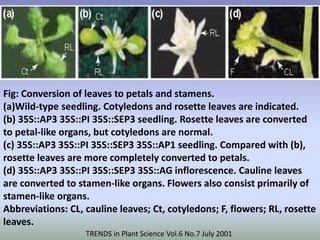
Fig: Conversion of leaves to petals and stamens. 
(a)Wild-type seedling. Cotyledons and rosette leaves are indicated. 
(b) 35S::AP3 35S::PI 35S::SEP3 seedling. Rosette leaves are converted 
to petal-like organs, but cotyledons are normal. 
(c) 35S::AP3 35S::PI 35S::SEP3 35S::AP1 seedling. Compared with (b), 
rosette leaves are more completely converted to petals. 
(d) 35S::AP3 35S::PI 35S::SEP3 35S::AG inflorescence. Cauline leaves 
are converted to stamen-like organs. Flowers also consist primarily of 
stamen-like organs. 
Abbreviations: CL, cauline leaves; Ct, cotyledons; F, flowers; RL, rosette 
leaves. 
TRENDS in Plant Science Vol.6 No.7 July 2001
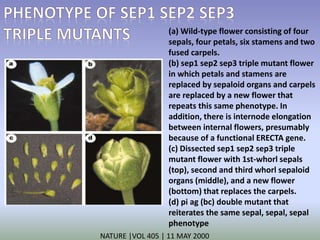
(a) Wild-type flower consisting of four 
sepals, four petals, six stamens and two 
fused carpels. 
(b) sep1 sep2 sep3 triple mutant flower 
in which petals and stamens are 
replaced by sepaloid organs and carpels 
are replaced by a new flower that 
repeats this same phenotype. In 
addition, there is internode elongation 
between internal flowers, presumably 
because of a functional ERECTA gene. 
(c) Dissected sep1 sep2 sep3 triple 
mutant flower with 1st-whorl sepals 
(top), second and third whorl sepaloid 
organs (middle), and a new flower 
(bottom) that replaces the carpels. 
(d) pi ag (bc) double mutant that 
reiterates the same sepal, sepal, sepal 
phenotype 
NATURE |VOL 405 | 11 MAY 2000
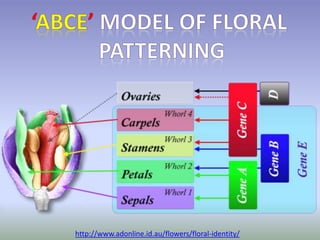
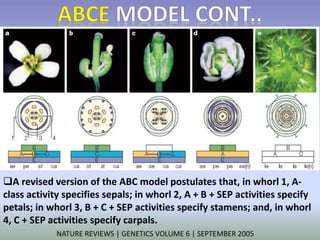
A revised version of the ABC model postulates that, in whorl 1, A-class 
activity specifies sepals; in whorl 2, A + B + SEP activities specify 
petals; in whorl 3, B + C + SEP activities specify stamens; and, in whorl 
4, C + SEP activities specify carpals. 
NATURE REVIEWS | GENETICS VOLUME 6 | SEPTEMBER 2005
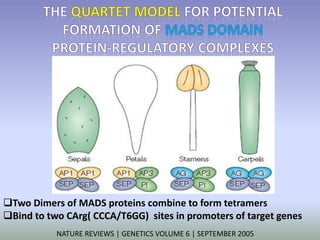
Two Dimers of MADS proteins combine to form tetramers 
Bind to two CArg( CCCA/T6GG) sites in promoters of target genes 
NATURE REVIEWS | GENETICS VOLUME 6 | SEPTEMBER 2005
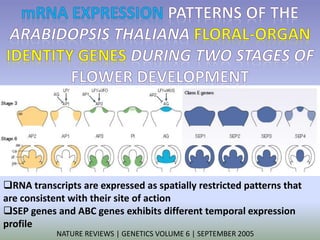
RNA transcripts are expressed as spatially restricted patterns that 
are consistent with their site of action 
SEP genes and ABC genes exhibits different temporal expression 
profile 
NATURE REVIEWS | GENETICS VOLUME 6 | SEPTEMBER 2005
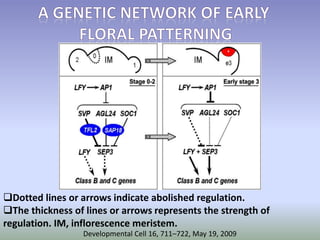
Dotted lines or arrows indicate abolished regulation. 
The thickness of lines or arrows represents the strength of 
regulation. IM, inflorescence meristem. 
Developmental Cell 16, 711–722, May 19, 2009
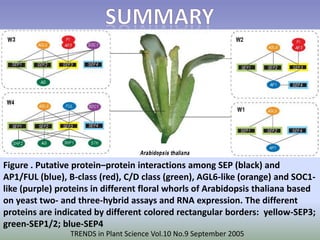
Figure . Putative protein–protein interactions among SEP (black) and 
AP1/FUL (blue), B-class (red), C/D class (green), AGL6-like (orange) and SOC1- 
like (purple) proteins in different floral whorls of Arabidopsis thaliana based 
on yeast two- and three-hybrid assays and RNA expression. The different 
proteins are indicated by different colored rectangular borders: yellow-SEP3; 
green-SEP1/2; blue-SEP4 
TRENDS in Plant Science Vol.10 No.9 September 2005
Thomas Jack ‘Molecular and GeneticMechanisms of Floral Control’ 
The Plant Cell, Vol. 16, S1–S17, Supplement 2004 
Beth A. Krizek And Jennifer C. Fletcher ‘Molecular Mechanisms Of 
Flower Development: An Armchair Guide’ Nature Publishing Group, 
September 2005, Volume 6 688-698 
Yaron Y. Levy and Caroline Dean ‘The Transition to Flowering’ The 
Plant Cell, Vol. 10, 1973–1989, December 1998 
Soraya Pelaz, Rosalinda Tapia-Lo´ pez, Elena R. Alvarez-Buylla and 
Martin F. Yanofsky, Conversion of leaves into petals in Arabidopsis, 
Current Biology 2001, 11:182–184. 
Soraya Pelaz, Gary S. Ditta, Elvira Baumann, Ellen Wisman and Martin 
F. Yanofsky, B and C floral organ identity functions require SEPALLATA 
MADS-box genes, NATURE |VOL 405 | 11 MAY 2000
Simon T. Malcomber and Elizabeth A. Kellogg, SEPALLATA gene 
diversification: brave new whorls, TRENDS in Plant Science Vol.10 No.9 
September 2005 
Chang Liu, Wanyan Xi,Lisha Shen, Caiping Tan and Hao Yu, Regulation 
of Floral Patterning by Flowering Time Genes, Developmental Cell 16, 
711–722, May 19, 2009 
Gary Ditta, Anusak Pinyopich, Pedro Robles, Soraya Pelaz, and Martin 
F. Yanofsky, The SEP4 Gene of Arabidopsis thaliana Functions in Floral 
Organ and Meristem Identity, Current Biology, Vol. 14, 1935–1940, 
November 9, 2004 
Thomas Jack, Relearning our ABCs: new twists on an old model, 
TRENDS in Plant Science Vol.6 No.7 July 2001
E class genes

E class genes

  • 2.
    FLORAL IDENTITY GENES 1.Transcription factors 2.Control the expression of other genes CADASTRAL GENES 1.Spatial regulators 2.By setting the boundaries for their expression MERISTEM IDENTITY GENES 1.Transcription factors 2.Belongs to MADS box gene family 3.Initial induction of organ identity genes 4.Positive regulators
  • 3.
    Elliott Meyerowitz, EnricoCoen and colleagues http://www.adonline.id.au/flowers/floral-identity/
  • 4.
    APETELA 1* APETELA2 APETELA 3* PISTILLATA* AGAMOUS* Those marked * are MADS Box genes
  • 5.
  • 6.
  • 7.
    The ABC andSEP genes specify floral organ identity. The three SEP genes function redundantly and are necessary for petal, stamen and carpel development, in the absence of SEP genes the inner whorls of flower develops as sepals. SEP genes are AGL homolog When the SEPALLATA genes are expressed together with the ABC genes, both vegetative and cauline leaves are converted to floral organs SEP triple mutant exhibits floral indeterminacy. Phenotype resembles to the BC double mutant.
  • 8.
    Fig: Conversion ofleaves to petals and stamens. (a)Wild-type seedling. Cotyledons and rosette leaves are indicated. (b) 35S::AP3 35S::PI 35S::SEP3 seedling. Rosette leaves are converted to petal-like organs, but cotyledons are normal. (c) 35S::AP3 35S::PI 35S::SEP3 35S::AP1 seedling. Compared with (b), rosette leaves are more completely converted to petals. (d) 35S::AP3 35S::PI 35S::SEP3 35S::AG inflorescence. Cauline leaves are converted to stamen-like organs. Flowers also consist primarily of stamen-like organs. Abbreviations: CL, cauline leaves; Ct, cotyledons; F, flowers; RL, rosette leaves. TRENDS in Plant Science Vol.6 No.7 July 2001
  • 9.
    (a) Wild-type flowerconsisting of four sepals, four petals, six stamens and two fused carpels. (b) sep1 sep2 sep3 triple mutant flower in which petals and stamens are replaced by sepaloid organs and carpels are replaced by a new flower that repeats this same phenotype. In addition, there is internode elongation between internal flowers, presumably because of a functional ERECTA gene. (c) Dissected sep1 sep2 sep3 triple mutant flower with 1st-whorl sepals (top), second and third whorl sepaloid organs (middle), and a new flower (bottom) that replaces the carpels. (d) pi ag (bc) double mutant that reiterates the same sepal, sepal, sepal phenotype NATURE |VOL 405 | 11 MAY 2000
  • 10.
    A revised versionof the ABC model postulates that, in whorl 1, A-class activity specifies sepals; in whorl 2, A + B + SEP activities specify petals; in whorl 3, B + C + SEP activities specify stamens; and, in whorl 4, C + SEP activities specify carpals. NATURE REVIEWS | GENETICS VOLUME 6 | SEPTEMBER 2005
  • 11.
    Two Dimers ofMADS proteins combine to form tetramers Bind to two CArg( CCCA/T6GG) sites in promoters of target genes NATURE REVIEWS | GENETICS VOLUME 6 | SEPTEMBER 2005
  • 12.
    RNA transcripts areexpressed as spatially restricted patterns that are consistent with their site of action SEP genes and ABC genes exhibits different temporal expression profile NATURE REVIEWS | GENETICS VOLUME 6 | SEPTEMBER 2005
  • 13.
    Dotted lines orarrows indicate abolished regulation. The thickness of lines or arrows represents the strength of regulation. IM, inflorescence meristem. Developmental Cell 16, 711–722, May 19, 2009
  • 14.
    Figure . Putativeprotein–protein interactions among SEP (black) and AP1/FUL (blue), B-class (red), C/D class (green), AGL6-like (orange) and SOC1- like (purple) proteins in different floral whorls of Arabidopsis thaliana based on yeast two- and three-hybrid assays and RNA expression. The different proteins are indicated by different colored rectangular borders: yellow-SEP3; green-SEP1/2; blue-SEP4 TRENDS in Plant Science Vol.10 No.9 September 2005
  • 15.
    Thomas Jack ‘Molecularand GeneticMechanisms of Floral Control’ The Plant Cell, Vol. 16, S1–S17, Supplement 2004 Beth A. Krizek And Jennifer C. Fletcher ‘Molecular Mechanisms Of Flower Development: An Armchair Guide’ Nature Publishing Group, September 2005, Volume 6 688-698 Yaron Y. Levy and Caroline Dean ‘The Transition to Flowering’ The Plant Cell, Vol. 10, 1973–1989, December 1998 Soraya Pelaz, Rosalinda Tapia-Lo´ pez, Elena R. Alvarez-Buylla and Martin F. Yanofsky, Conversion of leaves into petals in Arabidopsis, Current Biology 2001, 11:182–184. Soraya Pelaz, Gary S. Ditta, Elvira Baumann, Ellen Wisman and Martin F. Yanofsky, B and C floral organ identity functions require SEPALLATA MADS-box genes, NATURE |VOL 405 | 11 MAY 2000
  • 16.
    Simon T. Malcomberand Elizabeth A. Kellogg, SEPALLATA gene diversification: brave new whorls, TRENDS in Plant Science Vol.10 No.9 September 2005 Chang Liu, Wanyan Xi,Lisha Shen, Caiping Tan and Hao Yu, Regulation of Floral Patterning by Flowering Time Genes, Developmental Cell 16, 711–722, May 19, 2009 Gary Ditta, Anusak Pinyopich, Pedro Robles, Soraya Pelaz, and Martin F. Yanofsky, The SEP4 Gene of Arabidopsis thaliana Functions in Floral Organ and Meristem Identity, Current Biology, Vol. 14, 1935–1940, November 9, 2004 Thomas Jack, Relearning our ABCs: new twists on an old model, TRENDS in Plant Science Vol.6 No.7 July 2001

Editor's Notes

  • #6 new class of floral organ identity MADS-box genes, SEP1, SEP2, and SEP3, was recently described This trio of largely redundant genes is required for the development of petals, stamens, and carpels since triple mutants lacking all three SEP activities produce flowers that consist only of sepals helps B ancd C genes
  • #11 Protein-protein interaction data, together with the fact that sep1 sep2 sep3 triple mutants closely resemble BC double mutants (ap3 ag or pi ag), indicate that the SEP proteins interact with the products of the B and C organ identity genes to direct petal, stamen, and carpel development
  • #12 Regulation of floral organ identity genes a model was praposed.
  • #14 A genetic model shows that activation of floral homeotic gene expression requires the orchestrated regulation of SEP3 by SVP, SOC1, and AGL24 in emerging floral meristems. In floral anlagen and stage 1 and 2 floral meristems, class B and C homeotic genes are not activated by LFY alone, because its coregulator, SEP3, is repressed by SVP, SOC1, and AGL24, whose expression is directly mediated by AP1. To repress SEP3, SVP interacts with TFL2 to modulate H3K27me3, while SOC1 and AGL24 interact with SAP18 to modulate H3 acetylation. In early stage 3 (e3) floral meristem, strong repression of SVP, SOC1, and AGL24 by AP1 derepresses SEP3, which in turn functions with LFY to activate class B and C genes. The asterisk indicates the region where high SEP3 expression coincides with initial expression of class B and C genes. Dotted lines or arrows indicate abolished regulation. The thickness of lines or arrows represents the strength of regulation. IM, inflorescence meristem.