Downloaded 855 times

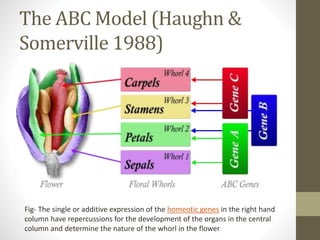
![MADS Box
• The MADS box is a conserved sequence motif. The genes which
contain this motif are called the MADS-box gene family
• The length of the MADS-box reported by various researchers varies
somewhat, but typical lengths are in the range of 168 to 180 base
pairs (how many amino acids are there in MADS domain then?)
• The MADS box encodes the DNA-binding MADS domain.
• MADS-box gene family got its name later as an acronym referring to
the four founding members
1. MCM1 from the budding yeast, Saccharomyces cerevisiae,
2. AGAMOUS from the thale cress Arabidopsis thaliana,
3. DEFICIENS from the snapdragon Antirrhinum majus,[10]
4. SRF from the human Homo sapiens](https://image.slidesharecdn.com/photoperiodism-170524144059/85/Photoperiodism-23-320.jpg)
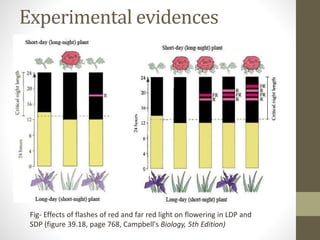
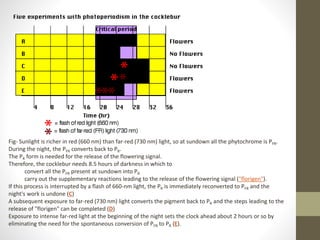
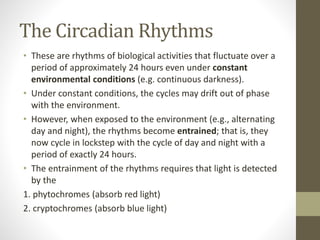
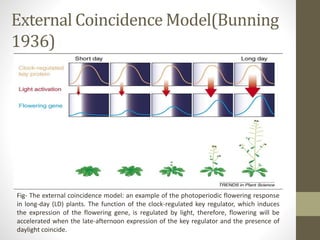
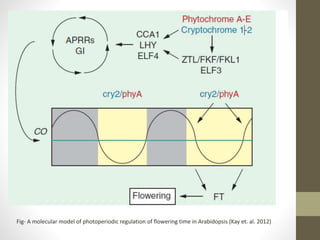
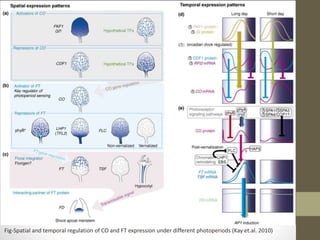
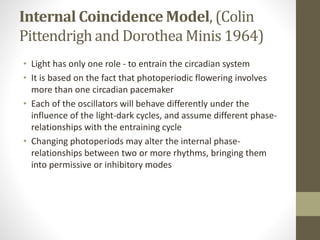
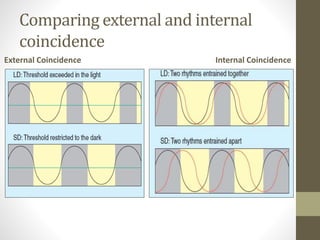
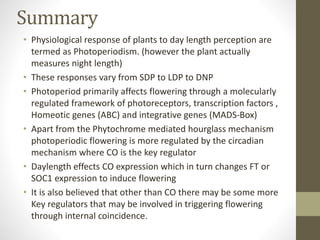



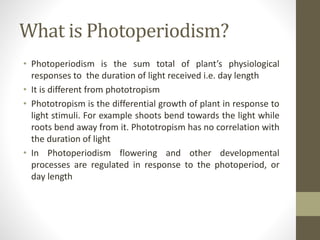
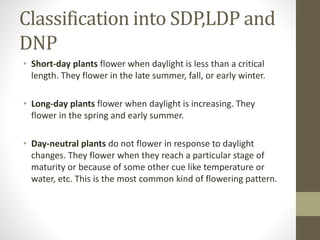
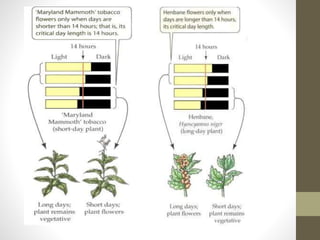
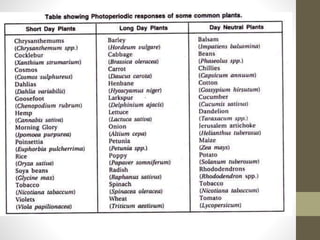
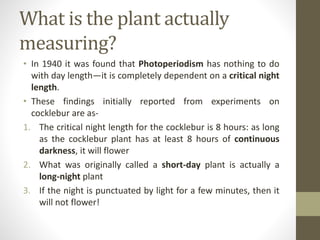
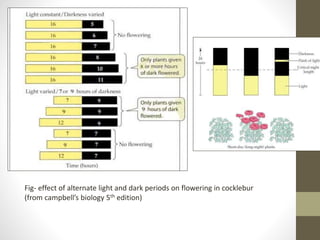
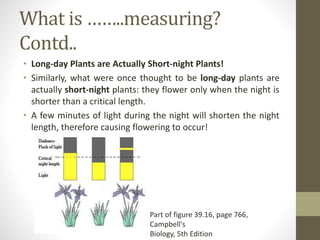
Photoperiodism refers to plants' physiological responses to light duration, significantly influencing flowering, bud dormancy, and other developmental processes. This concept was pioneered by researchers in the 1920s who categorized plants into short-day, long-day, and day-neutral types based on their flowering responses to light. The critical night length, rather than day length, has been found to govern flowering, revealing complex molecular interactions and circadian rhythms that regulate these processes.


