
Introduction
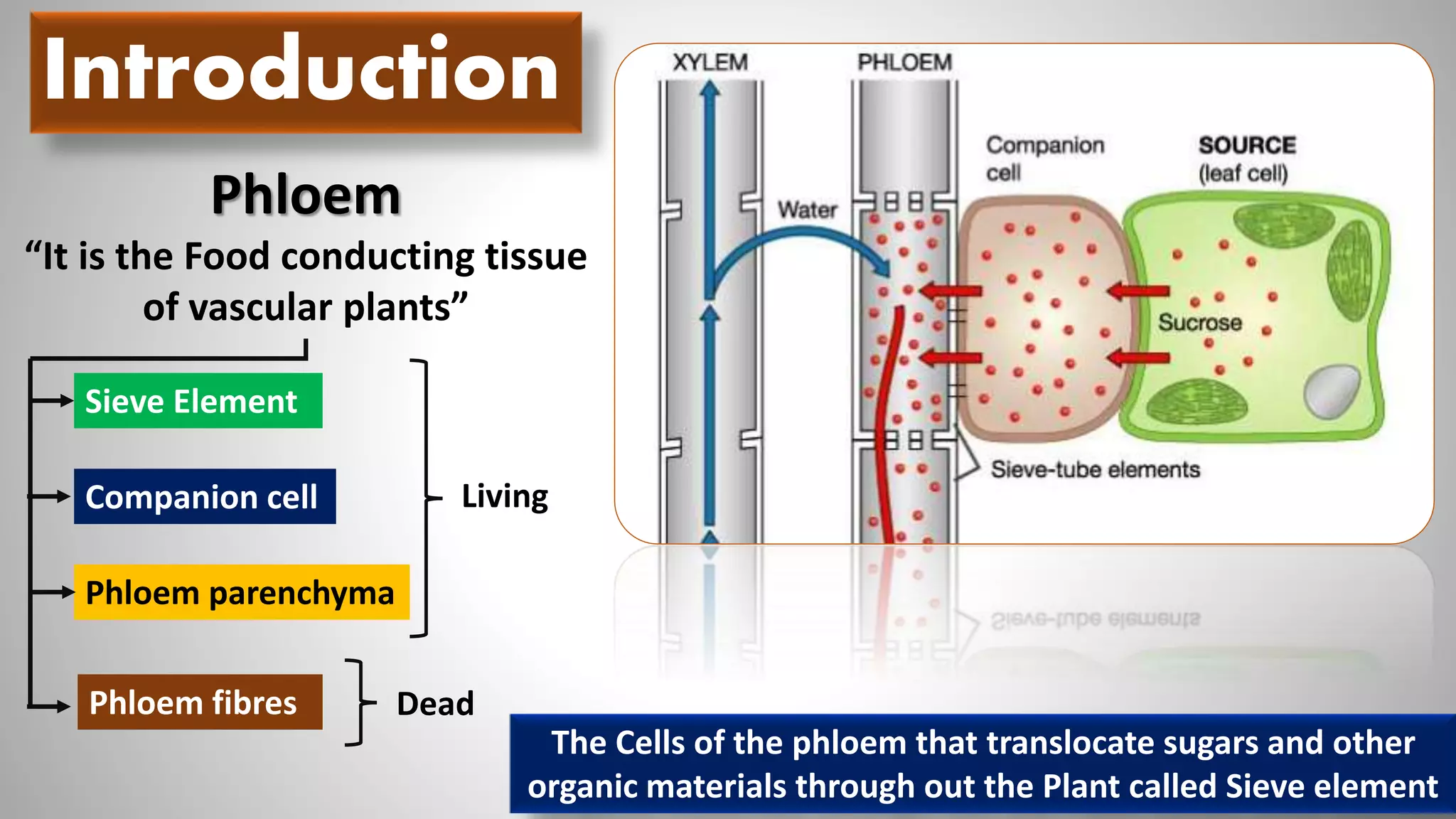
Phloem
“It is the Food conducting tissue
of vascular plants”
Sieve Element
Companion cell
Phloem parenchyma
Phloem fibres
Living
Dead
The Cells of the phloem that translocate sugars and other
organic materials through out the Plant called Sieve element
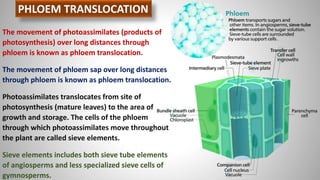
PHLOEM TRANSLOCATION
The movement of photoassimilates (products of
photosynthesis) over long distances through
phloem is known as phloem translocation.
The movement of phloem sap over long distances
through phloem is known as phloem translocation.
Photoassimilates translocates from site of
photosynthesis (mature leaves) to the area of
growth and storage. The cells of the phloem
through which photoassimilates move throughout
the plant are called sieve elements.
Sieve elements includes both sieve tube elements
of angiosperms and less specialized sieve cells of
gymnosperms.
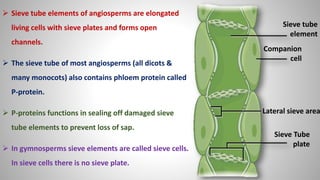
Sieve tube
element
Companion
cell
Lateral sieve area
Sieve Tube
plate
 Sieve tube elements of angiosperms are elongated
living cells with sieve plates and forms open
channels.
 The sieve tube of most angiosperms (all dicots &
many monocots) also contains phloem protein called
P-protein.
 P-proteins functions in sealing off damaged sieve
tube elements to prevent loss of sap.
 In gymnosperms sieve elements are called sieve cells.
In sieve cells there is no sieve plate.
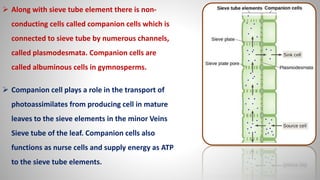
 Along with sieve tube element there is non-
conducting cells called companion cells which is
connected to sieve tube by numerous channels,
called plasmodesmata. Companion cells are
called albuminous cells in gymnosperms.
 Companion cell plays a role in the transport of
photoassimilates from producing cell in mature
leaves to the sieve elements in the minor Veins
Sieve tube of the leaf. Companion cells also
functions as nurse cells and supply energy as ATP
to the sieve tube elements.
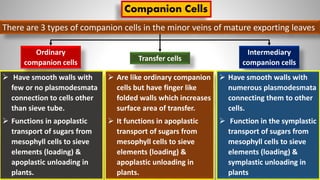
Companion Cells
There are 3 types of companion cells in the minor veins of mature exporting leaves
 Have smooth walls with
few or no plasmodesmata
connection to cells other
than sieve tube.
 Functions in apoplastic
transport of sugars from
mesophyll cells to sieve
elements (loading) &
apoplastic unloading in
plants.
Ordinary
companion cells
Transfer cells
Intermediary
companion cells
 Are like ordinary companion
cells but have finger like
folded walls which increases
surface area of transfer.
 It functions in apoplastic
transport of sugars from
mesophyll cells to sieve
elements (loading) &
apoplastic unloading in
plants.
 Have smooth walls with
numerous plasmodesmata
connecting them to other
cells.
 Function in the symplastic
transport of sugars from
mesophyll cells to sieve
elements (loading) &
symplastic unloading in
plants
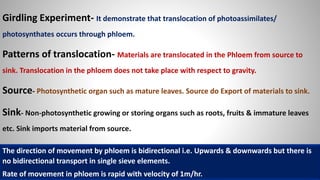
Girdling Experiment- It demonstrate that translocation of photoassimilates/
photosynthates occurs through phloem.
Patterns of translocation- Materials are translocated in the Phloem from source to
sink. Translocation in the phloem does not take place with respect to gravity.
Source- Photosynthetic organ such as mature leaves. Source do Export of materials to sink.
Sink- Non-photosynthetic growing or storing organs such as roots, fruits & immature leaves
etc. Sink imports material from source.
The direction of movement by phloem is bidirectional i.e. Upwards & downwards but there is
no bidirectional transport in single sieve elements.
Rate of movement in phloem is rapid with velocity of 1m/hr.
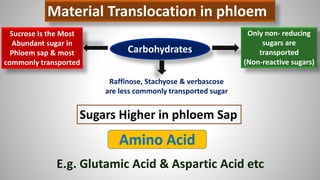
Material Translocation in phloem
Carbohydrates
Sucrose Is the Most
Abundant sugar in
Phloem sap & most
commonly transported
Only non- reducing
sugars are
transported
(Non-reactive sugars)
Raffinose, Stachyose & verbascose
are less commonly transported sugar
Sugars Higher in phloem Sap
Amino Acid
E.g. Glutamic Acid & Aspartic Acid etc
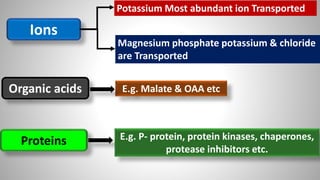
Ions
Organic acids
Proteins
Potassium Most abundant ion Transported
Magnesium phosphate potassium & chloride
are Transported
E.g. Malate & OAA etc
E.g. P- protein, protein kinases, chaperones,
protease inhibitors etc.
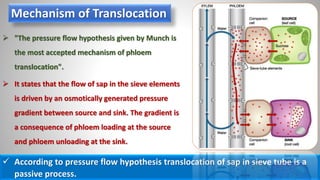
Mechanism of Translocation
 "The pressure flow hypothesis given by Munch is
the most accepted mechanism of phloem
translocation".
 It states that the flow of sap in the sieve elements
is driven by an osmotically generated pressure
gradient between source and sink. The gradient is
a consequence of phloem loading at the source
and phloem unloading at the sink.
 According to pressure flow hypothesis translocation of sap in sieve tube is a
passive process.
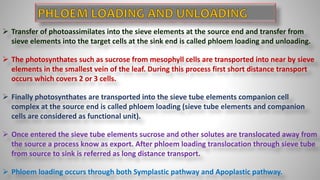
 Transfer of photoassimilates into the sieve elements at the source end and transfer from
sieve elements into the target cells at the sink end is called phloem loading and unloading.
 The photosynthates such as sucrose from mesophyll cells are transported into near by sieve
elements in the smallest vein of the leaf. During this process first short distance transport
occurs which covers 2 or 3 cells.
 Finally photosynthates are transported into the sieve tube elements companion cell
complex at the source end is called phloem loading (sieve tube elements and companion
cells are considered as functional unit).
 Once entered the sieve tube elements sucrose and other solutes are translocated away from
the source a process know as export. After phloem loading translocation through sieve tube
from source to sink is referred as long distance transport.
 Phloem loading occurs through both Symplastic pathway and Apoplastic pathway.
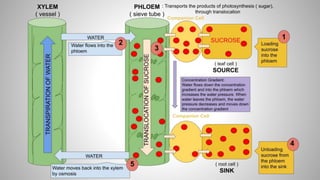
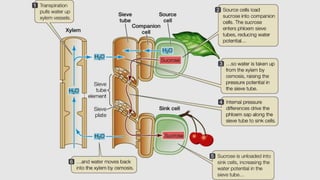
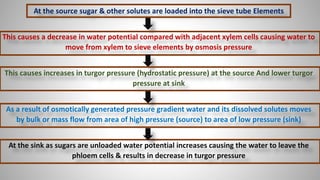
At the source sugar & other solutes are loaded into the sieve tube Elements
This causes a decrease in water potential compared with adjacent xylem cells causing water to
move from xylem to sieve elements by osmosis pressure
This causes increases in turgor pressure (hydrostatic pressure) at the source And lower turgor
pressure at sink
As a result of osmotically generated pressure gradient water and its dissolved solutes moves
by bulk or mass flow from area of high pressure (source) to area of low pressure (sink)
At the sink as sugars are unloaded water potential increases causing the water to leave the
phloem cells & results in decrease in turgor pressure
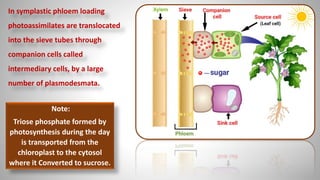
Note:
Triose phosphate formed by
photosynthesis during the day
is transported from the
chloroplast to the cytosol
where it Converted to sucrose.
In symplastic phloem loading
photoassimilates are translocated
into the sieve tubes through
companion cells called
intermediary cells, by a large
number of plasmodesmata.
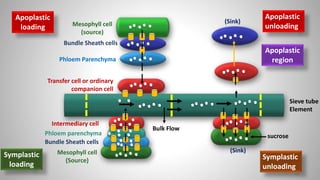
Intermediary cell
Phloem parenchyma
Bundle Sheath cells
Mesophyll cell
(Source)
Bulk Flow
sucrose
Transfer cell or ordinary
companion cell
Phloem Parenchyma
Bundle Sheath cells
Mesophyll cell
(source)
Symplastic
loading
Symplastic
unloading
Apoplastic
loading
(Sink)
(Sink)
Apoplastic
unloading
Apoplastic
region
Sieve tube
Element
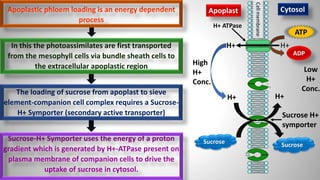
Apoplastic phloem loading is an energy dependent
process
In this the photoassimilates are first transported
from the mesophyll cells via bundle sheath cells to
the extracellular apoplastic region
The loading of sucrose from apoplast to sieve
element-companion cell complex requires a Sucrose-
H+ Symporter (secondary active transporter)
Sucrose-H+ Symporter uses the energy of a proton
gradient which is generated by H+-ATPase present on
plasma membrane of companion cells to drive the
uptake of sucrose in cytosol.
ATP
ADP
H+
H+
H+
H+
Sucrose Sucrose
Sucrose H+
symporter
High
H+
Conc.
H+ ATPase
Apoplast Cytosol
Low
H+
Conc.
Transfer of Photoassimilates from sieve elements into the target cells at the sink end is called
phloem unloading
After unloading the photoassimilates are transported to cell in the sink by means of short
distance transport pathway called post-sieve elements transport
Phloem unloading occurs through both Symplastic & Apoplastic pathways
In Symplastic phloem unloading the photoassimilates reach the cells of the sink directly from
the sieve elements-companion cell complex via plasmodesmata
In Apoplastic unloading the photoassimilates are first transported from the sieve tube-
Companion cell complex to the extracellular apoplastic region and are taken up into the cells of
the sink organs. Unloading through apoplastic pathway is an active process and requires energy
In the final step sugars are stored or metabolised in the sink cells
 Growing vegetative sinks e.g. young leaves & roots usually undergo symplastic
phloem unloading
 In plants with both Symplastic & Apoplastic pathways if sucrose concentration
is low the loading & unloading of sucrose is energy dependent and carrier
mediated (apoplastic) but if the concentration of sucrose is high the pathway
is symplastic via. Plasmodesmata
 Apoplastic phloem loading happens between cells with no plasmodesmata
connections
 Sucrose is a disaccharide made up of glucose & fructose linked by 1a-28
glycosidic bond
 Carbohydrates stored as starch exits the chloroplast at night in the form of
maltose and is converted to sucrose in cytosol and transported by phloem to
whole plant.
Phloem loading ( Food Transported)

Phloem loading ( Food Transported)

  • 1.
    Introduction Phloem “It is theFood conducting tissue of vascular plants” Sieve Element Companion cell Phloem parenchyma Phloem fibres Living Dead The Cells of the phloem that translocate sugars and other organic materials through out the Plant called Sieve element
  • 2.
    PHLOEM TRANSLOCATION The movementof photoassimilates (products of photosynthesis) over long distances through phloem is known as phloem translocation. The movement of phloem sap over long distances through phloem is known as phloem translocation. Photoassimilates translocates from site of photosynthesis (mature leaves) to the area of growth and storage. The cells of the phloem through which photoassimilates move throughout the plant are called sieve elements. Sieve elements includes both sieve tube elements of angiosperms and less specialized sieve cells of gymnosperms.
  • 3.
    Sieve tube element Companion cell Lateral sievearea Sieve Tube plate  Sieve tube elements of angiosperms are elongated living cells with sieve plates and forms open channels.  The sieve tube of most angiosperms (all dicots & many monocots) also contains phloem protein called P-protein.  P-proteins functions in sealing off damaged sieve tube elements to prevent loss of sap.  In gymnosperms sieve elements are called sieve cells. In sieve cells there is no sieve plate.
  • 4.
     Along withsieve tube element there is non- conducting cells called companion cells which is connected to sieve tube by numerous channels, called plasmodesmata. Companion cells are called albuminous cells in gymnosperms.  Companion cell plays a role in the transport of photoassimilates from producing cell in mature leaves to the sieve elements in the minor Veins Sieve tube of the leaf. Companion cells also functions as nurse cells and supply energy as ATP to the sieve tube elements.
  • 5.
    Companion Cells There are3 types of companion cells in the minor veins of mature exporting leaves  Have smooth walls with few or no plasmodesmata connection to cells other than sieve tube.  Functions in apoplastic transport of sugars from mesophyll cells to sieve elements (loading) & apoplastic unloading in plants. Ordinary companion cells Transfer cells Intermediary companion cells  Are like ordinary companion cells but have finger like folded walls which increases surface area of transfer.  It functions in apoplastic transport of sugars from mesophyll cells to sieve elements (loading) & apoplastic unloading in plants.  Have smooth walls with numerous plasmodesmata connecting them to other cells.  Function in the symplastic transport of sugars from mesophyll cells to sieve elements (loading) & symplastic unloading in plants
  • 6.
    Girdling Experiment- Itdemonstrate that translocation of photoassimilates/ photosynthates occurs through phloem. Patterns of translocation- Materials are translocated in the Phloem from source to sink. Translocation in the phloem does not take place with respect to gravity. Source- Photosynthetic organ such as mature leaves. Source do Export of materials to sink. Sink- Non-photosynthetic growing or storing organs such as roots, fruits & immature leaves etc. Sink imports material from source. The direction of movement by phloem is bidirectional i.e. Upwards & downwards but there is no bidirectional transport in single sieve elements. Rate of movement in phloem is rapid with velocity of 1m/hr.
  • 7.
    Material Translocation inphloem Carbohydrates Sucrose Is the Most Abundant sugar in Phloem sap & most commonly transported Only non- reducing sugars are transported (Non-reactive sugars) Raffinose, Stachyose & verbascose are less commonly transported sugar Sugars Higher in phloem Sap Amino Acid E.g. Glutamic Acid & Aspartic Acid etc
  • 8.
    Ions Organic acids Proteins Potassium Mostabundant ion Transported Magnesium phosphate potassium & chloride are Transported E.g. Malate & OAA etc E.g. P- protein, protein kinases, chaperones, protease inhibitors etc.
  • 9.
    Mechanism of Translocation "The pressure flow hypothesis given by Munch is the most accepted mechanism of phloem translocation".  It states that the flow of sap in the sieve elements is driven by an osmotically generated pressure gradient between source and sink. The gradient is a consequence of phloem loading at the source and phloem unloading at the sink.  According to pressure flow hypothesis translocation of sap in sieve tube is a passive process.
  • 12.
     Transfer ofphotoassimilates into the sieve elements at the source end and transfer from sieve elements into the target cells at the sink end is called phloem loading and unloading.  The photosynthates such as sucrose from mesophyll cells are transported into near by sieve elements in the smallest vein of the leaf. During this process first short distance transport occurs which covers 2 or 3 cells.  Finally photosynthates are transported into the sieve tube elements companion cell complex at the source end is called phloem loading (sieve tube elements and companion cells are considered as functional unit).  Once entered the sieve tube elements sucrose and other solutes are translocated away from the source a process know as export. After phloem loading translocation through sieve tube from source to sink is referred as long distance transport.  Phloem loading occurs through both Symplastic pathway and Apoplastic pathway.
  • 13.
    At the sourcesugar & other solutes are loaded into the sieve tube Elements This causes a decrease in water potential compared with adjacent xylem cells causing water to move from xylem to sieve elements by osmosis pressure This causes increases in turgor pressure (hydrostatic pressure) at the source And lower turgor pressure at sink As a result of osmotically generated pressure gradient water and its dissolved solutes moves by bulk or mass flow from area of high pressure (source) to area of low pressure (sink) At the sink as sugars are unloaded water potential increases causing the water to leave the phloem cells & results in decrease in turgor pressure
  • 14.
    Note: Triose phosphate formedby photosynthesis during the day is transported from the chloroplast to the cytosol where it Converted to sucrose. In symplastic phloem loading photoassimilates are translocated into the sieve tubes through companion cells called intermediary cells, by a large number of plasmodesmata.
  • 15.
    Intermediary cell Phloem parenchyma BundleSheath cells Mesophyll cell (Source) Bulk Flow sucrose Transfer cell or ordinary companion cell Phloem Parenchyma Bundle Sheath cells Mesophyll cell (source) Symplastic loading Symplastic unloading Apoplastic loading (Sink) (Sink) Apoplastic unloading Apoplastic region Sieve tube Element
  • 16.
    Apoplastic phloem loadingis an energy dependent process In this the photoassimilates are first transported from the mesophyll cells via bundle sheath cells to the extracellular apoplastic region The loading of sucrose from apoplast to sieve element-companion cell complex requires a Sucrose- H+ Symporter (secondary active transporter) Sucrose-H+ Symporter uses the energy of a proton gradient which is generated by H+-ATPase present on plasma membrane of companion cells to drive the uptake of sucrose in cytosol. ATP ADP H+ H+ H+ H+ Sucrose Sucrose Sucrose H+ symporter High H+ Conc. H+ ATPase Apoplast Cytosol Low H+ Conc.
  • 17.
    Transfer of Photoassimilatesfrom sieve elements into the target cells at the sink end is called phloem unloading After unloading the photoassimilates are transported to cell in the sink by means of short distance transport pathway called post-sieve elements transport Phloem unloading occurs through both Symplastic & Apoplastic pathways In Symplastic phloem unloading the photoassimilates reach the cells of the sink directly from the sieve elements-companion cell complex via plasmodesmata In Apoplastic unloading the photoassimilates are first transported from the sieve tube- Companion cell complex to the extracellular apoplastic region and are taken up into the cells of the sink organs. Unloading through apoplastic pathway is an active process and requires energy In the final step sugars are stored or metabolised in the sink cells
  • 18.
     Growing vegetativesinks e.g. young leaves & roots usually undergo symplastic phloem unloading  In plants with both Symplastic & Apoplastic pathways if sucrose concentration is low the loading & unloading of sucrose is energy dependent and carrier mediated (apoplastic) but if the concentration of sucrose is high the pathway is symplastic via. Plasmodesmata  Apoplastic phloem loading happens between cells with no plasmodesmata connections  Sucrose is a disaccharide made up of glucose & fructose linked by 1a-28 glycosidic bond  Carbohydrates stored as starch exits the chloroplast at night in the form of maltose and is converted to sucrose in cytosol and transported by phloem to whole plant.