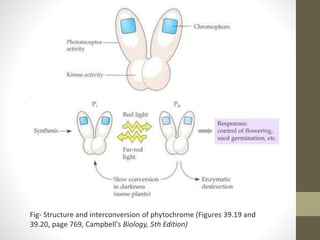
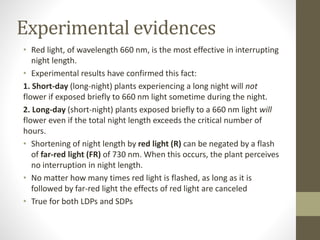
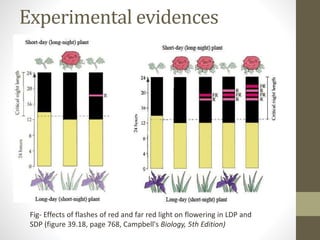
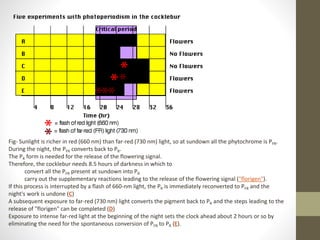
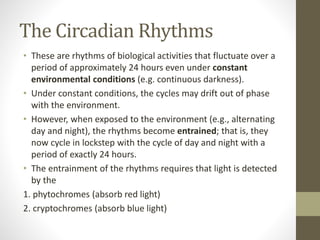
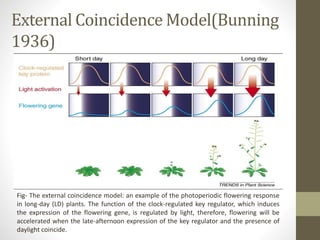
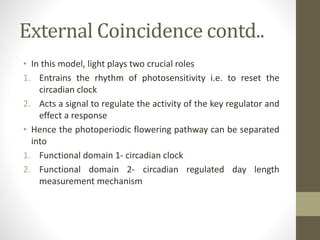
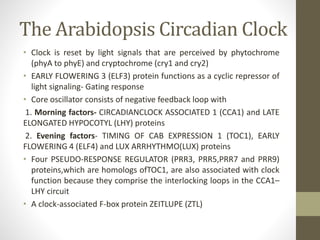
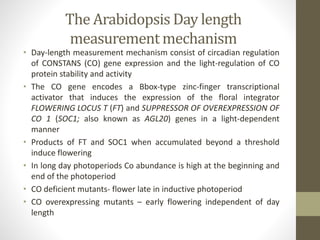
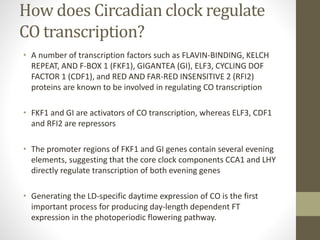
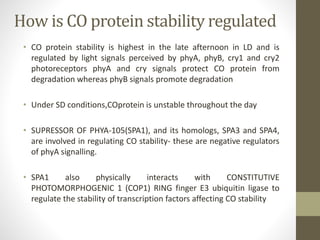
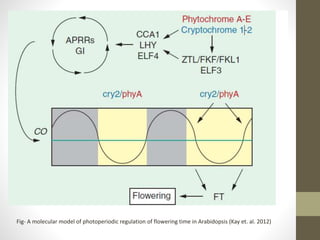
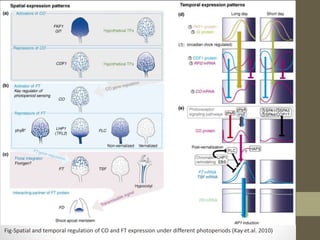
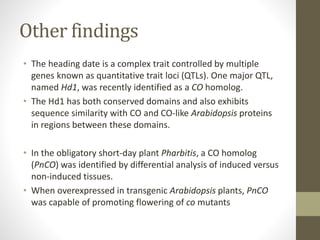
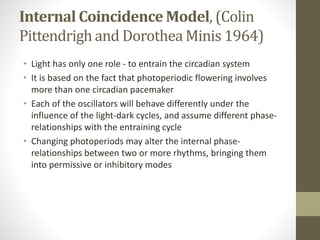
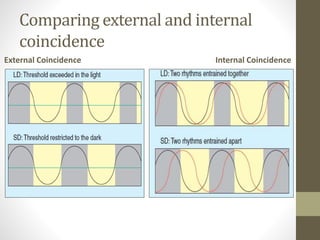
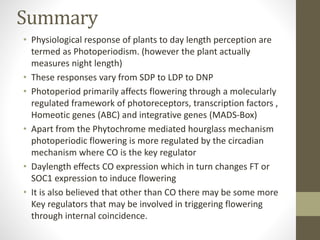
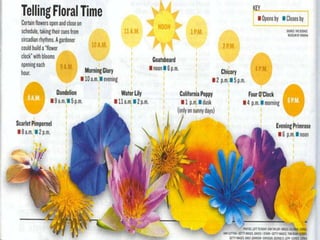
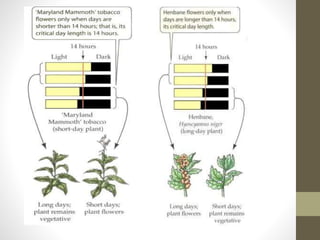
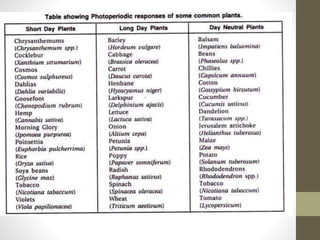
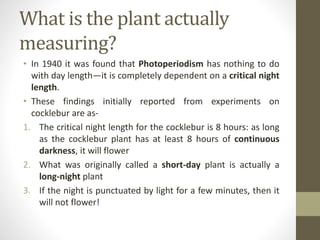
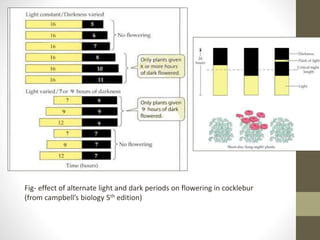
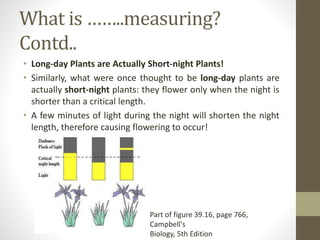
Photoperiodism refers to plant responses to day length and plays a key role in flowering. Garner and Allard discovered that tobacco plants were either short-day or long-day plants, flowering only under certain critical day lengths. It was later found that plants actually respond to night length rather than day length. The phytochrome pigment system, involving conversion between PR and PFR forms via red and far-red light absorption, allows plants to measure night length. The circadian clock model proposes that an internal timing mechanism is entrained by light to regulate flowering.

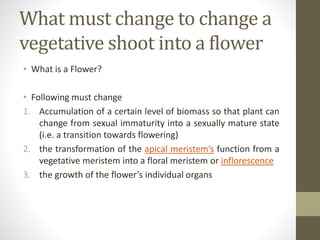
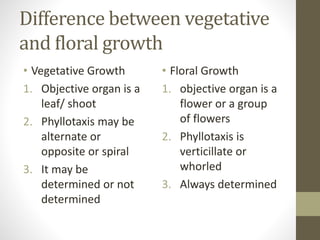
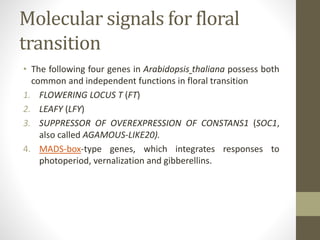
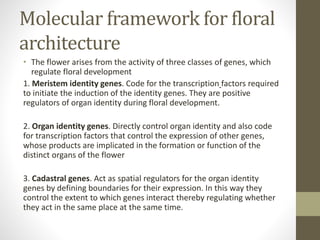
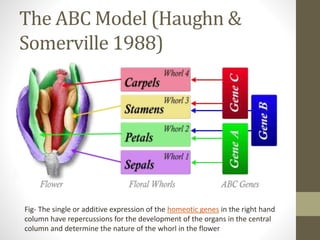
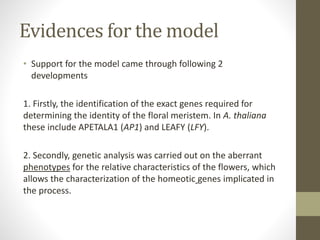
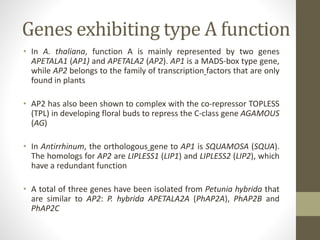
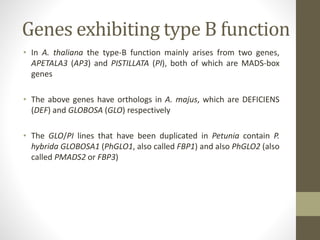
![MADS Box
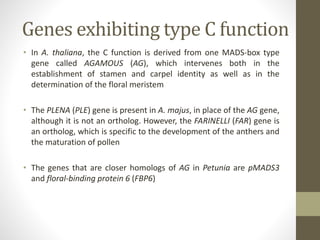
• The MADS box is a conserved sequence motif. The genes which
contain this motif are called the MADS-box gene family
• The length of the MADS-box reported by various researchers varies
somewhat, but typical lengths are in the range of 168 to 180 base
pairs (how many amino acids are there in MADS domain then?)
• The MADS box encodes the DNA-binding MADS domain.
• MADS-box gene family got its name later as an acronym referring to
the four founding members
1. MCM1 from the budding yeast, Saccharomyces cerevisiae,
2. AGAMOUS from the thale cress Arabidopsis thaliana,
3. DEFICIENS from the snapdragon Antirrhinum majus,[10]
4. SRF from the human Homo sapiens](https://image.slidesharecdn.com/photoperiodism-170524144059-240105151623-711109a2/85/photoperiodism-170524144059-It-s-defination-23-320.jpg)