A New Approach to Promoting Active
Learning in the Classroom
Richard Dettling MSHRM
Program Manager, School of Business
University of Phoenix, South Florida Campus
Alexandra Escobar MAED
College Chair, College of Education
University of Phoenix, South Florida Campus
Session Objectives
1. Discuss the importance of active learning in the K-12 classroom
2. Explore research on the effectiveness of active learning
3. Explain the Soft Skills Gap
4. Describe active learning techniques teachers can use in the classroom
5. Explain a new approach to promoting active learning in the classroom
© 2010 University of Phoenix, Inc. All rights reserved.”
What is Active Learning?
• Student-centered, not instructor centered. Students’ learning needs
drive instruction and the activity
• Multi-directional learning experience
• Learning occurs teacher-to-student, student-to-teacher, and student-to-student
• Involves activity-based learning experiences, can be whole group,
small group, trios, pairs, individuals
• May take many forms talking, writing, reading, discussing, debating,
acting, role-playing, journaling, conferring, interviewing, building,
creating...
Importance of Active Learning in the K-12
Classroom
© 2010 University of Phoenix, Inc. All rights reserved.”
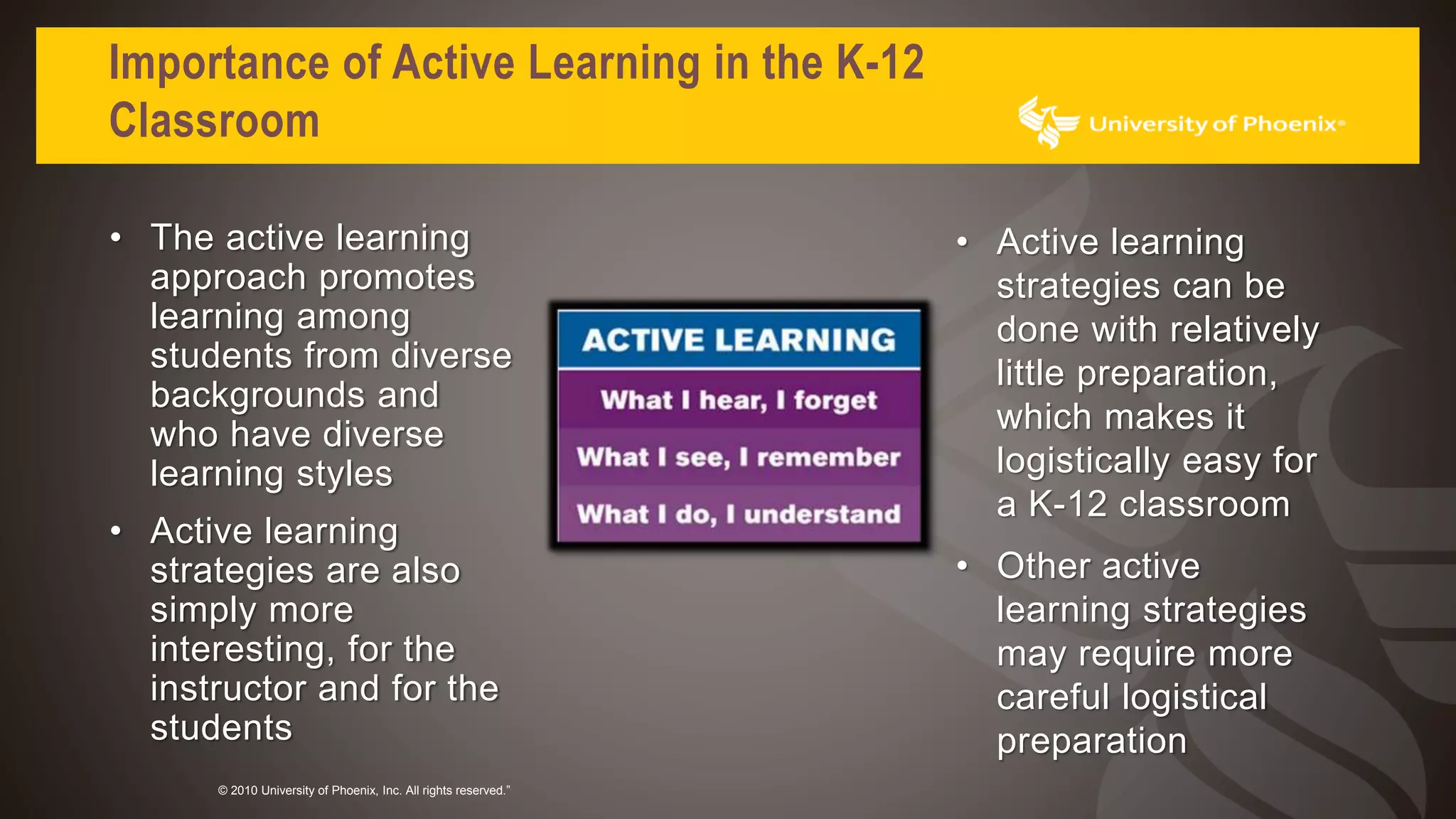
• The active learning
approach promotes
learning among
students from diverse
backgrounds and
who have diverse
learning styles
• Active learning
strategies are also
simply more
interesting, for the
instructor and for the
students
• Active learning
strategies can be
done with relatively
little preparation,
which makes it
logistically easy for
a K-12 classroom
• Other active
learning strategies
may require more
careful logistical
preparation
What does research say about the effectiveness of
active learning?
• Research shows that when students engage with each other
in learning tasks, they remember material better and they
figure out how to apply and extend their new knowledge
more effectively
(UC Berkeley, 2015)
• “For new standards to be a healthy challenge and not a
threatening one for students, teachers must intentionally
scaffold lessons using student-centric strategies with more
frequency and in greater depth. It’s clear that the
development of such skills requires a new way of thinking
about the traditional teacher-centric classroom.”
(Marazano & Toth, 2014, p. 10)
© 2010 University of Phoenix, Inc. All rights reserved.”
What does the research say about the
effectiveness of active learning?
© 2010 University of Phoenix, Inc. All rights reserved.”
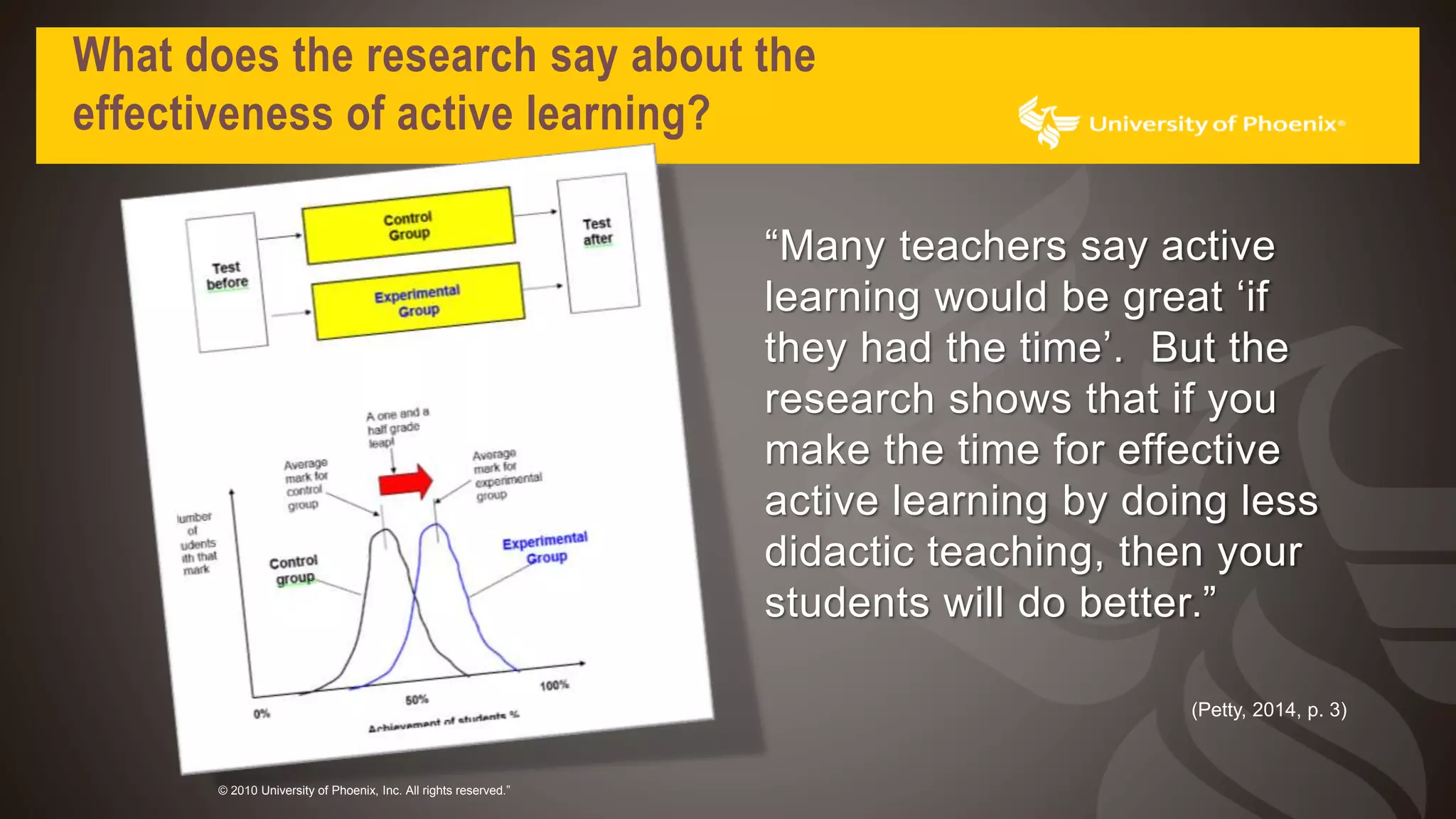
“Many teachers say active
learning would be great ‘if
they had the time’. But the
research shows that if you
make the time for effective
active learning by doing less
didactic teaching, then your
students will do better.”
(Petty, 2014, p. 3)
© 2010 University of Phoenix, Inc. All rights reserved.”
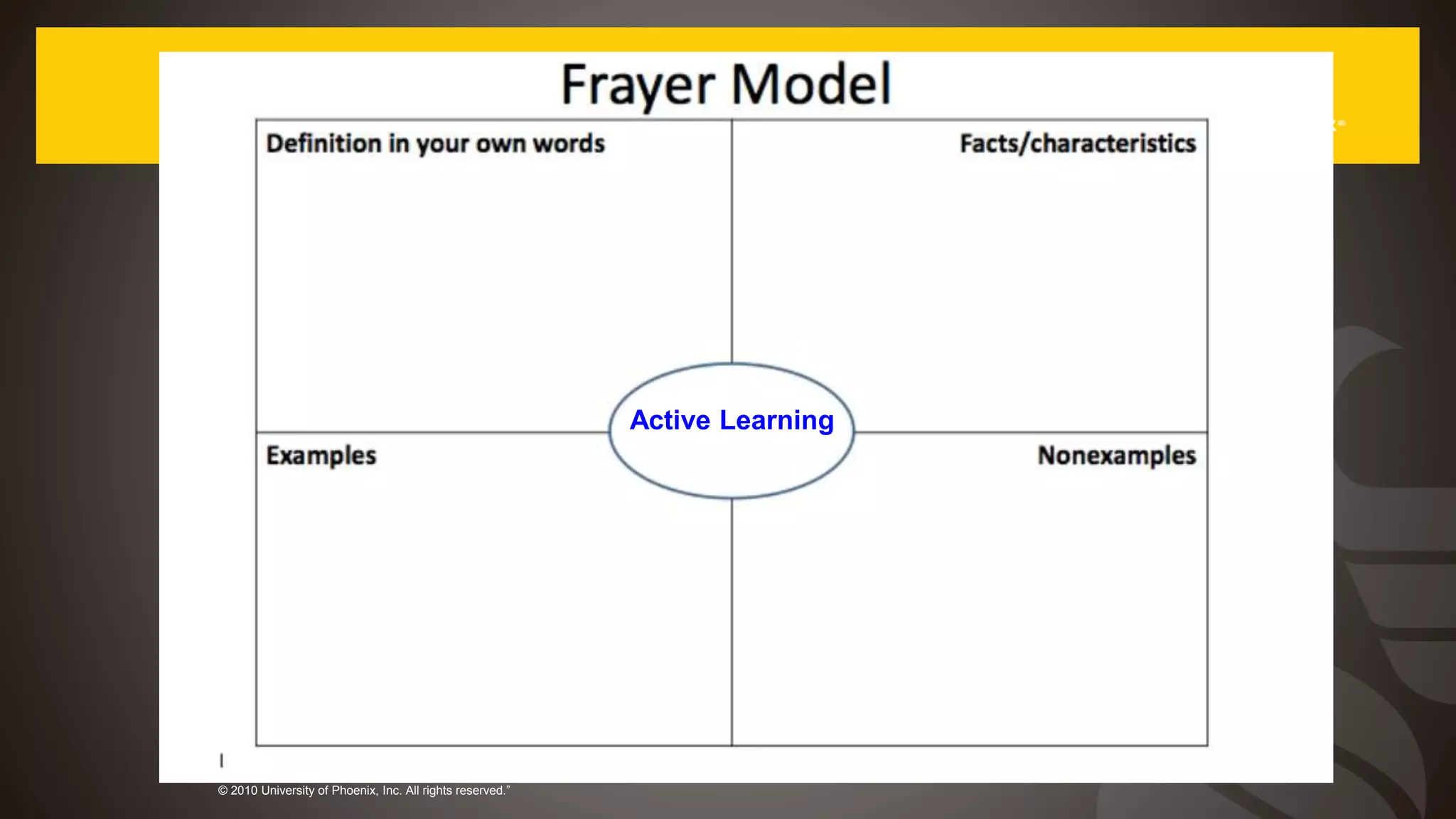
Active Learning
Soft Skills Gap
© 2010 University of Phoenix, Inc. All rights reserved.”
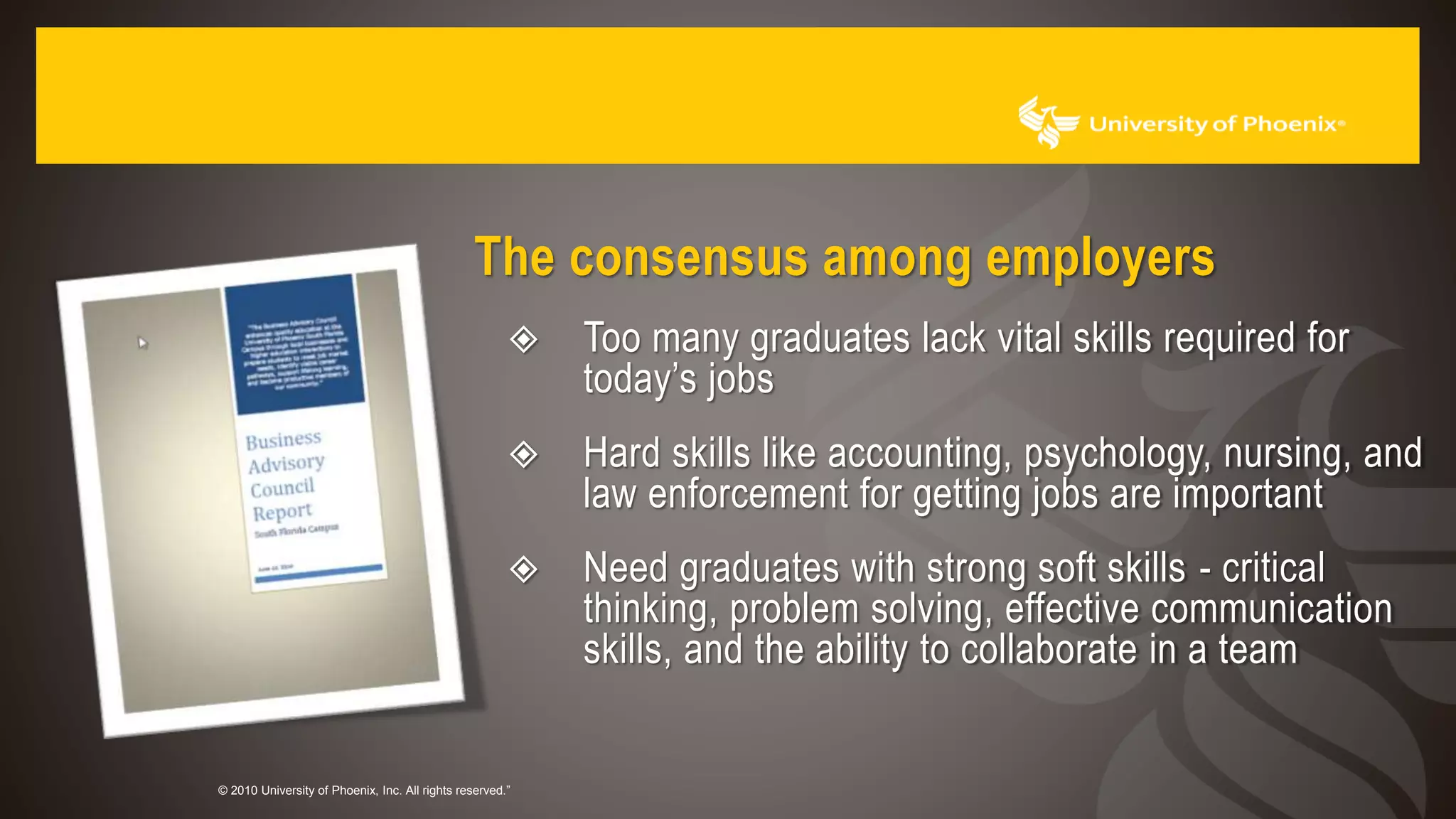
The consensus among employers
 Too many graduates lack vital skills required for
today’s jobs
 Hard skills like accounting, psychology, nursing, and
law enforcement for getting jobs are important
 Need graduates with strong soft skills - critical
thinking, problem solving, effective communication
skills, and the ability to collaborate in a team
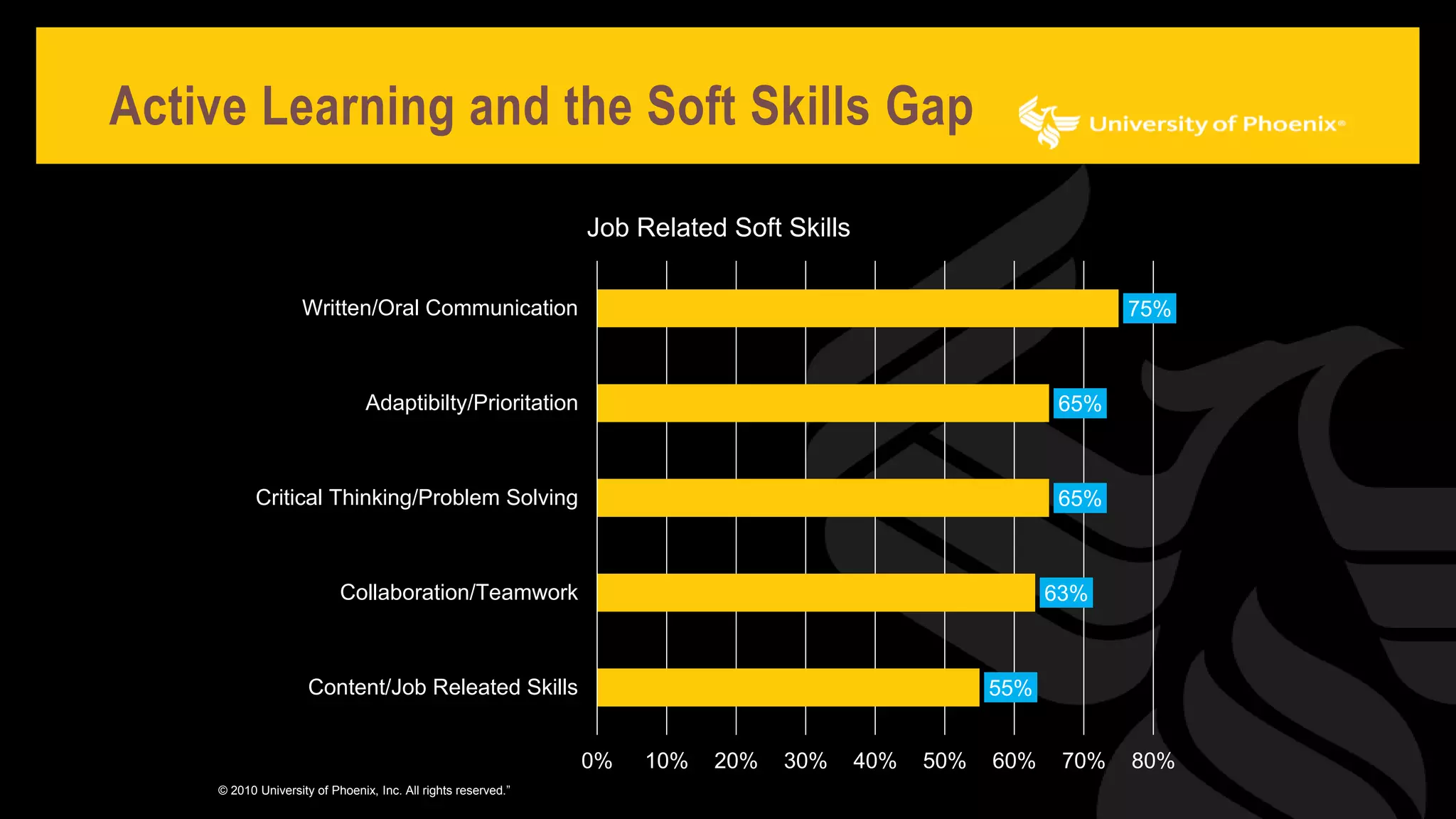
Active Learning and the Soft Skills Gap
55%
63%
65%
65%
75%
0% 10% 20% 30% 40% 50% 60% 70% 80%
Content/Job Releated Skills
Collaboration/Teamwork
Critical Thinking/Problem Solving
Adaptibilty/Prioritation
Written/Oral Communication
Job Related Soft Skills
© 2010 University of Phoenix, Inc. All rights reserved.”
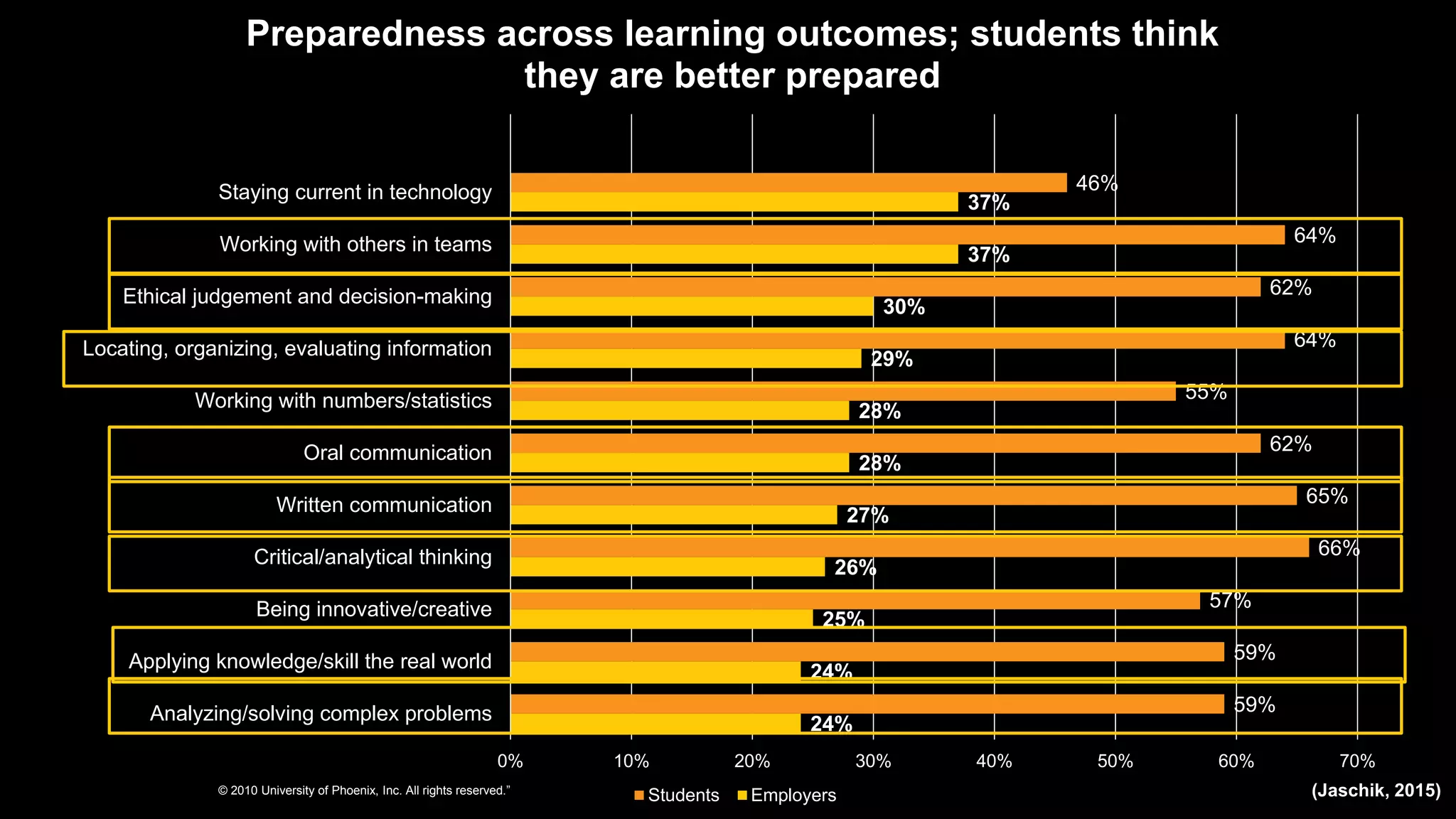
24%
24%
25%
26%
27%
28%
28%
29%
30%
37%
37%
59%
59%
57%
66%
65%
62%
55%
64%
62%
64%
46%
0% 10% 20% 30% 40% 50% 60% 70%
Analyzing/solving complex problems
Applying knowledge/skill the real world
Being innovative/creative
Critical/analytical thinking
Written communication
Oral communication
Working with numbers/statistics
Locating, organizing, evaluating information
Ethical judgement and decision-making
Working with others in teams
Staying current in technology
Preparedness across learning outcomes; students think
they are better prepared
Students Employers© 2010 University of Phoenix, Inc. All rights reserved.” (Jaschik, 2015)
Soft Skills Gap
© 2010 University of Phoenix, Inc. All rights reserved.”
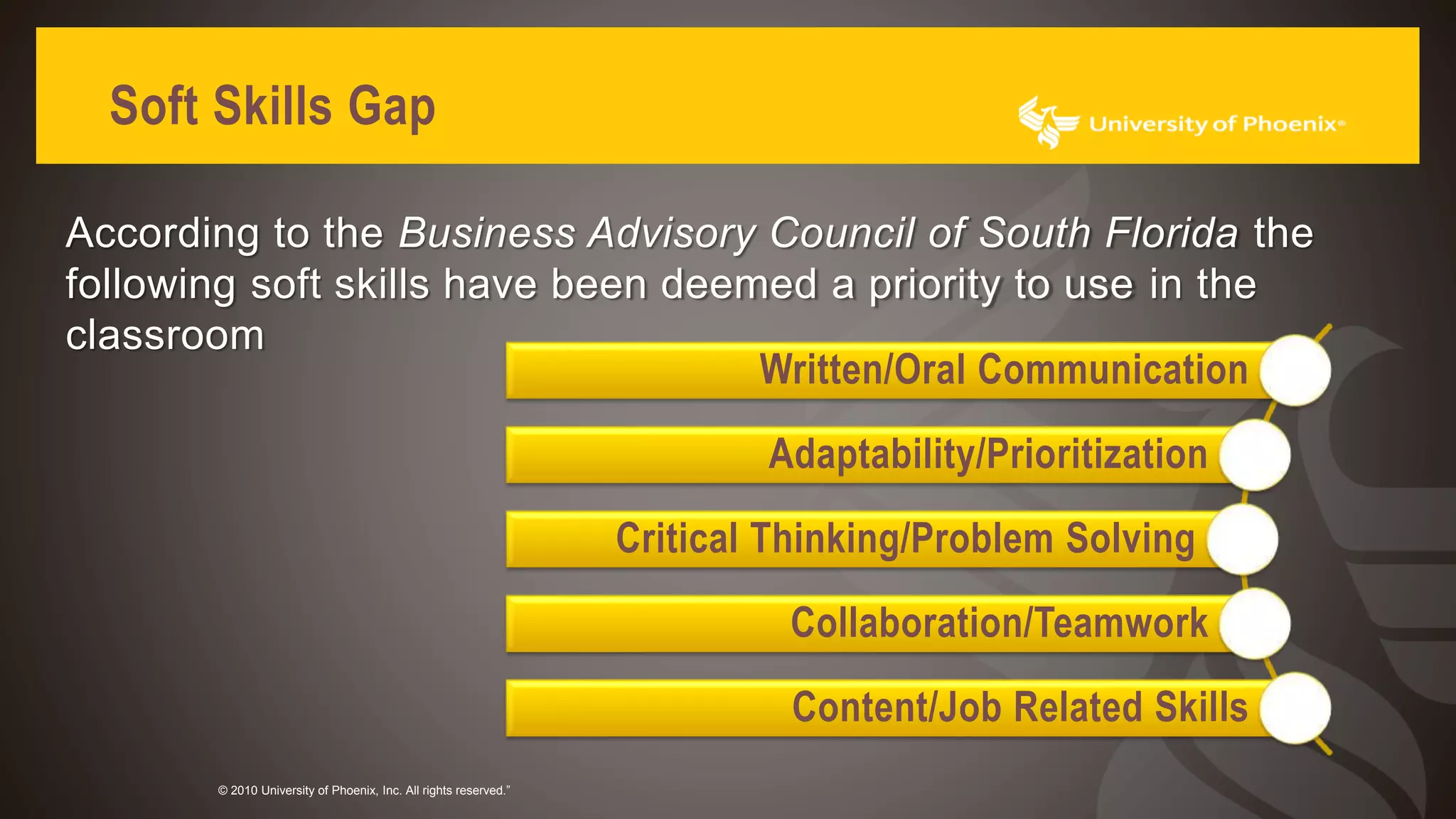
Written/Oral Communication
Adaptability/Prioritization
Critical Thinking/Problem Solving
Collaboration/Teamwork
Content/Job Related Skills
According to the Business Advisory Council of South Florida the
following soft skills have been deemed a priority to use in the
classroom
Active Learning Strategies
© 2010 University of Phoenix, Inc. All rights reserved.”
Active Learning Strategies
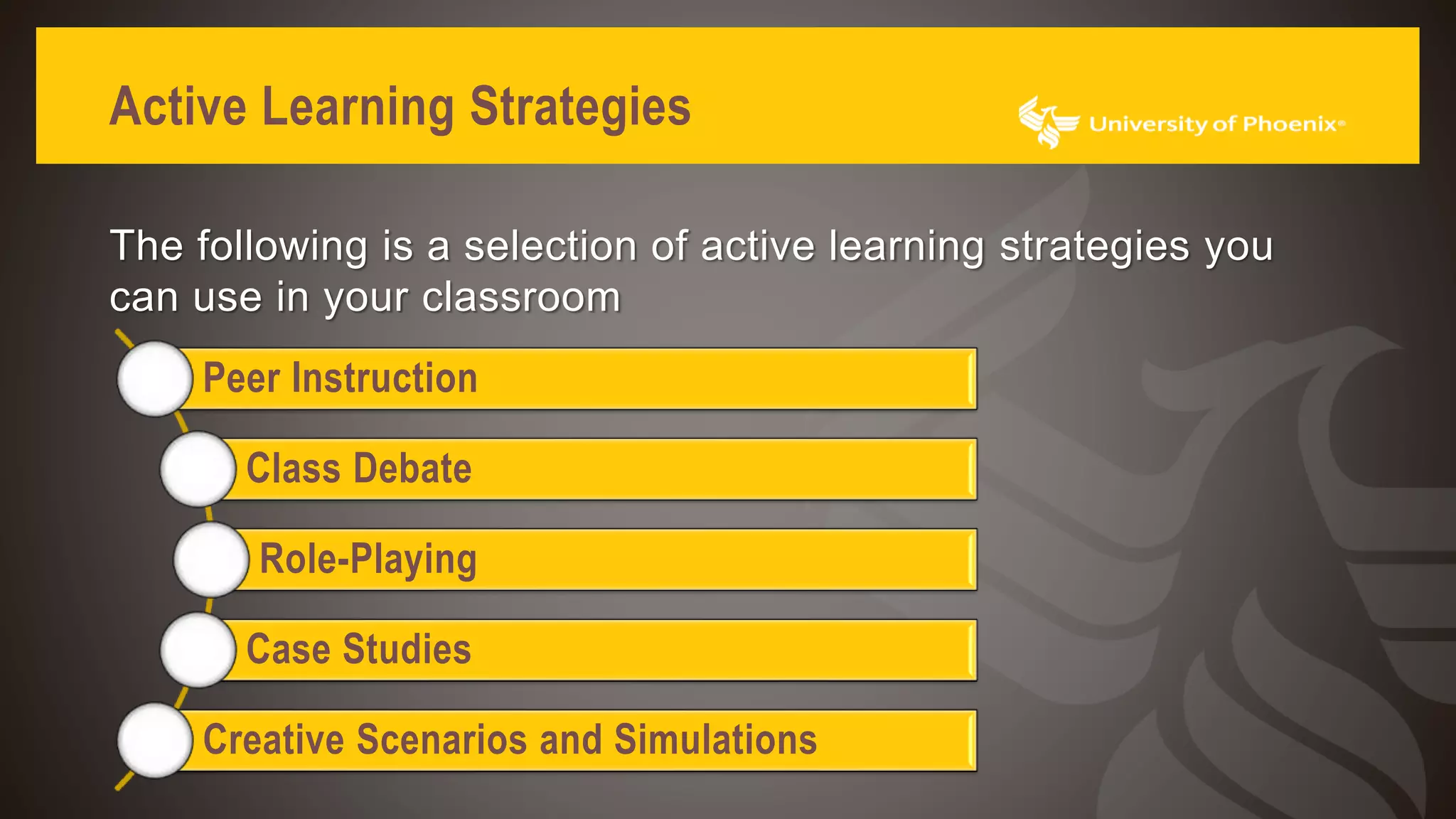
The following is a selection of active learning strategies you
can use in your classroom
Peer Instruction
Class Debate
Role-Playing
Case Studies
Creative Scenarios and Simulations
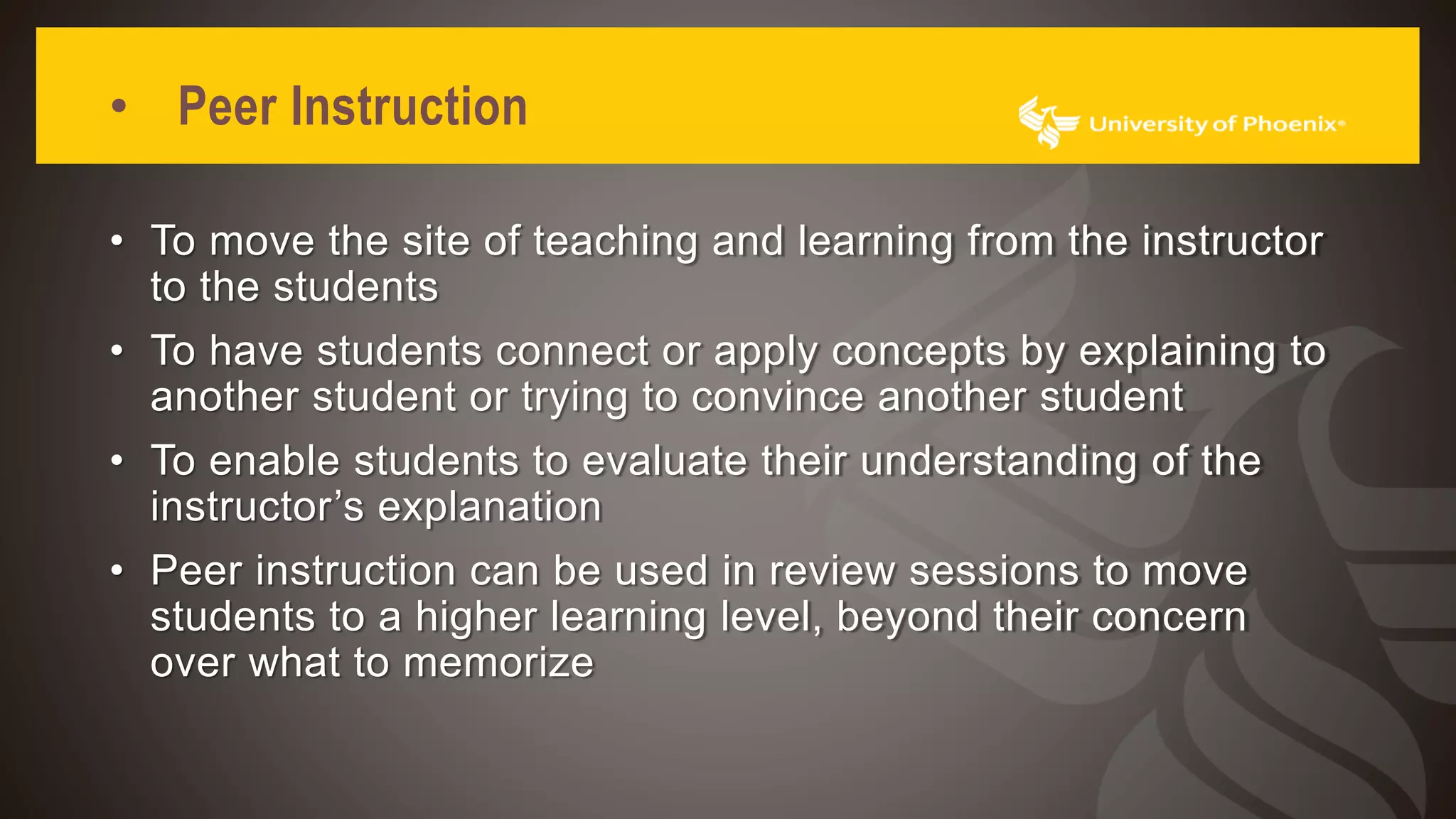
• Peer Instruction
• To move the site of teaching and learning from the instructor
to the students
• To have students connect or apply concepts by explaining to
another student or trying to convince another student
• To enable students to evaluate their understanding of the
instructor’s explanation
• Peer instruction can be used in review sessions to move
students to a higher learning level, beyond their concern
over what to memorize
• Class Debate
• To encourage students to organize their thoughts in a critical
or argumentative way that takes into account the complexity
of issues and the existence of alternative and opposing
views
• To increase students’ public speaking and presentation skills,
including the ability to think quickly on one’s feet
• Class debate can also be used to develop students’ research
skills and give them a chance to become experts on a
particular subject
• Role-Playing
• To increase student awareness of the interconnectedness of
knowledge and the subtle complexities of a situation
• To include affective learning as well as cognitive
understanding
• To expand personal experience by simulating a situation
• Role-playing can be used make learning more active
• Case Studies
• To facilitate intuitive and integrated understanding of
complex, interconnected issues
• To encourage students to integrate theory with practice
• Case studies can be used to enliven the material by making
it concrete and relating it to the lived world
• Creative Scenarios and Simulations
• To encourage students to extrapolate beyond the information
they receive in class
• To stimulate creative and original thinking by forcing students
to look at their knowledge from a new perspective
• To foster a greater awareness of the interdependence of
theories and facts
• Creative scenarios and simulations can also be used to
make students more active in their learning and to increase
their research skills
New Approach to Active Learning
© 2010 University of Phoenix, Inc. All rights reserved.”
Categories of Active Learning Strategies
1. Individual activities
2. Paired activities
3. Informal small groups
4. Cooperative student projects
Teachers can incorporate a variety of strategies and adapt as needed based
on the objectives of your lesson, the number of students, space, and time
considerations.
(University of Minnesota, 2015)
Planning an Active Learning Activity
• What are your objectives?
• Will you give students any time to reflect on their learning and action
plan to address the activity prior to starting?
• How will students be grouped?
• What time will the activity take place and how long will it take?
• Is the activity graded or non-graded? Will it be submitted?
• Will you call on volunteers?
• What preparation do students need to participate in the activity fully?
(University of Minnesota, 2015)
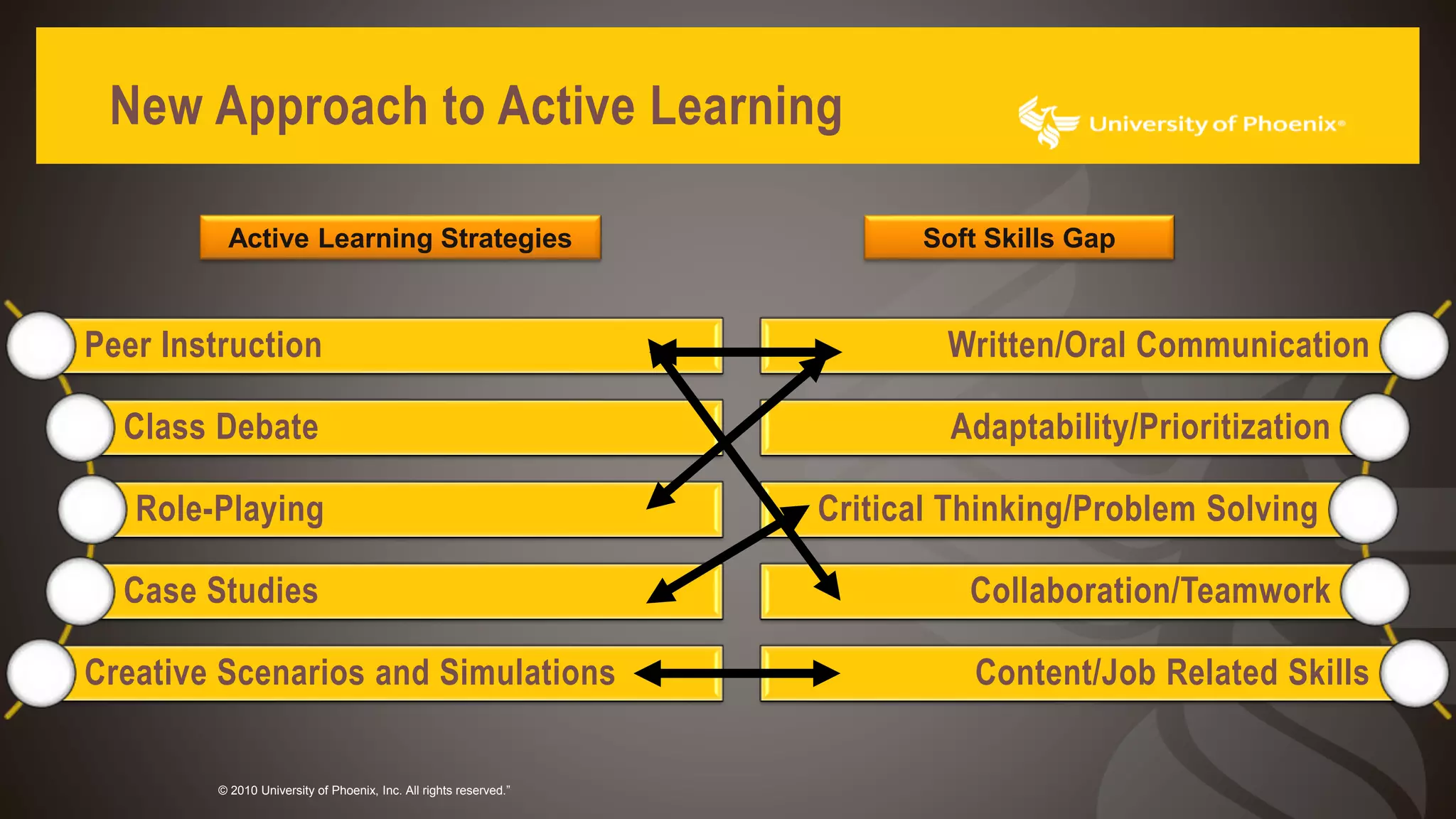
New Approach to Active Learning
© 2010 University of Phoenix, Inc. All rights reserved.”
Written/Oral Communication
Adaptability/Prioritization
Critical Thinking/Problem Solving
Collaboration/Teamwork
Content/Job Related Skills
Peer Instruction
Class Debate
Role-Playing
Case Studies
Creative Scenarios and Simulations
Active Learning Strategies Soft Skills Gap
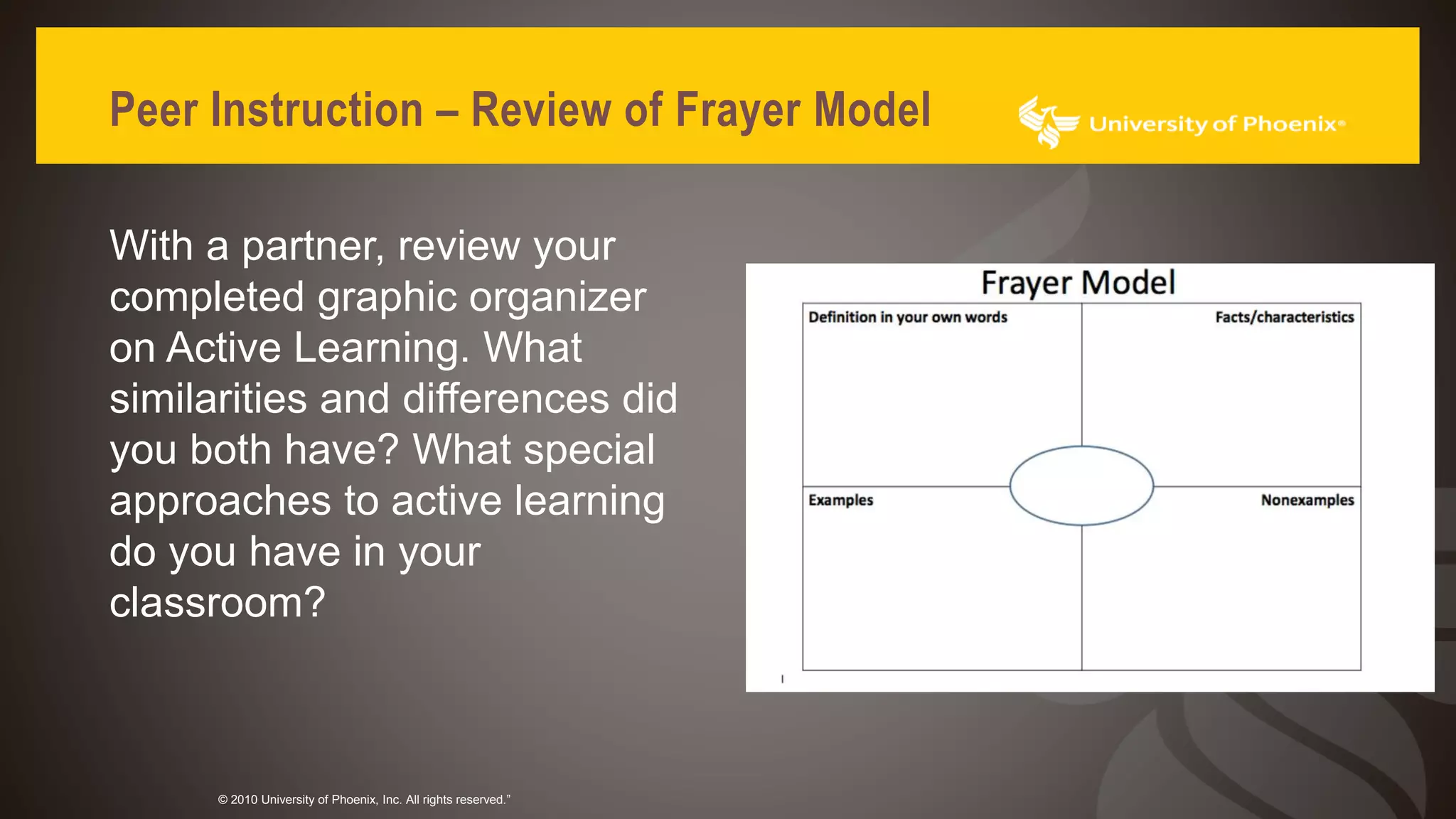
Peer Instruction – Review of Frayer Model
© 2010 University of Phoenix, Inc. All rights reserved.”
With a partner, review your
completed graphic organizer
on Active Learning. What
similarities and differences did
you both have? What special
approaches to active learning
do you have in your
classroom?
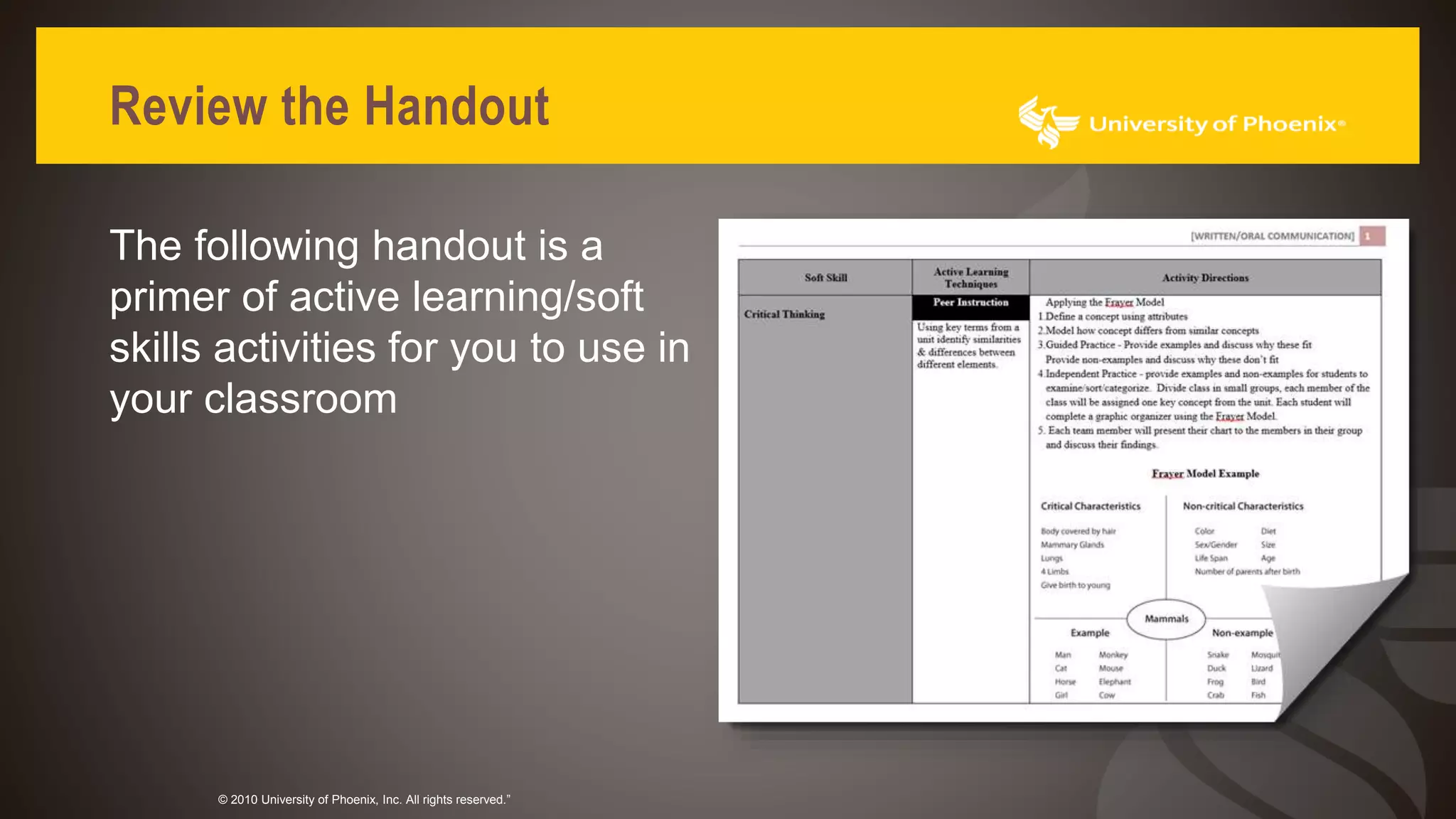
Review the Handout
© 2010 University of Phoenix, Inc. All rights reserved.”
The following handout is a
primer of active learning/soft
skills activities for you to use in
your classroom
References
Marzano, R.J. & Toth, M.D. (2014, March). Teaching for Rigor: A Call for a Critical
Instructional Shift. Why essential shifts in instruction are necessary for teachers and
students to success with college and career readiness standards. West Palm Beach,
FL: Learning Sciences Marzano Center
Petty, G. (2014). Active Learning Works. Retrieved from
www.geoffpetty.com/downloads/WORD/ActiveLearningWorks.doc
University of Minnesota (2015). What Is Active Learning? Retrieved from
http://www1.umn.edu/ohr/teachlearn/tutorials/active/what/index.html
© 2010 University of Phoenix, Inc. All rights reserved.”

A new approach to promoting active learning in the classroom ppt

  • 1.
    A New Approachto Promoting Active Learning in the Classroom Richard Dettling MSHRM Program Manager, School of Business University of Phoenix, South Florida Campus Alexandra Escobar MAED College Chair, College of Education University of Phoenix, South Florida Campus
  • 2.
    Session Objectives 1. Discussthe importance of active learning in the K-12 classroom 2. Explore research on the effectiveness of active learning 3. Explain the Soft Skills Gap 4. Describe active learning techniques teachers can use in the classroom 5. Explain a new approach to promoting active learning in the classroom © 2010 University of Phoenix, Inc. All rights reserved.”
  • 3.
    What is ActiveLearning? • Student-centered, not instructor centered. Students’ learning needs drive instruction and the activity • Multi-directional learning experience • Learning occurs teacher-to-student, student-to-teacher, and student-to-student • Involves activity-based learning experiences, can be whole group, small group, trios, pairs, individuals • May take many forms talking, writing, reading, discussing, debating, acting, role-playing, journaling, conferring, interviewing, building, creating...
  • 4.
    Importance of ActiveLearning in the K-12 Classroom © 2010 University of Phoenix, Inc. All rights reserved.” • The active learning approach promotes learning among students from diverse backgrounds and who have diverse learning styles • Active learning strategies are also simply more interesting, for the instructor and for the students • Active learning strategies can be done with relatively little preparation, which makes it logistically easy for a K-12 classroom • Other active learning strategies may require more careful logistical preparation
  • 5.
    What does researchsay about the effectiveness of active learning? • Research shows that when students engage with each other in learning tasks, they remember material better and they figure out how to apply and extend their new knowledge more effectively (UC Berkeley, 2015) • “For new standards to be a healthy challenge and not a threatening one for students, teachers must intentionally scaffold lessons using student-centric strategies with more frequency and in greater depth. It’s clear that the development of such skills requires a new way of thinking about the traditional teacher-centric classroom.” (Marazano & Toth, 2014, p. 10) © 2010 University of Phoenix, Inc. All rights reserved.”
  • 6.
    What does theresearch say about the effectiveness of active learning? © 2010 University of Phoenix, Inc. All rights reserved.” “Many teachers say active learning would be great ‘if they had the time’. But the research shows that if you make the time for effective active learning by doing less didactic teaching, then your students will do better.” (Petty, 2014, p. 3)
  • 7.
    © 2010 Universityof Phoenix, Inc. All rights reserved.” Active Learning
  • 8.
    Soft Skills Gap ©2010 University of Phoenix, Inc. All rights reserved.”
  • 9.
    © 2010 Universityof Phoenix, Inc. All rights reserved.”
  • 10.
    © 2010 Universityof Phoenix, Inc. All rights reserved.” The consensus among employers  Too many graduates lack vital skills required for today’s jobs  Hard skills like accounting, psychology, nursing, and law enforcement for getting jobs are important  Need graduates with strong soft skills - critical thinking, problem solving, effective communication skills, and the ability to collaborate in a team
  • 11.
    Active Learning andthe Soft Skills Gap 55% 63% 65% 65% 75% 0% 10% 20% 30% 40% 50% 60% 70% 80% Content/Job Releated Skills Collaboration/Teamwork Critical Thinking/Problem Solving Adaptibilty/Prioritation Written/Oral Communication Job Related Soft Skills © 2010 University of Phoenix, Inc. All rights reserved.”
  • 12.
    24% 24% 25% 26% 27% 28% 28% 29% 30% 37% 37% 59% 59% 57% 66% 65% 62% 55% 64% 62% 64% 46% 0% 10% 20%30% 40% 50% 60% 70% Analyzing/solving complex problems Applying knowledge/skill the real world Being innovative/creative Critical/analytical thinking Written communication Oral communication Working with numbers/statistics Locating, organizing, evaluating information Ethical judgement and decision-making Working with others in teams Staying current in technology Preparedness across learning outcomes; students think they are better prepared Students Employers© 2010 University of Phoenix, Inc. All rights reserved.” (Jaschik, 2015)
  • 13.
    Soft Skills Gap ©2010 University of Phoenix, Inc. All rights reserved.” Written/Oral Communication Adaptability/Prioritization Critical Thinking/Problem Solving Collaboration/Teamwork Content/Job Related Skills According to the Business Advisory Council of South Florida the following soft skills have been deemed a priority to use in the classroom
  • 14.
    Active Learning Strategies ©2010 University of Phoenix, Inc. All rights reserved.”
  • 15.
    Active Learning Strategies Thefollowing is a selection of active learning strategies you can use in your classroom Peer Instruction Class Debate Role-Playing Case Studies Creative Scenarios and Simulations
  • 16.
    • Peer Instruction •To move the site of teaching and learning from the instructor to the students • To have students connect or apply concepts by explaining to another student or trying to convince another student • To enable students to evaluate their understanding of the instructor’s explanation • Peer instruction can be used in review sessions to move students to a higher learning level, beyond their concern over what to memorize
  • 17.
    • Class Debate •To encourage students to organize their thoughts in a critical or argumentative way that takes into account the complexity of issues and the existence of alternative and opposing views • To increase students’ public speaking and presentation skills, including the ability to think quickly on one’s feet • Class debate can also be used to develop students’ research skills and give them a chance to become experts on a particular subject
  • 18.
    • Role-Playing • Toincrease student awareness of the interconnectedness of knowledge and the subtle complexities of a situation • To include affective learning as well as cognitive understanding • To expand personal experience by simulating a situation • Role-playing can be used make learning more active
  • 19.
    • Case Studies •To facilitate intuitive and integrated understanding of complex, interconnected issues • To encourage students to integrate theory with practice • Case studies can be used to enliven the material by making it concrete and relating it to the lived world
  • 20.
    • Creative Scenariosand Simulations • To encourage students to extrapolate beyond the information they receive in class • To stimulate creative and original thinking by forcing students to look at their knowledge from a new perspective • To foster a greater awareness of the interdependence of theories and facts • Creative scenarios and simulations can also be used to make students more active in their learning and to increase their research skills
  • 21.
    New Approach toActive Learning © 2010 University of Phoenix, Inc. All rights reserved.”
  • 22.
    Categories of ActiveLearning Strategies 1. Individual activities 2. Paired activities 3. Informal small groups 4. Cooperative student projects Teachers can incorporate a variety of strategies and adapt as needed based on the objectives of your lesson, the number of students, space, and time considerations. (University of Minnesota, 2015)
  • 23.
    Planning an ActiveLearning Activity • What are your objectives? • Will you give students any time to reflect on their learning and action plan to address the activity prior to starting? • How will students be grouped? • What time will the activity take place and how long will it take? • Is the activity graded or non-graded? Will it be submitted? • Will you call on volunteers? • What preparation do students need to participate in the activity fully? (University of Minnesota, 2015)
  • 24.
    New Approach toActive Learning © 2010 University of Phoenix, Inc. All rights reserved.” Written/Oral Communication Adaptability/Prioritization Critical Thinking/Problem Solving Collaboration/Teamwork Content/Job Related Skills Peer Instruction Class Debate Role-Playing Case Studies Creative Scenarios and Simulations Active Learning Strategies Soft Skills Gap
  • 25.
    Peer Instruction –Review of Frayer Model © 2010 University of Phoenix, Inc. All rights reserved.” With a partner, review your completed graphic organizer on Active Learning. What similarities and differences did you both have? What special approaches to active learning do you have in your classroom?
  • 26.
    Review the Handout ©2010 University of Phoenix, Inc. All rights reserved.” The following handout is a primer of active learning/soft skills activities for you to use in your classroom
  • 27.
    References Marzano, R.J. &Toth, M.D. (2014, March). Teaching for Rigor: A Call for a Critical Instructional Shift. Why essential shifts in instruction are necessary for teachers and students to success with college and career readiness standards. West Palm Beach, FL: Learning Sciences Marzano Center Petty, G. (2014). Active Learning Works. Retrieved from www.geoffpetty.com/downloads/WORD/ActiveLearningWorks.doc University of Minnesota (2015). What Is Active Learning? Retrieved from http://www1.umn.edu/ohr/teachlearn/tutorials/active/what/index.html © 2010 University of Phoenix, Inc. All rights reserved.”