ACTIVE
LEARNING
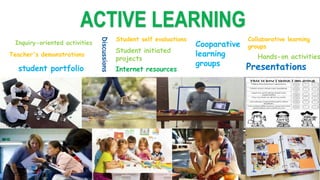
Collaborative learning
groups
Hands-on activities
Inquiry-oriented activities
ACTIVE LEARNING
student portfolio
Teacher's demonstrations
Internet resources
Discussions
Presentations
Cooparative
learning
groups
Student self evaluations
Student initiated
projects
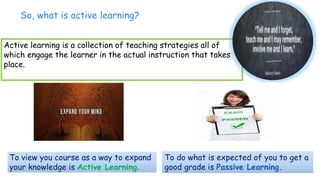
So, what is active learning?
To view you course as a way to expand
your knowledge is Active Learning.
Active learning is a collection of teaching strategies all of
which engage the learner in the actual instruction that takes
place.
To do what is expected of you to get a
good grade is Passive Learning.
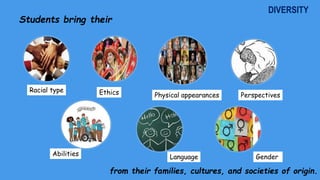
Students bring their
from their families, cultures, and societies of origin.
Racial type Ethics Physical appearances Perspectives
Abilities Language Gender
DIVERSITY
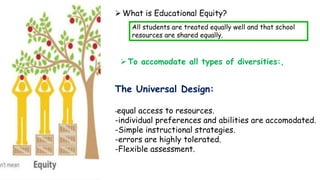
What is Educational Equity?
All students are treated equally well and that school
resources are shared equally.
To accomodate all types of diversities:,
The Universal Design:
-equal access to resources.
-individual preferences and abilities are accomodated.
-Simple instructional strategies.
-errors are highly tolerated.
-Flexible assessment.
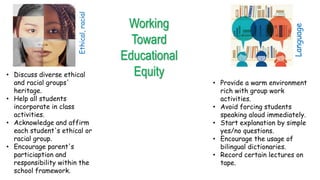
Working
Toward
Educational
Equity• Discuss diverse ethical
and racial groups'
heritage.
• Help all students
incorporate in class
activities.
• Acknowledge and affirm
each student's ethical or
racial group.
• Encourage parent's
particiaption and
responsibility within the
school framework.
• Provide a warm environment
rich with group work
activities.
• Avoid forcing students
speaking aloud immediately.
• Start explanation by simple
yes/no questions.
• Encourage the usage of
bilingual dictionaries.
• Record certain lectures on
tape.
Ethical,racial
Language
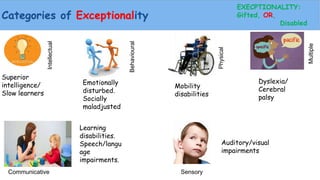
Categories of Exceptionality
Superior
intelligence/
Slow learners
Learning
disabilities.
Speech/langu
age
impairments.
Mobility
disabilities
Emotionally
disturbed.
Socially
maladjusted
Dyslexia/
Cerebral
palsy
Auditory/visual
impairments
EXECPTIONALITY:
Gifted, OR,
Disabled
Intellectual
Behavioural
Physical
Multiple
SensoryCommunicative
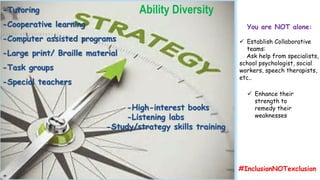
-Tutoring
-Cooperative learning
-Computer assisted programs
-Large print/ Braille material
-Task groups
-Special teachers
-High-interest books
-Listening labs
-Study/strategy skills training
Ability Diversity
 Establish Collaborative
teams:
Ask help from specialists,
school psychologist, social
workers, speech therapists,
etc..
 Enhance their
strength to
remedy their
weaknesses
You are NOT alone:
#InclusionNOTexclusion
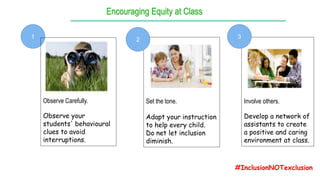
1
Encouraging Equity at Class
Observe Carefully.
Observe your
students' behavioural
clues to avoid
interruptions.
Set the tone.
Adapt your instruction
to help every child.
Do net let inclusion
diminish.
Involve others.
Develop a network of
assistants to create
a positive and caring
environment at class.
2 3
#InclusionNOTexclusion
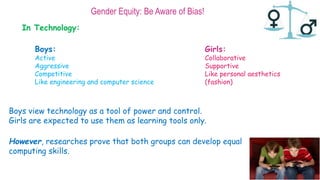
Gender Equity: Be Aware of Bias!
In Technology:
Boys:
Active
Aggressive
Competitive
Like engineering and computer science
Girls:
Collaborative
Supportive
Like personal aesthetics
(fashion)
Boys view technology as a tool of power and control.
Girls are expected to use them as learning tools only.
However, researches prove that both groups can develop equal
computing skills.
Instructional Implications of Gender Equity:
• Communicate high expectations to girls to improve their motivation.
• Provide leadership opportunities for boys and girls equally.
• Be aware of your verbal and nonverbal actions to every class
member.
• You should instil a love of learning in every student.
• Call on girls as much as you call on boys.
• Assign problems equally.
• Add to reading list stories about
important women, and assign researches
concerning this subject.
• Place equal number of girls and boys in
cooperative learning groups.

Active learning

  • 1.
  • 2.
    Collaborative learning groups Hands-on activities Inquiry-orientedactivities ACTIVE LEARNING student portfolio Teacher's demonstrations Internet resources Discussions Presentations Cooparative learning groups Student self evaluations Student initiated projects
  • 3.
    So, what isactive learning? To view you course as a way to expand your knowledge is Active Learning. Active learning is a collection of teaching strategies all of which engage the learner in the actual instruction that takes place. To do what is expected of you to get a good grade is Passive Learning.
  • 4.
    Students bring their fromtheir families, cultures, and societies of origin. Racial type Ethics Physical appearances Perspectives Abilities Language Gender DIVERSITY
  • 5.
    What is EducationalEquity? All students are treated equally well and that school resources are shared equally. To accomodate all types of diversities:, The Universal Design: -equal access to resources. -individual preferences and abilities are accomodated. -Simple instructional strategies. -errors are highly tolerated. -Flexible assessment.
  • 6.
    Working Toward Educational Equity• Discuss diverseethical and racial groups' heritage. • Help all students incorporate in class activities. • Acknowledge and affirm each student's ethical or racial group. • Encourage parent's particiaption and responsibility within the school framework. • Provide a warm environment rich with group work activities. • Avoid forcing students speaking aloud immediately. • Start explanation by simple yes/no questions. • Encourage the usage of bilingual dictionaries. • Record certain lectures on tape. Ethical,racial Language
  • 7.
    Categories of Exceptionality Superior intelligence/ Slowlearners Learning disabilities. Speech/langu age impairments. Mobility disabilities Emotionally disturbed. Socially maladjusted Dyslexia/ Cerebral palsy Auditory/visual impairments EXECPTIONALITY: Gifted, OR, Disabled Intellectual Behavioural Physical Multiple SensoryCommunicative
  • 8.
    -Tutoring -Cooperative learning -Computer assistedprograms -Large print/ Braille material -Task groups -Special teachers -High-interest books -Listening labs -Study/strategy skills training Ability Diversity  Establish Collaborative teams: Ask help from specialists, school psychologist, social workers, speech therapists, etc..  Enhance their strength to remedy their weaknesses You are NOT alone: #InclusionNOTexclusion
  • 9.
    1 Encouraging Equity atClass Observe Carefully. Observe your students' behavioural clues to avoid interruptions. Set the tone. Adapt your instruction to help every child. Do net let inclusion diminish. Involve others. Develop a network of assistants to create a positive and caring environment at class. 2 3 #InclusionNOTexclusion
  • 10.
    Gender Equity: BeAware of Bias! In Technology: Boys: Active Aggressive Competitive Like engineering and computer science Girls: Collaborative Supportive Like personal aesthetics (fashion) Boys view technology as a tool of power and control. Girls are expected to use them as learning tools only. However, researches prove that both groups can develop equal computing skills.
  • 11.
    Instructional Implications ofGender Equity: • Communicate high expectations to girls to improve their motivation. • Provide leadership opportunities for boys and girls equally. • Be aware of your verbal and nonverbal actions to every class member. • You should instil a love of learning in every student. • Call on girls as much as you call on boys. • Assign problems equally. • Add to reading list stories about important women, and assign researches concerning this subject. • Place equal number of girls and boys in cooperative learning groups.