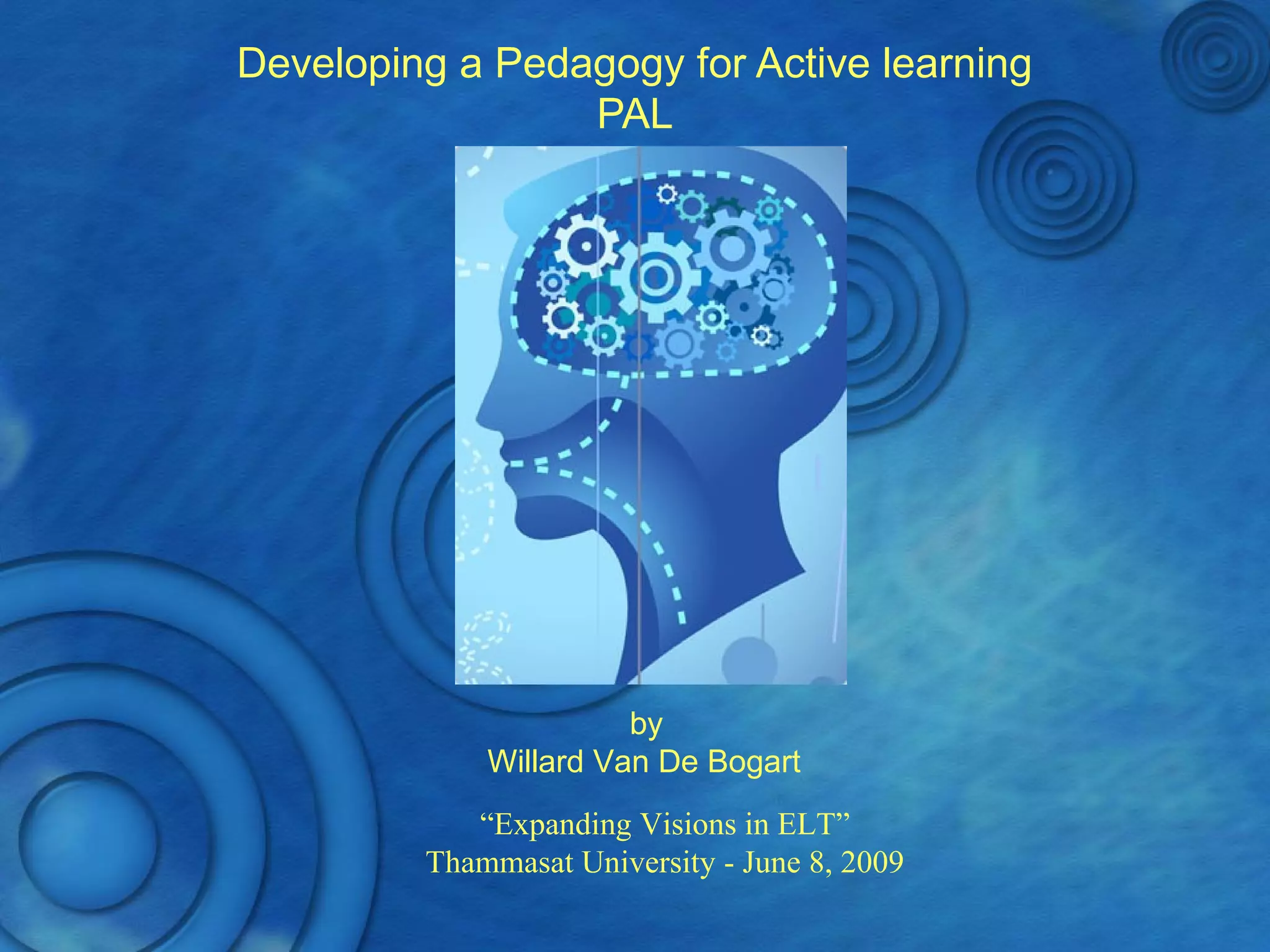
Developing a Pedagogy for Active learning
PAL
“Expanding Visions in ELT”
Thammasat University - June 8, 2009
by
Willard Van De Bogart
Table of Contents
• Brief History of Active learning in
Thailand
• Brief History of Learning Theory
• Definitions of Active Learning
• Cognitivism and Active Learning
• Using Active learning in the
Classroom
• Designing a Pedagogy for
Active Learning
• What the future holds
National Education Act
An Education Reform Act for Future
Development of the Thai People 1999
Improve efficiency and
effectiveness in learning.
Encourage students to
become critical and develop
critical thinking skills.
Acquire facility with
information technologies.
Develop a “student-centered”
learning approach.
Make “online learning” the
technology of choice for the
Thai higher education
system.
• An on-line course on
"How to Help Thai Students
Develop Ideas and Express Op
inions"
• Search Strategies in the IT and
Internet Era
• Internet Based Learning with
ESL
• On-line active learning
strategies
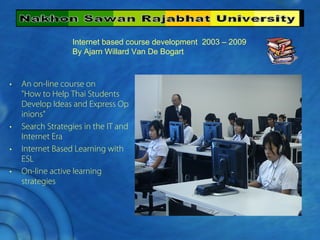
Internet based course development 2003 – 2009
By Ajarn Willard Van De Bogart
Faculty of Humanities and Social sciences
Nakhon Sawan Rajabhat University
2nd
Semester - Academic year 2550-1
• Course: Active Learning
• Subject: Advanced
Communicative English
• Program: Bachelor of
Education
• Teacher: Ajarn Willard Van De
Bogart
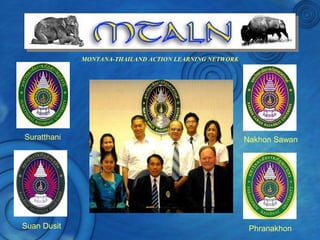
MONTANA-THAILAND ACTION LEARNING NETWORK
Nakhon SawanSuratthani
Suan Dusit Phranakhon
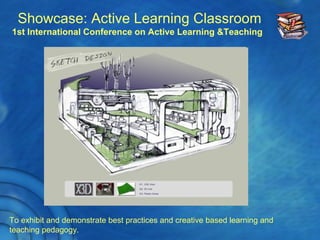
Showcase: Active Learning Classroom
1st International Conference on Active Learning &Teaching
To exhibit and demonstrate best practices and creative based learning and
teaching pedagogy.
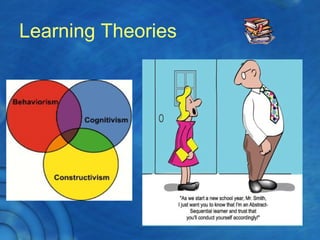
Learning Theories
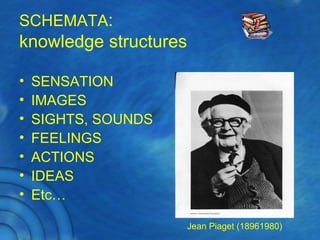
SCHEMATA:
knowledge structures
• SENSATION
• IMAGES
• SIGHTS, SOUNDS
• FEELINGS
• ACTIONS
• IDEAS
• Etc…
Jean Piaget (18961980)
KNOWLEDGE IS “CONSTRUCTED”
BY THE LEARNER
• Knowledge exists in the mind of the
learner.
• Every learner is different.
• Every learner’s mental schemes are
different.
• Knowledge cannot be transmitted as a
whole.
• Knowledge must be built up by the learner
on the basis of experience.
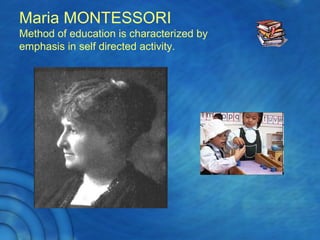
Maria MONTESSORI
Method of education is characterized by
emphasis in self directed activity.
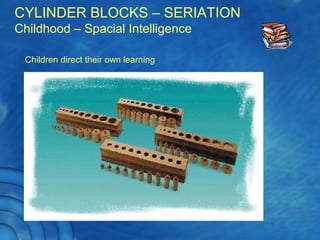
CYLINDER BLOCKS – SERIATION
Childhood – Spacial Intelligence
Children direct their own learning
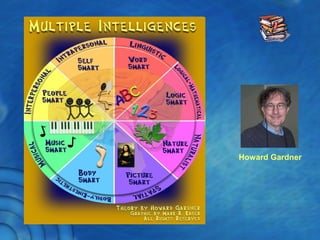
Howard Gardner
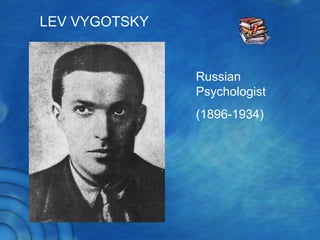
LEV VYGOTSKY
Russian
Psychologist
(1896-1934)
“Zone of Proximal Development”
“What the learner can do with a teacher’s
assistance but cannot do alone.”
• What does the Learner already know?
• Use assessment of find out.
• Growth occurs at the edge.
• What is the learner ready for next?
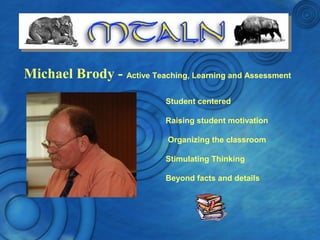
Michael Brody - Active Teaching, Learning and Assessment
Student centered
Raising student motivation
Organizing the classroom
Stimulating Thinking
Beyond facts and details
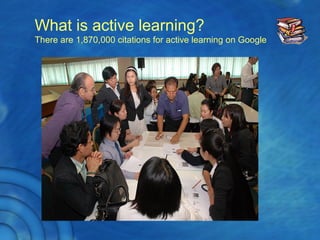
What is active learning?
There are 1,870,000 citations for active learning on Google
Definition of Active learning
• Active Learning refers to techniques
where students do more than simply listen
to a lecture. Students are doing something
including discovering, processing, and
applying information (McKinney 2007 ).
• Processing and Applying Information.
Definition of Active learning
• Active Learning attempts to model the methods
and mindsets which are at the heart of scientific
inquiry, and to provide opportunities for students
to connect abstract ideas to their real world
applications and acquire useful skills, and in so
doing gain knowledge that persists beyond the
course experience in which it was acquired
(Allen & Tanner 2003).
• Connect Abstract Ideas
Definition of Active learning
• Active Learning is comprised of a student
centered environment which raises
student’s motivational level to stimulate
thinking and go beyond facts and details
(Brody 2009).
• Stimulate Thinking.
Definition of Active learning
• Construct interesting “problem spaces”
that serve to really engage the learner’s
interest, and, hence, to motivate them in
ways that are authentic
(Carson 2009).
• Motivate the students.
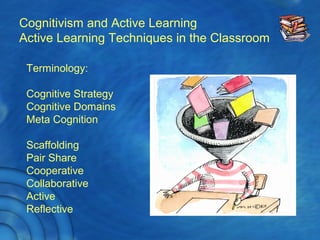
Cognitivism and Active Learning
Active Learning Techniques in the Classroom
Terminology:
Cognitive Strategy
Cognitive Domains
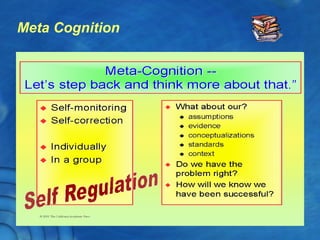
Meta Cognition
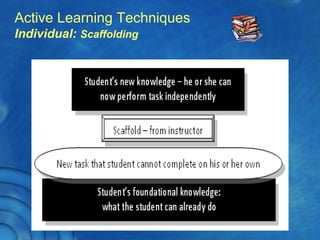
Scaffolding
Pair Share
Cooperative
Collaborative
Active
Reflective
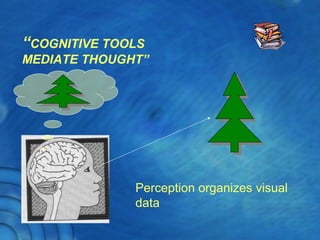
“COGNITIVE TOOLS
MEDIATE THOUGHT”
Perception organizes visual
data
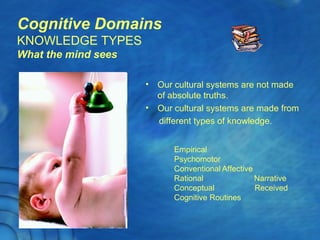
Cognitive Domains
KNOWLEDGE TYPES
What the mind sees
• Our cultural systems are not made
of absolute truths.
• Our cultural systems are made from
different types of knowledge.
Empirical
Psychomotor
Conventional Affective
Rational Narrative
Conceptual Received
Cognitive Routines
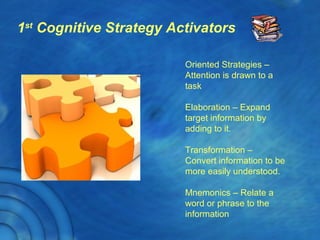
1st
Cognitive Strategy Activators
Oriented Strategies –
Attention is drawn to a
task
Elaboration – Expand
target information by
adding to it.
Transformation –
Convert information to be
more easily understood.
Mnemonics – Relate a
word or phrase to the
information
Meta Cognition
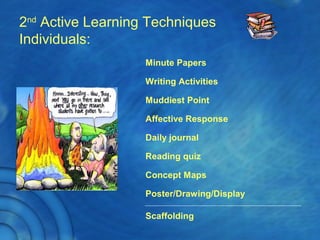
2nd
Active Learning Techniques
Individuals:
Minute Papers
Writing Activities
Muddiest Point
Affective Response
Daily journal
Reading quiz
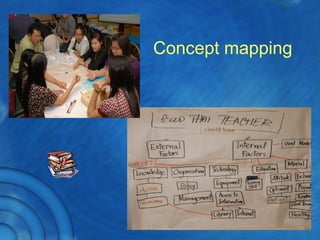
Concept Maps
Poster/Drawing/Display
Scaffolding
Active Learning Techniques
Individual: Scaffolding
Oriented Strategies –
Attention is drawn to a task
Elaboration – Expand taget
information by adding to it.
Transformation – Convert
information to be more
easily understood.
Mnemonics – Relate a word
or phrase to the information
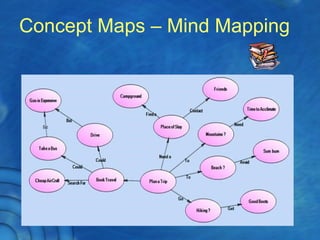
Concept Maps – Mind Mapping
Concept mapping
Active Learning Techniques
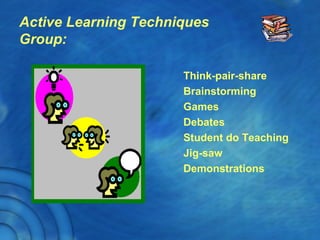
Group:
Think-pair-share
Brainstorming
Games
Debates
Student do Teaching
Jig-saw
Demonstrations
Active Learning Technique
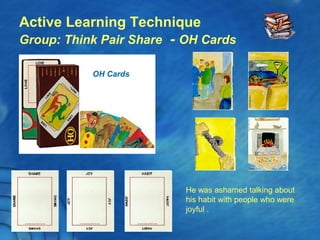
Group: Think Pair Share - OH Cards
He was ashamed talking about
his habit with people who were
joyful .
OH Cards
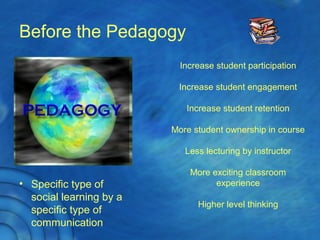
Before the Pedagogy
• Specific type of
social learning by a
specific type of
communication
Increase student participation
Increase student engagement
Increase student retention
More student ownership in course
Less lecturing by instructor
More exciting classroom
experience
Higher level thinking
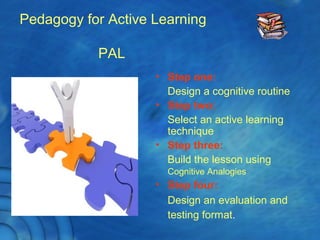
Pedagogy for Active Learning
PAL
• Step one:
Design a cognitive routine
• Step two:
Select an active learning
technique
• Step three:
Build the lesson using
Cognitive Analogies
• Step four:
Design an evaluation and
testing format.
Developing Cognitive Routines
• Utilize a person’s
memory.
• Demand the use of
inductive reasoning.
• Require quickness of
response.
• Use mentally
stimulating suggestions.
• Puzzles of all kinds.
• Board games and card
games.
• Reading and writing.
The Future of Learning
• Universal Libraries
• Natural Language
Search engines
• Decision search
engine
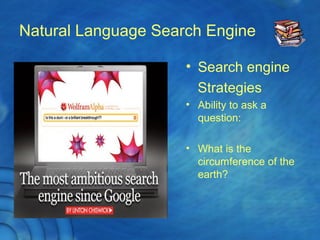
Natural Language Search Engine
• Search engine
Strategies
• Ability to ask a
question:
• What is the
circumference of the
earth?
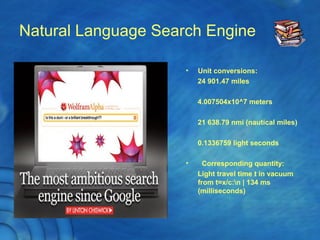
Natural Language Search Engine
• Unit conversions:
24 901.47 miles
4.007504x10^7 meters
21 638.79 nmi (nautical miles)
0.1336759 light seconds
• Corresponding quantity:
Light travel time t in vacuum
from t=x/c:n | 134 ms
(milliseconds)
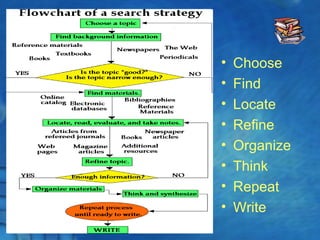
• Choose
• Find
• Locate
• Refine
• Organize
• Think
• Repeat
• Write
Dedicated E-book Readers
• Dedicated readers – about
100,000
• Palm devices – 6,000,000
• PC’s – hundreds of millions
• “For people accustomed to
reading text on a computer
for hours at a time, e-book
screen clarity is a non-issue.”
• 20 hours of video are uploaded
every minute on
You tube.
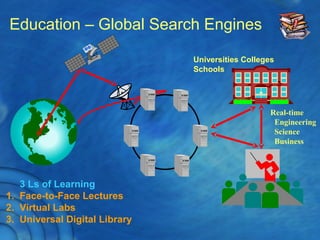
Education – Global Search Engines
Real-time
Engineering
Science
Business
3 Ls of Learning
1. Face-to-Face Lectures
2. Virtual Labs
3. Universal Digital Library
Universities Colleges
Schools
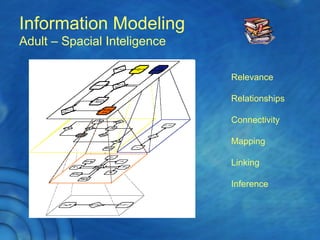
Information Modeling
Adult – Spacial Inteligence
Relevance
Relationships
Connectivity
Mapping
Linking
Inference
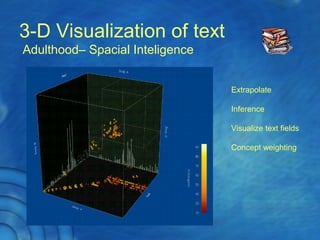
3-D Visualization of text
Adulthood– Spacial Inteligence
Extrapolate
Inference
Visualize text fields
Concept weighting
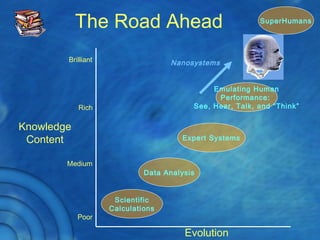
The Road Ahead
Scientific
Calculations
Data Analysis
Expert Systems
SuperHumans
Poor
Medium
Rich
Brilliant
Knowledge
Content
Emulating Human
Performance:
See, Hear, Talk, and “Think”
Evolution
Nanosystems
Activelearning

Activelearning

  • 1.
    Developing a Pedagogyfor Active learning PAL “Expanding Visions in ELT” Thammasat University - June 8, 2009 by Willard Van De Bogart
  • 2.
    Table of Contents •Brief History of Active learning in Thailand • Brief History of Learning Theory • Definitions of Active Learning • Cognitivism and Active Learning • Using Active learning in the Classroom • Designing a Pedagogy for Active Learning • What the future holds
  • 3.
    National Education Act AnEducation Reform Act for Future Development of the Thai People 1999 Improve efficiency and effectiveness in learning. Encourage students to become critical and develop critical thinking skills. Acquire facility with information technologies. Develop a “student-centered” learning approach. Make “online learning” the technology of choice for the Thai higher education system.
  • 4.
    • An on-linecourse on "How to Help Thai Students Develop Ideas and Express Op inions" • Search Strategies in the IT and Internet Era • Internet Based Learning with ESL • On-line active learning strategies Internet based course development 2003 – 2009 By Ajarn Willard Van De Bogart
  • 5.
    Faculty of Humanitiesand Social sciences Nakhon Sawan Rajabhat University 2nd Semester - Academic year 2550-1 • Course: Active Learning • Subject: Advanced Communicative English • Program: Bachelor of Education • Teacher: Ajarn Willard Van De Bogart
  • 6.
    MONTANA-THAILAND ACTION LEARNINGNETWORK Nakhon SawanSuratthani Suan Dusit Phranakhon
  • 7.
    Showcase: Active LearningClassroom 1st International Conference on Active Learning &Teaching To exhibit and demonstrate best practices and creative based learning and teaching pedagogy.
  • 8.
  • 9.
    SCHEMATA: knowledge structures • SENSATION •IMAGES • SIGHTS, SOUNDS • FEELINGS • ACTIONS • IDEAS • Etc… Jean Piaget (18961980)
  • 10.
    KNOWLEDGE IS “CONSTRUCTED” BYTHE LEARNER • Knowledge exists in the mind of the learner. • Every learner is different. • Every learner’s mental schemes are different. • Knowledge cannot be transmitted as a whole. • Knowledge must be built up by the learner on the basis of experience.
  • 11.
    Maria MONTESSORI Method ofeducation is characterized by emphasis in self directed activity.
  • 12.
    CYLINDER BLOCKS –SERIATION Childhood – Spacial Intelligence Children direct their own learning
  • 13.
  • 14.
  • 15.
    “Zone of ProximalDevelopment” “What the learner can do with a teacher’s assistance but cannot do alone.” • What does the Learner already know? • Use assessment of find out. • Growth occurs at the edge. • What is the learner ready for next?
  • 16.
    Michael Brody -Active Teaching, Learning and Assessment Student centered Raising student motivation Organizing the classroom Stimulating Thinking Beyond facts and details
  • 17.
    What is activelearning? There are 1,870,000 citations for active learning on Google
  • 18.
    Definition of Activelearning • Active Learning refers to techniques where students do more than simply listen to a lecture. Students are doing something including discovering, processing, and applying information (McKinney 2007 ). • Processing and Applying Information.
  • 19.
    Definition of Activelearning • Active Learning attempts to model the methods and mindsets which are at the heart of scientific inquiry, and to provide opportunities for students to connect abstract ideas to their real world applications and acquire useful skills, and in so doing gain knowledge that persists beyond the course experience in which it was acquired (Allen & Tanner 2003). • Connect Abstract Ideas
  • 20.
    Definition of Activelearning • Active Learning is comprised of a student centered environment which raises student’s motivational level to stimulate thinking and go beyond facts and details (Brody 2009). • Stimulate Thinking.
  • 21.
    Definition of Activelearning • Construct interesting “problem spaces” that serve to really engage the learner’s interest, and, hence, to motivate them in ways that are authentic (Carson 2009). • Motivate the students.
  • 22.
    Cognitivism and ActiveLearning Active Learning Techniques in the Classroom Terminology: Cognitive Strategy Cognitive Domains Meta Cognition Scaffolding Pair Share Cooperative Collaborative Active Reflective
  • 23.
  • 24.
    Cognitive Domains KNOWLEDGE TYPES Whatthe mind sees • Our cultural systems are not made of absolute truths. • Our cultural systems are made from different types of knowledge. Empirical Psychomotor Conventional Affective Rational Narrative Conceptual Received Cognitive Routines
  • 25.
    1st Cognitive Strategy Activators OrientedStrategies – Attention is drawn to a task Elaboration – Expand target information by adding to it. Transformation – Convert information to be more easily understood. Mnemonics – Relate a word or phrase to the information
  • 26.
  • 27.
    2nd Active Learning Techniques Individuals: MinutePapers Writing Activities Muddiest Point Affective Response Daily journal Reading quiz Concept Maps Poster/Drawing/Display Scaffolding
  • 28.
    Active Learning Techniques Individual:Scaffolding Oriented Strategies – Attention is drawn to a task Elaboration – Expand taget information by adding to it. Transformation – Convert information to be more easily understood. Mnemonics – Relate a word or phrase to the information
  • 29.
    Concept Maps –Mind Mapping
  • 30.
  • 31.
  • 32.
    Active Learning Technique Group:Think Pair Share - OH Cards He was ashamed talking about his habit with people who were joyful . OH Cards
  • 33.
    Before the Pedagogy •Specific type of social learning by a specific type of communication Increase student participation Increase student engagement Increase student retention More student ownership in course Less lecturing by instructor More exciting classroom experience Higher level thinking
  • 34.
    Pedagogy for ActiveLearning PAL • Step one: Design a cognitive routine • Step two: Select an active learning technique • Step three: Build the lesson using Cognitive Analogies • Step four: Design an evaluation and testing format.
  • 35.
    Developing Cognitive Routines •Utilize a person’s memory. • Demand the use of inductive reasoning. • Require quickness of response. • Use mentally stimulating suggestions. • Puzzles of all kinds. • Board games and card games. • Reading and writing.
  • 36.
    The Future ofLearning • Universal Libraries • Natural Language Search engines • Decision search engine
  • 37.
    Natural Language SearchEngine • Search engine Strategies • Ability to ask a question: • What is the circumference of the earth?
  • 38.
    Natural Language SearchEngine • Unit conversions: 24 901.47 miles 4.007504x10^7 meters 21 638.79 nmi (nautical miles) 0.1336759 light seconds • Corresponding quantity: Light travel time t in vacuum from t=x/c:n | 134 ms (milliseconds)
  • 39.
    • Choose • Find •Locate • Refine • Organize • Think • Repeat • Write
  • 40.
    Dedicated E-book Readers •Dedicated readers – about 100,000 • Palm devices – 6,000,000 • PC’s – hundreds of millions • “For people accustomed to reading text on a computer for hours at a time, e-book screen clarity is a non-issue.” • 20 hours of video are uploaded every minute on You tube.
  • 41.
    Education – GlobalSearch Engines Real-time Engineering Science Business 3 Ls of Learning 1. Face-to-Face Lectures 2. Virtual Labs 3. Universal Digital Library Universities Colleges Schools
  • 42.
    Information Modeling Adult –Spacial Inteligence Relevance Relationships Connectivity Mapping Linking Inference
  • 43.
    3-D Visualization oftext Adulthood– Spacial Inteligence Extrapolate Inference Visualize text fields Concept weighting
  • 44.
    The Road Ahead Scientific Calculations DataAnalysis Expert Systems SuperHumans Poor Medium Rich Brilliant Knowledge Content Emulating Human Performance: See, Hear, Talk, and “Think” Evolution Nanosystems

Editor's Notes

  • #41 When OPAC introduced, said 1st generation as poor as it will be and will only get better. And it is!