Active Learning in modern education A CBSE training
1.
ACTIVE LEARNING
CAPACITY BUILDINGPROGRAMME
ON
CENTRAL BOARD OF SECONDARY EDUCATION
केंद्रीय माध्यमिक शिक्षा बोर्ड
Collaboration
Hands-On Experience
Student-Centered
Engagement
Problem-Solving
Feedback
2.
"Children do notlearn by being told, they learn by doing; for in the heart of exploration,
understanding is born."
3.
OBJECTIVES
By the endof the program , the participants will be able to
1.Differentiate between active and passive learning, identifying the un
benefits of the active learning approach.
2.Describe various active learning strategies, recognizing their suitab
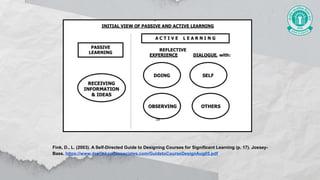
situations and settings.
3.Integrate 21st-century competencies into active learning plans, ens
methods are both engaging and relevant to modern learners.
4.Demonstrating their competence in translating the theory of active le
classroom practices.
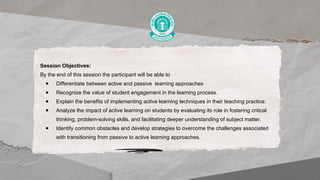
Session Objectives:
By theend of this session the participant will be able to
● Differentiate between active and passive learning approaches
● Recognize the value of student engagement in the learning process.
● Explain the benefits of implementing active learning techniques in their teaching practice.
● Analyze the impact of active learning on students by evaluating its role in fostering critical
thinking, problem-solving skills, and facilitating deeper understanding of subject matter.
● Identify common obstacles and develop strategies to overcome the challenges associated
with transitioning from passive to active learning approaches.
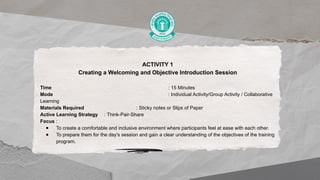
6.
ACTIVITY 1
Creating aWelcoming and Objective Introduction Session
Time : 15 Minutes
Mode : Individual Activity/Group Activity / Collaborative
Learning
Materials Required : Sticky notes or Slips of Paper
Active Learning Strategy : Think-Pair-Share
Focus :
● To create a comfortable and inclusive environment where participants feel at ease with each other.
● To prepare them for the day's session and gain a clear understanding of the objectives of the training
program.
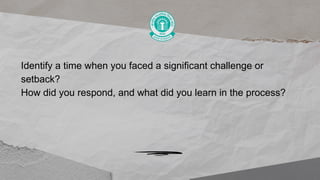
7.
Identify a timewhen you faced a significant challenge or
setback?
How did you respond, and what did you learn in the process?
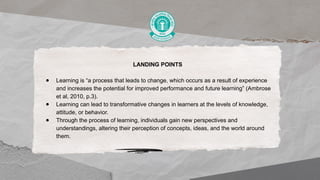
8.
LANDING POINTS
● Learningis “a process that leads to change, which occurs as a result of experience
and increases the potential for improved performance and future learning” (Ambrose
et al, 2010, p.3).
● Learning can lead to transformative changes in learners at the levels of knowledge,
attitude, or behavior.
● Through the process of learning, individuals gain new perspectives and
understandings, altering their perception of concepts, ideas, and the world around
them.
9.
ACTIVITY 2
Embracing MeaningfulEngagement
Time : 75 Minutes
Mode : Individual Activity/Group Activity / Collaborative Learning
Materials Required : Handout 1A,1B,1C,1D,IE,1F,1G,1H,1I,Chart Paper , Sketch Pens ,Sticky
Notes
Active Learning Strategy : Case Study and Discussion
Learning Objectives :
● Recognize the value of student engagement in the learning process.
● Differentiate between active and passive learning approaches
● Explain the benefits of implementing active learning techniques in their teaching practice.
● Analyze the impact of active learning on students by evaluating its role in fostering critical thinking,
problem-solving skills, and facilitating deeper understanding of subject matter.
10.
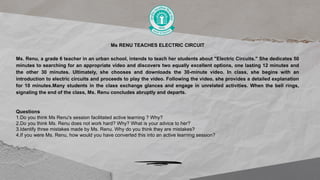
Ms RENU TEACHESELECTRIC CIRCUIT
Ms. Renu, a grade 6 teacher in an urban school, intends to teach her students about "Electric Circuits." She dedicates 50
minutes to searching for an appropriate video and discovers two equally excellent options, one lasting 12 minutes and
the other 30 minutes. Ultimately, she chooses and downloads the 30-minute video. In class, she begins with an
introduction to electric circuits and proceeds to play the video. Following the video, she provides a detailed explanation
for 10 minutes.Many students in the class exchange glances and engage in unrelated activities. When the bell rings,
signaling the end of the class, Ms. Renu concludes abruptly and departs.
Questions
1.Do you think Ms Renu's session facilitated active learning ? Why?
2.Do you think Ms. Renu does not work hard? Why? What is your advice to her?
3.Identify three mistakes made by Ms. Renu. Why do you think they are mistakes?
4.If you were Ms. Renu, how would you have converted this into an active learning session?
11.
By honestly answeringthese questions and rating them,
you can assess whether your teaching practices lean
more towards active learning or passive learning
methods. Remember, active learning promotes student
engagement, critical thinking, and problem-solving, while
passive learning relies more on teacher-centered
instruction and passive reception of information
12.
If the majorityof your responses fall under "Strongly Disagree" or "Disagree," it may be a sign that you need to
incorporate more active learning strategies into your teaching practices to enhance student engagement and
critical thinking.
If your responses are mostly "Neutral," you are taking some steps towards active learning, but there is room for
improvement. Consider incorporating more active learning strategies to enhance student participation and
understanding.
If the majority of your responses are "Agree" or "Strongly Agree," it suggests that you are actively fostering an
engaging and student-centered learning environment. Continue to explore and implement new teaching strategies
to further enhance student engagement and learning outcomes.
INTERPRETATION
13.
● Teachers mustpractice active learning because it directly engages
students in the learning process. Through discussions, problem-solving,
and group work, students are more likely to retain information over longer
periods than if they were mere passive listeners.
● Teachers must practice active learning because it nurtures critical thinking
and problem-solving abilities. Rather than facilitating rote memorization,
students are challenged to interrogate the material, ask probing questions,
and make connections to other subjects, better preparing them for the
intricacies of real-world challenges.
● Teachers must practice active learning because it fosters collaboration
and the development of interpersonal skills. Group projects, peer
teaching, and other cooperative exercises ensure that students not only
derive knowledge from the instructor but also from their peers, enhancing
their team dynamics and interpersonal prowess.
● Teachers must practice active learning because it provides immediate
feedback on student comprehension.
LANDING POINTS
14.
ACTIVITY 2
What andWhy of Active Learning ?
Time : 50 Minutes
Mode : Individual Activity/Group Activity / Collaborative Learning
Learning Objectives :
● Read and thoroughly understand their assigned concept using the handouts provided. [10 Minutes]
● Discuss and collaborate, sharing their insights and perspectives
● Deliver a concise and informative presentation, focusing on key points and relevant examples.
● Be creative in selecting presentation formats, such as charts, diagrams, role plays, or multimedia
tools, to effectively convey the content.
● Encourage questions, clarifications, and further insights from the larger group.
15.
UNLOCKING
THE ESSENCE OFACTIVE LEARNING
● Each group will receive a handout detailing a unique facet of active learning.
● Dive deep into your topic, understand its nuances, and bring it to life for the larger group.
● Whether through a chart, role play, or any other creative medium, illuminate the
significance of your assigned aspect.
● Remember, the goal is not just to present but to engage, mirroring the very essence of
active learning and learn.
16.
ACTIVE LEARNING
A processwhereby students engage in activities, such as reading, writing, discussion,
or problem-solving that promotes analysis, synthesis, and evaluation of class content.
Elizabeth F. Barkley (2010)
17.
WHAT IS ACTIVELEARNING ?
● Active learning is an educational approach that emphasizes student engagement, participation, and
involvement in the learning process
● In active learning, students are encouraged to interact with the subject matter, their peers, and the
instructor through various activities and strategies.
● The goal is to promote critical thinking, problem-solving skills, creativity, and a deep understanding
of the subject matter.
● Instead of the teacher being the sole source of information, active learning recognizes that students
have valuable knowledge, experiences, and perspectives that contribute to the learning process.
● Active learning also promotes higher-order thinking skills, such as analysing, evaluating, and
creating.
● Active learning is an instructional approach that empowers students to be active participants in their
learning journey.
18.
WHY IS ACTIVELEARNING IMPORTANT ?
1. Enhanced engagement
2. Deeper understanding
3. Improved retention and transfer
4.Development of critical skills
5.Increased student autonomy
6. Enhanced social interaction
7. Preparation for future challenges
It promotes engagement, deep understanding, retention of knowledge, development of
critical skills, autonomy, and social interaction, and prepares students for future success.
19.
THE LIMITATIONS OFPASSIVE LEARNING: WHY IT FALLS SHORT ?
1. Reduced engagement
2. Limited retention
3. Limited critical thinking skills
4. Lack of real-world application
5. Limited interaction and collaboration
6. Passive role of students
7. Limited creativity and innovation
By recognizing these negative effects, educators can strive to incorporate more active
learning strategies to enhance student engagement, deep understanding, critical thinking,
and overall learning outcomes.
20.
ACTIVE LEARNING ASA PEDAGOGICAL CONCEPT
It's important to note that the conceptualization and development of active learning have
evolved over time through the contributions of numerous educators, researchers, and
theorists. The collective efforts of these individuals, along with ongoing research and
practice, have shaped and refined the understanding and implementation of active learning
in educational contexts.
21.
CHALLENGES TO OVERCOME
1.Classroom Management
2. Planning and Preparation
3. Facilitating Student Engagement
4. Assessment and Evaluation
5. Time Constraints
6. Classroom Environment
7. Differentiated Instruction
8. Technology Integration
9. Resistance to Change
What different strategies can be followed to overcome these challenges ?
22.
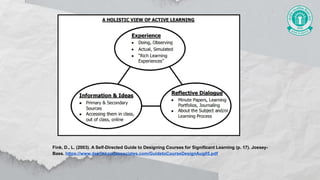
Fink, D., L.(2003). A Self-Directed Guide to Designing Courses for Significant Learning (p. 17). Jossey-
Bass. https://www.deefinkandassociates.com/GuidetoCourseDesignAug05.pdf
23.
Fink, D., L.(2003). A Self-Directed Guide to Designing Courses for Significant Learning (p. 17). Jossey-
Bass. https://www.deefinkandassociates.com/GuidetoCourseDesignAug05.pdf
24.
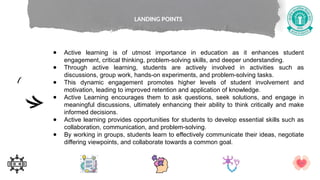
● Active learningis of utmost importance in education as it enhances student
engagement, critical thinking, problem-solving skills, and deeper understanding.
● Through active learning, students are actively involved in activities such as
discussions, group work, hands-on experiments, and problem-solving tasks.
● This dynamic engagement promotes higher levels of student involvement and
motivation, leading to improved retention and application of knowledge.
● Active Learning encourages them to ask questions, seek solutions, and engage in
meaningful discussions, ultimately enhancing their ability to think critically and make
informed decisions.
● Active learning provides opportunities for students to develop essential skills such as
collaboration, communication, and problem-solving.
● By working in groups, students learn to effectively communicate their ideas, negotiate
differing viewpoints, and collaborate towards a common goal.
LANDING POINTS
Session Objectives:
By theend of this session, the participant will be able to
● Describe a diverse range of active learning strategies
● Relate active learning with real-time experiences.
● Promote holistic learning through effective adoption of strategies.
● Develop higher order thinking skills through designed activities.
27.
ACTIVITY 1
ACTIVE ENGAGEMENTOF STUDENTS
Time : 30 Minutes
Mode : Individual Activity / Group Discussion
Materials Required : Handout 2A and 2B
Active Learning Strategy : Reflect and Respond
Focus :
● To critically analyze a teaching strategy – in this case, posing questions
● To evaluate the advantages and disadvantages of employing such a strategy in real-life teaching
scenarios
28.
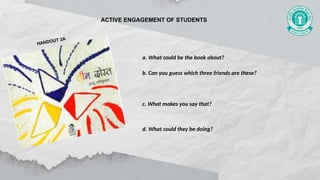
HANDOUT 2A
a. Whatcould be the book about?
b. Can you guess which three friends are these?
c. What makes you say that?
d. What could they be doing?
ACTIVE ENGAGEMENT OF STUDENTS
29.
● Before accessingcontent, being provoked to think critically about what lies ahead
encourages students to actively form hypotheses, wonder, and question, which are
foundational skills in analytical thinking.
● Active engagement isn't just about participation; it's about mentally grappling with
content. By asking questions upfront, educators invite students to become active
players in their learning journey, rather than passive consumers.
● Active engagement is not just a pedagogical tool; it has real, tangible effects on brain
development. Encouraging students to think critically, evaluate, and form hypotheses
stimulates neural pathways, emphasizing the interconnectedness of active learning
and cognitive growth.
LANDING POINTS
30.
SESSION 2 -ACTIVITY 2
UNLOCKING THE TOOLBOX: STRATEGIES FOR FOSTERING ACTIVE LEARNING IN THE CLASSROOM
Time : 45 Minutes
Mode : Group Activity
Materials Required : Handout 2C ,2D , Chart Paper , Sketch Pens ,Paper,Color Paper
Active Learning Strategy : Exploratory Learning
Focus :
● To Familiarize Participants with Diverse Active Learning Strategies
● To Encourage Collaborative Exploration and Presentation
31.
● An evolvingclassroom that continually introduces new active learning strategies keeps
students engaged, curious, and motivated.
● By regularly integrating different methods, we keep the learning environment fresh and
invigorating, encouraging students to actively participate and anticipate what's next.
● The educational landscape is continually evolving, influenced by technological
advancements, societal changes, and pedagogical research. As educators, our
adaptability in choosing and implementing varied active learning strategies showcases
our commitment to staying current and effective.
● It demonstrates our dedication to providing the best educational experience, tailored to
the needs of today's students
LANDING POINTS
Session Objectives:
By theend of this session, the participant will be able to
● Explain the key components of an effective active learning activity plan
● Demonstrate their understanding of various active learning strategies by selecting and incorporating
appropriate techniques into their activity plans, catering to diverse learner needs.
● Analyze their learning objectives and align them with the active learning activity plan, ensuring a coherent
and effective instructional design.
● Map and select a potential activity to incorporate 21st-century skills into their teaching
● Present and justify their active learning activity plans, highlighting the integration of 21st-century skills,
and effectively respond to questions and concerns from their peers
34.
SESSION 3 -ACTIVITY 1
COMPONENTS OF 21ST CENTURY SKILLS
Time : 15 Minutes
Mode : Collaboration/Discussion
Materials Required : Handout 3A,Sketch pens and Chart paper
Active Learning Strategy : Spider Web Mapping
Focus :
● Familiarize teachers with the ten essential components of 21st-century skills
● Facilitate their understanding of how these skills can be integrated into the
teaching and learning process effectively.
35.
SESSION 3 -ACTIVITY 2
21ST CENTURY SKILLS: PRODUCTS OR BYPRODUCTS
Time : 10 Minutes
Mode : Group Activity / Collaborative Learning
Materials Required :Handout 3B, Sticky notes or Slips of Paper, T Chart, Sketch Pens
Active Learning Strategy : Pro and Con Grid Assignment
Focus :
● Critically evaluate and analyze the role of teachers in incorporating 21st-century skills in
classrooms
● Identify the potential areas of influence and the extent to which these skills can be developed
through active teaching strategies.
36.
PRODUCTS OR BYPRODUCTS
1.Products: Products are the main or primary outcomes of a process or activity. They are intentionally produced and
form the primary goal or objective of the process.Products are typically planned, expected, and sought after for their
specific value or usefulness.
2. Byproducts: Byproducts are secondary or additional outcomes that arise unintentionally during a process or
activity.They are not the main focus or intended result of the process but are rather incidental outcomes.Byproducts
can be beneficial, neutral, or even undesirable, depending on the context.
37.
● By nurturingskills such as critical thinking, creativity, problem-solving, collaboration,
and adaptability, we empower students to become lifelong learners, capable of
embracing change and uncertainty with confidence.
● Integrating 21st-century skills ensures that our students are prepared to meet the
demands of a constantly evolving job market.
● By honing critical thinking and problem-solving abilities, we cultivate students who can
analyze complex situations, make informed decisions, and contribute effectively to
society.
● As educators, we play a pivotal role in shaping the future of our society through the
young minds we teach.
LANDING POINTS
SESSION 3 -ACTIVITY 4
21ST CENTURY SKILLS: PRODUCTS OR BYPRODUCTS
Time : 50 Minutes
Mode : Collaboration/Discussion
Materials Required : Handout 3D and 3E ALAP Model Template
Focus :
● To design effective active learning activity plans that align with specific learning outcomes.
41.
● Active learningis of paramount importance in a classroom as it transforms the traditional
teacher-centered approach to a more dynamic and student-centered learning environment.
● Active learning empowers students to take ownership of their learning journey, promoting a
growth mindset and a passion for continuous learning.
● Active learning actively involves students in the learning process, encouraging them to
participate, interact, and contribute to the discussions and activities. This increased
engagement leads to improved attentiveness, motivation, and overall interest in learning.
● As educators, we play a vital role in cultivating a student-centered approach that instills
confidence, creativity, and adaptability in our learners, preparing them to thrive in an ever-
changing global landscape.
● Embrace this spirit of collaboration beyond this session, and let's continue to support each
other in refining and implementing active learning strategies to create transformative learning
experiences for our students.
● Mapping 21st-century skills, values, and social dynamics are essential while preparing an
active learning plan. By doing so, educators can create more effective and purposeful learning
experiences that cater to the holistic development of their students.
LANDING POINTS
Session Objectives:
By theend of this session, the participant will be able to
● Effectively demonstrate a chosen active learning strategy, showcasing their ability to translate theoretical
knowledge into practical execution within a classroom setting.
● Exhibit their preparedness to integrate it into real classroom scenarios for maximum student engagement
and optimal learning outcomes
44.
SESSION 4 -ACTIVITY 1
STRATEGIES IN SPOTLIGHT: PARTICIPANT-LED ACTIVE LEARNING DEMONSTRATIONS
Time : 90 Minutes
Mode : Collaboration
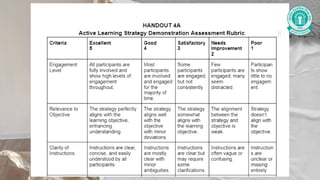
Materials Required : Handout 4A,4B,4C and 4D,Chart Paper,Sketch Pen/Marker ,Text
Book
Active Learning Strategy : Demonstration
Focus :
● To provide participants with a hands-on experience of designing and implementing active
learning strategies in subject groups, fostering a deeper understanding of the active learning
process.
46.
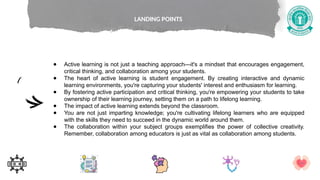
● Active learningis not just a teaching approach—it's a mindset that encourages engagement,
critical thinking, and collaboration among your students.
● The heart of active learning is student engagement. By creating interactive and dynamic
learning environments, you're capturing your students' interest and enthusiasm for learning.
● By fostering active participation and critical thinking, you're empowering your students to take
ownership of their learning journey, setting them on a path to lifelong learning.
● The impact of active learning extends beyond the classroom.
● You are not just imparting knowledge; you're cultivating lifelong learners who are equipped
with the skills they need to succeed in the dynamic world around them.
● The collaboration within your subject groups exemplifies the power of collective creativity.
Remember, collaboration among educators is just as vital as collaboration among students.
LANDING POINTS
47.
I AM ATEACHER
“I have come to the frightening conclusion that I am the
decisive element.
It is my personal approach that creates the climate.
It is my daily mood that makes the weather.
I possess tremendous power to make life miserable or joyous.
I can be a tool of torture or an instrument of inspiration, I can
humiliate or humor, hurt or heal.
In all situations, it is my response that decides whether a
crisis is escalated or de-escalated, and a person is
humanized or de-humanized.
If we treat people as they are, we make them worse. If we
treat people as they ought to be, we help them become what
they are capable of becoming.”
—Johann Wolfgang von Goethe
― Haim G. Ginott, Teacher and Child: A Book for Parents and Teachers




![ACTIVITY 2
What and Why of Active Learning ?
Time : 50 Minutes
Mode : Individual Activity/Group Activity / Collaborative Learning
Learning Objectives :
● Read and thoroughly understand their assigned concept using the handouts provided. [10 Minutes]
● Discuss and collaborate, sharing their insights and perspectives
● Deliver a concise and informative presentation, focusing on key points and relevant examples.
● Be creative in selecting presentation formats, such as charts, diagrams, role plays, or multimedia
tools, to effectively convey the content.
● Encourage questions, clarifications, and further insights from the larger group.](https://image.slidesharecdn.com/activelearningppt-250824160408-32c1da16/85/Active-Learning-in-modern-education-A-CBSE-training-14-320.jpg)