Connecting with Students
Oh No! My teacher wants me to speak up in class...
2Page© 2012 University of Phoenix, Inc. | All rights reserved
Objective
Address ways to overcome participation barriers
and demonstrate techniques that may easily be
used to promote active engagement of all
students in a class
3Page© 2012 University of Phoenix, Inc. | All rights reserved
Agenda
 Class Participation Relevance
 Traditional Techniques to Promote Classroom
Participation
 Factors Influencing Student Participation
 Goals of Participation
 Classroom Challenges to Participation and Some
Solutions
 Final Thoughts
Class Participation Relevance
5Page© 2012 University of Phoenix, Inc. | All rights reserved
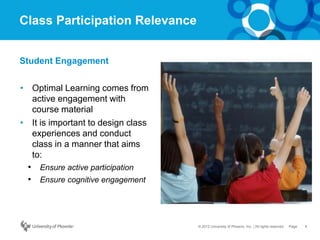
Class Participation Relevance
• Optimal Learning comes from
active engagement with
course material
• It is important to design class
experiences and conduct
class in a manner that aims
to:
• Ensure active participation
• Ensure cognitive engagement
Student Engagement
6Page© 2012 University of Phoenix, Inc. | All rights reserved
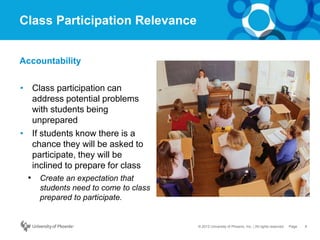
Class Participation Relevance
• Class participation can
address potential problems
with students being
unprepared
• If students know there is a
chance they will be asked to
participate, they will be
inclined to prepare for class
• Create an expectation that
students need to come to class
prepared to participate.
Accountability
7Page© 2012 University of Phoenix, Inc. | All rights reserved
Class Participation Relevance
• Students prefer a class that
relies less on teacher-talk and
more on participatory
engagement
• Activities and relatable
experiences
• Lectures has its place in college
teaching
• K-12 lectures are simply boring
and unenjoyable
More Enjoyable Class
8Page© 2012 University of Phoenix, Inc. | All rights reserved
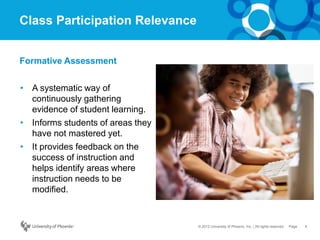
Class Participation Relevance
• A systematic way of
continuously gathering
evidence of student learning.
• Informs students of areas they
have not mastered yet.
• It provides feedback on the
success of instruction and
helps identify areas where
instruction needs to be
modified.
Formative Assessment
Traditional Techniques to Promote
Classroom Participation
10Page© 2012 University of Phoenix, Inc. | All rights reserved
Initiate-Respond-Evaluate (I-R-E)
AKA Initiation – Response – Feedback
• The most common strategy teachers use to engage their students in
participation.
• In this approach teaches control participation in class discussions by
posing questions, recruiting a student response (voluntary or involuntary)
and then evaluating the students response by offering feedback
• Using this method, teachers may stylistically use slight variations,
where feedback initiates further response and evaluation.
11Page© 2012 University of Phoenix, Inc. | All rights reserved
Cold Calling
• Refers to calling on a
student at random without
warning
• Controversial to some who
feel that participation should
be voluntary, especially for
students who are shy or
have anxiety
• Proponents argue that this is
a useful practice to hold
students accountable for
outside classwork and
preparation
12Page© 2012 University of Phoenix, Inc. | All rights reserved
Group Discussion
• Participation in group discussion is valuable to student learning
• The common style of group discussion is dividing students into
groups to discuss some aspect of the material and then report
back
• Social loafing is a routine problem
• Students will “check out” or disengage during the activity
• Teachers can guarantee participation of students by keeping
students guessing who will be asked to present back to the whole
class
Factors Influencing Student Participation
14Page© 2012 University of Phoenix, Inc. | All rights reserved
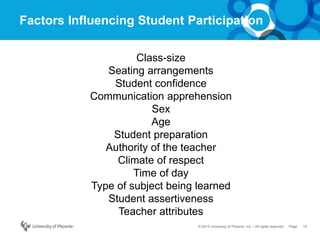
Factors Influencing Student Participation
Class-size
Seating arrangements
Student confidence
Communication apprehension
Sex
Age
Student preparation
Authority of the teacher
Climate of respect
Time of day
Type of subject being learned
Student assertiveness
Teacher attributes
Goals of Student Participation
16Page© 2012 University of Phoenix, Inc. | All rights reserved
What are your expectations for
student participation?
• Our goal should not be that every student will participate in the same
way or at the same rate. Instead, it is to create an environment in
which all participants have the opportunity to learn and in which the
class explores issues and ideas in depth, from a variety of
viewpoints.
• Active Learners – they typically think while they speak
• Reflective Learners – they need to reflect on their ideas before
sharing with others.
Classroom Challenges & Solutions
18Page© 2012 University of Phoenix, Inc. | All rights reserved
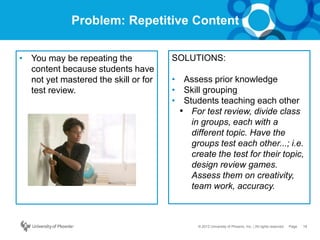
Problem: Repetitive Content
• You may be repeating the
content because students have
not yet mastered the skill or for
test review.
SOLUTIONS:
• Assess prior knowledge
• Skill grouping
• Students teaching each other
• For test review, divide class
in groups, each with a
different topic. Have the
groups test each other...; i.e.
create the test for their topic,
design review games.
Assess them on creativity,
team work, accuracy.
19Page© 2012 University of Phoenix, Inc. | All rights reserved
Problem: The content is too hard.
Part of the challenge is also that some students may hesitate to
ask questions because they fear that other students will see them
as not smart.
20Page© 2012 University of Phoenix, Inc. | All rights reserved
Solutions – Content too Hard
SOLUTIONS
• Allow anonymous questions.
• Question box
• Index cards – all students write a card with a question or
comment
• Allow them to work together.
• Do a quick check for homework completeness and then let
students grade their papers in pairs and then review in whole
group
• Jigsaw approach – divide up content among groups, each group
becomes an expert on an area and then teach each other.
• Connect material with real-world application – use index cards to
write a real-world application of the content they are learning.
• Break things down – Have students summarize a short text in a
single word and then write 1-2 paragraphs on why they selected
their word.
21Page© 2012 University of Phoenix, Inc. | All rights reserved
Problem: There is too much information to
cover
SOLUTIONS
• Plan lectures for no more than 15 minute segments
• Break up larger concepts into smaller segments, then assign
activities for reinforcement. Repeat this cycle.
• Give students the opportunity to stay connected with you during your
lesson – handouts with blanks for them to complete as the material
is covered; lecture bingo, quick-writes or quick-draws at key points
in the lesson.
• Ask for initial predictions on the topic – students can give their best
guess on true/false questions before the topic is reviewed, and then
revisit their responses once the lesson is given.
Problem: There is too much to cover.
22Page© 2012 University of Phoenix, Inc. | All rights reserved
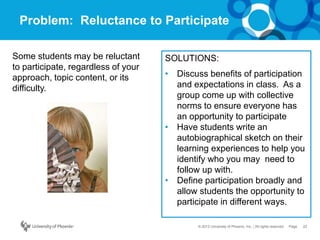
Problem: Reluctance to Participate
Some students may be reluctant
to participate, regardless of your
approach, topic content, or its
difficulty. Normal text
• Bullet
• Bullet
o Sub-bullet
SOLUTIONS:
• Discuss benefits of participation
and expectations in class. As a
group come up with collective
norms to ensure everyone has
an opportunity to participate
• Have students write an
autobiographical sketch on their
learning experiences to help you
identify who you may need to
follow up with.
• Define participation broadly and
allow students the opportunity to
participate in different ways.
Feedback
What are you experiencing?
Final Thoughts
25Page© 2012 University of Phoenix, Inc. | All rights reserved
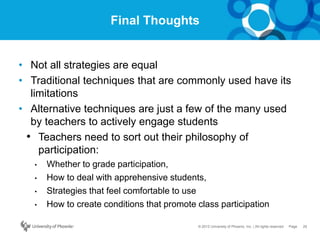
Final Thoughts
• Not all strategies are equal
• Traditional techniques that are commonly used have its
limitations
• Alternative techniques are just a few of the many used
by teachers to actively engage students
• Teachers need to sort out their philosophy of
participation:
• Whether to grade participation,
• How to deal with apprehensive students,
• Strategies that feel comfortable to use
• How to create conditions that promote class participation
26Page© 2012 University of Phoenix, Inc. | All rights reserved
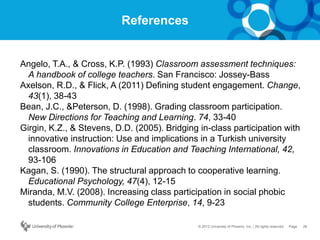
References
Angelo, T.A., & Cross, K.P. (1993) Classroom assessment techniques:
A handbook of college teachers. San Francisco: Jossey-Bass
Axelson, R.D., & Flick, A (2011) Defining student engagement. Change,
43(1), 38-43
Bean, J.C., &Peterson, D. (1998). Grading classroom participation.
New Directions for Teaching and Learning. 74, 33-40
Girgin, K.Z., & Stevens, D.D. (2005). Bridging in-class participation with
innovative instruction: Use and implications in a Turkish university
classroom. Innovations in Education and Teaching International, 42,
93-106
Kagan, S. (1990). The structural approach to cooperative learning.
Educational Psychology, 47(4), 12-15
Miranda, M.V. (2008). Increasing class participation in social phobic
students. Community College Enterprise, 14, 9-23

Connecting with students

  • 1.
    Connecting with Students OhNo! My teacher wants me to speak up in class...
  • 2.
    2Page© 2012 Universityof Phoenix, Inc. | All rights reserved Objective Address ways to overcome participation barriers and demonstrate techniques that may easily be used to promote active engagement of all students in a class
  • 3.
    3Page© 2012 Universityof Phoenix, Inc. | All rights reserved Agenda  Class Participation Relevance  Traditional Techniques to Promote Classroom Participation  Factors Influencing Student Participation  Goals of Participation  Classroom Challenges to Participation and Some Solutions  Final Thoughts
  • 4.
  • 5.
    5Page© 2012 Universityof Phoenix, Inc. | All rights reserved Class Participation Relevance • Optimal Learning comes from active engagement with course material • It is important to design class experiences and conduct class in a manner that aims to: • Ensure active participation • Ensure cognitive engagement Student Engagement
  • 6.
    6Page© 2012 Universityof Phoenix, Inc. | All rights reserved Class Participation Relevance • Class participation can address potential problems with students being unprepared • If students know there is a chance they will be asked to participate, they will be inclined to prepare for class • Create an expectation that students need to come to class prepared to participate. Accountability
  • 7.
    7Page© 2012 Universityof Phoenix, Inc. | All rights reserved Class Participation Relevance • Students prefer a class that relies less on teacher-talk and more on participatory engagement • Activities and relatable experiences • Lectures has its place in college teaching • K-12 lectures are simply boring and unenjoyable More Enjoyable Class
  • 8.
    8Page© 2012 Universityof Phoenix, Inc. | All rights reserved Class Participation Relevance • A systematic way of continuously gathering evidence of student learning. • Informs students of areas they have not mastered yet. • It provides feedback on the success of instruction and helps identify areas where instruction needs to be modified. Formative Assessment
  • 9.
    Traditional Techniques toPromote Classroom Participation
  • 10.
    10Page© 2012 Universityof Phoenix, Inc. | All rights reserved Initiate-Respond-Evaluate (I-R-E) AKA Initiation – Response – Feedback • The most common strategy teachers use to engage their students in participation. • In this approach teaches control participation in class discussions by posing questions, recruiting a student response (voluntary or involuntary) and then evaluating the students response by offering feedback • Using this method, teachers may stylistically use slight variations, where feedback initiates further response and evaluation.
  • 11.
    11Page© 2012 Universityof Phoenix, Inc. | All rights reserved Cold Calling • Refers to calling on a student at random without warning • Controversial to some who feel that participation should be voluntary, especially for students who are shy or have anxiety • Proponents argue that this is a useful practice to hold students accountable for outside classwork and preparation
  • 12.
    12Page© 2012 Universityof Phoenix, Inc. | All rights reserved Group Discussion • Participation in group discussion is valuable to student learning • The common style of group discussion is dividing students into groups to discuss some aspect of the material and then report back • Social loafing is a routine problem • Students will “check out” or disengage during the activity • Teachers can guarantee participation of students by keeping students guessing who will be asked to present back to the whole class
  • 13.
  • 14.
    14Page© 2012 Universityof Phoenix, Inc. | All rights reserved Factors Influencing Student Participation Class-size Seating arrangements Student confidence Communication apprehension Sex Age Student preparation Authority of the teacher Climate of respect Time of day Type of subject being learned Student assertiveness Teacher attributes
  • 15.
    Goals of StudentParticipation
  • 16.
    16Page© 2012 Universityof Phoenix, Inc. | All rights reserved What are your expectations for student participation? • Our goal should not be that every student will participate in the same way or at the same rate. Instead, it is to create an environment in which all participants have the opportunity to learn and in which the class explores issues and ideas in depth, from a variety of viewpoints. • Active Learners – they typically think while they speak • Reflective Learners – they need to reflect on their ideas before sharing with others.
  • 17.
  • 18.
    18Page© 2012 Universityof Phoenix, Inc. | All rights reserved Problem: Repetitive Content • You may be repeating the content because students have not yet mastered the skill or for test review. SOLUTIONS: • Assess prior knowledge • Skill grouping • Students teaching each other • For test review, divide class in groups, each with a different topic. Have the groups test each other...; i.e. create the test for their topic, design review games. Assess them on creativity, team work, accuracy.
  • 19.
    19Page© 2012 Universityof Phoenix, Inc. | All rights reserved Problem: The content is too hard. Part of the challenge is also that some students may hesitate to ask questions because they fear that other students will see them as not smart.
  • 20.
    20Page© 2012 Universityof Phoenix, Inc. | All rights reserved Solutions – Content too Hard SOLUTIONS • Allow anonymous questions. • Question box • Index cards – all students write a card with a question or comment • Allow them to work together. • Do a quick check for homework completeness and then let students grade their papers in pairs and then review in whole group • Jigsaw approach – divide up content among groups, each group becomes an expert on an area and then teach each other. • Connect material with real-world application – use index cards to write a real-world application of the content they are learning. • Break things down – Have students summarize a short text in a single word and then write 1-2 paragraphs on why they selected their word.
  • 21.
    21Page© 2012 Universityof Phoenix, Inc. | All rights reserved Problem: There is too much information to cover SOLUTIONS • Plan lectures for no more than 15 minute segments • Break up larger concepts into smaller segments, then assign activities for reinforcement. Repeat this cycle. • Give students the opportunity to stay connected with you during your lesson – handouts with blanks for them to complete as the material is covered; lecture bingo, quick-writes or quick-draws at key points in the lesson. • Ask for initial predictions on the topic – students can give their best guess on true/false questions before the topic is reviewed, and then revisit their responses once the lesson is given. Problem: There is too much to cover.
  • 22.
    22Page© 2012 Universityof Phoenix, Inc. | All rights reserved Problem: Reluctance to Participate Some students may be reluctant to participate, regardless of your approach, topic content, or its difficulty. Normal text • Bullet • Bullet o Sub-bullet SOLUTIONS: • Discuss benefits of participation and expectations in class. As a group come up with collective norms to ensure everyone has an opportunity to participate • Have students write an autobiographical sketch on their learning experiences to help you identify who you may need to follow up with. • Define participation broadly and allow students the opportunity to participate in different ways.
  • 23.
    Feedback What are youexperiencing?
  • 24.
  • 25.
    25Page© 2012 Universityof Phoenix, Inc. | All rights reserved Final Thoughts • Not all strategies are equal • Traditional techniques that are commonly used have its limitations • Alternative techniques are just a few of the many used by teachers to actively engage students • Teachers need to sort out their philosophy of participation: • Whether to grade participation, • How to deal with apprehensive students, • Strategies that feel comfortable to use • How to create conditions that promote class participation
  • 26.
    26Page© 2012 Universityof Phoenix, Inc. | All rights reserved References Angelo, T.A., & Cross, K.P. (1993) Classroom assessment techniques: A handbook of college teachers. San Francisco: Jossey-Bass Axelson, R.D., & Flick, A (2011) Defining student engagement. Change, 43(1), 38-43 Bean, J.C., &Peterson, D. (1998). Grading classroom participation. New Directions for Teaching and Learning. 74, 33-40 Girgin, K.Z., & Stevens, D.D. (2005). Bridging in-class participation with innovative instruction: Use and implications in a Turkish university classroom. Innovations in Education and Teaching International, 42, 93-106 Kagan, S. (1990). The structural approach to cooperative learning. Educational Psychology, 47(4), 12-15 Miranda, M.V. (2008). Increasing class participation in social phobic students. Community College Enterprise, 14, 9-23