









MY BACKGROUND
• 7 YEARS AS A UNIVERSITY ADMINISTRATOR
• 15 YEARS AS AN ADJUNCT PROFESSOR OF HUMAN RESOURCE MANAGEMENT
• 16 YEARS AS A HUMAN RESOURCE PROFESSIONAL (CONCURRENT)
• PHD CANDIDATE – HIGHER EDUCATION ADMINISTRATION
• MASTERS OF HUMAN RESOURCE MANAGEMENT
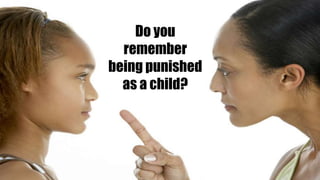
Do you
remember
being punished
as a child?
Why do you think
your parents did
that?
Despite what we
thought back then.
It wasn’t because
they hated us or
enjoyed watching
us suffer through
a week without
television.
They merely
disapproved of
our actions
They merely
disapproved of
our actions
and were hoping
to prevent us from
repeating them in
our future
BEHAVIOR MODIFICATION
THE TECHNIQUES USED TO TRY AND DECREASE OR
INCREASE A PARTICULAR TYPE OF BEHAVIOR OR ACTION
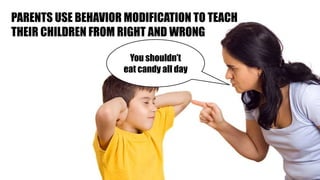
PARENTS USE BEHAVIOR MODIFICATION TO TEACH
THEIR CHILDREN FROM RIGHT AND WRONG
You shouldn’t
eat candy all day
THERAPISTS USE BEHAVIOR MODIFICATION
TO ENCOURAGE HEALTHY BEHAVIORS IN
THEIR PATIENTS
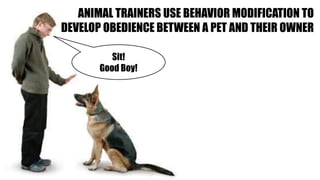
ANIMAL TRAINERS USE BEHAVIOR MODIFICATION TO
DEVELOP OBEDIENCE BETWEEN A PET AND THEIR OWNER
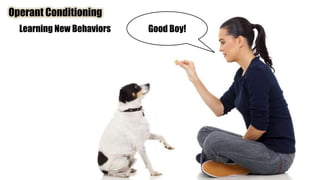
Sit!
Good Boy!
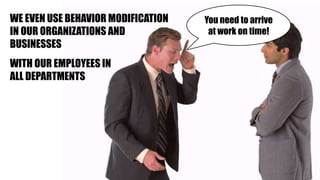
WE EVEN USE BEHAVIOR MODIFICATION
IN OUR ORGANIZATIONS AND
BUSINESSES
WITH OUR EMPLOYEES IN
ALL DEPARTMENTS
You need to arrive
at work on time!
LIST OF ITEMS
• BEHAVIOR MODIFICATION
• BEHAVIOR MODIFICATION IN ORGANIZATIONS
• PROBLEMATIC EMPLOYEES
• USING BEHAVIOR MODIFICATION FOR PROBLEMATIC EMPLOYEES
• USING PROBLEM SOLVING TOOLS AT WORK
• A NEW PROBLEM SOLVING APPROACH FOR PROBLEMATIC EMPLOYEES
BEHAVIOR MODIFICATION
•THE FIRST USE OF THE TERM BEHAVIOR MODIFICATION APPEARS TO IN
1911. IN THORNDIKE’S ARTICLE PROVISIONAL LAWS OF ACQUIRED
BEHAVIOR OR LEARNING , WHICH MAKES FREQUENT USE OF THE TERM
"MODIFYING BEHAVIOR”
•SKINNER’S BOOK THE BEHAVIOR OF ORGANISMS, PUBLISHED IN 1938,
INITIATED THE STUDY OF OPERANT CONDITIONING AND ITS APPLICATION
TO HUMAN AND ANIMAL BEHAVIOR.
BEHAVIOR MODIFICATION
•THROUGH EARLY RESEARCH IN THE 1940S AND THE 1950S THE TERM WAS USED
BY JOSEPH WOLPE'S RESEARCH GROUP.
•THE EXPERIMENTAL TRADITION IN CLINICAL PSYCHOLOGY USED IT TO REFER TO
PSYCHO-THERAPEUTIC TECHNIQUES DERIVED FROM EMPIRICAL RESEARCH
•IT HAS SINCE COME TO REFER MAINLY TO TECHNIQUES FOR INCREASING
ADAPTIVE BEHAVIOR THROUGH REINFORCEMENT AND DECREASING
MALADAPTIVE BEHAVIOR THROUGH EXTINCTION OR PUNISHMENT
BEHAVIOR MODIFICATION
•BEHAVIOR MODIFICATION RELIES ON THE CONCEPT OF
CONDITIONING
•CONDITIONING IS A FORM OF LEARNING
TWO MAJOR TYPES OF CONDITIONING
CLASSICAL CONDITIONING
•RELIES ON A PARTICULAR STIMULUS
OR SIGNAL THAT PRODUCES A
PARTICULAR RESPONSE
OPERANT CONDITIONING
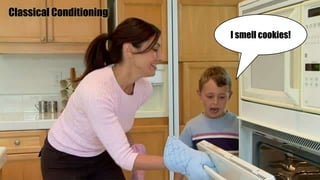
Classical Conditioning
I smell cookies!
TWO MAJOR TYPES OF CONDITIONING
CLASSICAL CONDITIONING
•RELIES ON A PARTICULAR STIMULUS
OR SIGNAL THAT PRODUCES A
PARTICULAR RESPONSE
OPERANT CONDITIONING
•USES A SYSTEM OF REWARDS AND/OR
PUNISHMENTS
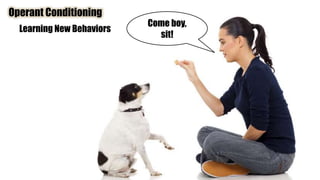
Operant Conditioning
Come boy,
sit!
Learning New Behaviors
Operant Conditioning
Good Boy!Learning New Behaviors
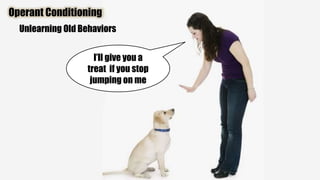
I’ll give you a
treat if you stop
jumping on me
Operant Conditioning
Unlearning Old Behaviors
BEHAVIOR MODIFICATION
•DOES NOT FOCUS ON WHY A PARTICULAR BEHAVIOR
STARTED
•IT FOCUSES ON CHANGING THE BEHAVIOR
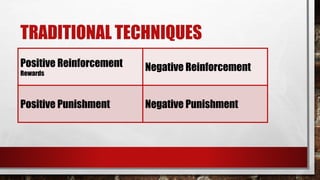
TRADITIONAL TECHNIQUES
Positive Reinforcement
Rewards
Negative Reinforcement
Positive Punishment Negative Punishment
“
”
REINFORCEMENT IS THE PROCESS IN
WHICH A BEHAVIOR IS STRENGTHEN BY
THE IMMEDIATE CONSEQUENCES THAT
RELIABLY FOLLOW ITS OCCURRENCE
(MILTENBERGER, 2008, P.73)
WHAT IS REINFORCEMENT?
POSITIVE REINFORCEMENT
REWARDS
A REWARD FOR DOING SOMETHING WELL
Positive Reinforcement/
Rewards: Giving a child
candy after cleaning up
their toys
NEGATIVE REINFORCEMENT
DOING SOMETHING WELL TO AVOID A PENALTY
Negative Reinforcement:
Cleaning up your room in
order to avoid getting
yelled at by your parents
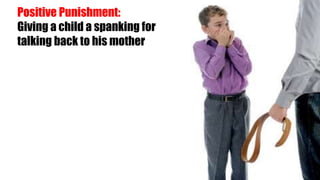
POSITIVE PUNISHMENT
A PENALTY FOR DOING SOMETHING YOU’RE NOT SUPPOSED TO DO
Positive Punishment:
Giving a child a spanking for
talking back to his mother
NEGATIVE PUNISHMENT
THE REMOVAL OF A REWARD FOR DOING SOMETHING YOU’RE NOT
SUPPOSED TO DO
nishment:
Not giving a child dessert if
they do not eat their broccoli
NEGATIVE REINFORCEMENT VS. PUNISHMENT
•NEGATIVE REINFORCEMENT IS NOT THE SAME THING AS “PUNISHMENT.”
•PUNISHMENT IMPLIES THAT YOU RECEIVE A PENALTY FOR DOING
SOMETHING YOU’RE NOT SUPPOSED TO DO
•WHEREAS NEGATIVE REINFORCEMENT IMPLIES NOT RECEIVING A PENALTY
FOR DOING SOMETHING
ORGANIZATIONAL BEHAVIOR MODIFICATION
•MODIFY EMPLOYEE BEHAVIOR AND ENCOURAGE PRODUCTIVITY
•USED TO ADJUST THE BEHAVIOR OF YOUR EMPLOYEES
•DEPARTMENT WIDE BEHAVIORAL CHANGE
•USE VARIOUS RESPONSES TO ENCOURAGE OR DISCOURAGE CERTAIN
BEHAVIORS
•RE-TEACHING THE EMPLOYEE HOW TO DRIVE IN-BETWEEN THE LINES
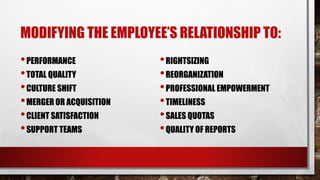
MODIFYING THE EMPLOYEE’S RELATIONSHIP TO:
•PERFORMANCE
•TOTAL QUALITY
•CULTURE SHIFT
•MERGER OR ACQUISITION
•CLIENT SATISFACTION
•SUPPORT TEAMS
•RIGHTSIZING
•REORGANIZATION
•PROFESSIONAL EMPOWERMENT
•TIMELINESS
•SALES QUOTAS
•QUALITY OF REPORTS
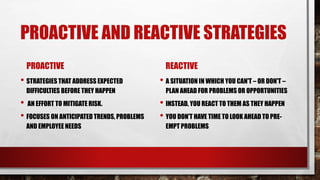
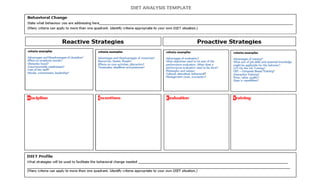
PROACTIVE AND REACTIVE STRATEGIES
PROACTIVE
• STRATEGIES THAT ADDRESS EXPECTED
DIFFICULTIES BEFORE THEY HAPPEN
• AN EFFORT TO MITIGATE RISK.
• FOCUSES ON ANTICIPATED TRENDS, PROBLEMS
AND EMPLOYEE NEEDS
REACTIVE
• A SITUATION IN WHICH YOU CAN'T – OR DON'T –
PLAN AHEAD FOR PROBLEMS OR OPPORTUNITIES
• INSTEAD, YOU REACT TO THEM AS THEY HAPPEN
• YOU DON'T HAVE TIME TO LOOK AHEAD TO PRE-
EMPT PROBLEMS
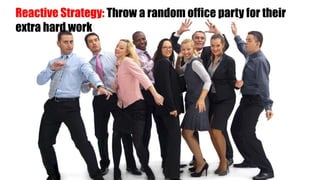
Reactive Strategy: Throw a random office party for their
extra hard work
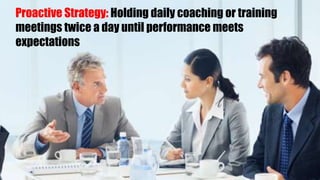
Proactive Strategy: Holding daily coaching or training
meetings twice a day until performance meets
expectations
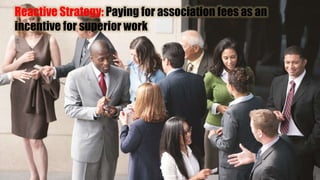
Reactive Strategy: Paying for association fees as an
incentive for superior work
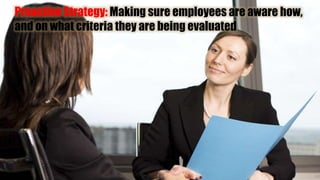
Proactive Strategy: Making sure employees are aware how,
and on what criteria they are being evaluated
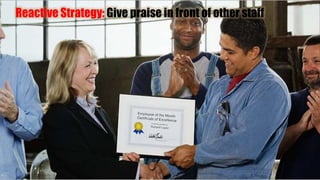
Reactive Strategy: Give praise in front of other staff
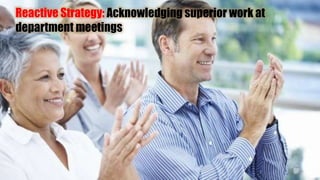
Reactive Strategy: Acknowledging superior work at
department meetings
Reactive Strategy: Ceasing required overtime when staff
regularly meet their sales quotas
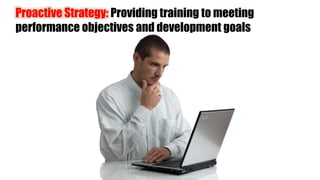
Proactive Strategy: Providing training to meeting
performance objectives and development goals
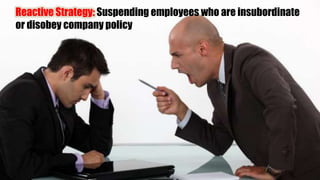
Reactive Strategy: Suspending employees who are insubordinate
or disobey company policy
Reactive Strategy: Requiring overtime when someone
misses their sales quota
PROBLEMATIC EMPLOYEES
•PROBLEMATIC EMPLOYEES CREATE NEGATIVE WORK ENVIRONMENTS AND
UNHEALTHY CONSEQUENCES FOR OTHER EMPLOYEES
•EMPLOYEES RESISTANCE TO CHANGE
•UNCLEAR EXPECTATIONS IN JOB ROLES
•NEED TO RELEARN THEIR JOBS OR CHANGE THE WAY THEY ARE DOING THINGS
•APATHY OR EMPLOYEES ARE UNMOTIVATED
PROBLEMATIC EMPLOYEES
•NEGATIVE EMOTIONS TOWARD THE ORGANIZATION.
•INSUBORDINATE CHALLENGES TO AUTHORITY
•LAZY, UNMOTIVATED
•OVERLY ARGUMENTATIVE
IDENTIFYING PROBLEMATIC TRENDS IN EMPLOYEES
•PROBLEMATIC EMPLOYEES CREATE NEW PROBLEMS FOR DEPARTMENTS
•DOESN’T FOLLOW DIRECTIONS
•INCOMPETENCE
•TAKES TOO LONG
•NERVOUS WORKER
• MANAGERIAL SUPPORT IS ESSENTIAL FOR TRANSFORMING POOR PERFORMERS INTO QUALITY
EMPLOYEES
• INSUFFICIENT PRODUCTION FROM A NORMALLY PRODUCTIVE EMPLOYEE IS A CONCERN FOR EVERY
MANAGER. DO NOT WRITE OFF EMPLOYEES WHO ARE STRUGGLING TO PRODUCE. AS A MANAGER, IT IS
YOUR RESPONSIBILITY TO IDENTIFY POOR PERFORMANCE AND MOTIVATE THE EMPLOYEE TO ACHIEVE THE
DESIRED GOAL
TRANSFORMATION
•TO ACHIEVE ANY SIGNIFICANT AND SUSTAINABLE IMPACT ON
PERFORMANCE, ORGANIZATIONS MUST FOCUS ON MODIFYING
THE BEHAVIOR OF EMPLOYEES (Spector, 2013)
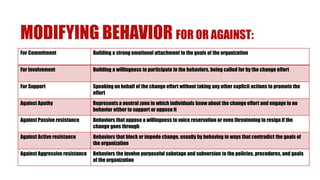
MODIFYING BEHAVIOR FOR OR AGAINST:
For Commitment Building a strong emotional attachment to the goals of the organization
For Involvement Building a willingness to participate in the behaviors, being called for by the change effort
For Support Speaking on behalf of the change effort without taking any other explicit actions to promote the
effort
Against Apathy Represents a neutral zone in which individuals know about the change effort and engage in no
behavior either to support or oppose it
Against Passive resistance Behaviors that oppose a willingness to voice reservation or even threatening to resign if the
change goes through
Against Active resistance Behaviors that block or impede change, usually by behaving in ways that contradict the goals of
the organization
Against Aggressive resistance Behaviors the involve purposeful sabotage and subversion to the policies, procedures, and goals
of the organization
Having powerful problem solving tools can make a huge
difference to your organization
A fundamental part of every manager's role is finding ways to solve them.
So, being a confident problem solver is really important to your success.
PROBLEM SOLVING TOOLS
• FOR DECADES, PEOPLE HAVE USED PROBLEM SOLVING TOOLS TO GENERATE IDEAS, AND TO COME UP WITH
CREATIVE SOLUTIONS TO PROBLEMS
• PROBLEM SOLVING TOOLS COMBINES A RELAXED, INFORMAL APPROACH TO PROBLEM SOLVING WITH LATERAL
THINKING
• IT ENCOURAGES MANAGERS TO COME UP WITH THOUGHTS AND SOLUTIONS THAT CAN, AT FIRST, SEEM A BIT
CRAZY
• SOME OF THESE SOLUTIONS CAN BE CRAFTED INTO ORIGINAL, CREATIVE SOLUTIONS TO A PROBLEM
• PROBLEM SOLVING TOOLS HELPS TO GET MANAGERS UNSTUCK BY "JOLTING" THEM OUT OF THEIR NORMAL
WAYS OF THINKING
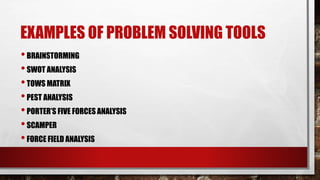
EXAMPLES OF PROBLEM SOLVING TOOLS
•BRAINSTORMING
•SWOT ANALYSIS
•TOWS MATRIX
•PEST ANALYSIS
•PORTER’S FIVE FORCES ANALYSIS
•SCAMPER
•FORCE FIELD ANALYSIS
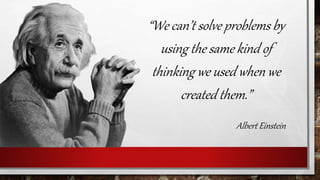
“We can’t solve problems by
using the same kind of
thinking we used when we
created them.”
Albert Einstein
REFERENCES
Bachrach, A. J., ed. (1962). Experimental Foundations of Clinical Psychology. New York: Basic Books. pp. 3–25.
Martin, G.; Pear, J. (2007). Behavior modification: What it is and how to do it (Eighth ed.). Upper Saddle River, NJ:
Pearson Prentice Hall. ISBN 978-0-13-194227-1.
Thorndike, E.L. (1911). Provisional Laws of Acquired Behavior or Learning. Animal Intelligence. New York: The
McMillian Company.
Wolpe, J. (1968). "Psychotheraphy by Reciprocal Inhibition". Conditional Reflex. 3 (4): 234–240.
doi:10.1007/BF03000093.

Handling problematic employees

  • 2.
    MY BACKGROUND • 7YEARS AS A UNIVERSITY ADMINISTRATOR • 15 YEARS AS AN ADJUNCT PROFESSOR OF HUMAN RESOURCE MANAGEMENT • 16 YEARS AS A HUMAN RESOURCE PROFESSIONAL (CONCURRENT) • PHD CANDIDATE – HIGHER EDUCATION ADMINISTRATION • MASTERS OF HUMAN RESOURCE MANAGEMENT
  • 3.
  • 4.
    Why do youthink your parents did that? Despite what we thought back then.
  • 5.
    It wasn’t because theyhated us or enjoyed watching us suffer through a week without television.
  • 6.
  • 7.
    They merely disapproved of ouractions and were hoping to prevent us from repeating them in our future
  • 8.
    BEHAVIOR MODIFICATION THE TECHNIQUESUSED TO TRY AND DECREASE OR INCREASE A PARTICULAR TYPE OF BEHAVIOR OR ACTION
  • 9.
    PARENTS USE BEHAVIORMODIFICATION TO TEACH THEIR CHILDREN FROM RIGHT AND WRONG You shouldn’t eat candy all day
  • 10.
    THERAPISTS USE BEHAVIORMODIFICATION TO ENCOURAGE HEALTHY BEHAVIORS IN THEIR PATIENTS
  • 11.
    ANIMAL TRAINERS USEBEHAVIOR MODIFICATION TO DEVELOP OBEDIENCE BETWEEN A PET AND THEIR OWNER Sit! Good Boy!
  • 12.
    WE EVEN USEBEHAVIOR MODIFICATION IN OUR ORGANIZATIONS AND BUSINESSES WITH OUR EMPLOYEES IN ALL DEPARTMENTS You need to arrive at work on time!
  • 13.
    LIST OF ITEMS •BEHAVIOR MODIFICATION • BEHAVIOR MODIFICATION IN ORGANIZATIONS • PROBLEMATIC EMPLOYEES • USING BEHAVIOR MODIFICATION FOR PROBLEMATIC EMPLOYEES • USING PROBLEM SOLVING TOOLS AT WORK • A NEW PROBLEM SOLVING APPROACH FOR PROBLEMATIC EMPLOYEES
  • 14.
    BEHAVIOR MODIFICATION •THE FIRSTUSE OF THE TERM BEHAVIOR MODIFICATION APPEARS TO IN 1911. IN THORNDIKE’S ARTICLE PROVISIONAL LAWS OF ACQUIRED BEHAVIOR OR LEARNING , WHICH MAKES FREQUENT USE OF THE TERM "MODIFYING BEHAVIOR” •SKINNER’S BOOK THE BEHAVIOR OF ORGANISMS, PUBLISHED IN 1938, INITIATED THE STUDY OF OPERANT CONDITIONING AND ITS APPLICATION TO HUMAN AND ANIMAL BEHAVIOR.
  • 15.
    BEHAVIOR MODIFICATION •THROUGH EARLYRESEARCH IN THE 1940S AND THE 1950S THE TERM WAS USED BY JOSEPH WOLPE'S RESEARCH GROUP. •THE EXPERIMENTAL TRADITION IN CLINICAL PSYCHOLOGY USED IT TO REFER TO PSYCHO-THERAPEUTIC TECHNIQUES DERIVED FROM EMPIRICAL RESEARCH •IT HAS SINCE COME TO REFER MAINLY TO TECHNIQUES FOR INCREASING ADAPTIVE BEHAVIOR THROUGH REINFORCEMENT AND DECREASING MALADAPTIVE BEHAVIOR THROUGH EXTINCTION OR PUNISHMENT
  • 16.
    BEHAVIOR MODIFICATION •BEHAVIOR MODIFICATIONRELIES ON THE CONCEPT OF CONDITIONING •CONDITIONING IS A FORM OF LEARNING
  • 17.
    TWO MAJOR TYPESOF CONDITIONING CLASSICAL CONDITIONING •RELIES ON A PARTICULAR STIMULUS OR SIGNAL THAT PRODUCES A PARTICULAR RESPONSE OPERANT CONDITIONING
  • 18.
  • 19.
    TWO MAJOR TYPESOF CONDITIONING CLASSICAL CONDITIONING •RELIES ON A PARTICULAR STIMULUS OR SIGNAL THAT PRODUCES A PARTICULAR RESPONSE OPERANT CONDITIONING •USES A SYSTEM OF REWARDS AND/OR PUNISHMENTS
  • 20.
  • 21.
  • 22.
    I’ll give youa treat if you stop jumping on me Operant Conditioning Unlearning Old Behaviors
  • 23.
    BEHAVIOR MODIFICATION •DOES NOTFOCUS ON WHY A PARTICULAR BEHAVIOR STARTED •IT FOCUSES ON CHANGING THE BEHAVIOR
  • 24.
    TRADITIONAL TECHNIQUES Positive Reinforcement Rewards NegativeReinforcement Positive Punishment Negative Punishment
  • 25.
    “ ” REINFORCEMENT IS THEPROCESS IN WHICH A BEHAVIOR IS STRENGTHEN BY THE IMMEDIATE CONSEQUENCES THAT RELIABLY FOLLOW ITS OCCURRENCE (MILTENBERGER, 2008, P.73) WHAT IS REINFORCEMENT?
  • 26.
  • 27.
    Positive Reinforcement/ Rewards: Givinga child candy after cleaning up their toys
  • 28.
  • 29.
    Negative Reinforcement: Cleaning upyour room in order to avoid getting yelled at by your parents
  • 30.
    POSITIVE PUNISHMENT A PENALTYFOR DOING SOMETHING YOU’RE NOT SUPPOSED TO DO
  • 31.
    Positive Punishment: Giving achild a spanking for talking back to his mother
  • 32.
    NEGATIVE PUNISHMENT THE REMOVALOF A REWARD FOR DOING SOMETHING YOU’RE NOT SUPPOSED TO DO
  • 33.
    nishment: Not giving achild dessert if they do not eat their broccoli
  • 34.
    NEGATIVE REINFORCEMENT VS.PUNISHMENT •NEGATIVE REINFORCEMENT IS NOT THE SAME THING AS “PUNISHMENT.” •PUNISHMENT IMPLIES THAT YOU RECEIVE A PENALTY FOR DOING SOMETHING YOU’RE NOT SUPPOSED TO DO •WHEREAS NEGATIVE REINFORCEMENT IMPLIES NOT RECEIVING A PENALTY FOR DOING SOMETHING
  • 35.
    ORGANIZATIONAL BEHAVIOR MODIFICATION •MODIFYEMPLOYEE BEHAVIOR AND ENCOURAGE PRODUCTIVITY •USED TO ADJUST THE BEHAVIOR OF YOUR EMPLOYEES •DEPARTMENT WIDE BEHAVIORAL CHANGE •USE VARIOUS RESPONSES TO ENCOURAGE OR DISCOURAGE CERTAIN BEHAVIORS •RE-TEACHING THE EMPLOYEE HOW TO DRIVE IN-BETWEEN THE LINES
  • 36.
    MODIFYING THE EMPLOYEE’SRELATIONSHIP TO: •PERFORMANCE •TOTAL QUALITY •CULTURE SHIFT •MERGER OR ACQUISITION •CLIENT SATISFACTION •SUPPORT TEAMS •RIGHTSIZING •REORGANIZATION •PROFESSIONAL EMPOWERMENT •TIMELINESS •SALES QUOTAS •QUALITY OF REPORTS
  • 37.
    PROACTIVE AND REACTIVESTRATEGIES PROACTIVE • STRATEGIES THAT ADDRESS EXPECTED DIFFICULTIES BEFORE THEY HAPPEN • AN EFFORT TO MITIGATE RISK. • FOCUSES ON ANTICIPATED TRENDS, PROBLEMS AND EMPLOYEE NEEDS REACTIVE • A SITUATION IN WHICH YOU CAN'T – OR DON'T – PLAN AHEAD FOR PROBLEMS OR OPPORTUNITIES • INSTEAD, YOU REACT TO THEM AS THEY HAPPEN • YOU DON'T HAVE TIME TO LOOK AHEAD TO PRE- EMPT PROBLEMS
  • 38.
    Reactive Strategy: Throwa random office party for their extra hard work
  • 39.
    Proactive Strategy: Holdingdaily coaching or training meetings twice a day until performance meets expectations
  • 40.
    Reactive Strategy: Payingfor association fees as an incentive for superior work
  • 41.
    Proactive Strategy: Makingsure employees are aware how, and on what criteria they are being evaluated
  • 42.
    Reactive Strategy: Givepraise in front of other staff
  • 43.
    Reactive Strategy: Acknowledgingsuperior work at department meetings
  • 44.
    Reactive Strategy: Ceasingrequired overtime when staff regularly meet their sales quotas
  • 45.
    Proactive Strategy: Providingtraining to meeting performance objectives and development goals
  • 46.
    Reactive Strategy: Suspendingemployees who are insubordinate or disobey company policy
  • 47.
    Reactive Strategy: Requiringovertime when someone misses their sales quota
  • 48.
    PROBLEMATIC EMPLOYEES •PROBLEMATIC EMPLOYEESCREATE NEGATIVE WORK ENVIRONMENTS AND UNHEALTHY CONSEQUENCES FOR OTHER EMPLOYEES •EMPLOYEES RESISTANCE TO CHANGE •UNCLEAR EXPECTATIONS IN JOB ROLES •NEED TO RELEARN THEIR JOBS OR CHANGE THE WAY THEY ARE DOING THINGS •APATHY OR EMPLOYEES ARE UNMOTIVATED
  • 49.
    PROBLEMATIC EMPLOYEES •NEGATIVE EMOTIONSTOWARD THE ORGANIZATION. •INSUBORDINATE CHALLENGES TO AUTHORITY •LAZY, UNMOTIVATED •OVERLY ARGUMENTATIVE
  • 50.
    IDENTIFYING PROBLEMATIC TRENDSIN EMPLOYEES •PROBLEMATIC EMPLOYEES CREATE NEW PROBLEMS FOR DEPARTMENTS •DOESN’T FOLLOW DIRECTIONS •INCOMPETENCE •TAKES TOO LONG •NERVOUS WORKER
  • 51.
    • MANAGERIAL SUPPORTIS ESSENTIAL FOR TRANSFORMING POOR PERFORMERS INTO QUALITY EMPLOYEES • INSUFFICIENT PRODUCTION FROM A NORMALLY PRODUCTIVE EMPLOYEE IS A CONCERN FOR EVERY MANAGER. DO NOT WRITE OFF EMPLOYEES WHO ARE STRUGGLING TO PRODUCE. AS A MANAGER, IT IS YOUR RESPONSIBILITY TO IDENTIFY POOR PERFORMANCE AND MOTIVATE THE EMPLOYEE TO ACHIEVE THE DESIRED GOAL
  • 52.
    TRANSFORMATION •TO ACHIEVE ANYSIGNIFICANT AND SUSTAINABLE IMPACT ON PERFORMANCE, ORGANIZATIONS MUST FOCUS ON MODIFYING THE BEHAVIOR OF EMPLOYEES (Spector, 2013)
  • 53.
    MODIFYING BEHAVIOR FOROR AGAINST: For Commitment Building a strong emotional attachment to the goals of the organization For Involvement Building a willingness to participate in the behaviors, being called for by the change effort For Support Speaking on behalf of the change effort without taking any other explicit actions to promote the effort Against Apathy Represents a neutral zone in which individuals know about the change effort and engage in no behavior either to support or oppose it Against Passive resistance Behaviors that oppose a willingness to voice reservation or even threatening to resign if the change goes through Against Active resistance Behaviors that block or impede change, usually by behaving in ways that contradict the goals of the organization Against Aggressive resistance Behaviors the involve purposeful sabotage and subversion to the policies, procedures, and goals of the organization
  • 54.
    Having powerful problemsolving tools can make a huge difference to your organization A fundamental part of every manager's role is finding ways to solve them. So, being a confident problem solver is really important to your success.
  • 55.
    PROBLEM SOLVING TOOLS •FOR DECADES, PEOPLE HAVE USED PROBLEM SOLVING TOOLS TO GENERATE IDEAS, AND TO COME UP WITH CREATIVE SOLUTIONS TO PROBLEMS • PROBLEM SOLVING TOOLS COMBINES A RELAXED, INFORMAL APPROACH TO PROBLEM SOLVING WITH LATERAL THINKING • IT ENCOURAGES MANAGERS TO COME UP WITH THOUGHTS AND SOLUTIONS THAT CAN, AT FIRST, SEEM A BIT CRAZY • SOME OF THESE SOLUTIONS CAN BE CRAFTED INTO ORIGINAL, CREATIVE SOLUTIONS TO A PROBLEM • PROBLEM SOLVING TOOLS HELPS TO GET MANAGERS UNSTUCK BY "JOLTING" THEM OUT OF THEIR NORMAL WAYS OF THINKING
  • 56.
    EXAMPLES OF PROBLEMSOLVING TOOLS •BRAINSTORMING •SWOT ANALYSIS •TOWS MATRIX •PEST ANALYSIS •PORTER’S FIVE FORCES ANALYSIS •SCAMPER •FORCE FIELD ANALYSIS
  • 57.
    “We can’t solveproblems by using the same kind of thinking we used when we created them.” Albert Einstein
  • 59.
    REFERENCES Bachrach, A. J.,ed. (1962). Experimental Foundations of Clinical Psychology. New York: Basic Books. pp. 3–25. Martin, G.; Pear, J. (2007). Behavior modification: What it is and how to do it (Eighth ed.). Upper Saddle River, NJ: Pearson Prentice Hall. ISBN 978-0-13-194227-1. Thorndike, E.L. (1911). Provisional Laws of Acquired Behavior or Learning. Animal Intelligence. New York: The McMillian Company. Wolpe, J. (1968). "Psychotheraphy by Reciprocal Inhibition". Conditional Reflex. 3 (4): 234–240. doi:10.1007/BF03000093.

Editor's Notes

  • #49 • Negative emotions toward the organization. There are always those employees who are quick to make negative comments about upper management or coworkers. These negative feelings contradict the overall mission of the organization and may cause other employees to have negative feelings as well. • Insubordinate challenges to authority. There are many times when employees refuse to do what they are asked in order to prove a point or make a statement. These employees have no respect for you and will likely lose the trust of their peers. • Lazy, unmotivated. These employees spend most of their day goofing off and distracting other employees. • Overly argumentative. Employees who are looking to pick a fight put coworkers on edge and create a high level of discomfort in the workplace.
  • #50 • Negative emotions toward the organization. There are always those employees who are quick to make negative comments about upper management or coworkers. These negative feelings contradict the overall mission of the organization and may cause other employees to have negative feelings as well. • Insubordinate challenges to authority. There are many times when employees refuse to do what they are asked in order to prove a point or make a statement. These employees have no respect for you and will likely lose the trust of their peers. • Lazy, unmotivated. These employees spend most of their day goofing off and distracting other employees. • Overly argumentative. Employees who are looking to pick a fight put coworkers on edge and create a high level of discomfort in the workplace.
  • #51 Doesn’t follow directions. An employee who doesn’t follow directions well is always someone who is difficult to manage. He makes his own rules and can’t be trusted to complete important tasks. • Incompetence. An incompetent employee makes mistakes, is disorganized, and has a hard time learning new concepts. He may be overwhelmed by a new job assignment or by having to adapt to something new. • Takes too long. Timeliness wouldn’t be a major problem to manage if it only involved one employee, but you may have five other employees who can’t do their jobs until the slowmoving employee does his. • Nervous worker. A nervous employee has a difficult time dealing with the stress and pressure of his job. If you manage in a highly competitive industry, nervous workers who are concerned about issues such as job security and meeting sales quotas could drag down performance.
  • #52 Insufficient production from a normally productive employee is a concern for every manager. Do not write off employees who are struggling to produce. As a manager, it is your responsibility to identify poor performance and motivate the employee to achieve the desired goal. Keeping in mind the reasons for poor performance that we identified previously, here are some proposed solutions to those problems: • Communicate directions clearly. For the employee who struggles to follow directions, try communicating those directions in a more detailed or concrete way. • Explain the expectations better. An incompetent employee needs to learn more about what is expected of him. Take a step back and explain the expectations of the job and his role in the team and the organization. • Provide additional training. If an employee has a difficult time organizing his work, provide a specific training day to help him learn how to organize better. • Use other team members. If an employee continues to work at a slow pace, assign a more experienced team member to work with him. Providing extra help and support will help speed up his processes. If additional support and training do not help the employee achieve more success at work, there is probably a poor fit between the employee and the job. Assessments can help managers identify job fit and provide suggested jobs for each employee.