Theoretical Frameworks to Deter Academic
Misconduct in the Classroom
Richard Dettling MSHRM, PHR
Program Manager and Professor
University of Phoenix
1.To learn the difference between academic integrity and academic
misconduct
2.To review the research on academic misconduct
3.To learn the difference between traditional cheating and contemporary
cheating
4.To learn students intrinsic and extrinsic motivations for learning and
studying
5.To learn how human relations theory determines whether students are
academically honest or dishonest
6.To learn the human relations strategies to deter student academic
misconduct
• The pursuit of scholarly activity in an open, honest and
responsible manner.
• Academic integrity is a basic guiding principle for all
academic activity… and all members of the [education]
community are expected to act in accordance with this
principle.
• Consistent with this expectation…all students should act
with personal integrity, respect other students’ dignity,
rights and property, and help create and maintain an
environment in which all can succeed through the fruits of
their efforts (University, 2014).
What is
Academic
Integrity?
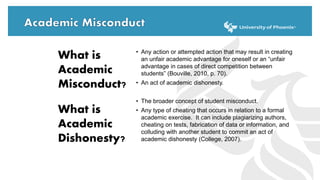
• Any action or attempted action that may result in creating
an unfair academic advantage for oneself or an “unfair
advantage in cases of direct competition between
students” (Bouville, 2010, p. 70).
• An act of academic dishonesty.
• The broader concept of student misconduct.
• Any type of cheating that occurs in relation to a formal
academic exercise. It can include plagiarizing authors,
cheating on tests, fabrication of data or information, and
colluding with another student to commit an act of
academic dishonesty (College, 2007).
What is
Academic
Misconduct?
What is
Academic
Dishonesty?
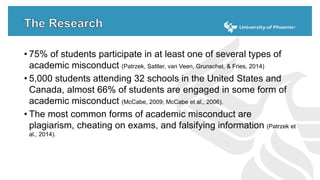
• 75% of students participate in at least one of several types of
academic misconduct (Patrzek, Sattler, van Veen, Grunschel, & Fries, 2014)
• 5,000 students attending 32 schools in the United States and
Canada, almost 66% of students are engaged in some form of
academic misconduct (McCabe, 2009; McCabe et al., 2006).
• The most common forms of academic misconduct are
plagiarism, cheating on exams, and falsifying information (Patrzek et
al., 2014).
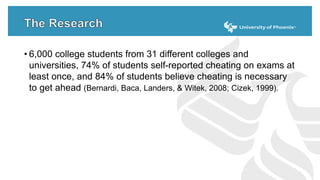
• 6,000 college students from 31 different colleges and
universities, 74% of students self-reported cheating on exams at
least once, and 84% of students believe cheating is necessary
to get ahead (Bernardi, Baca, Landers, & Witek, 2008; Cizek, 1999).
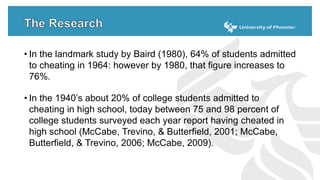
• In the landmark study by Baird (1980), 64% of students admitted
to cheating in 1964: however by 1980, that figure increases to
76%.
• In the 1940’s about 20% of college students admitted to
cheating in high school, today between 75 and 98 percent of
college students surveyed each year report having cheated in
high school (McCabe, Trevino, & Butterfield, 2001; McCabe,
Butterfield, & Trevino, 2006; McCabe, 2009).
• Dishonesty is common among students of all ages.
–Researchers have found that cheating begins in elementary school.
–When children break or bend the rules to win competitive games against
classmates (Anderman & Murdock, 2006; Ariely, 2013; Cizek, 2003).
–Cheating peaks during high school when about 75% of students admit to
some sort of academic misconduct ("Academic Cheating Fact Sheet,"
1999).
A. Plagiarism
B. Self-plagiarism,
C. Double dipping, or dovetailing
D. Fabrication
E. Unauthorized Assistance
F. Copyright infringement
G. Misrepresentation
H. Collusion
Traditional cheating methods
include cheating inside of the
classroom, cheating outside of the
classroom, and plagiarism”
(Witherspoon et al., 2010)
The submission of work that is not
one’s own
The giving or receiving of illegal aid
from other persons or material or
from materials brought into the
classroom by [the student] (such as
looking at someone else’s paper or
“cheat sheets”);
The use of prior knowledge of the
contents of the test or quiz without
authorization from the instructor
(Burrus et al, 2007).
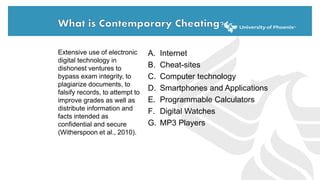
A. Internet
B. Cheat-sites
C. Computer technology
D. Smartphones and Applications
E. Programmable Calculators
F. Digital Watches
G. MP3 Players
Extensive use of electronic
digital technology in
dishonest ventures to
bypass exam integrity, to
plagiarize documents, to
falsify records, to attempt to
improve grades as well as
distribute information and
facts intended as
confidential and secure
(Witherspoon et al., 2010).
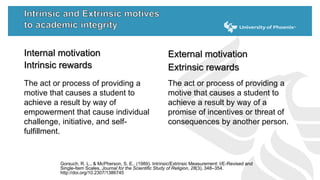
Internal motivation
Intrinsic rewards
External motivation
Extrinsic rewards
The act or process of providing a
motive that causes a student to
achieve a result by way of
empowerment that cause individual
challenge, initiative, and self-
fulfillment.
The act or process of providing a
motive that causes a student to
achieve a result by way of a
promise of incentives or threat of
consequences by another person.
Gorsuch, R. L., & McPherson, S. E.. (1989). Intrinsic/Extrinsic Measurement: I/E-Revised and
Single-Item Scales. Journal for the Scientific Study of Religion, 28(3), 348–354.
http://doi.org/10.2307/1386745
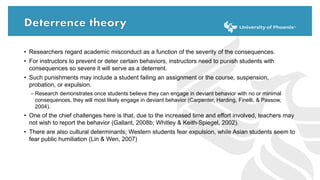
• Researchers regard academic misconduct as a function of the severity of the consequences.
• For instructors to prevent or deter certain behaviors, instructors need to punish students with
consequences so severe it will serve as a deterrent.
• Such punishments may include a student failing an assignment or the course, suspension,
probation, or expulsion.
– Research demonstrates once students believe they can engage in deviant behavior with no or minimal
consequences, they will most likely engage in deviant behavior (Carpenter, Harding, Finelli, & Passow,
2004).
• One of the chief challenges here is that, due to the increased time and effort involved, teachers may
not wish to report the behavior (Gallant, 2008b; Whitley & Keith-Spiegel, 2002).
• There are also cultural determinants; Western students fear expulsion, while Asian students seem to
fear public humiliation (Lin & Wen, 2007)
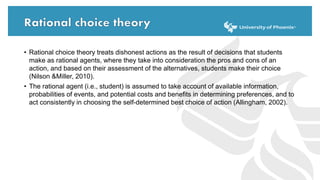
• Rational choice theory treats dishonest actions as the result of decisions that students
make as rational agents, where they take into consideration the pros and cons of an
action, and based on their assessment of the alternatives, students make their choice
(Nilson &Miller, 2010).
• The rational agent (i.e., student) is assumed to take account of available information,
probabilities of events, and potential costs and benefits in determining preferences, and to
act consistently in choosing the self-determined best choice of action (Allingham, 2002).
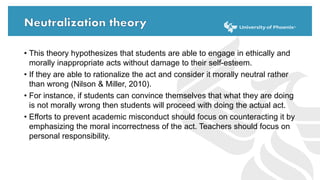
• This theory hypothesizes that students are able to engage in ethically and
morally inappropriate acts without damage to their self-esteem.
• If they are able to rationalize the act and consider it morally neutral rather
than wrong (Nilson & Miller, 2010).
• For instance, if students can convince themselves that what they are doing
is not morally wrong then students will proceed with doing the actual act.
• Efforts to prevent academic misconduct should focus on counteracting it by
emphasizing the moral incorrectness of the act. Teachers should focus on
personal responsibility.
• Academic misconduct happens because of the opportunity to cheat as well
as the intention to cheat (Nilson & Miller, 2010).
• Teachers need to take efforts to reduce the opportunity to cheat by
increasing vigilance during exams and using additional proctors and exam
versions, and by increasing education on the value of integrity and honesty.
• This theory resembles rational choice theory and is a direct outgrowth of
John Stuart Mills and his initial utilitarianism (Nilson & Miller, 2010).
• Each student has to weight the specifics of his or her situation;
–Students take into consideration alternatives of academic misconduct and
deduce whether or not the risks of academic misconduct are worth the
potential benefit.
• Each student will bring his or her specific issues into consideration
therefore making academic misconduct hard to address.
www.slideshare.net/profrichdett
Questions

Theoretical Frameworks to Deter Academic Misconduct in the Classroom

  • 1.
    Theoretical Frameworks toDeter Academic Misconduct in the Classroom Richard Dettling MSHRM, PHR Program Manager and Professor University of Phoenix
  • 2.
    1.To learn thedifference between academic integrity and academic misconduct 2.To review the research on academic misconduct 3.To learn the difference between traditional cheating and contemporary cheating 4.To learn students intrinsic and extrinsic motivations for learning and studying 5.To learn how human relations theory determines whether students are academically honest or dishonest 6.To learn the human relations strategies to deter student academic misconduct
  • 3.
    • The pursuitof scholarly activity in an open, honest and responsible manner. • Academic integrity is a basic guiding principle for all academic activity… and all members of the [education] community are expected to act in accordance with this principle. • Consistent with this expectation…all students should act with personal integrity, respect other students’ dignity, rights and property, and help create and maintain an environment in which all can succeed through the fruits of their efforts (University, 2014). What is Academic Integrity?
  • 4.
    • Any actionor attempted action that may result in creating an unfair academic advantage for oneself or an “unfair advantage in cases of direct competition between students” (Bouville, 2010, p. 70). • An act of academic dishonesty. • The broader concept of student misconduct. • Any type of cheating that occurs in relation to a formal academic exercise. It can include plagiarizing authors, cheating on tests, fabrication of data or information, and colluding with another student to commit an act of academic dishonesty (College, 2007). What is Academic Misconduct? What is Academic Dishonesty?
  • 5.
    • 75% ofstudents participate in at least one of several types of academic misconduct (Patrzek, Sattler, van Veen, Grunschel, & Fries, 2014) • 5,000 students attending 32 schools in the United States and Canada, almost 66% of students are engaged in some form of academic misconduct (McCabe, 2009; McCabe et al., 2006). • The most common forms of academic misconduct are plagiarism, cheating on exams, and falsifying information (Patrzek et al., 2014).
  • 6.
    • 6,000 collegestudents from 31 different colleges and universities, 74% of students self-reported cheating on exams at least once, and 84% of students believe cheating is necessary to get ahead (Bernardi, Baca, Landers, & Witek, 2008; Cizek, 1999).
  • 7.
    • In thelandmark study by Baird (1980), 64% of students admitted to cheating in 1964: however by 1980, that figure increases to 76%. • In the 1940’s about 20% of college students admitted to cheating in high school, today between 75 and 98 percent of college students surveyed each year report having cheated in high school (McCabe, Trevino, & Butterfield, 2001; McCabe, Butterfield, & Trevino, 2006; McCabe, 2009).
  • 8.
    • Dishonesty iscommon among students of all ages. –Researchers have found that cheating begins in elementary school. –When children break or bend the rules to win competitive games against classmates (Anderman & Murdock, 2006; Ariely, 2013; Cizek, 2003). –Cheating peaks during high school when about 75% of students admit to some sort of academic misconduct ("Academic Cheating Fact Sheet," 1999).
  • 9.
    A. Plagiarism B. Self-plagiarism, C.Double dipping, or dovetailing D. Fabrication E. Unauthorized Assistance F. Copyright infringement G. Misrepresentation H. Collusion Traditional cheating methods include cheating inside of the classroom, cheating outside of the classroom, and plagiarism” (Witherspoon et al., 2010) The submission of work that is not one’s own The giving or receiving of illegal aid from other persons or material or from materials brought into the classroom by [the student] (such as looking at someone else’s paper or “cheat sheets”); The use of prior knowledge of the contents of the test or quiz without authorization from the instructor (Burrus et al, 2007).
  • 10.
    A. Internet B. Cheat-sites C.Computer technology D. Smartphones and Applications E. Programmable Calculators F. Digital Watches G. MP3 Players Extensive use of electronic digital technology in dishonest ventures to bypass exam integrity, to plagiarize documents, to falsify records, to attempt to improve grades as well as distribute information and facts intended as confidential and secure (Witherspoon et al., 2010).
  • 11.
    Internal motivation Intrinsic rewards Externalmotivation Extrinsic rewards The act or process of providing a motive that causes a student to achieve a result by way of empowerment that cause individual challenge, initiative, and self- fulfillment. The act or process of providing a motive that causes a student to achieve a result by way of a promise of incentives or threat of consequences by another person. Gorsuch, R. L., & McPherson, S. E.. (1989). Intrinsic/Extrinsic Measurement: I/E-Revised and Single-Item Scales. Journal for the Scientific Study of Religion, 28(3), 348–354. http://doi.org/10.2307/1386745
  • 15.
    • Researchers regardacademic misconduct as a function of the severity of the consequences. • For instructors to prevent or deter certain behaviors, instructors need to punish students with consequences so severe it will serve as a deterrent. • Such punishments may include a student failing an assignment or the course, suspension, probation, or expulsion. – Research demonstrates once students believe they can engage in deviant behavior with no or minimal consequences, they will most likely engage in deviant behavior (Carpenter, Harding, Finelli, & Passow, 2004). • One of the chief challenges here is that, due to the increased time and effort involved, teachers may not wish to report the behavior (Gallant, 2008b; Whitley & Keith-Spiegel, 2002). • There are also cultural determinants; Western students fear expulsion, while Asian students seem to fear public humiliation (Lin & Wen, 2007)
  • 17.
    • Rational choicetheory treats dishonest actions as the result of decisions that students make as rational agents, where they take into consideration the pros and cons of an action, and based on their assessment of the alternatives, students make their choice (Nilson &Miller, 2010). • The rational agent (i.e., student) is assumed to take account of available information, probabilities of events, and potential costs and benefits in determining preferences, and to act consistently in choosing the self-determined best choice of action (Allingham, 2002).
  • 19.
    • This theoryhypothesizes that students are able to engage in ethically and morally inappropriate acts without damage to their self-esteem. • If they are able to rationalize the act and consider it morally neutral rather than wrong (Nilson & Miller, 2010). • For instance, if students can convince themselves that what they are doing is not morally wrong then students will proceed with doing the actual act. • Efforts to prevent academic misconduct should focus on counteracting it by emphasizing the moral incorrectness of the act. Teachers should focus on personal responsibility.
  • 21.
    • Academic misconducthappens because of the opportunity to cheat as well as the intention to cheat (Nilson & Miller, 2010). • Teachers need to take efforts to reduce the opportunity to cheat by increasing vigilance during exams and using additional proctors and exam versions, and by increasing education on the value of integrity and honesty.
  • 23.
    • This theoryresembles rational choice theory and is a direct outgrowth of John Stuart Mills and his initial utilitarianism (Nilson & Miller, 2010). • Each student has to weight the specifics of his or her situation; –Students take into consideration alternatives of academic misconduct and deduce whether or not the risks of academic misconduct are worth the potential benefit. • Each student will bring his or her specific issues into consideration therefore making academic misconduct hard to address.
  • 24.