Educational Games and SimulationsLauren BeckTaylor FieldsLynee FlemingRachel OwensChristine Wilson
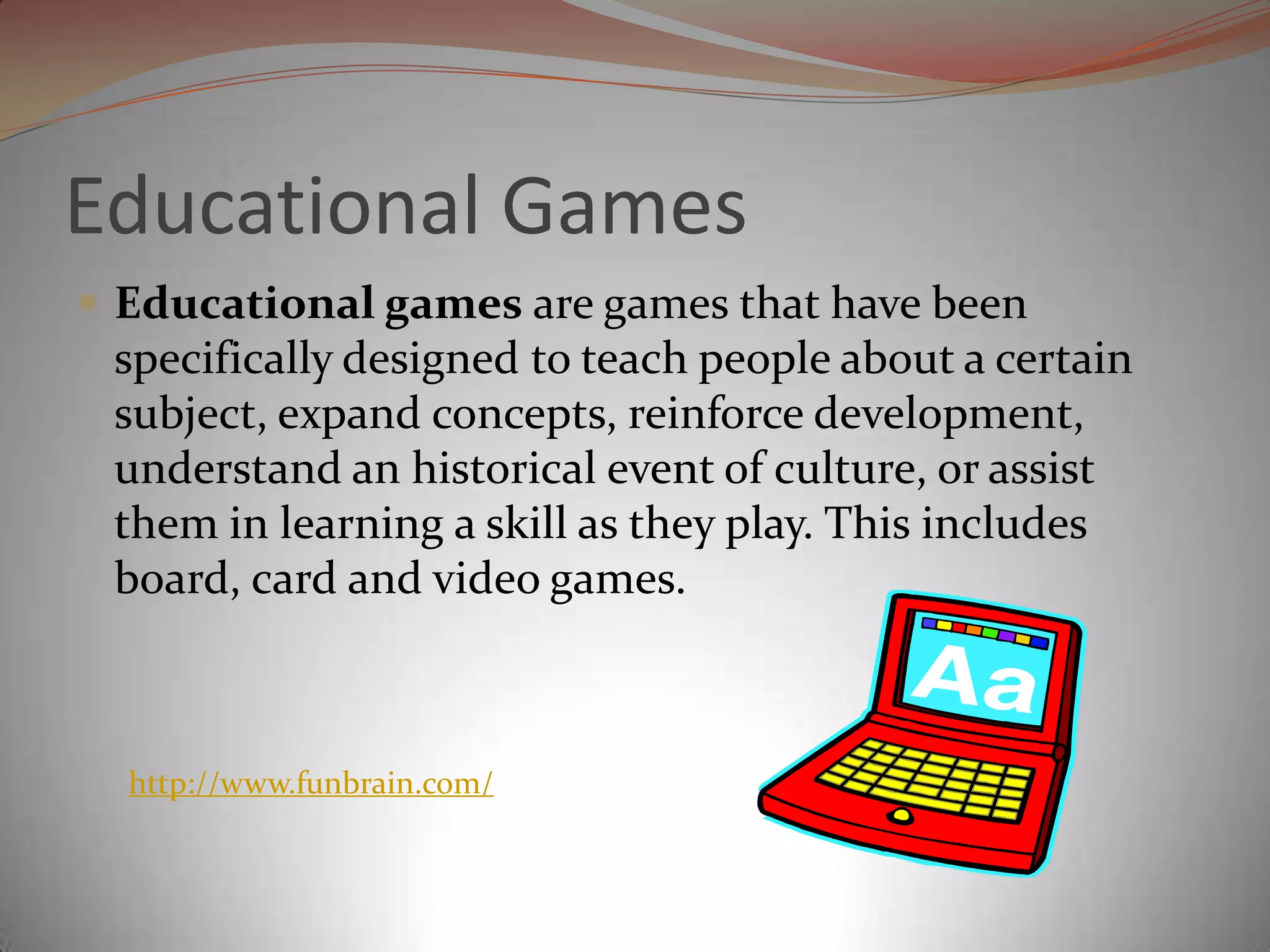
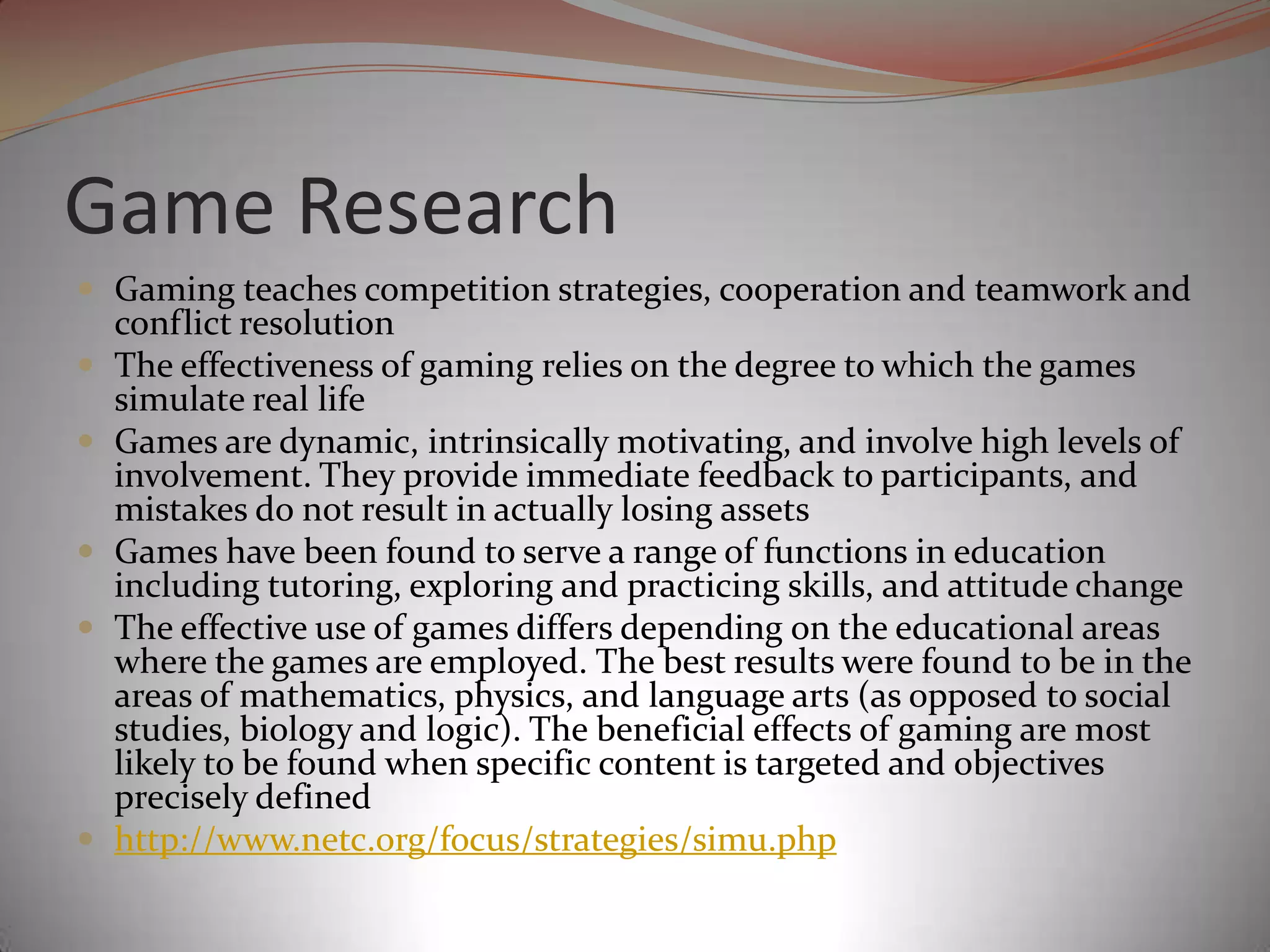
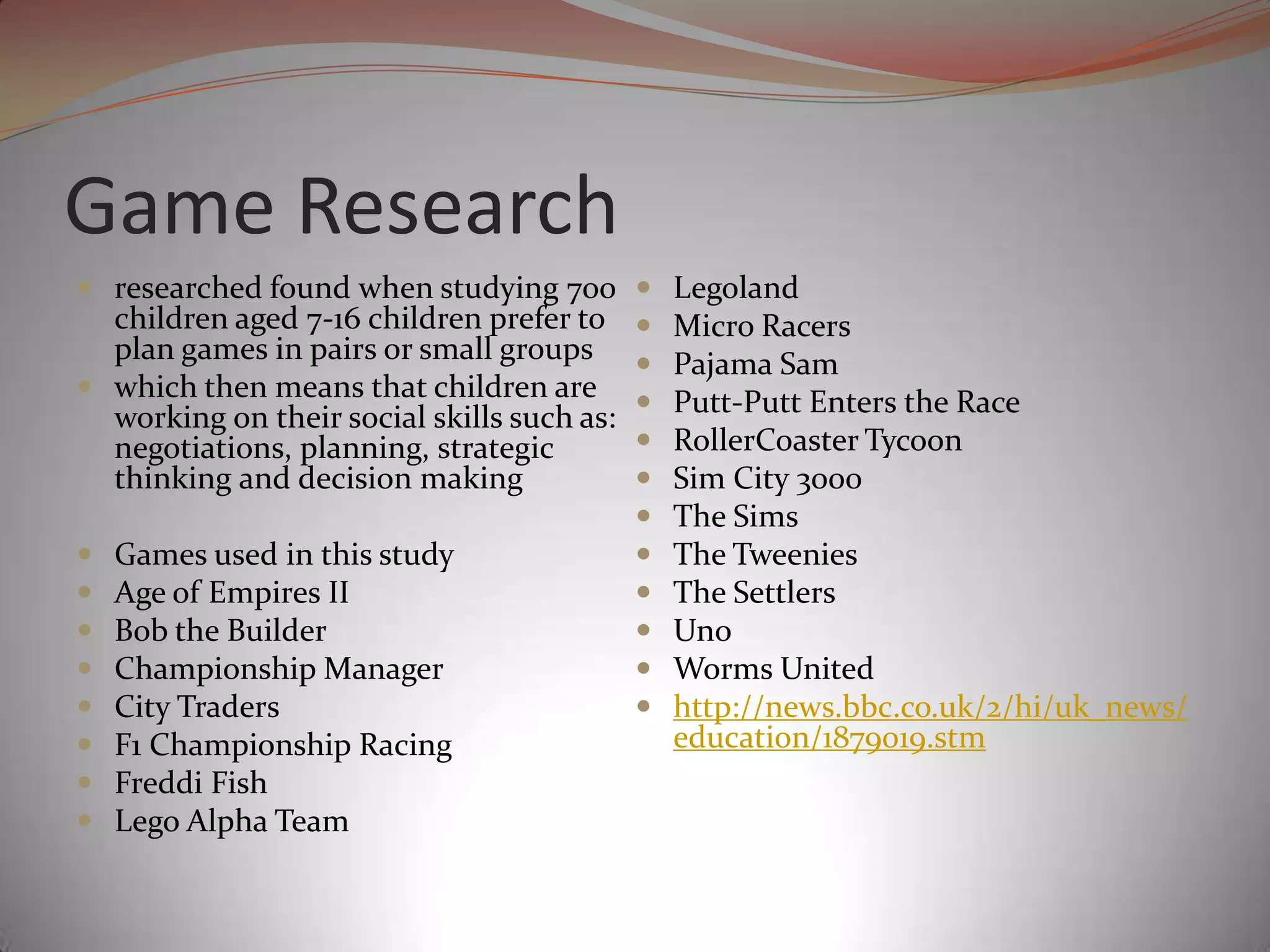
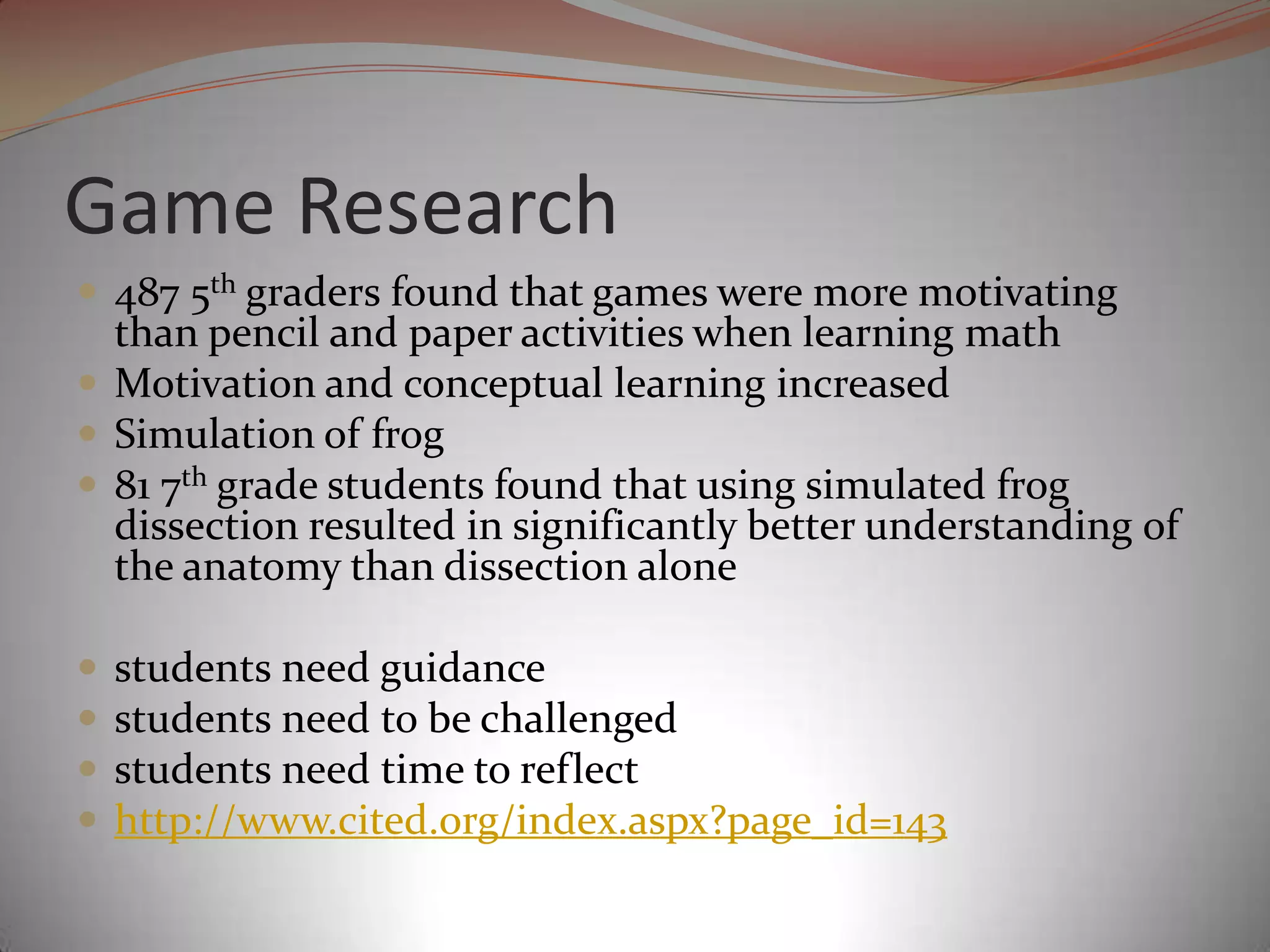
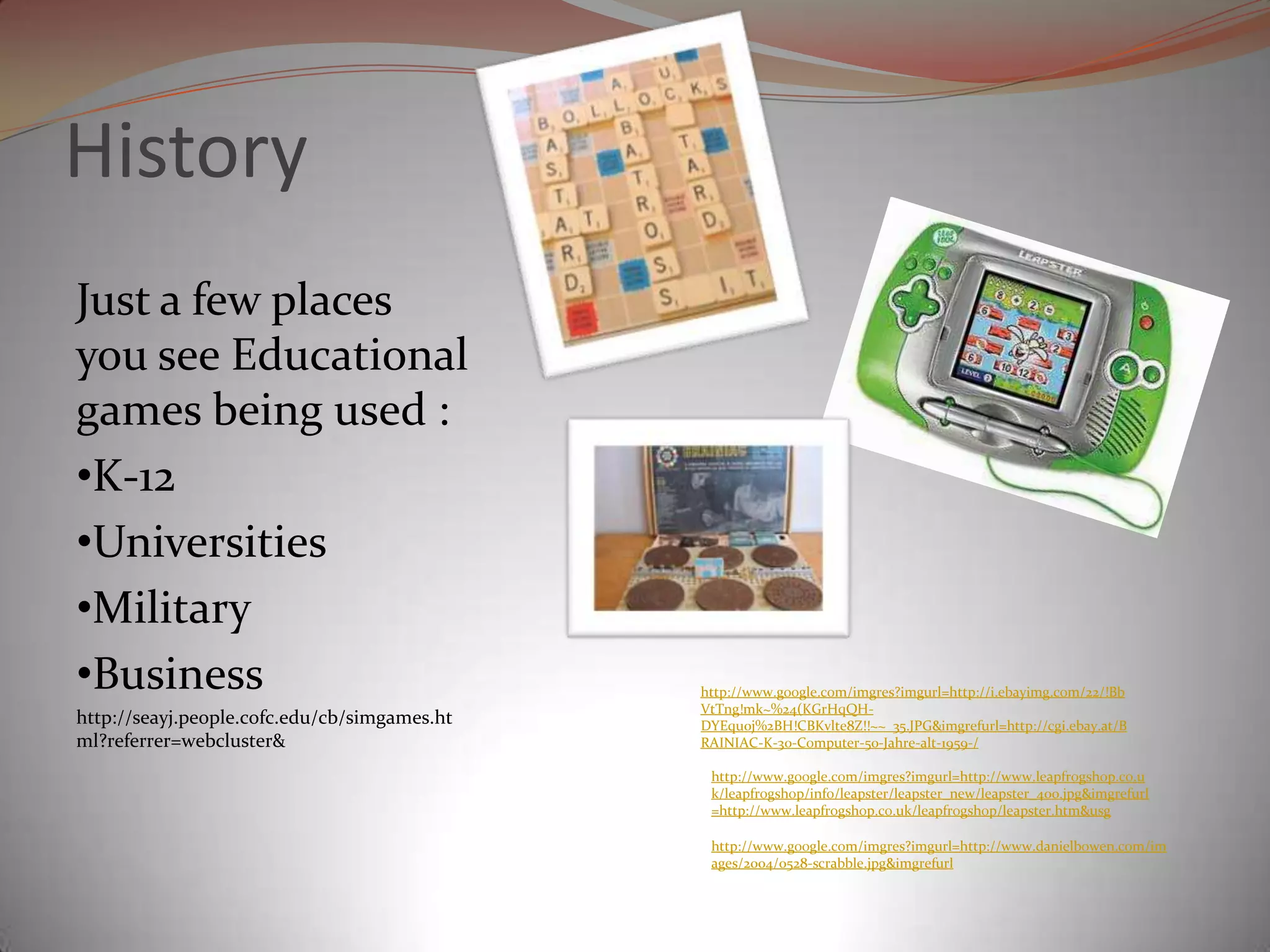
Educational GamesEducational games are games that have been specifically designed to teach people about a certain subject, expand concepts, reinforce development, understand an historical event of culture, or assist them in learning a skill as they play. This includes board, card and video games.http://www.funbrain.com/
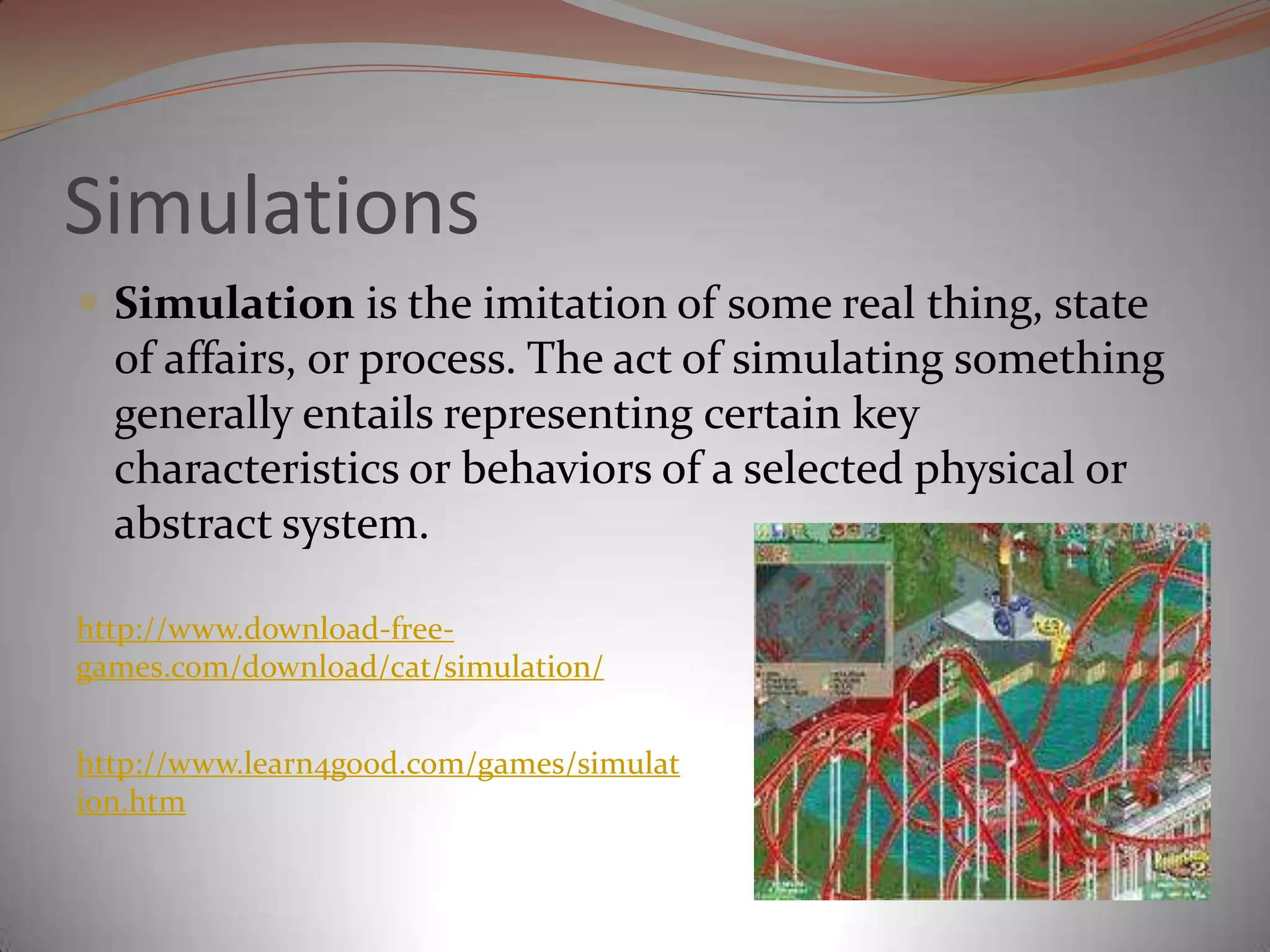
SimulationsSimulation is the imitation of some real thing, state of affairs, or process. The act of simulating something generally entails representing certain key characteristics or behaviors of a selected physical or abstract system.http://www.download-free-games.com/download/cat/simulation/http://www.learn4good.com/games/simulation.htm
Pros of Educational Games and Simulations Improves analytic skills and decision making skills.Improves communication, problem solving skills, and alertness.Improves mathematics, spelling and reading grades. Children love games and won't even realize that they are learning.Real life problems can be taught using games. Fun and excitement will encourage children to learn to their best ability.Provides real-world contexts. Increases attention span.
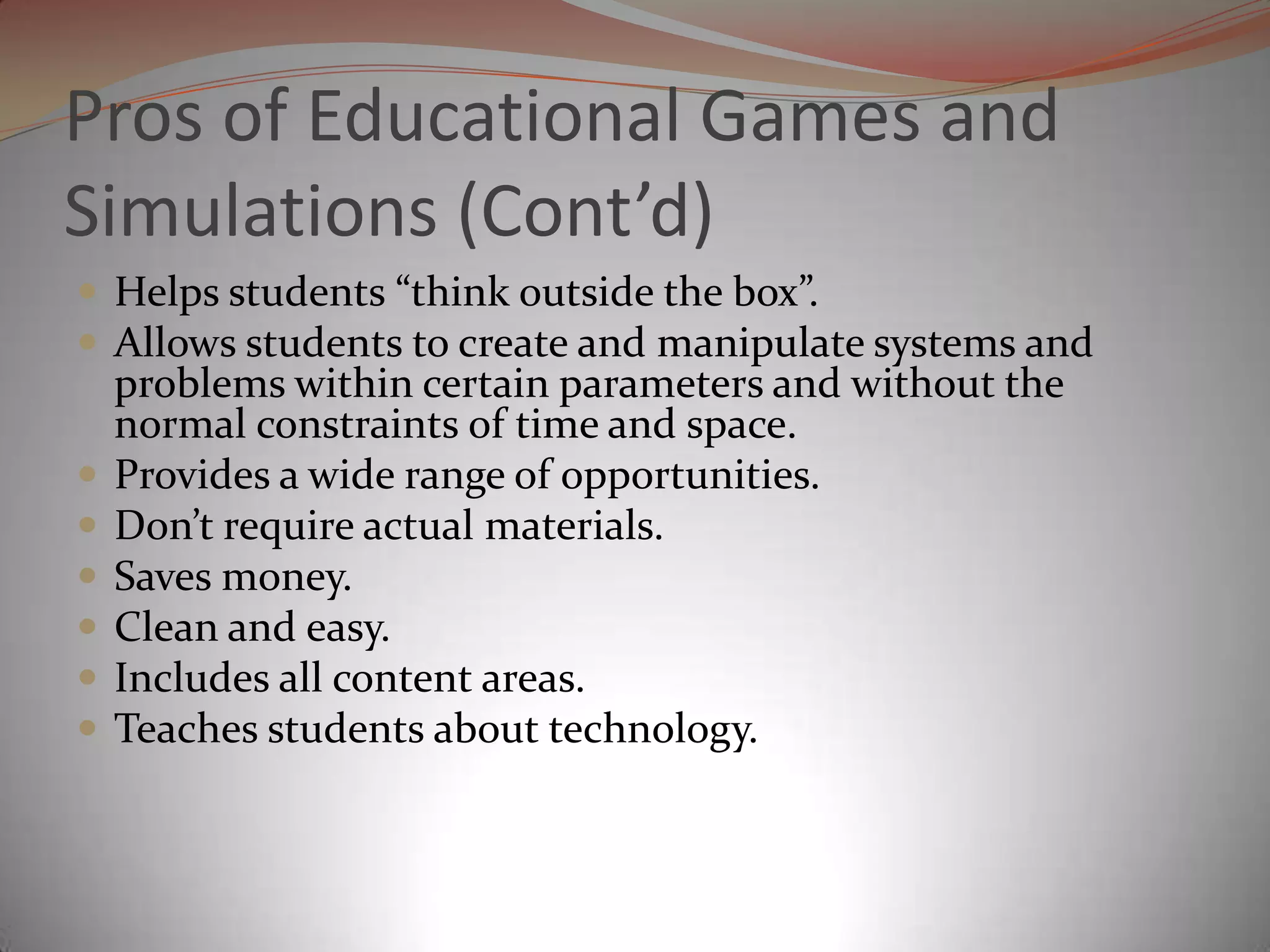
Pros of Educational Games and Simulations (Cont’d)Helps students “think outside the box”. Allows students to create and manipulate systems and problems within certain parameters and without the normal constraints of time and space.Provides a wide range of opportunities.Don’t require actual materials.Saves money. Clean and easy.Includes all content areas.Teaches students about technology.
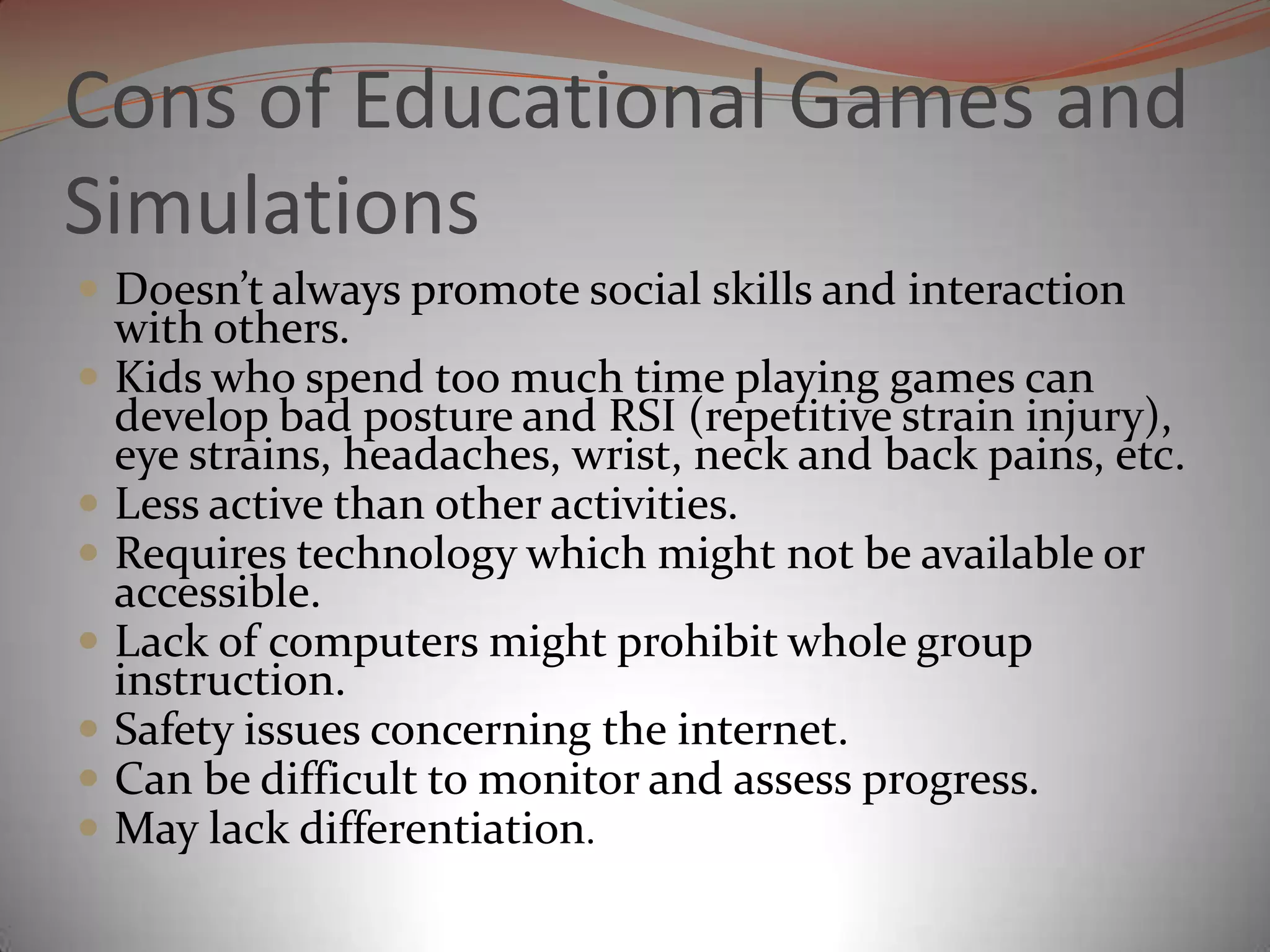
Cons of Educational Games and Simulations Doesn’t always promote social skills and interaction with others.
Kids who spend too much time playing games can develop bad posture and RSI (repetitive strain injury), eye strains, headaches, wrist, neck and back pains, etc.
Less active than other activities.
Requires technology which might not be available or accessible.
Lack of computers might prohibit whole group instruction.
Safety issues concerning the internet.
Can be difficult to monitor and assess progress.
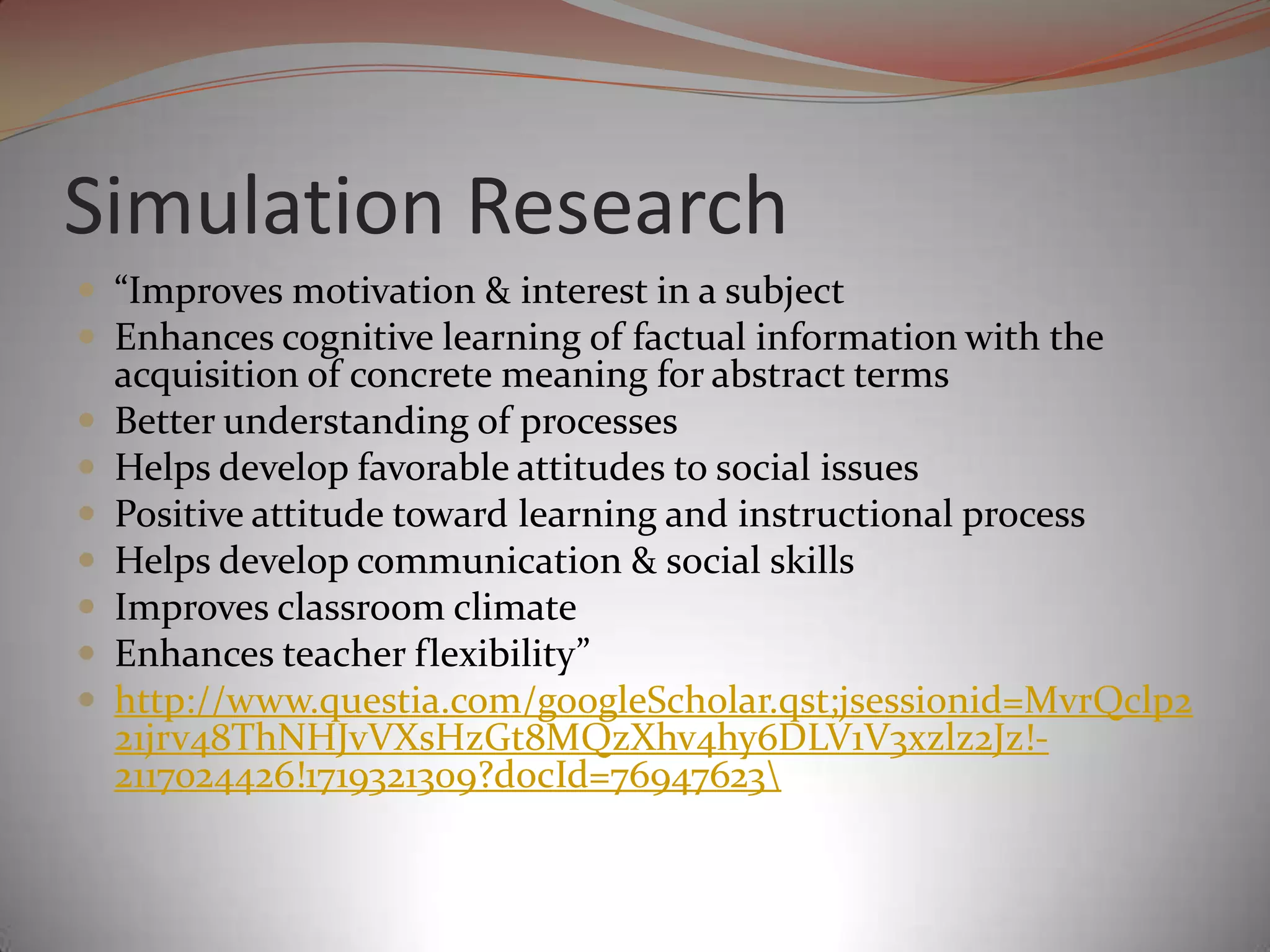
May lack differentiation. Simulation Research“Improves motivation & interest in a subject
Enhances cognitive learning of factual information with the acquisition of concrete meaning for abstract terms
Better understanding of processes
Helps develop favorable attitudes to social issues
Positive attitude toward learning and instructional process
Helps develop communication & social skills
Improves classroom climate
Enhances teacher flexibility”
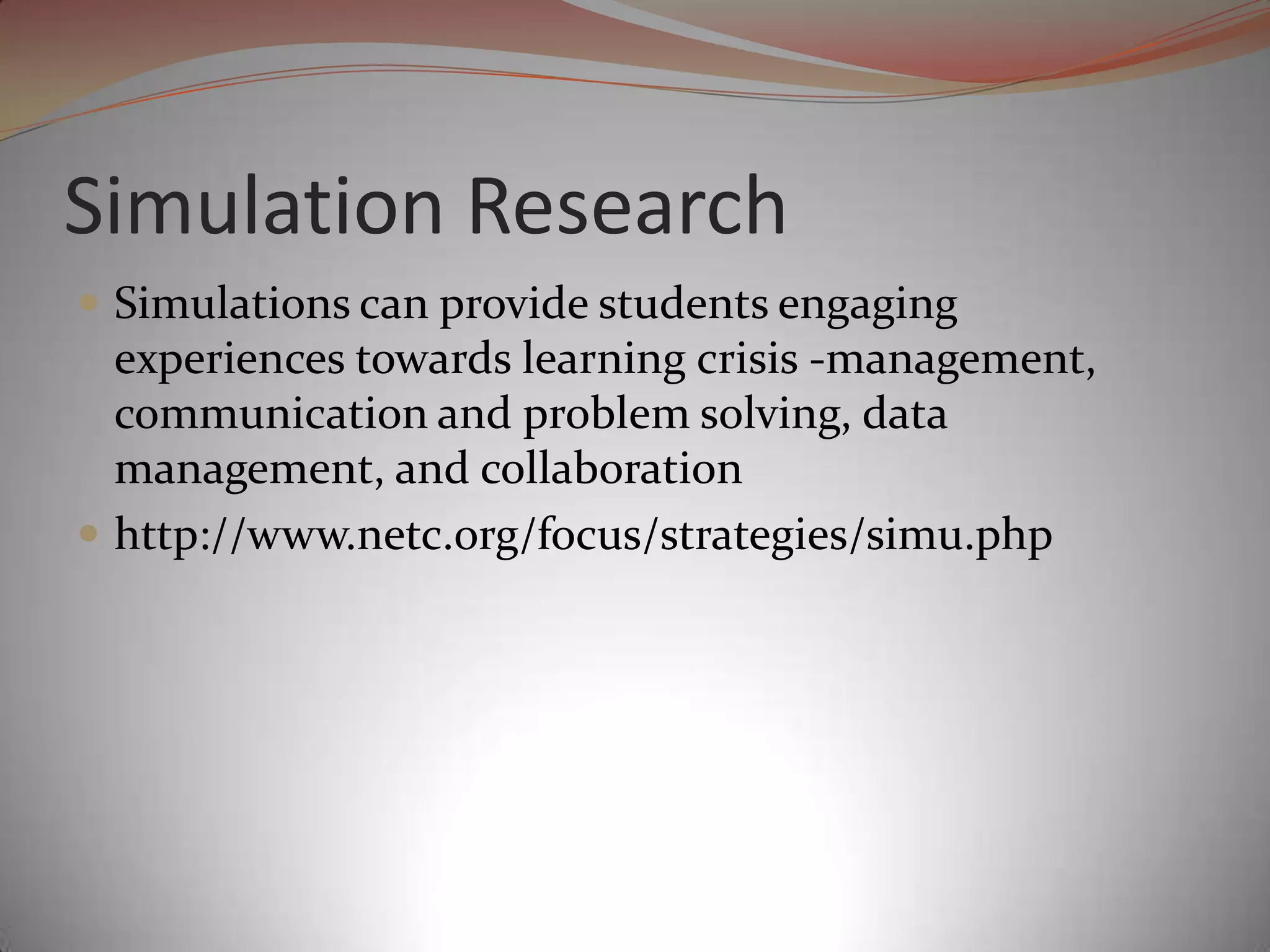
http://www.questia.com/googleScholar.qst;jsessionid=MvrQclp221jrv48ThNHJvVXsHzGt8MQzXhv4hy6DLV1V3xzlz2Jz!-2117024426!1719321309?docId=76947623\Simulation ResearchSimulations can provide students engaging experiences towards learning crisis -management, communication and problem solving, data management, and collaborationhttp://www.netc.org/focus/strategies/simu.php
Game ResearchGaming teaches competition strategies, cooperation and teamwork and conflict resolution
The effectiveness of gaming relies on the degree to which the games simulate real life
Games are dynamic, intrinsically motivating, and involve high levels of involvement. They provide immediate feedback to participants, and mistakes do not result in actually losing assets
Games have been found to serve a range of functions in education including tutoring, exploring and practicing skills, and attitude change
The effective use of games differs depending on the educational areas where the games are employed. The best results were found to be in the areas of mathematics, physics, and language arts (as opposed to social studies, biology and logic). The beneficial effects of gaming are most likely to be found when specific content is targeted and objectives precisely defined
http://www.netc.org/focus/strategies/simu.phpGame Research researched found when studying 700 children aged 7-16 children prefer to plan games in pairs or small groups

Educational games and simulations