By
Dr.Shazia Zamir
Assistant Professor, Dept. of Education.
National University of Modern Languages
lslamabad
At the end of this session the participants shall be able
to:
• state the meaning of active learning
• explain the need for active learning
• discuss Principles of active learning
• define characteristics of active learning
• differentiate between active and passive learning
• Explain jigsaw method
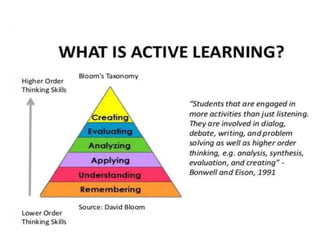
• Connect active learning and Bloom taxonomy
• Active Learning
• Principles of Active learning
• Maps of Active Learning
• Active learning vs. Passive learning
• Jigsaw method
• Active Learning and Bloom taxonomy
• Active Learning Toolkits
Do you Know?
• Consider these statistics reported by Meyers and
Jones (1993).
• Students are not attentive to what is being said in
a lecture 40% of the time.
• Students retain 70% of the information in the first
ten minutes of a lecture but only 20% in the last
ten minutes.
• Four months after taking an introductory
psychology course, students know only 8% more
than students who had never taken the course.
• Mostly in our class rooms, there is no comparing,
analyzing, classifying, hypothesizing, generalizing,
synthesizing, evaluating etc.
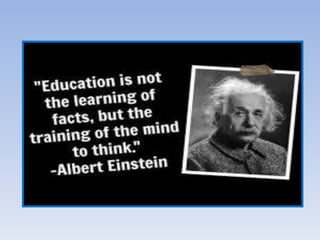
• No thinking, no real intellectual challenge just-
“remember what’s in the book and fill in the right
column”
Most textbooks are….
Road blocks standing in the way of active learning
and intellectual Thinking.
Active Learning
• Active learning involves providing
opportunities for students to meaningfully
talk and listen, write, read, and reflect on the
content, ideas, issues, and concerns of an
academic subject. (Meyers & Jones, 1993)
Characteristics of Active Learning
• The elements of active learning are talking and
listening, writing, reading, and reflecting.
• “Students are involved in more than listening, less
emphasis is placed on transmitting information and
more on developing students' skills, students are
involved in higher-order thinking (analysis, synthesis,
evaluation), students are engaged in activities (e.g.,
reading discussing, writing), and greater emphasis is
placed on students' exploration of their own
attitudes and values.”
Some Goals of Active Learning
• Develop communicative skills
• Develop collaboration skills
• Encourage students to take responsibility for their
own learning.
• Practice creating shared meaning.
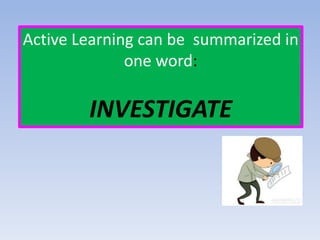
Active Learning can be summarized in
one word:
INVESTIGATE
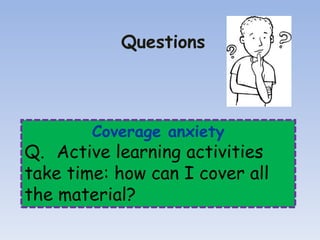
Coverage anxiety
Q. Active learning activities
take time: how can I cover all
the material?
Questions
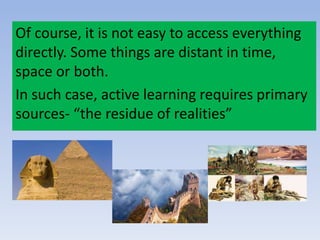
Of course, it is not easy to access everything
directly. Some things are distant in time,
space or both.
In such case, active learning requires primary
sources- “the residue of realities”
The myth of "coverage"
Faculty:
"Students won't/can't learn the material
unless I tell them about it."
"The more I cover in lecture, the more they
will learn."
Students:
"I can't learn from the textbook."
"It's not fair to examine us on things you
haven’t told us in class."
Questions
Q. Is active learning simply fun and games?
A. No. Active learning presents students with
problem solving challenges that require hard work.
Q. Doesn’t active learning require lots of time?
A. Yes—but its worth it. It gives students
opportunities to apply and reflect on what is
being learned.
Questions
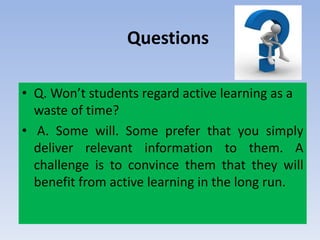
• Q. Won’t students regard active learning as a
waste of time?
• A. Some will. Some prefer that you simply
deliver relevant information to them. A
challenge is to convince them that they will
benefit from active learning in the long run.
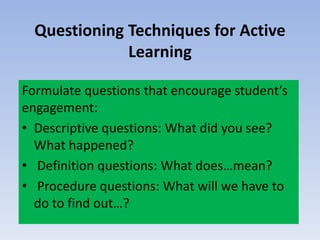
Questioning Techniques for Active
Learning
Formulate questions that encourage student’s
engagement:
• Descriptive questions: What did you see?
What happened?
• Definition questions: What does…mean?
• Procedure questions: What will we have to
do to find out…?
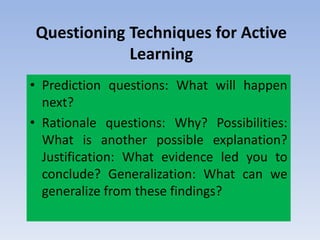
Questioning Techniques for Active
Learning
• Prediction questions: What will happen
next?
• Rationale questions: Why? Possibilities:
What is another possible explanation?
Justification: What evidence led you to
conclude? Generalization: What can we
generalize from these findings?
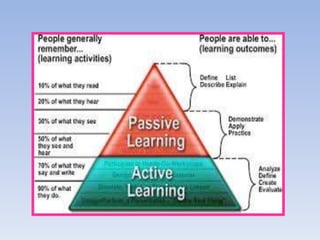
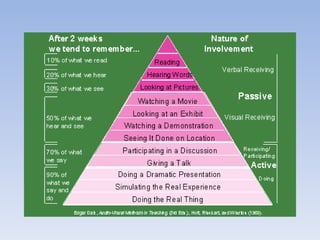
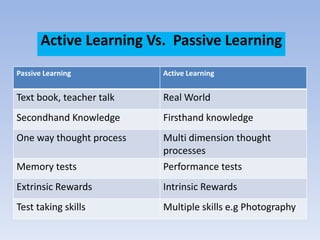
Active Learning Vs. Passive Learning
Passive Learning Active Learning
Text book, teacher talk Real World
Secondhand Knowledge Firsthand knowledge
One way thought process Multi dimension thought
processes
Memory tests Performance tests
Extrinsic Rewards Intrinsic Rewards
Test taking skills Multiple skills e.g Photography
Online learning(11:08)
• https://www.youtube.com/watch?v=hza-
EAff5Qk
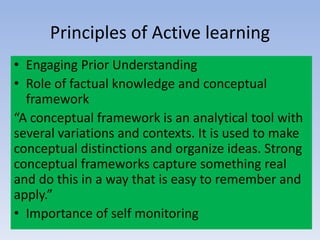
Principles of Active learning
• Engaging Prior Understanding
• Role of factual knowledge and conceptual
framework
“A conceptual framework is an analytical tool with
several variations and contexts. It is used to make
conceptual distinctions and organize ideas. Strong
conceptual frameworks capture something real
and do this in a way that is easy to remember and
apply.”
• Importance of self monitoring
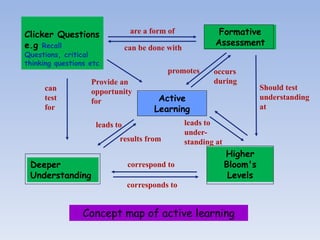
Active
Learning
Clicker Questions
e.g Recall
Questions, critical
thinking questions etc
Deeper
Understanding
leads to
can
test
for
Formative
Assessment
promotes
are a form of
Higher
Bloom's
Levels
Should test
understanding
at
corresponds to
Concept map of active learning
Provide an
opportunity
for
can be done with
leads to
under-
standing at
occurs
during
correspond to
results from
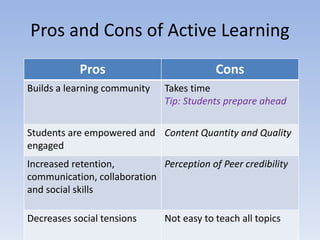
Pros and Cons of Active Learning
Pros Cons
Builds a learning community Takes time
Tip: Students prepare ahead
Students are empowered and
engaged
Content Quantity and Quality
Increased retention,
communication, collaboration
and social skills
Perception of Peer credibility
Decreases social tensions Not easy to teach all topics
Active Learning is not always easy to
start
• Passive learning is much easier to evaluate than active
learning
• As rigid external educational standards for education
are imposed on educational institutions and
opportunities for active learning are largely blocked.
• There may be some resistance to active learning by
students who are used to lectures, students who prefer
passive learning, or students in large classes (who don't
expect it). Thus, you need to prepare students.
Jigsaw Instructional Strategy
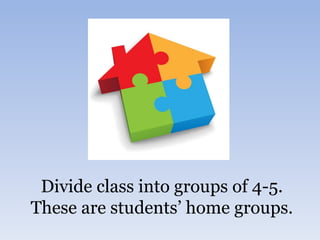
Divide class into groups of 4-5.
These are students’ home groups.
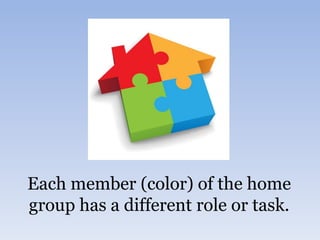
Each member (color) of the home
group has a different role or task.
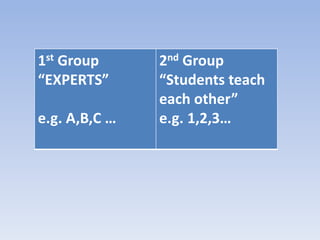
1st Group
“EXPERTS”
e.g. A,B,C …
2nd Group
“Students teach
each other”
e.g. 1,2,3…
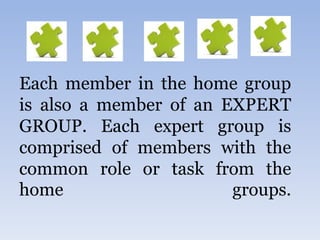
Each member in the home group
is also a member of an EXPERT
GROUP. Each expert group is
comprised of members with the
common role or task from the
home groups.
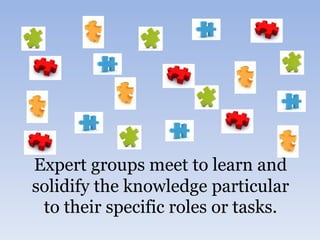
Expert groups meet to learn and
solidify the knowledge particular
to their specific roles or tasks.
• Divide the day's lesson into 5-6 segments. For
example, if you want history students to learn
about Abdul Sattar Edhi, you might divide a
short biography of his into stand-alone
segments on: (1) His childhood, (2) His family
life with Bilquis Edhi and their children, (3)His
Charity work, (4) travel issues (5) Honors and
Awards
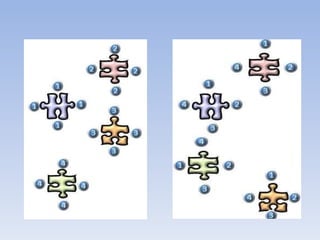
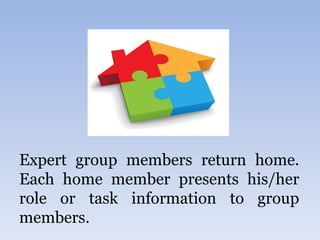
Expert group members return home.
Each home member presents his/her
role or task information to group
members.
In home groups, students then
report or present on the issue –
each group benefitting from
compiled expertise and focused
experience.
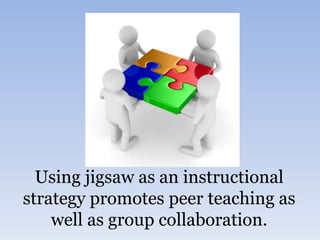
Using jigsaw as an instructional
strategy promotes peer teaching as
well as group collaboration.
Wrap-up
• Active Learning
• Principles of Active learning
• Maps of Active Learning
• Active learning vs. Passive learning
• Pros and Cons of Active Learning
• Jigsaw Method
Instructor’s Responsibilities
• Topic Division
• Monitor Group Activity
• Facilitate Class Reflection
• Content and Exam Alignment
Student’s Responsibilities
• Efficient Self Starters
• Communication Skills
• Consultative Skills
• Higher order thinking Skills
Online learning
• https://www.youtube.com/watch?v=_QyNAJK
Gq7I(15:09)
• https://www.youtube.com/watch?v=dwxmPrB
dIcQ(3:35)
ACTIVE LEARNING TOOLS
Big Blue Button
is an open source web conferencing system for on-
line learning. Big Blue Button enables you to share
documents (PDF and any office document),
webcams, chat, audio and your desktop.
Simulations
Educational simulations imitate a real
scenario, process, activity, or state of affairs.
Participation in a simulation requires the
student to perform specific tasks that emulate
real life situations or scenario.
http://citt.ufl.edu/tool-type/active-learning/
ACTIVE LEARNING TOOLS
Storyline
Overview Using Storyline, instructors can build
interactive content for online delivery, potentially
increasing the range and styles of active learning.
Interactive content options include screencasts,
simulation..
Clickers/Classroom Response System
refers to an audience response system that allows
instructors in a face-to-face classroom to collect real-
time data…
ACTIVE LEARNING TOOLS
Twitter
Twitter is a free social software and micro blogging
service that allows users to post, or "tweet," 140
characters of text in the style of a blog or RSS feed.
Posts can be made directly through the website…
Collaborative/Peer editing
refers to a group of students who edit a document
together. This can be done simultaneously in a face to
face environment or in a distance education
environment by using collaborative
ACTIVE LEARNING TOOLS
Quizlet
Overview Quizlet is a free online study tool that
students may use to choose from a variety of
interactive study activities including flashcards,
matching activities, and other learning games….
Virtual field trips
Overview Virtual field trips present a variety of content
for student learning in online environments. Virtual
field trips tend to be highly visual, and offer varying
levels of interactivity....
ACTIVE LEARNING TOOLS
Gamification
Overview Gamification is an approach to motivating
students to learn by incorporating game elements into
the learning environment. These game mechanics can
be used as motivational tools to encourage student ...
Virtual Laboratory
A virtual laboratory is an interactive environment for
creating and conducting simulated experiments...
ACTIVE LEARNING TOOLS
wiki
A wiki is a type of website that permits users to edit
available content. Wikis are designed with the
philosophy of making it easy to correct mistakes and
through collaboration, difficult to make mistakes….
Virtual Laboratory
A virtual laboratory is an interactive environment for
creating and conducting simulated experiments...
ACTIVE LEARNING TOOLS
Self-evaluation
refers to reviewing one's own performance critically.
Self-evaluations can be done individually or in the
context of a larger review...
Role Play
In role playing activities participants act as various
characters or roles. Role playing activities encourage
students to "put themselves in another's shoes" in
order to act out a fictional scenario. ..
ACTIVE LEARNING TOOLS
Virtual Reality (VR)
Virtual Reality is a technology that allows users to
interact in a computer-simulated environment.
Although there are many different types of VR…
Blended Learning
Knewton defines blended learning as any situation in
which “…a student learns, at least in part, at a brick-
and-mortar facility and through online delivery with
student control over time, place, path, or pace.”
ACTIVE LEARNING TOOLS
 A massive open online course (MOOC /muːk/) is
an online course aimed at unlimited participation and
open access via the web.[1]
 https://www.youtube.com/watch?v=NfP92tlC
 https://www.youtube.com/watch?v=-qGx2DOaRZ8
 https://www.youtube.com/watch?v=aTlkUMEkA-8
Is active learning Good?
Questions/Comments

Active learning(jigsaw method)1 merged

  • 1.
    By Dr.Shazia Zamir Assistant Professor,Dept. of Education. National University of Modern Languages lslamabad
  • 2.
    At the endof this session the participants shall be able to: • state the meaning of active learning • explain the need for active learning • discuss Principles of active learning • define characteristics of active learning • differentiate between active and passive learning • Explain jigsaw method • Connect active learning and Bloom taxonomy
  • 3.
    • Active Learning •Principles of Active learning • Maps of Active Learning • Active learning vs. Passive learning • Jigsaw method • Active Learning and Bloom taxonomy • Active Learning Toolkits
  • 7.
    Do you Know? •Consider these statistics reported by Meyers and Jones (1993). • Students are not attentive to what is being said in a lecture 40% of the time. • Students retain 70% of the information in the first ten minutes of a lecture but only 20% in the last ten minutes. • Four months after taking an introductory psychology course, students know only 8% more than students who had never taken the course.
  • 8.
    • Mostly inour class rooms, there is no comparing, analyzing, classifying, hypothesizing, generalizing, synthesizing, evaluating etc. • No thinking, no real intellectual challenge just- “remember what’s in the book and fill in the right column” Most textbooks are…. Road blocks standing in the way of active learning and intellectual Thinking.
  • 9.
    Active Learning • Activelearning involves providing opportunities for students to meaningfully talk and listen, write, read, and reflect on the content, ideas, issues, and concerns of an academic subject. (Meyers & Jones, 1993)
  • 10.
    Characteristics of ActiveLearning • The elements of active learning are talking and listening, writing, reading, and reflecting. • “Students are involved in more than listening, less emphasis is placed on transmitting information and more on developing students' skills, students are involved in higher-order thinking (analysis, synthesis, evaluation), students are engaged in activities (e.g., reading discussing, writing), and greater emphasis is placed on students' exploration of their own attitudes and values.”
  • 11.
    Some Goals ofActive Learning • Develop communicative skills • Develop collaboration skills • Encourage students to take responsibility for their own learning. • Practice creating shared meaning.
  • 12.
    Active Learning canbe summarized in one word: INVESTIGATE
  • 14.
    Coverage anxiety Q. Activelearning activities take time: how can I cover all the material? Questions
  • 15.
    Of course, itis not easy to access everything directly. Some things are distant in time, space or both. In such case, active learning requires primary sources- “the residue of realities”
  • 16.
    The myth of"coverage" Faculty: "Students won't/can't learn the material unless I tell them about it." "The more I cover in lecture, the more they will learn." Students: "I can't learn from the textbook." "It's not fair to examine us on things you haven’t told us in class."
  • 17.
    Questions Q. Is activelearning simply fun and games? A. No. Active learning presents students with problem solving challenges that require hard work. Q. Doesn’t active learning require lots of time? A. Yes—but its worth it. It gives students opportunities to apply and reflect on what is being learned.
  • 18.
    Questions • Q. Won’tstudents regard active learning as a waste of time? • A. Some will. Some prefer that you simply deliver relevant information to them. A challenge is to convince them that they will benefit from active learning in the long run.
  • 19.
    Questioning Techniques forActive Learning Formulate questions that encourage student’s engagement: • Descriptive questions: What did you see? What happened? • Definition questions: What does…mean? • Procedure questions: What will we have to do to find out…?
  • 20.
    Questioning Techniques forActive Learning • Prediction questions: What will happen next? • Rationale questions: Why? Possibilities: What is another possible explanation? Justification: What evidence led you to conclude? Generalization: What can we generalize from these findings?
  • 21.
    Active Learning Vs.Passive Learning Passive Learning Active Learning Text book, teacher talk Real World Secondhand Knowledge Firsthand knowledge One way thought process Multi dimension thought processes Memory tests Performance tests Extrinsic Rewards Intrinsic Rewards Test taking skills Multiple skills e.g Photography
  • 22.
  • 23.
    Principles of Activelearning • Engaging Prior Understanding • Role of factual knowledge and conceptual framework “A conceptual framework is an analytical tool with several variations and contexts. It is used to make conceptual distinctions and organize ideas. Strong conceptual frameworks capture something real and do this in a way that is easy to remember and apply.” • Importance of self monitoring
  • 24.
    Active Learning Clicker Questions e.g Recall Questions,critical thinking questions etc Deeper Understanding leads to can test for Formative Assessment promotes are a form of Higher Bloom's Levels Should test understanding at corresponds to Concept map of active learning Provide an opportunity for can be done with leads to under- standing at occurs during correspond to results from
  • 25.
    Pros and Consof Active Learning Pros Cons Builds a learning community Takes time Tip: Students prepare ahead Students are empowered and engaged Content Quantity and Quality Increased retention, communication, collaboration and social skills Perception of Peer credibility Decreases social tensions Not easy to teach all topics
  • 26.
    Active Learning isnot always easy to start • Passive learning is much easier to evaluate than active learning • As rigid external educational standards for education are imposed on educational institutions and opportunities for active learning are largely blocked. • There may be some resistance to active learning by students who are used to lectures, students who prefer passive learning, or students in large classes (who don't expect it). Thus, you need to prepare students.
  • 27.
  • 28.
    Divide class intogroups of 4-5. These are students’ home groups.
  • 29.
    Each member (color)of the home group has a different role or task.
  • 30.
    1st Group “EXPERTS” e.g. A,B,C… 2nd Group “Students teach each other” e.g. 1,2,3…
  • 31.
    Each member inthe home group is also a member of an EXPERT GROUP. Each expert group is comprised of members with the common role or task from the home groups.
  • 32.
    Expert groups meetto learn and solidify the knowledge particular to their specific roles or tasks.
  • 34.
    • Divide theday's lesson into 5-6 segments. For example, if you want history students to learn about Abdul Sattar Edhi, you might divide a short biography of his into stand-alone segments on: (1) His childhood, (2) His family life with Bilquis Edhi and their children, (3)His Charity work, (4) travel issues (5) Honors and Awards
  • 35.
    Expert group membersreturn home. Each home member presents his/her role or task information to group members.
  • 36.
    In home groups,students then report or present on the issue – each group benefitting from compiled expertise and focused experience.
  • 37.
    Using jigsaw asan instructional strategy promotes peer teaching as well as group collaboration.
  • 38.
    Wrap-up • Active Learning •Principles of Active learning • Maps of Active Learning • Active learning vs. Passive learning • Pros and Cons of Active Learning • Jigsaw Method
  • 39.
    Instructor’s Responsibilities • TopicDivision • Monitor Group Activity • Facilitate Class Reflection • Content and Exam Alignment
  • 40.
    Student’s Responsibilities • EfficientSelf Starters • Communication Skills • Consultative Skills • Higher order thinking Skills
  • 41.
    Online learning • https://www.youtube.com/watch?v=_QyNAJK Gq7I(15:09) •https://www.youtube.com/watch?v=dwxmPrB dIcQ(3:35)
  • 43.
    ACTIVE LEARNING TOOLS BigBlue Button is an open source web conferencing system for on- line learning. Big Blue Button enables you to share documents (PDF and any office document), webcams, chat, audio and your desktop. Simulations Educational simulations imitate a real scenario, process, activity, or state of affairs. Participation in a simulation requires the student to perform specific tasks that emulate real life situations or scenario. http://citt.ufl.edu/tool-type/active-learning/
  • 44.
    ACTIVE LEARNING TOOLS Storyline OverviewUsing Storyline, instructors can build interactive content for online delivery, potentially increasing the range and styles of active learning. Interactive content options include screencasts, simulation.. Clickers/Classroom Response System refers to an audience response system that allows instructors in a face-to-face classroom to collect real- time data…
  • 45.
    ACTIVE LEARNING TOOLS Twitter Twitteris a free social software and micro blogging service that allows users to post, or "tweet," 140 characters of text in the style of a blog or RSS feed. Posts can be made directly through the website… Collaborative/Peer editing refers to a group of students who edit a document together. This can be done simultaneously in a face to face environment or in a distance education environment by using collaborative
  • 46.
    ACTIVE LEARNING TOOLS Quizlet OverviewQuizlet is a free online study tool that students may use to choose from a variety of interactive study activities including flashcards, matching activities, and other learning games…. Virtual field trips Overview Virtual field trips present a variety of content for student learning in online environments. Virtual field trips tend to be highly visual, and offer varying levels of interactivity....
  • 47.
    ACTIVE LEARNING TOOLS Gamification OverviewGamification is an approach to motivating students to learn by incorporating game elements into the learning environment. These game mechanics can be used as motivational tools to encourage student ... Virtual Laboratory A virtual laboratory is an interactive environment for creating and conducting simulated experiments...
  • 48.
    ACTIVE LEARNING TOOLS wiki Awiki is a type of website that permits users to edit available content. Wikis are designed with the philosophy of making it easy to correct mistakes and through collaboration, difficult to make mistakes…. Virtual Laboratory A virtual laboratory is an interactive environment for creating and conducting simulated experiments...
  • 49.
    ACTIVE LEARNING TOOLS Self-evaluation refersto reviewing one's own performance critically. Self-evaluations can be done individually or in the context of a larger review... Role Play In role playing activities participants act as various characters or roles. Role playing activities encourage students to "put themselves in another's shoes" in order to act out a fictional scenario. ..
  • 50.
    ACTIVE LEARNING TOOLS VirtualReality (VR) Virtual Reality is a technology that allows users to interact in a computer-simulated environment. Although there are many different types of VR… Blended Learning Knewton defines blended learning as any situation in which “…a student learns, at least in part, at a brick- and-mortar facility and through online delivery with student control over time, place, path, or pace.”
  • 51.
    ACTIVE LEARNING TOOLS A massive open online course (MOOC /muːk/) is an online course aimed at unlimited participation and open access via the web.[1]  https://www.youtube.com/watch?v=NfP92tlC  https://www.youtube.com/watch?v=-qGx2DOaRZ8  https://www.youtube.com/watch?v=aTlkUMEkA-8
  • 53.
    Is active learningGood? Questions/Comments