VERNACULAR ARCHITECTURE
GUIDED BY:
PROF. Leena Aphale.
PROF. Abhishek Mahajan.
SUBMITTED BY:
Vishaka Bothra.
CONTENT:
INTRODUCTION.
HISTORY.
VERNICULAR ARCHITECTURE OF WORLD.
Africa, Rome, Turkey.
VERNICULAR ARCHITECTURE OF INDIA.
Uttarakhand, Assam, Ladakh, Andhra Pradesh.
VERNICULAR ARCHITECTURE OF MAHARASHTRA.
Wada, Forts.
VERNICULAR ARCHITECTURE OF NATIVE Place.
Nanded, Aurangabad.
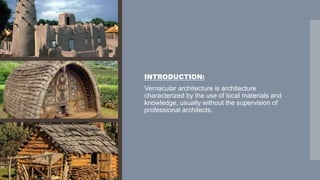
INTRODUCTION:
Vernacular architecture is architecture
characterized by the use of local materials and
knowledge, usually without the supervision of
professional architects.
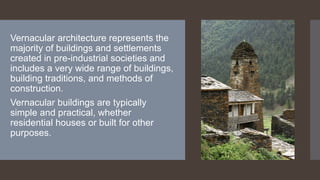
Vernacular architecture represents the
majority of buildings and settlements
created in pre-industrial societies and
includes a very wide range of buildings,
building traditions, and methods of
construction.
Vernacular buildings are typically
simple and practical, whether
residential houses or built for other
purposes.
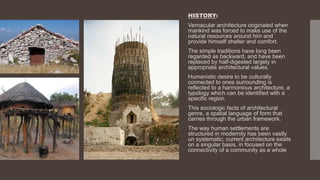
HISTORY:
Vernacular architecture originated when
mankind was forced to make use of the
natural resources around him and
provide himself shelter and comfort.
The simple traditions have long been
regarded as backward, and have been
replaced by half-digested largely in
appropriate architectural values.
Humanistic desire to be culturally
connected to ones surrounding is
reflected to a harmonious architecture, a
typology which can be identified with a
specific region.
This sociologic facts of architectural
genre, a spatial language of form that
carries through the urban framework.
The way human settlements are
structured in modernity has been vastly
un systematic; current architecture exists
on a singular basis, in focused on the
connectivity of a community as a whole
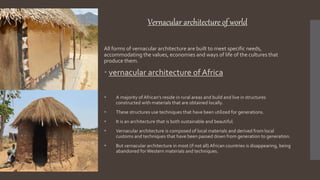
Vernacular architecture of world
All forms of vernacular architecture are built to meet specific needs,
accommodating the values, economies and ways of life of the cultures that
produce them.
 vernacular architecture of Africa
 A majority ofAfrican's reside in rural areas and build and live in structures
constructed with materials that are obtained locally.
 These structures use techniques that have been utilized for generations.
 It is an architecture that is both sustainable and beautiful.
 Vernacular architecture is composed of local materials and derived from local
customs and techniques that have been passed down from generation to generation.
 But vernacular architecture in most (if not all) African countries is disappearing, being
abandoned forWestern materials and techniques.
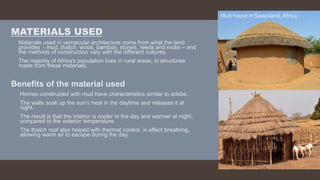
MATERIALS USED
 Materials used in vernacular architecture come from what the land
provides - mud, thatch, wood, bamboo, stones, reeds and rocks – and
the methods of construction vary with the different cultures.
 The majority of Africa's population lives in rural areas, in structures
made from these materials.
Benefits of the material used
 Homes constructed with mud have characteristics similar to adobe.
 The walls soak up the sun’s heat in the daytime and releases it at
night.
 The result is that the interior is cooler in the day and warmer at night,
compared to the exterior temperature.
 The thatch roof also helped with thermal control, in effect breathing,
allowing warm air to escape during the day.
Mud house in Swaziland, Africa
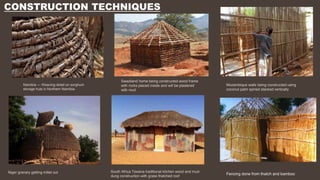
CONSTRUCTION TECHNIQUES
Namibia — Weaving detail on sorghum
storage huts in Northern Namibia
Niger granary getting millet out South Africa Tswana traditional kitchen wood and mud-
dung construction with grass thatched roof
Swaziland home being constructed wood frame
with rocks placed inside and will be plastered
with mud
Mozambique walls being constructed using
coconut palm spined stacked vertically
Fencing done from thatch and bamboo
Vernacular architecture of Rome
Colosseum
 Location – regio IV templum pacis (temple of
peace) , Rome, Italy
 Built in – 70-80 AD
 Type of structure – amphitheatre
MATERIALS USED
 Several materials
several materials were employed for the building of the Colosseum, all of them easily found or produced in the Roman
area: first of all there is the travertino, a limestone, then tuff for the other pillars and radial walls, tiles for the floors of the
upper storeys and the walls & concrete for the vaults.
1.Travertine
 A limestone that the is a sedimentary stone.
 Its color is whitish, slightly yellow or reddish.
 It is still used for building, for floors or as a veneer.
 The travertino of the Colosseum was quarried fromTibur
(todayTivoli, a town about 20 Km from Rome).
 it was used for the main pillars, the ground floor and the external wall.
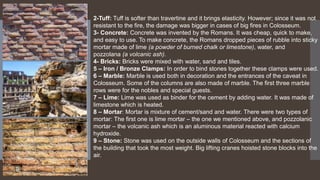
2-Tuff: Tuff is softer than travertine and it brings elasticity. However; since it was not
resistant to the fire, the damage was bigger in cases of big fires in Colosseum.
3- Concrete: Concrete was invented by the Romans. It was cheap, quick to make,
and easy to use. To make concrete, the Romans dropped pieces of rubble into sticky
mortar made of lime (a powder of burned chalk or limestone), water, and
pozzolana (a volcanic ash).
4- Bricks: Bricks were mixed with water, sand and tiles.
5 – Iron / Bronze Clamps: In order to bind stones together these clamps were used.
6 – Marble: Marble is used both in decoration and the entrances of the caveat in
Colosseum. Some of the columns are also made of marble. The first three marble
rows were for the nobles and special guests.
7 – Lime: Lime was used as binder for the cement by adding water. It was made of
limestone which is heated.
8 – Mortar: Mortar is mixture of cement/sand and water. There were two types of
mortar: The first one is lime mortar – the one we mentioned above, and pozzolanic
mortar – the volcanic ash which is an aluminous material reacted with calcium
hydroxide.
9 – Stone: Stone was used on the outside walls of Colosseum and the sections of
the building that took the most weight. Big lifting cranes hoisted stone blocks into the
air.
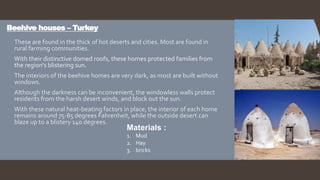
Beehive houses – Turkey
 These are found in the thick of hot deserts and cities. Most are found in
rural farming communities.
 With their distinctive domed roofs, these homes protected families from
the region's blistering sun.
 The interiors of the beehive homes are very dark, as most are built without
windows.
 Although the darkness can be inconvenient, the windowless walls protect
residents from the harsh desert winds, and block out the sun.
 With these natural heat-beating factors in place, the interior of each home
remains around 75-85 degrees Fahrenheit, while the outside desert can
blaze up to a blistery 140 degrees.
Materials :
1. Mud
2. Hay
3. bricks
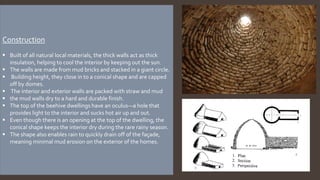
Construction
 Built of all natural local materials, the thick walls act as thick
insulation, helping to cool the interior by keeping out the sun.
 The walls are made from mud bricks and stacked in a giant circle.
 Building height, they close in to a conical shape and are capped
off by domes.
 The interior and exterior walls are packed with straw and mud
 the mud walls dry to a hard and durable finish.
 The top of the beehive dwellings have an oculus—a hole that
provides light to the interior and sucks hot air up and out.
 Even though there is an opening at the top of the dwelling, the
conical shape keeps the interior dry during the rare rainy season.
 The shape also enables rain to quickly drain off of the façade,
meaning minimal mud erosion on the exterior of the homes.
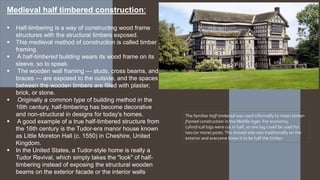
The familiar half-timbered was used informally to mean timber-
framed construction in the Middle Ages. For economy,
cylindrical logs were cut in half, so one log could be used for
two (or more) posts.The shaved side was traditionally on the
exterior and everyone knew it to be half the timber.
Medieval half timbered construction:
 Half-timbering is a way of constructing wood frame
structures with the structural timbers exposed.
 This medieval method of construction is called timber
framing.
 A half-timbered building wears its wood frame on its
sleeve, so to speak.
 The wooden wall framing — studs, cross beams, and
braces — are exposed to the outside, and the spaces
between the wooden timbers are filled with plaster,
brick, or stone.
 Originally a common type of building method in the
16th century, half-timbering has become decorative
and non-structural in designs for today's homes.
 A good example of a true half-timbered structure from
the 16th century is the Tudor-era manor house known
as Little Moreton Hall (c. 1550) in Cheshire, United
Kingdom.
 In the United States, a Tudor-style home is really a
Tudor Revival, which simply takes the "look" of half-
timbering instead of exposing the structural wooden
beams on the exterior facade or the interior walls
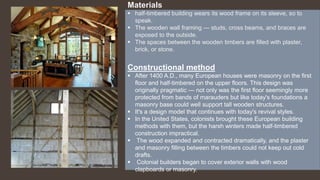
Materials
 half-timbered building wears its wood frame on its sleeve, so to
speak.
 The wooden wall framing — studs, cross beams, and braces are
exposed to the outside.
 The spaces between the wooden timbers are filled with plaster,
brick, or stone.
Constructional method
 After 1400 A.D., many European houses were masonry on the first
floor and half-timbered on the upper floors. This design was
originally pragmatic — not only was the first floor seemingly more
protected from bands of marauders but like today's foundations a
masonry base could well support tall wooden structures.
 It's a design model that continues with today's revival styles.
 In the United States, colonists brought these European building
methods with them, but the harsh winters made half-timbered
construction impractical.
 The wood expanded and contracted dramatically, and the plaster
and masonry filling between the timbers could not keep out cold
drafts.
 Colonial builders began to cover exterior walls with wood
clapboards or masonry.
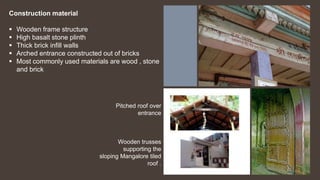
Pitched roof over
entrance
Wooden trusses
supporting the
sloping Mangalore tiled
roof .
Construction material
 Wooden frame structure
 High basalt stone plinth
 Thick brick infill walls
 Arched entrance constructed out of bricks
 Most commonly used materials are wood , stone
and brick
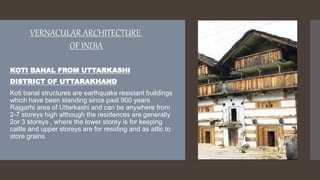
KOTI BANAL FROM UTTARKASHI
DISTRICT OF UTTARAKHAND
Koti banal structures are earthquake resistant buildings
which have been standing since past 900 years
Rajgarhi area of Uttarkashi and can be anywhere from
2-7 storeys high although the residences are generally
2or 3 storeys , where the lower storey is for keeping
cattle and upper storeys are for residing and as attic to
store grains.
VERNACULAR ARCHITECTURE
OF INDIA
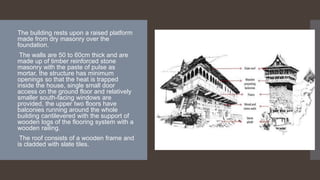
• The building rests upon a raised platform
made from dry masonry over the
foundation.
• The walls are 50 to 60cm thick and are
made up of timber reinforced stone
masonry with the paste of pulse as
mortar, the structure has minimum
openings so that the heat is trapped
inside the house, single small door
access on the ground floor and relatively
smaller south-facing windows are
provided, the upper two floors have
balconies running around the whole
building cantilevered with the support of
wooden logs of the flooring system with a
wooden railing.
• The roof consists of a wooden frame and
is cladded with slate tiles.
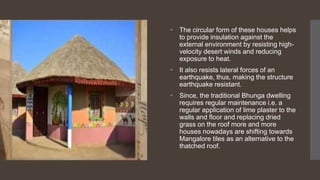
• The circular form of these houses helps
to provide insulation against the
external environment by resisting high-
velocity desert winds and reducing
exposure to heat.
• It also resists lateral forces of an
earthquake, thus, making the structure
earthquake resistant.
• Since, the traditional Bhunga dwelling
requires regular maintenance i.e. a
regular application of lime plaster to the
walls and floor and replacing dried
grass on the roof more and more
houses nowadays are shifting towards
Mangalore tiles as an alternative to the
thatched roof.
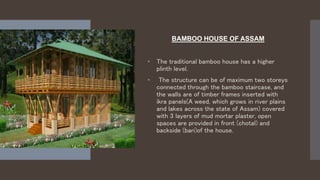
BAMBOO HOUSE OF ASSAM
• The traditional bamboo house has a higher
plinth level.
• The structure can be of maximum two storeys
connected through the bamboo staircase, and
the walls are of timber frames inserted with
ikra panels(A weed, which grows in river plains
and lakes across the state of Assam) covered
with 3 layers of mud mortar plaster, open
spaces are provided in front (chotal) and
backside (bari)of the house.
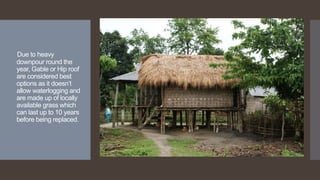
Due to heavy
downpour round the
year, Gable or Hip roof
are considered best
options as it doesn’t
allow waterlogging and
are made up of locally
available grass which
can last up to 10 years
before being replaced.
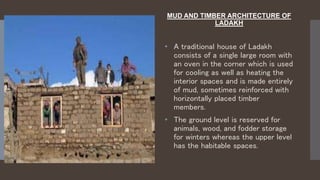
MUD AND TIMBER ARCHITECTURE OF
LADAKH
• A traditional house of Ladakh
consists of a single large room with
an oven in the corner which is used
for cooling as well as heating the
interior spaces and is made entirely
of mud, sometimes reinforced with
horizontally placed timber
members.
• The ground level is reserved for
animals, wood, and fodder storage
for winters whereas the upper level
has the habitable spaces.
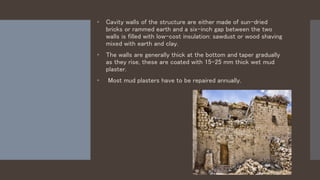
• Cavity walls of the structure are either made of sun-dried
bricks or rammed earth and a six-inch gap between the two
walls is filled with low-cost insulation: sawdust or wood shaving
mixed with earth and clay.
• The walls are generally thick at the bottom and taper gradually
as they rise, these are coated with 15-25 mm thick wet mud
plaster.
• Most mud plasters have to be repaired annually.
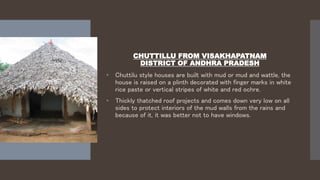
CHUTTILLU FROM VISAKHAPATNAM
DISTRICT OF ANDHRA PRADESH
• Chuttilu style houses are built with mud or mud and wattle, the
house is raised on a plinth decorated with finger marks in white
rice paste or vertical stripes of white and red ochre.
• Thickly thatched roof projects and comes down very low on all
sides to protect interiors of the mud walls from the rains and
because of it, it was better not to have windows.
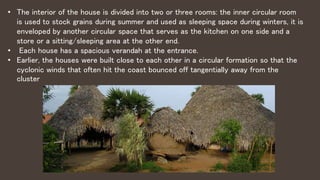
• The interior of the house is divided into two or three rooms: the inner circular room
is used to stock grains during summer and used as sleeping space during winters, it is
enveloped by another circular space that serves as the kitchen on one side and a
store or a sitting/sleeping area at the other end.
• Each house has a spacious verandah at the entrance.
• Earlier, the houses were built close to each other in a circular formation so that the
cyclonic winds that often hit the coast bounced off tangentially away from the
cluster
Vernacular architecture of Maharashtra
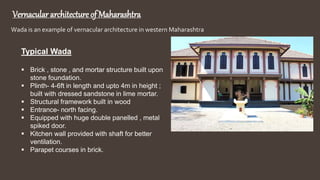
Wada is an example of vernacular architecture in western Maharashtra
Typical Wada
 Brick , stone , and mortar structure built upon
stone foundation.
 Plinth- 4-6ft in length and upto 4m in height ;
built with dressed sandstone in lime mortar.
 Structural framework built in wood
 Entrance- north facing.
 Equipped with huge double panelled , metal
spiked door.
 Kitchen wall provided with shaft for better
ventilation.
 Parapet courses in brick.
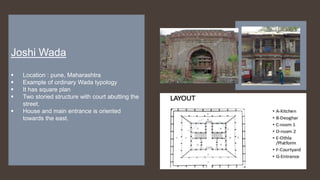
Joshi Wada
 Location : pune, Maharashtra
 Example of ordinary Wada typology
 It has square plan
 Two storied structure with court abutting the
street.
 House and main entrance is oriented
towards the east.
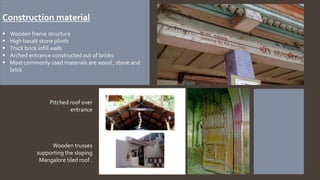
Construction material
 Wooden frame structure
 High basalt stone plinth
 Thick brick infill walls
 Arched entrance constructed out of bricks
 Most commonly used materials are wood ,
stone and brick
Pitched roof over
entrance
Wooden trusses
supporting the sloping
Mangalore tiled roof .
Construction material
 Wooden frame structure
 High basalt stone plinth
 Thick brick infill walls
 Arched entrance constructed out of bricks
 Most commonly used materials are wood , stone and
brick
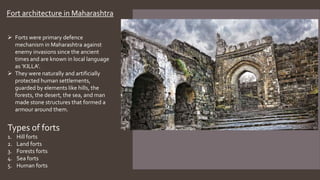
Fort architecture in Maharashtra
 Forts were primary defence
mechanism in Maharashtra against
enemy invasions since the ancient
times and are known in local language
as ‘KILLA’.
 They were naturally and artificially
protected human settlements,
guarded by elements like hills, the
forests, the desert, the sea, and man
made stone structures that formed a
armour around them.
Types of forts
1. Hill forts
2. Land forts
3. Forests forts
4. Sea forts
5. Human forts
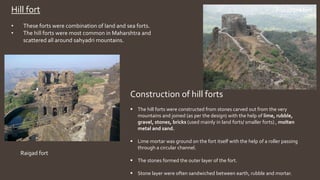
Hill fort
• These forts were combination of land and sea forts.
• The hill forts were most common in Maharshtra and
scattered all around sahyadri mountains.
Pratapgad fort ,
Raigad fort
Construction of hill forts
 The hill forts were constructed from stones carved out from the very
mountains and joined (as per the design) with the help of lime, rubble,
gravel, stones, bricks (used mainly in land forts/ smaller forts) , molten
metal and sand.
 Lime mortar was ground on the fort itself with the help of a roller passing
through a circular channel.
 The stones formed the outer layer of the fort.
 Stone layer were often sandwiched between earth, rubble and mortar.
VERNACULAR ARCHITECTURE OF NANDED.
KANDHAR FORT
Kandhar Fort or Kandhar Khilla is a fort located
in Kandhar, Nanded district in the state of Maharashtra,
India.[1] Its construction attributed to the Rashtrakuta King
Krishna IIII of Malkhed.
Kandhar is the taluka place of Nanded district which is 40 KM
from Nanded, the Kandahar city was the capital of the
Rashtrakuta. Kandhar Fort was built during the reign of
Rashtrakuta dynasty.
Encircling the fort, is a ditch filled with water. Outside the
Kandhar fort at some distance is a hillock on which an old Eidgah
held in reverence by the Muslims. It is of Nizamsahi period with
two domes in characteristic Ahmednagar style.
The architecture of the fort has some amazingly elaborates
security designs. There is a ditch in the periphery and Mogul
style construction in the Kandhar fort is remarkable.
VERNACULAR ARCHITECTURE OF NATIVE PLACE.
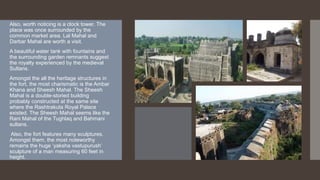
Also, worth noticing is a clock tower. The
place was once surrounded by the
common market area. Lal Mahal and
Darbar Mahal are worth a visit.
A beautiful water tank with fountains and
the surrounding garden remnants suggest
the royalty experienced by the medieval
Sultans.
Amongst the all the heritage structures in
the fort, the most charismatic is the Ambar
Khana and Sheesh Mahal. The Sheesh
Mahal is a double-storied building
probably constructed at the same site
where the Rashtrakuta Royal Palace
existed. The Sheesh Mahal seems like the
Rani Mahal of the Tughlaq and Bahmani
sultans.
Also, the fort features many sculptures.
Amongst them, the most noteworthy
remains the huge ‘yaksha vastupurush’
sculpture of a man measuring 60 feet in
height.
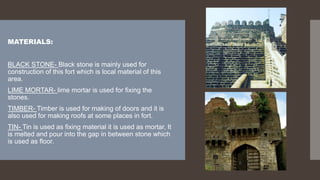
MATERIALS:
BLACK STONE- Black stone is mainly used for
construction of this fort which is local material of this
area.
LIME MORTAR- lime mortar is used for fixing the
stones.
TIMBER- Timber is used for making of doors and it is
also used for making roofs at some places in fort.
TIN- Tin is used as fixing material it is used as mortar, It
is melted and pour into the gap in between stone which
is used as floor.
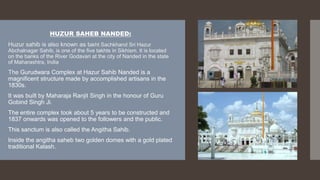
HUZUR SAHEB NANDED:
Huzur sahib is also known as takht Sachkhand Sri Hazur
Abchalnagar Sahib, is one of the five takhts in Sikhism. It is located
on the banks of the River Godavari at the city of Nanded in the state
of Maharashtra, India
The Gurudwara Complex at Hazur Sahib Nanded is a
magnificent structure made by accomplished artisans in the
1830s.
It was built by Maharaja Ranjit Singh in the honour of Guru
Gobind Singh Ji.
The entire complex took about 5 years to be constructed and
1837 onwards was opened to the followers and the public.
This sanctum is also called the Angitha Sahib.
Inside the angitha saheb two golden domes with a gold plated
traditional Kalash.
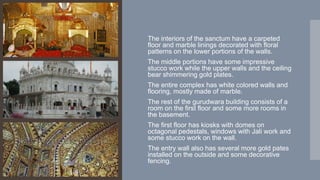
The interiors of the sanctum have a carpeted
floor and marble linings decorated with floral
patterns on the lower portions of the walls.
The middle portions have some impressive
stucco work while the upper walls and the ceiling
bear shimmering gold plates.
The entire complex has white colored walls and
flooring, mostly made of marble.
The rest of the gurudwara building consists of a
room on the first floor and some more rooms in
the basement.
The first floor has kiosks with domes on
octagonal pedestals, windows with Jali work and
some stucco work on the wall.
The entry wall also has several more gold pates
installed on the outside and some decorative
fencing.
MATERIALS:
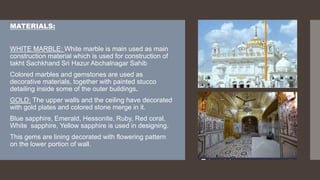
WHITE MARBLE: White marble is main used as main
construction material which is used for construction of
takht Sachkhand Sri Hazur Abchalnagar Sahib
Colored marbles and gemstones are used as
decorative materials, together with painted stucco
detailing inside some of the outer buildings.
GOLD: The upper walls and the ceiling have decorated
with gold plates and colored stone merge in it.
Blue sapphire, Emerald, Hessonite, Ruby, Red coral,
White sapphire, Yellow sapphire is used in designing.
This gems are lining decorated with flowering pattern
on the lower portion of wall.
VERNICULAR
ARCHITECTURE OF
AURANGABAD
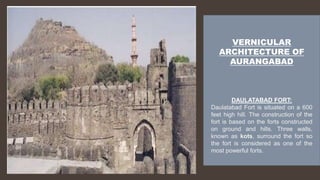
DAULATABAD FORT:
Daulatabad Fort is situated on a 600
feet high hill. The construction of the
fort is based on the forts constructed
on ground and hills. Three walls,
known as kots, surround the fort so
the fort is considered as one of the
most powerful forts.
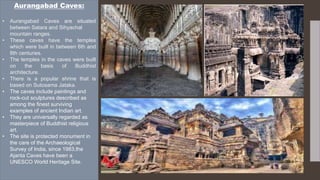
Aurangabad Caves:
• Aurangabad Caves are situated
between Satara and Sihyachal
mountain ranges.
• These caves have the temples
which were built in between 6th and
8th centuries.
• The temples in the caves were built
on the basis of Buddhist
architecture.
• There is a popular shrine that is
based on Sutosama Jataka.
• The caves include paintings and
rock-cut sculptures described as
among the finest surviving
examples of ancient Indian art.
• They are universally regarded as
masterpiece of Buddhist religious
art.
• The site is protected monument in
the care of the Archaeological
Survey of India, since 1983,the
Ajanta Caves have been a
UNESCO World Heritage Site.
THANKYOU

Vernacular architecture case study with examples

  • 1.
    VERNACULAR ARCHITECTURE GUIDED BY: PROF.Leena Aphale. PROF. Abhishek Mahajan. SUBMITTED BY: Vishaka Bothra.
  • 2.
    CONTENT: INTRODUCTION. HISTORY. VERNICULAR ARCHITECTURE OFWORLD. Africa, Rome, Turkey. VERNICULAR ARCHITECTURE OF INDIA. Uttarakhand, Assam, Ladakh, Andhra Pradesh. VERNICULAR ARCHITECTURE OF MAHARASHTRA. Wada, Forts. VERNICULAR ARCHITECTURE OF NATIVE Place. Nanded, Aurangabad.
  • 3.
    INTRODUCTION: Vernacular architecture isarchitecture characterized by the use of local materials and knowledge, usually without the supervision of professional architects.
  • 4.
    Vernacular architecture representsthe majority of buildings and settlements created in pre-industrial societies and includes a very wide range of buildings, building traditions, and methods of construction. Vernacular buildings are typically simple and practical, whether residential houses or built for other purposes.
  • 5.
    HISTORY: Vernacular architecture originatedwhen mankind was forced to make use of the natural resources around him and provide himself shelter and comfort. The simple traditions have long been regarded as backward, and have been replaced by half-digested largely in appropriate architectural values. Humanistic desire to be culturally connected to ones surrounding is reflected to a harmonious architecture, a typology which can be identified with a specific region. This sociologic facts of architectural genre, a spatial language of form that carries through the urban framework. The way human settlements are structured in modernity has been vastly un systematic; current architecture exists on a singular basis, in focused on the connectivity of a community as a whole
  • 6.
    Vernacular architecture ofworld All forms of vernacular architecture are built to meet specific needs, accommodating the values, economies and ways of life of the cultures that produce them.  vernacular architecture of Africa  A majority ofAfrican's reside in rural areas and build and live in structures constructed with materials that are obtained locally.  These structures use techniques that have been utilized for generations.  It is an architecture that is both sustainable and beautiful.  Vernacular architecture is composed of local materials and derived from local customs and techniques that have been passed down from generation to generation.  But vernacular architecture in most (if not all) African countries is disappearing, being abandoned forWestern materials and techniques.
  • 7.
    MATERIALS USED  Materialsused in vernacular architecture come from what the land provides - mud, thatch, wood, bamboo, stones, reeds and rocks – and the methods of construction vary with the different cultures.  The majority of Africa's population lives in rural areas, in structures made from these materials. Benefits of the material used  Homes constructed with mud have characteristics similar to adobe.  The walls soak up the sun’s heat in the daytime and releases it at night.  The result is that the interior is cooler in the day and warmer at night, compared to the exterior temperature.  The thatch roof also helped with thermal control, in effect breathing, allowing warm air to escape during the day. Mud house in Swaziland, Africa
  • 8.
    CONSTRUCTION TECHNIQUES Namibia —Weaving detail on sorghum storage huts in Northern Namibia Niger granary getting millet out South Africa Tswana traditional kitchen wood and mud- dung construction with grass thatched roof Swaziland home being constructed wood frame with rocks placed inside and will be plastered with mud Mozambique walls being constructed using coconut palm spined stacked vertically Fencing done from thatch and bamboo
  • 9.
    Vernacular architecture ofRome Colosseum  Location – regio IV templum pacis (temple of peace) , Rome, Italy  Built in – 70-80 AD  Type of structure – amphitheatre MATERIALS USED  Several materials several materials were employed for the building of the Colosseum, all of them easily found or produced in the Roman area: first of all there is the travertino, a limestone, then tuff for the other pillars and radial walls, tiles for the floors of the upper storeys and the walls & concrete for the vaults. 1.Travertine  A limestone that the is a sedimentary stone.  Its color is whitish, slightly yellow or reddish.  It is still used for building, for floors or as a veneer.  The travertino of the Colosseum was quarried fromTibur (todayTivoli, a town about 20 Km from Rome).  it was used for the main pillars, the ground floor and the external wall.
  • 10.
    2-Tuff: Tuff issofter than travertine and it brings elasticity. However; since it was not resistant to the fire, the damage was bigger in cases of big fires in Colosseum. 3- Concrete: Concrete was invented by the Romans. It was cheap, quick to make, and easy to use. To make concrete, the Romans dropped pieces of rubble into sticky mortar made of lime (a powder of burned chalk or limestone), water, and pozzolana (a volcanic ash). 4- Bricks: Bricks were mixed with water, sand and tiles. 5 – Iron / Bronze Clamps: In order to bind stones together these clamps were used. 6 – Marble: Marble is used both in decoration and the entrances of the caveat in Colosseum. Some of the columns are also made of marble. The first three marble rows were for the nobles and special guests. 7 – Lime: Lime was used as binder for the cement by adding water. It was made of limestone which is heated. 8 – Mortar: Mortar is mixture of cement/sand and water. There were two types of mortar: The first one is lime mortar – the one we mentioned above, and pozzolanic mortar – the volcanic ash which is an aluminous material reacted with calcium hydroxide. 9 – Stone: Stone was used on the outside walls of Colosseum and the sections of the building that took the most weight. Big lifting cranes hoisted stone blocks into the air.
  • 11.
    Beehive houses –Turkey  These are found in the thick of hot deserts and cities. Most are found in rural farming communities.  With their distinctive domed roofs, these homes protected families from the region's blistering sun.  The interiors of the beehive homes are very dark, as most are built without windows.  Although the darkness can be inconvenient, the windowless walls protect residents from the harsh desert winds, and block out the sun.  With these natural heat-beating factors in place, the interior of each home remains around 75-85 degrees Fahrenheit, while the outside desert can blaze up to a blistery 140 degrees. Materials : 1. Mud 2. Hay 3. bricks
  • 12.
    Construction  Built ofall natural local materials, the thick walls act as thick insulation, helping to cool the interior by keeping out the sun.  The walls are made from mud bricks and stacked in a giant circle.  Building height, they close in to a conical shape and are capped off by domes.  The interior and exterior walls are packed with straw and mud  the mud walls dry to a hard and durable finish.  The top of the beehive dwellings have an oculus—a hole that provides light to the interior and sucks hot air up and out.  Even though there is an opening at the top of the dwelling, the conical shape keeps the interior dry during the rare rainy season.  The shape also enables rain to quickly drain off of the façade, meaning minimal mud erosion on the exterior of the homes.
  • 13.
    The familiar half-timberedwas used informally to mean timber- framed construction in the Middle Ages. For economy, cylindrical logs were cut in half, so one log could be used for two (or more) posts.The shaved side was traditionally on the exterior and everyone knew it to be half the timber. Medieval half timbered construction:  Half-timbering is a way of constructing wood frame structures with the structural timbers exposed.  This medieval method of construction is called timber framing.  A half-timbered building wears its wood frame on its sleeve, so to speak.  The wooden wall framing — studs, cross beams, and braces — are exposed to the outside, and the spaces between the wooden timbers are filled with plaster, brick, or stone.  Originally a common type of building method in the 16th century, half-timbering has become decorative and non-structural in designs for today's homes.  A good example of a true half-timbered structure from the 16th century is the Tudor-era manor house known as Little Moreton Hall (c. 1550) in Cheshire, United Kingdom.  In the United States, a Tudor-style home is really a Tudor Revival, which simply takes the "look" of half- timbering instead of exposing the structural wooden beams on the exterior facade or the interior walls
  • 14.
    Materials  half-timbered buildingwears its wood frame on its sleeve, so to speak.  The wooden wall framing — studs, cross beams, and braces are exposed to the outside.  The spaces between the wooden timbers are filled with plaster, brick, or stone. Constructional method  After 1400 A.D., many European houses were masonry on the first floor and half-timbered on the upper floors. This design was originally pragmatic — not only was the first floor seemingly more protected from bands of marauders but like today's foundations a masonry base could well support tall wooden structures.  It's a design model that continues with today's revival styles.  In the United States, colonists brought these European building methods with them, but the harsh winters made half-timbered construction impractical.  The wood expanded and contracted dramatically, and the plaster and masonry filling between the timbers could not keep out cold drafts.  Colonial builders began to cover exterior walls with wood clapboards or masonry.
  • 15.
    Pitched roof over entrance Woodentrusses supporting the sloping Mangalore tiled roof . Construction material  Wooden frame structure  High basalt stone plinth  Thick brick infill walls  Arched entrance constructed out of bricks  Most commonly used materials are wood , stone and brick
  • 16.
    KOTI BANAL FROMUTTARKASHI DISTRICT OF UTTARAKHAND Koti banal structures are earthquake resistant buildings which have been standing since past 900 years Rajgarhi area of Uttarkashi and can be anywhere from 2-7 storeys high although the residences are generally 2or 3 storeys , where the lower storey is for keeping cattle and upper storeys are for residing and as attic to store grains. VERNACULAR ARCHITECTURE OF INDIA
  • 17.
    • The buildingrests upon a raised platform made from dry masonry over the foundation. • The walls are 50 to 60cm thick and are made up of timber reinforced stone masonry with the paste of pulse as mortar, the structure has minimum openings so that the heat is trapped inside the house, single small door access on the ground floor and relatively smaller south-facing windows are provided, the upper two floors have balconies running around the whole building cantilevered with the support of wooden logs of the flooring system with a wooden railing. • The roof consists of a wooden frame and is cladded with slate tiles.
  • 18.
    • The circularform of these houses helps to provide insulation against the external environment by resisting high- velocity desert winds and reducing exposure to heat. • It also resists lateral forces of an earthquake, thus, making the structure earthquake resistant. • Since, the traditional Bhunga dwelling requires regular maintenance i.e. a regular application of lime plaster to the walls and floor and replacing dried grass on the roof more and more houses nowadays are shifting towards Mangalore tiles as an alternative to the thatched roof.
  • 19.
    BAMBOO HOUSE OFASSAM • The traditional bamboo house has a higher plinth level. • The structure can be of maximum two storeys connected through the bamboo staircase, and the walls are of timber frames inserted with ikra panels(A weed, which grows in river plains and lakes across the state of Assam) covered with 3 layers of mud mortar plaster, open spaces are provided in front (chotal) and backside (bari)of the house.
  • 20.
    Due to heavy downpourround the year, Gable or Hip roof are considered best options as it doesn’t allow waterlogging and are made up of locally available grass which can last up to 10 years before being replaced.
  • 21.
    MUD AND TIMBERARCHITECTURE OF LADAKH • A traditional house of Ladakh consists of a single large room with an oven in the corner which is used for cooling as well as heating the interior spaces and is made entirely of mud, sometimes reinforced with horizontally placed timber members. • The ground level is reserved for animals, wood, and fodder storage for winters whereas the upper level has the habitable spaces.
  • 22.
    • Cavity wallsof the structure are either made of sun-dried bricks or rammed earth and a six-inch gap between the two walls is filled with low-cost insulation: sawdust or wood shaving mixed with earth and clay. • The walls are generally thick at the bottom and taper gradually as they rise, these are coated with 15-25 mm thick wet mud plaster. • Most mud plasters have to be repaired annually.
  • 23.
    CHUTTILLU FROM VISAKHAPATNAM DISTRICTOF ANDHRA PRADESH • Chuttilu style houses are built with mud or mud and wattle, the house is raised on a plinth decorated with finger marks in white rice paste or vertical stripes of white and red ochre. • Thickly thatched roof projects and comes down very low on all sides to protect interiors of the mud walls from the rains and because of it, it was better not to have windows.
  • 24.
    • The interiorof the house is divided into two or three rooms: the inner circular room is used to stock grains during summer and used as sleeping space during winters, it is enveloped by another circular space that serves as the kitchen on one side and a store or a sitting/sleeping area at the other end. • Each house has a spacious verandah at the entrance. • Earlier, the houses were built close to each other in a circular formation so that the cyclonic winds that often hit the coast bounced off tangentially away from the cluster
  • 25.
    Vernacular architecture ofMaharashtra Wada is an example of vernacular architecture in western Maharashtra Typical Wada  Brick , stone , and mortar structure built upon stone foundation.  Plinth- 4-6ft in length and upto 4m in height ; built with dressed sandstone in lime mortar.  Structural framework built in wood  Entrance- north facing.  Equipped with huge double panelled , metal spiked door.  Kitchen wall provided with shaft for better ventilation.  Parapet courses in brick.
  • 26.
    Joshi Wada  Location: pune, Maharashtra  Example of ordinary Wada typology  It has square plan  Two storied structure with court abutting the street.  House and main entrance is oriented towards the east.
  • 27.
    Construction material  Woodenframe structure  High basalt stone plinth  Thick brick infill walls  Arched entrance constructed out of bricks  Most commonly used materials are wood , stone and brick Pitched roof over entrance Wooden trusses supporting the sloping Mangalore tiled roof . Construction material  Wooden frame structure  High basalt stone plinth  Thick brick infill walls  Arched entrance constructed out of bricks  Most commonly used materials are wood , stone and brick
  • 28.
    Fort architecture inMaharashtra  Forts were primary defence mechanism in Maharashtra against enemy invasions since the ancient times and are known in local language as ‘KILLA’.  They were naturally and artificially protected human settlements, guarded by elements like hills, the forests, the desert, the sea, and man made stone structures that formed a armour around them. Types of forts 1. Hill forts 2. Land forts 3. Forests forts 4. Sea forts 5. Human forts
  • 29.
    Hill fort • Theseforts were combination of land and sea forts. • The hill forts were most common in Maharshtra and scattered all around sahyadri mountains. Pratapgad fort , Raigad fort Construction of hill forts  The hill forts were constructed from stones carved out from the very mountains and joined (as per the design) with the help of lime, rubble, gravel, stones, bricks (used mainly in land forts/ smaller forts) , molten metal and sand.  Lime mortar was ground on the fort itself with the help of a roller passing through a circular channel.  The stones formed the outer layer of the fort.  Stone layer were often sandwiched between earth, rubble and mortar.
  • 30.
    VERNACULAR ARCHITECTURE OFNANDED. KANDHAR FORT Kandhar Fort or Kandhar Khilla is a fort located in Kandhar, Nanded district in the state of Maharashtra, India.[1] Its construction attributed to the Rashtrakuta King Krishna IIII of Malkhed. Kandhar is the taluka place of Nanded district which is 40 KM from Nanded, the Kandahar city was the capital of the Rashtrakuta. Kandhar Fort was built during the reign of Rashtrakuta dynasty. Encircling the fort, is a ditch filled with water. Outside the Kandhar fort at some distance is a hillock on which an old Eidgah held in reverence by the Muslims. It is of Nizamsahi period with two domes in characteristic Ahmednagar style. The architecture of the fort has some amazingly elaborates security designs. There is a ditch in the periphery and Mogul style construction in the Kandhar fort is remarkable. VERNACULAR ARCHITECTURE OF NATIVE PLACE.
  • 31.
    Also, worth noticingis a clock tower. The place was once surrounded by the common market area. Lal Mahal and Darbar Mahal are worth a visit. A beautiful water tank with fountains and the surrounding garden remnants suggest the royalty experienced by the medieval Sultans. Amongst the all the heritage structures in the fort, the most charismatic is the Ambar Khana and Sheesh Mahal. The Sheesh Mahal is a double-storied building probably constructed at the same site where the Rashtrakuta Royal Palace existed. The Sheesh Mahal seems like the Rani Mahal of the Tughlaq and Bahmani sultans. Also, the fort features many sculptures. Amongst them, the most noteworthy remains the huge ‘yaksha vastupurush’ sculpture of a man measuring 60 feet in height.
  • 32.
    MATERIALS: BLACK STONE- Blackstone is mainly used for construction of this fort which is local material of this area. LIME MORTAR- lime mortar is used for fixing the stones. TIMBER- Timber is used for making of doors and it is also used for making roofs at some places in fort. TIN- Tin is used as fixing material it is used as mortar, It is melted and pour into the gap in between stone which is used as floor.
  • 33.
    HUZUR SAHEB NANDED: Huzursahib is also known as takht Sachkhand Sri Hazur Abchalnagar Sahib, is one of the five takhts in Sikhism. It is located on the banks of the River Godavari at the city of Nanded in the state of Maharashtra, India The Gurudwara Complex at Hazur Sahib Nanded is a magnificent structure made by accomplished artisans in the 1830s. It was built by Maharaja Ranjit Singh in the honour of Guru Gobind Singh Ji. The entire complex took about 5 years to be constructed and 1837 onwards was opened to the followers and the public. This sanctum is also called the Angitha Sahib. Inside the angitha saheb two golden domes with a gold plated traditional Kalash.
  • 34.
    The interiors ofthe sanctum have a carpeted floor and marble linings decorated with floral patterns on the lower portions of the walls. The middle portions have some impressive stucco work while the upper walls and the ceiling bear shimmering gold plates. The entire complex has white colored walls and flooring, mostly made of marble. The rest of the gurudwara building consists of a room on the first floor and some more rooms in the basement. The first floor has kiosks with domes on octagonal pedestals, windows with Jali work and some stucco work on the wall. The entry wall also has several more gold pates installed on the outside and some decorative fencing.
  • 35.
    MATERIALS: WHITE MARBLE: Whitemarble is main used as main construction material which is used for construction of takht Sachkhand Sri Hazur Abchalnagar Sahib Colored marbles and gemstones are used as decorative materials, together with painted stucco detailing inside some of the outer buildings. GOLD: The upper walls and the ceiling have decorated with gold plates and colored stone merge in it. Blue sapphire, Emerald, Hessonite, Ruby, Red coral, White sapphire, Yellow sapphire is used in designing. This gems are lining decorated with flowering pattern on the lower portion of wall.
  • 36.
    VERNICULAR ARCHITECTURE OF AURANGABAD DAULATABAD FORT: DaulatabadFort is situated on a 600 feet high hill. The construction of the fort is based on the forts constructed on ground and hills. Three walls, known as kots, surround the fort so the fort is considered as one of the most powerful forts.
  • 37.
    Aurangabad Caves: • AurangabadCaves are situated between Satara and Sihyachal mountain ranges. • These caves have the temples which were built in between 6th and 8th centuries. • The temples in the caves were built on the basis of Buddhist architecture. • There is a popular shrine that is based on Sutosama Jataka. • The caves include paintings and rock-cut sculptures described as among the finest surviving examples of ancient Indian art. • They are universally regarded as masterpiece of Buddhist religious art. • The site is protected monument in the care of the Archaeological Survey of India, since 1983,the Ajanta Caves have been a UNESCO World Heritage Site.
  • 38.