POLITECNICO DI TORINO - DISEG G. P. CIMELLARO
A QUANTITATIVE FRAMEWORK TO
ASSESS COMMUNITIES’
RESILIENCE AT THE STATE LEVEL
O. Kammouh, A. Noori Zamani,
G.P. Cimellaro
Department of Structural, Building and Geotechnical
Engineering
Politecnico di Torino
August 30, 2016
POLITECNICO DI TORINO - DISEG G. P. CIMELLARO
 Resilience is a broad and multidisciplinary subject and
measuring it is one of the most demanding tasks due to the
complexity involved in the process. Research on measuring
community resilience is still in the early stages of development
and no accepted method exists so far
 Obtaining a reliable method to compare resilience among
different countries and communities
Motivation
POLITECNICO DI TORINO - DISEG G. P. CIMELLARO
Outline
 Introduction
 Resilience
 How to compute Resilience
 Intrinsic resilience
 Hyogo Framework for Action (HFA)
 The Dependence Tree Analysis (DTA)
 Case study and Results
 Intrinsic resilience indexes (IR)
 Resilience indexes (R)
Conclusion
POLITECNICO DI TORINO - DISEG G. P. CIMELLARO
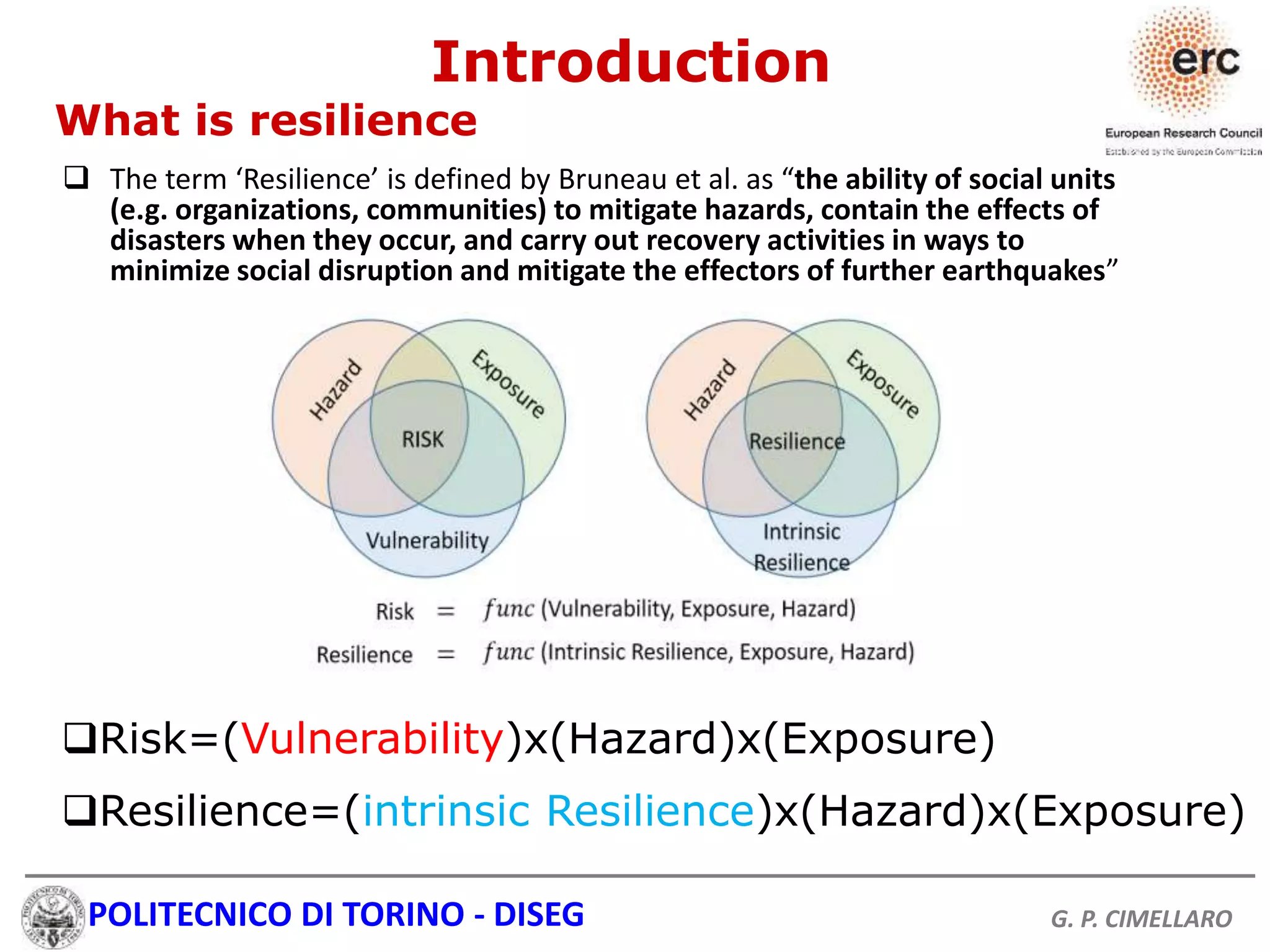
Risk=(Vulnerability)x(Hazard)x(Exposure)
Resilience=(intrinsic Resilience)x(Hazard)x(Exposure)
Introduction
What is resilience
 The term ‘Resilience’ is defined by Bruneau et al. as “the ability of social units
(e.g. organizations, communities) to mitigate hazards, contain the effects of
disasters when they occur, and carry out recovery activities in ways to
minimize social disruption and mitigate the effectors of further earthquakes”
POLITECNICO DI TORINO - DISEG G. P. CIMELLARO
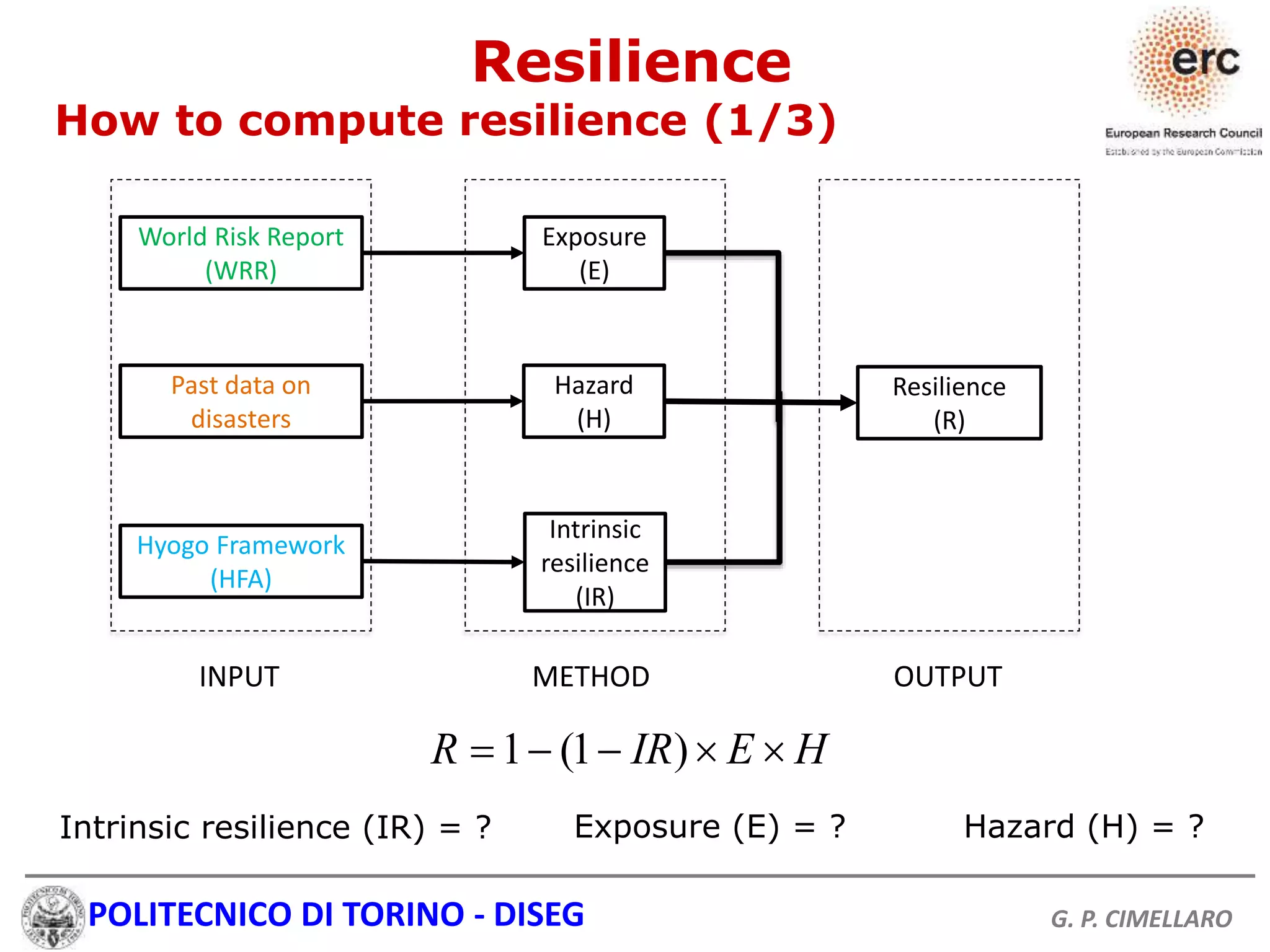
1 (1 )R IR E H    
Exposure
(E)
Hazard
(H)
Intrinsic
resilience
(IR)
Resilience
(R)
Past data on
disasters
World Risk Report
(WRR)
Hyogo Framework
(HFA)
INPUT METHOD OUTPUT
Exposure (E) = ? Hazard (H) = ?Intrinsic resilience (IR) = ?
Resilience
How to compute resilience (1/3)
POLITECNICO DI TORINO - DISEG G. P. CIMELLARO
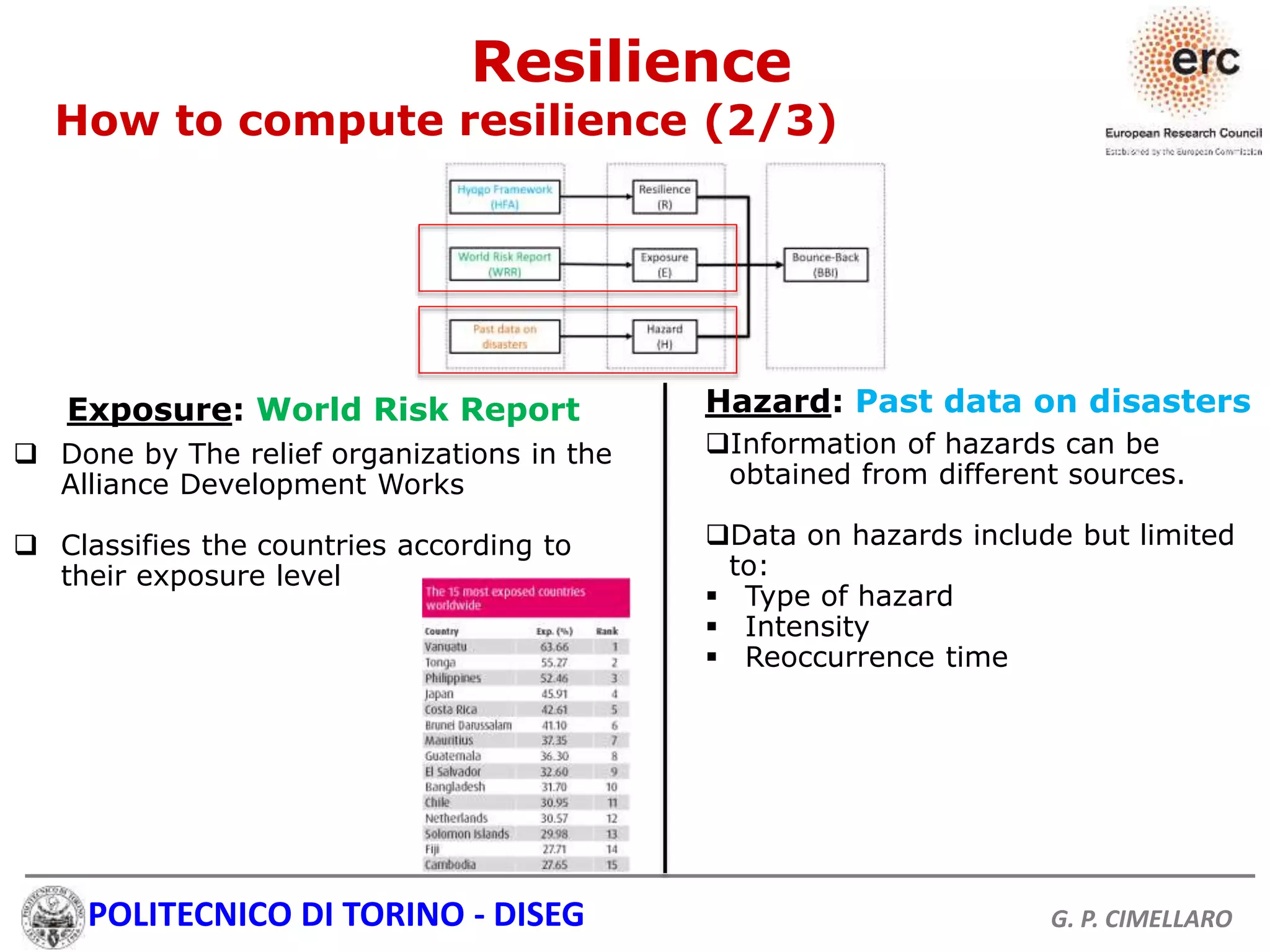
 Done by The relief organizations in the
Alliance Development Works
 Classifies the countries according to
their exposure level
Exposure: World Risk Report Hazard: Past data on disasters
Information of hazards can be
obtained from different sources.
Data on hazards include but limited
to:
 Type of hazard
 Intensity
 Reoccurrence time
Resilience
How to compute resilience (2/3)
POLITECNICO DI TORINO - DISEG G. P. CIMELLARO
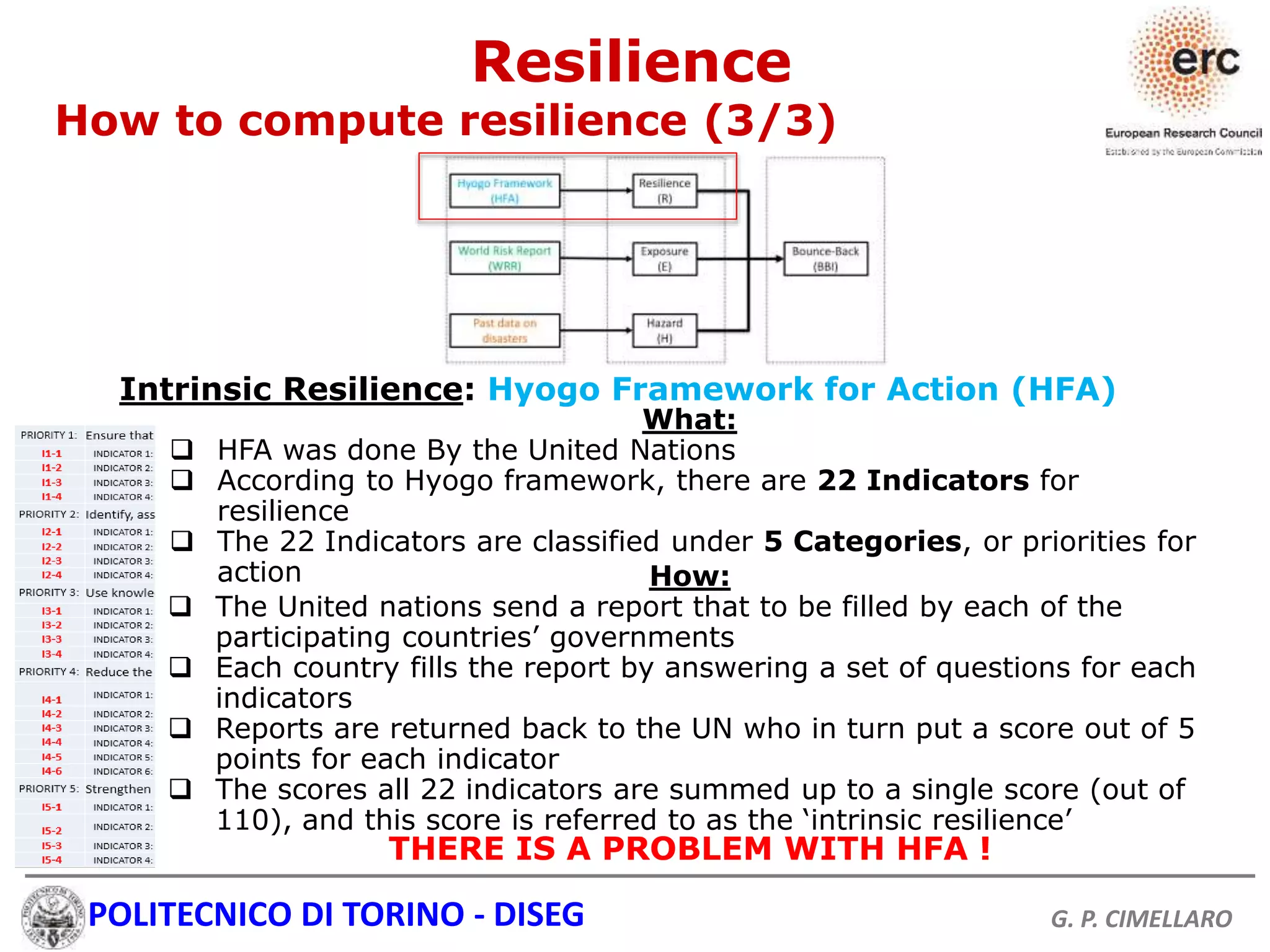
Intrinsic Resilience: Hyogo Framework for Action (HFA)
What:
 HFA was done By the United Nations
 According to Hyogo framework, there are 22 Indicators for
resilience
 The 22 Indicators are classified under 5 Categories, or priorities for
action How:
 The United nations send a report that to be filled by each of the
participating countries’ governments
 Each country fills the report by answering a set of questions for each
indicators
 Reports are returned back to the UN who in turn put a score out of 5
points for each indicator
 The scores all 22 indicators are summed up to a single score (out of
110), and this score is referred to as the ‘intrinsic resilience’
Resilience
How to compute resilience (3/3)
THERE IS A PROBLEM WITH HFA !
POLITECNICO DI TORINO - DISEG G. P. CIMELLARO
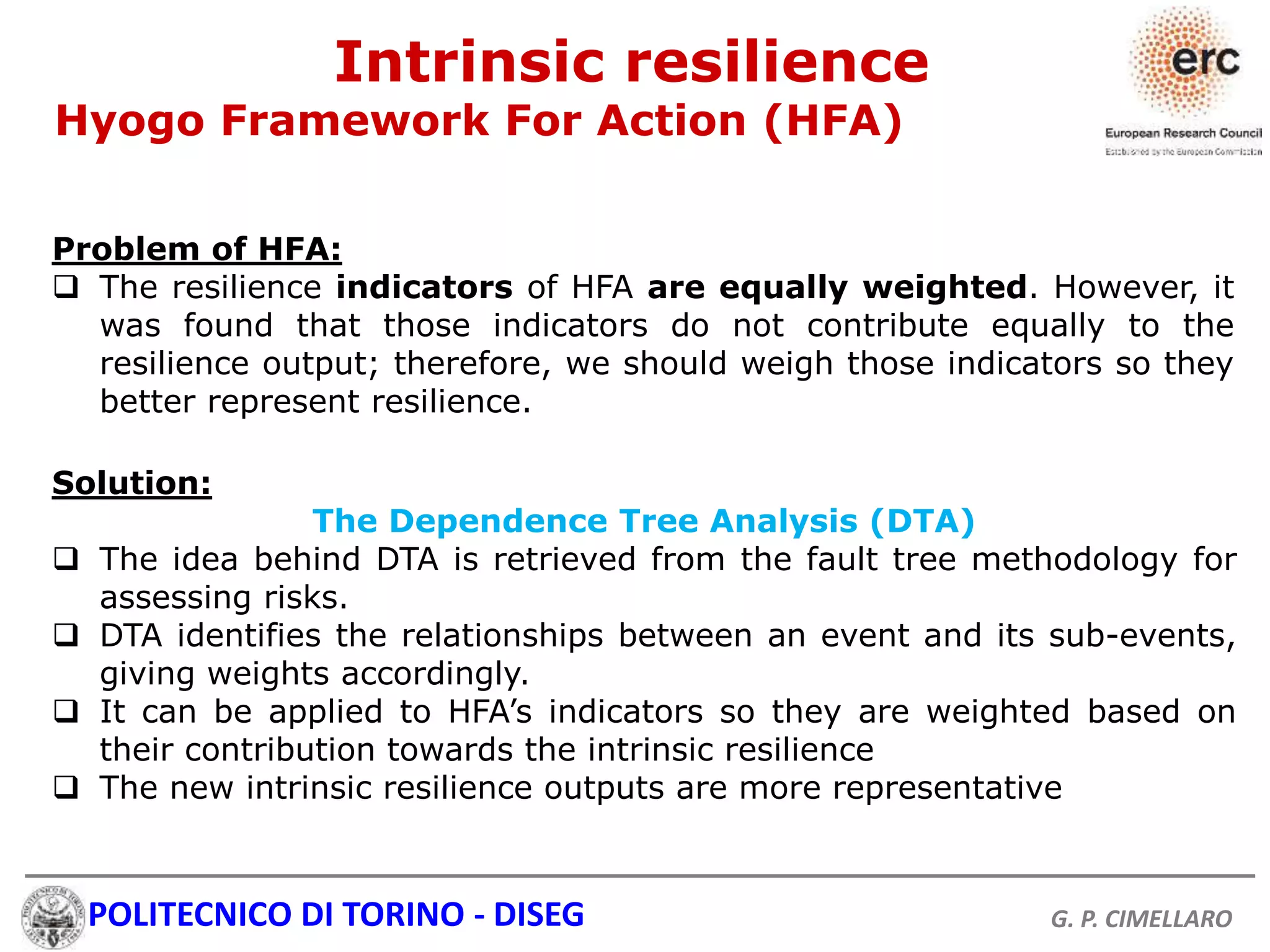
Solution:
The Dependence Tree Analysis (DTA)
 The idea behind DTA is retrieved from the fault tree methodology for
assessing risks.
 DTA identifies the relationships between an event and its sub-events,
giving weights accordingly.
 It can be applied to HFA’s indicators so they are weighted based on
their contribution towards the intrinsic resilience
 The new intrinsic resilience outputs are more representative
Intrinsic resilience
Hyogo Framework For Action (HFA)
Problem of HFA:
 The resilience indicators of HFA are equally weighted. However, it
was found that those indicators do not contribute equally to the
resilience output; therefore, we should weigh those indicators so they
better represent resilience.
POLITECNICO DI TORINO - DISEG G. P. CIMELLARO
Intrinsic resilience
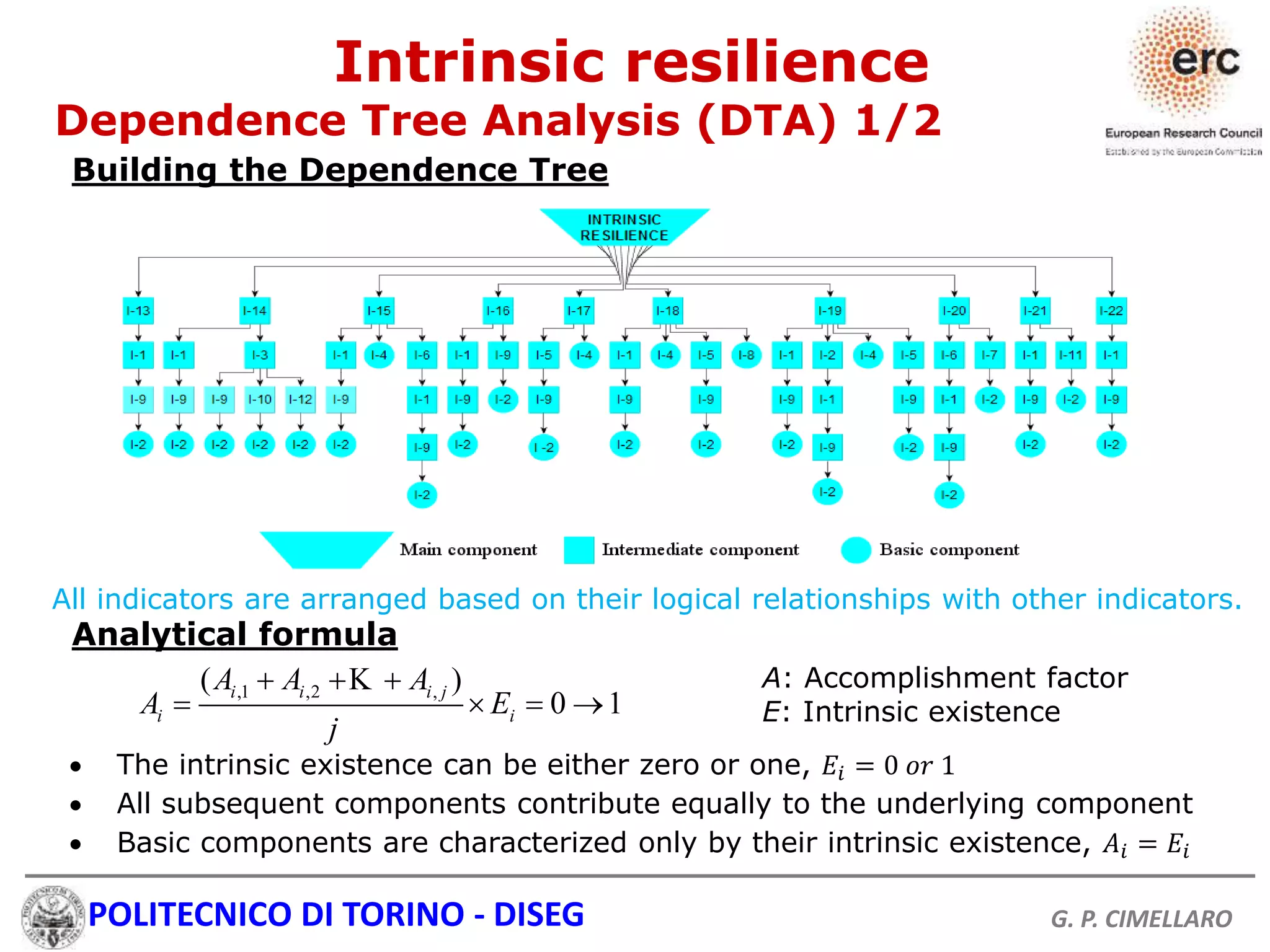
Dependence Tree Analysis (DTA) 1/2
Building the Dependence Tree
,1 ,2 ,( )
0 1i i i j
i i
A A A
A E
j
  
   
K
 The intrinsic existence can be either zero or one, 𝐸𝑖 = 0 𝑜𝑟 1
 All subsequent components contribute equally to the underlying component
 Basic components are characterized only by their intrinsic existence, 𝐴𝑖 = 𝐸𝑖
A: Accomplishment factor
E: Intrinsic existence
Analytical formula
All indicators are arranged based on their logical relationships with other indicators.
POLITECNICO DI TORINO - DISEG G. P. CIMELLARO
Intrinsic resilience
Dependence Tree Analysis (DTA) 2/2
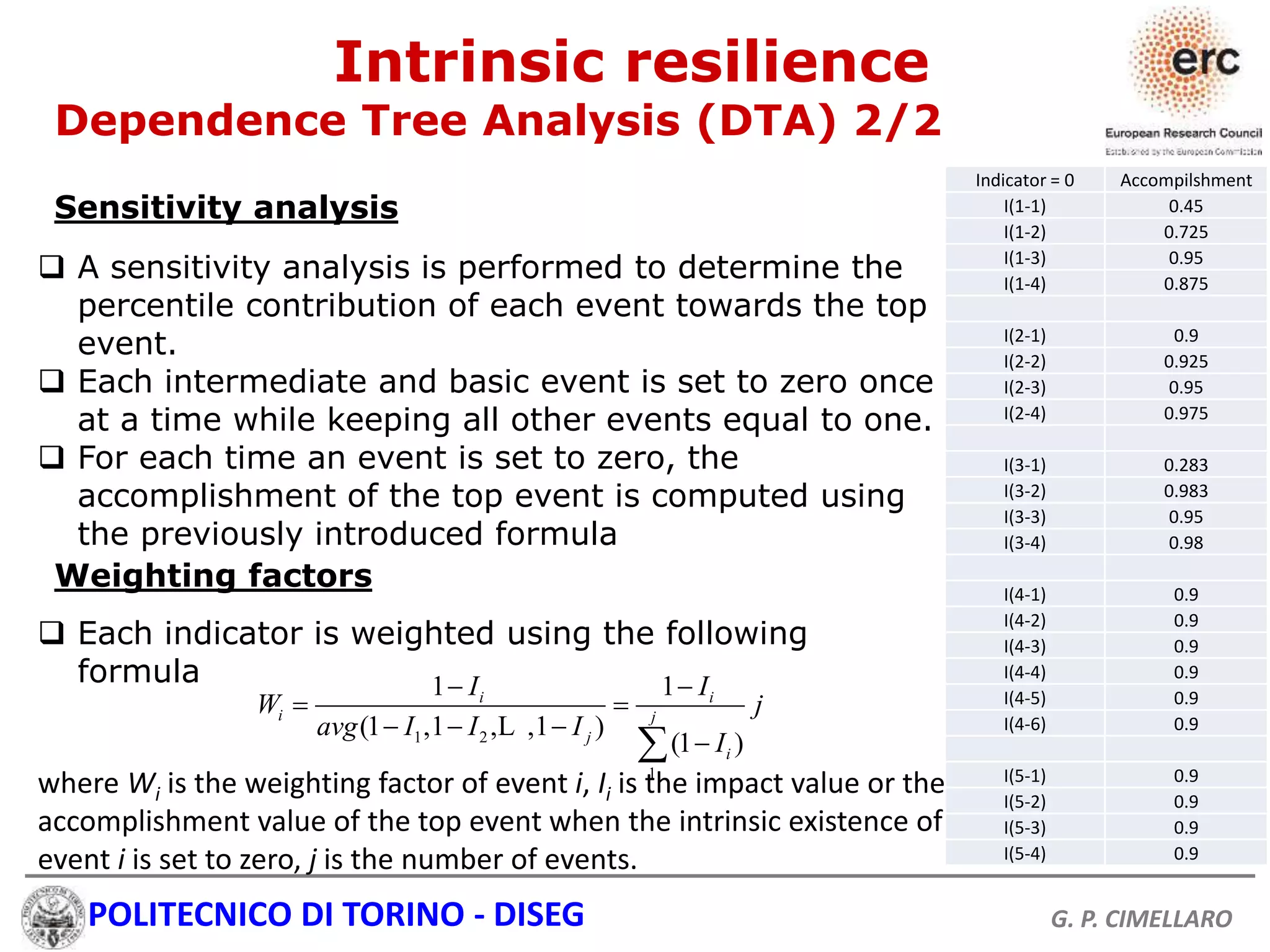
Sensitivity analysis
1 2
1
1 1
(1 ,1 , ,1 )
(1 )
i i
i j
j
i
I I
W j
avg I I I
I
 
 
  

L
Weighting factors
 A sensitivity analysis is performed to determine the
percentile contribution of each event towards the top
event.
 Each intermediate and basic event is set to zero once
at a time while keeping all other events equal to one.
 For each time an event is set to zero, the
accomplishment of the top event is computed using
the previously introduced formula
Indicator = 0 Accompilshment
I(1-1) 0.45
I(1-2) 0.725
I(1-3) 0.95
I(1-4) 0.875
I(2-1) 0.9
I(2-2) 0.925
I(2-3) 0.95
I(2-4) 0.975
I(3-1) 0.283
I(3-2) 0.983
I(3-3) 0.95
I(3-4) 0.98
I(4-1) 0.9
I(4-2) 0.9
I(4-3) 0.9
I(4-4) 0.9
I(4-5) 0.9
I(4-6) 0.9
I(5-1) 0.9
I(5-2) 0.9
I(5-3) 0.9
I(5-4) 0.9
 Each indicator is weighted using the following
formula
where Wi is the weighting factor of event i, Ii is the impact value or the
accomplishment value of the top event when the intrinsic existence of
event i is set to zero, j is the number of events.
POLITECNICO DI TORINO - DISEG G. P. CIMELLARO
Case study
 For the case study, we have chosen 37 countries of those of
participated in Hyogo Framework assessment project
 Countries were chosen randomly from all five continents
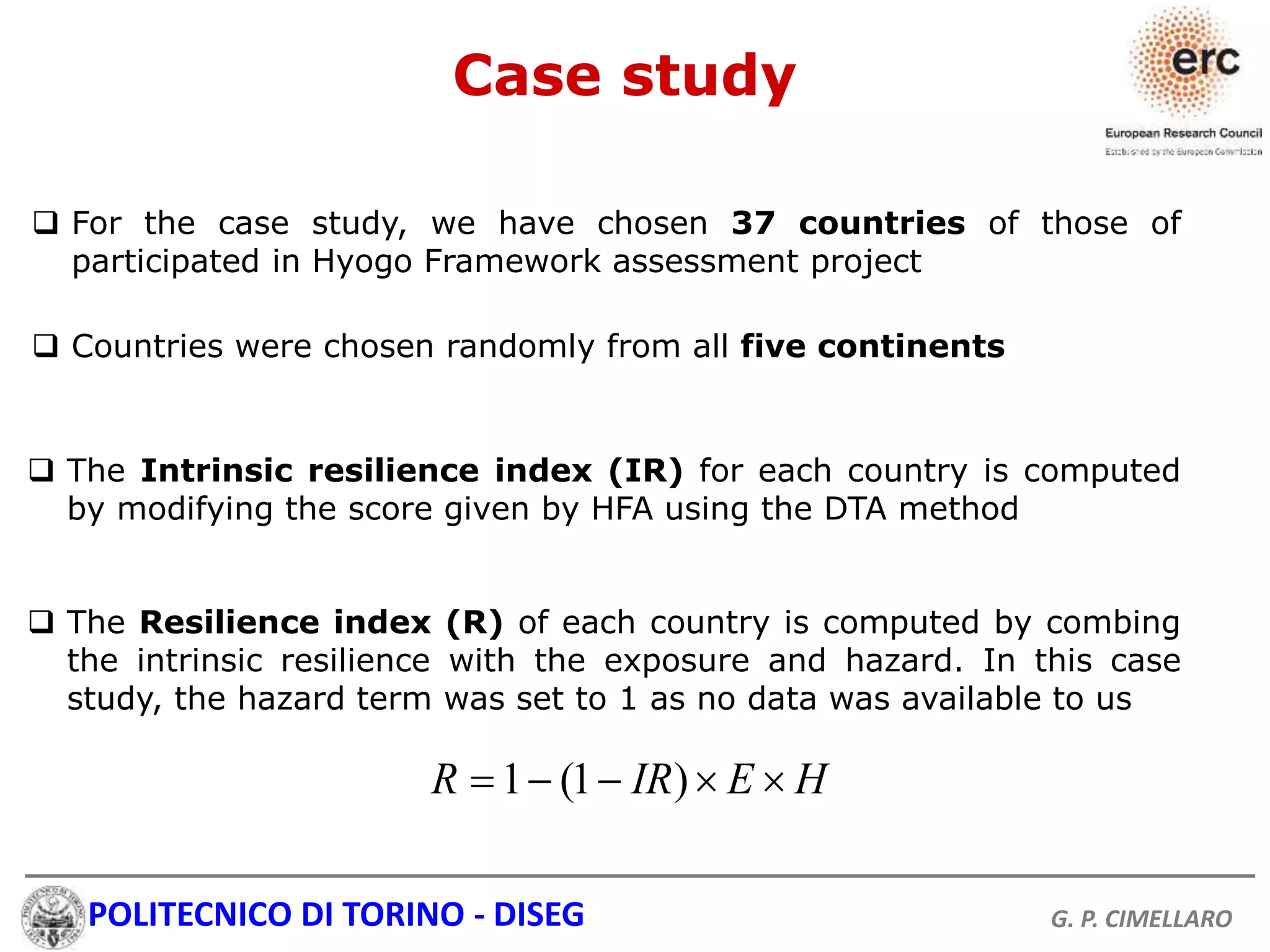
 The Intrinsic resilience index (IR) for each country is computed
by modifying the score given by HFA using the DTA method
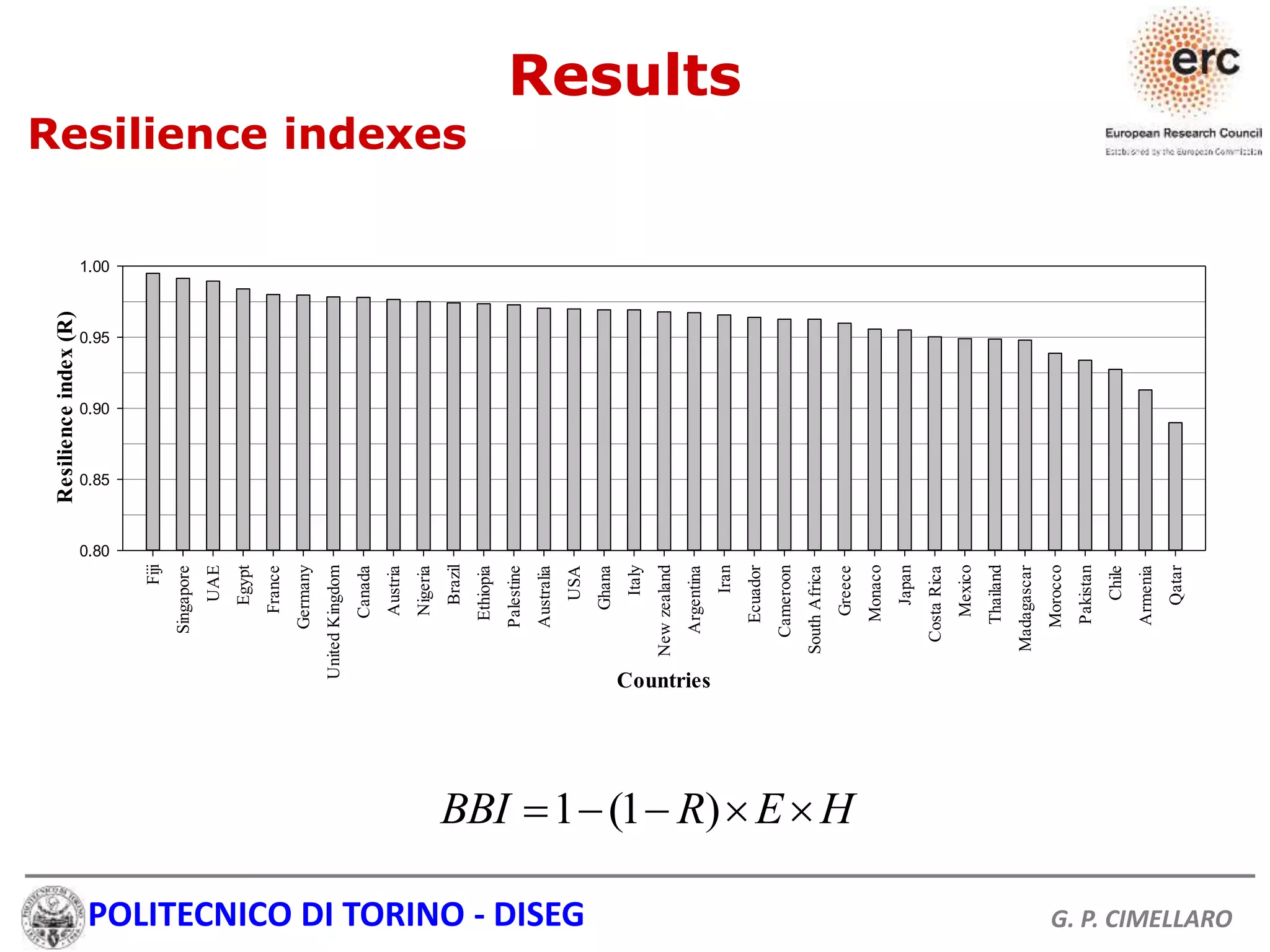
 The Resilience index (R) of each country is computed by combing
the intrinsic resilience with the exposure and hazard. In this case
study, the hazard term was set to 1 as no data was available to us
1 (1 )R IR E H    
POLITECNICO DI TORINO - DISEG G. P. CIMELLARO
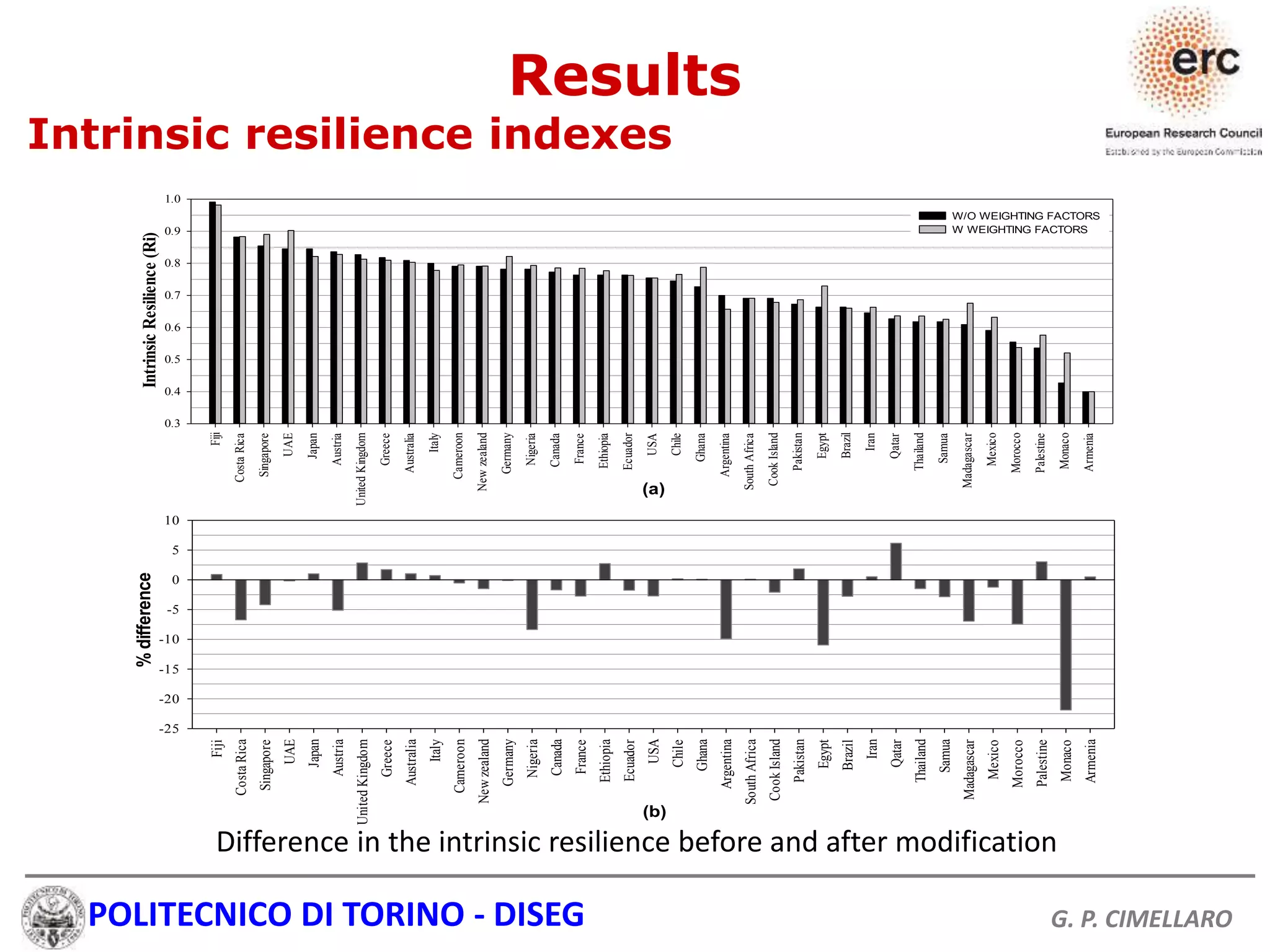
Difference in the intrinsic resilience before and after modification
Results
Intrinsic resilience indexes
(a)
Fiji
CostaRica
Singapore
UAE
Japan
Austria
UnitedKingdom
Greece
Australia
Italy
Cameroon
Newzealand
Germany
Nigeria
Canada
France
Ethiopia
Ecuador
USA
Chile
Ghana
Argentina
SouthAfrica
CookIsland
Pakistan
Egypt
Brazil
Iran
Qatar
Thailand
Samua
Madagascar
Mexico
Morocco
Palestine
Monaco
Armenia
IntrinsicResilience(Ri)
0.3
0.4
0.5
0.6
0.7
0.8
0.9
1.0
W/O WEIGHTING FACTORS
W WEIGHTING FACTORS
(b)
Fiji
CostaRica
Singapore
UAE
Japan
Austria
UnitedKingdom
Greece
Australia
Italy
Cameroon
Newzealand
Germany
Nigeria
Canada
France
Ethiopia
Ecuador
USA
Chile
Ghana
Argentina
SouthAfrica
CookIsland
Pakistan
Egypt
Brazil
Iran
Qatar
Thailand
Samua
Madagascar
Mexico
Morocco
Palestine
Monaco
Armenia
%difference
-25
-20
-15
-10
-5
0
5
10
POLITECNICO DI TORINO - DISEG G. P. CIMELLARO
1 (1 )BBI R E H    
Results
Resilience indexes
Countries
Fiji
Singapore
UAE
Egypt
France
Germany
UnitedKingdom
Canada
Austria
Nigeria
Brazil
Ethiopia
Palestine
Australia
USA
Ghana
Italy
Newzealand
Argentina
Iran
Ecuador
Cameroon
SouthAfrica
Greece
Monaco
Japan
CostaRica
Mexico
Thailand
Madagascar
Morocco
Pakistan
Chile
Armenia
Qatar
Resilienceindex(R)
0.80
0.85
0.90
0.95
1.00
POLITECNICO DI TORINO - DISEG G. P. CIMELLARO
Concluding remarks
 We introduced a new method to assess
resilience on the state level based the results of
Hyogo Framework for Action (HFA)
 To make the results of HFA usable, we proposed
the Dependence Tree Analysis (DTA) method,
which identifies the weight of relationships
between several events or indicators, giving
weights to the indicators accordingly.
 We introduced a new measure, Bounce-Back
index (BBI), which describes a system’s
capacity to adapt or bounce-back to its initial,
functional state. BBI is the combination of
Resilience, Vulnerability, and Exposure.
POLITECNICO DI TORINO - DISEG G. P. CIMELLARO
The applicability of the presented methodology was
tested on 37 countries by calculating their
respective intrinsic resilience and resilience
indexes.
Future research will be oriented towards
substituting the “Hyogo Framework for Action” with
its successor “Sendai Framework” in the evaluation
of resilience. This will lead to a better
representation of the resilience of the countries
given that the new UN framework is an enhanced
version of the previous one.
Concluding remarks
POLITECNICO DI TORINO - DISEG G. P. CIMELLARO
Cimellaro, G. P., Renschler, C., Reinhorn, A. M., and Arendt, L.
(2016). "PEOPLES: a framework for evaluating resilience." Journal
of Structural Engineering, ASCE, DOI
http://dx.doi.org/10.1061/(ASCE)ST.1943-541X.0001514.
Cimellaro, G., Tinebra, A., Renschler, C., and Fragiadakis, M. (2015).
"New Resilience Index for Urban Water Distribution Networks."
Journal of Structural Engineering, ASCE, 10.1061/(ASCE)ST.1943-
1541X.0001433 , C4015014.
Cimellaro, G. P., Villa, O., and Bruneau, M. (2014). "Resilience-
Based Design of Natural gas distribution networks." Journal of
Infrastructure Systems, ASCE, 10.1061/(ASCE)IS.1943-
555X.0000204.
Martinelli, D., Cimellaro, G. P., Terzic, V., and Mahin, S. (2014).
"Analysis of Economic Resiliency of Communities Affected By
Natural Disasters: The Bay Area Case Study." Procedia Economics
and Finance, 18 (( 2014 )), 959 – 968.
Cimellaro, G. P., Scura, G., Renschler, C., Reinhorn, A. M., and Kim,
H. (2014). "Rapid building damage assessment system using
mobile phone technology " Earthquake Engineering and
Engineering Vibration, 13(3), 519-533
Cimellaro Gian Paolo, R. A. M., Bruneau Michel. (2010).
"Framework for analytical quantification of disaster resilience."
Engineering Structures, 32(11), 3639-3649.
References
POLITECNICO DI TORINO - DISEG G. P. CIMELLARO
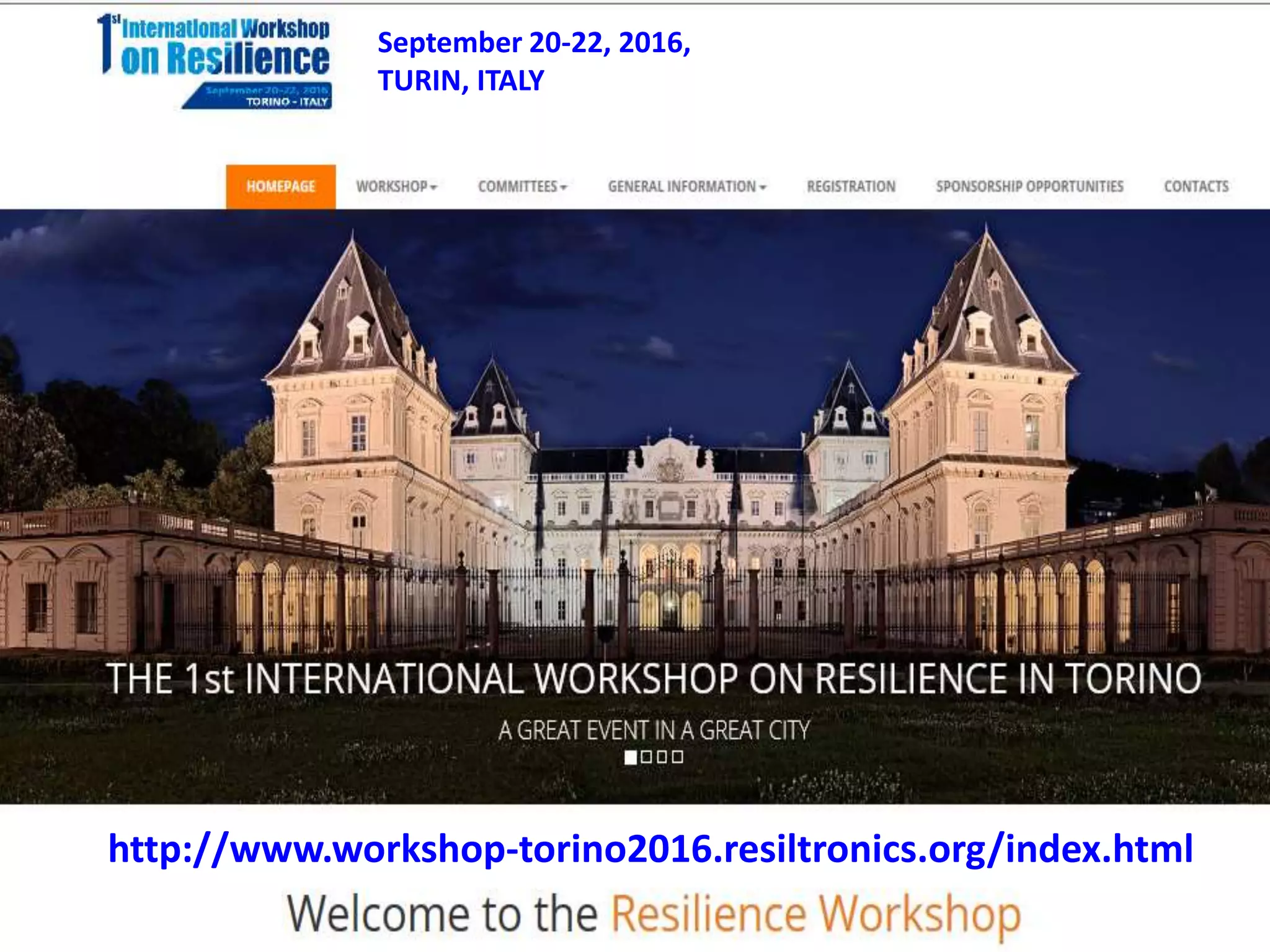
http://www.workshop-torino2016.resiltronics.org/index.html
September 20-22, 2016,
TURIN, ITALY

A Quantitative Framework to Assess Communities Resilience at the State Level, Gian Paolo CIMELLARO

  • 1.
    POLITECNICO DI TORINO- DISEG G. P. CIMELLARO A QUANTITATIVE FRAMEWORK TO ASSESS COMMUNITIES’ RESILIENCE AT THE STATE LEVEL O. Kammouh, A. Noori Zamani, G.P. Cimellaro Department of Structural, Building and Geotechnical Engineering Politecnico di Torino August 30, 2016
  • 2.
    POLITECNICO DI TORINO- DISEG G. P. CIMELLARO  Resilience is a broad and multidisciplinary subject and measuring it is one of the most demanding tasks due to the complexity involved in the process. Research on measuring community resilience is still in the early stages of development and no accepted method exists so far  Obtaining a reliable method to compare resilience among different countries and communities Motivation
  • 3.
    POLITECNICO DI TORINO- DISEG G. P. CIMELLARO Outline  Introduction  Resilience  How to compute Resilience  Intrinsic resilience  Hyogo Framework for Action (HFA)  The Dependence Tree Analysis (DTA)  Case study and Results  Intrinsic resilience indexes (IR)  Resilience indexes (R) Conclusion
  • 4.
    POLITECNICO DI TORINO- DISEG G. P. CIMELLARO Risk=(Vulnerability)x(Hazard)x(Exposure) Resilience=(intrinsic Resilience)x(Hazard)x(Exposure) Introduction What is resilience  The term ‘Resilience’ is defined by Bruneau et al. as “the ability of social units (e.g. organizations, communities) to mitigate hazards, contain the effects of disasters when they occur, and carry out recovery activities in ways to minimize social disruption and mitigate the effectors of further earthquakes”
  • 5.
    POLITECNICO DI TORINO- DISEG G. P. CIMELLARO 1 (1 )R IR E H     Exposure (E) Hazard (H) Intrinsic resilience (IR) Resilience (R) Past data on disasters World Risk Report (WRR) Hyogo Framework (HFA) INPUT METHOD OUTPUT Exposure (E) = ? Hazard (H) = ?Intrinsic resilience (IR) = ? Resilience How to compute resilience (1/3)
  • 6.
    POLITECNICO DI TORINO- DISEG G. P. CIMELLARO  Done by The relief organizations in the Alliance Development Works  Classifies the countries according to their exposure level Exposure: World Risk Report Hazard: Past data on disasters Information of hazards can be obtained from different sources. Data on hazards include but limited to:  Type of hazard  Intensity  Reoccurrence time Resilience How to compute resilience (2/3)
  • 7.
    POLITECNICO DI TORINO- DISEG G. P. CIMELLARO Intrinsic Resilience: Hyogo Framework for Action (HFA) What:  HFA was done By the United Nations  According to Hyogo framework, there are 22 Indicators for resilience  The 22 Indicators are classified under 5 Categories, or priorities for action How:  The United nations send a report that to be filled by each of the participating countries’ governments  Each country fills the report by answering a set of questions for each indicators  Reports are returned back to the UN who in turn put a score out of 5 points for each indicator  The scores all 22 indicators are summed up to a single score (out of 110), and this score is referred to as the ‘intrinsic resilience’ Resilience How to compute resilience (3/3) THERE IS A PROBLEM WITH HFA !
  • 8.
    POLITECNICO DI TORINO- DISEG G. P. CIMELLARO Solution: The Dependence Tree Analysis (DTA)  The idea behind DTA is retrieved from the fault tree methodology for assessing risks.  DTA identifies the relationships between an event and its sub-events, giving weights accordingly.  It can be applied to HFA’s indicators so they are weighted based on their contribution towards the intrinsic resilience  The new intrinsic resilience outputs are more representative Intrinsic resilience Hyogo Framework For Action (HFA) Problem of HFA:  The resilience indicators of HFA are equally weighted. However, it was found that those indicators do not contribute equally to the resilience output; therefore, we should weigh those indicators so they better represent resilience.
  • 9.
    POLITECNICO DI TORINO- DISEG G. P. CIMELLARO Intrinsic resilience Dependence Tree Analysis (DTA) 1/2 Building the Dependence Tree ,1 ,2 ,( ) 0 1i i i j i i A A A A E j        K  The intrinsic existence can be either zero or one, 𝐸𝑖 = 0 𝑜𝑟 1  All subsequent components contribute equally to the underlying component  Basic components are characterized only by their intrinsic existence, 𝐴𝑖 = 𝐸𝑖 A: Accomplishment factor E: Intrinsic existence Analytical formula All indicators are arranged based on their logical relationships with other indicators.
  • 10.
    POLITECNICO DI TORINO- DISEG G. P. CIMELLARO Intrinsic resilience Dependence Tree Analysis (DTA) 2/2 Sensitivity analysis 1 2 1 1 1 (1 ,1 , ,1 ) (1 ) i i i j j i I I W j avg I I I I         L Weighting factors  A sensitivity analysis is performed to determine the percentile contribution of each event towards the top event.  Each intermediate and basic event is set to zero once at a time while keeping all other events equal to one.  For each time an event is set to zero, the accomplishment of the top event is computed using the previously introduced formula Indicator = 0 Accompilshment I(1-1) 0.45 I(1-2) 0.725 I(1-3) 0.95 I(1-4) 0.875 I(2-1) 0.9 I(2-2) 0.925 I(2-3) 0.95 I(2-4) 0.975 I(3-1) 0.283 I(3-2) 0.983 I(3-3) 0.95 I(3-4) 0.98 I(4-1) 0.9 I(4-2) 0.9 I(4-3) 0.9 I(4-4) 0.9 I(4-5) 0.9 I(4-6) 0.9 I(5-1) 0.9 I(5-2) 0.9 I(5-3) 0.9 I(5-4) 0.9  Each indicator is weighted using the following formula where Wi is the weighting factor of event i, Ii is the impact value or the accomplishment value of the top event when the intrinsic existence of event i is set to zero, j is the number of events.
  • 11.
    POLITECNICO DI TORINO- DISEG G. P. CIMELLARO Case study  For the case study, we have chosen 37 countries of those of participated in Hyogo Framework assessment project  Countries were chosen randomly from all five continents  The Intrinsic resilience index (IR) for each country is computed by modifying the score given by HFA using the DTA method  The Resilience index (R) of each country is computed by combing the intrinsic resilience with the exposure and hazard. In this case study, the hazard term was set to 1 as no data was available to us 1 (1 )R IR E H    
  • 12.
    POLITECNICO DI TORINO- DISEG G. P. CIMELLARO Difference in the intrinsic resilience before and after modification Results Intrinsic resilience indexes (a) Fiji CostaRica Singapore UAE Japan Austria UnitedKingdom Greece Australia Italy Cameroon Newzealand Germany Nigeria Canada France Ethiopia Ecuador USA Chile Ghana Argentina SouthAfrica CookIsland Pakistan Egypt Brazil Iran Qatar Thailand Samua Madagascar Mexico Morocco Palestine Monaco Armenia IntrinsicResilience(Ri) 0.3 0.4 0.5 0.6 0.7 0.8 0.9 1.0 W/O WEIGHTING FACTORS W WEIGHTING FACTORS (b) Fiji CostaRica Singapore UAE Japan Austria UnitedKingdom Greece Australia Italy Cameroon Newzealand Germany Nigeria Canada France Ethiopia Ecuador USA Chile Ghana Argentina SouthAfrica CookIsland Pakistan Egypt Brazil Iran Qatar Thailand Samua Madagascar Mexico Morocco Palestine Monaco Armenia %difference -25 -20 -15 -10 -5 0 5 10
  • 13.
    POLITECNICO DI TORINO- DISEG G. P. CIMELLARO 1 (1 )BBI R E H     Results Resilience indexes Countries Fiji Singapore UAE Egypt France Germany UnitedKingdom Canada Austria Nigeria Brazil Ethiopia Palestine Australia USA Ghana Italy Newzealand Argentina Iran Ecuador Cameroon SouthAfrica Greece Monaco Japan CostaRica Mexico Thailand Madagascar Morocco Pakistan Chile Armenia Qatar Resilienceindex(R) 0.80 0.85 0.90 0.95 1.00
  • 14.
    POLITECNICO DI TORINO- DISEG G. P. CIMELLARO Concluding remarks  We introduced a new method to assess resilience on the state level based the results of Hyogo Framework for Action (HFA)  To make the results of HFA usable, we proposed the Dependence Tree Analysis (DTA) method, which identifies the weight of relationships between several events or indicators, giving weights to the indicators accordingly.  We introduced a new measure, Bounce-Back index (BBI), which describes a system’s capacity to adapt or bounce-back to its initial, functional state. BBI is the combination of Resilience, Vulnerability, and Exposure.
  • 15.
    POLITECNICO DI TORINO- DISEG G. P. CIMELLARO The applicability of the presented methodology was tested on 37 countries by calculating their respective intrinsic resilience and resilience indexes. Future research will be oriented towards substituting the “Hyogo Framework for Action” with its successor “Sendai Framework” in the evaluation of resilience. This will lead to a better representation of the resilience of the countries given that the new UN framework is an enhanced version of the previous one. Concluding remarks
  • 16.
    POLITECNICO DI TORINO- DISEG G. P. CIMELLARO Cimellaro, G. P., Renschler, C., Reinhorn, A. M., and Arendt, L. (2016). "PEOPLES: a framework for evaluating resilience." Journal of Structural Engineering, ASCE, DOI http://dx.doi.org/10.1061/(ASCE)ST.1943-541X.0001514. Cimellaro, G., Tinebra, A., Renschler, C., and Fragiadakis, M. (2015). "New Resilience Index for Urban Water Distribution Networks." Journal of Structural Engineering, ASCE, 10.1061/(ASCE)ST.1943- 1541X.0001433 , C4015014. Cimellaro, G. P., Villa, O., and Bruneau, M. (2014). "Resilience- Based Design of Natural gas distribution networks." Journal of Infrastructure Systems, ASCE, 10.1061/(ASCE)IS.1943- 555X.0000204. Martinelli, D., Cimellaro, G. P., Terzic, V., and Mahin, S. (2014). "Analysis of Economic Resiliency of Communities Affected By Natural Disasters: The Bay Area Case Study." Procedia Economics and Finance, 18 (( 2014 )), 959 – 968. Cimellaro, G. P., Scura, G., Renschler, C., Reinhorn, A. M., and Kim, H. (2014). "Rapid building damage assessment system using mobile phone technology " Earthquake Engineering and Engineering Vibration, 13(3), 519-533 Cimellaro Gian Paolo, R. A. M., Bruneau Michel. (2010). "Framework for analytical quantification of disaster resilience." Engineering Structures, 32(11), 3639-3649. References
  • 17.
    POLITECNICO DI TORINO- DISEG G. P. CIMELLARO http://www.workshop-torino2016.resiltronics.org/index.html September 20-22, 2016, TURIN, ITALY