SOUTHEAST UNIVERSITY
School of Science and Engineering, Department of Textile Engineering
A compressive study on Rib
Circular Knitting Machine
1
SOUTHEAST UNIVERSITY
School of Science and Engineering, Department of Textile Engineering
• The structure in which the face and back
loop occurs along to the coarse
successively but all the loops of a wale is
same is called rib structure. The circular
knitting machine which is used to produce
the rib structures is known as rib machine.
2
SOUTHEAST UNIVERSITY
School of Science and Engineering, Department of Textile Engineering
3
SOUTHEAST UNIVERSITY
School of Science and Engineering, Department of Textile Engineering
4
SOUTHEAST UNIVERSITY
School of Science and Engineering, Department of Textile Engineering
5
SOUTHEAST UNIVERSITY
School of Science and Engineering, Department of Textile Engineering
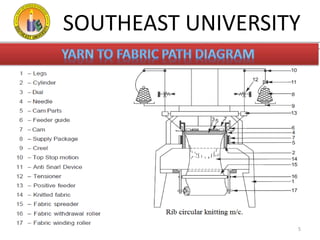
• Is the circular knitting m/c ,yarn is supplied from the set of
packages which is placed in the creel. When supplying the
yarn from the packages tensioner & anti snail device are
placed over & in contact with the yarn. The yarns is fed from
the feeder to the needles of the needles of the dial & cylinder.
In successively, the knitted fabric is produced by the action of
needles, cam & sinker. The produced knitted fabric is passed
over & in contact with the fabric spreader & fabric withdraw
roller. Finally the fabric is wound in the fabric winding roller.
6
SOUTHEAST UNIVERSITY
School of Science and Engineering, Department of Textile Engineering
• 1.Creel:Creels are the knitting elements which carry the yarn
packages to feed the knitting zone.
• 2.Feeder:The feeders feed the yarn into the needles hooks and
control the needle latches in their position while the needles attain
their position.
• 3.Dial:Dial is the upper steel needle bed used in double jersey
knitting mc. Into the grooves of the dial ,the needles are mounted
horizontally and near allowed to move radially in and out by their dial
cam.
• 4. Guide: Guides control the yarn path which is very necessary .
7
SOUTHEAST UNIVERSITY
School of Science and Engineering, Department of Textile Engineering
• 5. Needle: It is the principal element of knitting m/c. The function
of the needle to retain old loop & to receive the new loop.
• 6. Cam: The cams are the mechanical devices which convert the
rotary m/c drive into a suitable reciprocating action for the needles.
• 7. Cylinder: The cylinder is a steel circular bed having grooves on its
outer periphery where the needles are mounted.
• 8.Fabric Spreader: A simple fabric spreader is a solid wooden plate,
placed above the take down rollers & held in position by the fabric
tube.
• 9.Cloth roller: this mechanism withdraw the fabric from the needles
& winds them into cloth roller.
8
SOUTHEAST UNIVERSITY
School of Science and Engineering, Department of Textile Engineering
9
SOUTHEAST UNIVERSITY
School of Science and Engineering, Department of Textile Engineering
• 1 .Rest position: The rest position for the cylinder and dial needles.
Needles are constant. Loops are present in their hooks. Latches are close.
• 2. Tucking position for dial needle: The dial needle moves forward. Loop is
present on the latch. Latch is open. Cylinder needle is in the rest position.
• 3. Tucking position for cylinder needle: The cylinder needle moves
forward. The cylinder loop is present on the latch. Here dial needle holds
down the fabric on the cylinder needle. So that the latch of the cylinder
needle is opened.
• 4. Clearing position of dial needle: The dial needle further moves forward
to clear the old loop from its latch. Here dial latch is open.
10
SOUTHEAST UNIVERSITY
School of Science and Engineering, Department of Textile Engineering
11
SOUTHEAST UNIVERSITY
School of Science and Engineering, Department of Textile Engineering
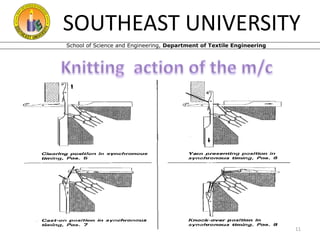
• 5 .Clearing position of cylinder needle: The cylinder needle will further
move forward to clear the old loop from its latch. Cylinder latch is open.
• 6 .Yarn presenting position: The cylinder and dial needles are pulled back
again and they move into their yarn presenting position. The newly
presented yarn is laid in the open needle hooks of both the needles.
• 7. Cast on position: The cylinder and dial needles are pulled further and
move into their cast on position. Here the loops lie over the closed needle
head and the newly presented yarn is held in the closed needle head.
• 8 .Knock-over position: The cylinder and dial needles are pulled further
.The new yarn is drawn through the loops of the both needles. The loops
are knocked-over as stitches and new loops are formed out of the yarn
presented.
12
SOUTHEAST UNIVERSITY
School of Science and Engineering, Department of Textile Engineering
Motor to cylinder gearing diagram
13
SOUTHEAST UNIVERSITY
School of Science and Engineering, Department of Textile Engineering
Description of motor to cylinder gearing diagram:
A motor is needed to perform the action of creating
the motion is the circular knitting m/c. This motor
drives the motor pulley & motor pulley gets the
motion. Then the motor pulley drives the other m/c
pulley. The driver m/c pulley also drives the next
m/c pulley. There after, m/c pulley drives the bevel
gear & finally the bevel gear drives the cylinder
gear.
14
SOUTHEAST UNIVERSITY
School of Science and Engineering, Department of Textile Engineering
• Production Calculation from our LAB double jersey knitting m/c
• R.P.M of cylinder=1400×3/8×3/11×33/237 =19.9367=20
• R.P.M of dial=1400×3/8×3/11×33/237×296/45×45/296=19.9367 =20
Specification:
• Cylinder diameter=22’’
• Gauge=24
• No of feeder=25
• Stitch length=2.2mm
• Yarn count=28Ne
• Shift =8
• Efficiency=90%=0.90
• Cylinder R.P.M=20
• CPI=36
15
SOUTHEAST UNIVERSITY
School of Science and Engineering, Department of Textile Engineering
16
SOUTHEAST UNIVERSITY
School of Science and Engineering, Department of Textile Engineering
1.Rib has a vertical cord appearance.
2.1×1 rib has the appearance of technical face of plain fabric
3.Relaxed 1×1 rib is theoretically twice as thick and 12 the width of an equivalent plain
fabric.
4.It is more expensive fabric to produce than plain fabric.
5.It can be unravel from the end knitted last by the free loop head through to the back
of each stitch.
6.It is a heavier structure.
7.It has very little curling tendency.
8.Rib structures are elastic from fitting and retain warmth better than plain structure.
17
SOUTHEAST UNIVERSITY
School of Science and Engineering, Department of Textile Engineering
18
• In This Presentation we learned about details of
rib circular machine. This experiment has
significance in our study life. In this experiment
we sketch the yarn path diagram of the
machine, show the knitting action, cam system.
We point out the various specification of the
machine.
SOUTHEAST UNIVERSITY
School of Science and Engineering, Department of Textile Engineering
• Class Lecture.
• Circular knitting, By lyer/schach/Mammel, Second edition
• Knitting Technology by David J. Spencer.
• International Journal of Engineering & Technology IJET-IJENS Vol: 11
No: 01
• Understanding textiles for A Merchandiser by Engr. Shah
Alimuzzaman Belal
• www.wikipedia.com
• www.britanica.com
• http://www.autexrj.org/No4-2006/0217.pdf
• http://textilelearner.blogspot.com/2012/01/mechanical-interlock-
circular-knitting_29.html#ixzz1sec2XeLV
• Etc…………..
19
SOUTHEAST UNIVERSITY
School of Science and Engineering, Department of Textile Engineering
20

A compressive study on rib circular knitting machine

  • 1.
    SOUTHEAST UNIVERSITY School ofScience and Engineering, Department of Textile Engineering A compressive study on Rib Circular Knitting Machine 1
  • 2.
    SOUTHEAST UNIVERSITY School ofScience and Engineering, Department of Textile Engineering • The structure in which the face and back loop occurs along to the coarse successively but all the loops of a wale is same is called rib structure. The circular knitting machine which is used to produce the rib structures is known as rib machine. 2
  • 3.
    SOUTHEAST UNIVERSITY School ofScience and Engineering, Department of Textile Engineering 3
  • 4.
    SOUTHEAST UNIVERSITY School ofScience and Engineering, Department of Textile Engineering 4
  • 5.
    SOUTHEAST UNIVERSITY School ofScience and Engineering, Department of Textile Engineering 5
  • 6.
    SOUTHEAST UNIVERSITY School ofScience and Engineering, Department of Textile Engineering • Is the circular knitting m/c ,yarn is supplied from the set of packages which is placed in the creel. When supplying the yarn from the packages tensioner & anti snail device are placed over & in contact with the yarn. The yarns is fed from the feeder to the needles of the needles of the dial & cylinder. In successively, the knitted fabric is produced by the action of needles, cam & sinker. The produced knitted fabric is passed over & in contact with the fabric spreader & fabric withdraw roller. Finally the fabric is wound in the fabric winding roller. 6
  • 7.
    SOUTHEAST UNIVERSITY School ofScience and Engineering, Department of Textile Engineering • 1.Creel:Creels are the knitting elements which carry the yarn packages to feed the knitting zone. • 2.Feeder:The feeders feed the yarn into the needles hooks and control the needle latches in their position while the needles attain their position. • 3.Dial:Dial is the upper steel needle bed used in double jersey knitting mc. Into the grooves of the dial ,the needles are mounted horizontally and near allowed to move radially in and out by their dial cam. • 4. Guide: Guides control the yarn path which is very necessary . 7
  • 8.
    SOUTHEAST UNIVERSITY School ofScience and Engineering, Department of Textile Engineering • 5. Needle: It is the principal element of knitting m/c. The function of the needle to retain old loop & to receive the new loop. • 6. Cam: The cams are the mechanical devices which convert the rotary m/c drive into a suitable reciprocating action for the needles. • 7. Cylinder: The cylinder is a steel circular bed having grooves on its outer periphery where the needles are mounted. • 8.Fabric Spreader: A simple fabric spreader is a solid wooden plate, placed above the take down rollers & held in position by the fabric tube. • 9.Cloth roller: this mechanism withdraw the fabric from the needles & winds them into cloth roller. 8
  • 9.
    SOUTHEAST UNIVERSITY School ofScience and Engineering, Department of Textile Engineering 9
  • 10.
    SOUTHEAST UNIVERSITY School ofScience and Engineering, Department of Textile Engineering • 1 .Rest position: The rest position for the cylinder and dial needles. Needles are constant. Loops are present in their hooks. Latches are close. • 2. Tucking position for dial needle: The dial needle moves forward. Loop is present on the latch. Latch is open. Cylinder needle is in the rest position. • 3. Tucking position for cylinder needle: The cylinder needle moves forward. The cylinder loop is present on the latch. Here dial needle holds down the fabric on the cylinder needle. So that the latch of the cylinder needle is opened. • 4. Clearing position of dial needle: The dial needle further moves forward to clear the old loop from its latch. Here dial latch is open. 10
  • 11.
    SOUTHEAST UNIVERSITY School ofScience and Engineering, Department of Textile Engineering 11
  • 12.
    SOUTHEAST UNIVERSITY School ofScience and Engineering, Department of Textile Engineering • 5 .Clearing position of cylinder needle: The cylinder needle will further move forward to clear the old loop from its latch. Cylinder latch is open. • 6 .Yarn presenting position: The cylinder and dial needles are pulled back again and they move into their yarn presenting position. The newly presented yarn is laid in the open needle hooks of both the needles. • 7. Cast on position: The cylinder and dial needles are pulled further and move into their cast on position. Here the loops lie over the closed needle head and the newly presented yarn is held in the closed needle head. • 8 .Knock-over position: The cylinder and dial needles are pulled further .The new yarn is drawn through the loops of the both needles. The loops are knocked-over as stitches and new loops are formed out of the yarn presented. 12
  • 13.
    SOUTHEAST UNIVERSITY School ofScience and Engineering, Department of Textile Engineering Motor to cylinder gearing diagram 13
  • 14.
    SOUTHEAST UNIVERSITY School ofScience and Engineering, Department of Textile Engineering Description of motor to cylinder gearing diagram: A motor is needed to perform the action of creating the motion is the circular knitting m/c. This motor drives the motor pulley & motor pulley gets the motion. Then the motor pulley drives the other m/c pulley. The driver m/c pulley also drives the next m/c pulley. There after, m/c pulley drives the bevel gear & finally the bevel gear drives the cylinder gear. 14
  • 15.
    SOUTHEAST UNIVERSITY School ofScience and Engineering, Department of Textile Engineering • Production Calculation from our LAB double jersey knitting m/c • R.P.M of cylinder=1400×3/8×3/11×33/237 =19.9367=20 • R.P.M of dial=1400×3/8×3/11×33/237×296/45×45/296=19.9367 =20 Specification: • Cylinder diameter=22’’ • Gauge=24 • No of feeder=25 • Stitch length=2.2mm • Yarn count=28Ne • Shift =8 • Efficiency=90%=0.90 • Cylinder R.P.M=20 • CPI=36 15
  • 16.
    SOUTHEAST UNIVERSITY School ofScience and Engineering, Department of Textile Engineering 16
  • 17.
    SOUTHEAST UNIVERSITY School ofScience and Engineering, Department of Textile Engineering 1.Rib has a vertical cord appearance. 2.1×1 rib has the appearance of technical face of plain fabric 3.Relaxed 1×1 rib is theoretically twice as thick and 12 the width of an equivalent plain fabric. 4.It is more expensive fabric to produce than plain fabric. 5.It can be unravel from the end knitted last by the free loop head through to the back of each stitch. 6.It is a heavier structure. 7.It has very little curling tendency. 8.Rib structures are elastic from fitting and retain warmth better than plain structure. 17
  • 18.
    SOUTHEAST UNIVERSITY School ofScience and Engineering, Department of Textile Engineering 18 • In This Presentation we learned about details of rib circular machine. This experiment has significance in our study life. In this experiment we sketch the yarn path diagram of the machine, show the knitting action, cam system. We point out the various specification of the machine.
  • 19.
    SOUTHEAST UNIVERSITY School ofScience and Engineering, Department of Textile Engineering • Class Lecture. • Circular knitting, By lyer/schach/Mammel, Second edition • Knitting Technology by David J. Spencer. • International Journal of Engineering & Technology IJET-IJENS Vol: 11 No: 01 • Understanding textiles for A Merchandiser by Engr. Shah Alimuzzaman Belal • www.wikipedia.com • www.britanica.com • http://www.autexrj.org/No4-2006/0217.pdf • http://textilelearner.blogspot.com/2012/01/mechanical-interlock- circular-knitting_29.html#ixzz1sec2XeLV • Etc………….. 19
  • 20.
    SOUTHEAST UNIVERSITY School ofScience and Engineering, Department of Textile Engineering 20