Interlock Fabrics
Fabrics Name : Interlock Fabrics
Introduction of Fabric :
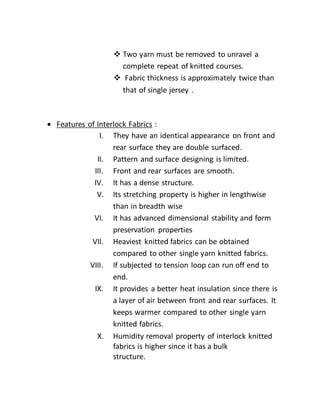
 Definition : Interlock means a device or mechanism for connecting
or coordinating the function of different components. a fabric
knitted with closely interlocking stitches allowing it to stretch.
Interlock fabric is a variation of rib knit construction. Similar to a
Jersey knit except both front and back of the fabric look identical.
Double knit construction makes this a thicker knit fabric. Interlock
is the tightest weave, gives the smoothest surface and the finest
hand. The fabric is extremely soft, firm and absorbent.
 Characteristics of Interlock Fabrics :
 Interlock the technical face of plain on both
sides so the appearance of face and back
are same.
 The Wales of each side re exactly apposite
to each other and are locked together.
 Widthwise and length elongations are
approximately the same as single jersey
 The fabric does not curl at the edges .
 The fabric can be unraveled from the
knitted last.
 Two yarn must be removed to unravel a
complete repeat of knitted courses.
 Fabric thickness is approximately twice than
that of single jersey .
 Features of Interlock Fabrics :
I. They have an identical appearance on front and
rear surface they are double surfaced.
II. Pattern and surface designing is limited.
III. Front and rear surfaces are smooth.
IV. It has a dense structure.
V. Its stretching property is higher in lengthwise
than in breadth wise
VI. It has advanced dimensional stability and form
preservation properties
VII. Heaviest knitted fabrics can be obtained
compared to other single yarn knitted fabrics.
VIII. If subjected to tension loop can run off end to
end.
IX. It provides a better heat insulation since there is
a layer of air between front and rear surfaces. It
keeps warmer compared to other single yarn
knitted fabrics.
X. Humidity removal property of interlock knitted
fabrics is higher since it has a bulk
structure.
 Machine requirement for interlock knit fabric :
 Interlock fabrics are mainly produced on specially
designed circular double jersey machines called
interlock machines
 They are high speed, multi-feeders with closed
cam track machines.
 The common gauges for interlock fabrics are 20-
24 NPI, using 1/30 Ne cotton or 1/48 Nm worsted
yarns.
 Worsted interlock is for ladies’ winter suiting
fabrics. For those 28 gauge fabrics, the yarns
used are mainly textures polyester of 75 denier.

Interlock fabrics

  • 1.
    Interlock Fabrics Fabrics Name: Interlock Fabrics Introduction of Fabric :  Definition : Interlock means a device or mechanism for connecting or coordinating the function of different components. a fabric knitted with closely interlocking stitches allowing it to stretch. Interlock fabric is a variation of rib knit construction. Similar to a Jersey knit except both front and back of the fabric look identical. Double knit construction makes this a thicker knit fabric. Interlock is the tightest weave, gives the smoothest surface and the finest hand. The fabric is extremely soft, firm and absorbent.  Characteristics of Interlock Fabrics :  Interlock the technical face of plain on both sides so the appearance of face and back are same.  The Wales of each side re exactly apposite to each other and are locked together.  Widthwise and length elongations are approximately the same as single jersey  The fabric does not curl at the edges .  The fabric can be unraveled from the knitted last.
  • 2.
     Two yarnmust be removed to unravel a complete repeat of knitted courses.  Fabric thickness is approximately twice than that of single jersey .  Features of Interlock Fabrics : I. They have an identical appearance on front and rear surface they are double surfaced. II. Pattern and surface designing is limited. III. Front and rear surfaces are smooth. IV. It has a dense structure. V. Its stretching property is higher in lengthwise than in breadth wise VI. It has advanced dimensional stability and form preservation properties VII. Heaviest knitted fabrics can be obtained compared to other single yarn knitted fabrics. VIII. If subjected to tension loop can run off end to end. IX. It provides a better heat insulation since there is a layer of air between front and rear surfaces. It keeps warmer compared to other single yarn knitted fabrics. X. Humidity removal property of interlock knitted fabrics is higher since it has a bulk structure.
  • 3.
     Machine requirementfor interlock knit fabric :  Interlock fabrics are mainly produced on specially designed circular double jersey machines called interlock machines  They are high speed, multi-feeders with closed cam track machines.  The common gauges for interlock fabrics are 20- 24 NPI, using 1/30 Ne cotton or 1/48 Nm worsted yarns.  Worsted interlock is for ladies’ winter suiting fabrics. For those 28 gauge fabrics, the yarns used are mainly textures polyester of 75 denier.