Presentation on: Circular knitting M/C
Prepared By:
Tanvir Ahammed Rana
Id. 2012000400038
19th Batch, Textile Department.
SouthEast University.
Introduction
Due to the ever increasing demand for quality
products a high quality standard is important
for the circular weft knitting industry. The high
quality standard can be guaranteed by careful
planning, incorporating appropriate quality
assurance ensure and by accurate allocation of
incurred overheads to their origins. Industrial analyses indicate
that product quality can be improved, and defect cost minimized,
by real-time monitoring of the circular knitting process. The
important function of such a concept lies not only in detecting
process interference but also in identifying their sources and
ensuring their quick and cost effective elimination.
What is knitting:
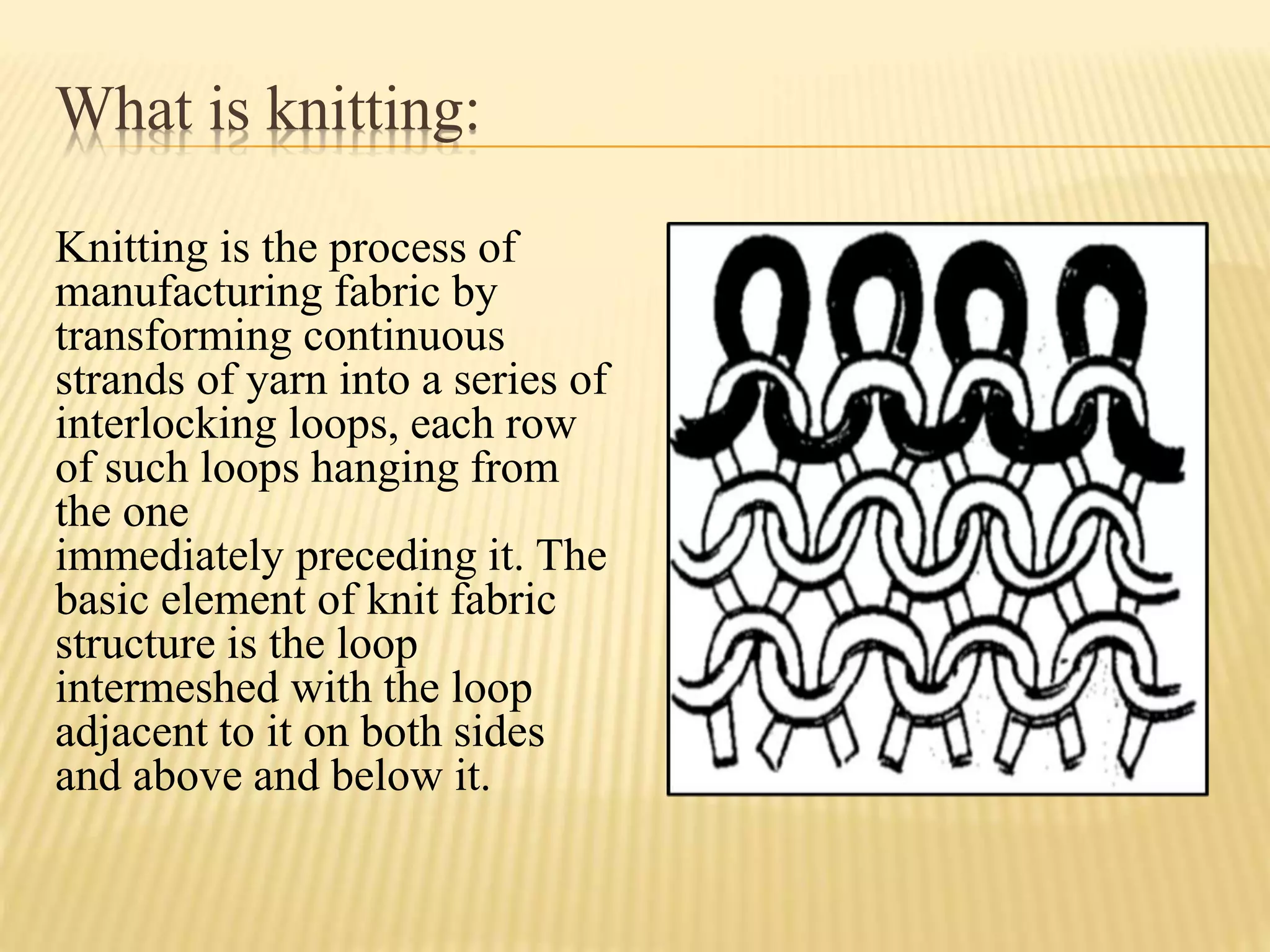
Knitting is the process of
manufacturing fabric by
transforming continuous
strands of yarn into a series of
interlocking loops, each row
of such loops hanging from
the one
immediately preceding it. The
basic element of knit fabric
structure is the loop
intermeshed with the loop
adjacent to it on both sides
and above and below it.
Circular knitting
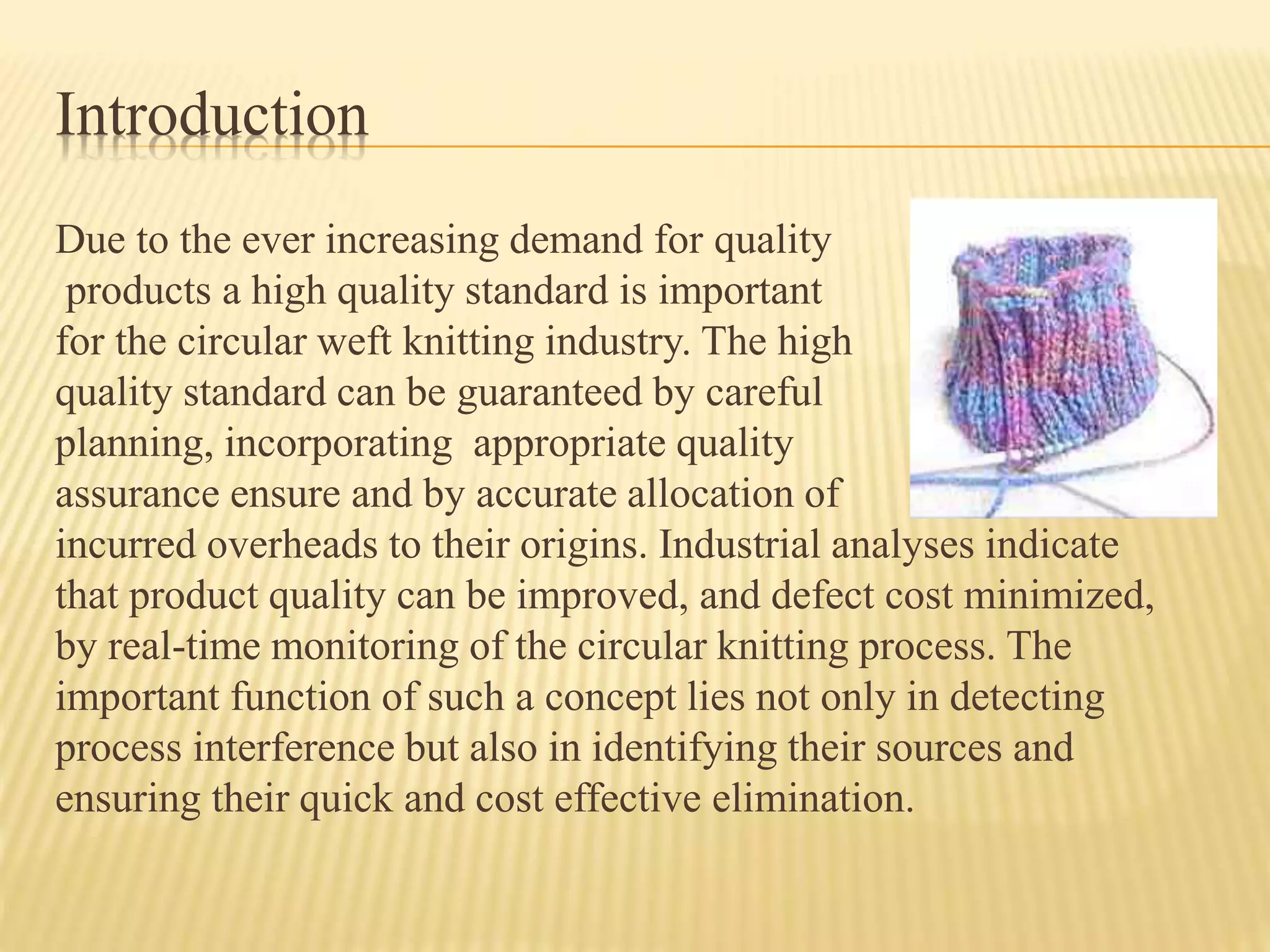
Circular knitting or knitting in the round is a form of knitting that creates a
seamless tube. When knitting circularly, the knitting is cast on and the circle of
stitches is joined. Knitting is worked in rounds in a spiral. Originally, circular
knitting was done using a set of four or five double-pointed needles. Later,
circular needles were invented, which can also be used to knit in the round: the
circular needle looks like two short knitting needles connected by a cable
between them.
Longer circular needles can be used to produce narrow tubes of knitting for
socks, mittens, and other items using the Magic Loop technique. Machines also
produce circular knitting; double bed machines can be set up to knit on the
front bed in one direction then the back bed on the return, creating a knitted
tube. Specialized knitting machines for sock-knitting use individual latch-hook
needles to make each stitch in a round frame.
Many types of sweaters are traditionally knit in the round. Planned openings
(arm holes, necks, cardigan fronts) are temporarily knitted with extra stitches,
reinforced if necessary. Then the extra stitches are cut to create the opening,
and are stitched with a sewing machine to prevent unraveling. This technique
is called steeking.
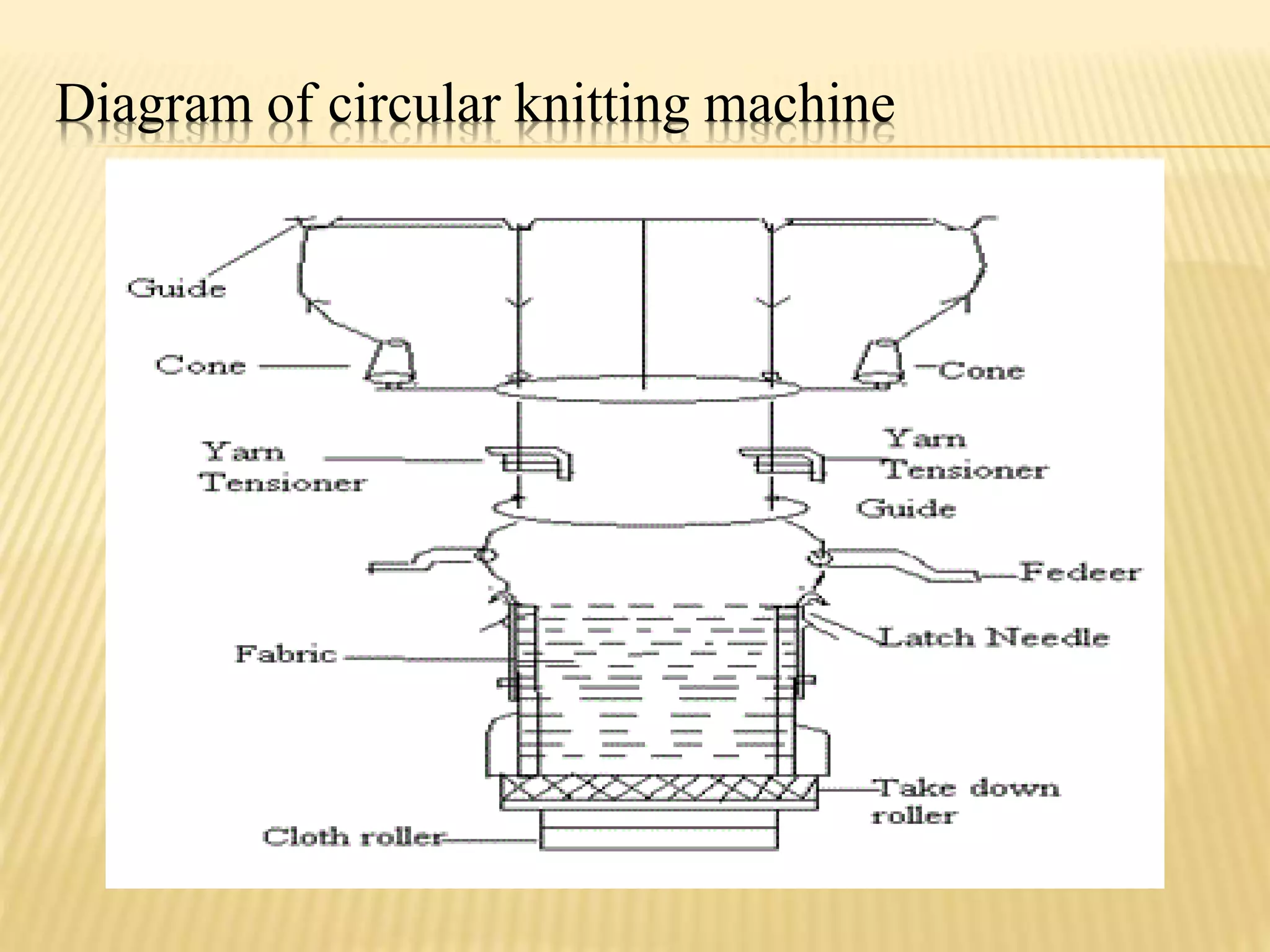
Diagram of circular knitting machine
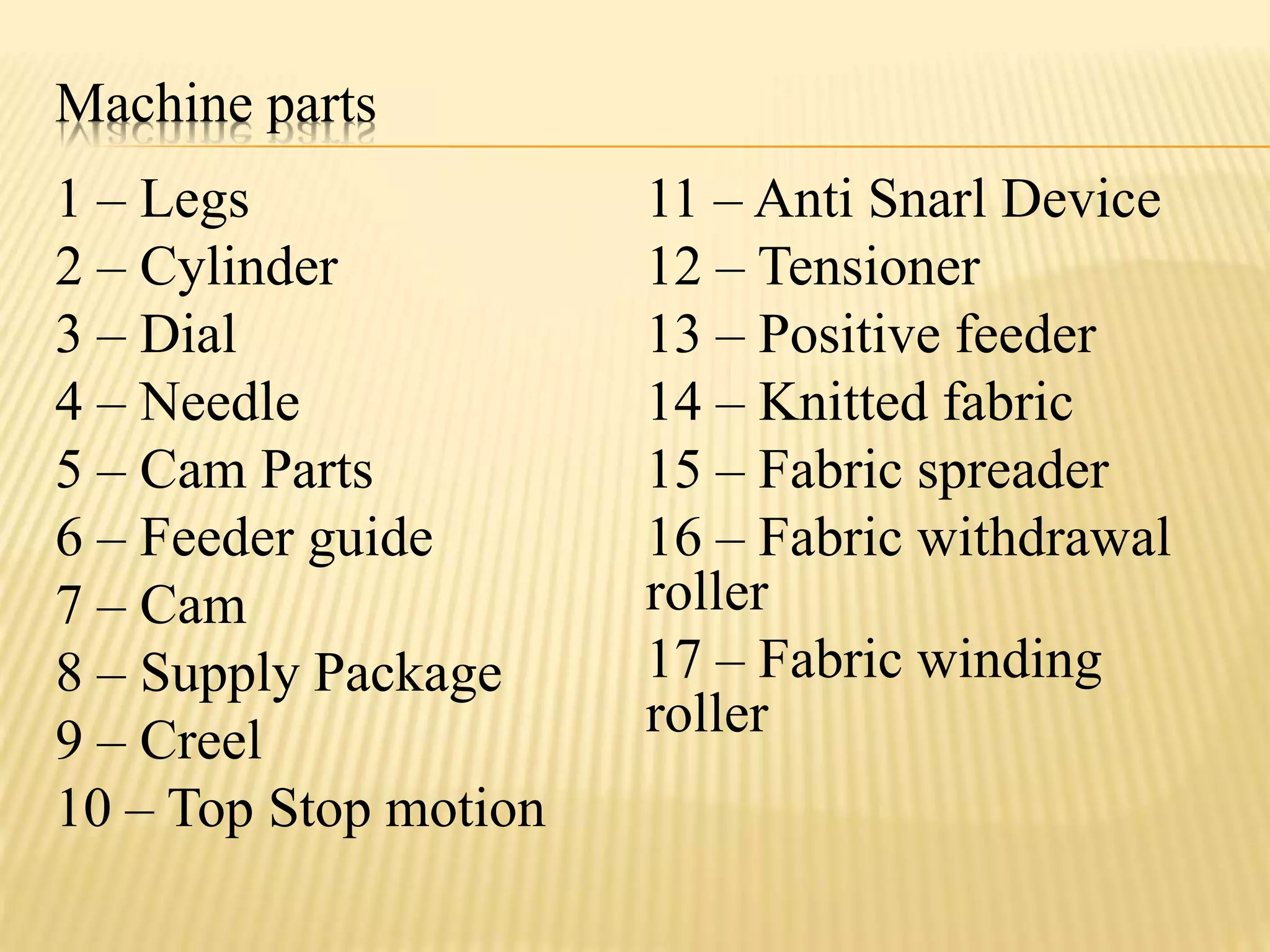
Machine parts
1 – Legs
2 – Cylinder
3 – Dial
4 – Needle
5 – Cam Parts
6 – Feeder guide
7 – Cam
8 – Supply Package
9 – Creel
10 – Top Stop motion
11 – Anti Snarl Device
12 – Tensioner
13 – Positive feeder
14 – Knitted fabric
15 – Fabric spreader
16 – Fabric withdrawal
roller
17 – Fabric winding
roller
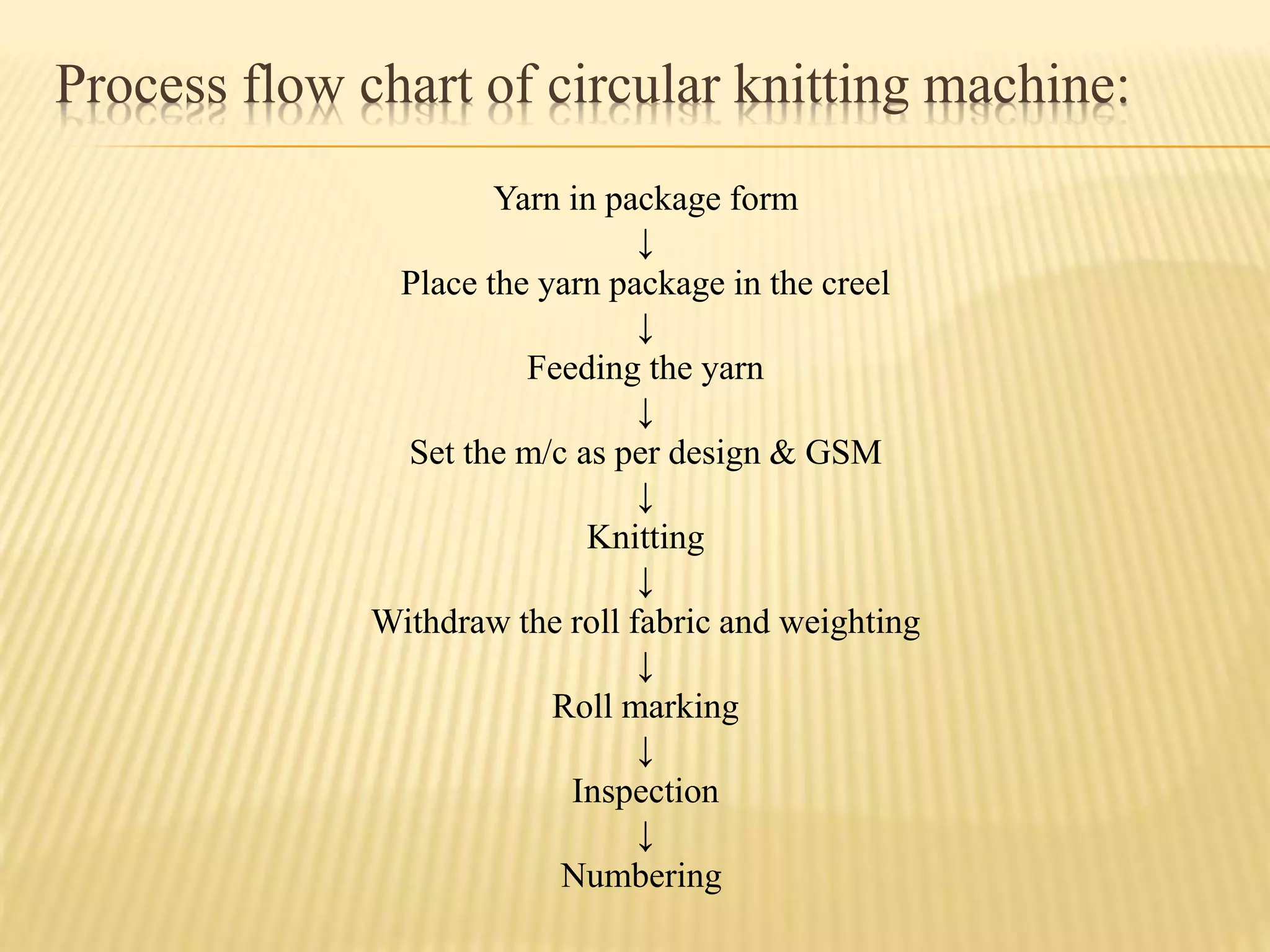
Process flow chart of circular knitting machine:
Yarn in package form
↓
Place the yarn package in the creel
↓
Feeding the yarn
↓
Set the m/c as per design & GSM
↓
Knitting
↓
Withdraw the roll fabric and weighting
↓
Roll marking
↓
Inspection
↓
Numbering
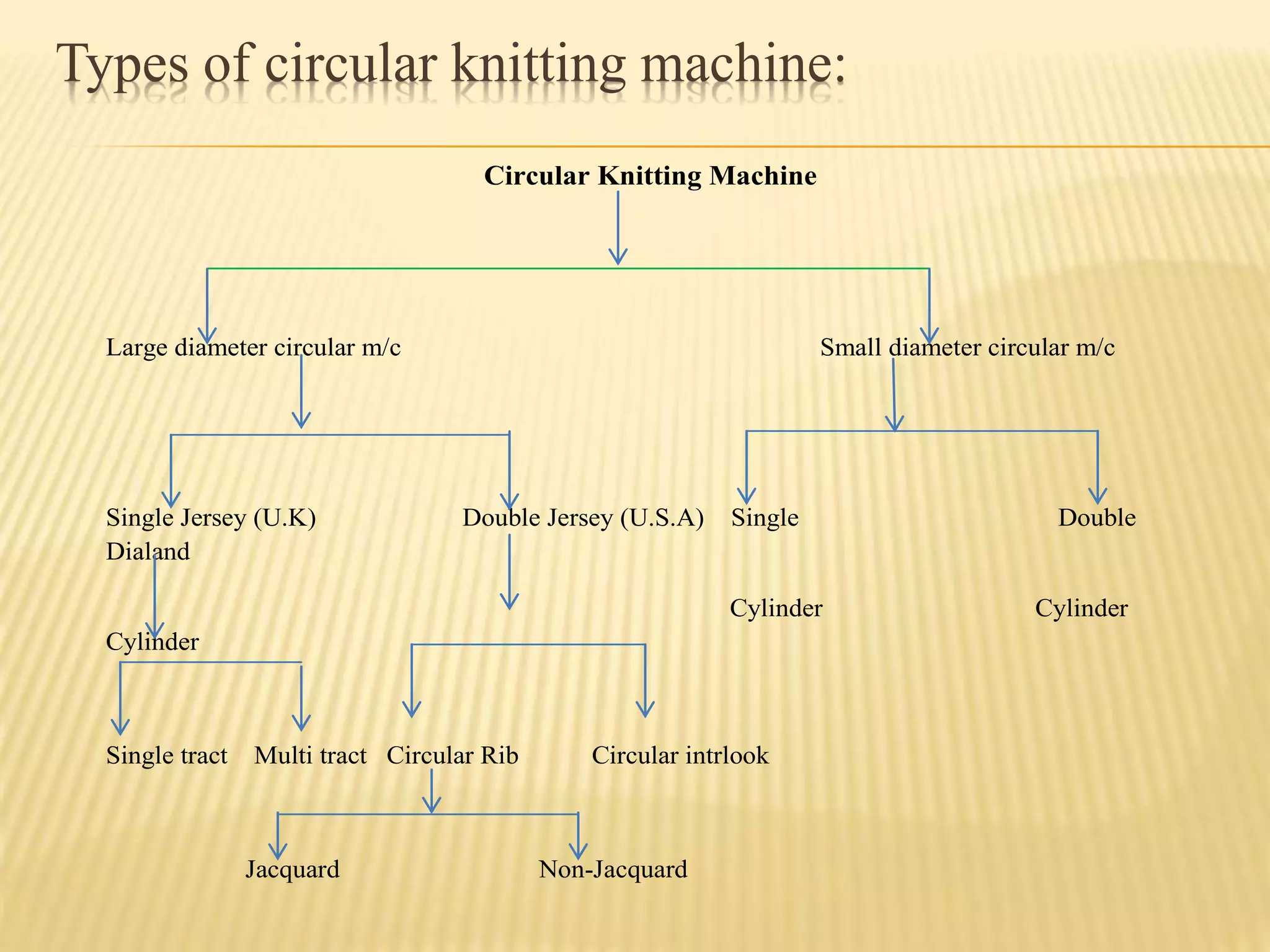
Types of circular knitting machine:
Circular Knitting Machine
Large diameter circular m/c Small diameter circular m/c
Single Jersey (U.K) Double Jersey (U.S.A) Single Double
Dialand
Cylinder Cylinder
Cylinder
Single tract Multi tract Circular Rib Circular intrlook
Jacquard Non-Jacquard
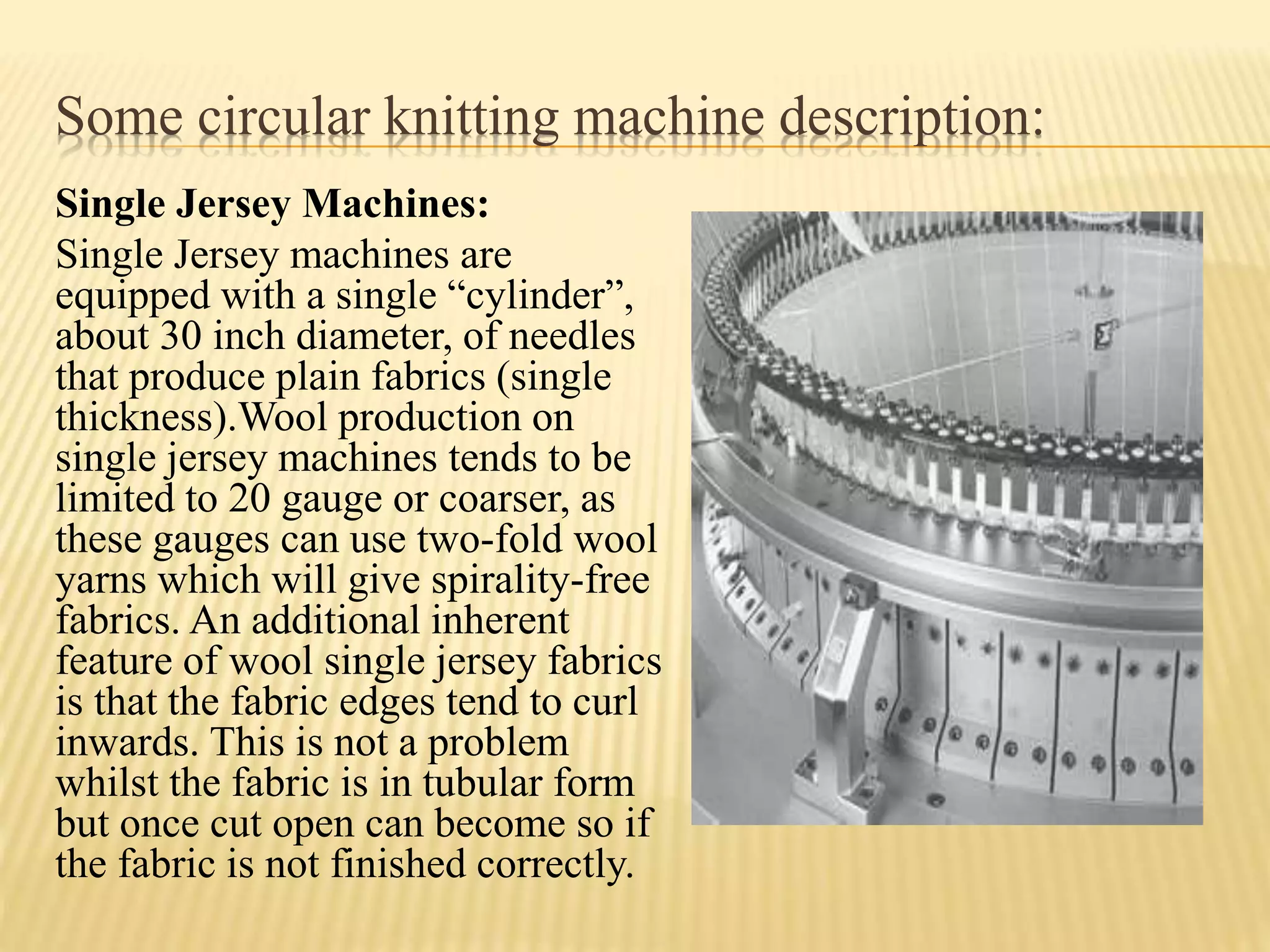
Some circular knitting machine description:
Single Jersey Machines:
Single Jersey machines are
equipped with a single “cylinder”,
about 30 inch diameter, of needles
that produce plain fabrics (single
thickness).Wool production on
single jersey machines tends to be
limited to 20 gauge or coarser, as
these gauges can use two-fold wool
yarns which will give spirality-free
fabrics. An additional inherent
feature of wool single jersey fabrics
is that the fabric edges tend to curl
inwards. This is not a problem
whilst the fabric is in tubular form
but once cut open can become so if
the fabric is not finished correctly.
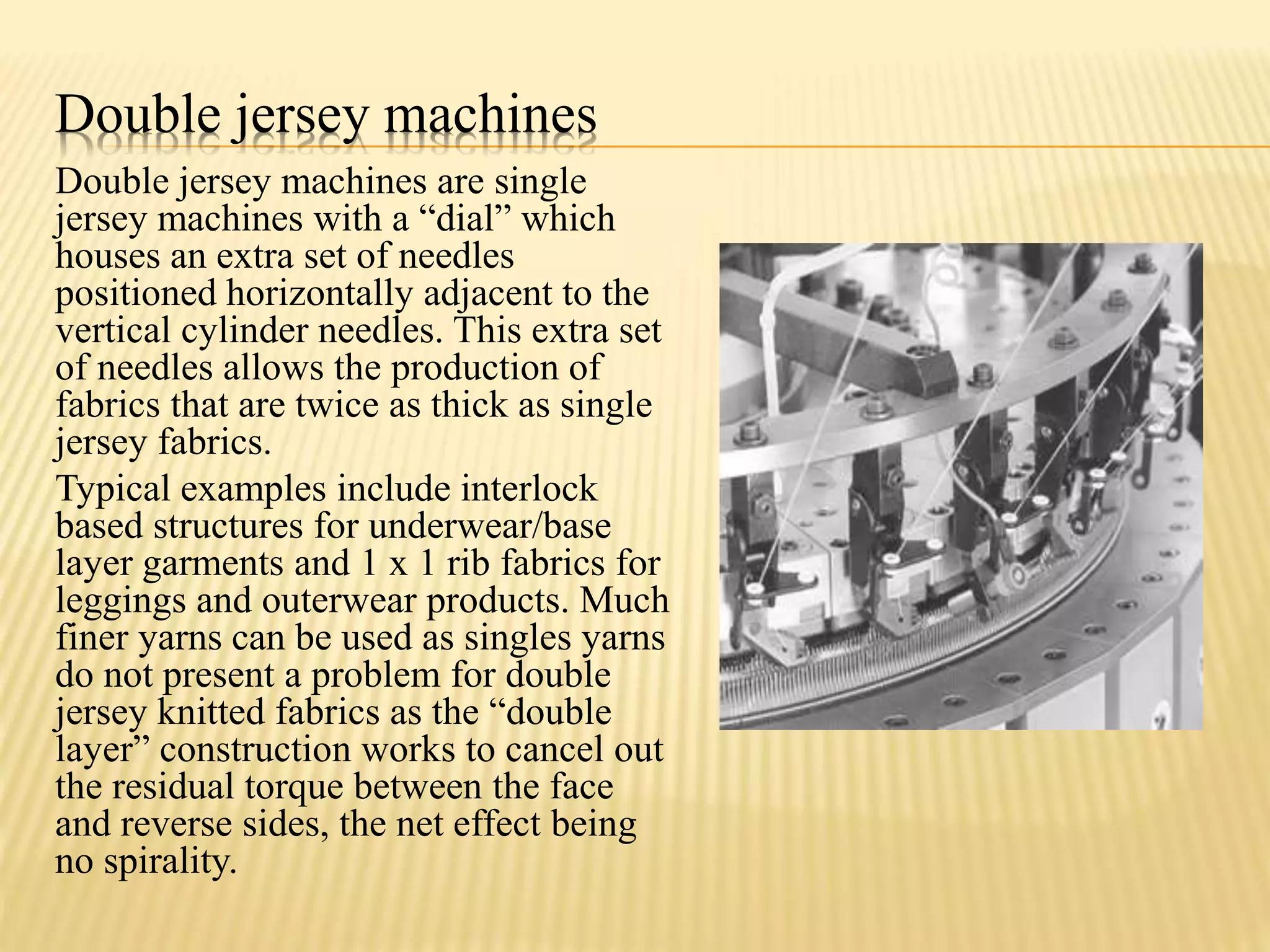
Double jersey machines
Double jersey machines are single
jersey machines with a “dial” which
houses an extra set of needles
positioned horizontally adjacent to the
vertical cylinder needles. This extra set
of needles allows the production of
fabrics that are twice as thick as single
jersey fabrics.
Typical examples include interlock
based structures for underwear/base
layer garments and 1 x 1 rib fabrics for
leggings and outerwear products. Much
finer yarns can be used as singles yarns
do not present a problem for double
jersey knitted fabrics as the “double
layer” construction works to cancel out
the residual torque between the face
and reverse sides, the net effect being
no spirality.
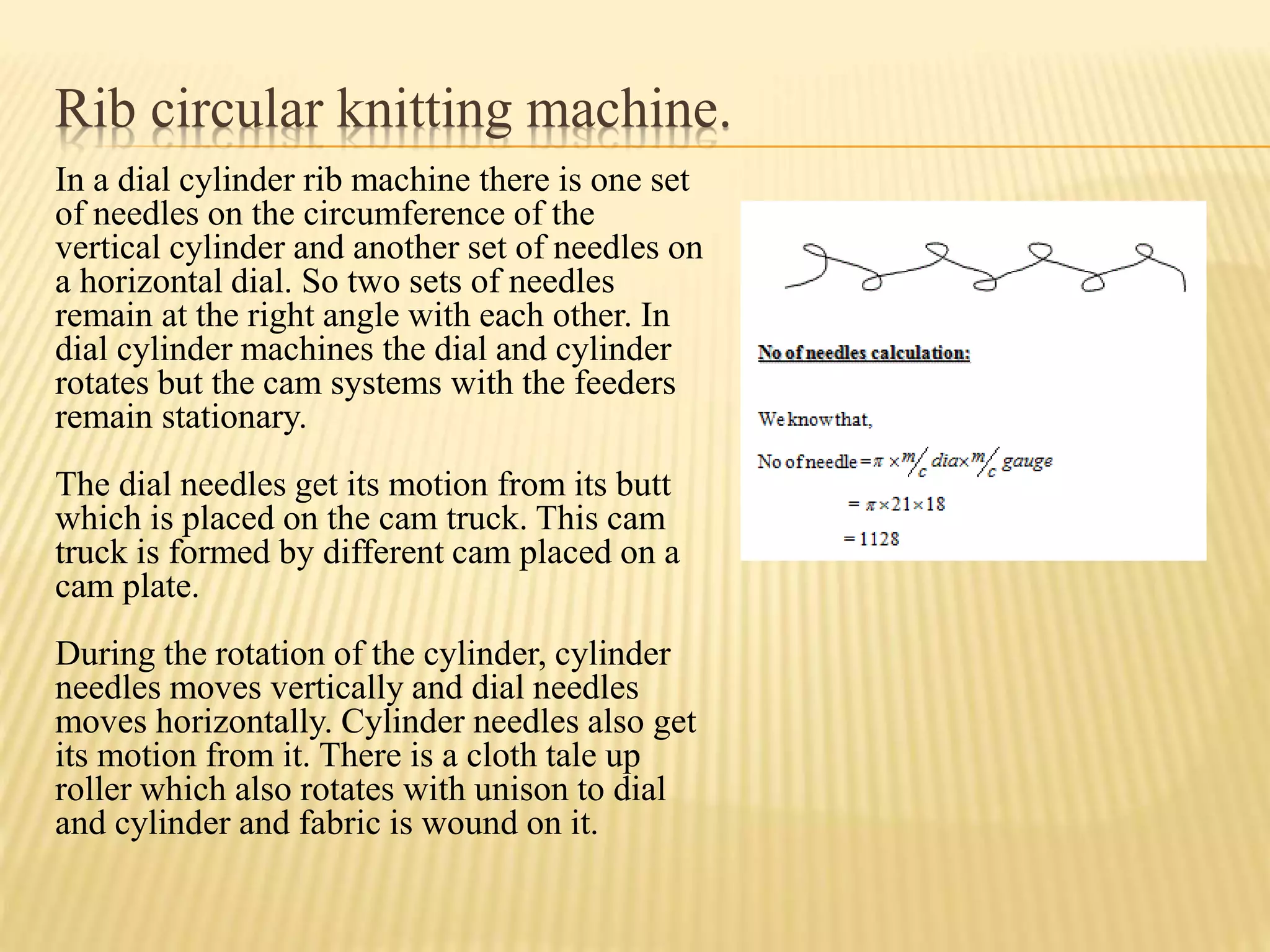
Rib circular knitting machine.
In a dial cylinder rib machine there is one set
of needles on the circumference of the
vertical cylinder and another set of needles on
a horizontal dial. So two sets of needles
remain at the right angle with each other. In
dial cylinder machines the dial and cylinder
rotates but the cam systems with the feeders
remain stationary.
The dial needles get its motion from its butt
which is placed on the cam truck. This cam
truck is formed by different cam placed on a
cam plate.
During the rotation of the cylinder, cylinder
needles moves vertically and dial needles
moves horizontally. Cylinder needles also get
its motion from it. There is a cloth tale up
roller which also rotates with unison to dial
and cylinder and fabric is wound on it.
Knitting action:
The knitting action of a circular rib machine is shown:
1. Clearing: The cylinder and dial needles move out to clear
the plain and rib loops formed in the previous cycle.
2. Yarn feeding: The needles are withdrawn into their tricks
so that the old loops are covered by the open latches and the
new yarn is fed into the open hooks.
3. Knocking Over: The needles are withdrawn into their
tricks so that the old loops are cast off and new loops are
drawn through them.
Interlock circular knitting machine:
The yarn is supplied from cone, placed either on an integral over
head bobbin stand or one free standing creel through tensioners
stop motion & guide eyes down to the yarn feeder guides.
The fabrics is tube form is drawn downwards from inside the
needle cylinder by tension rollers & is wound on to the fabric
batching roller of winding down fabrics.
The winding down mechanism revolves in unison with the
cylinder & fabrics tube & in rock lever operated via cam followers
running on the underside of a profiled cam - ring.
The sinker cam plate is mounted outside on the needle circle, the
center of the cylinder is referred to as an open top or sinker top
m/c.
Knitting action:
The knitting cycle of a interlock machine can be
divided in to eight headings. They are discussed below,
• Position – 1: Rest position: The head of these needles
are in the range of the knock over edges of cylinder &
dial respectively.
• Position – 2: Tucking position of dial needle: The dial
needles are brought into the tucking position.
• Position – 3: Tucking position: The cylinder needles
are brought in the tucking position.
Knitting action:
• Position – 4: Clearing position of dial needle: The dial
needles are come into the clearing position.
• Position – 5: Clearing position: The cylinder needle are
come into the clearing position.
• Position – 6: Yarn presenting position: Both cylinder & dial
are moved to the yarn presenting position.
• Position – 7: Cast on position: Both cylinder & dial are
moved to their cast on position.
• Position – 8: Knock over position: Both cylinder & dial are
reaches to the knock over position.
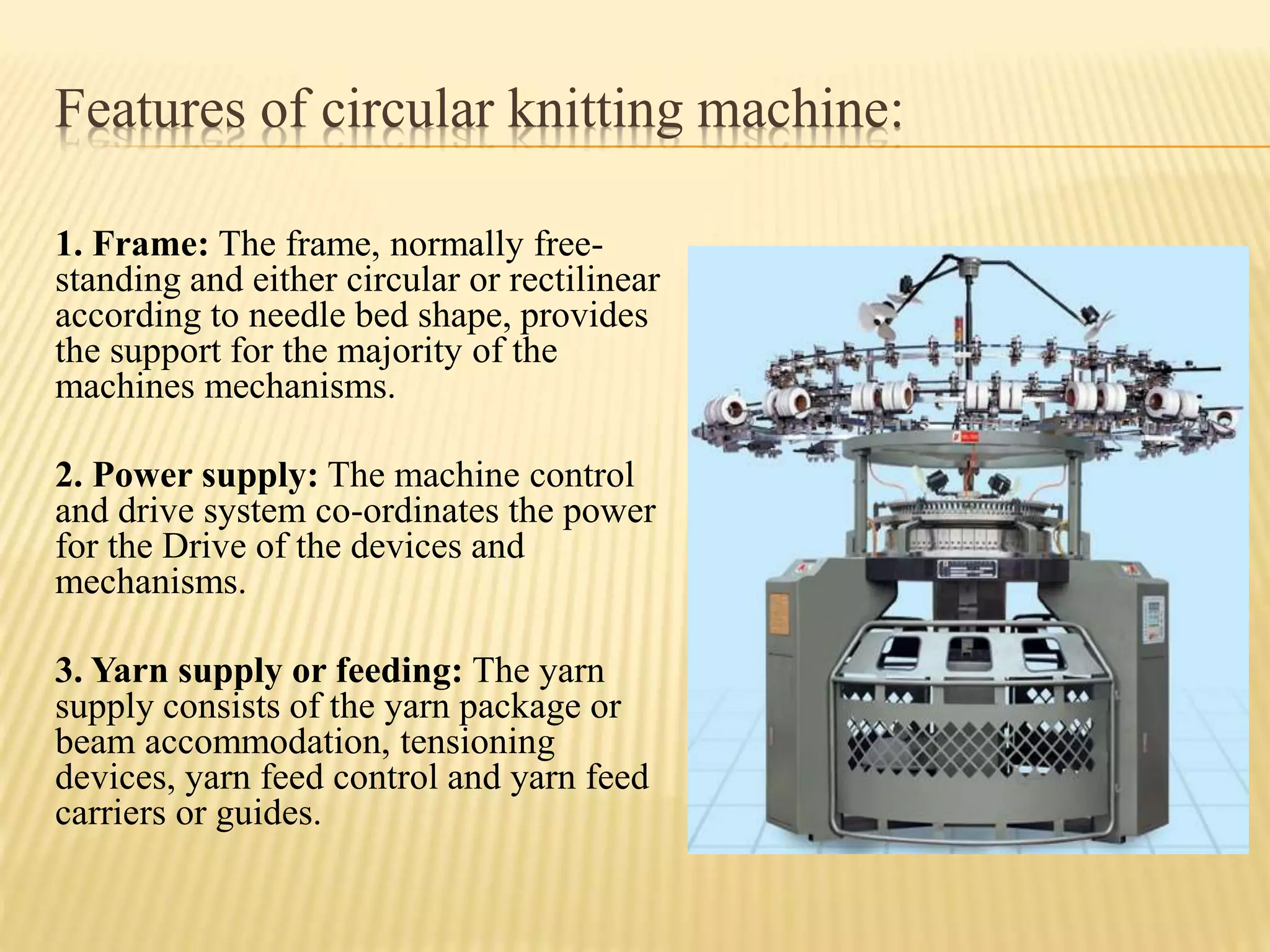
Features of circular knitting machine:
1. Frame: The frame, normally free-
standing and either circular or rectilinear
according to needle bed shape, provides
the support for the majority of the
machines mechanisms.
2. Power supply: The machine control
and drive system co-ordinates the power
for the Drive of the devices and
mechanisms.
3. Yarn supply or feeding: The yarn
supply consists of the yarn package or
beam accommodation, tensioning
devices, yarn feed control and yarn feed
carriers or guides.
Features of circular knitting machine:
4. Knitting action: The knitting system includes the
knitting elements, their housing, drive and control, as
well as associated pattern selection and garment-
length control devices (if equipped).
5. Fabric Take-away: The fabric take away
mechanism includes fabric tensioning, windup and
accommodation devices.
6. Quality control: The quality control system
includes stop motions, fault detectors, automatic oilers
and lint removal systems.
Uses of circular knitting machine:
Fabric machines: Jackets, ladies tops, spots & T-
shirt, casual wear, suits, dresses, swimwear, bath
robes, dressing gowns, track suits, jogging suits,
furnishing, upholstery, automotive & technical
fabrics, household fabrics.
Advantages of circular knitting machine:
 Less load by high precision
 Perfect gaps between all
parts.
 Smooth passing of Needles
between cylinder and cams
 better quality of plated
fabric
 Less friction for each part
 Longer needle’s life
 Save power consumption
 Fantastic Machine Speed
 Awesome Specification of
Rib
 Immediate restart after
Setting
 Save Maintenance Cost
 Life time guaranty of
Ceramic yarn carrier.
 Longer needle life
 Special servomotor for
take-up system
Conclusion:
Modern circular knitting machines feature on-board computers
(CPU) complete with a display and a keyboard to monitor and
control the most important functions:
 Speed
 Number of machine revolutions (R.P.M)
 Working hours
 Causes of machine stops
 Detector of the yarn length fed into the machine
On modern microprocessor-controlled machines, the LCD display
(TOUCH SCREEN) is equipped with an alphanumeric keyboard
for entering the operator’s settings. The whole system is
controlled by an electronic circuit which signals the status of the
machine and the possible causes of machine stops by means of
flashing lights.

Circular knitting machine

  • 1.
    Presentation on: Circularknitting M/C Prepared By: Tanvir Ahammed Rana Id. 2012000400038 19th Batch, Textile Department. SouthEast University.
  • 2.
    Introduction Due to theever increasing demand for quality products a high quality standard is important for the circular weft knitting industry. The high quality standard can be guaranteed by careful planning, incorporating appropriate quality assurance ensure and by accurate allocation of incurred overheads to their origins. Industrial analyses indicate that product quality can be improved, and defect cost minimized, by real-time monitoring of the circular knitting process. The important function of such a concept lies not only in detecting process interference but also in identifying their sources and ensuring their quick and cost effective elimination.
  • 3.
    What is knitting: Knittingis the process of manufacturing fabric by transforming continuous strands of yarn into a series of interlocking loops, each row of such loops hanging from the one immediately preceding it. The basic element of knit fabric structure is the loop intermeshed with the loop adjacent to it on both sides and above and below it.
  • 4.
    Circular knitting Circular knittingor knitting in the round is a form of knitting that creates a seamless tube. When knitting circularly, the knitting is cast on and the circle of stitches is joined. Knitting is worked in rounds in a spiral. Originally, circular knitting was done using a set of four or five double-pointed needles. Later, circular needles were invented, which can also be used to knit in the round: the circular needle looks like two short knitting needles connected by a cable between them. Longer circular needles can be used to produce narrow tubes of knitting for socks, mittens, and other items using the Magic Loop technique. Machines also produce circular knitting; double bed machines can be set up to knit on the front bed in one direction then the back bed on the return, creating a knitted tube. Specialized knitting machines for sock-knitting use individual latch-hook needles to make each stitch in a round frame. Many types of sweaters are traditionally knit in the round. Planned openings (arm holes, necks, cardigan fronts) are temporarily knitted with extra stitches, reinforced if necessary. Then the extra stitches are cut to create the opening, and are stitched with a sewing machine to prevent unraveling. This technique is called steeking.
  • 5.
    Diagram of circularknitting machine
  • 6.
    Machine parts 1 –Legs 2 – Cylinder 3 – Dial 4 – Needle 5 – Cam Parts 6 – Feeder guide 7 – Cam 8 – Supply Package 9 – Creel 10 – Top Stop motion 11 – Anti Snarl Device 12 – Tensioner 13 – Positive feeder 14 – Knitted fabric 15 – Fabric spreader 16 – Fabric withdrawal roller 17 – Fabric winding roller
  • 7.
    Process flow chartof circular knitting machine: Yarn in package form ↓ Place the yarn package in the creel ↓ Feeding the yarn ↓ Set the m/c as per design & GSM ↓ Knitting ↓ Withdraw the roll fabric and weighting ↓ Roll marking ↓ Inspection ↓ Numbering
  • 8.
    Types of circularknitting machine: Circular Knitting Machine Large diameter circular m/c Small diameter circular m/c Single Jersey (U.K) Double Jersey (U.S.A) Single Double Dialand Cylinder Cylinder Cylinder Single tract Multi tract Circular Rib Circular intrlook Jacquard Non-Jacquard
  • 9.
    Some circular knittingmachine description: Single Jersey Machines: Single Jersey machines are equipped with a single “cylinder”, about 30 inch diameter, of needles that produce plain fabrics (single thickness).Wool production on single jersey machines tends to be limited to 20 gauge or coarser, as these gauges can use two-fold wool yarns which will give spirality-free fabrics. An additional inherent feature of wool single jersey fabrics is that the fabric edges tend to curl inwards. This is not a problem whilst the fabric is in tubular form but once cut open can become so if the fabric is not finished correctly.
  • 10.
    Double jersey machines Doublejersey machines are single jersey machines with a “dial” which houses an extra set of needles positioned horizontally adjacent to the vertical cylinder needles. This extra set of needles allows the production of fabrics that are twice as thick as single jersey fabrics. Typical examples include interlock based structures for underwear/base layer garments and 1 x 1 rib fabrics for leggings and outerwear products. Much finer yarns can be used as singles yarns do not present a problem for double jersey knitted fabrics as the “double layer” construction works to cancel out the residual torque between the face and reverse sides, the net effect being no spirality.
  • 11.
    Rib circular knittingmachine. In a dial cylinder rib machine there is one set of needles on the circumference of the vertical cylinder and another set of needles on a horizontal dial. So two sets of needles remain at the right angle with each other. In dial cylinder machines the dial and cylinder rotates but the cam systems with the feeders remain stationary. The dial needles get its motion from its butt which is placed on the cam truck. This cam truck is formed by different cam placed on a cam plate. During the rotation of the cylinder, cylinder needles moves vertically and dial needles moves horizontally. Cylinder needles also get its motion from it. There is a cloth tale up roller which also rotates with unison to dial and cylinder and fabric is wound on it.
  • 12.
    Knitting action: The knittingaction of a circular rib machine is shown: 1. Clearing: The cylinder and dial needles move out to clear the plain and rib loops formed in the previous cycle. 2. Yarn feeding: The needles are withdrawn into their tricks so that the old loops are covered by the open latches and the new yarn is fed into the open hooks. 3. Knocking Over: The needles are withdrawn into their tricks so that the old loops are cast off and new loops are drawn through them.
  • 13.
    Interlock circular knittingmachine: The yarn is supplied from cone, placed either on an integral over head bobbin stand or one free standing creel through tensioners stop motion & guide eyes down to the yarn feeder guides. The fabrics is tube form is drawn downwards from inside the needle cylinder by tension rollers & is wound on to the fabric batching roller of winding down fabrics. The winding down mechanism revolves in unison with the cylinder & fabrics tube & in rock lever operated via cam followers running on the underside of a profiled cam - ring. The sinker cam plate is mounted outside on the needle circle, the center of the cylinder is referred to as an open top or sinker top m/c.
  • 14.
    Knitting action: The knittingcycle of a interlock machine can be divided in to eight headings. They are discussed below, • Position – 1: Rest position: The head of these needles are in the range of the knock over edges of cylinder & dial respectively. • Position – 2: Tucking position of dial needle: The dial needles are brought into the tucking position. • Position – 3: Tucking position: The cylinder needles are brought in the tucking position.
  • 15.
    Knitting action: • Position– 4: Clearing position of dial needle: The dial needles are come into the clearing position. • Position – 5: Clearing position: The cylinder needle are come into the clearing position. • Position – 6: Yarn presenting position: Both cylinder & dial are moved to the yarn presenting position. • Position – 7: Cast on position: Both cylinder & dial are moved to their cast on position. • Position – 8: Knock over position: Both cylinder & dial are reaches to the knock over position.
  • 16.
    Features of circularknitting machine: 1. Frame: The frame, normally free- standing and either circular or rectilinear according to needle bed shape, provides the support for the majority of the machines mechanisms. 2. Power supply: The machine control and drive system co-ordinates the power for the Drive of the devices and mechanisms. 3. Yarn supply or feeding: The yarn supply consists of the yarn package or beam accommodation, tensioning devices, yarn feed control and yarn feed carriers or guides.
  • 17.
    Features of circularknitting machine: 4. Knitting action: The knitting system includes the knitting elements, their housing, drive and control, as well as associated pattern selection and garment- length control devices (if equipped). 5. Fabric Take-away: The fabric take away mechanism includes fabric tensioning, windup and accommodation devices. 6. Quality control: The quality control system includes stop motions, fault detectors, automatic oilers and lint removal systems.
  • 18.
    Uses of circularknitting machine: Fabric machines: Jackets, ladies tops, spots & T- shirt, casual wear, suits, dresses, swimwear, bath robes, dressing gowns, track suits, jogging suits, furnishing, upholstery, automotive & technical fabrics, household fabrics.
  • 19.
    Advantages of circularknitting machine:  Less load by high precision  Perfect gaps between all parts.  Smooth passing of Needles between cylinder and cams  better quality of plated fabric  Less friction for each part  Longer needle’s life  Save power consumption  Fantastic Machine Speed  Awesome Specification of Rib  Immediate restart after Setting  Save Maintenance Cost  Life time guaranty of Ceramic yarn carrier.  Longer needle life  Special servomotor for take-up system
  • 20.
    Conclusion: Modern circular knittingmachines feature on-board computers (CPU) complete with a display and a keyboard to monitor and control the most important functions:  Speed  Number of machine revolutions (R.P.M)  Working hours  Causes of machine stops  Detector of the yarn length fed into the machine On modern microprocessor-controlled machines, the LCD display (TOUCH SCREEN) is equipped with an alphanumeric keyboard for entering the operator’s settings. The whole system is controlled by an electronic circuit which signals the status of the machine and the possible causes of machine stops by means of flashing lights.