
FIBRE MIXING, OPENING, CLEANING & BLENDING PROCESSES
REFERENCES
1. Eric Oxtoby., Spun Yarn Technology, Butterworth&Co (Publishers) Ltd,
London, 1987.
2. Carl A.Lawrence., Fundamentals of SpunYarn Technology, CRC Press LLC,
Boca Raton, Florida, 2003.
3. P.R. Lord., Handbook of Yarn Production, WoodheadPublishing Ltd,
Cambridge, England, 2003.
4. B. Wulfhorst, T. Gries, D. Viet., Textile Technology, Hanser Publications,
Munich, 2000.
5. www.bdtextileinfo.blogspot.com.- Assessedon25.5.2016 12:10pm
BLOW ROOM
Blowroom consistsof a numberof machinesusedinsuccessiontoopenand clean fibre to the required
degree.40-70% trash isremovedin this section. A section in which the supplied compressed bales are
opened, cleaned and blending or mixing to form uniform lap of specific length is called BLOW ROOM
section. The cleaning efficiency of blow room is 60-65%. This is the first section of spinning line for
cotton yarn.
BASIC TEXTILE TERMS OF SPINNING
FIBRE: The fundamental component used in making textile yarns and fabrics. According to ASTM
definition;afibre has been defined as a unit of matter characterized by flexibility, fineness and a high
ratio of length to thickness. They can be either natural (e.g. cotton, wool, silk, etc.) or synthetic (e.g.
polyester, nylon, acrylic, etc.)
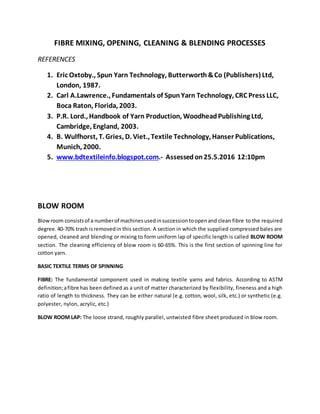
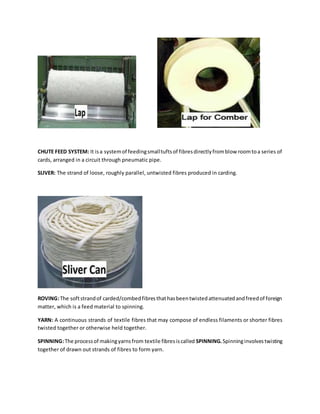
BLOW ROOM LAP: The loose strand, roughly parallel, untwisted fibre sheet produced in blow room.
CHUTE FEED SYSTEM: It isa systemof feedingsmalltuftsof fibresdirectlyfromblow roomtoa series of
cards, arranged in a circuit through pneumatic pipe.
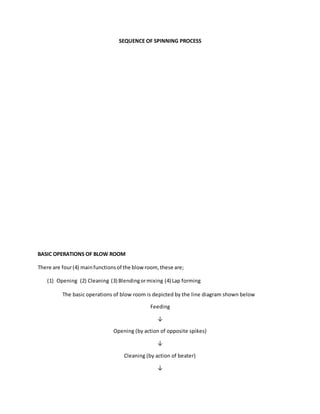
SLIVER: The strand of loose, roughly parallel, untwisted fibres produced in carding.
ROVING:The softstrandof carded/combedfibresthathasbeentwistedattenuatedandfreedof foreign
matter, which is a feed material to spinning.
YARN: A continuous strands of textile fibres that may compose of endless filaments or shorter fibres
twisted together or otherwise held together.
SPINNING:The processof makingyarnsfrom textile fibresiscalled SPINNING.Spinninginvolvestwisting
together of drawn out strands of fibres to form yarn.
SEQUENCE OF SPINNING PROCESS
BASIC OPERATIONS OF BLOW ROOM
There are four(4) mainfunctionsof the blow room, these are;
(1) Opening (2) Cleaning (3) Blendingormixing (4) Lap forming
The basic operations of blow room is depicted by the line diagram shown below
Feeding
↓
Opening (by action of opposite spikes)
↓
Cleaning (by action of beater)
↓
Blending/Mixing
↓
Dust removal (by action of air current)
↓
Transporting/Transferring
↓
Lap sheet formation
(i) Scutcher(fixed) intermittent
(ii)Chute feeding(continuous)
OPENING
a. To openthe compressedbales of fibres
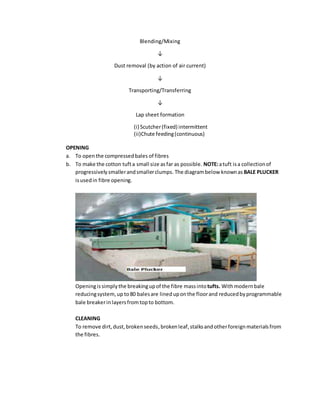
b. To make the cotton tufta small size asfar as possible. NOTE:atuft isa collectionof
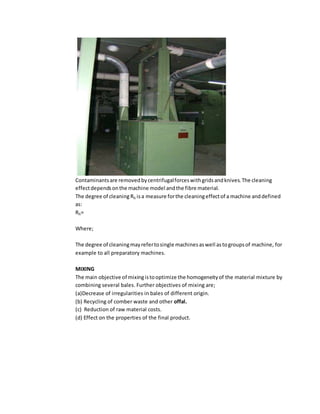
progressivelysmallerandsmallerclumps. The diagrambelow knownas BALE PLUCKER
isusedin fibre opening.
Openingissimplythe breakingupof the fibre massintotufts. Withmodernbale
reducingsystem,up to80 balesare lineduponthe floorand reducedbyprogrammable
bale breakerinlayersfromtopto bottom.
CLEANING
To remove dirt,dust,brokenseeds,brokenleaf,stalksandotherforeignmaterialsfrom
the fibres.
Contaminantsare removedbycentrifugalforceswithgridsandknives.The cleaning
effectdependsonthe machine model andthe fibre material.
The degree of cleaning RG isa measure forthe cleaningeffectof a machine anddefined
as:
RG=
Where;
The degree of cleaningmayrefertosingle machinesaswell astogroupsof machine, for
example to all preparatory machines.
MIXING
The main objective of mixingistooptimize the homogeneityof the material mixture by
combining several bales. Further objectives of mixing are;
(a)Decrease of irregularities in bales of different origin.
(b) Recycling of comber waste and other offal.
(c) Reduction of raw material costs.
(d) Effect on the properties of the final product.
BLENDING
Blending may be defined as the mixing of two or more masses of fibres so that the
resulting mixture has the characteristics of the average of the component items.
LAP or FLOCKS FORMING/FORMATION
(a) To transfer the opened and cleaned fibres into a sheet form of definite width and
uniform unit length which is called lap or in modern system directly feed the
material to the carding machine in flock form.
(b) To roll the lap of predetermined length in a cylindrical shape around a lap pin.
(c) To transfer the lap from the lap pin to a rod to suitable handle and feed it to
subsequent processing machine (i.e. carding).
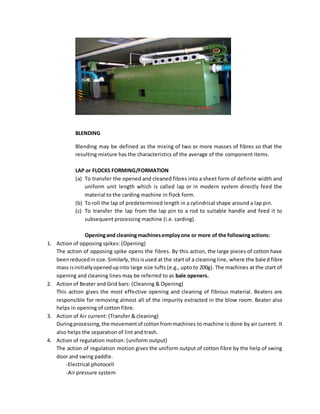
Openingand cleaningmachinesemployone or more of the followingactions:
1. Action of opposing spikes: (Opening)
The action of opposing spike opens the fibres. By this action, the large pieces of cotton have
beenreducedinsize.Similarly,thisisused at the start of a cleaning line, where the baled fibre
mass isinitiallyopenedupinto large size tufts (e.g., upto to 200g). The machines at the start of
opening and cleaning lines may be referred to as bale openers.
2. Action of Beater and Grid bars: (Cleaning & Opening)
This action gives the most effective opening and cleaning of fibrous material. Beaters are
responsible for removing almost all of the impurity extracted in the blow room. Beater also
helps in opening of cotton fibre.
3. Action of Air current: (Transfer & cleaning)
Duringprocessing,the movementof cottonfrommachines to machine is done by air current. It
also helps the separation of lint and trash.
4. Action of regulation motion: (uniform output)
The action of regulation motion gives the uniform output of cotton fibre by the help of swing
door and swing paddle.
-Electrical photocell
-Air pressure system
Machine used for opening in Blow room
Conventional bale opener-
(a) Multiple Bale opener (Hergeth mixer) (b) Automatic bale opener (c) Unifloz-Rieter.
Opening devices used in Blow room
(a) Roller-Small diameter i.e. step cleaner
(b) Drums- Larger diameter i.e. mono cylinder
(c) Multi beater- Two or three arms i.e. Krischner beater
(d) Spiked lattice- Endless belt (very gentle opening)
Beating/Cleaning points in Blow room
(a) Ultracleaner/step cleaner/Super cleaner (b) Axiflow cleaner
(b) Saw toothed beater
(c) Porcupine beater
(d) Bladed beater
(e) Krischer beater
(f) Twin opener
(g) Vertical opener
(h) Multimixer
Auxiliary Equipment used in Modern Blow room (Line)
(a) Hopper feeder (b) Reserve box (c) Condenser or Condenser cage
(b) Exhaust fan (e) Feed regulating motions (f) By-pass system (g) Filter room.
BEATERS
Beaters are
Different types of beaters commonly used are discussed below:
Porcupine beaters
Function:
 To separate the fibres by strikes and also to clean the fibres.
 Good opening beater and considered most suitable for long staple cotton.
 The striker are arranged at different angles to cover the total width of the machine in one
revolution of the beater and operates at 750-960rpm
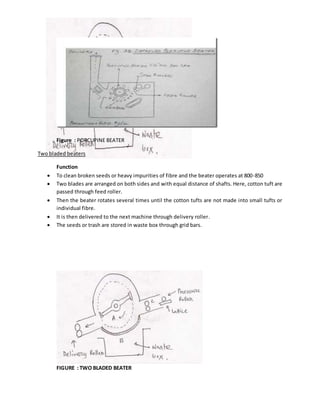
Figure : PORCUPINE BEATER
Two bladed beaters
Function
 To clean broken seeds or heavy impurities of fibre and the beater operates at 800-850
 Two blades are arranged on both sides and with equal distance of shafts. Here, cotton tuft are
passed through feed roller.
 Then the beater rotates several times until the cotton tufts are not made into small tufts or
individual fibre.
 It is then delivered to the next machine through delivery roller.
 The seeds or trash are stored in waste box through grid bars.
FIGURE : TWO BLADED BEATER
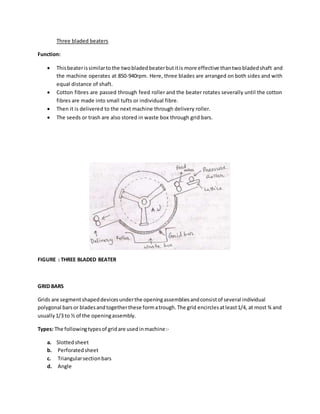
Three bladed beaters
Function:
 Thisbeaterissimilartothe twobladedbeaterbutitis more effective thantwobladedshaft and
the machine operates at 850-940rpm. Here, three blades are arranged on both sides and with
equal distance of shaft.
 Cotton fibres are passed through feed roller and the beater rotates severally until the cotton
fibres are made into small tufts or individual fibre.
 Then it is delivered to the next machine through delivery roller.
 The seeds or trash are also stored in waste box through grid bars.
FIGURE : THREE BLADED BEATER
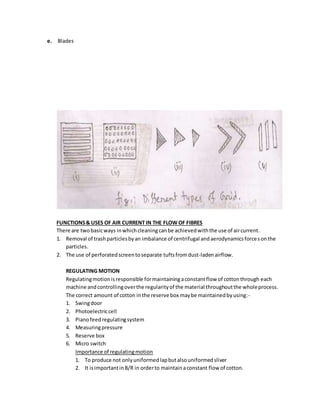
GRID BARS
Grids are segmentshapeddevicesunderthe openingassembliesandconsistof several individual
polygonal barsor bladesandtogetherthese formatrough.The grid encirclesatleast1/4, at most ¾ and
usually1/3 to ½ of the openingassembly.
Types: The followingtypesof gridare usedinmachine:-
a. Slottedsheet
b. Perforatedsheet
c. Triangularsectionbars
d. Angle
e. Blades
FUNCTIONS& USES OF AIR CURRENT IN THE FLOW OF FIBRES
There are twobasicways inwhichcleaningcanbe achievedwiththe use of aircurrent.
1. Removal of trashparticlesbyan imbalance of centrifugal andaerodynamicsforcesonthe
particles.
2. The use of perforatedscreentoseparate tuftsfromdust-ladenairflow.
REGULATING MOTION
Regulatingmotionisresponsible formaintainingaconstantflow of cottonthrough each
machine andcontrollingoverthe regularityof the material throughoutthe wholeprocess.
The correct amount of cotton inthe reserve box maybe maintainedbyusing:-
1. Swingdoor
2. Photoelectriccell
3. Pianofeedregulatingsystem
4. Measuringpressure
5. Reserve box
6. Micro switch
Importance of regulatingmotion
1. To produce not onlyuniformedlapbutalsouniformedsliver
2. It isimportantinB/R in orderto maintainaconstant flow of cotton.
3. For uniformfeedingandtogetoptimumefficiency..
4. To maintainthe desiredcharacteristicsof lap.
Operatingprinciple of some regulatingaction:
The followingregulatingactionsare presentinmodernB/R;
1. By swingdoor: The arrangementof swingdoorissuch that whenthe hopperis
about2/3 to ¾ full of cotton,it isforceddownagainstthe resistance of the counter
balance spring,thenthe drive tofeedlattice isstopped.The swingdoorisusedfor
uniformfeedingof cottontospikedlattice.
2 By photoelectriccell:Here,the lightsource and photocell are fittedoppositeawindowin
each side of the machine sothat the light passesthroughonto the machine.While filling
the cotton if the lightis brokenbetween lightsource andphoto-cell,the feedof cottonis
stoppeduntil cottonagainmovesawayfromthe lightsource.
3. By piano feedregulatingsystem: Here,the pedal movementcausedbythickandthinplaces
of cottonisemployedtoshiftthe beltinthe cone drumsby meansof levertoalterthe
speedof the feedrollerinordertokeepthe feedcontainsperunittime.
PRINCIPLES OF BLENDING COTTON FIBRES IN THE BLOW ROOM
A blendisformedbyblendingvarioussortsof qualitiesinsuchaway that whensubsequent
mixingtakesplace (e.g.inthe cardingprocess),anacceptable uniformmixture will ensue.
The basic objective of fibre blendingistoassembleandcombine togetherthe correct
proportionsof componentssothatthe relative amountsof eachkindfedtothe succeeding
process(e.g.carding) remainconstantthroughoutthe whole batchof material. Therefore,
the product of a blendingprocessisnotan intimate mixture of fibres,butrathera fibre
assembly(of slivers,tufts,orbundles) inthe requiredproportionsanddimensionstoenable
the followingprocesstobringaboutthe necessaryfibre-to-fibremixing.
The more detailedreasonsforblendingof fibresinclude:
1. To substitute one type of fibre foranother
2. To produce colourand cross-dyeingeffects,ornoveltyeffectssuchasslubs,kemps,and
knops.
3. To improve processingperformance andproductionrates.
4. To reduce large mattedfibre bundlestosmaller,relativelyloftyfibrebundles,remove
some dirtfrom natural fibres,andthenaddlubricationtothe fibres.
Fabricsmade from blendsof differentfibre typesare unlikelytobe superior inanyone
propertyto fabricsproducedfromanindividual fibre type,butfibreblendingdoes
enable fabricstobe producedwithcombinationsof propertieswhichwouldbe
unattainable byusingonlyone fibre type.
Blendingisbestcarriedoutfroma maximumnumberof balesandearlyinthe sequence
of processingsothatmaximumbenefitcanbe obtainedfromthe mixinginvolvedinthe
subsequentprocesses.
Blendingcantake place before oraftercarding.Pre-cardblendingtakesadvantage of
the openingpowerof the card and therefore gives the mostintimatemixingof fibres,
whichinturn may improve subsequentdrafting.
Blendingsystemshave beendevelopedfordifferentfibresandeachclassifiedaccording
to the principlesinvolved:
 Bale blending(6-60bales)
 Flockblending
 Lap blending(4-6laps)
 Webblending
 Sliverblending
 Rovingblending
Assignment
Discussindetail FLOCKblendingandWEBblending systems.

Opening, cleaning, mixing & blending

  • 1.
    FIBRE MIXING, OPENING,CLEANING & BLENDING PROCESSES REFERENCES 1. Eric Oxtoby., Spun Yarn Technology, Butterworth&Co (Publishers) Ltd, London, 1987. 2. Carl A.Lawrence., Fundamentals of SpunYarn Technology, CRC Press LLC, Boca Raton, Florida, 2003. 3. P.R. Lord., Handbook of Yarn Production, WoodheadPublishing Ltd, Cambridge, England, 2003. 4. B. Wulfhorst, T. Gries, D. Viet., Textile Technology, Hanser Publications, Munich, 2000. 5. www.bdtextileinfo.blogspot.com.- Assessedon25.5.2016 12:10pm BLOW ROOM Blowroom consistsof a numberof machinesusedinsuccessiontoopenand clean fibre to the required degree.40-70% trash isremovedin this section. A section in which the supplied compressed bales are opened, cleaned and blending or mixing to form uniform lap of specific length is called BLOW ROOM section. The cleaning efficiency of blow room is 60-65%. This is the first section of spinning line for cotton yarn. BASIC TEXTILE TERMS OF SPINNING FIBRE: The fundamental component used in making textile yarns and fabrics. According to ASTM definition;afibre has been defined as a unit of matter characterized by flexibility, fineness and a high ratio of length to thickness. They can be either natural (e.g. cotton, wool, silk, etc.) or synthetic (e.g. polyester, nylon, acrylic, etc.) BLOW ROOM LAP: The loose strand, roughly parallel, untwisted fibre sheet produced in blow room.
  • 2.
    CHUTE FEED SYSTEM:It isa systemof feedingsmalltuftsof fibresdirectlyfromblow roomtoa series of cards, arranged in a circuit through pneumatic pipe. SLIVER: The strand of loose, roughly parallel, untwisted fibres produced in carding. ROVING:The softstrandof carded/combedfibresthathasbeentwistedattenuatedandfreedof foreign matter, which is a feed material to spinning. YARN: A continuous strands of textile fibres that may compose of endless filaments or shorter fibres twisted together or otherwise held together. SPINNING:The processof makingyarnsfrom textile fibresiscalled SPINNING.Spinninginvolvestwisting together of drawn out strands of fibres to form yarn.
  • 3.
    SEQUENCE OF SPINNINGPROCESS BASIC OPERATIONS OF BLOW ROOM There are four(4) mainfunctionsof the blow room, these are; (1) Opening (2) Cleaning (3) Blendingormixing (4) Lap forming The basic operations of blow room is depicted by the line diagram shown below Feeding ↓ Opening (by action of opposite spikes) ↓ Cleaning (by action of beater) ↓
  • 4.
    Blending/Mixing ↓ Dust removal (byaction of air current) ↓ Transporting/Transferring ↓ Lap sheet formation (i) Scutcher(fixed) intermittent (ii)Chute feeding(continuous) OPENING a. To openthe compressedbales of fibres b. To make the cotton tufta small size asfar as possible. NOTE:atuft isa collectionof progressivelysmallerandsmallerclumps. The diagrambelow knownas BALE PLUCKER isusedin fibre opening. Openingissimplythe breakingupof the fibre massintotufts. Withmodernbale reducingsystem,up to80 balesare lineduponthe floorand reducedbyprogrammable bale breakerinlayersfromtopto bottom. CLEANING To remove dirt,dust,brokenseeds,brokenleaf,stalksandotherforeignmaterialsfrom the fibres.
  • 5.
    Contaminantsare removedbycentrifugalforceswithgridsandknives.The cleaning effectdependsonthemachine model andthe fibre material. The degree of cleaning RG isa measure forthe cleaningeffectof a machine anddefined as: RG= Where; The degree of cleaningmayrefertosingle machinesaswell astogroupsof machine, for example to all preparatory machines. MIXING The main objective of mixingistooptimize the homogeneityof the material mixture by combining several bales. Further objectives of mixing are; (a)Decrease of irregularities in bales of different origin. (b) Recycling of comber waste and other offal. (c) Reduction of raw material costs. (d) Effect on the properties of the final product.
  • 6.
    BLENDING Blending may bedefined as the mixing of two or more masses of fibres so that the resulting mixture has the characteristics of the average of the component items. LAP or FLOCKS FORMING/FORMATION (a) To transfer the opened and cleaned fibres into a sheet form of definite width and uniform unit length which is called lap or in modern system directly feed the material to the carding machine in flock form. (b) To roll the lap of predetermined length in a cylindrical shape around a lap pin. (c) To transfer the lap from the lap pin to a rod to suitable handle and feed it to subsequent processing machine (i.e. carding). Openingand cleaningmachinesemployone or more of the followingactions: 1. Action of opposing spikes: (Opening) The action of opposing spike opens the fibres. By this action, the large pieces of cotton have beenreducedinsize.Similarly,thisisused at the start of a cleaning line, where the baled fibre mass isinitiallyopenedupinto large size tufts (e.g., upto to 200g). The machines at the start of opening and cleaning lines may be referred to as bale openers. 2. Action of Beater and Grid bars: (Cleaning & Opening) This action gives the most effective opening and cleaning of fibrous material. Beaters are responsible for removing almost all of the impurity extracted in the blow room. Beater also helps in opening of cotton fibre. 3. Action of Air current: (Transfer & cleaning) Duringprocessing,the movementof cottonfrommachines to machine is done by air current. It also helps the separation of lint and trash. 4. Action of regulation motion: (uniform output) The action of regulation motion gives the uniform output of cotton fibre by the help of swing door and swing paddle. -Electrical photocell -Air pressure system
  • 7.
    Machine used foropening in Blow room Conventional bale opener- (a) Multiple Bale opener (Hergeth mixer) (b) Automatic bale opener (c) Unifloz-Rieter. Opening devices used in Blow room (a) Roller-Small diameter i.e. step cleaner (b) Drums- Larger diameter i.e. mono cylinder (c) Multi beater- Two or three arms i.e. Krischner beater (d) Spiked lattice- Endless belt (very gentle opening) Beating/Cleaning points in Blow room (a) Ultracleaner/step cleaner/Super cleaner (b) Axiflow cleaner (b) Saw toothed beater (c) Porcupine beater (d) Bladed beater (e) Krischer beater (f) Twin opener (g) Vertical opener (h) Multimixer Auxiliary Equipment used in Modern Blow room (Line) (a) Hopper feeder (b) Reserve box (c) Condenser or Condenser cage (b) Exhaust fan (e) Feed regulating motions (f) By-pass system (g) Filter room. BEATERS Beaters are Different types of beaters commonly used are discussed below: Porcupine beaters Function:  To separate the fibres by strikes and also to clean the fibres.  Good opening beater and considered most suitable for long staple cotton.  The striker are arranged at different angles to cover the total width of the machine in one revolution of the beater and operates at 750-960rpm
  • 8.
    Figure : PORCUPINEBEATER Two bladed beaters Function  To clean broken seeds or heavy impurities of fibre and the beater operates at 800-850  Two blades are arranged on both sides and with equal distance of shafts. Here, cotton tuft are passed through feed roller.  Then the beater rotates several times until the cotton tufts are not made into small tufts or individual fibre.  It is then delivered to the next machine through delivery roller.  The seeds or trash are stored in waste box through grid bars. FIGURE : TWO BLADED BEATER
  • 9.
    Three bladed beaters Function: Thisbeaterissimilartothe twobladedbeaterbutitis more effective thantwobladedshaft and the machine operates at 850-940rpm. Here, three blades are arranged on both sides and with equal distance of shaft.  Cotton fibres are passed through feed roller and the beater rotates severally until the cotton fibres are made into small tufts or individual fibre.  Then it is delivered to the next machine through delivery roller.  The seeds or trash are also stored in waste box through grid bars. FIGURE : THREE BLADED BEATER GRID BARS Grids are segmentshapeddevicesunderthe openingassembliesandconsistof several individual polygonal barsor bladesandtogetherthese formatrough.The grid encirclesatleast1/4, at most ¾ and usually1/3 to ½ of the openingassembly. Types: The followingtypesof gridare usedinmachine:- a. Slottedsheet b. Perforatedsheet c. Triangularsectionbars d. Angle
  • 10.
    e. Blades FUNCTIONS& USESOF AIR CURRENT IN THE FLOW OF FIBRES There are twobasicways inwhichcleaningcanbe achievedwiththe use of aircurrent. 1. Removal of trashparticlesbyan imbalance of centrifugal andaerodynamicsforcesonthe particles. 2. The use of perforatedscreentoseparate tuftsfromdust-ladenairflow. REGULATING MOTION Regulatingmotionisresponsible formaintainingaconstantflow of cottonthrough each machine andcontrollingoverthe regularityof the material throughoutthe wholeprocess. The correct amount of cotton inthe reserve box maybe maintainedbyusing:- 1. Swingdoor 2. Photoelectriccell 3. Pianofeedregulatingsystem 4. Measuringpressure 5. Reserve box 6. Micro switch Importance of regulatingmotion 1. To produce not onlyuniformedlapbutalsouniformedsliver 2. It isimportantinB/R in orderto maintainaconstant flow of cotton.
  • 11.
    3. For uniformfeedingandtogetoptimumefficiency.. 4.To maintainthe desiredcharacteristicsof lap. Operatingprinciple of some regulatingaction: The followingregulatingactionsare presentinmodernB/R; 1. By swingdoor: The arrangementof swingdoorissuch that whenthe hopperis about2/3 to ¾ full of cotton,it isforceddownagainstthe resistance of the counter balance spring,thenthe drive tofeedlattice isstopped.The swingdoorisusedfor uniformfeedingof cottontospikedlattice. 2 By photoelectriccell:Here,the lightsource and photocell are fittedoppositeawindowin each side of the machine sothat the light passesthroughonto the machine.While filling the cotton if the lightis brokenbetween lightsource andphoto-cell,the feedof cottonis stoppeduntil cottonagainmovesawayfromthe lightsource. 3. By piano feedregulatingsystem: Here,the pedal movementcausedbythickandthinplaces of cottonisemployedtoshiftthe beltinthe cone drumsby meansof levertoalterthe speedof the feedrollerinordertokeepthe feedcontainsperunittime. PRINCIPLES OF BLENDING COTTON FIBRES IN THE BLOW ROOM A blendisformedbyblendingvarioussortsof qualitiesinsuchaway that whensubsequent mixingtakesplace (e.g.inthe cardingprocess),anacceptable uniformmixture will ensue. The basic objective of fibre blendingistoassembleandcombine togetherthe correct proportionsof componentssothatthe relative amountsof eachkindfedtothe succeeding process(e.g.carding) remainconstantthroughoutthe whole batchof material. Therefore, the product of a blendingprocessisnotan intimate mixture of fibres,butrathera fibre assembly(of slivers,tufts,orbundles) inthe requiredproportionsanddimensionstoenable the followingprocesstobringaboutthe necessaryfibre-to-fibremixing. The more detailedreasonsforblendingof fibresinclude: 1. To substitute one type of fibre foranother 2. To produce colourand cross-dyeingeffects,ornoveltyeffectssuchasslubs,kemps,and knops. 3. To improve processingperformance andproductionrates. 4. To reduce large mattedfibre bundlestosmaller,relativelyloftyfibrebundles,remove some dirtfrom natural fibres,andthenaddlubricationtothe fibres. Fabricsmade from blendsof differentfibre typesare unlikelytobe superior inanyone propertyto fabricsproducedfromanindividual fibre type,butfibreblendingdoes enable fabricstobe producedwithcombinationsof propertieswhichwouldbe unattainable byusingonlyone fibre type. Blendingisbestcarriedoutfroma maximumnumberof balesandearlyinthe sequence of processingsothatmaximumbenefitcanbe obtainedfromthe mixinginvolvedinthe subsequentprocesses.
  • 12.
    Blendingcantake place beforeoraftercarding.Pre-cardblendingtakesadvantage of the openingpowerof the card and therefore gives the mostintimatemixingof fibres, whichinturn may improve subsequentdrafting. Blendingsystemshave beendevelopedfordifferentfibresandeachclassifiedaccording to the principlesinvolved:  Bale blending(6-60bales)  Flockblending  Lap blending(4-6laps)  Webblending  Sliverblending  Rovingblending Assignment Discussindetail FLOCKblendingandWEBblending systems.