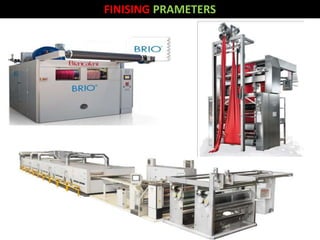
FINISING PRAMETERS
Name : MAZADUL HASAN SHESHIR
ID: 2010000400008
Batch: 13th Batch (Session 2009-2013)
Department: Wet Processing Technology
Email: mazadulhasan@yahoo.com (FB)
Blog: www. Textilelab.blogspot.com
Southeast University,Bangladesh
Department of Textile Engineering
PREPARED BY ©right
Knit fabric Finishing
The term finishing, in a broad sense it covers all the processes of making
the fabric good looking, good hand feeling, luster and of course for buyer
requirement. It is done after dying and before delivery to market. Various
types of parameters are controlled during finishing section considering
buyer requirement. The term also includes bleaching, dyeing, mercerizing
etc. But normally the term is restricted to the final stage in the sequence
of treatment of Knit fabrics after bleaching and dyeing. However, fabrics
which are neither bleached nor dyed are also finished.
The aim of finishing is to render textile goods fit for their purpose or end
use. Besides that, finishing can be done for achieving the following
purposes-
a) To improve fabric attractiveness.
- By modification of fabric appearance(optical brightening),
-By altering fabric handle (Softening, Stiffening)
-Control of fabric dimension (Sanforising, Compacting)
b) To improve service ability.
-Protection of fabric (Flame proofing, Water proofing)
-Improved performance (Water repellency, Raising)
-Easy care properties (Resin finish, Crease recovery)
Objects of finishing:
Achieving finishing target of knit fabric means to achieve the finished fabric with all the
quality or parameters that is required by the customer.
 In case of knit fabric, target quality refers to the shade, GSM, shrinkage, spirality, color
fastness etc. When order is placed, at first fabric structure, GSM, shade is considered.
Depending on the parameters yarn count, m/c gauge, stitch length, machine dia, yarn
type are selected all those factors are related with target quality.
 Grey fabric gsm should be lower than finished gsm. In case of knitting fabric at least
15% weight will increase during wet processing.
 Grey gsm will depend on the shade percentage, lycra %, type of yarn used and type of
finishing pequired for that particular fabric. For light shade stitch length will be more
than deep shade.
 In case of spirality, it will depend on the yarn count, compactness, feeder no. of the
knitting machine. If count (Ne) is high, compactness of the fabric is more and feeder
no. of the m/c is lower than fabric spirality and shrinkage will be less.
Finishing & Finishing Target:
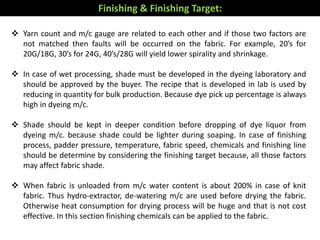
 Yarn count and m/c gauge are related to each other and if those two factors are
not matched then faults will be occurred on the fabric. For example, 20’s for
20G/18G, 30’s for 24G, 40’s/28G will yield lower spirality and shrinkage.
 In case of wet processing, shade must be developed in the dyeing laboratory and
should be approved by the buyer. The recipe that is developed in lab is used by
reducing in quantity for bulk production. Because dye pick up percentage is always
high in dyeing m/c.
 Shade should be kept in deeper condition before dropping of dye liquor from
dyeing m/c. because shade could be lighter during soaping. In case of finishing
process, padder pressure, temperature, fabric speed, chemicals and finishing line
should be determine by considering the finishing target because, all those factors
may affect fabric shade.
 When fabric is unloaded from m/c water content is about 200% in case of knit
fabric. Thus hydro-extractor, de-watering m/c are used before drying the fabric.
Otherwise heat consumption for drying process will be huge and that is not cost
effective. In this section finishing chemicals can be applied to the fabric.
Finishing & Finishing Target:
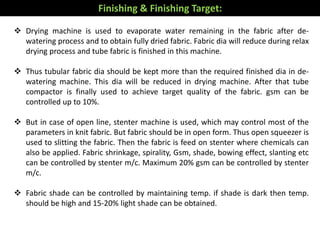
 Drying machine is used to evaporate water remaining in the fabric after de-
watering process and to obtain fully dried fabric. Fabric dia will reduce during relax
drying process and tube fabric is finished in this machine.
 Thus tubular fabric dia should be kept more than the required finished dia in de-
watering machine. This dia will be reduced in drying machine. After that tube
compactor is finally used to achieve target quality of the fabric. gsm can be
controlled up to 10%.
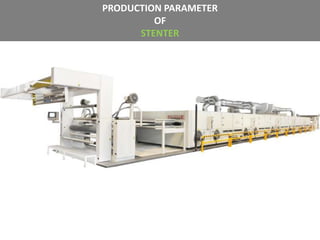
 But in case of open line, stenter machine is used, which may control most of the
parameters in knit fabric. But fabric should be in open form. Thus open squeezer is
used to slitting the fabric. Then the fabric is feed on stenter where chemicals can
also be applied. Fabric shrinkage, spirality, Gsm, shade, bowing effect, slanting etc
can be controlled by stenter m/c. Maximum 20% gsm can be controlled by stenter
m/c.
 Fabric shade can be controlled by maintaining temp. if shade is dark then temp.
should be high and 15-20% light shade can be obtained.
Finishing & Finishing Target:
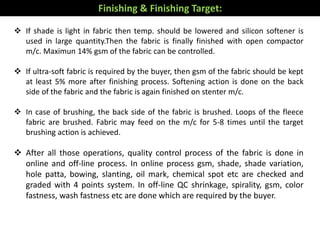
 If shade is light in fabric then temp. should be lowered and silicon softener is
used in large quantity.Then the fabric is finally finished with open compactor
m/c. Maximun 14% gsm of the fabric can be controlled.
 If ultra-soft fabric is required by the buyer, then gsm of the fabric should be kept
at least 5% more after finishing process. Softening action is done on the back
side of the fabric and the fabric is again finished on stenter m/c.
 In case of brushing, the back side of the fabric is brushed. Loops of the fleece
fabric are brushed. Fabric may feed on the m/c for 5-8 times until the target
brushing action is achieved.
 After all those operations, quality control process of the fabric is done in
online and off-line process. In online process gsm, shade, shade variation,
hole patta, bowing, slanting, oil mark, chemical spot etc are checked and
graded with 4 points system. In off-line QC shrinkage, spirality, gsm, color
fastness, wash fastness etc are done which are required by the buyer.
Finishing & Finishing Target:
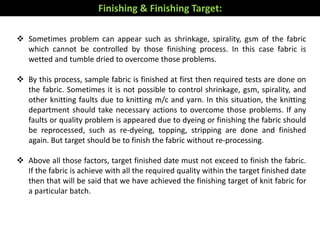
 Sometimes problem can appear such as shrinkage, spirality, gsm of the fabric
which cannot be controlled by those finishing process. In this case fabric is
wetted and tumble dried to overcome those problems.
 By this process, sample fabric is finished at first then required tests are done on
the fabric. Sometimes it is not possible to control shrinkage, gsm, spirality, and
other knitting faults due to knitting m/c and yarn. In this situation, the knitting
department should take necessary actions to overcome those problems. If any
faults or quality problem is appeared due to dyeing or finishing the fabric should
be reprocessed, such as re-dyeing, topping, stripping are done and finished
again. But target should be to finish the fabric without re-processing.
 Above all those factors, target finished date must not exceed to finish the fabric.
If the fabric is achieve with all the required quality within the target finished date
then that will be said that we have achieved the finishing target of knit fabric for
a particular batch.
Finishing & Finishing Target:
PRODUCTION PARAMETER
OF
STENTER
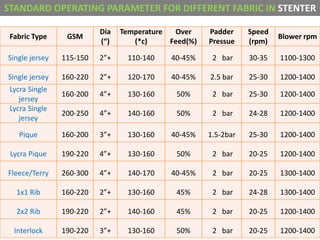
STANDARD OPERATING PARAMETER FOR DIFFERENT FABRIC IN STENTER
Fabric Type GSM
Dia
(“)
Temperature
(*c)
Over
Feed(%)
Padder
Pressue
Speed
(rpm)
Blower rpm
Single jersey 115-150 2”+ 110-140 40-45% 2 bar 30-35 1100-1300
Single jersey 160-220 2”+ 120-170 40-45% 2.5 bar 25-30 1200-1400
Lycra Single
jersey
160-200 4”+ 130-160 50% 2 bar 25-30 1200-1400
Lycra Single
jersey
200-250 4”+ 140-160 50% 2 bar 24-28 1200-1400
Pique 160-200 3”+ 130-160 40-45% 1.5-2bar 25-30 1200-1400
Lycra Pique 190-220 4”+ 130-160 50% 2 bar 20-25 1200-1400
Fleece/Terry 260-300 4”+ 140-170 40-45% 2 bar 20-25 1300-1400
1x1 Rib 160-220 2”+ 130-160 45% 2 bar 24-28 1300-1400
2x2 Rib 190-220 2”+ 140-160 45% 2 bar 20-25 1200-1400
Interlock 190-220 3”+ 130-160 50% 2 bar 20-25 1200-1400
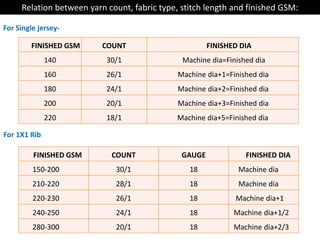
Relation between yarn count, fabric type, stitch length and finished GSM:
For Single jersey-
FINISHED GSM COUNT FINISHED DIA
140 30/1 Machine dia=Finished dia
160 26/1 Machine dia+1=Finished dia
180 24/1 Machine dia+2=Finished dia
200 20/1 Machine dia+3=Finished dia
220 18/1 Machine dia+5=Finished dia
For 1X1 Rib
FINISHED GSM COUNT GAUGE FINISHED DIA
150-200 30/1 18 Machine dia
210-220 28/1 18 Machine dia
220-230 26/1 18 Machine dia+1
240-250 24/1 18 Machine dia+1/2
280-300 20/1 18 Machine dia+2/3
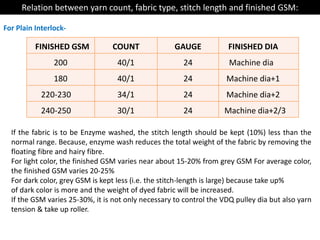
For Plain Interlock-
FINISHED GSM COUNT GAUGE FINISHED DIA
200 40/1 24 Machine dia
180 40/1 24 Machine dia+1
220-230 34/1 24 Machine dia+2
240-250 30/1 24 Machine dia+2/3
Relation between yarn count, fabric type, stitch length and finished GSM:
If the fabric is to be Enzyme washed, the stitch length should be kept (10%) less than the
normal range. Because, enzyme wash reduces the total weight of the fabric by removing the
floating fibre and hairy fibre.
For light color, the finished GSM varies near about 15-20% from grey GSM For average color,
the finished GSM varies 20-25%
For dark color, grey GSM is kept less (i.e. the stitch-length is large) because take up%
of dark color is more and the weight of dyed fabric will be increased.
If the GSM varies 25-30%, it is not only necessary to control the VDQ pulley dia but also yarn
tension & take up roller.
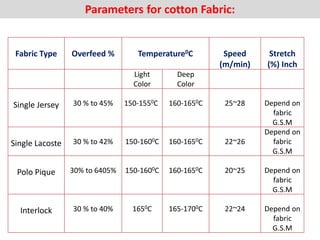
Fabric Type Overfeed % Temperature0C Speed
(m/min)
Stretch
(%) Inch
Light
Color
Deep
Color
Single Jersey 30 % to 45% 150-1550C 160-1650C 25~28 Depend on
fabric
G.S.M
Single Lacoste 30 % to 42% 150-1600C 160-1650C 22~26
Depend on
fabric
G.S.M
Polo Pique 30% to 6405% 150-1600C 160-1650C 20~25 Depend on
fabric
G.S.M
Interlock 30 % to 40% 1650C 165-1700C 22~24 Depend on
fabric
G.S.M
Parameters for cotton Fabric:
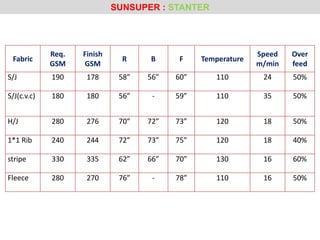
SUNSUPER : STANTER
Fabric
Req.
GSM
Finish
GSM
R B F Temperature
Speed
m/min
Over
feed
S/J 190 178 58” 56” 60” 110 24 50%
S/J(c.v.c) 180 180 56” - 59” 110 35 50%
H/J 280 276 70” 72” 73” 120 18 50%
1*1 Rib 240 244 72” 73” 75” 120 18 40%
stripe 330 335 62” 66” 70” 130 16 60%
Fleece 280 270 76” - 78” 110 16 50%
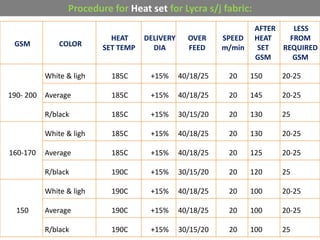
GSM COLOR
HEAT
SET TEMP
DELIVERY
DIA
OVER
FEED
SPEED
m/min
AFTER
HEAT
SET
GSM
LESS
FROM
REQUIRED
GSM
190- 200
White & ligh 185C +15% 40/18/25 20 150 20-25
Average 185C +15% 40/18/25 20 145 20-25
R/black 185C +15% 30/15/20 20 130 25
160-170
White & ligh 185C +15% 40/18/25 20 130 20-25
Average 185C +15% 40/18/25 20 125 20-25
R/black 190C +15% 30/15/20 20 120 25
150
White & ligh 190C +15% 40/18/25 20 100 20-25
Average 190C +15% 40/18/25 20 100 20-25
R/black 190C +15% 30/15/20 20 100 25
Procedure for Heat set for Lycra s/j fabric:
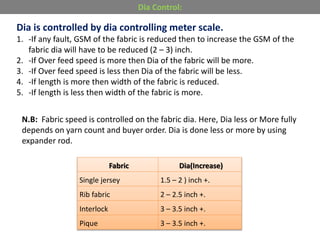
Dia Control:
Fabric Dia(Increase)
Single jersey 1.5 – 2 ) inch +.
Rib fabric 2 – 2.5 inch +.
Interlock 3 – 3.5 inch +.
Pique 3 – 3.5 inch +.
Dia is controlled by dia controlling meter scale.
1. -If any fault, GSM of the fabric is reduced then to increase the GSM of the
fabric dia will have to be reduced (2 – 3) inch.
2. -If Over feed speed is more then Dia of the fabric will be more.
3. -If Over feed speed is less then Dia of the fabric will be less.
4. -If length is more then width of the fabric is reduced.
5. -If length is less then width of the fabric is more.
N.B: Fabric speed is controlled on the fabric dia. Here, Dia less or More fully
depends on yarn count and buyer order. Dia is done less or more by using
expander rod.
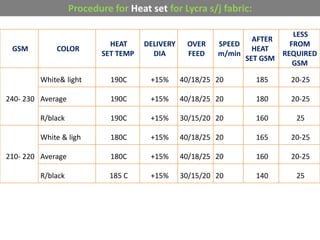
Procedure for Heat set for Lycra s/j fabric:
GSM COLOR
HEAT
SET TEMP
DELIVERY
DIA
OVER
FEED
SPEED
m/min
AFTER
HEAT
SET GSM
LESS
FROM
REQUIRED
GSM
240- 230
White& light 190C +15% 40/18/25 20 185 20-25
Average 190C +15% 40/18/25 20 180 20-25
R/black 190C +15% 30/15/20 20 160 25
210- 220
White & ligh 180C +15% 40/18/25 20 165 20-25
Average 180C +15% 40/18/25 20 160 20-25
R/black 185 C +15% 30/15/20 20 140 25
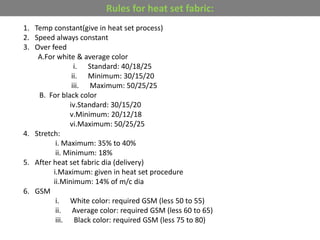
Rules for heat set fabric:
1. Temp constant(give in heat set process)
2. Speed always constant
3. Over feed
A.For white & average color
i. Standard: 40/18/25
ii. Minimum: 30/15/20
iii. Maximum: 50/25/25
B. For black color
iv.Standard: 30/15/20
v.Minimum: 20/12/18
vi.Maximum: 50/25/25
4. Stretch:
i. Maximum: 35% to 40%
ii. Minimum: 18%
5. After heat set fabric dia (delivery)
i.Maximum: given in heat set procedure
ii.Minimum: 14% of m/c dia
6. GSM
i. White color: required GSM (less 50 to 55)
ii. Average color: required GSM (less 60 to 65)
iii. Black color: required GSM (less 75 to 80)
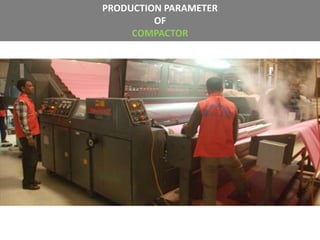
PRODUCTION PARAMETER
OF
COMPACTOR
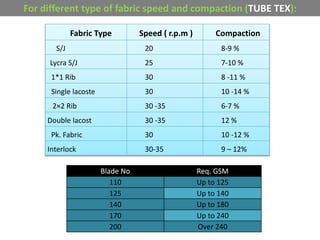
For different type of fabric speed and compaction (TUBE TEX):
Fabric Type Speed ( r.p.m ) Compaction
S/J 20 8-9 %
Lycra S/J 25 7-10 %
1*1 Rib 30 8 -11 %
Single lacoste 30 10 -14 %
2×2 Rib 30 -35 6-7 %
Double lacost 30 -35 12 %
Pk. Fabric 30 10 -12 %
Interlock 30-35 9 – 12%
Blade No Req. GSM
110 Up to 125
125 Up to 140
140 Up to 180
170 Up to 240
200 Over 240
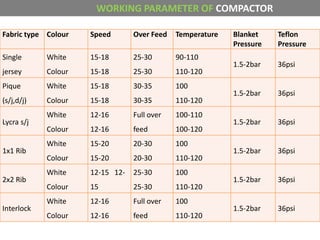
WORKING PARAMETER OF COMPACTOR
Fabric type Colour Speed Over Feed Temperature Blanket
Pressure
Teflon
Pressure
Single
jersey
White
Colour
15-18
15-18
25-30
25-30
90-110
110-120
1.5-2bar 36psi
Pique
(s/j,d/j)
White
Colour
15-18
15-18
30-35
30-35
100
110-120
1.5-2bar 36psi
Lycra s/j
White
Colour
12-16
12-16
Full over
feed
100-110
100-120
1.5-2bar 36psi
1x1 Rib
White
Colour
15-20
15-20
20-30
20-30
100
110-120
1.5-2bar 36psi
2x2 Rib
White
Colour
12-15 12-
15
25-30
25-30
100
110-120
1.5-2bar 36psi
Interlock
White
Colour
12-16
12-16
Full over
feed
100
110-120
1.5-2bar 36psi
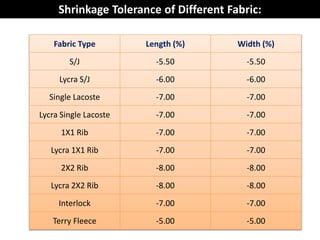
Shrinkage Tolerance of Different Fabric:
Fabric Type Length (%) Width (%)
S/J -5.50 -5.50
Lycra S/J -6.00 -6.00
Single Lacoste -7.00 -7.00
Lycra Single Lacoste -7.00 -7.00
1X1 Rib -7.00 -7.00
Lycra 1X1 Rib -7.00 -7.00
2X2 Rib -8.00 -8.00
Lycra 2X2 Rib -8.00 -8.00
Interlock -7.00 -7.00
Terry Fleece -5.00 -5.00
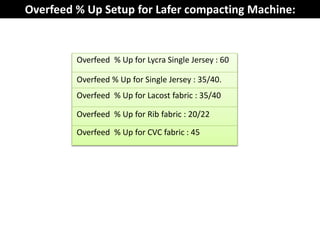
Overfeed % Up Setup for Lafer compacting Machine:
Overfeed % Up for Lycra Single Jersey : 60
Overfeed % Up for Single Jersey : 35/40.
Overfeed % Up for Lacost fabric : 35/40
Overfeed % Up for Rib fabric : 20/22
Overfeed % Up for CVC fabric : 45
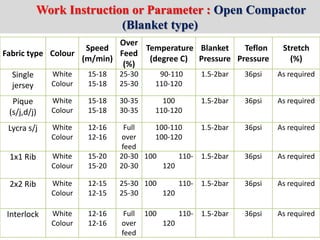
Fabric type Colour
Speed
(m/min)
Over
Feed
(%)
Temperature
(degree C)
Blanket
Pressure
Teflon
Pressure
Stretch
(%)
Single
jersey
White
Colour
15-18
15-18
25-30
25-30
90-110
110-120
1.5-2bar 36psi As required
Pique
(s/j,d/j)
White
Colour
15-18
15-18
30-35
30-35
100
110-120
1.5-2bar 36psi As required
Lycra s/j White
Colour
12-16
12-16
Full
over
feed
100-110
100-120
1.5-2bar 36psi As required
1x1 Rib White
Colour
15-20
15-20
20-30
20-30
100 110-
120
1.5-2bar 36psi As required
2x2 Rib White
Colour
12-15
12-15
25-30
25-30
100 110-
120
1.5-2bar 36psi As required
Interlock White
Colour
12-16
12-16
Full
over
feed
100 110-
120
1.5-2bar 36psi As required
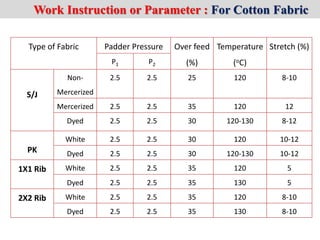
Work Instruction or Parameter : Open Compactor
(Blanket type)
Type of Fabric Padder Pressure Over feed
(%)
Temperature
(oC)
Stretch (%)
P1 P2
S/J
Non-
Mercerized
2.5 2.5 25 120 8-10
Mercerized 2.5 2.5 35 120 12
Dyed 2.5 2.5 30 120-130 8-12
PK
White 2.5 2.5 30 120 10-12
Dyed 2.5 2.5 30 120-130 10-12
1X1 Rib White 2.5 2.5 35 120 5
Dyed 2.5 2.5 35 130 5
2X2 Rib White 2.5 2.5 35 120 8-10
Dyed 2.5 2.5 35 130 8-10
Work Instruction or Parameter : For Cotton Fabric
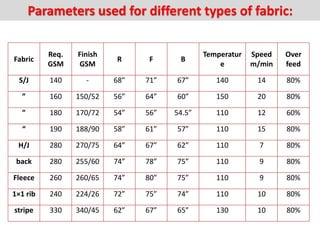
Parameters used for different types of fabric:
Fabric
Req.
GSM
Finish
GSM
R F B
Temperatur
e
Speed
m/min
Over
feed
S/J 140 - 68” 71” 67” 140 14 80%
” 160 150/52 56” 64” 60” 150 20 80%
” 180 170/72 54” 56” 54.5” 110 12 60%
“ 190 188/90 58” 61” 57” 110 15 80%
H/J 280 270/75 64” 67” 62” 110 7 80%
back 280 255/60 74” 78” 75” 110 9 80%
Fleece 260 260/65 74” 80” 75” 110 9 80%
1×1 rib 240 224/26 72” 75” 74” 110 10 80%
stripe 330 340/45 62” 67” 65” 130 10 80%
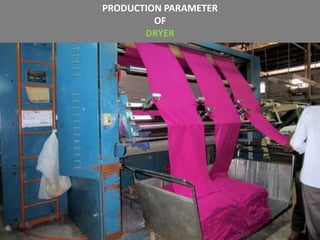
PRODUCTION PARAMETER
OF
DRYER
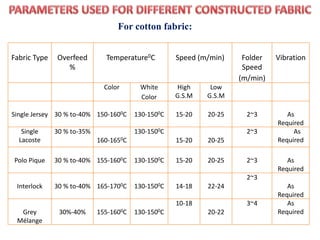
Fabric Type Overfeed
%
Temperature0C Speed (m/min) Folder
Speed
(m/min)
Vibration
Color White
Color
High
G.S.M
Low
G.S.M
Single Jersey 30 % to-40% 150-1600C 130-1500C 15-20 20-25 2~3 As
Required
Single
Lacoste
30 % to-35%
160-1650C
130-1500C
15-20 20-25
2~3 As
Required
Polo Pique 30 % to-40% 155-1600C 130-1500C 15-20 20-25 2~3 As
Required
Interlock 30 % to-40% 165-1700C 130-1500C 14-18 22-24
2~3
As
Required
Grey
Mélange
30%-40% 155-1600C 130-1500C
10-18
20-22
3~4 As
Required
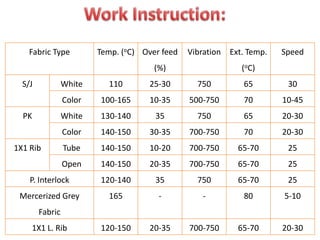
For cotton fabric:
Fabric Type Temp. (oC) Over feed
(%)
Vibration Ext. Temp.
(oC)
Speed
S/J White 110 25-30 750 65 30
Color 100-165 10-35 500-750 70 10-45
PK White 130-140 35 750 65 20-30
Color 140-150 30-35 700-750 70 20-30
1X1 Rib Tube 140-150 10-20 700-750 65-70 25
Open 140-150 20-35 700-750 65-70 25
P. Interlock 120-140 35 750 65-70 25
Mercerized Grey
Fabric
165 - - 80 5-10
1X1 L. Rib 120-150 20-35 700-750 65-70 20-30
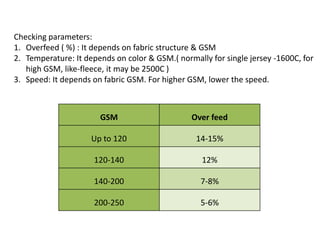
Checking parameters:
1. Overfeed ( %) : It depends on fabric structure & GSM
2. Temperature: It depends on color & GSM.( normally for single jersey -1600C, for
high GSM, like-fleece, it may be 2500C )
3. Speed: It depends on fabric GSM. For higher GSM, lower the speed.
GSM Over feed
Up to 120 14-15%
120-140 12%
140-200 7-8%
200-250 5-6%
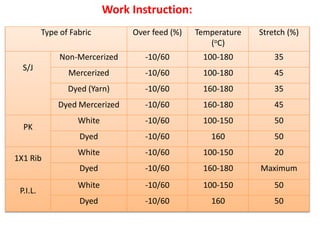
Work Instruction:
Type of Fabric Over feed (%) Temperature
(oC)
Stretch (%)
S/J
Non-Mercerized -10/60 100-180 35
Mercerized -10/60 100-180 45
Dyed (Yarn) -10/60 160-180 35
Dyed Mercerized -10/60 160-180 45
PK
White -10/60 100-150 50
Dyed -10/60 160 50
1X1 Rib
White -10/60 100-150 20
Dyed -10/60 160-180 Maximum
P.I.L.
White -10/60 100-150 50
Dyed -10/60 160 50
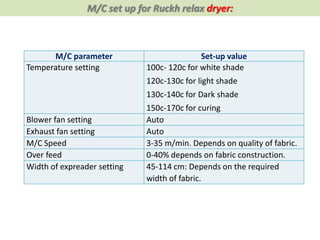
M/C set up for Ruckh relax dryer:
M/C parameter Set-up value
Temperature setting 100c- 120c for white shade
120c-130c for light shade
130c-140c for Dark shade
150c-170c for curing
Blower fan setting Auto
Exhaust fan setting Auto
M/C Speed 3-35 m/min. Depends on quality of fabric.
Over feed 0-40% depends on fabric construction.
Width of expreader setting 45-114 cm: Depends on the required
width of fabric.
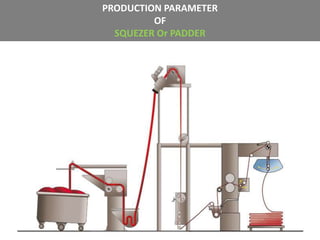
PRODUCTION PARAMETER
OF
SQUEZER Or PADDER
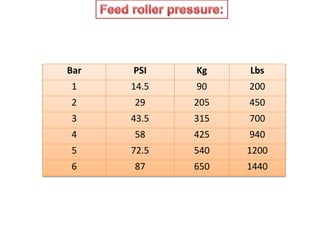
Bar PSI Kg Lbs
1 14.5 90 200
2 29 205 450
3 43.5 315 700
4 58 425 940
5 72.5 540 1200
6 87 650 1440
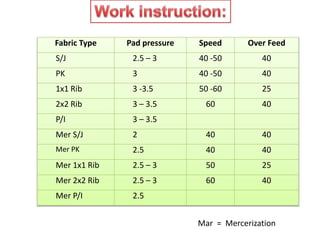
Fabric Type Pad pressure Speed Over Feed
S/J 2.5 – 3 40 -50 40
PK 3 40 -50 40
1x1 Rib 3 -3.5 50 -60 25
2x2 Rib 3 – 3.5 60 40
P/I 3 – 3.5
Mer S/J 2 40 40
Mer PK 2.5 40 40
Mer 1x1 Rib 2.5 – 3 50 25
Mer 2x2 Rib 2.5 – 3 60 40
Mer P/I 2.5
Mar = Mercerization
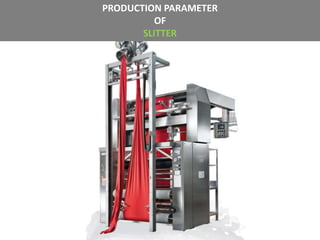
PRODUCTION PARAMETER
OF
SLITTER
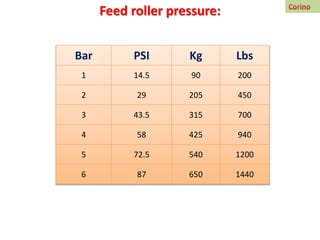
Bar PSI Kg Lbs
1 14.5 90 200
2 29 205 450
3 43.5 315 700
4 58 425 940
5 72.5 540 1200
6 87 650 1440
Feed roller pressure:
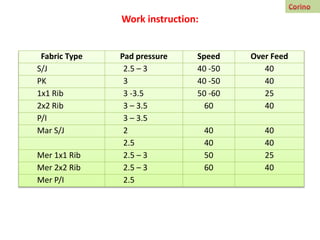
Fabric Type Pad pressure Speed Over Feed
S/J 2.5 – 3 40 -50 40
PK 3 40 -50 40
1x1 Rib 3 -3.5 50 -60 25
2x2 Rib 3 – 3.5 60 40
P/I 3 – 3.5
Mar S/J 2 40 40
2.5 40 40
Mer 1x1 Rib 2.5 – 3 50 25
Mer 2x2 Rib 2.5 – 3 60 40
Mer P/I 2.5
Work instruction:
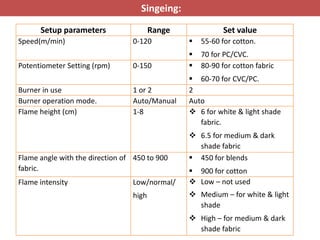
Singeing:
Setup parameters Range Set value
Speed(m/min) 0-120  55-60 for cotton.
 70 for PC/CVC.
Potentiometer Setting (rpm) 0-150  80-90 for cotton fabric
 60-70 for CVC/PC.
Burner in use 1 or 2 2
Burner operation mode. Auto/Manual Auto
Flame height (cm) 1-8  6 for white & light shade
fabric.
 6.5 for medium & dark
shade fabric
Flame angle with the direction of
fabric.
450 to 900  450 for blends
 900 for cotton
Flame intensity Low/normal/
high
 Low – not used
 Medium – for white & light
shade
 High – for medium & dark
shade fabric
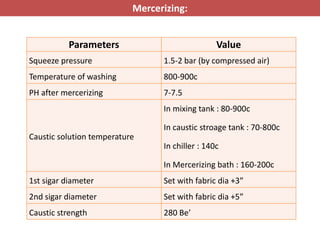
Mercerizing:
Parameters Value
Squeeze pressure 1.5-2 bar (by compressed air)
Temperature of washing 800-900c
PH after mercerizing 7-7.5
Caustic solution temperature
In mixing tank : 80-900c
In caustic stroage tank : 70-800c
In chiller : 140c
In Mercerizing bath : 160-200c
1st sigar diameter Set with fabric dia +3
2nd sigar diameter Set with fabric dia +5
Caustic strength 280 Be
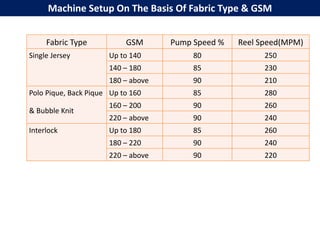
Fabric Type GSM Pump Speed % Reel Speed(MPM)
Single Jersey Up to 140 80 250
140 – 180 85 230
180 – above 90 210
Polo Pique, Back Pique
& Bubble Knit
Up to 160 85 280
160 – 200 90 260
220 – above 90 240
Interlock Up to 180 85 260
180 – 220 90 240
220 – above 90 220
Machine Setup On The Basis Of Fabric Type & GSM
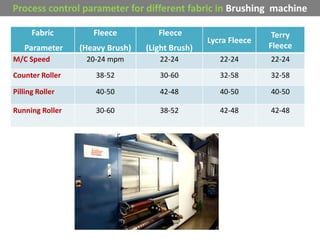
Fabric
Parameter
Fleece
(Heavy Brush)
Fleece
(Light Brush)
Lycra Fleece
Terry
Fleece
M/C Speed 20-24 mpm 22-24 22-24 22-24
Counter Roller 38-52 30-60 32-58 32-58
Pilling Roller 40-50 42-48 40-50 40-50
Running Roller 30-60 38-52 42-48 42-48
Process control parameter for different fabric in Brushing machine
Parameters of finishing machine

Parameters of finishing machine

  • 1.
  • 2.
    Name : MAZADULHASAN SHESHIR ID: 2010000400008 Batch: 13th Batch (Session 2009-2013) Department: Wet Processing Technology Email: mazadulhasan@yahoo.com (FB) Blog: www. Textilelab.blogspot.com Southeast University,Bangladesh Department of Textile Engineering PREPARED BY ©right
  • 3.
    Knit fabric Finishing Theterm finishing, in a broad sense it covers all the processes of making the fabric good looking, good hand feeling, luster and of course for buyer requirement. It is done after dying and before delivery to market. Various types of parameters are controlled during finishing section considering buyer requirement. The term also includes bleaching, dyeing, mercerizing etc. But normally the term is restricted to the final stage in the sequence of treatment of Knit fabrics after bleaching and dyeing. However, fabrics which are neither bleached nor dyed are also finished.
  • 4.
    The aim offinishing is to render textile goods fit for their purpose or end use. Besides that, finishing can be done for achieving the following purposes- a) To improve fabric attractiveness. - By modification of fabric appearance(optical brightening), -By altering fabric handle (Softening, Stiffening) -Control of fabric dimension (Sanforising, Compacting) b) To improve service ability. -Protection of fabric (Flame proofing, Water proofing) -Improved performance (Water repellency, Raising) -Easy care properties (Resin finish, Crease recovery) Objects of finishing:
  • 5.
    Achieving finishing targetof knit fabric means to achieve the finished fabric with all the quality or parameters that is required by the customer.  In case of knit fabric, target quality refers to the shade, GSM, shrinkage, spirality, color fastness etc. When order is placed, at first fabric structure, GSM, shade is considered. Depending on the parameters yarn count, m/c gauge, stitch length, machine dia, yarn type are selected all those factors are related with target quality.  Grey fabric gsm should be lower than finished gsm. In case of knitting fabric at least 15% weight will increase during wet processing.  Grey gsm will depend on the shade percentage, lycra %, type of yarn used and type of finishing pequired for that particular fabric. For light shade stitch length will be more than deep shade.  In case of spirality, it will depend on the yarn count, compactness, feeder no. of the knitting machine. If count (Ne) is high, compactness of the fabric is more and feeder no. of the m/c is lower than fabric spirality and shrinkage will be less. Finishing & Finishing Target:
  • 6.
     Yarn countand m/c gauge are related to each other and if those two factors are not matched then faults will be occurred on the fabric. For example, 20’s for 20G/18G, 30’s for 24G, 40’s/28G will yield lower spirality and shrinkage.  In case of wet processing, shade must be developed in the dyeing laboratory and should be approved by the buyer. The recipe that is developed in lab is used by reducing in quantity for bulk production. Because dye pick up percentage is always high in dyeing m/c.  Shade should be kept in deeper condition before dropping of dye liquor from dyeing m/c. because shade could be lighter during soaping. In case of finishing process, padder pressure, temperature, fabric speed, chemicals and finishing line should be determine by considering the finishing target because, all those factors may affect fabric shade.  When fabric is unloaded from m/c water content is about 200% in case of knit fabric. Thus hydro-extractor, de-watering m/c are used before drying the fabric. Otherwise heat consumption for drying process will be huge and that is not cost effective. In this section finishing chemicals can be applied to the fabric. Finishing & Finishing Target:
  • 7.
     Drying machineis used to evaporate water remaining in the fabric after de- watering process and to obtain fully dried fabric. Fabric dia will reduce during relax drying process and tube fabric is finished in this machine.  Thus tubular fabric dia should be kept more than the required finished dia in de- watering machine. This dia will be reduced in drying machine. After that tube compactor is finally used to achieve target quality of the fabric. gsm can be controlled up to 10%.  But in case of open line, stenter machine is used, which may control most of the parameters in knit fabric. But fabric should be in open form. Thus open squeezer is used to slitting the fabric. Then the fabric is feed on stenter where chemicals can also be applied. Fabric shrinkage, spirality, Gsm, shade, bowing effect, slanting etc can be controlled by stenter m/c. Maximum 20% gsm can be controlled by stenter m/c.  Fabric shade can be controlled by maintaining temp. if shade is dark then temp. should be high and 15-20% light shade can be obtained. Finishing & Finishing Target:
  • 8.
     If shadeis light in fabric then temp. should be lowered and silicon softener is used in large quantity.Then the fabric is finally finished with open compactor m/c. Maximun 14% gsm of the fabric can be controlled.  If ultra-soft fabric is required by the buyer, then gsm of the fabric should be kept at least 5% more after finishing process. Softening action is done on the back side of the fabric and the fabric is again finished on stenter m/c.  In case of brushing, the back side of the fabric is brushed. Loops of the fleece fabric are brushed. Fabric may feed on the m/c for 5-8 times until the target brushing action is achieved.  After all those operations, quality control process of the fabric is done in online and off-line process. In online process gsm, shade, shade variation, hole patta, bowing, slanting, oil mark, chemical spot etc are checked and graded with 4 points system. In off-line QC shrinkage, spirality, gsm, color fastness, wash fastness etc are done which are required by the buyer. Finishing & Finishing Target:
  • 9.
     Sometimes problemcan appear such as shrinkage, spirality, gsm of the fabric which cannot be controlled by those finishing process. In this case fabric is wetted and tumble dried to overcome those problems.  By this process, sample fabric is finished at first then required tests are done on the fabric. Sometimes it is not possible to control shrinkage, gsm, spirality, and other knitting faults due to knitting m/c and yarn. In this situation, the knitting department should take necessary actions to overcome those problems. If any faults or quality problem is appeared due to dyeing or finishing the fabric should be reprocessed, such as re-dyeing, topping, stripping are done and finished again. But target should be to finish the fabric without re-processing.  Above all those factors, target finished date must not exceed to finish the fabric. If the fabric is achieve with all the required quality within the target finished date then that will be said that we have achieved the finishing target of knit fabric for a particular batch. Finishing & Finishing Target:
  • 10.
  • 11.
    STANDARD OPERATING PARAMETERFOR DIFFERENT FABRIC IN STENTER Fabric Type GSM Dia (“) Temperature (*c) Over Feed(%) Padder Pressue Speed (rpm) Blower rpm Single jersey 115-150 2”+ 110-140 40-45% 2 bar 30-35 1100-1300 Single jersey 160-220 2”+ 120-170 40-45% 2.5 bar 25-30 1200-1400 Lycra Single jersey 160-200 4”+ 130-160 50% 2 bar 25-30 1200-1400 Lycra Single jersey 200-250 4”+ 140-160 50% 2 bar 24-28 1200-1400 Pique 160-200 3”+ 130-160 40-45% 1.5-2bar 25-30 1200-1400 Lycra Pique 190-220 4”+ 130-160 50% 2 bar 20-25 1200-1400 Fleece/Terry 260-300 4”+ 140-170 40-45% 2 bar 20-25 1300-1400 1x1 Rib 160-220 2”+ 130-160 45% 2 bar 24-28 1300-1400 2x2 Rib 190-220 2”+ 140-160 45% 2 bar 20-25 1200-1400 Interlock 190-220 3”+ 130-160 50% 2 bar 20-25 1200-1400
  • 12.
    Relation between yarncount, fabric type, stitch length and finished GSM: For Single jersey- FINISHED GSM COUNT FINISHED DIA 140 30/1 Machine dia=Finished dia 160 26/1 Machine dia+1=Finished dia 180 24/1 Machine dia+2=Finished dia 200 20/1 Machine dia+3=Finished dia 220 18/1 Machine dia+5=Finished dia For 1X1 Rib FINISHED GSM COUNT GAUGE FINISHED DIA 150-200 30/1 18 Machine dia 210-220 28/1 18 Machine dia 220-230 26/1 18 Machine dia+1 240-250 24/1 18 Machine dia+1/2 280-300 20/1 18 Machine dia+2/3
  • 13.
    For Plain Interlock- FINISHEDGSM COUNT GAUGE FINISHED DIA 200 40/1 24 Machine dia 180 40/1 24 Machine dia+1 220-230 34/1 24 Machine dia+2 240-250 30/1 24 Machine dia+2/3 Relation between yarn count, fabric type, stitch length and finished GSM: If the fabric is to be Enzyme washed, the stitch length should be kept (10%) less than the normal range. Because, enzyme wash reduces the total weight of the fabric by removing the floating fibre and hairy fibre. For light color, the finished GSM varies near about 15-20% from grey GSM For average color, the finished GSM varies 20-25% For dark color, grey GSM is kept less (i.e. the stitch-length is large) because take up% of dark color is more and the weight of dyed fabric will be increased. If the GSM varies 25-30%, it is not only necessary to control the VDQ pulley dia but also yarn tension & take up roller.
  • 14.
    Fabric Type Overfeed% Temperature0C Speed (m/min) Stretch (%) Inch Light Color Deep Color Single Jersey 30 % to 45% 150-1550C 160-1650C 25~28 Depend on fabric G.S.M Single Lacoste 30 % to 42% 150-1600C 160-1650C 22~26 Depend on fabric G.S.M Polo Pique 30% to 6405% 150-1600C 160-1650C 20~25 Depend on fabric G.S.M Interlock 30 % to 40% 1650C 165-1700C 22~24 Depend on fabric G.S.M Parameters for cotton Fabric:
  • 15.
    SUNSUPER : STANTER Fabric Req. GSM Finish GSM RB F Temperature Speed m/min Over feed S/J 190 178 58” 56” 60” 110 24 50% S/J(c.v.c) 180 180 56” - 59” 110 35 50% H/J 280 276 70” 72” 73” 120 18 50% 1*1 Rib 240 244 72” 73” 75” 120 18 40% stripe 330 335 62” 66” 70” 130 16 60% Fleece 280 270 76” - 78” 110 16 50%
  • 16.
    GSM COLOR HEAT SET TEMP DELIVERY DIA OVER FEED SPEED m/min AFTER HEAT SET GSM LESS FROM REQUIRED GSM 190-200 White & ligh 185C +15% 40/18/25 20 150 20-25 Average 185C +15% 40/18/25 20 145 20-25 R/black 185C +15% 30/15/20 20 130 25 160-170 White & ligh 185C +15% 40/18/25 20 130 20-25 Average 185C +15% 40/18/25 20 125 20-25 R/black 190C +15% 30/15/20 20 120 25 150 White & ligh 190C +15% 40/18/25 20 100 20-25 Average 190C +15% 40/18/25 20 100 20-25 R/black 190C +15% 30/15/20 20 100 25 Procedure for Heat set for Lycra s/j fabric:
  • 17.
    Dia Control: Fabric Dia(Increase) Singlejersey 1.5 – 2 ) inch +. Rib fabric 2 – 2.5 inch +. Interlock 3 – 3.5 inch +. Pique 3 – 3.5 inch +. Dia is controlled by dia controlling meter scale. 1. -If any fault, GSM of the fabric is reduced then to increase the GSM of the fabric dia will have to be reduced (2 – 3) inch. 2. -If Over feed speed is more then Dia of the fabric will be more. 3. -If Over feed speed is less then Dia of the fabric will be less. 4. -If length is more then width of the fabric is reduced. 5. -If length is less then width of the fabric is more. N.B: Fabric speed is controlled on the fabric dia. Here, Dia less or More fully depends on yarn count and buyer order. Dia is done less or more by using expander rod.
  • 18.
    Procedure for Heatset for Lycra s/j fabric: GSM COLOR HEAT SET TEMP DELIVERY DIA OVER FEED SPEED m/min AFTER HEAT SET GSM LESS FROM REQUIRED GSM 240- 230 White& light 190C +15% 40/18/25 20 185 20-25 Average 190C +15% 40/18/25 20 180 20-25 R/black 190C +15% 30/15/20 20 160 25 210- 220 White & ligh 180C +15% 40/18/25 20 165 20-25 Average 180C +15% 40/18/25 20 160 20-25 R/black 185 C +15% 30/15/20 20 140 25
  • 19.
    Rules for heatset fabric: 1. Temp constant(give in heat set process) 2. Speed always constant 3. Over feed A.For white & average color i. Standard: 40/18/25 ii. Minimum: 30/15/20 iii. Maximum: 50/25/25 B. For black color iv.Standard: 30/15/20 v.Minimum: 20/12/18 vi.Maximum: 50/25/25 4. Stretch: i. Maximum: 35% to 40% ii. Minimum: 18% 5. After heat set fabric dia (delivery) i.Maximum: given in heat set procedure ii.Minimum: 14% of m/c dia 6. GSM i. White color: required GSM (less 50 to 55) ii. Average color: required GSM (less 60 to 65) iii. Black color: required GSM (less 75 to 80)
  • 20.
  • 21.
    For different typeof fabric speed and compaction (TUBE TEX): Fabric Type Speed ( r.p.m ) Compaction S/J 20 8-9 % Lycra S/J 25 7-10 % 1*1 Rib 30 8 -11 % Single lacoste 30 10 -14 % 2×2 Rib 30 -35 6-7 % Double lacost 30 -35 12 % Pk. Fabric 30 10 -12 % Interlock 30-35 9 – 12% Blade No Req. GSM 110 Up to 125 125 Up to 140 140 Up to 180 170 Up to 240 200 Over 240
  • 22.
    WORKING PARAMETER OFCOMPACTOR Fabric type Colour Speed Over Feed Temperature Blanket Pressure Teflon Pressure Single jersey White Colour 15-18 15-18 25-30 25-30 90-110 110-120 1.5-2bar 36psi Pique (s/j,d/j) White Colour 15-18 15-18 30-35 30-35 100 110-120 1.5-2bar 36psi Lycra s/j White Colour 12-16 12-16 Full over feed 100-110 100-120 1.5-2bar 36psi 1x1 Rib White Colour 15-20 15-20 20-30 20-30 100 110-120 1.5-2bar 36psi 2x2 Rib White Colour 12-15 12- 15 25-30 25-30 100 110-120 1.5-2bar 36psi Interlock White Colour 12-16 12-16 Full over feed 100 110-120 1.5-2bar 36psi
  • 23.
    Shrinkage Tolerance ofDifferent Fabric: Fabric Type Length (%) Width (%) S/J -5.50 -5.50 Lycra S/J -6.00 -6.00 Single Lacoste -7.00 -7.00 Lycra Single Lacoste -7.00 -7.00 1X1 Rib -7.00 -7.00 Lycra 1X1 Rib -7.00 -7.00 2X2 Rib -8.00 -8.00 Lycra 2X2 Rib -8.00 -8.00 Interlock -7.00 -7.00 Terry Fleece -5.00 -5.00
  • 24.
    Overfeed % UpSetup for Lafer compacting Machine: Overfeed % Up for Lycra Single Jersey : 60 Overfeed % Up for Single Jersey : 35/40. Overfeed % Up for Lacost fabric : 35/40 Overfeed % Up for Rib fabric : 20/22 Overfeed % Up for CVC fabric : 45
  • 25.
    Fabric type Colour Speed (m/min) Over Feed (%) Temperature (degreeC) Blanket Pressure Teflon Pressure Stretch (%) Single jersey White Colour 15-18 15-18 25-30 25-30 90-110 110-120 1.5-2bar 36psi As required Pique (s/j,d/j) White Colour 15-18 15-18 30-35 30-35 100 110-120 1.5-2bar 36psi As required Lycra s/j White Colour 12-16 12-16 Full over feed 100-110 100-120 1.5-2bar 36psi As required 1x1 Rib White Colour 15-20 15-20 20-30 20-30 100 110- 120 1.5-2bar 36psi As required 2x2 Rib White Colour 12-15 12-15 25-30 25-30 100 110- 120 1.5-2bar 36psi As required Interlock White Colour 12-16 12-16 Full over feed 100 110- 120 1.5-2bar 36psi As required Work Instruction or Parameter : Open Compactor (Blanket type)
  • 26.
    Type of FabricPadder Pressure Over feed (%) Temperature (oC) Stretch (%) P1 P2 S/J Non- Mercerized 2.5 2.5 25 120 8-10 Mercerized 2.5 2.5 35 120 12 Dyed 2.5 2.5 30 120-130 8-12 PK White 2.5 2.5 30 120 10-12 Dyed 2.5 2.5 30 120-130 10-12 1X1 Rib White 2.5 2.5 35 120 5 Dyed 2.5 2.5 35 130 5 2X2 Rib White 2.5 2.5 35 120 8-10 Dyed 2.5 2.5 35 130 8-10 Work Instruction or Parameter : For Cotton Fabric
  • 27.
    Parameters used fordifferent types of fabric: Fabric Req. GSM Finish GSM R F B Temperatur e Speed m/min Over feed S/J 140 - 68” 71” 67” 140 14 80% ” 160 150/52 56” 64” 60” 150 20 80% ” 180 170/72 54” 56” 54.5” 110 12 60% “ 190 188/90 58” 61” 57” 110 15 80% H/J 280 270/75 64” 67” 62” 110 7 80% back 280 255/60 74” 78” 75” 110 9 80% Fleece 260 260/65 74” 80” 75” 110 9 80% 1×1 rib 240 224/26 72” 75” 74” 110 10 80% stripe 330 340/45 62” 67” 65” 130 10 80%
  • 28.
  • 29.
    Fabric Type Overfeed % Temperature0CSpeed (m/min) Folder Speed (m/min) Vibration Color White Color High G.S.M Low G.S.M Single Jersey 30 % to-40% 150-1600C 130-1500C 15-20 20-25 2~3 As Required Single Lacoste 30 % to-35% 160-1650C 130-1500C 15-20 20-25 2~3 As Required Polo Pique 30 % to-40% 155-1600C 130-1500C 15-20 20-25 2~3 As Required Interlock 30 % to-40% 165-1700C 130-1500C 14-18 22-24 2~3 As Required Grey Mélange 30%-40% 155-1600C 130-1500C 10-18 20-22 3~4 As Required For cotton fabric:
  • 30.
    Fabric Type Temp.(oC) Over feed (%) Vibration Ext. Temp. (oC) Speed S/J White 110 25-30 750 65 30 Color 100-165 10-35 500-750 70 10-45 PK White 130-140 35 750 65 20-30 Color 140-150 30-35 700-750 70 20-30 1X1 Rib Tube 140-150 10-20 700-750 65-70 25 Open 140-150 20-35 700-750 65-70 25 P. Interlock 120-140 35 750 65-70 25 Mercerized Grey Fabric 165 - - 80 5-10 1X1 L. Rib 120-150 20-35 700-750 65-70 20-30
  • 31.
    Checking parameters: 1. Overfeed( %) : It depends on fabric structure & GSM 2. Temperature: It depends on color & GSM.( normally for single jersey -1600C, for high GSM, like-fleece, it may be 2500C ) 3. Speed: It depends on fabric GSM. For higher GSM, lower the speed. GSM Over feed Up to 120 14-15% 120-140 12% 140-200 7-8% 200-250 5-6%
  • 32.
    Work Instruction: Type ofFabric Over feed (%) Temperature (oC) Stretch (%) S/J Non-Mercerized -10/60 100-180 35 Mercerized -10/60 100-180 45 Dyed (Yarn) -10/60 160-180 35 Dyed Mercerized -10/60 160-180 45 PK White -10/60 100-150 50 Dyed -10/60 160 50 1X1 Rib White -10/60 100-150 20 Dyed -10/60 160-180 Maximum P.I.L. White -10/60 100-150 50 Dyed -10/60 160 50
  • 33.
    M/C set upfor Ruckh relax dryer: M/C parameter Set-up value Temperature setting 100c- 120c for white shade 120c-130c for light shade 130c-140c for Dark shade 150c-170c for curing Blower fan setting Auto Exhaust fan setting Auto M/C Speed 3-35 m/min. Depends on quality of fabric. Over feed 0-40% depends on fabric construction. Width of expreader setting 45-114 cm: Depends on the required width of fabric.
  • 34.
  • 36.
    Bar PSI KgLbs 1 14.5 90 200 2 29 205 450 3 43.5 315 700 4 58 425 940 5 72.5 540 1200 6 87 650 1440
  • 37.
    Fabric Type Padpressure Speed Over Feed S/J 2.5 – 3 40 -50 40 PK 3 40 -50 40 1x1 Rib 3 -3.5 50 -60 25 2x2 Rib 3 – 3.5 60 40 P/I 3 – 3.5 Mer S/J 2 40 40 Mer PK 2.5 40 40 Mer 1x1 Rib 2.5 – 3 50 25 Mer 2x2 Rib 2.5 – 3 60 40 Mer P/I 2.5 Mar = Mercerization
  • 38.
  • 40.
    Bar PSI KgLbs 1 14.5 90 200 2 29 205 450 3 43.5 315 700 4 58 425 940 5 72.5 540 1200 6 87 650 1440 Feed roller pressure:
  • 41.
    Fabric Type Padpressure Speed Over Feed S/J 2.5 – 3 40 -50 40 PK 3 40 -50 40 1x1 Rib 3 -3.5 50 -60 25 2x2 Rib 3 – 3.5 60 40 P/I 3 – 3.5 Mar S/J 2 40 40 2.5 40 40 Mer 1x1 Rib 2.5 – 3 50 25 Mer 2x2 Rib 2.5 – 3 60 40 Mer P/I 2.5 Work instruction:
  • 42.
    Singeing: Setup parameters RangeSet value Speed(m/min) 0-120  55-60 for cotton.  70 for PC/CVC. Potentiometer Setting (rpm) 0-150  80-90 for cotton fabric  60-70 for CVC/PC. Burner in use 1 or 2 2 Burner operation mode. Auto/Manual Auto Flame height (cm) 1-8  6 for white & light shade fabric.  6.5 for medium & dark shade fabric Flame angle with the direction of fabric. 450 to 900  450 for blends  900 for cotton Flame intensity Low/normal/ high  Low – not used  Medium – for white & light shade  High – for medium & dark shade fabric
  • 43.
    Mercerizing: Parameters Value Squeeze pressure1.5-2 bar (by compressed air) Temperature of washing 800-900c PH after mercerizing 7-7.5 Caustic solution temperature In mixing tank : 80-900c In caustic stroage tank : 70-800c In chiller : 140c In Mercerizing bath : 160-200c 1st sigar diameter Set with fabric dia +3 2nd sigar diameter Set with fabric dia +5 Caustic strength 280 Be
  • 44.
    Fabric Type GSMPump Speed % Reel Speed(MPM) Single Jersey Up to 140 80 250 140 – 180 85 230 180 – above 90 210 Polo Pique, Back Pique & Bubble Knit Up to 160 85 280 160 – 200 90 260 220 – above 90 240 Interlock Up to 180 85 260 180 – 220 90 240 220 – above 90 220 Machine Setup On The Basis Of Fabric Type & GSM
  • 45.
    Fabric Parameter Fleece (Heavy Brush) Fleece (Light Brush) LycraFleece Terry Fleece M/C Speed 20-24 mpm 22-24 22-24 22-24 Counter Roller 38-52 30-60 32-58 32-58 Pilling Roller 40-50 42-48 40-50 40-50 Running Roller 30-60 38-52 42-48 42-48 Process control parameter for different fabric in Brushing machine