A  CASE  OF  FLACCID QUADRIPARESIS S.GEETHALAKSHMI PROF  DR.MAGESHKUMAR’S  UNIT
32 yr old male admitted with acute onset of weakness of both lower limbs OF A WEEK DURATION which progressed 3 days later to involve  both upper limbs assoc with H/O parasthesia of both lowerlimbs NO H/O Bladder/bowel symptoms tingling/numbness Worsening/improvement of weakness with activity NO H/S/O cranial n palsy
NO  HISTORY  OF Trauma Loss of consciousness seizures fever/loose stools recent vaccination exanthematous fever drug intake dog  bite difficulty in breathing difficulty in extending neck
PAST HISTORY Not a known case of SHT/T2DM/PT/BA/CAD H/O Intermittent episodes of jt pain &swelling 3 months back relieved with analgesics But no H/0 skin rash/oral ulcers/photosensitivity NO H/S/O Raynaud’s phenomenon H/O previous similar episodes in the past twice in 2005 n 2007 from which he recovered completely with treatment in a span of 6wks and 8 wks respectively FAMILY HISTORY No similar history in family members PERSONAL HISTORY Occ. Alcoholic-10yrs NO OCCUPATIONAL EXPOSURE
On  Examination Pt conscious oriented Afebrile Not dyspnoeic Pallor+, anicteric , acyanosed NO clubbing , no PE No gen lymphadenopathy No ptosis/no neurocutaneous markers. BP 130/90mm Hg  PR 83/min SINGLE  BREATH  COUNT : 33/min MUSCULOSKELETAL SYS NRL CVS-S1S2+.no murmur RS –B/L NVBS+.clear P/A--Soft,not tender.no organomegaly
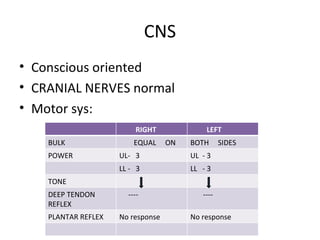
CNS Conscious oriented CRANIAL NERVES normal Motor sys: RIGHT LEFT BULK EQUAL  ON BOTH  SIDES POWER UL-  3 UL  - 3 LL -  3 LL  - 3 TONE DEEP TENDON REFLEX ---- ---- PLANTAR REFLEX No response No response
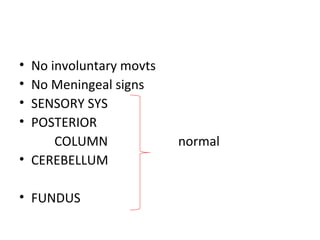
No involuntary movts No Meningeal signs  SENSORY SYS  POSTERIOR  COLUMN  normal CEREBELLUM  FUNDUS
PROVISIONAL DIAGNOSIS RECURRENT QUADRIPARESIS
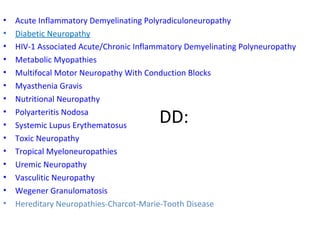
DD: Acute Inflammatory Demyelinating Polyradiculoneuropathy Diabetic Neuropathy HIV-1 Associated Acute/Chronic Inflammatory Demyelinating Polyneuropathy Metabolic Myopathies Multifocal Motor Neuropathy With Conduction Blocks Myasthenia Gravis Nutritional Neuropathy Polyarteritis Nodosa Systemic Lupus Erythematosus Toxic Neuropathy Tropical Myeloneuropathies Uremic Neuropathy Vasculitic Neuropathy Wegener Granulomatosis Hereditary Neuropathies-Charcot-Marie-Tooth Disease
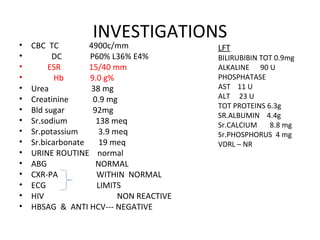
INVESTIGATIONS CBC  TC  4900c/mm DC  P60% L36% E4% ESR  15/40 mm Hb  9.0 g% Urea  38 mg Creatinine  0.9 mg Bld sugar  92mg Sr.sodium  138 meq Sr.potassium  3.9 meq Sr.bicarbonate  19 meq URINE ROUTINE  normal ABG  NORMAL  CXR-PA  WITHIN  NORMAL  ECG  LIMITS HIV  NON REACTIVE HBSAG  &  ANTI HCV--- NEGATIVE  LFT BILIRUBIBIN TOT 0.9mg ALKALINE  90 U PHOSPHATASE AST  11 U ALT  23 U TOT PROTEINS 6.3g  SR.ALBUMIN  4.4g  Sr.CALCIUM  8.8 mg Sr.PHOSPHORUS  4 mg VDRL – NR
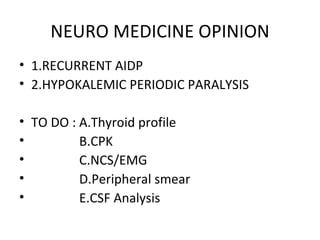
NEURO MEDICINE OPINION 1.RECURRENT AIDP 2.HYPOKALEMIC PERIODIC PARALYSIS TO DO : A.Thyroid profile B.CPK C.NCS/EMG D.Peripheral smear  E.CSF Analysis
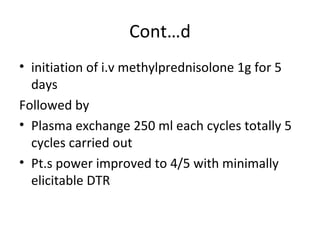
Cont…d initiation of i.v methylprednisolone 1g for 5 days Followed by Plasma exchange 250 ml each cycles totally 5 cycles carried out Pt.s power improved to 4/5 with minimally elicitable DTR
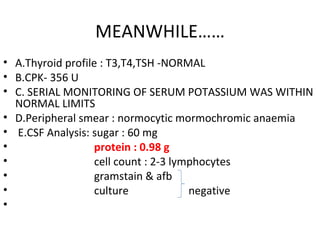
MEANWHILE…… A.Thyroid profile : T3,T4,TSH -NORMAL B.CPK- 356 U C. SERIAL MONITORING OF SERUM POTASSIUM WAS WITHIN NORMAL LIMITS D.Peripheral smear : normocytic mormochromic anaemia E.CSF Analysis: sugar : 60 mg protein : 0.98 g cell count : 2-3 lymphocytes  gramstain & afb culture  negative
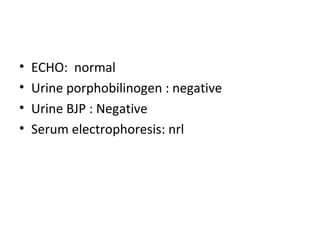
ECHO:  normal Urine porphobilinogen : negative Urine BJP : Negative Serum electrophoresis: nrl
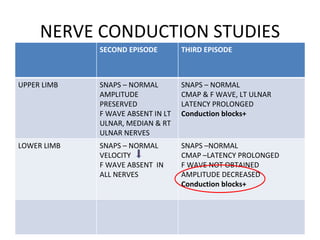
NERVE CONDUCTION STUDIES SECOND EPISODE THIRD EPISODE UPPER LIMB SNAPS – NORMAL AMPLITUDE PRESERVED F WAVE ABSENT IN LT ULNAR, MEDIAN & RT ULNAR NERVES SNAPS – NORMAL CMAP & F WAVE, LT ULNAR LATENCY PROLONGED Conduction blocks+  LOWER LIMB SNAPS – NORMAL VELOCITY  F WAVE ABSENT  IN ALL NERVES SNAPS –NORMAL CMAP –LATENCY PROLONGED F WAVE NOT OBTAINED AMPLITUDE DECREASED Conduction blocks+
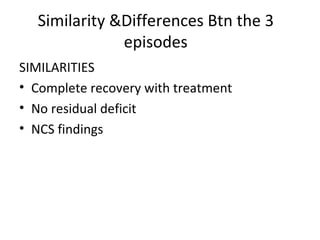
Similarity &Differences Btn the 3 episodes SIMILARITIES Complete recovery with treatment No residual deficit NCS findings
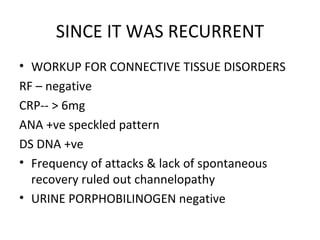
SINCE IT WAS RECURRENT WORKUP FOR CONNECTIVE TISSUE DISORDERS RF – negative CRP-- > 6mg ANA +ve speckled pattern DS DNA +ve  Frequency of attacks & lack of spontaneous recovery ruled out channelopathy URINE PORPHOBILINOGEN negative
FURTHER COURSE PT IMPROVED WITH IV FOLLOWED BY ORAL STEROIDS AS PER RHEUMATOLOGIST ADVICE PT WAS PUT ON TAPERING DOSE OF STEROIDS AND AZATHIOPRINE ADDED RECENT FOLLOWUP, PT WAS ABLE TO WALK WITHOUT SUPPORT O/E DTR regained,power all 4 limbs 4+/5
PROBABLE  DIAGNOSIS 1.MOTOR PREDOMINANT POLYNEUROPATHY 2.AUTOIMMUNE ETIOLOGY (SLE) 3.DEMYELINATING WITH MIN AXONAL INV 4.CHRONIC RELAPSING & REMITTING VARIANT ALL POINT TWDS  CIDP
INTRODUCTION:  CIDP is an Acquired. Demyelinating.Ds.of P.N.S, characterized by relapsing/prog. Proximal and distal muscle weakness with possible sensory loss it is considered the  chronic  counterpart of that  acute  disease. CIDP is a multifocal  predominantly proximal,inflammatory affect spinal roots, spinal nerves, major complexes,or nerve trunks and ANS CIDP is under-recognized and under-treated due to its  heterogeneous  presentation (both clinical and electrophysiological) and the limitations of clinical, serologic, and electrophysiologic diagnostic criteria. there are no generally agreed-on clinical diagnostic criteria for CIDP due to its different presentations in symptoms
Frequency  CIDP is uncommon. The estimated prevalence of CIDP in populations from the UK, Australia, Italy, Norway, and Japan is 0.8-7.7 per 100,000.  2009 study-incidence&prevalence is variable depending on diagnostic criteria . In UK on 2008,  prevalence of CIDP was 4.77/100,000 if  EFNS/PNS criteria were used but only 1.97 per 100,000 if  AAN criteria were used.  annual incidence 0.7 per 100,000 using  EFNS criteria &0.35 using AAN criteria. Mortality/Morbidity most commonly has an insidious onset and either chronic progressive or relapsing course. Occasionally, complete remissions occur. Quadriplegia, respiratory failure, and death have been described but are rare.  Race  No racial predilection has been identified. Sex  Both sexes affected.multifocal motor neuropathy has male predominance of 2:1  Age   may occur at any age, but  more common in fifth and sixth decades. Relapsing course is associated with younger age of patients (third and fourth decades). CIDP has been described in childhood.
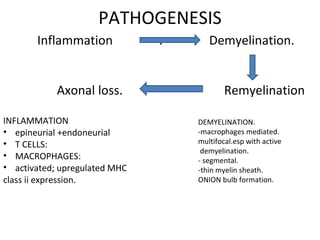
PATHOGENESIS Inflammation  .  Demyelination.    Axonal loss.    Remyelination INFLAMMATION  epineurial +endoneurial  T CELLS:  MACROPHAGES:  activated; upregulated MHC  class ii expression.  DEMYELINATION.  -macrophages mediated.  multifocal.esp with active demyelination. - segmental. -thin myelin sheath. ONION bulb formation.
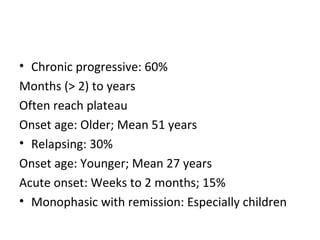
Chronic progressive: 60%  Months (> 2) to years  Often reach plateau  Onset age: Older; Mean 51 years  Relapsing: 30%  Onset age: Younger; Mean 27 years  Acute onset: Weeks to 2 months; 15%  Monophasic with remission: Especially children
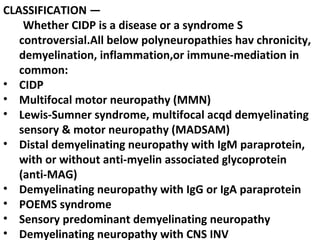
CLASSIFICATION — Whether CIDP is a disease or a syndrome S controversial.All below polyneuropathies hav chronicity, demyelination, inflammation,or immune-mediation in common: CIDP  Multifocal motor neuropathy (MMN)  Lewis-Sumner syndrome, multifocal acqd demyelinating sensory & motor neuropathy (MADSAM)  Distal demyelinating neuropathy with IgM paraprotein, with or without anti-myelin associated glycoprotein (anti-MAG)  Demyelinating neuropathy with IgG or IgA paraprotein  POEMS syndrome Sensory predominant demyelinating neuropathy  Demyelinating neuropathy with CNS INV
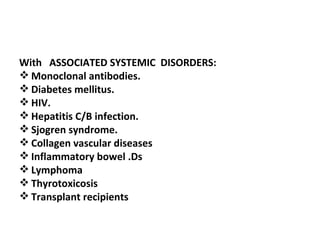
With  ASSOCIATED SYSTEMIC  DISORDERS:  Monoclonal antibodies. Diabetes mellitus. HIV. Hepatitis C/B infection. Sjogren syndrome. Collagen vascular diseases Inflammatory bowel .Ds Lymphoma Thyrotoxicosis Transplant recipients
AAN CRITERIA CLINICAL CRITERIA   Pattern of clinical involvement:  motor/sensory dysfunction involving more  than one limb.    TIME COURSE: at least 2/12.   REFLEXES:  areflexia or hyporeflexia  C.S.F CRITERIA:    mandatory: cell count less than 10/mm.   Supportive: elevated protein. PATHOLOGICAL CRITERIA:   Sural .n biopsy:  mandatory: evidence of demyelination/remyelination.  supportive: evidence of  perineurial/endoneurial,onion bulb   formation with mononuclear infiltration
ELECTROPHYSIOLOGICAL CRITERIA:   AT least 3 of 4 criteria must be met.   1 - partial conduction block. Def,prob,possb must  be present in at least 1 motor.N.   2 - conduction velocity must be abnormal in at  least 2 motor nerves.   3 - distal latency must be abnormal in at least 2  motor nerves.   4 - F- waves must be abnormal in at least 2 .N
AAN criteria allow the diagnosis of  CIDP into……….  DEFINATE CIDP.  PROBABLE CIDP.  POSSIBLE CIDP.
NERVE BIOPSY- ITS ROLE  The diagnostic utility of nerve biopsy for suspected CIDP is controversial . Nerve biopsy is used mainly when other studies fail to clearly establish the diagnosis of CIDP, particularly when electrophysiologic criteria for demyelination are not met. #A major limitation of nerve biopsy is suboptimal sensitivity and specificity #CIDP is a multifocal disorder, and motor nerve fibers tend to be more affected than sensory nerves (the usual nerves used for biopsy). As a result, the biopsy sample may not demonstrate the demyelination. In addition, the inflammatory component of CIDP may not be prominent and thus may not be apparent on biopsy.
#Typically, the sural nerve is biopsied, but other candidate nerves include the superficial peroneal, superficial radial, and gracilis motor nerve. Electron microscopy and teased fiber analysis of nerve biopsy specimens is highly desirable. #Supportive features for CIDP on nerve biopsy include the following : Endoneurial edema  Macrophage-associated demyelination  Demyelinated and remyelinated nerve fibers  Onion bulb formation  Endoneurial mononuclear cell infiltration  Variation between fascicles
WHY NERVE BIOPSY NOT DONE IN OUR CASE CURRENT CONSENSUS  Biopsy is considered for those patients in whom the diagnosis is not completely clear, when other causes of neuropathy (e.g., hereditary, vasculitic) cannot be excluded, or when profound  axonal  involvement is observed on EMG.
DIAGNOSTIC CRITERIA FOR CIDP The EFNS/PNS guideline  defines CIDP as typical (ie, classic) or atypical . Atypical CIDP encompasses variants of CIDP with predominantly distal weakness such as DADS, and variants with pure motor or pure sensory presentations. determined by clinical, electrodiagnostic, and supportive criteria .  For definite CIDP,  one must have a typical or atypical clinical picture with clear demyelinating electrodiagnostic changes in two nerves, or probable demyelinating features in two nerves plus at least one supportive feature  (from cerebrospinal fluid analysis, nerve biopsy, MRI, or treatment response to immunotherapy). Diagnostic evaluation — Electrodiagnostic testing is recommended for all patients with suspected CIDP. Additional studies that may be indicated in select patients include: Cerebrospinal fluid analysis  Nerve biopsy  MRI of spinal roots, brachial plexus, and lumbosacral plexus  Laboratory studies  Evaluation for inherited neuropathies
KOSKI CRITERIA  Chronic polyneuropathy, progressive for at least 8 weeks  No serum paraprotein and no genetic abnormality and Either  Recordable CMAP in at least 75 percent of motor nerves and either abnormal distal latency or abnormal motor conduction velocity or abnormal F wave latency in >50 percent of motor nerves Or  Symmetric onset of weakness in all four limbs and proximal weakness in at least one limb Of note, while the Koski criteria combine clinical presentation and electrophysiologic abnormalities, either is sufficient to establish the diagnosis.  sensitivity -83 percent and specificity- 97 percent
TREATMENT OPTIONS:  First-line treatment for CIDP includes  corticosteroids  (e.g.  prednisone ),  plasmapheresis  (plasma exchange) and  intravenous immunoglobulin  (IVIG) which may be prescribed alone or in combination with an  immunosuppressant drug  1-Prednisone: 60-100mg/d,p/o. than taper.   Start taper after 3-6 month or clinical  improvement begins.    many pt. Will relapse if prednisone is  stopped without additional immunosuppressants.   2- methylprednisolone: 1 gm/d.than  additional i.v/p.o weekly to monthly
3- I.V Immune globulin:  1.gm/kg/d for 2 days;repeat 3 to 8 week. 0.4gm/kg 1 to 2 times per week for 8weeks. 4- cyclosporine : 5- plasma exchange: 6- interferon alpha 2 A
RECURRENT AIDP & CIDP CONTINUM OR DISTINCT ENTITIES?? CIDP SLOWLY PROG.COURSE >4-8 WKS MORE FREQUENCY OF RELAPSES PRECEEDING H/O VIRAL INF URI / GI INFECTION RARE RESPIRATORY FAILURE IS UNCOMMON DIFFUSE CONDUCTION SLOWING RESPONSE TO PREDNISONE AIDP COURSE STATIC OR IMPROVES BY 4WKS RARELY RELAPSE ESP IN POST TRANSPLANT PTS  PRECEEDING H/S/O  INFECTION RESPIRATORY FAILURE IS COMMON PATCHY CONDUCTION SLOWING NO RESPONSE TO STEROIDS
SLE  IN  CIDP Objectives To identify clinical characteristics, laboratory features, approaches to management, and predictors of outcome of  (CIDP) in patients with SLE. Methods An analysis of 6 adults with the concurrent diagnosis of CIDP and SLE seen at a SLE Clinic from 1994 to 2004 with a review of 13 patients with SLE and CIDP reported in the medical literature from 1950 through 2004. Results Among our 6 patients with SLE and CIDP, 3 (50%) achieved a substantial clinical response to intravenous immunoglobulin (IVIg) and remainder had a minimal response.
The improved patients were more likely to have received treatment earlier (within 1 year of CIDP onset) and to respond faster (<1 to 3 months) than minimally improved patients. They tended to have CIDP features of weakness of all extremities, hyporeflexia of upper extremities, slowed nerve conduction velocity of motor median nerve.  Compared with minimal responders,  responders had more serious internal organ manifestations and multiple autoantibodies associated with SLE. Review of the literature identified 13 previously reported CIDP patients with SLE. Many had neurological involvement of all extremities, nerve biopsies showing demyelination, & serious SLE internal organ manifestations. Most were treated with steroids, but the 1 treated with IVIg had similar characteristics to our subset of patients who improved with IVIg.
Conclusions  : CIDP is an uncommon, but not rare, manifestation of SLE. Certain characteristics including early CIDP diagnosis, involvement of all 4 extremities, hyporeflexia of upper extremities, &slowed motor nerve conduction velocity of median nerve in addition to SLE involvement of critical internal organs &presence of multiple antibodies associated with SLE all appear to predict a good response to IVIg
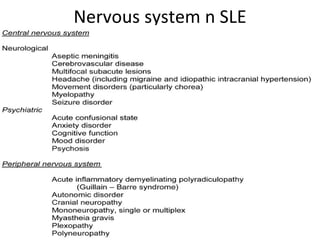
Nervous system n SLE
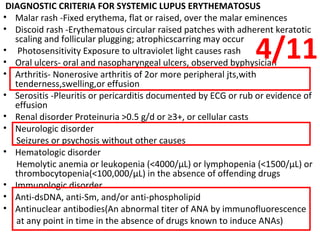
DIAGNOSTIC CRITERIA FOR SYSTEMIC LUPUS ERYTHEMATOSUS Malar rash -Fixed erythema, flat or raised, over the malar eminences Discoid rash -Erythematous circular raised patches with adherent keratotic scaling and follicular plugging; atrophicscarring may occur Photosensitivity Exposure to ultraviolet light causes rash Oral ulcers- oral and nasopharyngeal ulcers, observed byphysician Arthritis- Nonerosive arthritis of 2or more peripheral jts,with tenderness,swelling,or effusion Serositis -Pleuritis or pericarditis documented by ECG or rub or evidence of effusion Renal disorder Proteinuria >0.5 g/d or ≥3+, or cellular casts Neurologic disorder Seizures or psychosis without other causes Hematologic disorder Hemolytic anemia or leukopenia (<4000/ μ L) or lymphopenia (<1500/ μ L) or thrombocytopenia(<100,000/ μ L) in the absence of offending drugs Immunologic disorder Anti-dsDNA, anti-Sm, and/or anti-phospholipid Antinuclear antibodies(An abnormal titer of ANA by immunofluorescence at any point in time in the absence of drugs known to induce ANAs) 4/11
THANK  U
Despite these limitations, early diagnosis and treatment is important in preventing irreversible axonal loss and improving functional recovery. [2] Lack of awareness and treatment of CIDP is also due to limitations of clinical trials. Although there are stringent research criteria for selecting patients to clinical trials, Application of the present research criteria to routine clinical practice often miss the diagnosis in a majority of patients, and patients are often left untreated despite progression of their disease. [3] In some cases electrophysiological studies fail to show any evidence of demyelination. Though conventional  electrophysiological  diagnostic criteria are not met, the patient may still respond to immunomodulatory treatments. In such cases, presence of clinical characteristics suggestive of CIDP are critical, justifying full investigations, including sural nerve biopsy. [4]
. [5] IVIG and plasmapheresis have proven benefit in randomized, double-blind, placebo-controlled trials. Despite less definitive published evidence of efficacy, corticosteroids are considered standard therapies because of their long history of use and cost effectiveness. IVIG is probably the first-line CIDP treatment, but is extremely expensive (in the U.S., a single 65 g dose of Gamunex brand in 2010 might be billed at the rate of $8,000, just for the immunoglobulin, not including other charges such as nurse administration). Gamunex brand IVIG is the only U.S. FDA approved treatment for CIDP, as in 2008 Talecris, the maker of Gamunex, received  orphan drug  status for this drug for the treatment of CIDP. Immunosuppressive drugs are often of the  cytotoxic  (chemotherapy) class, including  Rituximab  (Rituxan) which targets  B Cells , and cyclophosphamide, a drug which reduces the function of the immune system. Ciclosporin has also been used in CIDP but with less frequency as it is a newer approach. [6]  Ciclosporin is thought to bind to immunocompetent lymphocytes, especially T-lymphocytes. Non-cytotoxic immunosuppressive treatments usually include the anti-rejection transplant drugs azathioprine (Imuran) and mycophenolate mofetil (Cellcept).
Chronic inflammatory demyelinating polyradiculoneuropathy is presumed to occur because of immunologic antibody-mediated reaction along with interstitial and perivascular infiltration of the endoneurium with inflammatory T cells and macrophages. The consequence is a segmental demyelination of peripheral nerves.  Human leukocyte antigens Dw3, DRw3, A1, and B8 occur more frequently in patients with CIDP than in the healthy population
Only a small proportion of patients (approximately 16%) have a relatively acute or subacute onset of symptoms, with subsequent steadily progressive or fluctuating course.  Children usually have a more precipitous onset of symptoms. Most experts consider the necessary duration of symptoms to be greater than 8 weeks for the diagnosis of CIDP to be made.
EMG is a critical test to determine whether the disorder is truly a peripheral neuropathy and whether the neuropathy is demyelinating. Findings of a demyelinating neuropathy are as follows: Multifocal conduction block or temporal dispersion of compound muscle action potential, as shown in the image belowElectromyography of a patient with chronic inflammatory demyelinating polyradiculoneuropathy illustrating conduction block, temporal dispersion of compound muscle action potential, prolonged distal latencies, and slowed conduction.  Prolonged distal latencies and dispersion of the distal compound motor action potential Variable conduction slowing to less than 70% of normal Absent or prolonged F wave latencies, as shown belowProlonged F wave latencies (normal is < 31).  As the disease progresses, patients tend to develop secondary axonal degeneration. Reports exist of a predominantly axonal neuropathy with clinical course and response to treatment similar to those of CIDP. Most cases of axonal neuropathy are not immune or inflammatory. However, some patients with an aggressive axonal neuropathy have been treated effectively with immunosuppressive and/or immunomodulatory therapy, raising the question of whether a chronic axonal inflammatory neuropathy, akin to the acute axonal variants of GBS, may be present. The relationship of these chronic axonal variants to CIDP is unclear.
Peripheral (sural) nerve biopsy is considered as supportive evidence of CIDP. Consider biopsy for those patients in whom the diagnosis is not completely clear, when other causes of neuropathy (eg, hereditary, vasculitic) cannot be excluded, or when profound axonal involvement is observed on EMG.  Some experts recommend biopsy for most patients prior to initiating immunosuppressive therapy, but more recent guidelines no longer recommend biopsy.
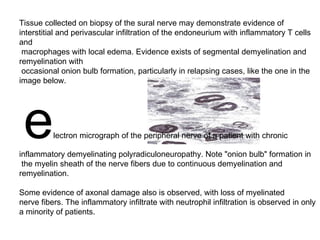
Tissue collected on biopsy of the sural nerve may demonstrate evidence of  interstitial and perivascular infiltration of the endoneurium with inflammatory T cells and macrophages with local edema. Evidence exists of segmental demyelination and remyelination with occasional onion bulb formation, particularly in relapsing cases, like the one in the image below. e lectron micrograph of the peripheral nerve of a patient with chronic  inflammatory demyelinating polyradiculoneuropathy. Note &quot;onion bulb&quot; formation in the myelin sheath of the nerve fibers due to continuous demyelination and remyelination.  Some evidence of axonal damage also is observed, with loss of myelinated  nerve fibers. The inflammatory infiltrate with neutrophil infiltration is observed in only a minority of patients.
CIDP RECURRENT GUILLAIN-BARRÉ SYNDROME CLINICAL AND LABORATORY FEATURES F. GRAND'MAISON,  T. E. FEASBY,  A. F. HAHN and  W. J. KOOPMAN + Author Affiliations Department of Clinical Neurological Sciences, Victoria Hospital, University of Western Ontario London, Ontario, Canada Correspondence to: François Grand'Maison, MD, Centre Hospitalier Universitaire de Sherbrooke, Service de Neurologie, 3001, 12e Avenue N, Sherbrooke, Quebec, Canada, J1H 5N4  Received August 20, 1991.  Revision received February 2, 1992.  Accepted March 12, 1992.  Summary The clinical and laboratory features of recurrent Guillain-Barré syndrome (RGBS) were reviewed in 12 patients in whom a total of 32 episodes fulfilled accepted criteria for Guillain-Barré syndrome (GBS). All patients were asymptomatic or only mildly symptomatic between attacks. In a given patient, the time to reach peak deficit from the onset of symptoms, the functional grade at peak deficit and the duration of the intervals between episodes varied considerably and unpredictably from one episode to the next. Analysis of these parameters across the entire group revealed no significant change as the number of attacks increased. The distribution of weakness varied between episodes with the possible exception of features of the Miller Fisher variant which were more constant Tremor was noted in two patients and enlarged nerves in one patient. There was no evident response to immunosuppressive therapy Results of cerebrospinal fluid (CSF) analysis and nerve conduction studies during recurrences were those expected in typical monophasic GBS. On nerve biopsy, onion bulb formations were sometimes observed after several recurrences.  The following characteristics of RGBS may be sufficiently distinctive from those of chronic relapsing polyneuropathy to justify their nosological separation: rapid onset of symptoms with subsequent complete or near complete recovery, high incidence of an antecedent illness, lack of an apparent response to immunosuppressive therapy and normal CSF protein levels at the onset of a recurrence.
 

A Case of CIDP

  • 1.
    A CASE OF FLACCID QUADRIPARESIS S.GEETHALAKSHMI PROF DR.MAGESHKUMAR’S UNIT
  • 2.
    32 yr oldmale admitted with acute onset of weakness of both lower limbs OF A WEEK DURATION which progressed 3 days later to involve both upper limbs assoc with H/O parasthesia of both lowerlimbs NO H/O Bladder/bowel symptoms tingling/numbness Worsening/improvement of weakness with activity NO H/S/O cranial n palsy
  • 3.
    NO HISTORY OF Trauma Loss of consciousness seizures fever/loose stools recent vaccination exanthematous fever drug intake dog bite difficulty in breathing difficulty in extending neck
  • 4.
    PAST HISTORY Nota known case of SHT/T2DM/PT/BA/CAD H/O Intermittent episodes of jt pain &swelling 3 months back relieved with analgesics But no H/0 skin rash/oral ulcers/photosensitivity NO H/S/O Raynaud’s phenomenon H/O previous similar episodes in the past twice in 2005 n 2007 from which he recovered completely with treatment in a span of 6wks and 8 wks respectively FAMILY HISTORY No similar history in family members PERSONAL HISTORY Occ. Alcoholic-10yrs NO OCCUPATIONAL EXPOSURE
  • 5.
    On ExaminationPt conscious oriented Afebrile Not dyspnoeic Pallor+, anicteric , acyanosed NO clubbing , no PE No gen lymphadenopathy No ptosis/no neurocutaneous markers. BP 130/90mm Hg PR 83/min SINGLE BREATH COUNT : 33/min MUSCULOSKELETAL SYS NRL CVS-S1S2+.no murmur RS –B/L NVBS+.clear P/A--Soft,not tender.no organomegaly
  • 6.
    CNS Conscious orientedCRANIAL NERVES normal Motor sys: RIGHT LEFT BULK EQUAL ON BOTH SIDES POWER UL- 3 UL - 3 LL - 3 LL - 3 TONE DEEP TENDON REFLEX ---- ---- PLANTAR REFLEX No response No response
  • 7.
    No involuntary movtsNo Meningeal signs SENSORY SYS POSTERIOR COLUMN normal CEREBELLUM FUNDUS
  • 8.
  • 9.
    DD: Acute InflammatoryDemyelinating Polyradiculoneuropathy Diabetic Neuropathy HIV-1 Associated Acute/Chronic Inflammatory Demyelinating Polyneuropathy Metabolic Myopathies Multifocal Motor Neuropathy With Conduction Blocks Myasthenia Gravis Nutritional Neuropathy Polyarteritis Nodosa Systemic Lupus Erythematosus Toxic Neuropathy Tropical Myeloneuropathies Uremic Neuropathy Vasculitic Neuropathy Wegener Granulomatosis Hereditary Neuropathies-Charcot-Marie-Tooth Disease
  • 10.
    INVESTIGATIONS CBC TC 4900c/mm DC P60% L36% E4% ESR 15/40 mm Hb 9.0 g% Urea 38 mg Creatinine 0.9 mg Bld sugar 92mg Sr.sodium 138 meq Sr.potassium 3.9 meq Sr.bicarbonate 19 meq URINE ROUTINE normal ABG NORMAL CXR-PA WITHIN NORMAL ECG LIMITS HIV NON REACTIVE HBSAG & ANTI HCV--- NEGATIVE LFT BILIRUBIBIN TOT 0.9mg ALKALINE 90 U PHOSPHATASE AST 11 U ALT 23 U TOT PROTEINS 6.3g SR.ALBUMIN 4.4g Sr.CALCIUM 8.8 mg Sr.PHOSPHORUS 4 mg VDRL – NR
  • 11.
    NEURO MEDICINE OPINION1.RECURRENT AIDP 2.HYPOKALEMIC PERIODIC PARALYSIS TO DO : A.Thyroid profile B.CPK C.NCS/EMG D.Peripheral smear E.CSF Analysis
  • 12.
    Cont…d initiation ofi.v methylprednisolone 1g for 5 days Followed by Plasma exchange 250 ml each cycles totally 5 cycles carried out Pt.s power improved to 4/5 with minimally elicitable DTR
  • 13.
    MEANWHILE…… A.Thyroid profile: T3,T4,TSH -NORMAL B.CPK- 356 U C. SERIAL MONITORING OF SERUM POTASSIUM WAS WITHIN NORMAL LIMITS D.Peripheral smear : normocytic mormochromic anaemia E.CSF Analysis: sugar : 60 mg protein : 0.98 g cell count : 2-3 lymphocytes gramstain & afb culture negative
  • 14.
    ECHO: normalUrine porphobilinogen : negative Urine BJP : Negative Serum electrophoresis: nrl
  • 15.
    NERVE CONDUCTION STUDIESSECOND EPISODE THIRD EPISODE UPPER LIMB SNAPS – NORMAL AMPLITUDE PRESERVED F WAVE ABSENT IN LT ULNAR, MEDIAN & RT ULNAR NERVES SNAPS – NORMAL CMAP & F WAVE, LT ULNAR LATENCY PROLONGED Conduction blocks+ LOWER LIMB SNAPS – NORMAL VELOCITY F WAVE ABSENT IN ALL NERVES SNAPS –NORMAL CMAP –LATENCY PROLONGED F WAVE NOT OBTAINED AMPLITUDE DECREASED Conduction blocks+
  • 16.
    Similarity &Differences Btnthe 3 episodes SIMILARITIES Complete recovery with treatment No residual deficit NCS findings
  • 17.
    SINCE IT WASRECURRENT WORKUP FOR CONNECTIVE TISSUE DISORDERS RF – negative CRP-- > 6mg ANA +ve speckled pattern DS DNA +ve Frequency of attacks & lack of spontaneous recovery ruled out channelopathy URINE PORPHOBILINOGEN negative
  • 18.
    FURTHER COURSE PTIMPROVED WITH IV FOLLOWED BY ORAL STEROIDS AS PER RHEUMATOLOGIST ADVICE PT WAS PUT ON TAPERING DOSE OF STEROIDS AND AZATHIOPRINE ADDED RECENT FOLLOWUP, PT WAS ABLE TO WALK WITHOUT SUPPORT O/E DTR regained,power all 4 limbs 4+/5
  • 19.
    PROBABLE DIAGNOSIS1.MOTOR PREDOMINANT POLYNEUROPATHY 2.AUTOIMMUNE ETIOLOGY (SLE) 3.DEMYELINATING WITH MIN AXONAL INV 4.CHRONIC RELAPSING & REMITTING VARIANT ALL POINT TWDS CIDP
  • 20.
    INTRODUCTION: CIDPis an Acquired. Demyelinating.Ds.of P.N.S, characterized by relapsing/prog. Proximal and distal muscle weakness with possible sensory loss it is considered the chronic counterpart of that acute disease. CIDP is a multifocal predominantly proximal,inflammatory affect spinal roots, spinal nerves, major complexes,or nerve trunks and ANS CIDP is under-recognized and under-treated due to its heterogeneous presentation (both clinical and electrophysiological) and the limitations of clinical, serologic, and electrophysiologic diagnostic criteria. there are no generally agreed-on clinical diagnostic criteria for CIDP due to its different presentations in symptoms
  • 21.
    Frequency CIDPis uncommon. The estimated prevalence of CIDP in populations from the UK, Australia, Italy, Norway, and Japan is 0.8-7.7 per 100,000. 2009 study-incidence&prevalence is variable depending on diagnostic criteria . In UK on 2008, prevalence of CIDP was 4.77/100,000 if EFNS/PNS criteria were used but only 1.97 per 100,000 if AAN criteria were used. annual incidence 0.7 per 100,000 using EFNS criteria &0.35 using AAN criteria. Mortality/Morbidity most commonly has an insidious onset and either chronic progressive or relapsing course. Occasionally, complete remissions occur. Quadriplegia, respiratory failure, and death have been described but are rare. Race No racial predilection has been identified. Sex Both sexes affected.multifocal motor neuropathy has male predominance of 2:1 Age may occur at any age, but more common in fifth and sixth decades. Relapsing course is associated with younger age of patients (third and fourth decades). CIDP has been described in childhood.
  • 22.
    PATHOGENESIS Inflammation . Demyelination. Axonal loss. Remyelination INFLAMMATION epineurial +endoneurial T CELLS: MACROPHAGES: activated; upregulated MHC class ii expression. DEMYELINATION. -macrophages mediated. multifocal.esp with active demyelination. - segmental. -thin myelin sheath. ONION bulb formation.
  • 23.
    Chronic progressive: 60% Months (> 2) to years Often reach plateau Onset age: Older; Mean 51 years Relapsing: 30% Onset age: Younger; Mean 27 years Acute onset: Weeks to 2 months; 15% Monophasic with remission: Especially children
  • 24.
    CLASSIFICATION — WhetherCIDP is a disease or a syndrome S controversial.All below polyneuropathies hav chronicity, demyelination, inflammation,or immune-mediation in common: CIDP Multifocal motor neuropathy (MMN) Lewis-Sumner syndrome, multifocal acqd demyelinating sensory & motor neuropathy (MADSAM) Distal demyelinating neuropathy with IgM paraprotein, with or without anti-myelin associated glycoprotein (anti-MAG) Demyelinating neuropathy with IgG or IgA paraprotein POEMS syndrome Sensory predominant demyelinating neuropathy Demyelinating neuropathy with CNS INV
  • 25.
    With ASSOCIATEDSYSTEMIC DISORDERS: Monoclonal antibodies. Diabetes mellitus. HIV. Hepatitis C/B infection. Sjogren syndrome. Collagen vascular diseases Inflammatory bowel .Ds Lymphoma Thyrotoxicosis Transplant recipients
  • 26.
    AAN CRITERIA CLINICALCRITERIA  Pattern of clinical involvement: motor/sensory dysfunction involving more than one limb.  TIME COURSE: at least 2/12.  REFLEXES: areflexia or hyporeflexia C.S.F CRITERIA:  mandatory: cell count less than 10/mm.  Supportive: elevated protein. PATHOLOGICAL CRITERIA:  Sural .n biopsy: mandatory: evidence of demyelination/remyelination. supportive: evidence of perineurial/endoneurial,onion bulb formation with mononuclear infiltration
  • 27.
    ELECTROPHYSIOLOGICAL CRITERIA:  AT least 3 of 4 criteria must be met.  1 - partial conduction block. Def,prob,possb must be present in at least 1 motor.N.  2 - conduction velocity must be abnormal in at least 2 motor nerves.  3 - distal latency must be abnormal in at least 2 motor nerves.  4 - F- waves must be abnormal in at least 2 .N
  • 28.
    AAN criteria allowthe diagnosis of CIDP into………. DEFINATE CIDP. PROBABLE CIDP. POSSIBLE CIDP.
  • 29.
    NERVE BIOPSY- ITSROLE The diagnostic utility of nerve biopsy for suspected CIDP is controversial . Nerve biopsy is used mainly when other studies fail to clearly establish the diagnosis of CIDP, particularly when electrophysiologic criteria for demyelination are not met. #A major limitation of nerve biopsy is suboptimal sensitivity and specificity #CIDP is a multifocal disorder, and motor nerve fibers tend to be more affected than sensory nerves (the usual nerves used for biopsy). As a result, the biopsy sample may not demonstrate the demyelination. In addition, the inflammatory component of CIDP may not be prominent and thus may not be apparent on biopsy.
  • 30.
    #Typically, the suralnerve is biopsied, but other candidate nerves include the superficial peroneal, superficial radial, and gracilis motor nerve. Electron microscopy and teased fiber analysis of nerve biopsy specimens is highly desirable. #Supportive features for CIDP on nerve biopsy include the following : Endoneurial edema Macrophage-associated demyelination Demyelinated and remyelinated nerve fibers Onion bulb formation Endoneurial mononuclear cell infiltration Variation between fascicles
  • 31.
    WHY NERVE BIOPSYNOT DONE IN OUR CASE CURRENT CONSENSUS Biopsy is considered for those patients in whom the diagnosis is not completely clear, when other causes of neuropathy (e.g., hereditary, vasculitic) cannot be excluded, or when profound axonal involvement is observed on EMG.
  • 32.
    DIAGNOSTIC CRITERIA FORCIDP The EFNS/PNS guideline defines CIDP as typical (ie, classic) or atypical . Atypical CIDP encompasses variants of CIDP with predominantly distal weakness such as DADS, and variants with pure motor or pure sensory presentations. determined by clinical, electrodiagnostic, and supportive criteria . For definite CIDP, one must have a typical or atypical clinical picture with clear demyelinating electrodiagnostic changes in two nerves, or probable demyelinating features in two nerves plus at least one supportive feature (from cerebrospinal fluid analysis, nerve biopsy, MRI, or treatment response to immunotherapy). Diagnostic evaluation — Electrodiagnostic testing is recommended for all patients with suspected CIDP. Additional studies that may be indicated in select patients include: Cerebrospinal fluid analysis Nerve biopsy MRI of spinal roots, brachial plexus, and lumbosacral plexus Laboratory studies Evaluation for inherited neuropathies
  • 33.
    KOSKI CRITERIA  Chronicpolyneuropathy, progressive for at least 8 weeks No serum paraprotein and no genetic abnormality and Either Recordable CMAP in at least 75 percent of motor nerves and either abnormal distal latency or abnormal motor conduction velocity or abnormal F wave latency in >50 percent of motor nerves Or Symmetric onset of weakness in all four limbs and proximal weakness in at least one limb Of note, while the Koski criteria combine clinical presentation and electrophysiologic abnormalities, either is sufficient to establish the diagnosis. sensitivity -83 percent and specificity- 97 percent
  • 34.
    TREATMENT OPTIONS: First-line treatment for CIDP includes corticosteroids (e.g. prednisone ), plasmapheresis (plasma exchange) and intravenous immunoglobulin (IVIG) which may be prescribed alone or in combination with an immunosuppressant drug  1-Prednisone: 60-100mg/d,p/o. than taper.  Start taper after 3-6 month or clinical improvement begins.  many pt. Will relapse if prednisone is stopped without additional immunosuppressants.  2- methylprednisolone: 1 gm/d.than additional i.v/p.o weekly to monthly
  • 35.
    3- I.V Immuneglobulin:  1.gm/kg/d for 2 days;repeat 3 to 8 week. 0.4gm/kg 1 to 2 times per week for 8weeks. 4- cyclosporine : 5- plasma exchange: 6- interferon alpha 2 A
  • 36.
    RECURRENT AIDP &CIDP CONTINUM OR DISTINCT ENTITIES?? CIDP SLOWLY PROG.COURSE >4-8 WKS MORE FREQUENCY OF RELAPSES PRECEEDING H/O VIRAL INF URI / GI INFECTION RARE RESPIRATORY FAILURE IS UNCOMMON DIFFUSE CONDUCTION SLOWING RESPONSE TO PREDNISONE AIDP COURSE STATIC OR IMPROVES BY 4WKS RARELY RELAPSE ESP IN POST TRANSPLANT PTS PRECEEDING H/S/O INFECTION RESPIRATORY FAILURE IS COMMON PATCHY CONDUCTION SLOWING NO RESPONSE TO STEROIDS
  • 37.
    SLE IN CIDP Objectives To identify clinical characteristics, laboratory features, approaches to management, and predictors of outcome of (CIDP) in patients with SLE. Methods An analysis of 6 adults with the concurrent diagnosis of CIDP and SLE seen at a SLE Clinic from 1994 to 2004 with a review of 13 patients with SLE and CIDP reported in the medical literature from 1950 through 2004. Results Among our 6 patients with SLE and CIDP, 3 (50%) achieved a substantial clinical response to intravenous immunoglobulin (IVIg) and remainder had a minimal response.
  • 38.
    The improved patientswere more likely to have received treatment earlier (within 1 year of CIDP onset) and to respond faster (<1 to 3 months) than minimally improved patients. They tended to have CIDP features of weakness of all extremities, hyporeflexia of upper extremities, slowed nerve conduction velocity of motor median nerve. Compared with minimal responders, responders had more serious internal organ manifestations and multiple autoantibodies associated with SLE. Review of the literature identified 13 previously reported CIDP patients with SLE. Many had neurological involvement of all extremities, nerve biopsies showing demyelination, & serious SLE internal organ manifestations. Most were treated with steroids, but the 1 treated with IVIg had similar characteristics to our subset of patients who improved with IVIg.
  • 39.
    Conclusions :CIDP is an uncommon, but not rare, manifestation of SLE. Certain characteristics including early CIDP diagnosis, involvement of all 4 extremities, hyporeflexia of upper extremities, &slowed motor nerve conduction velocity of median nerve in addition to SLE involvement of critical internal organs &presence of multiple antibodies associated with SLE all appear to predict a good response to IVIg
  • 40.
  • 41.
    DIAGNOSTIC CRITERIA FORSYSTEMIC LUPUS ERYTHEMATOSUS Malar rash -Fixed erythema, flat or raised, over the malar eminences Discoid rash -Erythematous circular raised patches with adherent keratotic scaling and follicular plugging; atrophicscarring may occur Photosensitivity Exposure to ultraviolet light causes rash Oral ulcers- oral and nasopharyngeal ulcers, observed byphysician Arthritis- Nonerosive arthritis of 2or more peripheral jts,with tenderness,swelling,or effusion Serositis -Pleuritis or pericarditis documented by ECG or rub or evidence of effusion Renal disorder Proteinuria >0.5 g/d or ≥3+, or cellular casts Neurologic disorder Seizures or psychosis without other causes Hematologic disorder Hemolytic anemia or leukopenia (<4000/ μ L) or lymphopenia (<1500/ μ L) or thrombocytopenia(<100,000/ μ L) in the absence of offending drugs Immunologic disorder Anti-dsDNA, anti-Sm, and/or anti-phospholipid Antinuclear antibodies(An abnormal titer of ANA by immunofluorescence at any point in time in the absence of drugs known to induce ANAs) 4/11
  • 42.
  • 43.
    Despite these limitations,early diagnosis and treatment is important in preventing irreversible axonal loss and improving functional recovery. [2] Lack of awareness and treatment of CIDP is also due to limitations of clinical trials. Although there are stringent research criteria for selecting patients to clinical trials, Application of the present research criteria to routine clinical practice often miss the diagnosis in a majority of patients, and patients are often left untreated despite progression of their disease. [3] In some cases electrophysiological studies fail to show any evidence of demyelination. Though conventional electrophysiological diagnostic criteria are not met, the patient may still respond to immunomodulatory treatments. In such cases, presence of clinical characteristics suggestive of CIDP are critical, justifying full investigations, including sural nerve biopsy. [4]
  • 44.
    . [5] IVIGand plasmapheresis have proven benefit in randomized, double-blind, placebo-controlled trials. Despite less definitive published evidence of efficacy, corticosteroids are considered standard therapies because of their long history of use and cost effectiveness. IVIG is probably the first-line CIDP treatment, but is extremely expensive (in the U.S., a single 65 g dose of Gamunex brand in 2010 might be billed at the rate of $8,000, just for the immunoglobulin, not including other charges such as nurse administration). Gamunex brand IVIG is the only U.S. FDA approved treatment for CIDP, as in 2008 Talecris, the maker of Gamunex, received orphan drug status for this drug for the treatment of CIDP. Immunosuppressive drugs are often of the cytotoxic (chemotherapy) class, including Rituximab (Rituxan) which targets B Cells , and cyclophosphamide, a drug which reduces the function of the immune system. Ciclosporin has also been used in CIDP but with less frequency as it is a newer approach. [6] Ciclosporin is thought to bind to immunocompetent lymphocytes, especially T-lymphocytes. Non-cytotoxic immunosuppressive treatments usually include the anti-rejection transplant drugs azathioprine (Imuran) and mycophenolate mofetil (Cellcept).
  • 45.
    Chronic inflammatory demyelinatingpolyradiculoneuropathy is presumed to occur because of immunologic antibody-mediated reaction along with interstitial and perivascular infiltration of the endoneurium with inflammatory T cells and macrophages. The consequence is a segmental demyelination of peripheral nerves. Human leukocyte antigens Dw3, DRw3, A1, and B8 occur more frequently in patients with CIDP than in the healthy population
  • 46.
    Only a smallproportion of patients (approximately 16%) have a relatively acute or subacute onset of symptoms, with subsequent steadily progressive or fluctuating course. Children usually have a more precipitous onset of symptoms. Most experts consider the necessary duration of symptoms to be greater than 8 weeks for the diagnosis of CIDP to be made.
  • 47.
    EMG is acritical test to determine whether the disorder is truly a peripheral neuropathy and whether the neuropathy is demyelinating. Findings of a demyelinating neuropathy are as follows: Multifocal conduction block or temporal dispersion of compound muscle action potential, as shown in the image belowElectromyography of a patient with chronic inflammatory demyelinating polyradiculoneuropathy illustrating conduction block, temporal dispersion of compound muscle action potential, prolonged distal latencies, and slowed conduction. Prolonged distal latencies and dispersion of the distal compound motor action potential Variable conduction slowing to less than 70% of normal Absent or prolonged F wave latencies, as shown belowProlonged F wave latencies (normal is < 31). As the disease progresses, patients tend to develop secondary axonal degeneration. Reports exist of a predominantly axonal neuropathy with clinical course and response to treatment similar to those of CIDP. Most cases of axonal neuropathy are not immune or inflammatory. However, some patients with an aggressive axonal neuropathy have been treated effectively with immunosuppressive and/or immunomodulatory therapy, raising the question of whether a chronic axonal inflammatory neuropathy, akin to the acute axonal variants of GBS, may be present. The relationship of these chronic axonal variants to CIDP is unclear.
  • 48.
    Peripheral (sural) nervebiopsy is considered as supportive evidence of CIDP. Consider biopsy for those patients in whom the diagnosis is not completely clear, when other causes of neuropathy (eg, hereditary, vasculitic) cannot be excluded, or when profound axonal involvement is observed on EMG. Some experts recommend biopsy for most patients prior to initiating immunosuppressive therapy, but more recent guidelines no longer recommend biopsy.
  • 49.
    Tissue collected onbiopsy of the sural nerve may demonstrate evidence of interstitial and perivascular infiltration of the endoneurium with inflammatory T cells and macrophages with local edema. Evidence exists of segmental demyelination and remyelination with occasional onion bulb formation, particularly in relapsing cases, like the one in the image below. e lectron micrograph of the peripheral nerve of a patient with chronic inflammatory demyelinating polyradiculoneuropathy. Note &quot;onion bulb&quot; formation in the myelin sheath of the nerve fibers due to continuous demyelination and remyelination. Some evidence of axonal damage also is observed, with loss of myelinated nerve fibers. The inflammatory infiltrate with neutrophil infiltration is observed in only a minority of patients.
  • 50.
    CIDP RECURRENT GUILLAIN-BARRÉSYNDROME CLINICAL AND LABORATORY FEATURES F. GRAND'MAISON, T. E. FEASBY, A. F. HAHN and W. J. KOOPMAN + Author Affiliations Department of Clinical Neurological Sciences, Victoria Hospital, University of Western Ontario London, Ontario, Canada Correspondence to: François Grand'Maison, MD, Centre Hospitalier Universitaire de Sherbrooke, Service de Neurologie, 3001, 12e Avenue N, Sherbrooke, Quebec, Canada, J1H 5N4 Received August 20, 1991. Revision received February 2, 1992. Accepted March 12, 1992. Summary The clinical and laboratory features of recurrent Guillain-Barré syndrome (RGBS) were reviewed in 12 patients in whom a total of 32 episodes fulfilled accepted criteria for Guillain-Barré syndrome (GBS). All patients were asymptomatic or only mildly symptomatic between attacks. In a given patient, the time to reach peak deficit from the onset of symptoms, the functional grade at peak deficit and the duration of the intervals between episodes varied considerably and unpredictably from one episode to the next. Analysis of these parameters across the entire group revealed no significant change as the number of attacks increased. The distribution of weakness varied between episodes with the possible exception of features of the Miller Fisher variant which were more constant Tremor was noted in two patients and enlarged nerves in one patient. There was no evident response to immunosuppressive therapy Results of cerebrospinal fluid (CSF) analysis and nerve conduction studies during recurrences were those expected in typical monophasic GBS. On nerve biopsy, onion bulb formations were sometimes observed after several recurrences. The following characteristics of RGBS may be sufficiently distinctive from those of chronic relapsing polyneuropathy to justify their nosological separation: rapid onset of symptoms with subsequent complete or near complete recovery, high incidence of an antecedent illness, lack of an apparent response to immunosuppressive therapy and normal CSF protein levels at the onset of a recurrence.
  • 51.