SUPPLEMENT 1 – EFNS/PNS diagnostic criteria for CIDP
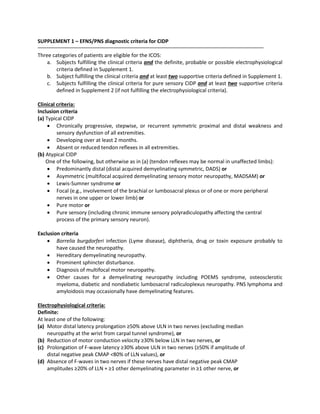
Three categories of patients are eligible for the ICOS:
a. Subjects fulfilling the clinical criteria and the definite, probable or possible electrophysiological
criteria defined in Supplement 1.
b. Subject fulfilling the clinical criteria and at least two supportive criteria defined in Supplement 1.
c. Subjects fulfilling the clinical criteria for pure sensory CIDP and at least two supportive criteria
defined in Supplement 2 (if not fulfilling the electrophysiological criteria).
Clinical criteria:
Inclusion criteria
(a) Typical CIDP
• Chronically progressive, stepwise, or recurrent symmetric proximal and distal weakness and
sensory dysfunction of all extremities.
• Developing over at least 2 months.
• Absent or reduced tendon reflexes in all extremities.
(b) Atypical CIDP
One of the following, but otherwise as in (a) (tendon reflexes may be normal in unaffected limbs):
• Predominantly distal (distal acquired demyelinating symmetric, DADS) or
• Asymmetric (multifocal acquired demyelinating sensory motor neuropathy, MADSAM) or
• Lewis-Sumner syndrome or
• Focal (e.g., involvement of the brachial or lumbosacral plexus or of one or more peripheral
nerves in one upper or lower limb) or
• Pure motor or
• Pure sensory (including chronic immune sensory polyradiculopathy affecting the central
process of the primary sensory neuron).
Exclusion criteria
• Borrelia burgdorferi infection (Lyme disease), diphtheria, drug or toxin exposure probably to
have caused the neuropathy.
• Hereditary demyelinating neuropathy.
• Prominent sphincter disturbance.
• Diagnosis of multifocal motor neuropathy.
• Other causes for a demyelinating neuropathy including POEMS syndrome, osteosclerotic
myeloma, diabetic and nondiabetic lumbosacral radiculoplexus neuropathy. PNS lymphoma and
amyloidosis may occasionally have demyelinating features.
Electrophysiological criteria:
Definite:
At least one of the following:
(a) Motor distal latency prolongation ≥50% above ULN in two nerves (excluding median
neuropathy at the wrist from carpal tunnel syndrome), or
(b) Reduction of motor conduction velocity ≥30% below LLN in two nerves, or
(c) Prolongation of F-wave latency ≥30% above ULN in two nerves (≥50% if amplitude of
distal negative peak CMAP <80% of LLN values), or
(d) Absence of F-waves in two nerves if these nerves have distal negative peak CMAP
amplitudes ≥20% of LLN + ≥1 other demyelinating parameter in ≥1 other nerve, or
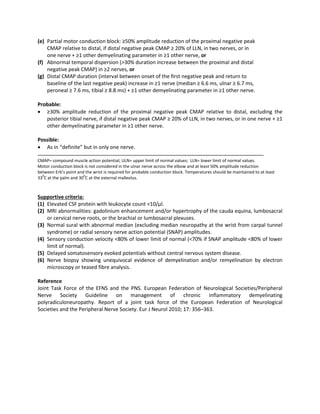
(e) Partial motor conduction block: ≥50% amplitude reduction of the proximal negative peak
CMAP relative to distal, if distal negative peak CMAP ≥ 20% of LLN, in two nerves, or in
one nerve + ≥1 other demyelinating parameter in ≥1 other nerve, or
(f) Abnormal temporal dispersion (>30% duration increase between the proximal and distal
negative peak CMAP) in ≥2 nerves, or
(g) Distal CMAP duration (interval between onset of the first negative peak and return to
baseline of the last negative peak) increase in ≥1 nerve (median ≥ 6.6 ms, ulnar ≥ 6.7 ms,
peroneal ≥ 7.6 ms, tibial ≥ 8.8 ms) + ≥1 other demyelinating parameter in ≥1 other nerve.
Probable:
• ≥30% amplitude reduction of the proximal negative peak CMAP relative to distal, excluding the
posterior tibial nerve, if distal negative peak CMAP ≥ 20% of LLN, in two nerves, or in one nerve + ≥1
other demyelinating parameter in ≥1 other nerve.
Possible:
• As in “definite” but in only one nerve.
CMAP= compound muscle action potential; ULN= upper limit of normal values; LLN= lower limit of normal values.
Motor conduction block is not considered in the ulnar nerve across the elbow and at least 50% amplitude reduction
between Erb’s point and the wrist is required for probable conduction block. Temperatures should be maintained to at least
33
0
C at the palm and 30
0
C at the external malleolus.
Supportive criteria:
(1) Elevated CSF protein with leukocyte count <10/μl.
(2) MRI abnormalities: gadolinium enhancement and/or hypertrophy of the cauda equina, lumbosacral
or cervical nerve roots, or the brachial or lumbosacral plexuses.
(3) Normal sural with abnormal median (excluding median neuropathy at the wrist from carpal tunnel
syndrome) or radial sensory nerve action potential (SNAP) amplitudes.
(4) Sensory conduction velocity <80% of lower limit of normal (<70% if SNAP amplitude <80% of lower
limit of normal).
(5) Delayed somatosensory evoked potentials without central nervous system disease.
(6) Nerve biopsy showing unequivocal evidence of demyelination and/or remyelination by electron
microscopy or teased fibre analysis.
Reference
Joint Task Force of the EFNS and the PNS. European Federation of Neurological Societies/Peripheral
Nerve Society Guideline on management of chronic inflammatory demyelinating
polyradiculoneuropathy. Report of a joint task force of the European Federation of Neurological
Societies and the Peripheral Nerve Society. Eur J Neurol 2010; 17: 356–363.
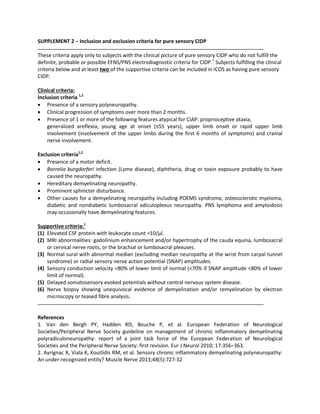
SUPPLEMENT 2 – Inclusion and exclusion criteria for pure sensory CIDP
These criteria apply only to subjects with the clinical picture of pure sensory CIDP who do not fulfill the
definite, probable or possible EFNS/PNS electrodiagnostic criteria for CIDP.1
Subjects fulfilling the clinical
criteria below and at least two of the supportive criteria can be included in ICOS as having pure sensory
CIDP.
Clinical criteria:
Inclusion criteria 1,2
• Presence of a sensory polyneuropathy.
• Clinical progression of symptoms over more than 2 months.
• Presence of 1 or more of the following features atypical for CIAP: proprioceptive ataxia,
generalized areflexia, young age at onset (≤55 years), upper limb onset or rapid upper limb
involvement (involvement of the upper limbs during the first 6 months of symptoms) and cranial
nerve involvement.
Exclusion criteria1,2
• Presence of a motor deficit.
• Borrelia burgdorferi infection (Lyme disease), diphtheria, drug or toxin exposure probably to have
caused the neuropathy.
• Hereditary demyelinating neuropathy.
• Prominent sphincter disturbance.
• Other causes for a demyelinating neuropathy including POEMS syndrome, osteosclerotic myeloma,
diabetic and nondiabetic lumbosacral adiculoplexus neuropathy. PNS lymphoma and amyloidosis
may occasionally have demyelinating features.
Supportive criteria:1
(1) Elevated CSF protein with leukocyte count <10/μl.
(2) MRI abnormalities: gadolinium enhancement and/or hypertrophy of the cauda equina, lumbosacral
or cervical nerve roots, or the brachial or lumbosacral plexuses.
(3) Normal sural with abnormal median (excluding median neuropathy at the wrist from carpal tunnel
syndrome) or radial sensory nerve action potential (SNAP) amplitudes.
(4) Sensory conduction velocity <80% of lower limit of normal (<70% if SNAP amplitude <80% of lower
limit of normal).
(5) Delayed somatosensory evoked potentials without central nervous system disease.
(6) Nerve biopsy showing unequivocal evidence of demyelination and/or remyelination by electron
microscopy or teased fibre analysis.
References
1. Van den Bergh PY, Hadden RD, Bouche P, et al. European Federation of Neurological
Societies/Peripheral Nerve Society guideline on management of chronic inflammatory demyelinating
polyradiculoneuropathy: report of a joint task force of the European Federation of Neurological
Societies and the Peripheral Nerve Society: first revision. Eur J Neurol 2010; 17:356–363.
2. Ayrignac X, Viala K, Koutlidis RM, et al. Sensory chronic inflammatory demyelinating polyneuropathy:
An under-recognized entity? Muscle Nerve 2013;48(5):727-32

Cidp diagnostic criteria

  • 1.
    SUPPLEMENT 1 –EFNS/PNS diagnostic criteria for CIDP Three categories of patients are eligible for the ICOS: a. Subjects fulfilling the clinical criteria and the definite, probable or possible electrophysiological criteria defined in Supplement 1. b. Subject fulfilling the clinical criteria and at least two supportive criteria defined in Supplement 1. c. Subjects fulfilling the clinical criteria for pure sensory CIDP and at least two supportive criteria defined in Supplement 2 (if not fulfilling the electrophysiological criteria). Clinical criteria: Inclusion criteria (a) Typical CIDP • Chronically progressive, stepwise, or recurrent symmetric proximal and distal weakness and sensory dysfunction of all extremities. • Developing over at least 2 months. • Absent or reduced tendon reflexes in all extremities. (b) Atypical CIDP One of the following, but otherwise as in (a) (tendon reflexes may be normal in unaffected limbs): • Predominantly distal (distal acquired demyelinating symmetric, DADS) or • Asymmetric (multifocal acquired demyelinating sensory motor neuropathy, MADSAM) or • Lewis-Sumner syndrome or • Focal (e.g., involvement of the brachial or lumbosacral plexus or of one or more peripheral nerves in one upper or lower limb) or • Pure motor or • Pure sensory (including chronic immune sensory polyradiculopathy affecting the central process of the primary sensory neuron). Exclusion criteria • Borrelia burgdorferi infection (Lyme disease), diphtheria, drug or toxin exposure probably to have caused the neuropathy. • Hereditary demyelinating neuropathy. • Prominent sphincter disturbance. • Diagnosis of multifocal motor neuropathy. • Other causes for a demyelinating neuropathy including POEMS syndrome, osteosclerotic myeloma, diabetic and nondiabetic lumbosacral radiculoplexus neuropathy. PNS lymphoma and amyloidosis may occasionally have demyelinating features. Electrophysiological criteria: Definite: At least one of the following: (a) Motor distal latency prolongation ≥50% above ULN in two nerves (excluding median neuropathy at the wrist from carpal tunnel syndrome), or (b) Reduction of motor conduction velocity ≥30% below LLN in two nerves, or (c) Prolongation of F-wave latency ≥30% above ULN in two nerves (≥50% if amplitude of distal negative peak CMAP <80% of LLN values), or (d) Absence of F-waves in two nerves if these nerves have distal negative peak CMAP amplitudes ≥20% of LLN + ≥1 other demyelinating parameter in ≥1 other nerve, or
  • 2.
    (e) Partial motorconduction block: ≥50% amplitude reduction of the proximal negative peak CMAP relative to distal, if distal negative peak CMAP ≥ 20% of LLN, in two nerves, or in one nerve + ≥1 other demyelinating parameter in ≥1 other nerve, or (f) Abnormal temporal dispersion (>30% duration increase between the proximal and distal negative peak CMAP) in ≥2 nerves, or (g) Distal CMAP duration (interval between onset of the first negative peak and return to baseline of the last negative peak) increase in ≥1 nerve (median ≥ 6.6 ms, ulnar ≥ 6.7 ms, peroneal ≥ 7.6 ms, tibial ≥ 8.8 ms) + ≥1 other demyelinating parameter in ≥1 other nerve. Probable: • ≥30% amplitude reduction of the proximal negative peak CMAP relative to distal, excluding the posterior tibial nerve, if distal negative peak CMAP ≥ 20% of LLN, in two nerves, or in one nerve + ≥1 other demyelinating parameter in ≥1 other nerve. Possible: • As in “definite” but in only one nerve. CMAP= compound muscle action potential; ULN= upper limit of normal values; LLN= lower limit of normal values. Motor conduction block is not considered in the ulnar nerve across the elbow and at least 50% amplitude reduction between Erb’s point and the wrist is required for probable conduction block. Temperatures should be maintained to at least 33 0 C at the palm and 30 0 C at the external malleolus. Supportive criteria: (1) Elevated CSF protein with leukocyte count <10/μl. (2) MRI abnormalities: gadolinium enhancement and/or hypertrophy of the cauda equina, lumbosacral or cervical nerve roots, or the brachial or lumbosacral plexuses. (3) Normal sural with abnormal median (excluding median neuropathy at the wrist from carpal tunnel syndrome) or radial sensory nerve action potential (SNAP) amplitudes. (4) Sensory conduction velocity <80% of lower limit of normal (<70% if SNAP amplitude <80% of lower limit of normal). (5) Delayed somatosensory evoked potentials without central nervous system disease. (6) Nerve biopsy showing unequivocal evidence of demyelination and/or remyelination by electron microscopy or teased fibre analysis. Reference Joint Task Force of the EFNS and the PNS. European Federation of Neurological Societies/Peripheral Nerve Society Guideline on management of chronic inflammatory demyelinating polyradiculoneuropathy. Report of a joint task force of the European Federation of Neurological Societies and the Peripheral Nerve Society. Eur J Neurol 2010; 17: 356–363.
  • 3.
    SUPPLEMENT 2 –Inclusion and exclusion criteria for pure sensory CIDP These criteria apply only to subjects with the clinical picture of pure sensory CIDP who do not fulfill the definite, probable or possible EFNS/PNS electrodiagnostic criteria for CIDP.1 Subjects fulfilling the clinical criteria below and at least two of the supportive criteria can be included in ICOS as having pure sensory CIDP. Clinical criteria: Inclusion criteria 1,2 • Presence of a sensory polyneuropathy. • Clinical progression of symptoms over more than 2 months. • Presence of 1 or more of the following features atypical for CIAP: proprioceptive ataxia, generalized areflexia, young age at onset (≤55 years), upper limb onset or rapid upper limb involvement (involvement of the upper limbs during the first 6 months of symptoms) and cranial nerve involvement. Exclusion criteria1,2 • Presence of a motor deficit. • Borrelia burgdorferi infection (Lyme disease), diphtheria, drug or toxin exposure probably to have caused the neuropathy. • Hereditary demyelinating neuropathy. • Prominent sphincter disturbance. • Other causes for a demyelinating neuropathy including POEMS syndrome, osteosclerotic myeloma, diabetic and nondiabetic lumbosacral adiculoplexus neuropathy. PNS lymphoma and amyloidosis may occasionally have demyelinating features. Supportive criteria:1 (1) Elevated CSF protein with leukocyte count <10/μl. (2) MRI abnormalities: gadolinium enhancement and/or hypertrophy of the cauda equina, lumbosacral or cervical nerve roots, or the brachial or lumbosacral plexuses. (3) Normal sural with abnormal median (excluding median neuropathy at the wrist from carpal tunnel syndrome) or radial sensory nerve action potential (SNAP) amplitudes. (4) Sensory conduction velocity <80% of lower limit of normal (<70% if SNAP amplitude <80% of lower limit of normal). (5) Delayed somatosensory evoked potentials without central nervous system disease. (6) Nerve biopsy showing unequivocal evidence of demyelination and/or remyelination by electron microscopy or teased fibre analysis. References 1. Van den Bergh PY, Hadden RD, Bouche P, et al. European Federation of Neurological Societies/Peripheral Nerve Society guideline on management of chronic inflammatory demyelinating polyradiculoneuropathy: report of a joint task force of the European Federation of Neurological Societies and the Peripheral Nerve Society: first revision. Eur J Neurol 2010; 17:356–363. 2. Ayrignac X, Viala K, Koutlidis RM, et al. Sensory chronic inflammatory demyelinating polyneuropathy: An under-recognized entity? Muscle Nerve 2013;48(5):727-32