Presentation
on
Scramjet Engines
By
Ishan K Patel
BTech-Aerospace Eng.(Vth Sem)
A50105513008
What is A Scramjet Engine?
• A scramjet (supersonic combustion ramjet) engine is variant of a ramjet air
breathing combustion jet engine in which the combustion process takes place in
supersonic airflow.
• As in ramjet, a scramjet relies on high vehicle speed to forcefully compress and
decelerate the incoming air before combustion (hence called ramjet), but
whereas a ramjet decelerates the air to subsonic velocities before combustion,
airflow in a scramjet is supersonic throughout the entire engine.
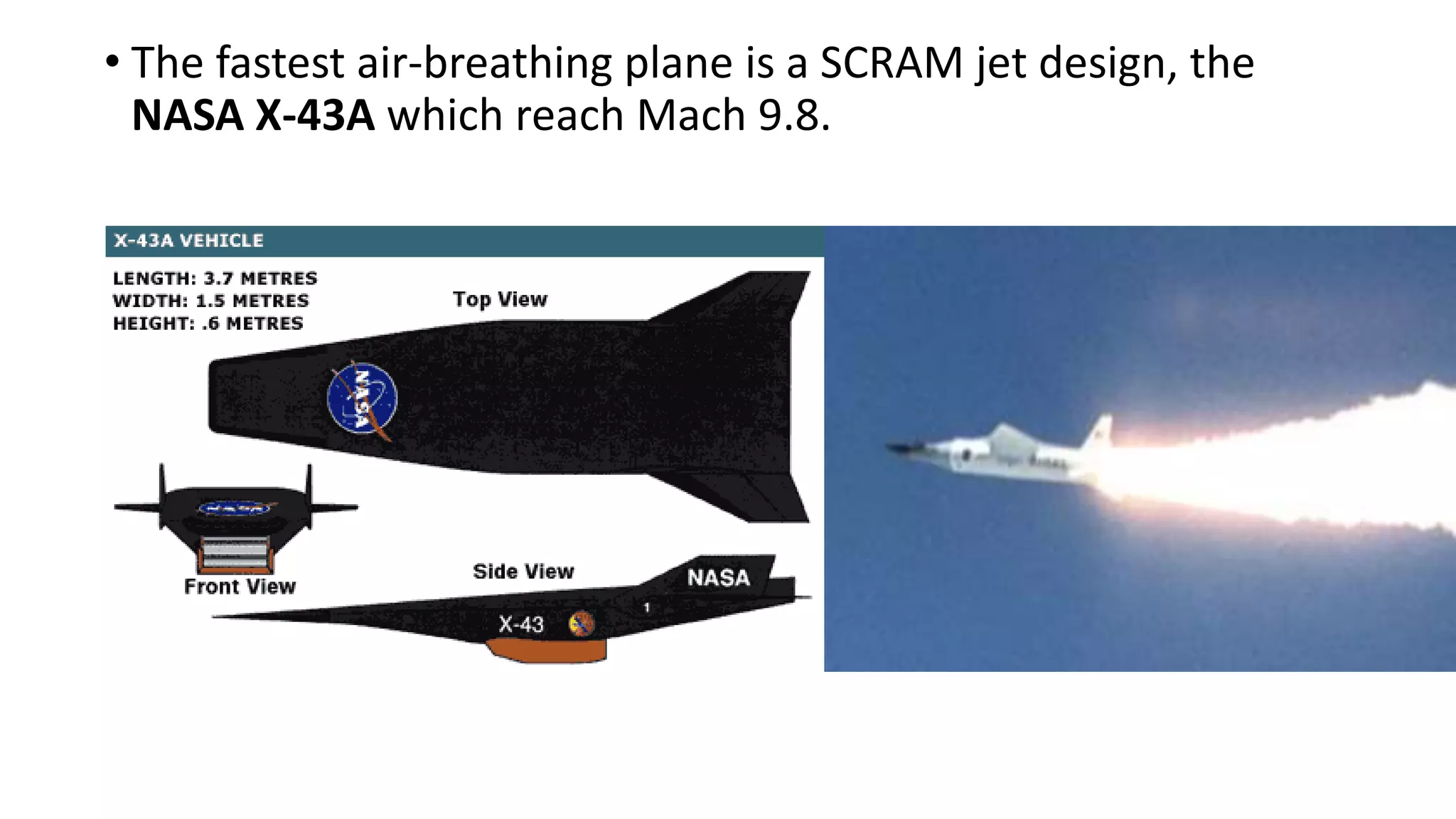
• The fastest air-breathing plane is a SCRAM jet design, the
NASA X-43A which reach Mach 9.8.
COMPONENTS OF SCRAMJET ENGINE
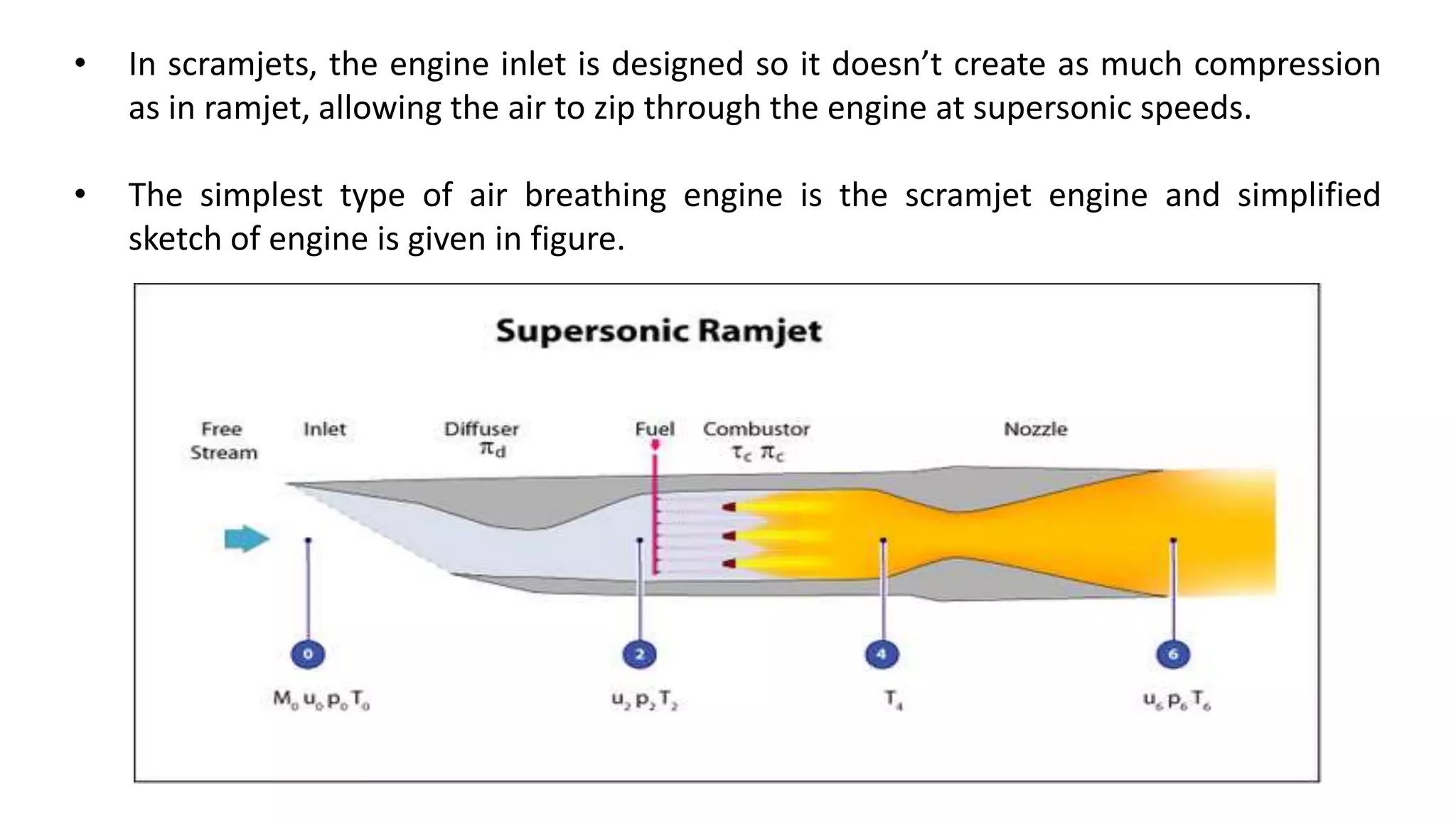
The scramjet is composed of three basic components :
1) A Converging Inlet, where incoming air is compressed and
decelerated.
2) A Combustor, where gaseous fuel is burned with atmospheric
oxygen to produce heat.
3) A Diverging Nozzle, where the heated air is accelerated to produce
thrust.
• In scramjets, the engine inlet is designed so it doesn’t create as much compression
as in ramjet, allowing the air to zip through the engine at supersonic speeds.
• The simplest type of air breathing engine is the scramjet engine and simplified
sketch of engine is given in figure.
PRINCIPLE OF WORKING
• Scramjets works on the same principle of ramjet.
• All the operations done by the varying cross section of passages.
• There are inlet passage, diffuser passage, combustion passage and
exhaust passage.
• Basically in order to achieve the initial speed, a second engine is
integrated in the Scramjet model, it may be rocket or turbojet engine.
PRINCIPLE OF WORKING (Cont.)
• As these are air breathing engines, air from the atmosphere enters at very
high speed in the inlet passage.
• In case of a scramjet the diffuser is merged with inlet.
• Hence the air from the atmosphere enters in the inlet section having very
high velocity reduced in diffuser section; thereby its static pressure
increases.
• Temperature of air also increases when passing through the narrow cross
section towards the combustion chamber.
PRINCIPLE OF WORKING
• Hot air flows in the combustion chamber and at this moment the
propellant i.e. hydrogen (having a very low ignition temperature) are
injected by the injector in the combustor, where it gets self ignited
within a millisecond and the combustion process is carried out at
supersonic speed.
• The fresh air supply to the diffuser builds up a pressure at the diffuser
so that these burned gases cannot expand towards the diffuser.
Instead the gases are made expand in combustor towards tail engine
hence providing the required thrust.
ADVANTAGES
• Does not have to carry oxygen.
• No rotating parts, makes it easier to manufacture.
• Less weight and simple design.
• As the hydrogen is used as a propellant combustion is carried out at
supersonic velocity with the help of oxygen from the atmosphere. As
a result of that, steam is being exhaust gas which is eco-friendly in
nature.
DISADVANTAGES
• A scramjet cannot produce efficient thrust unless boosted to high
speed, around Mach 5.
• As a result an additional propulsion systems are required.
• Lack of stealth.
• Testing difficulties.
RECENT DEVELOPMENTS
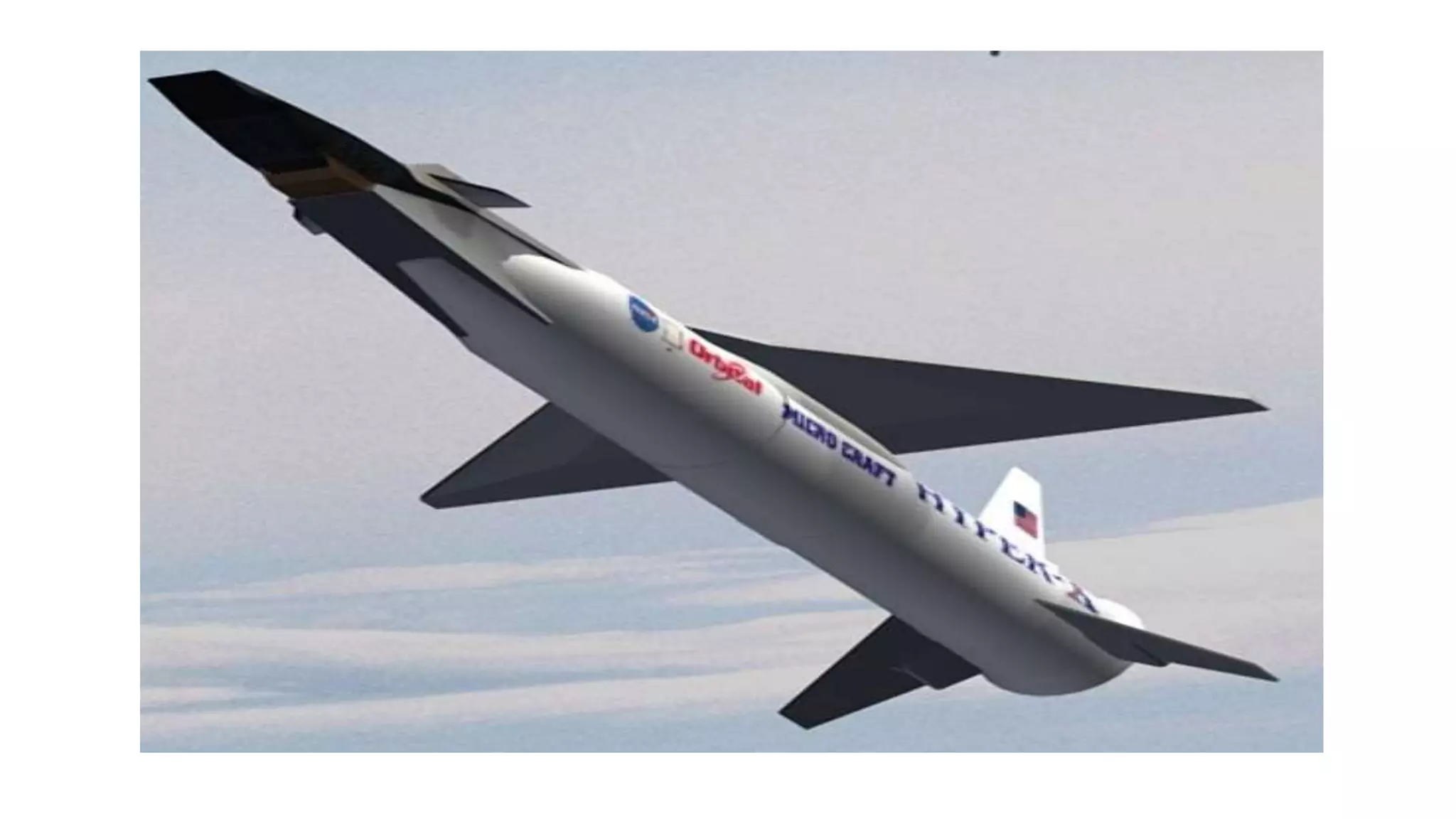
• Hyper-X “Scramjet”
A new program, called Hyper-X, was launched by NASA in 1997. The goal is to
build working jet airplanes that use a clever combination of ramjet, scramjet,
and rocket engines to reach sufficient speeds to achieve orbit around the earth.
These planes would be conventional rocket engines to get started and then
switch over to ramjet power at Mach 2 or 3, and then scramjet power at about
Mach 5.
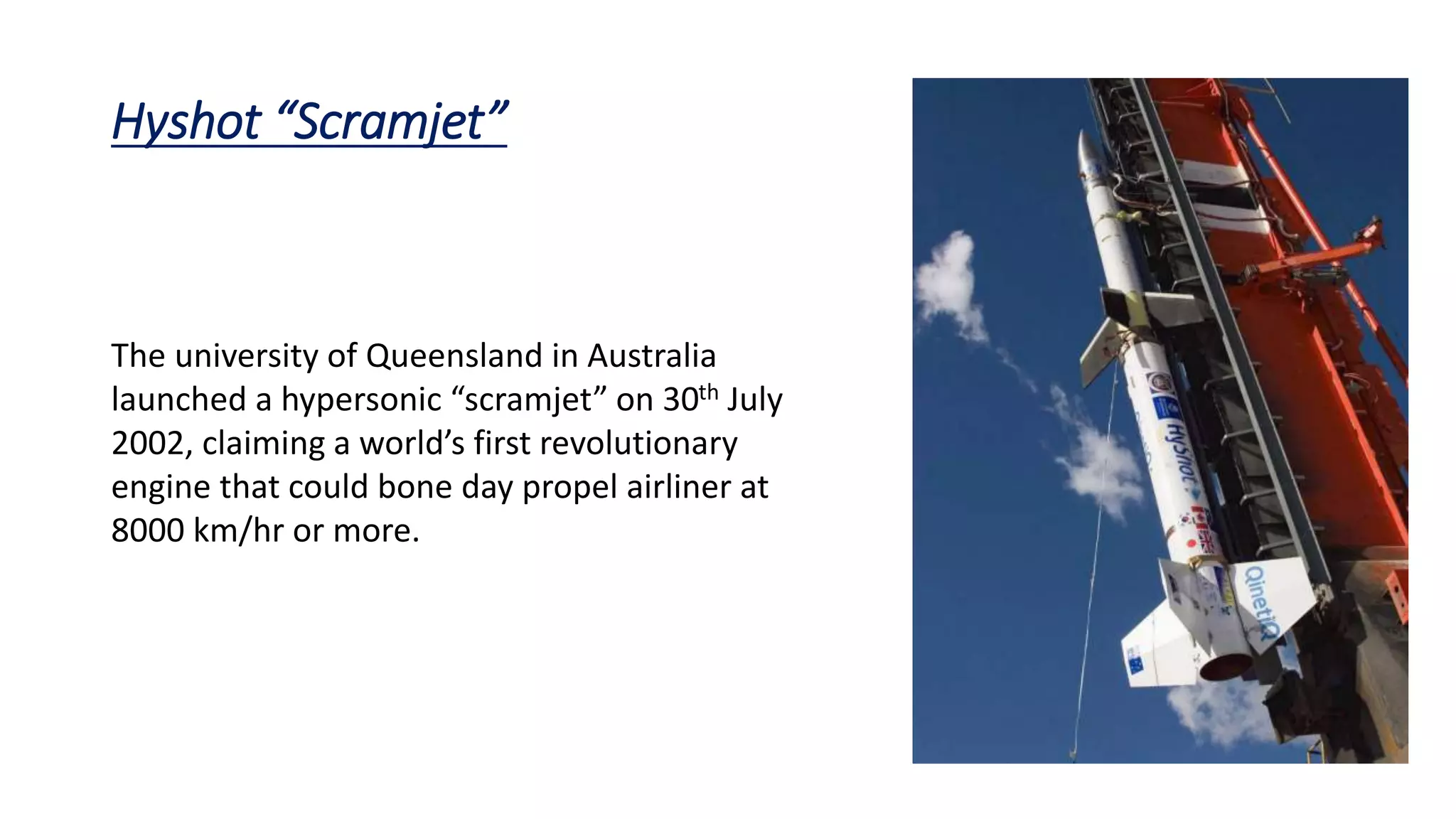
Hyshot “Scramjet”
The university of Queensland in Australia
launched a hypersonic “scramjet” on 30th July
2002, claiming a world’s first revolutionary
engine that could bone day propel airliner at
8000 km/hr or more.
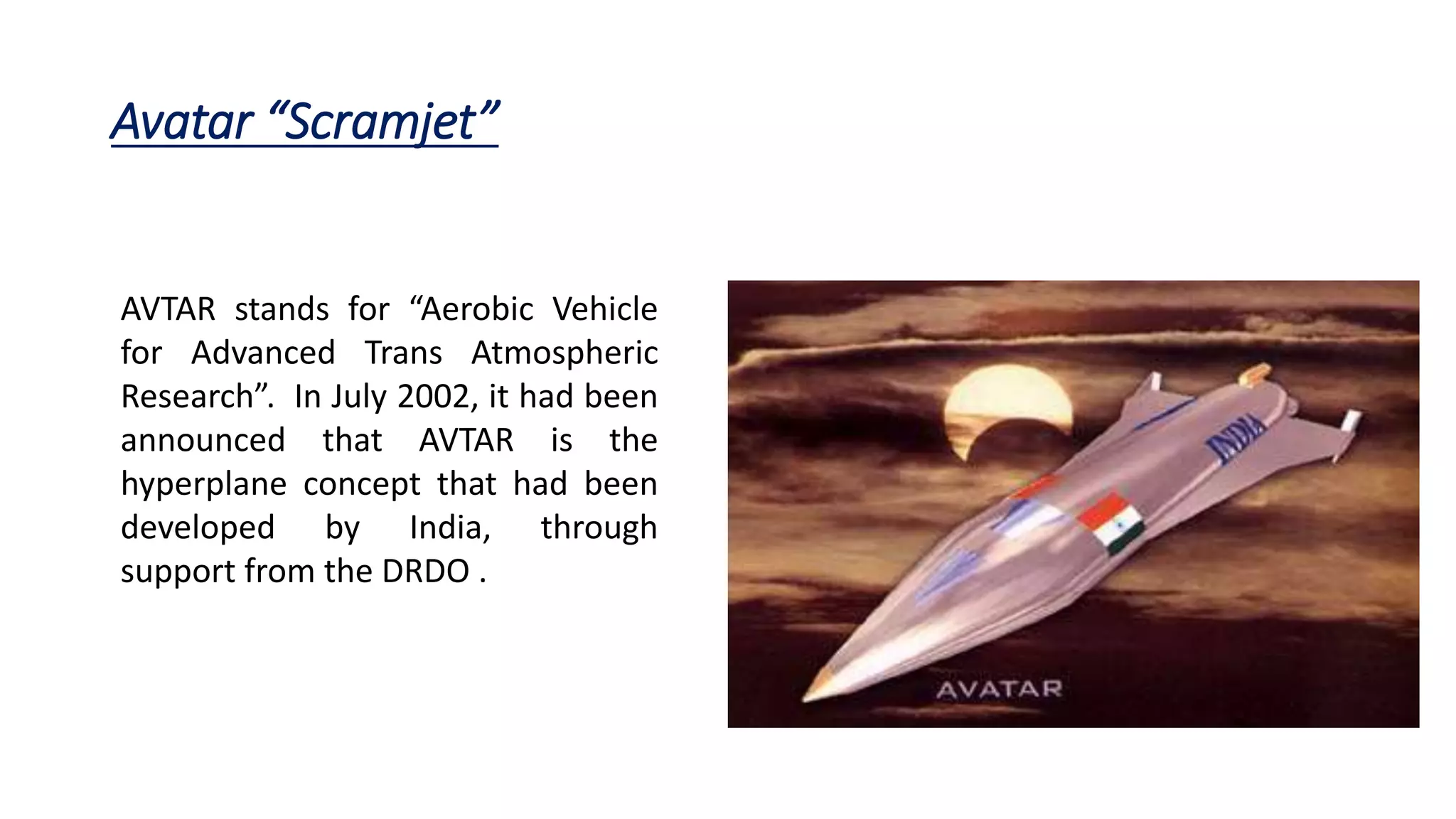
Avatar “Scramjet”
AVTAR stands for “Aerobic Vehicle
for Advanced Trans Atmospheric
Research”. In July 2002, it had been
announced that AVTAR is the
hyperplane concept that had been
developed by India, through
support from the DRDO .

A Brief Intro to Scramjet Engines

  • 1.
    Presentation on Scramjet Engines By Ishan KPatel BTech-Aerospace Eng.(Vth Sem) A50105513008
  • 2.
    What is AScramjet Engine? • A scramjet (supersonic combustion ramjet) engine is variant of a ramjet air breathing combustion jet engine in which the combustion process takes place in supersonic airflow. • As in ramjet, a scramjet relies on high vehicle speed to forcefully compress and decelerate the incoming air before combustion (hence called ramjet), but whereas a ramjet decelerates the air to subsonic velocities before combustion, airflow in a scramjet is supersonic throughout the entire engine.
  • 3.
    • The fastestair-breathing plane is a SCRAM jet design, the NASA X-43A which reach Mach 9.8.
  • 4.
    COMPONENTS OF SCRAMJETENGINE The scramjet is composed of three basic components : 1) A Converging Inlet, where incoming air is compressed and decelerated. 2) A Combustor, where gaseous fuel is burned with atmospheric oxygen to produce heat. 3) A Diverging Nozzle, where the heated air is accelerated to produce thrust.
  • 5.
    • In scramjets,the engine inlet is designed so it doesn’t create as much compression as in ramjet, allowing the air to zip through the engine at supersonic speeds. • The simplest type of air breathing engine is the scramjet engine and simplified sketch of engine is given in figure.
  • 6.
    PRINCIPLE OF WORKING •Scramjets works on the same principle of ramjet. • All the operations done by the varying cross section of passages. • There are inlet passage, diffuser passage, combustion passage and exhaust passage. • Basically in order to achieve the initial speed, a second engine is integrated in the Scramjet model, it may be rocket or turbojet engine.
  • 7.
    PRINCIPLE OF WORKING(Cont.) • As these are air breathing engines, air from the atmosphere enters at very high speed in the inlet passage. • In case of a scramjet the diffuser is merged with inlet. • Hence the air from the atmosphere enters in the inlet section having very high velocity reduced in diffuser section; thereby its static pressure increases. • Temperature of air also increases when passing through the narrow cross section towards the combustion chamber.
  • 8.
    PRINCIPLE OF WORKING •Hot air flows in the combustion chamber and at this moment the propellant i.e. hydrogen (having a very low ignition temperature) are injected by the injector in the combustor, where it gets self ignited within a millisecond and the combustion process is carried out at supersonic speed. • The fresh air supply to the diffuser builds up a pressure at the diffuser so that these burned gases cannot expand towards the diffuser. Instead the gases are made expand in combustor towards tail engine hence providing the required thrust.
  • 9.
    ADVANTAGES • Does nothave to carry oxygen. • No rotating parts, makes it easier to manufacture. • Less weight and simple design. • As the hydrogen is used as a propellant combustion is carried out at supersonic velocity with the help of oxygen from the atmosphere. As a result of that, steam is being exhaust gas which is eco-friendly in nature.
  • 10.
    DISADVANTAGES • A scramjetcannot produce efficient thrust unless boosted to high speed, around Mach 5. • As a result an additional propulsion systems are required. • Lack of stealth. • Testing difficulties.
  • 11.
    RECENT DEVELOPMENTS • Hyper-X“Scramjet” A new program, called Hyper-X, was launched by NASA in 1997. The goal is to build working jet airplanes that use a clever combination of ramjet, scramjet, and rocket engines to reach sufficient speeds to achieve orbit around the earth. These planes would be conventional rocket engines to get started and then switch over to ramjet power at Mach 2 or 3, and then scramjet power at about Mach 5.
  • 13.
    Hyshot “Scramjet” The universityof Queensland in Australia launched a hypersonic “scramjet” on 30th July 2002, claiming a world’s first revolutionary engine that could bone day propel airliner at 8000 km/hr or more.
  • 14.
    Avatar “Scramjet” AVTAR standsfor “Aerobic Vehicle for Advanced Trans Atmospheric Research”. In July 2002, it had been announced that AVTAR is the hyperplane concept that had been developed by India, through support from the DRDO .