NAME- SHUBHAM GUPTA
ROLL NO- 54
(ME) 3RD SEM
CONTENTS
Introduction
What is
scramjet
engine?
Components
principle of
working
Advantages Disadvantages
Applications Programmes
Recent
progress
Conclusion
INTRODUCTION
• Rockets combine a liquid fuel with liquid oxygen to create
thrust.
• If the need for liquid oxygen is taken away, spacecraft can be
smaller or carry more payloads.
• This is the concept behind a different propulsion system called
“scramjet” or “super sonic combustion ramjet”.
WHAT IS A SCRAMJET ENGINE?
• A Scramjet (supersonic combustion ramjet) is a
variant of a ramjet air breathing combustion jet
engine in which the combustion process takes place
in supersonic airflow.
• As in ramjets, a scramjet relies on high vehicle
speed to forcefully compress and decelerates the
incoming air before combustion (hence ramjet), but
whereas a ramjet decelerates the air to subsonic
throughout the entire engine.
• The theoretical projections place top speed of
scram between Mach 12 and Mach 24, which is
near orbital velocity.
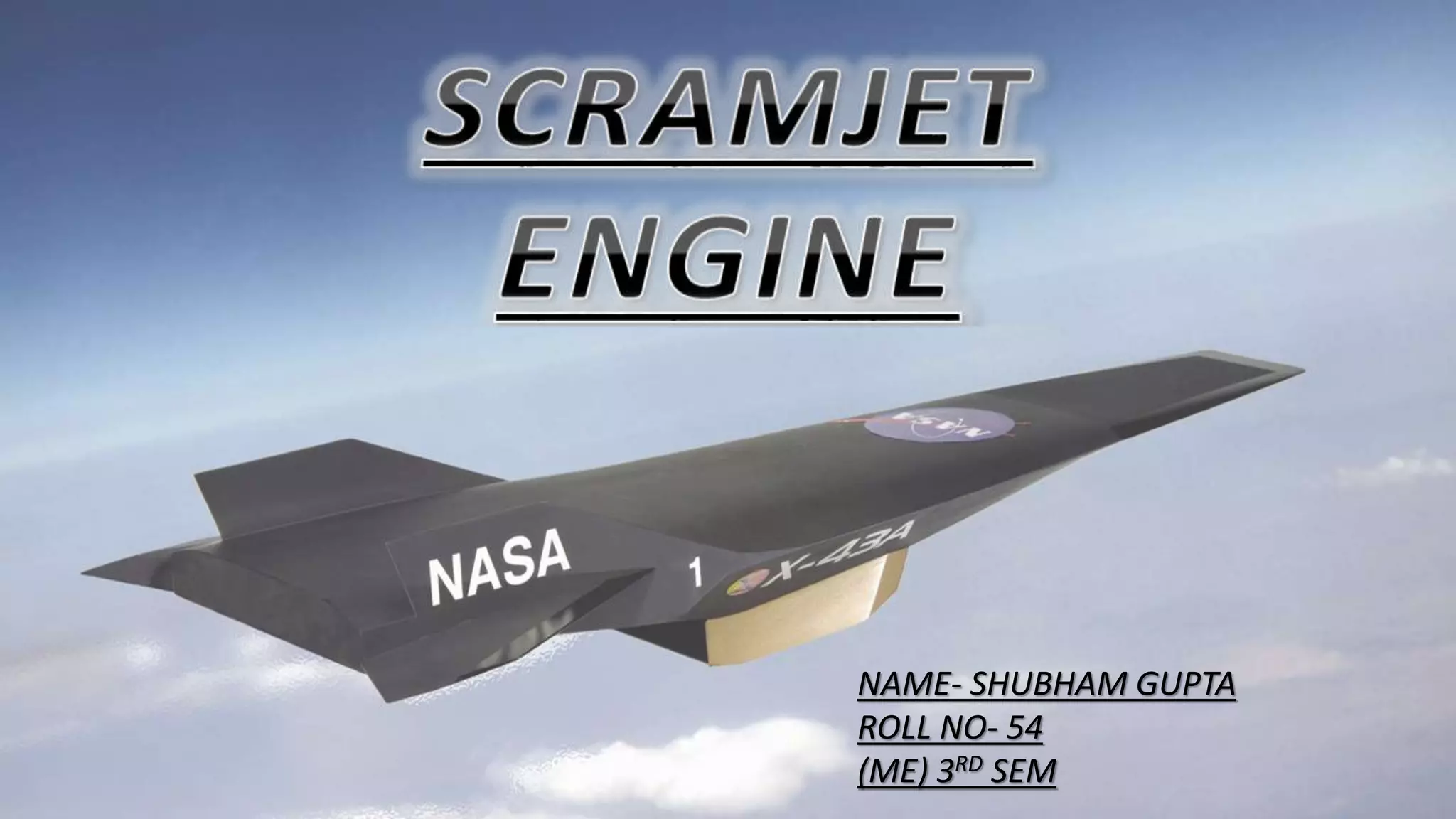
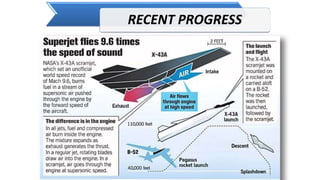
• The fastest air-breathing plane is a SCRAMJET
design, the NASA X-43a which reached Mach 9.6 or
12,144 km/h, on 16 Nov 2004.
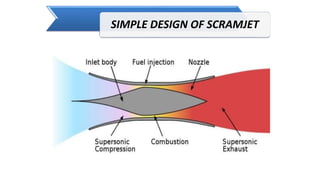
COMPONENTS OF SCRAMJET ENGINE
The Scramjet is composed of three basic
components:
1) A CONVERGING INLET, where incoming air is
compressed and decelerates.
2) A COMBUSTER, where gaseous fuel is burned with
atmospheric oxygen to produce heat.
3) A DIVERGING NOZZLE, where the heated air is
accelerated to produce thrust.
SIMPLE DESIGN OF SCRAMJET
PRINCIPLE OF WORKING
 Scramjets also works on the principle of ramjets.
 Basically in order to achieve the initial speed, a
second engine is integrated in the scramjet model,
it may be rocket or turbojet engine.
 Air from the atmosphere enters at very high speed
in the inlet passage.
Hence, the air from the atmosphere enters in the
inlet section having very high velocity is reduced in
diffuser section; thereby its static pressure
increases.
Temperature of air increases when passing through
the narrow cross section towards combustion
chamber.
Hot air flows in the combustion chamber and at this
moment the propellant i.e. hydrogen (having a very
low ignition temperature) are injected by the
injector in the combustor.
Where it gets self ignited within a millisecond and
the combustion process is carried out at the
supersonic speed.
The fresh air supply to the diffuser builds up a
pressure at the diffuser so that these burned gases
cannot expand towards the diffuser.
Instead, the gases are made expand in combustor
towards tail engine hence providing the required
thrust.
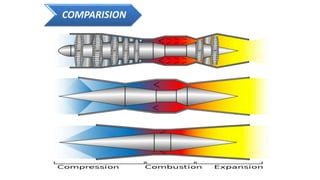
COMPARISION
ADVANTAGES
Does not have to carry oxygen tank.
No rotating parts makes it easier to manufacture.
Less weight and simple design.
As the hydrogen is used as a propellant and
combustion is carried out at supersonic velocity
with the help of oxygen from the atmosphere.
 As a result of that, steam (H2O) is being exhaust
gas which is eco-friendly in nature.
DISADVANTAGES
A Scramjet cannot produce efficient thrust unless
boosted to high speed, around Mach 5.
As a result an additional propulsion systems are
required.
Lack of stealth.
Testing difficulties.
APPLICATIONS
CIVIL APPLICATIONS:-
Scramjet speed could reach 15 times the
speed of sound .
An aircraft using this type of jet engine could
dramatically reduce the time it takes to travel from
one place to another, potentially putting any place
on earth within a 90 minutes flight, i.e. an 18 hour
trip to Tokyo from New York City becomes a 2 hour
flight.
TUPOLEV TU-144 (CHARGER)
“Tupolev tu-144 (charger)” was
the 1st commercial supersonic
Aircraft.
• Introduction- 26 Dec 1975
• Highest speed- 2430 km/hr
• Retired- 1 Jun 1978
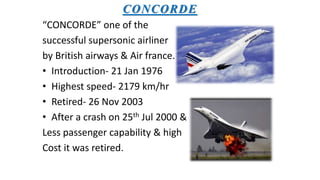
CONCORDE
“CONCORDE” one of the
successful supersonic airliner
by British airways & Air france.
• Introduction- 21 Jan 1976
• Highest speed- 2179 km/hr
• Retired- 26 Nov 2003
• After a crash on 25th Jul 2000 &
Less passenger capability & high
Cost it was retired.
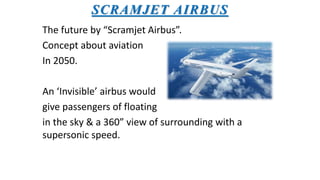
SCRAMJET AIRBUS
The future by “Scramjet Airbus”.
Concept about aviation
In 2050.
An ‘Invisible’ airbus would
give passengers of floating
in the sky & a 360” view of surrounding with a
supersonic speed.
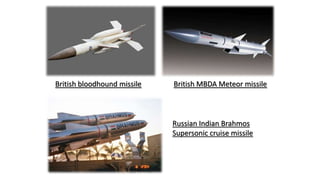
MILITARY APPLICATION:-
Scramjet can be used to propel missiles.
Currently used scramjet propelled missiles are:-
1) British bloodhound surface to air missile.
2) British MBDA Meteor air to air missile.
3) Russian Indian Brahmos Supersonic cruise missile.
British bloodhound missile British MBDA Meteor missile
Russian Indian Brahmos
Supersonic cruise missile
RECENT PROGRESS
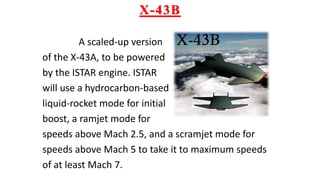
X-43B
A scaled-up version
of the X-43A, to be powered
by the ISTAR engine. ISTAR
will use a hydrocarbon-based
liquid-rocket mode for initial
boost, a ramjet mode for
speeds above Mach 2.5, and a scramjet mode for
speeds above Mach 5 to take it to maximum speeds
of at least Mach 7.
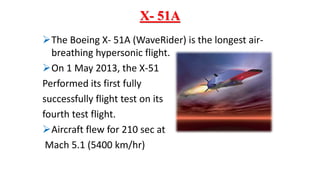
X- 51A
The Boeing X- 51A (WaveRider) is the longest air-
breathing hypersonic flight.
On 1 May 2013, the X-51
Performed its first fully
successfully flight test on its
fourth test flight.
Aircraft flew for 210 sec at
Mach 5.1 (5400 km/hr)
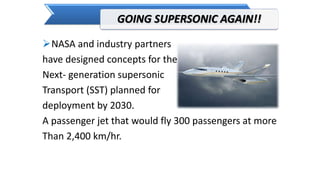
GOING SUPERSONIC AGAIN!!
NASA and industry partners
have designed concepts for the
Next- generation supersonic
Transport (SST) planned for
deployment by 2030.
A passenger jet that would fly 300 passengers at more
Than 2,400 km/hr.
CONCLUSION
Scramjet programme is a fast developing field in the
present world.
There are many application with scramjet. It
provides a cheaper and efficient access to space.
Scramjet has the potential for supersonic or
hypersonic transportation.
Scramjet technologies are also used for advanced
military applications.
REFERENCES
 www.wikipedia.org/wiki/scramjet
 www.scramjet.com
 www.nasa.com
 www.aerospaceweb.org
 Aircraft and missile propulsion- M J ZUCROW, JOHN
WILLY
 Hypersonic Air breathing propulsion- WH HEISER,
DT PRATT
“THANK YOU”

Scramjet engine

  • 1.
    NAME- SHUBHAM GUPTA ROLLNO- 54 (ME) 3RD SEM
  • 2.
    CONTENTS Introduction What is scramjet engine? Components principle of working AdvantagesDisadvantages Applications Programmes Recent progress Conclusion
  • 3.
    INTRODUCTION • Rockets combinea liquid fuel with liquid oxygen to create thrust. • If the need for liquid oxygen is taken away, spacecraft can be smaller or carry more payloads. • This is the concept behind a different propulsion system called “scramjet” or “super sonic combustion ramjet”.
  • 4.
    WHAT IS ASCRAMJET ENGINE? • A Scramjet (supersonic combustion ramjet) is a variant of a ramjet air breathing combustion jet engine in which the combustion process takes place in supersonic airflow. • As in ramjets, a scramjet relies on high vehicle speed to forcefully compress and decelerates the incoming air before combustion (hence ramjet), but whereas a ramjet decelerates the air to subsonic throughout the entire engine.
  • 5.
    • The theoreticalprojections place top speed of scram between Mach 12 and Mach 24, which is near orbital velocity. • The fastest air-breathing plane is a SCRAMJET design, the NASA X-43a which reached Mach 9.6 or 12,144 km/h, on 16 Nov 2004.
  • 6.
    COMPONENTS OF SCRAMJETENGINE The Scramjet is composed of three basic components: 1) A CONVERGING INLET, where incoming air is compressed and decelerates. 2) A COMBUSTER, where gaseous fuel is burned with atmospheric oxygen to produce heat. 3) A DIVERGING NOZZLE, where the heated air is accelerated to produce thrust.
  • 7.
  • 8.
    PRINCIPLE OF WORKING Scramjets also works on the principle of ramjets.  Basically in order to achieve the initial speed, a second engine is integrated in the scramjet model, it may be rocket or turbojet engine.  Air from the atmosphere enters at very high speed in the inlet passage.
  • 9.
    Hence, the airfrom the atmosphere enters in the inlet section having very high velocity is reduced in diffuser section; thereby its static pressure increases. Temperature of air increases when passing through the narrow cross section towards combustion chamber. Hot air flows in the combustion chamber and at this moment the propellant i.e. hydrogen (having a very low ignition temperature) are injected by the injector in the combustor.
  • 10.
    Where it getsself ignited within a millisecond and the combustion process is carried out at the supersonic speed. The fresh air supply to the diffuser builds up a pressure at the diffuser so that these burned gases cannot expand towards the diffuser. Instead, the gases are made expand in combustor towards tail engine hence providing the required thrust.
  • 12.
  • 13.
    ADVANTAGES Does not haveto carry oxygen tank. No rotating parts makes it easier to manufacture. Less weight and simple design. As the hydrogen is used as a propellant and combustion is carried out at supersonic velocity with the help of oxygen from the atmosphere.  As a result of that, steam (H2O) is being exhaust gas which is eco-friendly in nature.
  • 14.
    DISADVANTAGES A Scramjet cannotproduce efficient thrust unless boosted to high speed, around Mach 5. As a result an additional propulsion systems are required. Lack of stealth. Testing difficulties.
  • 15.
    APPLICATIONS CIVIL APPLICATIONS:- Scramjet speedcould reach 15 times the speed of sound . An aircraft using this type of jet engine could dramatically reduce the time it takes to travel from one place to another, potentially putting any place on earth within a 90 minutes flight, i.e. an 18 hour trip to Tokyo from New York City becomes a 2 hour flight.
  • 16.
    TUPOLEV TU-144 (CHARGER) “Tupolevtu-144 (charger)” was the 1st commercial supersonic Aircraft. • Introduction- 26 Dec 1975 • Highest speed- 2430 km/hr • Retired- 1 Jun 1978
  • 17.
    CONCORDE “CONCORDE” one ofthe successful supersonic airliner by British airways & Air france. • Introduction- 21 Jan 1976 • Highest speed- 2179 km/hr • Retired- 26 Nov 2003 • After a crash on 25th Jul 2000 & Less passenger capability & high Cost it was retired.
  • 18.
    SCRAMJET AIRBUS The futureby “Scramjet Airbus”. Concept about aviation In 2050. An ‘Invisible’ airbus would give passengers of floating in the sky & a 360” view of surrounding with a supersonic speed.
  • 19.
    MILITARY APPLICATION:- Scramjet canbe used to propel missiles. Currently used scramjet propelled missiles are:- 1) British bloodhound surface to air missile. 2) British MBDA Meteor air to air missile. 3) Russian Indian Brahmos Supersonic cruise missile.
  • 20.
    British bloodhound missileBritish MBDA Meteor missile Russian Indian Brahmos Supersonic cruise missile
  • 21.
  • 22.
    X-43B A scaled-up version ofthe X-43A, to be powered by the ISTAR engine. ISTAR will use a hydrocarbon-based liquid-rocket mode for initial boost, a ramjet mode for speeds above Mach 2.5, and a scramjet mode for speeds above Mach 5 to take it to maximum speeds of at least Mach 7.
  • 23.
    X- 51A The BoeingX- 51A (WaveRider) is the longest air- breathing hypersonic flight. On 1 May 2013, the X-51 Performed its first fully successfully flight test on its fourth test flight. Aircraft flew for 210 sec at Mach 5.1 (5400 km/hr)
  • 24.
    GOING SUPERSONIC AGAIN!! NASAand industry partners have designed concepts for the Next- generation supersonic Transport (SST) planned for deployment by 2030. A passenger jet that would fly 300 passengers at more Than 2,400 km/hr.
  • 25.
    CONCLUSION Scramjet programme isa fast developing field in the present world. There are many application with scramjet. It provides a cheaper and efficient access to space. Scramjet has the potential for supersonic or hypersonic transportation. Scramjet technologies are also used for advanced military applications.
  • 26.
    REFERENCES  www.wikipedia.org/wiki/scramjet  www.scramjet.com www.nasa.com  www.aerospaceweb.org  Aircraft and missile propulsion- M J ZUCROW, JOHN WILLY  Hypersonic Air breathing propulsion- WH HEISER, DT PRATT
  • 27.