A Seminar Presentation on :
SCRAMJET ENGINE
Presented By: Under The Guidance Of:
Saurav Ranjan Mishra Prof. S.K.Sahu
Regd no:1101292307
Mechanical- B
Contents
 Introduction
 History
 Progress of Scramjet Engine
 Designing Principle
 Working Principle
 Engine Efficiency
Advantage and Disadvantage
 Application
 References
Introduction
A Scramjet engine is a supersonic combusting ramjet
engine in which combustion takes place in a
supersonic airflow. Generally ramjet decelerates the air
to subsonic velocities before combustion, where as
airflow in a scramjet is supersonic throughout the entire
engine. This allows the scramjet to operate efficiently at
extremely high speeds.
Scramjet engines operate on the same principles as
ramjets, but do not decelerate the flow to subsonic
velocities. Rather, a scramjet combustor is supersonic
speed.
History
During World War II, a tremendous amount of time and
effort were put into researching high-speed jet engine
and rocket-powered aircraft, predominantly by the
Germans.
After the war, the US and UK took in several
German scientists and military technologies through
Operation to begin putting more emphasis on their own
weapons development, including jet engines.
In the 1950s and 1960s a variety of experimental
scramjet engines were built and ground tested in the US
and the UK.
Progress in 2000s
In 2000s, significant progress was made in the
development of hypersonic technology. In June 15, 2007,
the US Defense Advanced Research Project Agency
(DARPA), in cooperation with the Australian Defence
Science and Technology Organisation (DSTO),
announced a successful scramjet flight at Mach10 using
rocket engines to boost the test vehicle to hypersonic
speeds.
On 22 and 23 March 2010, Australian and American
defence scientists successfully tested a (HIFiRE)
hypersonic rocket. It reached an atmospheric velocity of
"more than 5,000 kilometres per hour.
Designing Principle
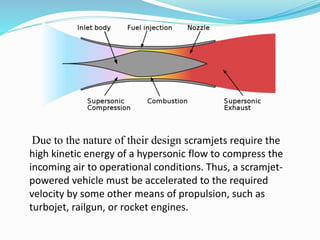
The scramjet is composed of three basic components
named as:
 A Converging inlet.
 A Combustor.
 A Diverging nozzle
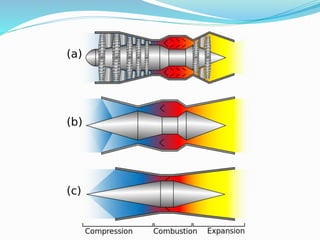
The function of converging inlet is to compress the
incoming air. Where inside the combustor
chamber gaseous fuel is burned with atmospheric
oxygen to produce heat and in the diverging nozzle,
the heated air is accelerated to produce thrust.
.
Due to the nature of their design scramjets require the
high kinetic energy of a hypersonic flow to compress the
incoming air to operational conditions. Thus, a scramjet-
powered vehicle must be accelerated to the required
velocity by some other means of propulsion, such as
turbojet, railgun, or rocket engines.
Working Principle
Scramjet engines are a type of jet engine, and rely on the
combustion of fuel and an oxidizer to produce thrust.
Similar to conventional jet engines, scramjet-powered
aircraft carry the fuel on board, and obtain the oxidizer by
the ingestion of atmospheric oxygen.
To keep the combustion rate of the fuel constant,
the pressure and temperature in the engine must also be
constant. Because air density reduces at higher altitudes,
a scramjet must climb at a specific rate as it accelerates
to maintain a constant air pressure at the intake
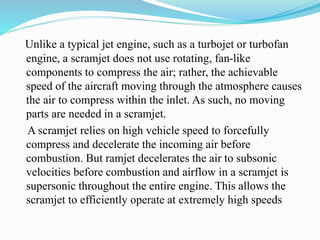
Unlike a typical jet engine, such as a turbojet or turbofan
engine, a scramjet does not use rotating, fan-like
components to compress the air; rather, the achievable
speed of the aircraft moving through the atmosphere causes
the air to compress within the inlet. As such, no moving
parts are needed in a scramjet.
A scramjet relies on high vehicle speed to forcefully
compress and decelerate the incoming air before
combustion. But ramjet decelerates the air to subsonic
velocities before combustion and airflow in a scramjet is
supersonic throughout the entire engine. This allows the
scramjet to efficiently operate at extremely high speeds
Engine Efficiency
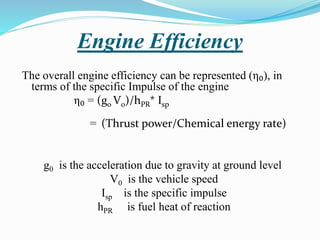
The overall engine efficiency can be represented (η₀), in
terms of the specific Impulse of the engine
η₀ = (g0 V0)/hPR* Isp
= (Thrust power/Chemical energy rate)
g0 is the acceleration due to gravity at ground level
V0 is the vehicle speed
Isp is the specific impulse
hPR is fuel heat of reaction
Advantages
No rotating fan like components.
Easy to manufacture.
 Less weight.
 High speed can be achieved upto mach 10.
Disadvantages
 Cost is high.
 Good insulation material is required.
 Special cooling is needed.
It doesn’t operate in atmospheric pressure.
Applications
An aircraft using this type of jet engine could
dramatically reduce the time which it takes to travel from
one place to another, potentially putting any place
on Earth within a 90-minute flight.
Scramjet vehicle has been proposed for
a single stage to tether vehicle, where a Mach 12
spinning orbital tether would pick up a payload from a
vehicle at around 100 km and carry it to orbit
References
Curran, E.T., “Scramjet Engines: The First Forty Years”,
Journal of Propulsion and Power, Vol. 17, No. 6, Nov-Dec
2001, pp. 1138-1148.
Epstein, M & Kutshenreuter, P 1994, ‘Fuel injection
system for scramjet engines’, United States Patent, Patent
number 5280705.
http://en.wikipedia.org/wiki/Scramjet.
THANK YOU

Scranjet Engine

  • 1.
    A Seminar Presentationon : SCRAMJET ENGINE Presented By: Under The Guidance Of: Saurav Ranjan Mishra Prof. S.K.Sahu Regd no:1101292307 Mechanical- B
  • 2.
    Contents  Introduction  History Progress of Scramjet Engine  Designing Principle  Working Principle  Engine Efficiency Advantage and Disadvantage  Application  References
  • 3.
    Introduction A Scramjet engineis a supersonic combusting ramjet engine in which combustion takes place in a supersonic airflow. Generally ramjet decelerates the air to subsonic velocities before combustion, where as airflow in a scramjet is supersonic throughout the entire engine. This allows the scramjet to operate efficiently at extremely high speeds. Scramjet engines operate on the same principles as ramjets, but do not decelerate the flow to subsonic velocities. Rather, a scramjet combustor is supersonic speed.
  • 4.
    History During World WarII, a tremendous amount of time and effort were put into researching high-speed jet engine and rocket-powered aircraft, predominantly by the Germans. After the war, the US and UK took in several German scientists and military technologies through Operation to begin putting more emphasis on their own weapons development, including jet engines. In the 1950s and 1960s a variety of experimental scramjet engines were built and ground tested in the US and the UK.
  • 5.
    Progress in 2000s In2000s, significant progress was made in the development of hypersonic technology. In June 15, 2007, the US Defense Advanced Research Project Agency (DARPA), in cooperation with the Australian Defence Science and Technology Organisation (DSTO), announced a successful scramjet flight at Mach10 using rocket engines to boost the test vehicle to hypersonic speeds. On 22 and 23 March 2010, Australian and American defence scientists successfully tested a (HIFiRE) hypersonic rocket. It reached an atmospheric velocity of "more than 5,000 kilometres per hour.
  • 6.
    Designing Principle The scramjetis composed of three basic components named as:  A Converging inlet.  A Combustor.  A Diverging nozzle The function of converging inlet is to compress the incoming air. Where inside the combustor chamber gaseous fuel is burned with atmospheric oxygen to produce heat and in the diverging nozzle, the heated air is accelerated to produce thrust. .
  • 7.
    Due to thenature of their design scramjets require the high kinetic energy of a hypersonic flow to compress the incoming air to operational conditions. Thus, a scramjet- powered vehicle must be accelerated to the required velocity by some other means of propulsion, such as turbojet, railgun, or rocket engines.
  • 8.
    Working Principle Scramjet enginesare a type of jet engine, and rely on the combustion of fuel and an oxidizer to produce thrust. Similar to conventional jet engines, scramjet-powered aircraft carry the fuel on board, and obtain the oxidizer by the ingestion of atmospheric oxygen. To keep the combustion rate of the fuel constant, the pressure and temperature in the engine must also be constant. Because air density reduces at higher altitudes, a scramjet must climb at a specific rate as it accelerates to maintain a constant air pressure at the intake
  • 10.
    Unlike a typicaljet engine, such as a turbojet or turbofan engine, a scramjet does not use rotating, fan-like components to compress the air; rather, the achievable speed of the aircraft moving through the atmosphere causes the air to compress within the inlet. As such, no moving parts are needed in a scramjet. A scramjet relies on high vehicle speed to forcefully compress and decelerate the incoming air before combustion. But ramjet decelerates the air to subsonic velocities before combustion and airflow in a scramjet is supersonic throughout the entire engine. This allows the scramjet to efficiently operate at extremely high speeds
  • 11.
    Engine Efficiency The overallengine efficiency can be represented (η₀), in terms of the specific Impulse of the engine η₀ = (g0 V0)/hPR* Isp = (Thrust power/Chemical energy rate) g0 is the acceleration due to gravity at ground level V0 is the vehicle speed Isp is the specific impulse hPR is fuel heat of reaction
  • 12.
    Advantages No rotating fanlike components. Easy to manufacture.  Less weight.  High speed can be achieved upto mach 10.
  • 13.
    Disadvantages  Cost ishigh.  Good insulation material is required.  Special cooling is needed. It doesn’t operate in atmospheric pressure.
  • 14.
    Applications An aircraft usingthis type of jet engine could dramatically reduce the time which it takes to travel from one place to another, potentially putting any place on Earth within a 90-minute flight. Scramjet vehicle has been proposed for a single stage to tether vehicle, where a Mach 12 spinning orbital tether would pick up a payload from a vehicle at around 100 km and carry it to orbit
  • 15.
    References Curran, E.T., “ScramjetEngines: The First Forty Years”, Journal of Propulsion and Power, Vol. 17, No. 6, Nov-Dec 2001, pp. 1138-1148. Epstein, M & Kutshenreuter, P 1994, ‘Fuel injection system for scramjet engines’, United States Patent, Patent number 5280705. http://en.wikipedia.org/wiki/Scramjet.
  • 16.