RAMJET ENGINE
By
S.VELMURUGAN
AP/AERO
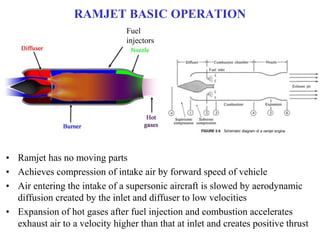
RAMJET BASIC OPERATION
• Ramjet has no moving parts
• Achieves compression of intake air by forward speed of vehicle
• Air entering the intake of a supersonic aircraft is slowed by aerodynamic
diffusion created by the inlet and diffuser to low velocities
• Expansion of hot gases after fuel injection and combustion accelerates
exhaust air to a velocity higher than that at inlet and creates positive thrust
Fuel
injectors
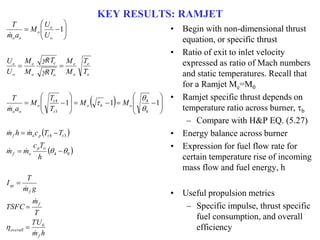
KEY RESULTS: RAMJET
• Begin with non-dimensional thrust
equation, or specific thrust
• Ratio of exit to inlet velocity
expressed as ratio of Mach numbers
and static temperatures. Recall that
for a Ramjet Me=M0
• Ramjet specific thrust depends on
temperature ratio across burner, tb
– Compare with H&P EQ. (5.27)
• Energy balance across burner
• Expression for fuel flow rate for
certain temperature rise of incoming
mass flow and fuel energy, h
• Useful propulsion metrics
– Specific impulse, thrust specific
fuel consumption, and overall
efficiency
 
 
 
h
m
TU
T
m
TSFC
g
m
T
I
h
T
c
m
m
T
T
c
m
h
m
M
M
T
T
M
a
m
T
T
T
M
M
RT
RT
M
M
U
U
U
U
M
a
m
T
f
overall
f
f
sp
o
p
o
f
t
t
p
o
f
o
b
o
t
t
o
o
o
o
e
o
e
o
e
o
e
o
e
o
e
o
o
o









0
0
4
3
4
0
4
3
4
1
1
1
1














































t


WHAT DID WE LEARN?
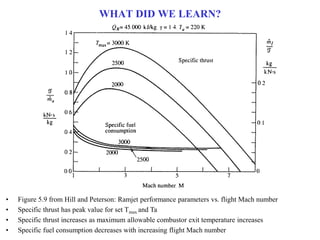
• Figure 5.9 from Hill and Peterson: Ramjet performance parameters vs. flight Mach number
• Specific thrust has peak value for set Tmax and Ta
• Specific thrust increases as maximum allowable combustor exit temperature increases
• Specific fuel consumption decreases with increasing flight Mach number
WHAT DID WE LEARN?
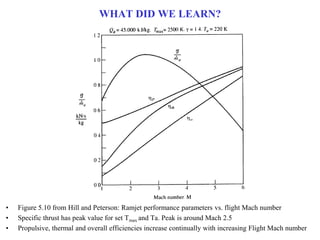
• Figure 5.10 from Hill and Peterson: Ramjet performance parameters vs. flight Mach number
• Specific thrust has peak value for set Tmax and Ta. Peak is around Mach 2.5
• Propulsive, thermal and overall efficiencies increase continually with increasing Flight Mach number
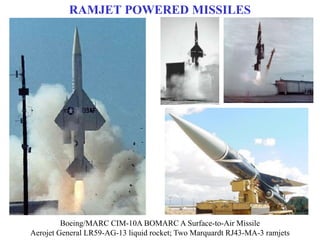
RAMJET POWERED MISSILES
Boeing/MARC CIM-10A BOMARC A Surface-to-Air Missile
Aerojet General LR59-AG-13 liquid rocket; Two Marquardt RJ43-MA-3 ramjets
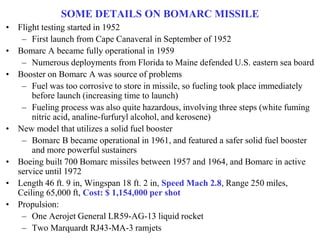
SOME DETAILS ON BOMARC MISSILE
• Flight testing started in 1952
– First launch from Cape Canaveral in September of 1952
• Bomarc A became fully operational in 1959
– Numerous deployments from Florida to Maine defended U.S. eastern sea board
• Booster on Bomarc A was source of problems
– Fuel was too corrosive to store in missile, so fueling took place immediately
before launch (increasing time to launch)
– Fueling process was also quite hazardous, involving three steps (white fuming
nitric acid, analine-furfuryl alcohol, and kerosene)
• New model that utilizes a solid fuel booster
– Bomarc B became operational in 1961, and featured a safer solid fuel booster
and more powerful sustainers
• Boeing built 700 Bomarc missiles between 1957 and 1964, and Bomarc in active
service until 1972
• Length 46 ft. 9 in, Wingspan 18 ft. 2 in, Speed Mach 2.8, Range 250 miles,
Ceiling 65,000 ft, Cost: $ 1,154,000 per shot
• Propulsion:
– One Aerojet General LR59-AG-13 liquid rocket
– Two Marquardt RJ43-MA-3 ramjets
MISS BOMARC
http://home.att.net/~ferguspcj/mbomarc/bomarc01.htm
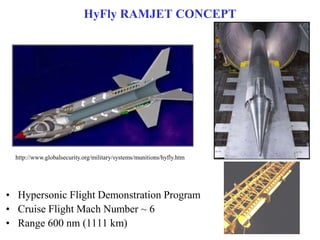
HyFly RAMJET CONCEPT
• Hypersonic Flight Demonstration Program
• Cruise Flight Mach Number ~ 6
• Range 600 nm (1111 km)
http://www.globalsecurity.org/military/systems/munitions/hyfly.htm
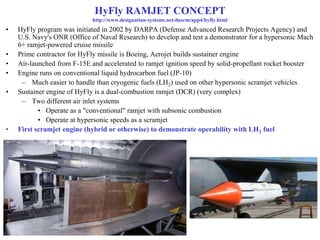
HyFly RAMJET CONCEPT
http://www.designation-systems.net/dusrm/app4/hyfly.html
• HyFly program was initiated in 2002 by DARPA (Defense Advanced Research Projects Agency) and
U.S. Navy's ONR (Office of Naval Research) to develop and test a demonstrator for a hypersonic Mach
6+ ramjet-powered cruise missile
• Prime contractor for HyFly missile is Boeing, Aerojet builds sustainer engine
• Air-launched from F-15E and accelerated to ramjet ignition speed by solid-propellant rocket booster
• Engine runs on conventional liquid hydrocarbon fuel (JP-10)
– Much easier to handle than cryogenic fuels (LH2) used on other hypersonic scramjet vehicles
• Sustainer engine of HyFly is a dual-combustion ramjet (DCR) (very complex)
– Two different air inlet systems
• Operate as a "conventional" ramjet with subsonic combustion
• Operate at hypersonic speeds as a scramjet
• First scramjet engine (hybrid or otherwise) to demonstrate operability with LH2 fuel
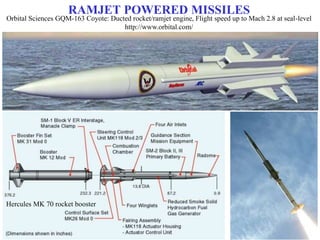
RAMJET POWERED MISSILES
Orbital Sciences GQM-163 Coyote: Ducted rocket/ramjet engine, Flight speed up to Mach 2.8 at seal-level
http://www.orbital.com/
Hercules MK 70 rocket booster
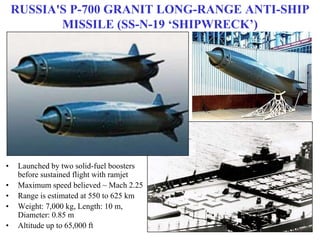
RUSSIA'S P-700 GRANIT LONG-RANGE ANTI-SHIP
MISSILE (SS-N-19 ‘SHIPWRECK’)
• Launched by two solid-fuel boosters
before sustained flight with ramjet
• Maximum speed believed ~ Mach 2.25
• Range is estimated at 550 to 625 km
• Weight: 7,000 kg, Length: 10 m,
Diameter: 0.85 m
• Altitude up to 65,000 ft
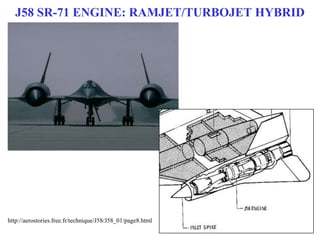
J58 SR-71 ENGINE: RAMJET/TURBOJET HYBRID
http://aerostories.free.fr/technique/J58/J58_01/page8.html
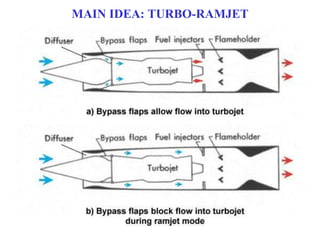
MAIN IDEA: TURBO-RAMJET
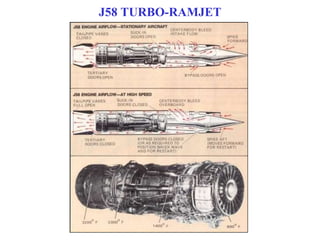
J58 TURBO-RAMJET
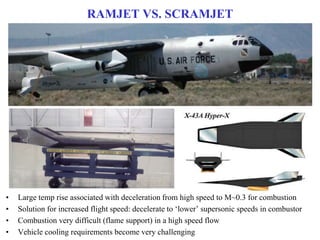
RAMJET VS. SCRAMJET
• Large temp rise associated with deceleration from high speed to M~0.3 for combustion
• Solution for increased flight speed: decelerate to ‘lower’ supersonic speeds in combustor
• Combustion very difficult (flame support) in a high speed flow
• Vehicle cooling requirements become very challenging
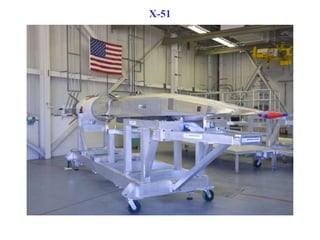
X-51
SUMMARY
• Ramjet develops no static thrust
• Relies on ‘ram’ compression of air
– Requires high speed flight
• Performance depends on increase in stagnation temperature across burner
(combustor)
• Efficiencies (thermal, propulsive, and overall) increase with increasing flight Mach
number
• Next step: We desire an engine that develops static thrust
– Put in a device to mechanically compress air (compressor)
– Put in a device to power compressor (turbine)
• Solution: Turbojet engine
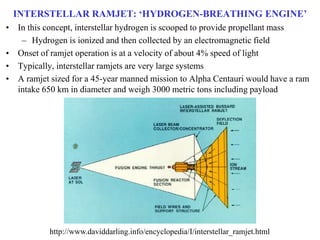
INTERSTELLAR RAMJET: ‘HYDROGEN-BREATHING ENGINE’
• In this concept, interstellar hydrogen is scooped to provide propellant mass
– Hydrogen is ionized and then collected by an electromagnetic field
• Onset of ramjet operation is at a velocity of about 4% speed of light
• Typically, interstellar ramjets are very large systems
• A ramjet sized for a 45-year manned mission to Alpha Centauri would have a ram
intake 650 km in diameter and weigh 3000 metric tons including payload
http://www.daviddarling.info/encyclopedia/I/interstellar_ramjet.html

UNIT 5 PROPULSION

  • 1.
  • 2.
    RAMJET BASIC OPERATION •Ramjet has no moving parts • Achieves compression of intake air by forward speed of vehicle • Air entering the intake of a supersonic aircraft is slowed by aerodynamic diffusion created by the inlet and diffuser to low velocities • Expansion of hot gases after fuel injection and combustion accelerates exhaust air to a velocity higher than that at inlet and creates positive thrust Fuel injectors
  • 3.
    KEY RESULTS: RAMJET •Begin with non-dimensional thrust equation, or specific thrust • Ratio of exit to inlet velocity expressed as ratio of Mach numbers and static temperatures. Recall that for a Ramjet Me=M0 • Ramjet specific thrust depends on temperature ratio across burner, tb – Compare with H&P EQ. (5.27) • Energy balance across burner • Expression for fuel flow rate for certain temperature rise of incoming mass flow and fuel energy, h • Useful propulsion metrics – Specific impulse, thrust specific fuel consumption, and overall efficiency       h m TU T m TSFC g m T I h T c m m T T c m h m M M T T M a m T T T M M RT RT M M U U U U M a m T f overall f f sp o p o f t t p o f o b o t t o o o o e o e o e o e o e o e o o o          0 0 4 3 4 0 4 3 4 1 1 1 1                                               t  
  • 4.
    WHAT DID WELEARN? • Figure 5.9 from Hill and Peterson: Ramjet performance parameters vs. flight Mach number • Specific thrust has peak value for set Tmax and Ta • Specific thrust increases as maximum allowable combustor exit temperature increases • Specific fuel consumption decreases with increasing flight Mach number
  • 5.
    WHAT DID WELEARN? • Figure 5.10 from Hill and Peterson: Ramjet performance parameters vs. flight Mach number • Specific thrust has peak value for set Tmax and Ta. Peak is around Mach 2.5 • Propulsive, thermal and overall efficiencies increase continually with increasing Flight Mach number
  • 7.
    RAMJET POWERED MISSILES Boeing/MARCCIM-10A BOMARC A Surface-to-Air Missile Aerojet General LR59-AG-13 liquid rocket; Two Marquardt RJ43-MA-3 ramjets
  • 8.
    SOME DETAILS ONBOMARC MISSILE • Flight testing started in 1952 – First launch from Cape Canaveral in September of 1952 • Bomarc A became fully operational in 1959 – Numerous deployments from Florida to Maine defended U.S. eastern sea board • Booster on Bomarc A was source of problems – Fuel was too corrosive to store in missile, so fueling took place immediately before launch (increasing time to launch) – Fueling process was also quite hazardous, involving three steps (white fuming nitric acid, analine-furfuryl alcohol, and kerosene) • New model that utilizes a solid fuel booster – Bomarc B became operational in 1961, and featured a safer solid fuel booster and more powerful sustainers • Boeing built 700 Bomarc missiles between 1957 and 1964, and Bomarc in active service until 1972 • Length 46 ft. 9 in, Wingspan 18 ft. 2 in, Speed Mach 2.8, Range 250 miles, Ceiling 65,000 ft, Cost: $ 1,154,000 per shot • Propulsion: – One Aerojet General LR59-AG-13 liquid rocket – Two Marquardt RJ43-MA-3 ramjets
  • 9.
  • 10.
    HyFly RAMJET CONCEPT •Hypersonic Flight Demonstration Program • Cruise Flight Mach Number ~ 6 • Range 600 nm (1111 km) http://www.globalsecurity.org/military/systems/munitions/hyfly.htm
  • 11.
    HyFly RAMJET CONCEPT http://www.designation-systems.net/dusrm/app4/hyfly.html •HyFly program was initiated in 2002 by DARPA (Defense Advanced Research Projects Agency) and U.S. Navy's ONR (Office of Naval Research) to develop and test a demonstrator for a hypersonic Mach 6+ ramjet-powered cruise missile • Prime contractor for HyFly missile is Boeing, Aerojet builds sustainer engine • Air-launched from F-15E and accelerated to ramjet ignition speed by solid-propellant rocket booster • Engine runs on conventional liquid hydrocarbon fuel (JP-10) – Much easier to handle than cryogenic fuels (LH2) used on other hypersonic scramjet vehicles • Sustainer engine of HyFly is a dual-combustion ramjet (DCR) (very complex) – Two different air inlet systems • Operate as a "conventional" ramjet with subsonic combustion • Operate at hypersonic speeds as a scramjet • First scramjet engine (hybrid or otherwise) to demonstrate operability with LH2 fuel
  • 12.
    RAMJET POWERED MISSILES OrbitalSciences GQM-163 Coyote: Ducted rocket/ramjet engine, Flight speed up to Mach 2.8 at seal-level http://www.orbital.com/ Hercules MK 70 rocket booster
  • 13.
    RUSSIA'S P-700 GRANITLONG-RANGE ANTI-SHIP MISSILE (SS-N-19 ‘SHIPWRECK’) • Launched by two solid-fuel boosters before sustained flight with ramjet • Maximum speed believed ~ Mach 2.25 • Range is estimated at 550 to 625 km • Weight: 7,000 kg, Length: 10 m, Diameter: 0.85 m • Altitude up to 65,000 ft
  • 14.
    J58 SR-71 ENGINE:RAMJET/TURBOJET HYBRID http://aerostories.free.fr/technique/J58/J58_01/page8.html
  • 15.
  • 16.
  • 17.
    RAMJET VS. SCRAMJET •Large temp rise associated with deceleration from high speed to M~0.3 for combustion • Solution for increased flight speed: decelerate to ‘lower’ supersonic speeds in combustor • Combustion very difficult (flame support) in a high speed flow • Vehicle cooling requirements become very challenging
  • 18.
  • 19.
    SUMMARY • Ramjet developsno static thrust • Relies on ‘ram’ compression of air – Requires high speed flight • Performance depends on increase in stagnation temperature across burner (combustor) • Efficiencies (thermal, propulsive, and overall) increase with increasing flight Mach number • Next step: We desire an engine that develops static thrust – Put in a device to mechanically compress air (compressor) – Put in a device to power compressor (turbine) • Solution: Turbojet engine
  • 20.
    INTERSTELLAR RAMJET: ‘HYDROGEN-BREATHINGENGINE’ • In this concept, interstellar hydrogen is scooped to provide propellant mass – Hydrogen is ionized and then collected by an electromagnetic field • Onset of ramjet operation is at a velocity of about 4% speed of light • Typically, interstellar ramjets are very large systems • A ramjet sized for a 45-year manned mission to Alpha Centauri would have a ram intake 650 km in diameter and weigh 3000 metric tons including payload http://www.daviddarling.info/encyclopedia/I/interstellar_ramjet.html