JET ENGINE
PRESENTED BY:-
K.AJIT ARAVIND
S.ARAVIND KUMARAN
K.ARAVINTH
V.AJITH
2
GUIDED BY:-
PROF.T.NITHYANANTHAM
JET ENGINE
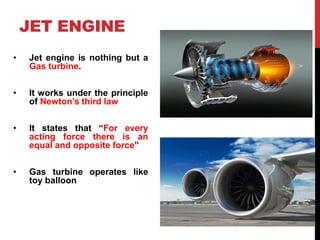
• Jet engine is nothing but a
Gas turbine.
• It works under the principle
of Newton’s third law
• It states that “For every
acting force there is an
equal and opposite force”
• Gas turbine operates like
toy balloon
HISTROY
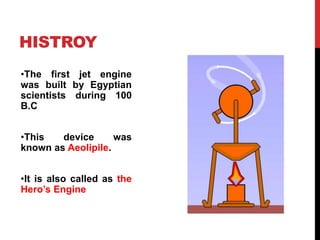
•The first jet engine
was built by Egyptian
scientists during 100
B.C
•This device was
known as Aeolipile.
•It is also called as the
Hero’s Engine
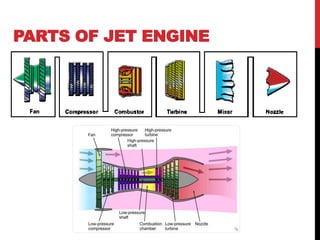
PARTS OF JET ENGINE
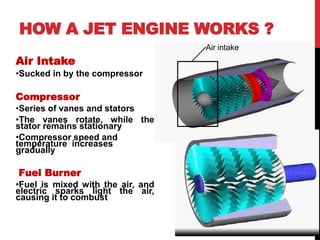
HOW A JET ENGINE WORKS ?
Air Intake
•Sucked in by the compressor
Compressor
•Series of vanes and stators
•The vanes rotate, while the
stator remains stationary
•Compressor speed and
temperature increases
gradually
Fuel Burner
•Fuel is mixed with the air, and
electric sparks light the air,
causing it to combust
Air intake
HOW A JET ENGINE WORKS ?
Combustion Chamber
• The air is burnt Increase in the
temperature of the air, thus
increases the pressure inside the
engine
Turbine
•The blades gain energy from the
hot gases moving past them which
is used to power the compressor
Jet Pipe and Propelling Nozzle
•The hot air rushes out of the
nozzle
•High pressure Hot air rushes out
at very high speed
TYPES OF JET
ENGINES
•Gas turbine
•Turbo jets
•Turbo propeller
•Turbofan
•Ramjet
•Pulse jet
GAS TURBINE
• Type of internal
combustion engine.
• Works on Brayton
cycle with air as
working fluid.
• Mechanical energy
is changed
irreversibly into
pressure and
thermal engergy
THEORY OF
OPERATION
Undergoes
four
thermodynami
c process
• An isentropic
compression
• An isobaric
combustion
• An isentropic
expansion
• An isobaric
heat rejection
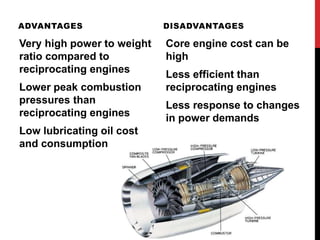
ADVANTAGES DISADVANTAGES
Very high power to weight
ratio compared to
reciprocating engines
Lower peak combustion
pressures than
reciprocating engines
Low lubricating oil cost
and consumption
Core engine cost can be
high
Less efficient than
reciprocating engines
Less response to changes
in power demands
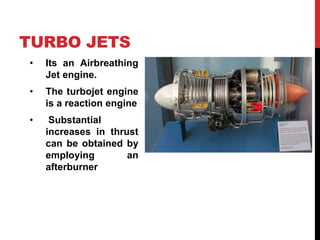
TURBO JETS
• Its an Airbreathing
Jet engine.
• The turbojet engine
is a reaction engine
• Substantial
increases in thrust
can be obtained by
employing an
afterburner
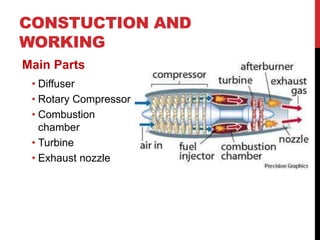
CONSTUCTION AND
WORKING
Main Parts
• Diffuser
• Rotary Compressor
• Combustion
chamber
• Turbine
• Exhaust nozzle
Advantages
• High exhaust speed
• Low frontal area
• Relative simplicity
Disadvantages
• Noisy
• Insufficient to use below
mach number 2
Applications
• Piloted Aircrafts
• Military Aircrafts
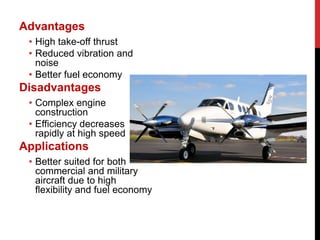
TURBO PROPELLER
• A turboprop is a jet
engine attached to
a propeller.
• Modern turboprop
engine are
equipped with
propeller that have
a smaller diameter
but a large number
of a blades for
efficient operation
at much higher
flight speed.
CONSTUCTION AND
WORKING
Main Parts
• Diffuser
• Compressor
• Combustion
chamber
• Turbine
• Exhaust nozzle
• Reduction gear
• Propeller
Advantages
• High take-off thrust
• Reduced vibration and
noise
• Better fuel economy
Disadvantages
• Complex engine
construction
• Efficiency decreases
rapidly at high speed
Applications
• Better suited for both
commercial and military
aircraft due to high
flexibility and fuel economy
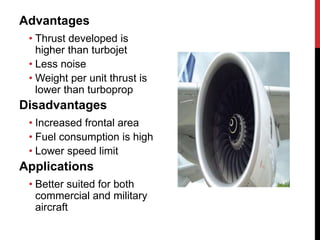
TURBOFAN
• Combination of turbo
propeller and turbojet
• The objective of the sort of
bypass system is to
increase thrust without
increasing fuel
consumption.
• It achieves this by
increasing the total air-
mass flow and reducing
the velocity within the
same total energy supply
CONSTUCTION AND
WORKING
Main Parts
• Fan
• Compressor
• Combustion
chamber
• Turbine
• Fan Nozzle
Advantages
• Thrust developed is
higher than turbojet
• Less noise
• Weight per unit thrust is
lower than turboprop
Disadvantages
• Increased frontal area
• Fuel consumption is high
• Lower speed limit
Applications
• Better suited for both
commercial and military
aircraft
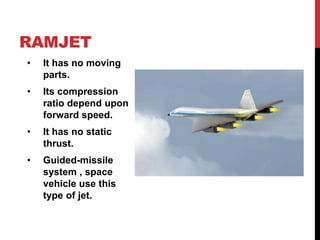
RAMJET
• It has no moving
parts.
• Its compression
ratio depend upon
forward speed.
• It has no static
thrust.
• Guided-missile
system , space
vehicle use this
type of jet.
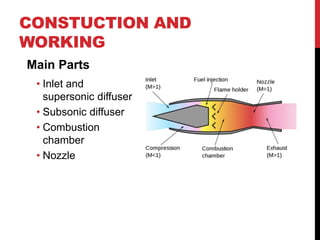
CONSTUCTION AND
WORKING
Main Parts
• Inlet and
supersonic diffuser
• Subsonic diffuser
• Combustion
chamber
• Nozzle
Advantages
• Simple and does’nt
moving part
• Cost is low
• Less maintance
Disadvantages
• Low thermal efficiency
• Starting is impossible
without external
launching device
Applications
• Subsonic ramjet are
used in target weapons
• High speed aircrafts and
missiles
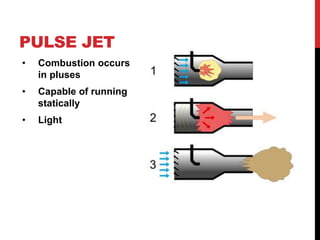
PULSE JET
• Combustion occurs
in pluses
• Capable of running
statically
• Light
CONSTUCTION AND
WORKING
Main Parts
• Diffuser
• Valve grid with
springs
• Combustion
chamber
• Spark plug
• Tail pipe
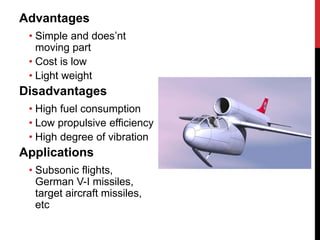
Advantages
• Simple and does’nt
moving part
• Cost is low
• Light weight
Disadvantages
• High fuel consumption
• Low propulsive efficiency
• High degree of vibration
Applications
• Subsonic flights,
German V-I missiles,
target aircraft missiles,
etc
MERITS AND
DEMERITS
Merits of jet engine over IC
engine
Mechanical efficiency of jet
engine is high as compared
to IC engine.
Weight and speed of jet
engine per HP developed is
higher then IC engine.
Ignition and lubricating
system are much simpler in
jet engine then IC engine.
Demerits of jet engine over
IC engine
Thermal efficiency of jet
engine is low compared to
IC engine.
Difficult to start.
Turbine blades need a
special cooling system due
high temperature.
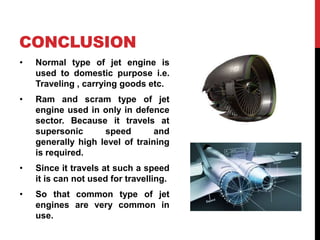
CONCLUSION
• Normal type of jet engine is
used to domestic purpose i.e.
Traveling , carrying goods etc.
• Ram and scram type of jet
engine used in only in defence
sector. Because it travels at
supersonic speed and
generally high level of training
is required.
• Since it travels at such a speed
it is can not used for travelling.
• So that common type of jet
engines are very common in
use.
THANK YOU
29

Jet engine

  • 2.
    JET ENGINE PRESENTED BY:- K.AJITARAVIND S.ARAVIND KUMARAN K.ARAVINTH V.AJITH 2 GUIDED BY:- PROF.T.NITHYANANTHAM
  • 3.
    JET ENGINE • Jetengine is nothing but a Gas turbine. • It works under the principle of Newton’s third law • It states that “For every acting force there is an equal and opposite force” • Gas turbine operates like toy balloon
  • 4.
    HISTROY •The first jetengine was built by Egyptian scientists during 100 B.C •This device was known as Aeolipile. •It is also called as the Hero’s Engine
  • 5.
  • 6.
    HOW A JETENGINE WORKS ? Air Intake •Sucked in by the compressor Compressor •Series of vanes and stators •The vanes rotate, while the stator remains stationary •Compressor speed and temperature increases gradually Fuel Burner •Fuel is mixed with the air, and electric sparks light the air, causing it to combust Air intake
  • 7.
    HOW A JETENGINE WORKS ? Combustion Chamber • The air is burnt Increase in the temperature of the air, thus increases the pressure inside the engine Turbine •The blades gain energy from the hot gases moving past them which is used to power the compressor Jet Pipe and Propelling Nozzle •The hot air rushes out of the nozzle •High pressure Hot air rushes out at very high speed
  • 8.
    TYPES OF JET ENGINES •Gasturbine •Turbo jets •Turbo propeller •Turbofan •Ramjet •Pulse jet
  • 9.
    GAS TURBINE • Typeof internal combustion engine. • Works on Brayton cycle with air as working fluid. • Mechanical energy is changed irreversibly into pressure and thermal engergy
  • 10.
    THEORY OF OPERATION Undergoes four thermodynami c process •An isentropic compression • An isobaric combustion • An isentropic expansion • An isobaric heat rejection
  • 11.
    ADVANTAGES DISADVANTAGES Very highpower to weight ratio compared to reciprocating engines Lower peak combustion pressures than reciprocating engines Low lubricating oil cost and consumption Core engine cost can be high Less efficient than reciprocating engines Less response to changes in power demands
  • 12.
    TURBO JETS • Itsan Airbreathing Jet engine. • The turbojet engine is a reaction engine • Substantial increases in thrust can be obtained by employing an afterburner
  • 13.
    CONSTUCTION AND WORKING Main Parts •Diffuser • Rotary Compressor • Combustion chamber • Turbine • Exhaust nozzle
  • 14.
    Advantages • High exhaustspeed • Low frontal area • Relative simplicity Disadvantages • Noisy • Insufficient to use below mach number 2 Applications • Piloted Aircrafts • Military Aircrafts
  • 15.
    TURBO PROPELLER • Aturboprop is a jet engine attached to a propeller. • Modern turboprop engine are equipped with propeller that have a smaller diameter but a large number of a blades for efficient operation at much higher flight speed.
  • 16.
    CONSTUCTION AND WORKING Main Parts •Diffuser • Compressor • Combustion chamber • Turbine • Exhaust nozzle • Reduction gear • Propeller
  • 17.
    Advantages • High take-offthrust • Reduced vibration and noise • Better fuel economy Disadvantages • Complex engine construction • Efficiency decreases rapidly at high speed Applications • Better suited for both commercial and military aircraft due to high flexibility and fuel economy
  • 18.
    TURBOFAN • Combination ofturbo propeller and turbojet • The objective of the sort of bypass system is to increase thrust without increasing fuel consumption. • It achieves this by increasing the total air- mass flow and reducing the velocity within the same total energy supply
  • 19.
    CONSTUCTION AND WORKING Main Parts •Fan • Compressor • Combustion chamber • Turbine • Fan Nozzle
  • 20.
    Advantages • Thrust developedis higher than turbojet • Less noise • Weight per unit thrust is lower than turboprop Disadvantages • Increased frontal area • Fuel consumption is high • Lower speed limit Applications • Better suited for both commercial and military aircraft
  • 21.
    RAMJET • It hasno moving parts. • Its compression ratio depend upon forward speed. • It has no static thrust. • Guided-missile system , space vehicle use this type of jet.
  • 22.
    CONSTUCTION AND WORKING Main Parts •Inlet and supersonic diffuser • Subsonic diffuser • Combustion chamber • Nozzle
  • 23.
    Advantages • Simple anddoes’nt moving part • Cost is low • Less maintance Disadvantages • Low thermal efficiency • Starting is impossible without external launching device Applications • Subsonic ramjet are used in target weapons • High speed aircrafts and missiles
  • 24.
    PULSE JET • Combustionoccurs in pluses • Capable of running statically • Light
  • 25.
    CONSTUCTION AND WORKING Main Parts •Diffuser • Valve grid with springs • Combustion chamber • Spark plug • Tail pipe
  • 26.
    Advantages • Simple anddoes’nt moving part • Cost is low • Light weight Disadvantages • High fuel consumption • Low propulsive efficiency • High degree of vibration Applications • Subsonic flights, German V-I missiles, target aircraft missiles, etc
  • 27.
    MERITS AND DEMERITS Merits ofjet engine over IC engine Mechanical efficiency of jet engine is high as compared to IC engine. Weight and speed of jet engine per HP developed is higher then IC engine. Ignition and lubricating system are much simpler in jet engine then IC engine. Demerits of jet engine over IC engine Thermal efficiency of jet engine is low compared to IC engine. Difficult to start. Turbine blades need a special cooling system due high temperature.
  • 28.
    CONCLUSION • Normal typeof jet engine is used to domestic purpose i.e. Traveling , carrying goods etc. • Ram and scram type of jet engine used in only in defence sector. Because it travels at supersonic speed and generally high level of training is required. • Since it travels at such a speed it is can not used for travelling. • So that common type of jet engines are very common in use.
  • 29.