PRESENTATION ON 
CARRIAGE AND WAGON SHOP 
PRESENTED BY :AJEET KUMAR 
ROLL NO- 1112240014
ABOUT CARRIAGE AND WAGON WORKSHOP 
• The Alambagh workshop, near Lucknow, was set up in 1865 by the Oudh and 
Rohilkhand Raiilway. It started off doing minor maintenance and periodic overhaul 
of coaches and wagons, and eventually became one of the top workshops engaged 
in overhaul, repair, and restoration of carriages and wagons. Today the workshop 
specializes in the new high-speed coaches (LHB Alstom, IR20/IRY, etc.), air-conditioned 
coaching stock, etc. 
The Basic Data for workshop are as under 
• WORKSHOPAREA = 204684 Sq. Mtrs. 
• COVERED AREA = 72595 Sq. Mtrs. 
• POWER CONSUMPTION = 14666 KWH/day 
• WATER CONSUMPTION = 1575000 Ltrs./day
CONTINUED…. 
Major Shops 
Train Lighting 
AC Deluxe 
Carriage Fitting 
Carriage Building 
Heavy Corrosion Repair 
Bogie Lifting 
Wheel Shop 
Spring Shop 
Common Shops 
Minor Shop Major Shop 
Paint Shop Mill Wright Shop 
Road Transport Shop New Machine Shop 
Yard Carriage Shop Carpentry Shop
Role of C&W workshop in Railways 
A. Related with Open Line working :- 
i) To ensure and co-operate in safer running of rolling stock. 
ii) To attend required schedule maintenance & running repairs of rolling Stocks till the 
stocks are again due for P.O.H. 
iii) To assist in time running of trains to maintain the punctuality. 
B. Related with Work -Shop working :- 
i) To attend Periodical Overhauling of Rolling Stocks. 
ii) To adopt required modifications. 
iii) To maintain proper records of all the rolling stocks running in Indian Railways.
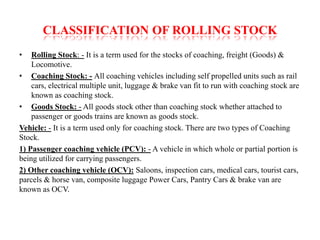
CLASSIFICATION OF ROLLING STOCK 
• Rolling Stock: - It is a term used for the stocks of coaching, freight (Goods) & 
Locomotive. 
• Coaching Stock: - All coaching vehicles including self propelled units such as rail 
cars, electrical multiple unit, luggage & brake van fit to run with coaching stock are 
known as coaching stock. 
• Goods Stock: - All goods stock other than coaching stock whether attached to 
passenger or goods trains are known as goods stock. 
Vehicle: - It is a term used only for coaching stock. There are two types of Coaching 
Stock. 
1) Passenger coaching vehicle (PCV): - A vehicle in which whole or partial portion is 
being utilized for carrying passengers. 
2) Other coaching vehicle (OCV): Saloons, inspection cars, medical cars, tourist cars, 
parcels & horse van, composite luggage Power Cars, Pantry Cars & brake van are 
known as OCV.
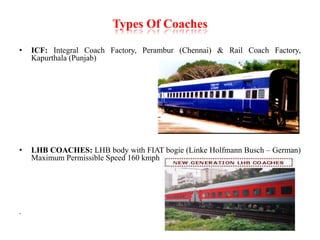
Types Of Coaches 
• ICF: Integral Coach Factory, Perambur (Chennai) & Rail Coach Factory, 
Kapurthala (Punjab) 
• LHB COACHES: LHB body with FIAT bogie (Linke Holfmann Busch – German) 
Maximum Permissible Speed 160 kmph 
.
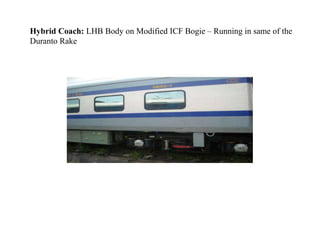
Hybrid Coach: LHB Body on Modified ICF Bogie – Running in same of the 
Duranto Rake
Loco- Brief Data 
 Weight of complete loco-123 tons. 
 Weight of Loco body is 73 tons. 
 Weight of complete bogie is 25 tons each. 
 Load exerted per axle is 20.5 tons. 
 Weight of Traction motor is 3.80 tons. 
 Wheel set with gears is approx. 2.15 tons.
Manufacturing units 
 Coaches- Integral Coach Factory,Perambur,Chennai. 
Rail coach factory, Kapurthala,Punjab. 
 Wagons-BEML(Bharat Earth Movers Limited). 
 Diesel components Workshop at Punjab. 
 Major workshops- 
DLW(Diesel Loco Workshop) at Varanasi. 
Chittaranjan Loco Workshop. 
 BHEL also manufacture on contract basis. 
 RDSO is the authentification Unit of railways.
TRAIN MAINTENANCE 
Washing line :- 
after every 2500 km 
Sick line :- 
Schedule “A” maintenance- 1 month 
Schedule “B” maintenance- 3 months 
IOH- 9 months or 2,00,000 km 
POH- 18 months or 4,00,000 km 
Platform Train Duty:- 
on starting & ending stations
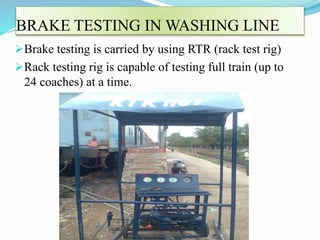
BRAKE TESTING IN WASHING LINE 
Brake testing is carried by using RTR (rack test rig) 
Rack testing rig is capable of testing full train (up to 
24 coaches) at a time.
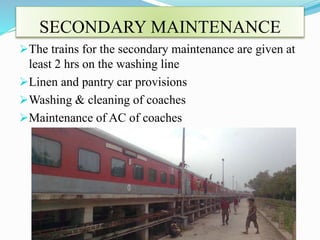
SECONDARY MAINTENANCE 
The trains for the secondary maintenance are given at 
least 2 hrs on the washing line 
Linen and pantry car provisions 
Washing & cleaning of coaches 
Maintenance of AC of coaches
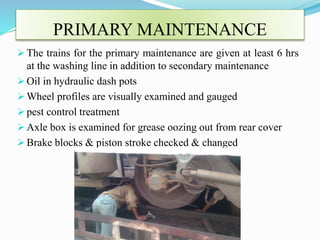
PRIMARY MAINTENANCE 
 The trains for the primary maintenance are given at least 6 hrs 
at the washing line in addition to secondary maintenance 
 Oil in hydraulic dash pots 
Wheel profiles are visually examined and gauged 
 pest control treatment 
 Axle box is examined for grease oozing out from rear cover 
 Brake blocks & piston stroke checked & changed
COACH MAINTENANCE 
In coach maintenance generally these work being done 
1. testing/maintenance of air conditioner. 
2. Maintenance of other electrical circuits like fan light 
etc. 
3. Buffer maintenance. 
4. Brake testing by S.C.T.R.
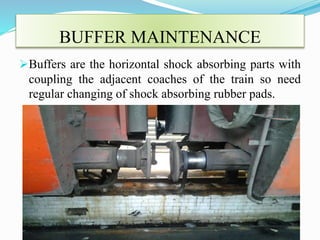
BUFFER MAINTENANCE 
Buffers are the horizontal shock absorbing parts with 
coupling the adjacent coaches of the train so need 
regular changing of shock absorbing rubber pads.
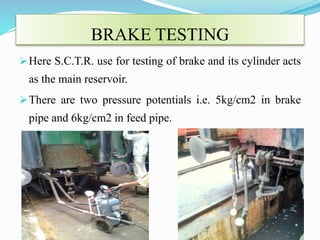
BRAKE TESTING 
Here S.C.T.R. use for testing of brake and its cylinder acts 
as the main reservoir. 
There are two pressure potentials i.e. 5kg/cm2 in brake 
pipe and 6kg/cm2 in feed pipe.
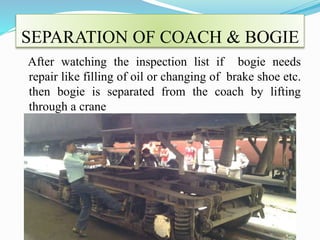
SEPARATION OF COACH & BOGIE 
After watching the inspection list if bogie needs 
repair like filling of oil or changing of brake shoe etc. 
then bogie is separated from the coach by lifting 
through a crane
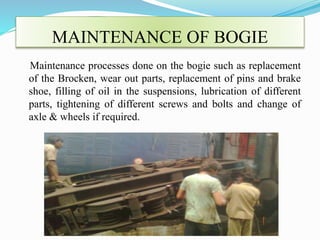
MAINTENANCE OF BOGIE 
Maintenance processes done on the bogie such as replacement 
of the Brocken, wear out parts, replacement of pins and brake 
shoe, filling of oil in the suspensions, lubrication of different 
parts, tightening of different screws and bolts and change of 
axle & wheels if required.
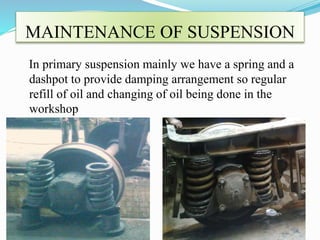
MAINTENANCE OF SUSPENSION 
In primary suspension mainly we have a spring and a 
dashpot to provide damping arrangement so regular 
refill of oil and changing of oil being done in the 
workshop
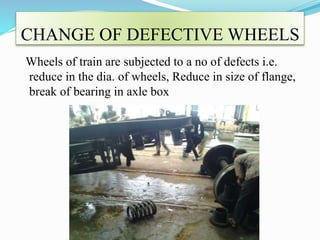
CHANGE OF DEFECTIVE WHEELS 
Wheels of train are subjected to a no of defects i.e. 
reduce in the dia. of wheels, Reduce in size of flange, 
break of bearing in axle box
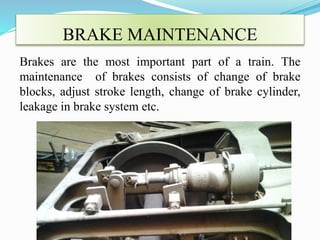
BRAKE MAINTENANCE 
Brakes are the most important part of a train. The 
maintenance of brakes consists of change of brake 
blocks, adjust stroke length, change of brake cylinder, 
leakage in brake system etc.
AXLE BOX FEELING 
After the train come to halt, all axle boxes are felt 
within 20 minutes. The temp. of axle is checked by 
touching with hand 
Temp. is found high then it is checked by the temp. 
gun which gives exact temp. 
If this temp. is found more than 30 degree than atm. 
temp. then the cause is inspected and coach is sent to 
workshop
COTINUED… 
i) Quick Coupling in case of Brake Van. 
j) Automatic empty load change over device in case of BOBR/BOBRN Wagons. 
Use new rubber items for joints between pipe and equipment irrespective of condition 
of old items. 
xiv) Properly secure nut and bolts of joints between pipe and equipment. 
xv) Examine all pipe and pipe fittings and brackets and properly secure them. 
Pipes should not be loose inside the pipe clamps. 
xvi) Fit following APD : 
a) Additional APD of DV. 
b) APD of DV. 
c) APD of Angle Cock 
xvii) Fit overhauled Hose Couplings at both ends of Brake Pipe. 
xviii) PAINTING 
All items shall be painted black as per standard practice.
PERIODICAL OVERHAUL OF WHEEL 
ASSEMBLY 
i. The dust shield should be examined, every time the axle box is repacked during POH. 
If found worn, torn, or if it has lost its stiffness, it should be replaced. 
ii. Axle boxes should be examined and inspected on open lines for defects. 
iii. The elongated/oval cut holes on face plate should not allowed. Proper 
riveting of the face plate to be done with axle box. 
iv. Bearing brass to be examined and repaired. 
v. Repair of the journal to be done. 
vi. Periodicity of repacking and oiling . 
vii. Proper attention must be paid to the examination and riveting of the face plate at the 
time of POH in workshop. 
ix. Procedure for white metalling to be done. 
x. Examination and maintenance of Axle, wheels and tyres should be done.
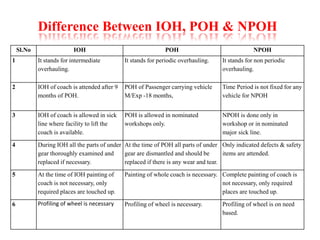
Difference Between IOH, POH & NPOH 
Sl.No IOH POH NPOH 
1 It stands for intermediate 
overhauling. 
It stands for periodic overhauling. It stands for non periodic 
overhauling. 
2 IOH of coach is attended after 9 
months of POH. 
POH of Passenger carrying vehicle 
M/Exp -18 months, 
Time Period is not fixed for any 
vehicle for NPOH 
3 IOH of coach is allowed in sick 
line where facility to lift the 
coach is available. 
POH is allowed in nominated 
workshops only. 
NPOH is done only in 
workshop or in nominated 
major sick line. 
4 During IOH all the parts of under 
gear thoroughly examined and 
replaced if necessary. 
At the time of POH all parts of under 
gear are dismantled and should be 
replaced if there is any wear and tear. 
Only indicated defects & safety 
items are attended. 
5 At the time of IOH painting of 
coach is not necessary, only 
required places are touched up. 
Painting of whole coach is necessary. Complete painting of coach is 
not necessary, only required 
places are touched up. 
6 Profiling of wheel is necessary Profiling of wheel is necessary. Profiling of wheel is on need 
based.
BOGIE-A brief description 
 4 wheel set is known as Bo-Bo type. 
 6 wheel set is known as Co-Co-CO type. 
 Former type is used as 
COACH 
GOODS WAGON 
• Later type is used as LOCOMOTIVE 
Comprises of bogie frame and the loco weight mounted 
on it.
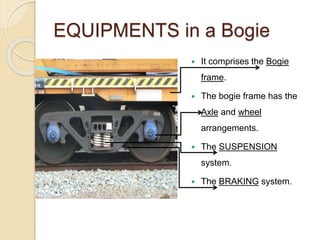
EQUIPMENTS in a Bogie 
 It comprises the Bogie 
frame. 
 The bogie frame has the 
Axle and wheel 
arrangements. 
 The SUSPENSION 
system. 
 The BRAKING system.
MAINTENANCE/INSPECTION 
 Various periodic inspections are made to 
ensure proper functioning of the LOCO 
• TRIP INSPECTION 
• MONTHLY INSPECTION 
• TWO MONTHLY NSPECTION 
• FOUR MONTHLY INSPECTION 
• YEARLY INSECTION 
• POH INSPECTION
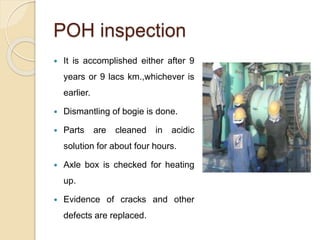
POH inspection 
 It is accomplished either after 9 
years or 9 lacs km.,whichever is 
earlier. 
 Dismantling of bogie is done. 
 Parts are cleaned in acidic 
solution for about four hours. 
 Axle box is checked for heating 
up. 
 Evidence of cracks and other 
defects are replaced.
Bogie Manufacturing 
 Initially done by Casting. 
Generated cracks 
Rate of success was 60 %. 
replacement was difficult. 
 Fabrication is done now a days 
Welding and Oxycutting is done. 
Rate of success is 80 %. 
replacement of parts is easy.
Bogie-Fuel Tank 
 Capacity of fuel tank- 5000 litres. 
 At full load, consumption is 325-365 litres/hour. 
 Average fuel consumption is 45 litres/hour at 
standby mode. 
 Approximately, 5.5 litres/km.
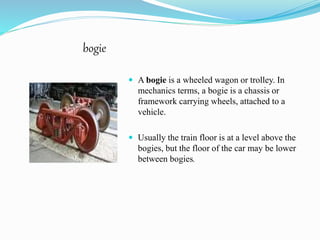
bogie 
 A bogie is a wheeled wagon or trolley. In 
mechanics terms, a bogie is a chassis or 
framework carrying wheels, attached to a 
vehicle. 
 Usually the train floor is at a level above the 
bogies, but the floor of the car may be lower 
between bogies.
 Bogies serve a number of purposes: 
1. To support the rail vehicle body 
2. To run stably on both straight and curved track 
3. To ensure ride comfort by absorbing vibration, and minimizing 
centrifugal forces when the train runs on curves at high speed 
 Usually two bogies are fitted to each carriage, wagon or locomotive, one at 
each end. Most bogies have two axles as it is the simplest design, but some 
cars designed for extremely heavy loads have been built with up to five 
axles per bogie.
 Key components of a bogie include: 
1. The bogie frame itself. 
2. Suspension to absorb shocks between the bogie frame and the rail vehicle 
body. Common types are coil springs, or rubber airbags. 
3. At least one wheel set, composed of an axle with a bearings and wheel at 
each end. 
4. Axle box suspension to absorb shocks between the axle bearings and the 
bogie frame. 
5. Brake equipment. Two main types are used: brake shoes that are pressed 
against the tread of the wheel, and disc brakes and pads.

Bogie

  • 1.
    PRESENTATION ON CARRIAGEAND WAGON SHOP PRESENTED BY :AJEET KUMAR ROLL NO- 1112240014
  • 2.
    ABOUT CARRIAGE ANDWAGON WORKSHOP • The Alambagh workshop, near Lucknow, was set up in 1865 by the Oudh and Rohilkhand Raiilway. It started off doing minor maintenance and periodic overhaul of coaches and wagons, and eventually became one of the top workshops engaged in overhaul, repair, and restoration of carriages and wagons. Today the workshop specializes in the new high-speed coaches (LHB Alstom, IR20/IRY, etc.), air-conditioned coaching stock, etc. The Basic Data for workshop are as under • WORKSHOPAREA = 204684 Sq. Mtrs. • COVERED AREA = 72595 Sq. Mtrs. • POWER CONSUMPTION = 14666 KWH/day • WATER CONSUMPTION = 1575000 Ltrs./day
  • 3.
    CONTINUED…. Major Shops Train Lighting AC Deluxe Carriage Fitting Carriage Building Heavy Corrosion Repair Bogie Lifting Wheel Shop Spring Shop Common Shops Minor Shop Major Shop Paint Shop Mill Wright Shop Road Transport Shop New Machine Shop Yard Carriage Shop Carpentry Shop
  • 4.
    Role of C&Wworkshop in Railways A. Related with Open Line working :- i) To ensure and co-operate in safer running of rolling stock. ii) To attend required schedule maintenance & running repairs of rolling Stocks till the stocks are again due for P.O.H. iii) To assist in time running of trains to maintain the punctuality. B. Related with Work -Shop working :- i) To attend Periodical Overhauling of Rolling Stocks. ii) To adopt required modifications. iii) To maintain proper records of all the rolling stocks running in Indian Railways.
  • 5.
    CLASSIFICATION OF ROLLINGSTOCK • Rolling Stock: - It is a term used for the stocks of coaching, freight (Goods) & Locomotive. • Coaching Stock: - All coaching vehicles including self propelled units such as rail cars, electrical multiple unit, luggage & brake van fit to run with coaching stock are known as coaching stock. • Goods Stock: - All goods stock other than coaching stock whether attached to passenger or goods trains are known as goods stock. Vehicle: - It is a term used only for coaching stock. There are two types of Coaching Stock. 1) Passenger coaching vehicle (PCV): - A vehicle in which whole or partial portion is being utilized for carrying passengers. 2) Other coaching vehicle (OCV): Saloons, inspection cars, medical cars, tourist cars, parcels & horse van, composite luggage Power Cars, Pantry Cars & brake van are known as OCV.
  • 6.
    Types Of Coaches • ICF: Integral Coach Factory, Perambur (Chennai) & Rail Coach Factory, Kapurthala (Punjab) • LHB COACHES: LHB body with FIAT bogie (Linke Holfmann Busch – German) Maximum Permissible Speed 160 kmph .
  • 7.
    Hybrid Coach: LHBBody on Modified ICF Bogie – Running in same of the Duranto Rake
  • 8.
    Loco- Brief Data  Weight of complete loco-123 tons.  Weight of Loco body is 73 tons.  Weight of complete bogie is 25 tons each.  Load exerted per axle is 20.5 tons.  Weight of Traction motor is 3.80 tons.  Wheel set with gears is approx. 2.15 tons.
  • 9.
    Manufacturing units Coaches- Integral Coach Factory,Perambur,Chennai. Rail coach factory, Kapurthala,Punjab.  Wagons-BEML(Bharat Earth Movers Limited).  Diesel components Workshop at Punjab.  Major workshops- DLW(Diesel Loco Workshop) at Varanasi. Chittaranjan Loco Workshop.  BHEL also manufacture on contract basis.  RDSO is the authentification Unit of railways.
  • 10.
    TRAIN MAINTENANCE Washingline :- after every 2500 km Sick line :- Schedule “A” maintenance- 1 month Schedule “B” maintenance- 3 months IOH- 9 months or 2,00,000 km POH- 18 months or 4,00,000 km Platform Train Duty:- on starting & ending stations
  • 11.
    BRAKE TESTING INWASHING LINE Brake testing is carried by using RTR (rack test rig) Rack testing rig is capable of testing full train (up to 24 coaches) at a time.
  • 12.
    SECONDARY MAINTENANCE Thetrains for the secondary maintenance are given at least 2 hrs on the washing line Linen and pantry car provisions Washing & cleaning of coaches Maintenance of AC of coaches
  • 13.
    PRIMARY MAINTENANCE The trains for the primary maintenance are given at least 6 hrs at the washing line in addition to secondary maintenance  Oil in hydraulic dash pots Wheel profiles are visually examined and gauged  pest control treatment  Axle box is examined for grease oozing out from rear cover  Brake blocks & piston stroke checked & changed
  • 14.
    COACH MAINTENANCE Incoach maintenance generally these work being done 1. testing/maintenance of air conditioner. 2. Maintenance of other electrical circuits like fan light etc. 3. Buffer maintenance. 4. Brake testing by S.C.T.R.
  • 15.
    BUFFER MAINTENANCE Buffersare the horizontal shock absorbing parts with coupling the adjacent coaches of the train so need regular changing of shock absorbing rubber pads.
  • 16.
    BRAKE TESTING HereS.C.T.R. use for testing of brake and its cylinder acts as the main reservoir. There are two pressure potentials i.e. 5kg/cm2 in brake pipe and 6kg/cm2 in feed pipe.
  • 17.
    SEPARATION OF COACH& BOGIE After watching the inspection list if bogie needs repair like filling of oil or changing of brake shoe etc. then bogie is separated from the coach by lifting through a crane
  • 18.
    MAINTENANCE OF BOGIE Maintenance processes done on the bogie such as replacement of the Brocken, wear out parts, replacement of pins and brake shoe, filling of oil in the suspensions, lubrication of different parts, tightening of different screws and bolts and change of axle & wheels if required.
  • 19.
    MAINTENANCE OF SUSPENSION In primary suspension mainly we have a spring and a dashpot to provide damping arrangement so regular refill of oil and changing of oil being done in the workshop
  • 20.
    CHANGE OF DEFECTIVEWHEELS Wheels of train are subjected to a no of defects i.e. reduce in the dia. of wheels, Reduce in size of flange, break of bearing in axle box
  • 21.
    BRAKE MAINTENANCE Brakesare the most important part of a train. The maintenance of brakes consists of change of brake blocks, adjust stroke length, change of brake cylinder, leakage in brake system etc.
  • 22.
    AXLE BOX FEELING After the train come to halt, all axle boxes are felt within 20 minutes. The temp. of axle is checked by touching with hand Temp. is found high then it is checked by the temp. gun which gives exact temp. If this temp. is found more than 30 degree than atm. temp. then the cause is inspected and coach is sent to workshop
  • 23.
    COTINUED… i) QuickCoupling in case of Brake Van. j) Automatic empty load change over device in case of BOBR/BOBRN Wagons. Use new rubber items for joints between pipe and equipment irrespective of condition of old items. xiv) Properly secure nut and bolts of joints between pipe and equipment. xv) Examine all pipe and pipe fittings and brackets and properly secure them. Pipes should not be loose inside the pipe clamps. xvi) Fit following APD : a) Additional APD of DV. b) APD of DV. c) APD of Angle Cock xvii) Fit overhauled Hose Couplings at both ends of Brake Pipe. xviii) PAINTING All items shall be painted black as per standard practice.
  • 24.
    PERIODICAL OVERHAUL OFWHEEL ASSEMBLY i. The dust shield should be examined, every time the axle box is repacked during POH. If found worn, torn, or if it has lost its stiffness, it should be replaced. ii. Axle boxes should be examined and inspected on open lines for defects. iii. The elongated/oval cut holes on face plate should not allowed. Proper riveting of the face plate to be done with axle box. iv. Bearing brass to be examined and repaired. v. Repair of the journal to be done. vi. Periodicity of repacking and oiling . vii. Proper attention must be paid to the examination and riveting of the face plate at the time of POH in workshop. ix. Procedure for white metalling to be done. x. Examination and maintenance of Axle, wheels and tyres should be done.
  • 25.
    Difference Between IOH,POH & NPOH Sl.No IOH POH NPOH 1 It stands for intermediate overhauling. It stands for periodic overhauling. It stands for non periodic overhauling. 2 IOH of coach is attended after 9 months of POH. POH of Passenger carrying vehicle M/Exp -18 months, Time Period is not fixed for any vehicle for NPOH 3 IOH of coach is allowed in sick line where facility to lift the coach is available. POH is allowed in nominated workshops only. NPOH is done only in workshop or in nominated major sick line. 4 During IOH all the parts of under gear thoroughly examined and replaced if necessary. At the time of POH all parts of under gear are dismantled and should be replaced if there is any wear and tear. Only indicated defects & safety items are attended. 5 At the time of IOH painting of coach is not necessary, only required places are touched up. Painting of whole coach is necessary. Complete painting of coach is not necessary, only required places are touched up. 6 Profiling of wheel is necessary Profiling of wheel is necessary. Profiling of wheel is on need based.
  • 26.
    BOGIE-A brief description  4 wheel set is known as Bo-Bo type.  6 wheel set is known as Co-Co-CO type.  Former type is used as COACH GOODS WAGON • Later type is used as LOCOMOTIVE Comprises of bogie frame and the loco weight mounted on it.
  • 27.
    EQUIPMENTS in aBogie  It comprises the Bogie frame.  The bogie frame has the Axle and wheel arrangements.  The SUSPENSION system.  The BRAKING system.
  • 28.
    MAINTENANCE/INSPECTION  Variousperiodic inspections are made to ensure proper functioning of the LOCO • TRIP INSPECTION • MONTHLY INSPECTION • TWO MONTHLY NSPECTION • FOUR MONTHLY INSPECTION • YEARLY INSECTION • POH INSPECTION
  • 29.
    POH inspection It is accomplished either after 9 years or 9 lacs km.,whichever is earlier.  Dismantling of bogie is done.  Parts are cleaned in acidic solution for about four hours.  Axle box is checked for heating up.  Evidence of cracks and other defects are replaced.
  • 30.
    Bogie Manufacturing Initially done by Casting. Generated cracks Rate of success was 60 %. replacement was difficult.  Fabrication is done now a days Welding and Oxycutting is done. Rate of success is 80 %. replacement of parts is easy.
  • 31.
    Bogie-Fuel Tank Capacity of fuel tank- 5000 litres.  At full load, consumption is 325-365 litres/hour.  Average fuel consumption is 45 litres/hour at standby mode.  Approximately, 5.5 litres/km.
  • 32.
    bogie  Abogie is a wheeled wagon or trolley. In mechanics terms, a bogie is a chassis or framework carrying wheels, attached to a vehicle.  Usually the train floor is at a level above the bogies, but the floor of the car may be lower between bogies.
  • 33.
     Bogies servea number of purposes: 1. To support the rail vehicle body 2. To run stably on both straight and curved track 3. To ensure ride comfort by absorbing vibration, and minimizing centrifugal forces when the train runs on curves at high speed  Usually two bogies are fitted to each carriage, wagon or locomotive, one at each end. Most bogies have two axles as it is the simplest design, but some cars designed for extremely heavy loads have been built with up to five axles per bogie.
  • 34.
     Key componentsof a bogie include: 1. The bogie frame itself. 2. Suspension to absorb shocks between the bogie frame and the rail vehicle body. Common types are coil springs, or rubber airbags. 3. At least one wheel set, composed of an axle with a bearings and wheel at each end. 4. Axle box suspension to absorb shocks between the axle bearings and the bogie frame. 5. Brake equipment. Two main types are used: brake shoes that are pressed against the tread of the wheel, and disc brakes and pads.