A
PRESENTATION
ON
JET ENGINE
Presented By:
Farman Ali
2015-UET-CCET-MECH-
17
BSc Mechanical
INTRODUCTION
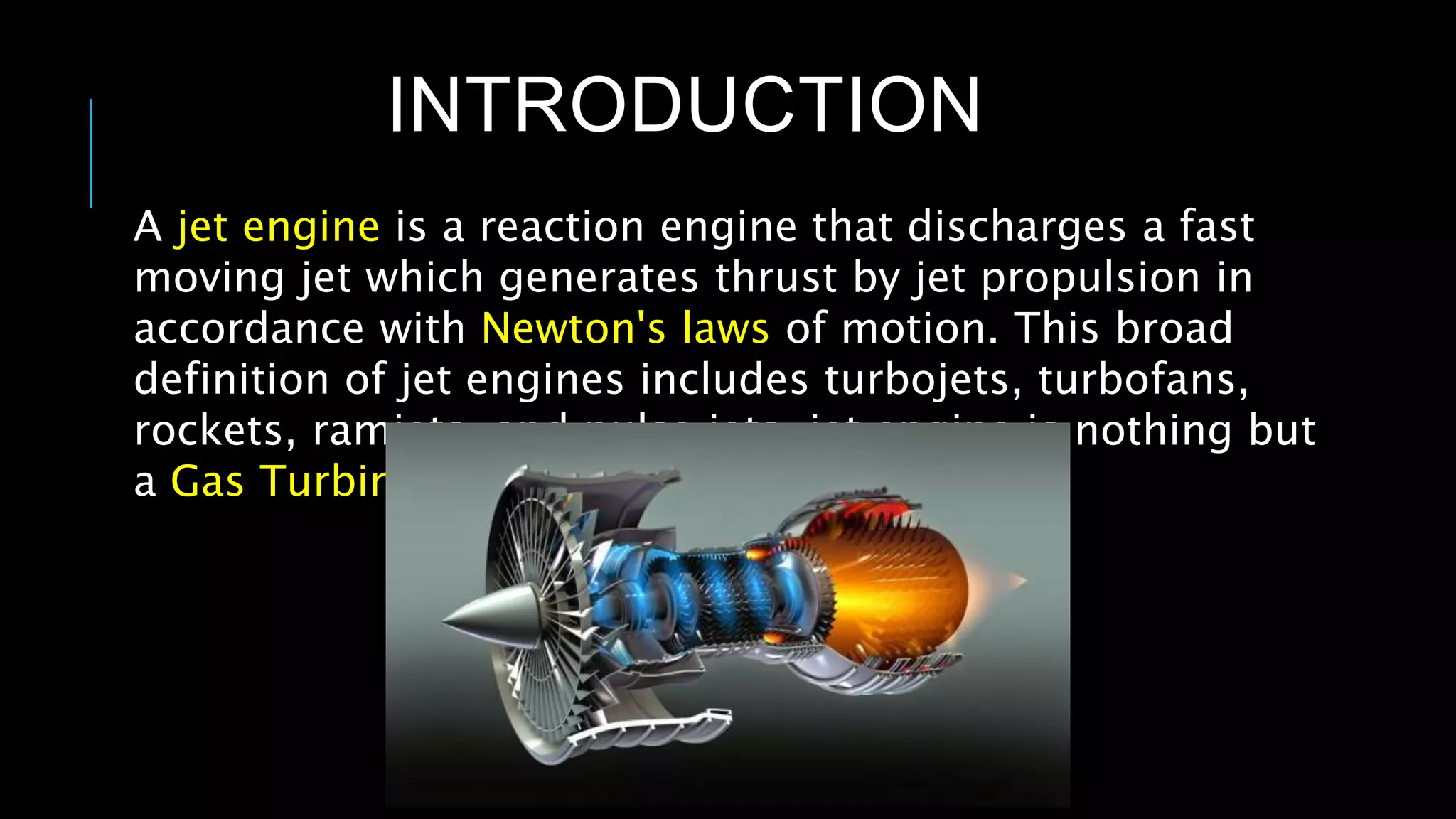
A jet engine is a reaction engine that discharges a fast
moving jet which generates thrust by jet propulsion in
accordance with Newton's laws of motion. This broad
definition of jet engines includes turbojets, turbofans,
rockets, ramjets, and pulse jets. jet engine is nothing but
a Gas Turbine.
PRINCIPLE OF JET
ENGINE
o Principle of jet engine is based on Newton’s second
and third law of motion.
o Second law states that the rate of change of momentum in anydirection is
proportional to the force acting in that direction.
o Third law states that for every action there is an equal and opposite
reaction.
TYPES OF JET ENGINE
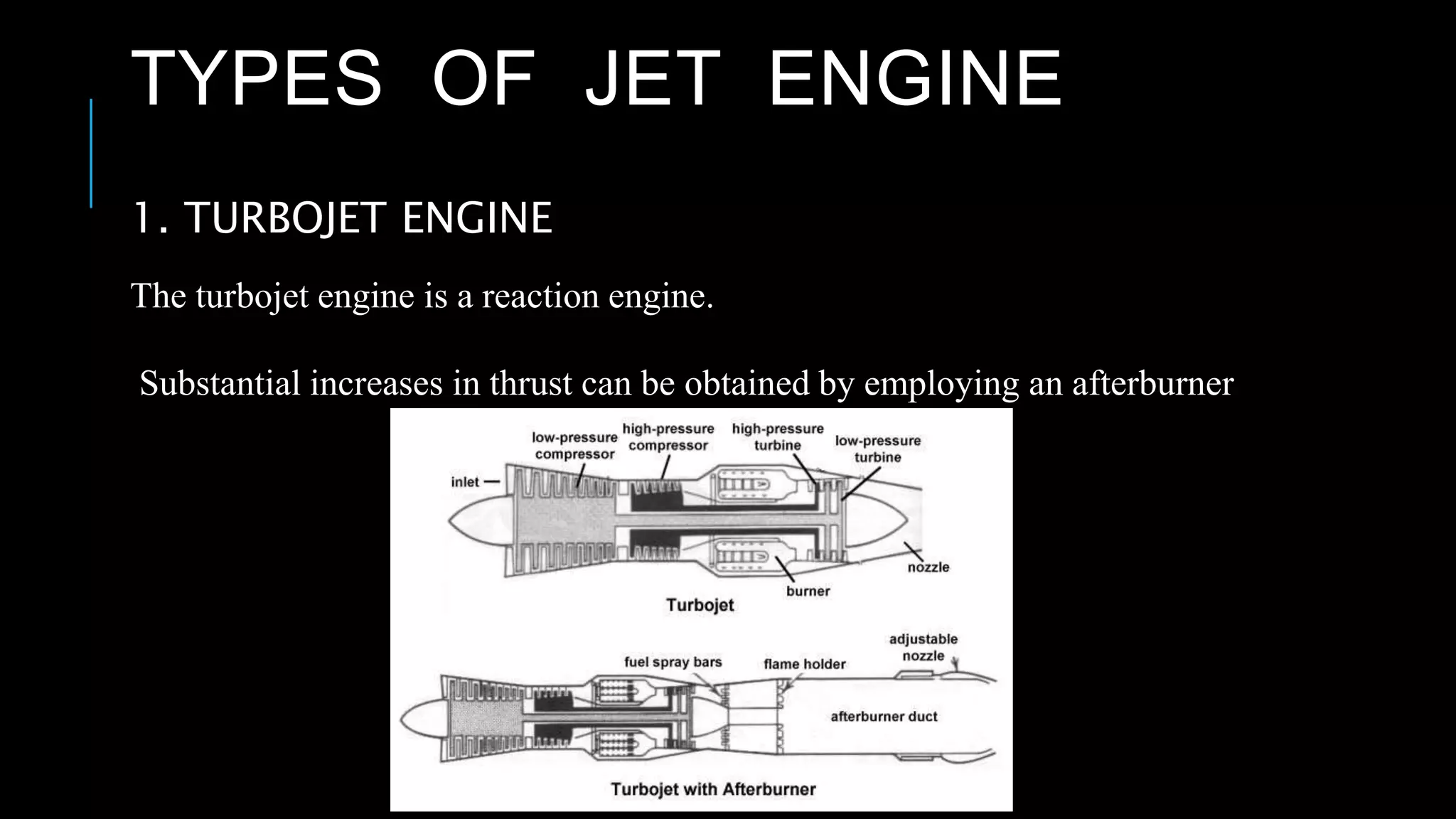
1. TURBOJET ENGINE
The turbojet engine is a reaction engine.
Substantial increases in thrust can be obtained by employing an afterburner
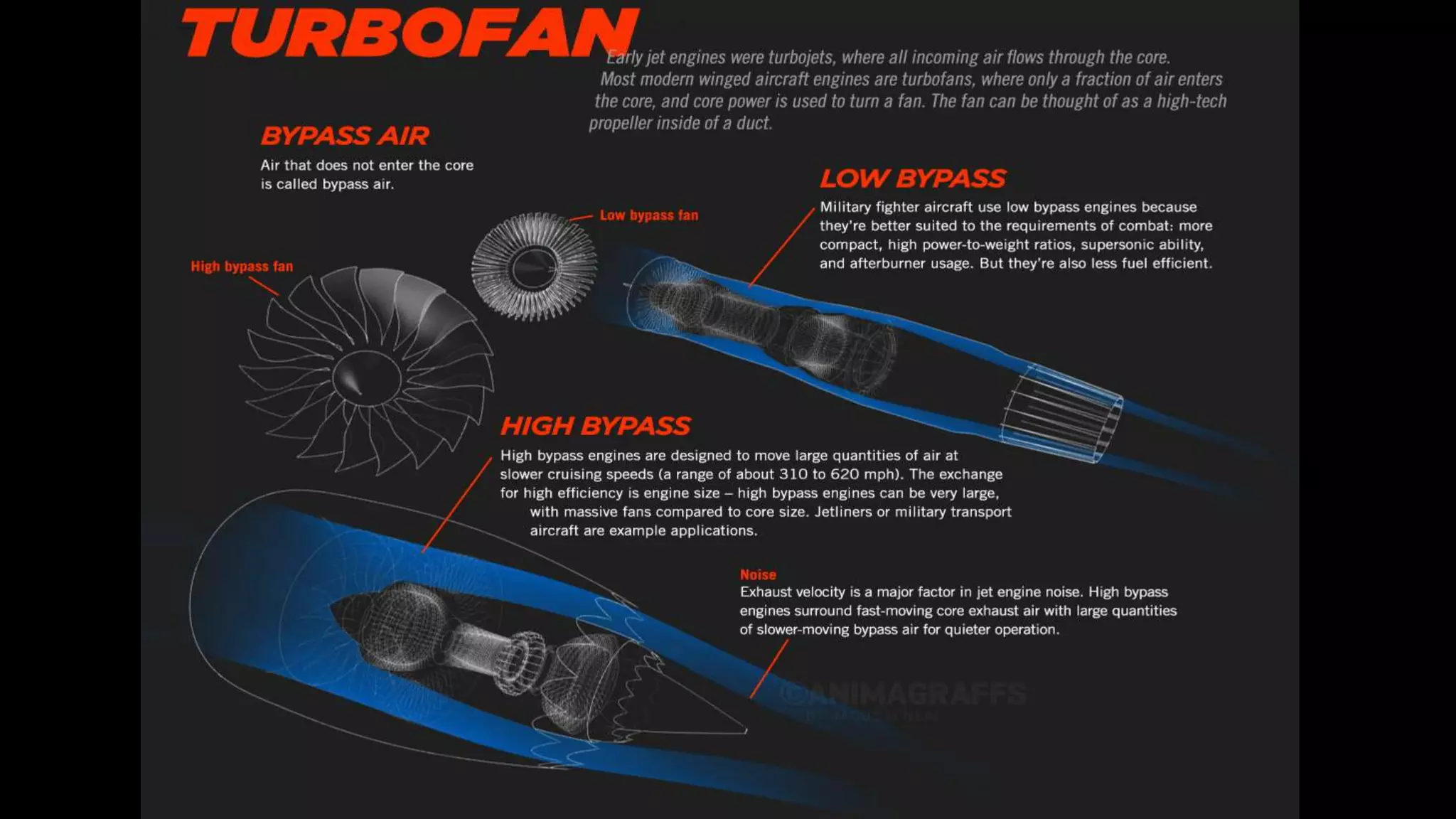
2. TURBOFAN
The word "turbofan" is combination of "turbine" and "fan":
the turbo portion refers to a gas turbine engine which takes
mechanical energy from combustion, and the fan, a ducted
fan that uses the mechanical energy from the gas turbine to
accelerate air rearwards.
3. TURBOPROP
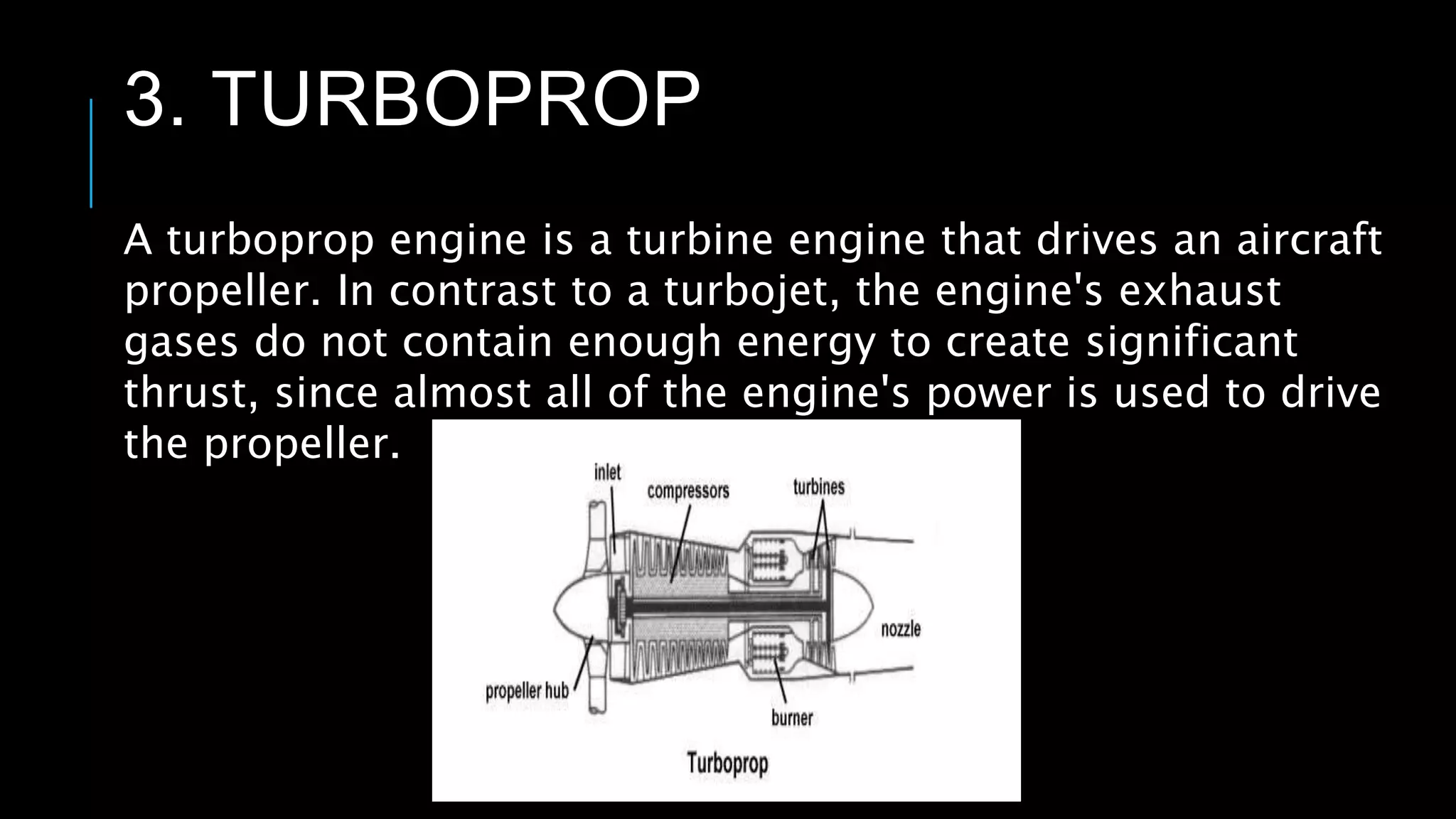
A turboprop engine is a turbine engine that drives an aircraft
propeller. In contrast to a turbojet, the engine's exhaust
gases do not contain enough energy to create significant
thrust, since almost all of the engine's power is used to drive
the propeller.
4. RAMJET
Ramjets cannot produce thrust at zero airspeed; they cannot
move an aircraft from a standstill. A ramjet-powered vehicle,
therefore, requires an assisted take-off like a rocket assist to
accelerate it to a speed where it begins to produce thrust.
Ramjets work most efficiently at supersonic speeds .
5.SCRAMJET ENGINE:
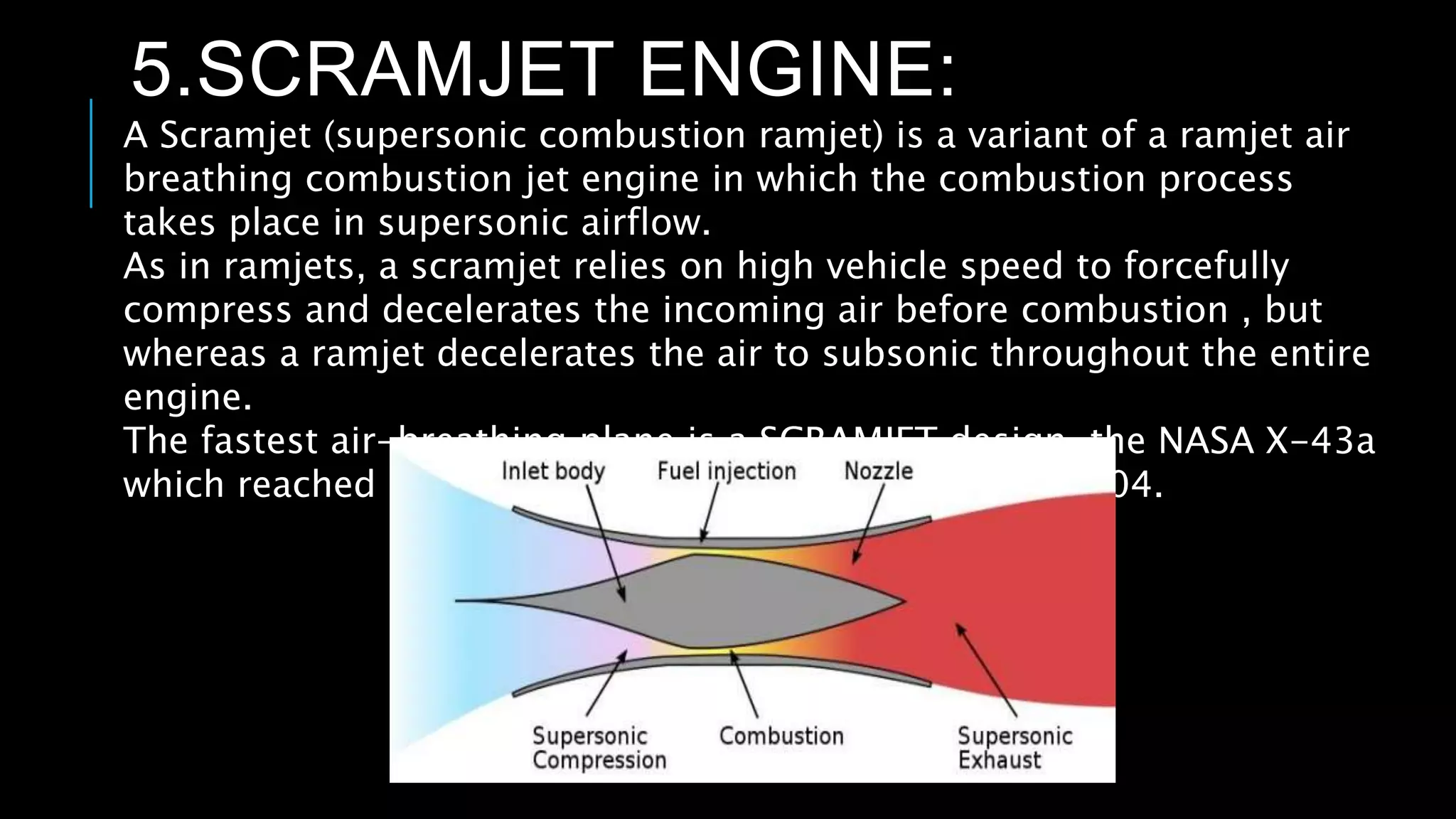
A Scramjet (supersonic combustion ramjet) is a variant of a ramjet air
breathing combustion jet engine in which the combustion process
takes place in supersonic airflow.
As in ramjets, a scramjet relies on high vehicle speed to forcefully
compress and decelerates the incoming air before combustion , but
whereas a ramjet decelerates the air to subsonic throughout the entire
engine.
The fastest air-breathing plane is a SCRAMJET design, the NASA X-43a
which reached Mach 9.6 or 12,144 km/h, on 16 Nov 2004.
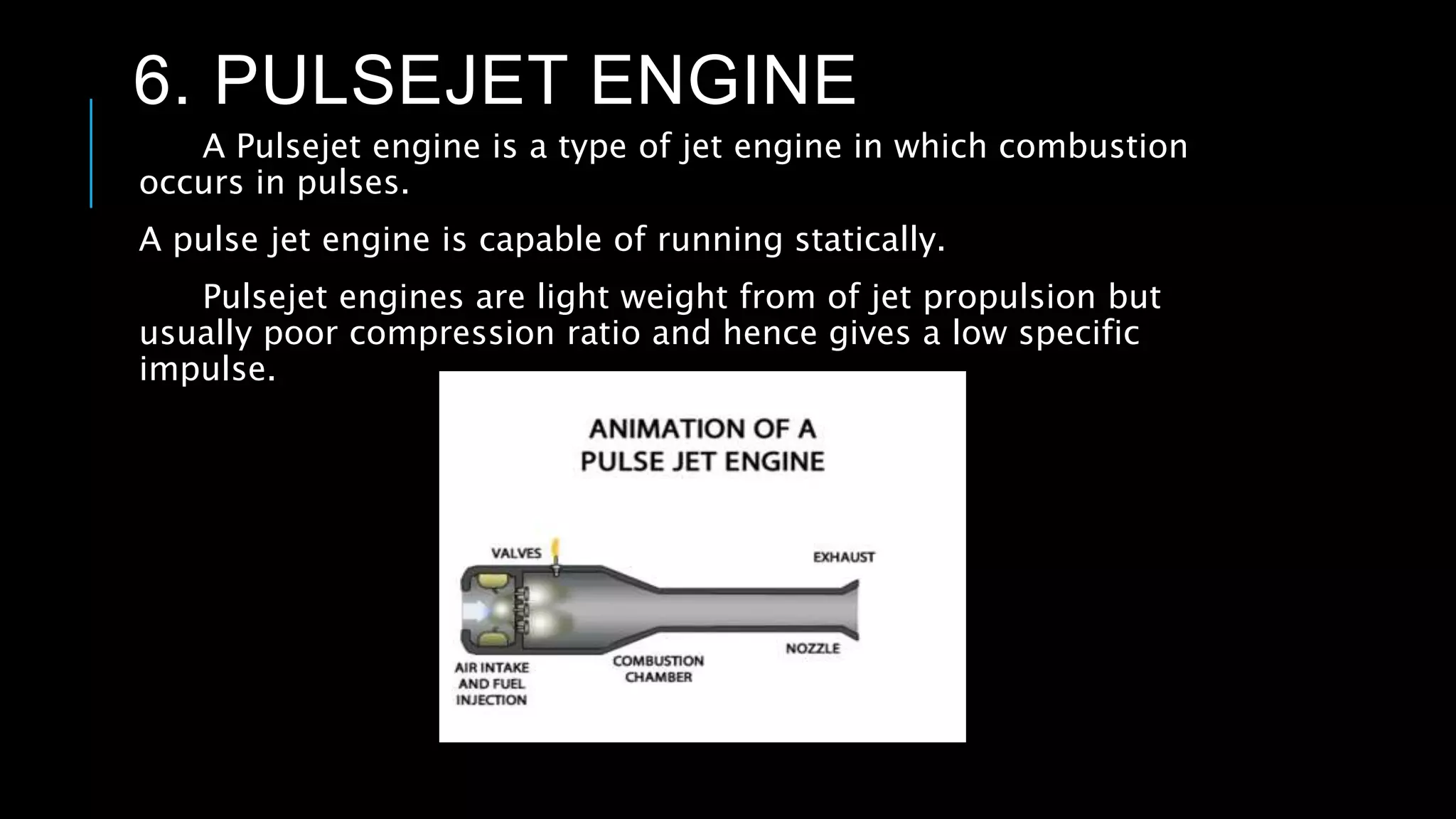
6. PULSEJET ENGINE
A Pulsejet engine is a type of jet engine in which combustion
occurs in pulses.
A pulse jet engine is capable of running statically.
Pulsejet engines are light weight from of jet propulsion but
usually poor compression ratio and hence gives a low specific
impulse.
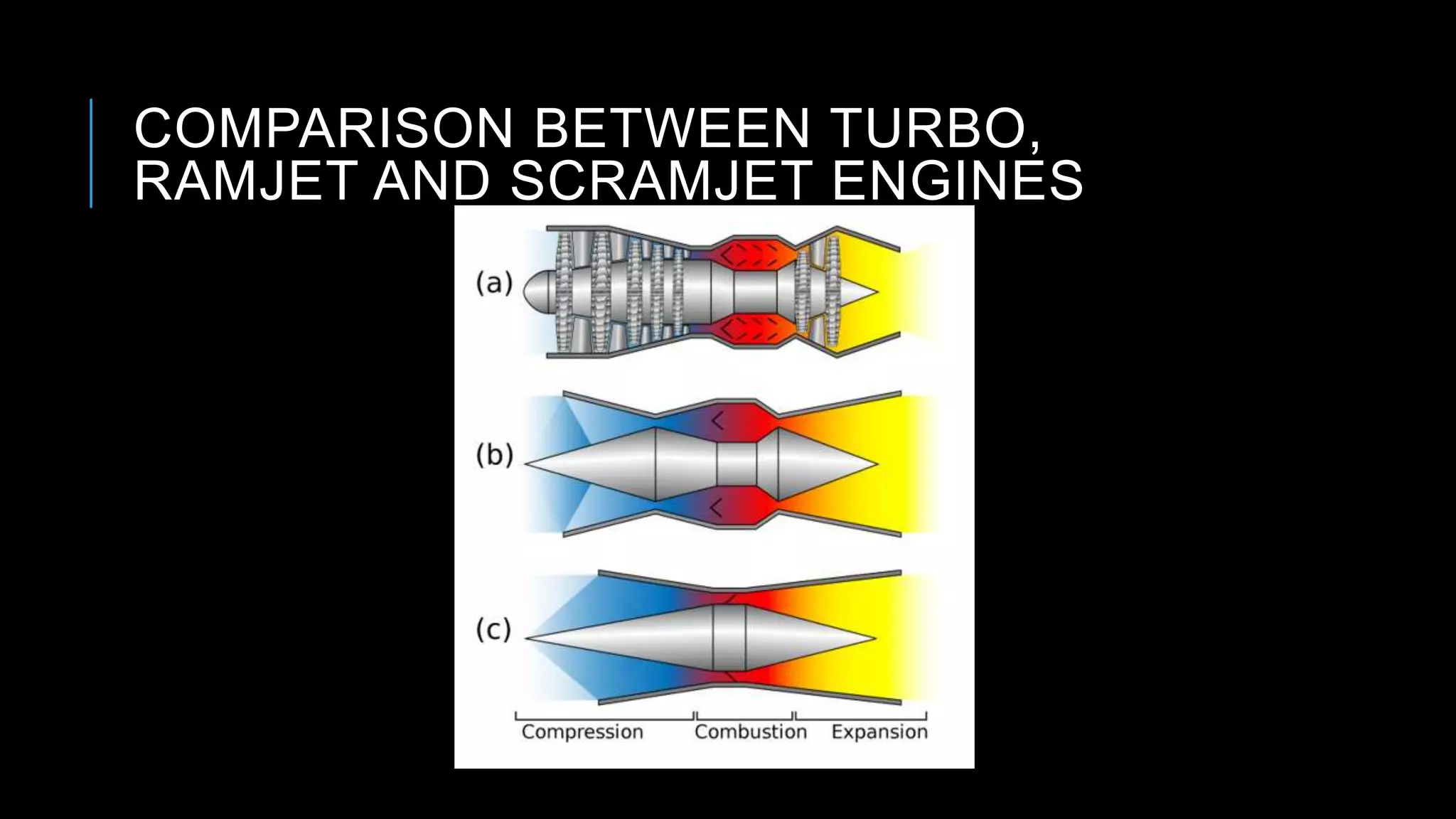
COMPARISON BETWEEN TURBO,
RAMJET AND SCRAMJET ENGINES
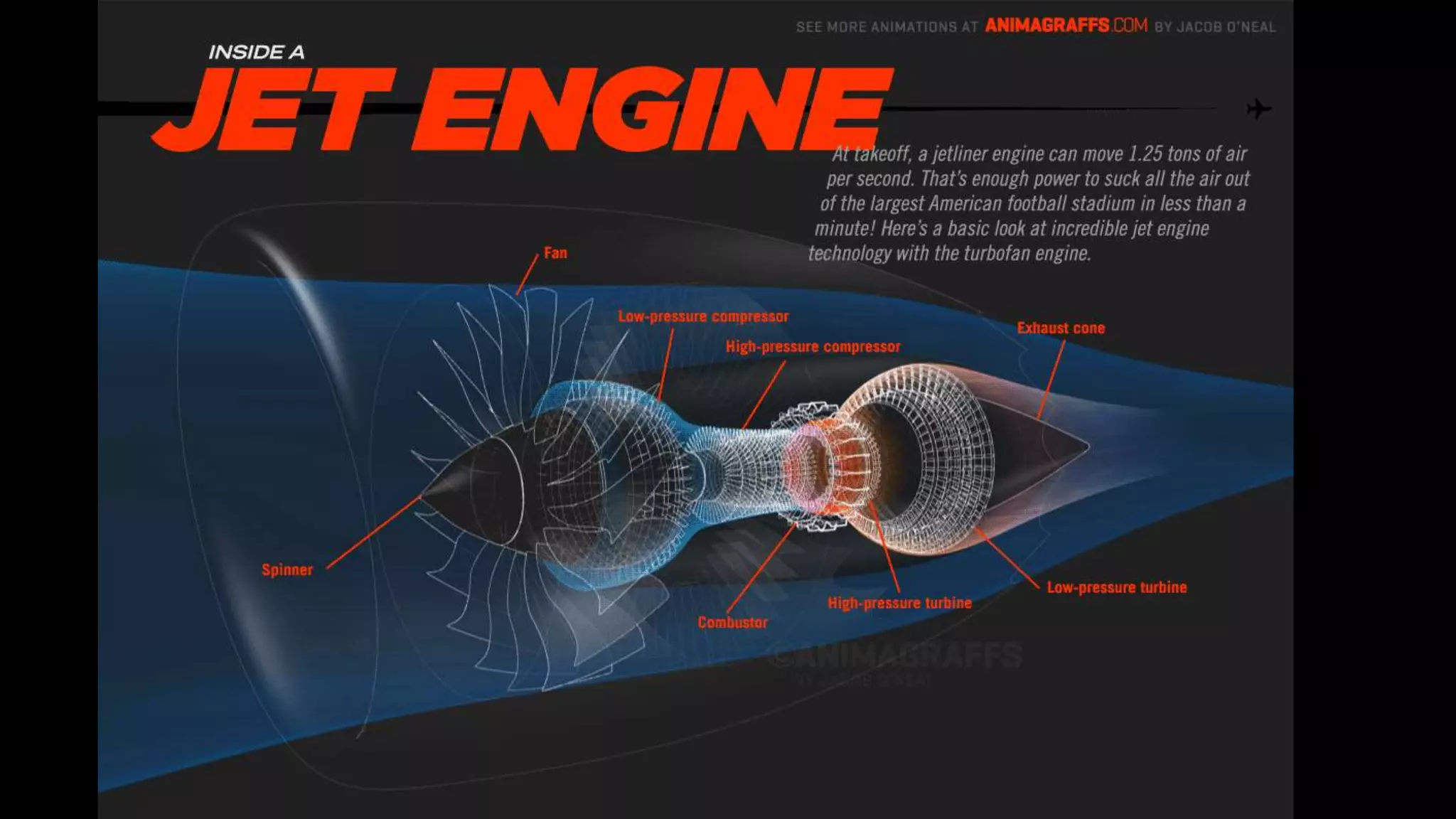
WORKING OF JET
ENGINE
GAS TURBINE PLANT
LAYOUT
SIMPLISTIC GAS TURBINES WORKING PRINCIPLES
Advantages
High power to weight ratio.
Very high speed therefore saves times.
Mechanical efficiency of jet engine is high as compared to I.C. engine.
Disadvantages
High fuel consumption.
It is difficult to design a turbine that will work in high temperature
with high speed.
Thermal efficiency of Jet engine is low compared to IC engine.
Conclusion
Jet engine works on laws of basic thermodynamics as steady flow energy
equation and Brayton cycle empowering the thought that natural resources
air can be used according to human mind for the benefit of world.
Ram type of jet engines is used only in Defence sector. Because it travels
at supersonic speed and generally high level of training is required. Since
it travels at such a high speed it cannot be used for traveling.
Net work output of a jet propulsion cycle is zero.
Thank
You

Jet Engine Types and Working

  • 1.
    A PRESENTATION ON JET ENGINE Presented By: FarmanAli 2015-UET-CCET-MECH- 17 BSc Mechanical
  • 2.
    INTRODUCTION A jet engineis a reaction engine that discharges a fast moving jet which generates thrust by jet propulsion in accordance with Newton's laws of motion. This broad definition of jet engines includes turbojets, turbofans, rockets, ramjets, and pulse jets. jet engine is nothing but a Gas Turbine.
  • 3.
    PRINCIPLE OF JET ENGINE oPrinciple of jet engine is based on Newton’s second and third law of motion. o Second law states that the rate of change of momentum in anydirection is proportional to the force acting in that direction. o Third law states that for every action there is an equal and opposite reaction.
  • 4.
    TYPES OF JETENGINE 1. TURBOJET ENGINE The turbojet engine is a reaction engine. Substantial increases in thrust can be obtained by employing an afterburner
  • 5.
    2. TURBOFAN The word"turbofan" is combination of "turbine" and "fan": the turbo portion refers to a gas turbine engine which takes mechanical energy from combustion, and the fan, a ducted fan that uses the mechanical energy from the gas turbine to accelerate air rearwards.
  • 6.
    3. TURBOPROP A turbopropengine is a turbine engine that drives an aircraft propeller. In contrast to a turbojet, the engine's exhaust gases do not contain enough energy to create significant thrust, since almost all of the engine's power is used to drive the propeller.
  • 7.
    4. RAMJET Ramjets cannotproduce thrust at zero airspeed; they cannot move an aircraft from a standstill. A ramjet-powered vehicle, therefore, requires an assisted take-off like a rocket assist to accelerate it to a speed where it begins to produce thrust. Ramjets work most efficiently at supersonic speeds .
  • 8.
    5.SCRAMJET ENGINE: A Scramjet(supersonic combustion ramjet) is a variant of a ramjet air breathing combustion jet engine in which the combustion process takes place in supersonic airflow. As in ramjets, a scramjet relies on high vehicle speed to forcefully compress and decelerates the incoming air before combustion , but whereas a ramjet decelerates the air to subsonic throughout the entire engine. The fastest air-breathing plane is a SCRAMJET design, the NASA X-43a which reached Mach 9.6 or 12,144 km/h, on 16 Nov 2004.
  • 9.
    6. PULSEJET ENGINE APulsejet engine is a type of jet engine in which combustion occurs in pulses. A pulse jet engine is capable of running statically. Pulsejet engines are light weight from of jet propulsion but usually poor compression ratio and hence gives a low specific impulse.
  • 10.
  • 11.
  • 12.
  • 13.
    SIMPLISTIC GAS TURBINESWORKING PRINCIPLES
  • 18.
    Advantages High power toweight ratio. Very high speed therefore saves times. Mechanical efficiency of jet engine is high as compared to I.C. engine. Disadvantages High fuel consumption. It is difficult to design a turbine that will work in high temperature with high speed. Thermal efficiency of Jet engine is low compared to IC engine.
  • 19.
    Conclusion Jet engine workson laws of basic thermodynamics as steady flow energy equation and Brayton cycle empowering the thought that natural resources air can be used according to human mind for the benefit of world. Ram type of jet engines is used only in Defence sector. Because it travels at supersonic speed and generally high level of training is required. Since it travels at such a high speed it cannot be used for traveling. Net work output of a jet propulsion cycle is zero.
  • 21.