A
SEMINAR REPORT
ON
“SPACECRAFT PROPULSION”
Submitted By
NAWALE NILESH AMBADAS
Exam Seat No: T120100908 Roll No: 62[B]
Under the Guidance of
PROF. DIPAK S. BAJAJ
DEPARTMENT OF MECHANICAL ENGINEERING
AMRUTVAHINI COLLEGE OF ENGINEERING
SANGAMNER-422608
2016-2017
AMRUTVAHINI COLLEGE OF ENGINEERING
SANGAMNER-422608
CERTIFICATE
This is to certify that the seminar report entitled
“SPACECRAFT PROPULSION”
Has satisfactorily completed by
NAWALE NILESH AMBADAS
(T120100908)
In partial fulfillment of term work for Third year of Mechanical Engineering in
Savitribai Phule Pune University for academic year 2016-17
Date: 18/04/2017
Place: AVCOE, Sangamner.
PROF.D.S.BAJAJ Dr.V.D.WAKCHAURE
(SEMINAR GUIDE) HEAD OF DEPT.( MECH. ENGG.)
CERTIFICATE
This is to certify that,
NAWALE NILESH AMBADAS
(T120100908)
Student of Third year Engineering were examined in the seminar report entitled
“SPACECRAFT PROPULSION”
On: 18/ 04/2017
At
Department of Mechanical Engineering
Amrutvahini College of Engineering,
Sangamner-422 608
Internal Examiner External Examiner
ACKNOWLEDGEMENT
It gives us immense pleasure in bringing out the seminar entitled ‘SPACECRAFT
PROPULSION’. I express my deep sense of gratitude and sincere regards to my seminar guide
PROF. D.S.BAJAJ his valuable supervision, cooperation and devotion of time that has given to
my seminar.
I also grateful to head of department DR. V. D. WAKCHAURE for his facilities extended
during seminar work and for his personal interest and inspiration.
I wish to express my profound thanks to DR. M. A. VENKATESH, Principal Amrutvahini
Collage of Engineering, for providing necessary facilities to make this project successful.
Finally, I should like to thank all those who directly or indirectly helped me during the
work. I also owe our sincere thanks to all faculty members of mechanical Department who have
always extended a helping hand.
NAWALE NILESH AMBADAS
(T120100908)
(T.E. Mechanical Engineering)
DATE: 18/04/2017
PLACE: AVCOE, SANGAMNER.
ABSTRACT
Spacecraft propulsion is based on jet propulsion as used by rocket motors. Propulsion in a
broad sense is the act of changing the motion of a body. Propulsion mechanisms provide a
force that moves bodies that are initially at rest, changes a velocity, or overcomes retarding
forces when a body is propelled through a medium. Jet propulsion is a means of locomotion
whereby a reaction force is imparted to a device by the momentum of ejected matter. The
burning rate of the solid rocket propellants is one of the most important factors that
determine the performance of the rocket. The burning rate of rocket motors running with
solid propellant is called flame regression, which occurs with the ignition in the fuel grain
perpendicular to the burning surface. This study investigates the effects of the addition of
metal-based high-energy matter (Aluminium) into the content of the propellant produced
within the scope of development project. The study starts with the manufacture of
propellant samples.
LIST OF FIGURES
Fig. No. Title Page No.
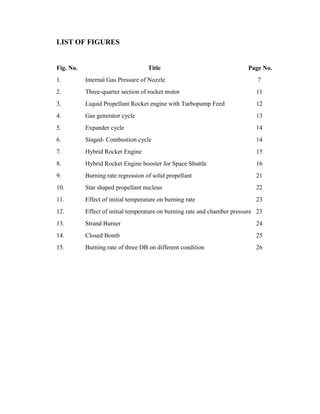
1. Internal Gas Pressure of Nozzle 7
2. Three-quarter section of rocket motor 11
3. Liquid Propellant Rocket engine with Turbopump Feed 12
4. Gas generator cycle 13
5. Expander cycle 14
6. Staged- Combustion cycle 14
7. Hybrid Rocket Engine 15
8. Hybrid Rocket Engine booster for Space Shuttle 16
9. Burning rate regression of solid propellant 21
10. Star shaped propellant nucleus 22
11. Effect of initial temperature on burning rate 23
12. Effect of initial temperature on burning rate and chamber pressure 23
13. Strand Burner 24
14. Closed Bomb 25
15. Burning rate of three DB on different condition 26
LIST OF TABLE
Table No. Title Page No.
1. Characteristic of operational solid propellant 17
2. Physical property of liquid rocket propellant 19
3. Effect of pressure on DB rocket propellant 24
4. Burning rate values of different DB rocket propellant 26
5. Energy level of DB propellant sample 27
CONTENTS
SR.NO. TITLE PAGE NO.
1. Introduction 1
1.1 Description 1
2. Literature Review 3
3. Basics of Spacecraft Propulsion 5
3.1 Types of Spacecraft Propulsion 5
3.2 Basics terms of Rocket Propulsion 6
4. Chemical Rocket Propulsion 10
4.1 Solid Rocket Propulsion 10
4.2 Liquid Rocket Propulsion 11
4.3 Hybrid Rocket Propulsion 15
5. Types of Propellants 17
6. Burning Rate of Solid Rocket Propellants 20
(Case Study)
7. Advantages and Disadvantages 28
8. Applications 30
9. Conclusion 31
References 32
SPACECRAFT PROPULSION
AVCOE, Sangamner, Mechanical Engineering
1
1. INTRODUCTION
1.1 Description
The rockets as weapons of war have been around for a long time. The Chinese are
credited with their invention and use as fire arrows in their war against the Mongol
hordes in the year 1232. The Europeans used them in the 14th and 15th century. Rockets
are not mentioned in the history books thereafter till Hyder Ali and his son Tipu Sultan
made improvements in the design and used it with telling effects on the British Army in
the famous battle of Pollilur in 1780 and also in the later Anglo-Mysore wars. Their
rockets used steel casing of 60 mm diameter and 200 mm length, which were filled with
gun powder. The steel casing allowed combustion at high pressure resulting in higher
thrust and higher range. A sword attached to the fore-end of the rocket acted as a bayonet
as well as stabilised the missile in flight. Infact, the Mysore Army under Haider Ali and
then Tipu Sultan had a dedicated rocket corps. The British were greatly impressed by
Tipu’s rockets and shipped back the spent rocket casings to England for study and
analysis. Colonel (later Sir) William Congreve was mainly responsible for the
improvements in the Mysore rockets. Consequently, the rockets came to be known as
Congreve Rockets [08].
Experimental rocketry was undertaken by Robert Goddard and he successfully flew his
liquid rocket in March 1926. Advances in rocketry came about rapidly thereafter with the
German V-2 making its presence felt emphatically in World War II. The V-2 rocket
technology and some of the scientists involved in its development provided the nucleus
for the post-war rocket and missile efforts in both Russia (then Soviet Union) and the
USA [07].
A spacecraft is a vehicle, or machine designed to fly in outer space.
Spacecraft are used for a variety of purposes, including communications, earth
observations, meteorology, navigation, space colonization, planetary exploration, and
transportation of humans and cargo. Propulsion mechanisms provide a force that moves
bodies that are initially at rest, changes a velocity, or overcomes retarding forces when a
body is propelled through a medium. Propulsion in a broad sense is the act of changing
SPACECRAFT PROPULSION
AVCOE, Sangamner, Mechanical Engineering
2
the motion of body. Spacecraft Propulsion is any method used to accelerate spacecraft
and artificial satellites. There are many different methods. Each method has drawbacks
and advantages, and spacecraft propulsion is an active area of research. However, most
spacecraft today are propelled by forcing a gas from the rear of the vehicle at very high
speed through a supersonic de laval nozzle. This sort of engine is called a rocket engine.
All current spacecraft use chemical rockets for launch, though some have used air-
breathing engines on their first stage [07].
SPACECRAFT PROPULSION
AVCOE, Sangamner, Mechanical Engineering
3
2. LITERATURE REVIEW
Shalini Chaturvedi et.al (2014 ) this article mainly discuss about AP/HTPB
composite solid propellants. Classification, components, properties, burning rate and
ignition behavior of propellants are mentioned here. Combustion of AP monopropellant,
HTPB and AP/HTPB is discussed in detail [01].
Hayri Yaman et.al (2013 ) have discussed about burning rate of the solid rocket
propellants which is one of the most important factors that determine the performance of
the rocket. The burning rate of rocket motors running with solid propellant is called flame
regression, which occurs with the ignition in the fuel grain perpendicular to the burning
surface. This study investigates the effects of the addition of metal-based high-energy
matter (Aluminum) into the content of the propellant produced within the scope of
development project. The study starts with the manufacture of propellant samples. For the
data input in the burning rate measurement device, the determination process of energy
levels of the manufactured propellant samples with a calorimeter is performed [02].
Jun Matsumoto et.al (2017 ) studied new propellant feed system referred to as a
self pressurized feed system is proposed for liquid rocket engines. The self-pressurized
feed system is a type of gas-pressure feed system; however, the pressurization source is
retained in the liquid state to reduce tank volume. The liquid pressurization source is
heated and gasified using heat exchange from the hot propellant using a regenerative
cooling strategy. The liquid pressurization source is raised to critical pressure by a
pressure booster referred to as a charger in order to avoid boiling and improve the heat
exchange efficiency. The charger is driven by a part of the generated pressurization gas
using a closed-loop self-pressurized feed system. The purpose of this study is to propose
a propellant feed system that is lighter and simpler than traditional gas pressure feed
systems [03].
C. DeLee et.al (2015 ) discussed cryogenic storage techniques such as
subcooling and the use of advanced insulation and low thermal conductivity support
SPACECRAFT PROPULSION
AVCOE, Sangamner, Mechanical Engineering
4
structures will allow for the long term storage and use of cryogenic propellants for solar
system exploration and hence allow NASA to deliver more payloads to targets of interest,
launch on smaller and less expensive launch vehicles, or both. These new cryogenic
storage technologies were implemented in a design study for the Titan Orbiter Polar
Surveyor (TOPS) mission, with LH2 and LO2 as propellants, and the resulting spacecraft
design was able to achieve a 43% launch mass reduction over a TOPS mission, that
utilized a traditional hypergolic propulsion system with monomethyl hydrazine (MMH)
and nitrogen tetroxide (NTO) propellants [04].
Fanli Shan (2013 ) HRM code for the simulation of N2O/HTPB hybrid rocket
motor operation and scale effect analysis has been developed. This code can be used to
calculate motor thrust and distribution so physical properties inside the combustion
chamber and nozzle during the operational phase by solving the unsteady Navier–Stokes
equation using a corrected compressible differences. Analysis of results suggests
improvements in combustion performance to the current hybrid rocket motor design and
explains scale effects in the variation of fuel regression rate with combustion chamber
diameter [05].
Francesco Barato et.al (2016 ) described hybrid rocket motors which is
generally to be simple from a mechanical point of view but difficult to optimize because
of their complex and still not well understood cross-coupled physics. The methodology
tightly combines together system analysis and design, numerical modelling from
elementary to sophisticated CFD, and experimental testing done with incremental
philosophy. As an example of the approach, the paper presents the experience done in the
successful development of a hybrid rocket booster designed for rocket assisted take off
operations. It is thought that following the proposed approach and selecting carefully the
most promising applications it is possible to finally exploit the major advantages of
hybrid rocket motors as safety, simplicity, low cost and reliability [06].
SPACECRAFT PROPULSION
AVCOE, Sangamner, Mechanical Engineering
5
3. BASICS OF SPACECRAFT PROPULSION
3.1 Types of Spacecraft Propulsion
Spacecraft propulsion is based on jet propulsion as used by rocket motors.
3.1.1 Jet Propulsion
Jet propulsion is a means of locomotion whereby a reaction force is imparted to a device
by the momentum of ejected matter.
1. Rocket Propulsion
Rocket propulsion is a class of jet propulsion that produces thrust by ejecting stored
matter, called the propellant.
2. Duct Propulsion
Duct propulsion is a class of jet propulsion and includes turbojets and ramjets; these
engines are also commonly called air- breathing engines. Duct propulsion devices utilize
mostly the surrounding medium as the working fluid, together with some stored fuel.
3.1.2 Types of Rocket Propulsion
Rocket propulsion systems can be classified according to the type of energy source
(chemical, nuclear, or solar), the basic function (booster stage, attitude control, orbit
station keeping, etc.), the type of vehicle (aircraft, missile, assisted take-off, space
vehicle, etc.), size, type of propellant, type of construction, or number of rocket
propulsion units used in a given vehicle. Classification is given below according to the
type of energy source,
1. Chemical Propulsion
The energy from a high-pressure combustion reaction of propellant chemicals, usually a
fuel and an oxidizing chemical, permits the heating of reaction product gases to very high
temperatures (2500 to 4100°C). These gases subsequently are expanded in a nozzle and
accelerated to high velocities (1800 to 4300 m/sec). According to the physical state of the
propellant, there are several different classes of chemical rocket propulsion devices [9].
SPACECRAFT PROPULSION
AVCOE, Sangamner, Mechanical Engineering
6
2. Electric Rocket Propulsion
In all electric propulsion the source of the electric power is physically separate from the
mechanism that produces the thrust. This type of propulsion has been handicapped by
heavy and inefficient power sources. The thrust usually is low, typically 0.005 to 1 N. In
order to allow a significant increase in the vehicle velocity, it is necessary to apply the
low thrust and thus a small acceleration for a long time. There are three types, viz.,
Electrothermal, Electrostatic, and Electromagnetic [9].
3. Nuclear Rocket Propulsion
Three different types of nuclear energy sources have been investigated for delivering heat
to a working fluid, usually liquid hydrogen, which subsequently can be expanded in a
nozzle and thus accelerated to high ejection velocities (6000 to 10,000 m/sec). However,
none can be considered fully developed today and none have flown. They are the fission
reactor, the radioactive isotope decay source, and the fusion reactor. All three types are
basically extensions of liquid propellant rocket engines. The heating of the gas is
accomplished by energy derived from transformations within the nuclei of atoms. In the
nuclear fission reactor rocket, heat can be generated by the fission of uranium in the solid
reactor material and subsequently transferred to the working fluid. The nuclear fission
rocket is primarily a high-thrust engine (above 40,000 N) with specific impulse values up
to 900 sec.
To date none have been tested and many concepts are not yet feasible or practical.
Concerns about an accident with the inadvertent spreading of radioactive materials in the
earth environment and the high cost of development programs have to date prevented a
renewed experimental development of a large nuclear rocket engine. Unless there are
some new findings and a change in world attitude, it is unlikely that a nuclear rocket
engine will be developed or flown in the next few decades [9].
3.2 Basics terms of Rocket Propulsion
Propulsion is achieved by applying a force to a vehicle, that is, accelerating vehicle or
SPACECRAFT PROPULSION
AVCOE, Sangamner, Mechanical Engineering
7
alternatively, maintaining a given velocity against a resisting force. This propulsive force
is obtained by ejecting propellant at high velocity.
3.2.1 Thrust
Fig.1 Internal Gas Pressure Forces On Nozzle [07].
The thrust is the force produced by a rocket propulsion system acting upon a vehicle. In a
simplified way, it is the reaction experienced by its structure due to the ejection of matter
at high velocity.
Rocket thrust is generated by momentum exchange between the exhaust and the vehicle
and by the pressure imbalance at the nozzle exit. The thrust due to momentum exchange
can be derived from Newton's second law. The thrust and the mass flow are constant and
the gas exit velocity is uniform and axial.
𝐹 =
𝑑𝑚
𝑑𝑡
𝑣2
𝐹 = 𝑚̇ 𝑣2
𝐹 =
𝑤̇
𝑔0
𝑣2, 𝑁
SPACECRAFT PROPULSION
AVCOE, Sangamner, Mechanical Engineering
8
This force represents the total propulsion force when the nozzle exit pressure equals the
ambient pressure.
Because of a fixed nozzle geometry and changes in ambient pressure due to variations in
altitude, there can be an imbalance of the external environment or atmospheric pressure
𝑝3 and the local pressure 𝑝2 of the hot gas jet at the exit plane of the nozzle. Thus, for a
steadily operating rocket propulsion system moving through a homogeneous atmosphere,
the total thrust is equal to,
𝐹 = 𝑚̇ 𝑣2 + (𝑝2 − 𝑝3)𝐴2
The first term is the momentum thrust represented by the product of the propellant mass
flow rate and its exhaust velocity relative to the vehicle. The second term represents the
pressure thrust consisting of the product of the cross-sectional area at the nozzle exit 𝐴2
and the difference between the exhaust gas pressure at the exit and the ambient fluid
pressure.
In the vacuum of space𝑝3 = 0, and the thrust becomes,
𝐹 = 𝑚̇ 𝑣2 + 𝑝2 𝐴2
3.2.2 Specific Impulse
The specific impulse 𝐼𝑠 is the total impulse per unit weight of propellant. It is an
important figure of merit of the performance of a rocket propulsion system, similar in
concept to the miles per gallon parameter used with automobiles. A higher number means
better performance.If the total mass flow rate of propellant is 𝑚̇ and the standard
acceleration of gravity at sea level 𝑔0 is 9.8066 𝑚/𝑠𝑒𝑐2
, then [7]
𝐼𝑆 =
∫ 𝐹 𝑑𝑡
𝑡
0
𝑔0 ∫ 𝑚 𝑑𝑡̇
This equation will give a time-averaged specific impulse value for any rocket propulsion
system, particularly where the thrust varies with time. During transient conditions values
of Is can be obtained by integration or by determining average values for F and 𝑚̇ for
SPACECRAFT PROPULSION
AVCOE, Sangamner, Mechanical Engineering
9
short time intervals. For constant thrust and propellant flow this equation can be
simplified; below, 𝑚 𝑝 is the total effective propellant mass.
𝐼𝑠 =
𝐼𝑡
𝑚 𝑝 𝑔0
, 𝑠𝑒𝑐
𝐼𝑠 =
𝐼𝑡
𝑤
, 𝑠𝑒𝑐
It is also defined as the ratio of thrust developed by rocket to the weight flow rate of
propellant.
𝐼𝑆 =
𝐹
𝑚̇ 𝑔0
=
𝐹
𝑤̇
, 𝑠𝑒𝑐
The product 𝑚̇ 𝑔0 is the total effective propellant weight w and the weight flow rate is 𝑤̇ .
3.2.3 Effective Exhaust Velocity
In a rocket nozzle the actual exhaust velocity is not uniform over the entire exit cross-
section and does not represent the entire thrust magnitude. The velocity profile is difficult
to measure accurately. For convenience a uniform axial velocity c is assumed which
allows a one-dimensional description of the problem. This effective exhaust velocity c is
the average equivalent velocity at which propellant is ejected from the vehicle. It is
defined as, [7]
𝑐 = 𝐼𝑠 𝑔0
𝑐 =
𝐹
𝑚̇
, 𝑚/𝑠𝑒𝑐
SPACECRAFT PROPULSION
AVCOE, Sangamner, Mechanical Engineering
10
4. CHEMICAL ROCKET PROPULSION
The energy to produce thrust is stored in the propellant, which is released by chemical
reactions and the propellant is then accelerated to a high velocity by expanding it in form
of gas through a nozzle. Chemical Propulsion is based on the principle of converting
chemical energy into kinetic energy of the exhaust gases in a nozzle of a rocket
propulsion device. Typically, rockets using solid propellants are called motors and
rockets using liquids are called engines [1].
4.1 Types of Chemical Rocket Propulsion
4.1.1 Solid Rocket Propulsion
In solid propellant rocket motors-and the word "motor" is as common to solid rockets as
the word "engine" is to liquid rockets-the propellant is contained and stored directly in
the combustion chamber. Historically, solid propellant rocket motors have been credited
with having no moving parts. This is still true of many, but some motor designs include
movable nozzles and actuators for vectoring the line of thrust relative to the motor axis.
In comparison to liquid rockets, solid rockets are usually relatively simple, are easy to
apply, and require little servicing; they can- not be fully checked out prior to use, and
thrust cannot usually be randomly varied in flight. Almost all rocket motors are used only
once. The hardware that remains after all the propellant has been burned and the mission
completed namely, the nozzle, case, or thrust vector control device is not reusable. In
very rare applications, such as the Shuttle solid booster, is the hardware recovered,
cleaned, refurbished, and reloaded; reusability makes the design more complex, but if the
hardware is reused often enough a major cost saving will result.
In solid propellant rocket motors the propellant to be burned is contained within the
combustion chamber or case. The solid propellant charge is called the grain and it
contains all the chemical elements for complete burning. Once ignited, it usually burns
smoothly at a predetermined rate on all the exposed internal surfaces of the grain. Initial
burning takes place at the internal surfaces of the cylinder perforation and the four slots.
The internal cavity grows as propellant is burned and consumed. The resulting hot gas
SPACECRAFT PROPULSION
AVCOE, Sangamner, Mechanical Engineering
11
Fig.2 Three-quarter section of solid rocket motor [07]
flows through the supersonic nozzle to impart thrust. Once ignited, the motor combustion
proceeds in an orderly manner until essentially all the propellant has been consumed.
There are no feed systems or valves [7].
4.1.2 Liquid Rocket Propulsion
Liquid propellant rocket engines use liquid propellants that are fed under pressure from
tanks into a thrust chamber The liquid bipropellant consists of a liquid oxidizer (e.g.,
liquid oxygen) and a liquid fuel (e.g., kerosene). A monopropellant is a single liquid that
contains both oxidizing and fuel species; it decomposes into hot gas when properly
catalyzed. A large turbopump-fed liquid propellant rocket engine is shown in Fig. Gas
pressure feed systems are used mostly on low thrust, low total energy propulsion systems,
such as those used for attitude control of flying vehicles, often with more than one thrust
chamber per engine. Pump-fed liquid rocket systems are used typically in applications
with larger amounts of propellants and higher thrusts, such as in space launch vehicles
[3].
SPACECRAFT PROPULSION
AVCOE, Sangamner, Mechanical Engineering
12
Fig.3 Liquid propellant rocket engine with a turbopump feed system and a separate gas
generator, which generates warm gas for driving the turbine[07].
Here the propellants are pressurized by means of pumps, which in turn are driven by
turbines. These turbines derive their power from the expansion of hot gases. Engines with
turbopumps are preferred for booster and sustainer stages of space launch vehicles, long
range missiles, and in the past also for aircraft performance augmentation. They are
usually lighter than other types for these high thrust, long duration applications.
An engine cycle for turbopump-fed engines describes the specific propellant flow paths
through the major engine components, the method of providing the hot gas to one or
more turbines, and the method of handling the turbine exhaust gases. There are open
SPACECRAFT PROPULSION
AVCOE, Sangamner, Mechanical Engineering
13
cycles and closed cycles. Open denotes that the working fluid exhausting from the turbine
is discharged overboard, after having been expanded in a nozzle of its own, or discharged
into the nozzle of the thrust chamber at a point in the expanding section far downstream
of the nozzle throat. In closed cycles or topping cycles all the working fluid from the
turbine is injected into the engine combustion chamber to make the most efficient use of
its remaining energy. The overall engine performance difference is typically between 1
and 8% of specific impulse and this is reflected in even larger differences in vehicle
performance [7].
4.1.3 Types of Liquid Propellant Rocket Engine Fed Cycle
1.Gas Generator Cycle
Fig.4, Gas Generator Cycle[07]
In the gas generator cycle the turbine inlet gas comes from a separate gas generator. This
cycle is relatively simple; the pressures in the liquid pipes and pumps are relatively low.
It has less engine-specific impulse than an expander cycle or a staged combustion cycle.
Alternatively, this turbine exhaust can be aspirated into the main flow through openings
in the diverging nozzle section [9]
2. Expander Cycle
In the expander cycle most of the engine coolant (usually hydrogen fuel) is fed to low-
SPACECRAFT PROPULSION
AVCOE, Sangamner, Mechanical Engineering
14
pressure-ratio turbines after having passed through the cooling jacket where it picked up
Fig.5 Expander Cycle [07]
energy. Part of the coolant, perhaps 5 to 15%, bypasses the turbine and re-joins the
turbine exhaust flow before the entire coolant flow is injected into the engine combustion
chamber where it mixes and burns with the oxidizer. The primary advantages of the
expander cycle are good specific impulse, engine simplicity, and relatively low engine
mass. In the expander cycle all the propellants are fully burned in the engine combustion
chamber and expanded efficiently in the engine exhaust nozzle [9].
3. Staged Combustion Cycle
Fig.6 Staged- Combustion Cycle [07]
SPACECRAFT PROPULSION
AVCOE, Sangamner, Mechanical Engineering
15
In the staged combustion cycle, the coolant flow path through the cooling jacket is the
same as that of the expander cycle. Here a high-pressure pre-combustor (gas generator)
burns all the fuel with part of the oxidizer to provide high-energy gas to the turbines. The
total turbine exhaust gas flow is injected into the main combustion chamber where it
burns with the remaining oxidizer. This cycle lends itself to high-chamber-pressure
operation, which allows a small thrust chamber size. The extra pressure drop in the pre-
combustor and turbines causes the pump discharge pressures of both the fuel and the
oxidizer to be higher than with open cycles, requiring heavier and more complex pumps,
turbines, and piping. The turbine flow is relatively high and the turbine pressure drop is
low, when compared to an open cycle. The staged combustion cycle gives the highest
specific impulse, but it is more complex and heavy. In contrast, an open cycle can allow a
relatively simple engine, lower pressures, and can have a lower production cost [9].
4.1.3 Hybrid Rocket Propulsion
Fig.7 Simplified schematic diagram of a typical hybrid rocket engine [07].
Rocket propulsion concepts in which one component of the propellant is stored in liquid
phase while the other is stored in solid phase are called hybrid propulsion systems. Such
systems most commonly employ a liquid oxidizer and solid fuel. Various combinations
of solid fuels and liquid oxidizers as well as liquid fuels and solid oxidizers have been
experimentally evaluated for use in hybrid rocket motors [6].
SPACECRAFT PROPULSION
AVCOE, Sangamner, Mechanical Engineering
16
Fig.8 Hybrid Rocket Booster. It has an inert solid fuel grain, a pressurized liquid oxygen
feed system [05]
The main advantages of a hybrid rocket propulsion system are:
(1) safety during fabrication, storage, or operation without any possibility of explosion or
detonation; (2) start-stop-restart capabilities; (3) relatively low system cost; (4) higher
specific impulse than solid rocket motors and higher density-specific impulse than liquid
bipropellant engines; and (5) the ability to smoothly change motor thrust over a wide
range on demand.
The disadvantages of hybrid rocket propulsion systems are:
(1) mixture ratio and, hence, specific impulse will vary somewhat during steady-state
operation and throttling [6].
SPACECRAFT PROPULSION
AVCOE, Sangamner, Mechanical Engineering
17
5. TYPES OF PROPELLANTS
5.1 Solid Propellants
Propellants are to be classified by specific applications, such as space launch booster
propellants or tactical missile propellants; each has somewhat specific chemical
ingredients, different burning rates, different physical properties, and different
performance. Propellants for rocket motors have hot (over 2400 K) gases and are used to
produce thrust, but gas generator propellants have lower-temperature combustion gases
(800 to 1200 K) and they are used to produce power, not thrust. Historically, the early
rocket motor propellants used to be grouped into two classes: double-base (DB)
propellants were used as the first production propellants, and then the development of
polymers as binders made the composite propellants feasible [1].
Now a days most commonly used solid propellants are AP/HTPB (Ammonium
Perchlorate/Hydroxyl Terminated Poly Butadiene ), HTPB.
Table 1 Characteristics of Some Operational Solid Propellants [07]
Propellant
Type
Specific
Impulse(𝑰 𝑺)
Range (sec)
Flame Temp.
(°𝒌)
Metal Content
(wt %)
Burning Rate
(in./sec)
DB 220-230 2550 0 0.05-1.2
DB/AP/Al 260-265 3880 20-21 0.2-1.0
PVC/AP/Al 260-265 3380 21 0.3-0.9
CTPB/AP/Al 260-265 3440 15-17 0.25-2.0
HTPB/AP/Al 260-265 3440 4-17 0.25-1.3
DB- Double Base, AP-Ammonium Perchlorate, Al- Aluminium, PVC- Polyvinyl
Chloride, CTPB- Carboxyl Terminated Polybutadiene, HTPB- Hydroxyl Terminated
Poybutadiene.
5.1.1 Propellant Characteristics
1. High performance or high specific impulse; really this means high gas temperature
and/or low molecular mass.
SPACECRAFT PROPULSION
AVCOE, Sangamner, Mechanical Engineering
18
2. Predictable, reproducible, and initially adjustable burning rate to fit the need of the
grain design and the thrust-time requirement.
3. For minimum variation in thrust or chamber pressure, the pressure or burning rate
exponent and the temperature coefficient should be small.
4. Low technical risk.
6. Non-toxic exhaust gases. Not prone to combustion instability [9]
5.2 Liquid Propellants
Liquid Propellants are classified as liquid oxidizers, liquid fuels and liquid
monopropellant. Liquid oxidizers are such as liquid oxygen (𝑂2), Hydrogen Peroxide
(𝐻2 𝑂2), Nitric Acid (HN𝑂3), Nitrogen Tetroxide (𝑁2 𝑂4). Liquid fuels are, liquid
hydrogen (𝐻2), Hydrazine (𝑁2 𝐻4), Unsymmetrical Dimethyl Hydrazine (UDMH),
Monomethyl Hydrazine (MMH) and liquid monopropellant are hydrazine, Hydroxyl
Ammonium Nitrate (HAN) [8].
Today we commonly use liquid bipropellant combinations. They are:
(1) The cryogenic oxygen-hydrogen propellant system, used in upper stages and
sometimes booster stages of space launch vehicles; it gives the highest specific impulse
for a non-toxic combination, which makes it best for high vehicle velocity missions [4].
(2) The liquid oxygen-hydrocarbon propellant combination, used for booster stages (and
a few second stages) of space launch vehicles; its higher average density allows a more
compact booster stage, when com- pared to the first combination; also, historically, it was
developed before the first combination and was originally used for ballistic missiles [4].
SPACECRAFT PROPULSION
AVCOE, Sangamner, Mechanical Engineering
19
Table 2 Some Physical Properties of Several Common Liquid Propellants [08]
5.3 Hybrid Propellants
Hybrid propulsion is well suited to applications or missions requiring throttling,
command shutdown and restart, long-duration missions requiring storable nontoxic
propellants, or infrastructure operations that would benefit from a non-self-deflagrating
propulsion system. Such applications would include primary boost propulsion for space
launch vehicles, upper stages, and satellite maneuvering systems [5].
The propellant system of choice for large hybrid booster applications is liquid oxygen
(LOX) oxidizer and HTPB fuel. Liquid oxygen is a widely used oxidizer in the space
launch industry, is relatively safe, and delivers high performance at low cost. This hybrid
propellant combination produces a nontoxic, relatively smoke-free exhaust. The
LOX/HTPB propellant combination favored for booster applications is chemically and
performance-wise equivalent to a LOX-kerosene bipropellant system [6].
Propellant Hydrazine Liquid
Hydrogen
Monomethyl-
hydrazine
Nitrogen
Tetroxide
Liquid
Oxygen
UDMH
Chemical
Formula
𝑁2 𝐻4 𝐻2 𝐶𝐻3 𝑁𝐻𝑁𝐻2 𝑁2 𝑂4 LOX (𝐶𝐻3)2 𝑁𝑁𝐻2
Boiling
Point (k)
386.66 20.4 360.6 294.3 90.0 336
Melting or
Freezing
Point (k)
274.69 14.0 220.7 261.95 54.4 216
Specific
Heat
(kcal/kg-k)
0.736
(293 k)
1.75
(20.4 k)
0.698
(293 k)
0.374
(290 k)
0.4
(65 k)
0.672
(298 k)
SPACECRAFT PROPULSION
AVCOE, Sangamner, Mechanical Engineering
20
6. EXPERIMENTAL INVESTIGATION OF THE FACTOR
AFFECTING THE BURNING RATE OF SOLID ROCKET
PROPELLANTS (CASE STUDY) [02]
The burning rate of the solid rocket propellants is one of the most important factors that
determine the performance of the rocket. The burning rate of rocket motors running with
solid propellant is called flame regression, which occurs with the ignition in the fuel grain
perpendicular to the burning surface. This study investigates the effects of the addition of
metal-based high-energy matter (Aluminum) into the content of the propellant produced
within the scope of development project.
The burning rate of a solid propellant is expressed as the regression of propellant
perpendicularly from the center of the nucleus. The burning rate of the solid propellants
varies depending on many factors, such as the combustion chamber pressure, the initial
temperature of solid propellant before the ignition, the percentage of high-energy matters
in the propellant content, the burn sensation of the flammable substance, the additional
chemical substances regulating the burning rate, and the percentage of the amount of
oxidizing agent. Burning which starts from the nucleus in motors of the solid rocket
propellant progresses in a direction perpendicular to the outside surface of the propellant.
As the burning progresses perpendicularly, the viscosity of the propellant lessens. The
amount of reduction in the thickness of the propellant per unit of time is expressed as the
burning rate.
In the design of the rocket engine, the specific impulse (𝐼𝑆), the burning rate (r), the
propellant density (𝜌 𝑏), the combustion chamber pressure (𝑃𝑐), the intended thrust force
(F),the maximum engine pipe diameter (D), the burning surface area(𝐴 𝑏), the nozzle
cross-sectional area (𝐴 𝑡), and the total mass of the engine should be determined carefully.
The mathematical representation of burning rate of solid rocket propellant and factors
affecting burning rate is given by,
𝐿𝑖𝑛𝑒𝑎𝑟 𝐵𝑢𝑟𝑛𝑖𝑛𝑔 𝑅𝑎𝑡𝑒 =
𝑆𝑜𝑙𝑖𝑑 𝑃𝑟𝑜𝑝𝑒𝑙𝑙𝑒𝑛𝑡 (𝑚𝑚)
𝐵𝑢𝑟𝑛𝑖𝑛𝑔 𝐷𝑢𝑟𝑎𝑡𝑖𝑜𝑛 (𝑠)
𝑟 =
𝑑𝑤
𝑑𝑡
SPACECRAFT PROPULSION
AVCOE, Sangamner, Mechanical Engineering
21
The solid propellant burning rate equation known as Vielle’s Law is,
𝑟 = 𝑘𝑃𝑐
𝑛
The burning rate (r) essentially depends on the initial temperature of propellant and
pressure of the combustion chamber. 𝑃𝑐 combustion chamber pressure, k initial constant
temperature of the solid and its value vary between 0.002 and 0.05, n which is called as
the pressure index or pressure base is a function of the solid propellant formulation. In
double base (DB) propellants, the value of n is between 0.2 and 0.5 and in AP
(Ammonium Perchlorate) based composite fuels, the value of n is relatively lower,
varying from 0.1 to 0.4.
The burning rate of propellant in a motor is a function of many parameters and at any
instant governs the mass flow rate 𝑚̇ of hot gas generated and flowing from the motor
(steady combustion):
𝑚̇ = 𝐴 𝑏 𝑟𝜌 𝑏
Here (𝐴 𝑏) is the burning the burning area of the propellant grain, (r) the burning rate, and
(𝜌 𝑏) the solid propellant density prior to motor start. The total mass (m) of effective
propellant burned can be determined by integrating equation:
𝑚 = ∫ 𝑚̇ 𝑑𝑡 = 𝜌 𝑏 ∫ 𝐴 𝑏 𝑑𝑡
6.1 Burning in solid propellants
Fig.9 Burning rate regression of solid propellant from the nucleus [02].
SPACECRAFT PROPULSION
AVCOE, Sangamner, Mechanical Engineering
22
The burning rate in rocket motors running with solid propellants is expressed as a
regression from the combustion surface in terms of time. As seen in Fig.9, the burning
rate of solid propellants can be accepted as the burning distance per unit of time.
Generally, mm/s, cm/s and inch/s are used as the units of burning rate. In DB fuels
burning happens without a need for oxygen due to the co-existence of propellant (NG and
NC), which are fundamental components of DB fuels. In composite solid propellants
used in modern solid propellant rocket motors, AP, polymer-based binder, and powdered
aluminum (Al, between 0% and 20% amount) are generally used as oxidizers . The use of
metallic fuel has a modulating effect on unsteady burning in low pressures. In addition, it
is known to increase the specific impulse of rockets. But on the other hand, it decreases
the temperatures and rates of burning products leaving the nozzle, due to the aluminum
oxide formation.
Star-shaped structures are generally preferred for representing the nucleus of the solid
propellant rocket motors despite the existence of other geometrical shapes. In star-shaped
solid fuels, the burning surface area remains approximately ±15% constant during the
burning. The remaining burning surface area helps the burning rate to progress smoothly,
allowing the rocket to fly more stable, as seen in Fig.10 in a star-shaped propellant
nucleus.
Fig.10 Minimal burning model in star-shaped propellant nucleus [02]
6.2 Effects of pressure on burning rate
The pressure increase in the combustion chamber is one of the most important factors
increasing the burning rate. As seen in Fig.11, as the pressure of the combustion chamber
SPACECRAFT PROPULSION
AVCOE, Sangamner, Mechanical Engineering
23
increases, the burning flame profile varies; flame size reduces and burns faster. The
burning behavior and rate of solid rocket propellants vary under different pressures.
Fig.11 The effect of initial temperature value of solid propellant on burning rate under
different pressures [02]
6.3 Effects of initial fuel temperature on burning rate
The initial temperature of solid propellants is one of the factors which directly affects the
working performance of the rocket. In rocket motors using composite fuel, a change of
25–35% in combustion chamber pressure and 20–30% in combustion duration can occur.
Fig.12 Effect of initial temperature of propellant nucleus on burning rate and
chamber pressure (A:+27 ℃, B:+50 ℃, C: -40℃ ) [02]
SPACECRAFT PROPULSION
AVCOE, Sangamner, Mechanical Engineering
24
In Fig.12, the comparison of combustion duration and pressure variations in three
different initial temperatures (A: +27 ℃, B: +50 ℃, C: -40 ℃) are shown. As the initial
temperature increases, the rocket combustion chamber pressure increases and combustion
duration shortens. As initial temperature decreases, combustion duration lengthens and
combustion chamber pressure decreases.
Table No.3 Effects of pressure on NG–NC double base rocket propellants
Experiments Pressure P (MPa) Burning Rate (mm/sec)
A 1.0 2.2
B 2.0 3.1
C 3.0 4.0
6.4 Methods of Measurement of the Burning Rate
1. Solid fuel burning rate measurement method in nitrogen environment by using
strand burner
Fig.13,Burning rate measurement system of solid propellant done by using Chimney-type
burning observation strand burner in nitrogen environment [02]
For the measurement of the burning rate, a strand burner is used. Since the burning of a
strand burner produces additional burning gas in the burning environment under the
nitrogen removal conditions, the pressure will increase. However, to ensure constant
pressure during the measurement, a pressure valve added to the nitrogen (N2) gas
supplier automatically controls the flow ratio of nitrogen gas.
SPACECRAFT PROPULSION
AVCOE, Sangamner, Mechanical Engineering
25
2. Solid fuel burning rate measurement with the method of high frequency
ultrasonic wave and pressure change. (Closed Bomb)
Fig.14 Schematic view of closed bomb measuring and testing assembly of burning rate
part of solid propellant sample [02]
The products DB-1, DB-2 and DB-3 solid propellant samples are used for experiment. A
DB-1 Al solid propellant without addition, B solid propellant with 2% addition, C solid
propellant with 4% addition. The burning rate of the sample solid propellants (DB-1,
DB-2 and DB-3) were measured with Strand burner method in nitrogen gas environment
under pressures of 10 MPa, 20 MPa, 30 MPa, 40 MPa, 50 MPa, 60 MPa,70 MPa, 80 MPa
and 90 MPa.
The energy levels of DB-1, DB-2, DB-3 propellants were input to the burning rate
measurement computer as data. After the sample propellants of which the burning rate
wished to be measured had been conditioned at 18 ℃ (291 K) for 8 h, they were put into
the closed bomb. So each sample solid propellants burning rate was provided to be done
at the same condition. The measurement system which was done in constant volume and
different pressure.
Closed bomb constant volume and different pressure measurement at the pressure points
of 10 MPa, 20 MPa, 30 MPa, 40 MPa, 50 MPa, 60 MPa, 70 MPa, 80 MPa and 90 MPa
were input to the burning rate measurement computer. The measurements done with the
Strand Burner method were compared to the burning rate of the sample propellants in
SPACECRAFT PROPULSION
AVCOE, Sangamner, Mechanical Engineering
26
constant volume. As a result the both measurements output were seen almost the same.
Fig..15 Burning rate changes of three different double base solid rocket propellants
(DB-1, DB-2, DB-3) under different pressure conditions[02]
6.5 Results and discussions
Table No.4 Burning rate values of three different double base solid rocket
propellant under pressure increase condition [02]
Pressure (MPa) DB-1 Burning Rate
0% Al, (mm/sec)
DB-2 Burning Rate
2% Al, (mm/sec)
DB-3 Burning Rate
4% Al, (mm/sec)
10 10.30 12.60 14.40
20 18.70 19.90 23.30
30 24.30 26.80 32.30
40 30.90 35.00 42.90
50 39.50 42.80 52.80
60 46.20 48.10 60.90
70 53.10 60.00 71.13
80 60.00 65.80 79.60
90 66.40 71.80 83.20
SPACECRAFT PROPULSION
AVCOE, Sangamner, Mechanical Engineering
27
Table No. 5 Energy level of double base propellant sample produced in three
different composition [02]
Propellant Sample DB-1 DB-2 DB-3
Combustion Heat
Joule/g
3400.7200 3536.57820 3680.0900
DB-1 component was prepared with a content as seen in Table 4 by using different
weight of double base (DB) solid propellant components as can be seen in Table 4. DB-2
solid propellant component was produced by decreasing the weight of DB-1 component
2%, 2% Al content was added instead. DB-3 sample propellant was produced by
decreasing DB-1 content 4%, spherical structured 10– 20 µm size Al was added instead.
The energy levels of the sample propellant products were measured and given in Table 5
here it was determined that when the amount of Al% was increased, the energy level of
the solid propellant increased.
SPACECRAFT PROPULSION
AVCOE, Sangamner, Mechanical Engineering
28
7. ADVANTAGES AND DISADVANTAGES
When a chemical rocket is deemed most suitable for a particular application, the selection
has to be made between a liquid propellant engine, a solid propellant motor, or a hybrid
propulsion system. Some of the major advantages and disadvantages of liquid propellant
engines and solid propellant motors are given below,
7.1.1 Solid Propellant Rocket Advantages
Simple design (few or no moving parts). Easy to operate (little preflight checkout). Ready
to operate quickly. Will not leak, spill, or slosh. Sometimes less overall weight for low
total impulse application. Can be throttled or stopped and restarted (a few times) if
preprogrammed. Can provide TVC, but at increased complexity. Can be stored for 5 to
25 years [9].
7.1.2 Solid Propellant Rocket Disadvantages
Explosion and fire potential is larger; failure can be catastrophic; most cannot accept
bullet impact or being dropped onto a hard surface. Once ignited, cannot change
predetermined thrust or duration. A moving pintle design with a variety throat area will
allow random thrust changes, but experience is limited. If propellant contains more than a
few percent particulate carbon, aluminum, or other metal, the exhaust will be smoky and
the plume radiation will be intense. Large boosters take a few seconds to start. Thermal
insulation is required in almost all rocket motors [9].
7.2.1 Liquid Propellant Rocket Advantages
Usually highest specific impulse; for a fixed propellant mass, this increases the vehicle
velocity increment and the attainable mission velocity. Can be randomly throttled and
randomly stopped and restarted. Most propellants have nontoxic exhaust, which is
environmentally acceptable. Same propellant feed system can supply several thrust
chambers in different parts of the vehicle [7].
SPACECRAFT PROPULSION
AVCOE, Sangamner, Mechanical Engineering
29
7.2.2 Liquid Propellant Rocket Disadvantages
Relatively complex design, more parts or components, more things to go wrong.
Cryogenic propellants cannot be stored for long periods except when tanks are well
insulated . Propellant loading occurs at the launch stand and requires cryogenic propellant
storage facilities. Spills or leaks of several propellants can be hazardous, corrosive, toxic,
and cause fires, but this can be minimized with gelled propellants. Smoky exhaust (soot)
plume can occur with some hydrocarbon fuels. Needs special design provisions for start
in zero gravity [7].
SPACECRAFT PROPULSION
AVCOE, Sangamner, Mechanical Engineering
30
8. APPLICATIONS OF ROCKET PROPULSION
8.1 Space Launch Vehicles
Each space launch vehicle has a specific space flight objective, such as an earth orbit or a
moon landing. It uses between two and five stages, each with its own propulsion system,
and each is usually fired sequentially after the lower stage is expended. The number of
stages depends on the specific space trajectory, the number and types of maneuvers, the
energy content of a unit mass of the propellant, and other factors. The initial stage,
usually called the booster stage, is the largest and it is operated first; this stage is then
separated from the ascending vehicle before the second-stage rocket propulsion system is
ignited and operated [9].
8.2 Spacecraft
Depending on their missions, spacecraft can be categorized as earth satellites, lunar,
interplanetary, and trans-solar types, and as manned and unmanned spacecraft and
secondary propulsion functions in these vehicles. Some of the secondary propulsion
functions are attitude control, spin control, momentum wheel and gyro unloading, stage
separation, and the settling of liquids in tanks. A space- craft usually has a series of
different rocket propulsion systems, some often very small. For spacecraft attitude
control about three perpendicular axes, each in two rotational directions, the system must
allow the application of pure torque for six modes of angular freedom, thus requiring a
minimum of 12 thrust chambers [9]
8.3 Missiles and Other Applications
They can be strategic missiles, such as long-range ballistic missiles (800 to 9000 km
range) which are aimed at military targets within an enemy country, or tactical missiles,
which are intended to support or defend military ground forces, aircraft, or navy ships
[9].
SPACECRAFT PROPULSION
AVCOE, Sangamner, Mechanical Engineering
31
9. CONCLUSION
Improvement of the burning rate of solid propellants has always been an important
research subject. The burning rate of a solid propellant varies depending on many factors.
Among these factors, the nucleus structure of the rocket motor directly affects the
working performance. The most appropriate nucleus geometry for the rocket motors
running with solid fuels is a star-shaped one. The initial temperature (𝑇0) of solid
propellants directly affects the burning combustion chamber pressure and burning rate.
As the combustion chamber pressure increases, so does the burning rate. It is seen that as
the energy levels of the solid fuels increases, so do their burning rates.
When the burning rate measurement methods of solid propellants are compared,
ultrasonic (high-frequency sound wave) method is preferred to the strand burner method,
since the former is more economic and practical. In addition, during the rocket motor
operation for testing purposes, the burning rate of solid propellants can be measured.
In future work, adding in different properties and different mass of metals like
aluminium(Al), boron (B), magnesium(Mg) to the solid propellant components will make
important developments in increasing the solid propellant energy density and burning
rate. Moreover, since smokeless nitramine based high energetic RDX (C3H6N6O6), HMX
and the metallic supplements have high energy level such as Al, Mg, and Boron, adding
these materials to double based ingredients might increase the energy and burn rate.
SPACECRAFT PROPULSION
AVCOE, Sangamner, Mechanical Engineering
32
REFERENCES
[1]. Chaturvedi, S. and Dave, P.N., “Solid Propellant:AP/HTPB composite propellants”,
Arabian Journal of Chemistry. December 2014.
[2]. Yaman, H. and Celik, V., “Experimental investigation of the factors affecting the
burning rate of solid rocket propellants”, Kirikkale University, Mechanical Engineering
Department, Yahsihan, Turkey. May 2013.
[3]. Matsumoto, J. and Okaya, S., “Concept of self-pressurized feed system for liquid
rocket engines and its fundamental experiment results”, Japan Aerospace Exploration
Agency, Japan. January 2017.
[4]. DeLee, C. and Francis, J., “Cryogenic propulsion for the Titan Orbiter Polar
Surveyor (TOPS) mission”, NASA/Goddard Space Flight Centre, Greenbelt, U.S.,
November 2015.
[5]. Shan, F., Hou, L. and Pio,Y., “Combustion Performance and scale effect from
N2O/HTPB hybrid rocket motor simulations”, Acta Astronautica, School of Aerospace,
Tsinghua University, Beijing, China. January 2013.
[6]. Barato, F., Bellomo, N. and Pavarin, D., “Integrated Approach for Hybrid Rocket
Technology Development”, Acta Astronautica, Department of Industrial Engineering,
University of Padua, Italy. 2016.
[7]. Sutton, G.P. and Biblarz, O., “Rocket Propulsion Elements”, Seventh Edition 2013,
Wiley INDIA EDITION. ISBN: 978-81-265-2577-5.
[8]. www.isro.gov.in
[9]. www.wikpedia.org/spacecraftpropulsion

Spacecraft Propulsion Report

  • 1.
    A SEMINAR REPORT ON “SPACECRAFT PROPULSION” SubmittedBy NAWALE NILESH AMBADAS Exam Seat No: T120100908 Roll No: 62[B] Under the Guidance of PROF. DIPAK S. BAJAJ DEPARTMENT OF MECHANICAL ENGINEERING AMRUTVAHINI COLLEGE OF ENGINEERING SANGAMNER-422608 2016-2017
  • 2.
    AMRUTVAHINI COLLEGE OFENGINEERING SANGAMNER-422608 CERTIFICATE This is to certify that the seminar report entitled “SPACECRAFT PROPULSION” Has satisfactorily completed by NAWALE NILESH AMBADAS (T120100908) In partial fulfillment of term work for Third year of Mechanical Engineering in Savitribai Phule Pune University for academic year 2016-17 Date: 18/04/2017 Place: AVCOE, Sangamner. PROF.D.S.BAJAJ Dr.V.D.WAKCHAURE (SEMINAR GUIDE) HEAD OF DEPT.( MECH. ENGG.)
  • 3.
    CERTIFICATE This is tocertify that, NAWALE NILESH AMBADAS (T120100908) Student of Third year Engineering were examined in the seminar report entitled “SPACECRAFT PROPULSION” On: 18/ 04/2017 At Department of Mechanical Engineering Amrutvahini College of Engineering, Sangamner-422 608 Internal Examiner External Examiner
  • 4.
    ACKNOWLEDGEMENT It gives usimmense pleasure in bringing out the seminar entitled ‘SPACECRAFT PROPULSION’. I express my deep sense of gratitude and sincere regards to my seminar guide PROF. D.S.BAJAJ his valuable supervision, cooperation and devotion of time that has given to my seminar. I also grateful to head of department DR. V. D. WAKCHAURE for his facilities extended during seminar work and for his personal interest and inspiration. I wish to express my profound thanks to DR. M. A. VENKATESH, Principal Amrutvahini Collage of Engineering, for providing necessary facilities to make this project successful. Finally, I should like to thank all those who directly or indirectly helped me during the work. I also owe our sincere thanks to all faculty members of mechanical Department who have always extended a helping hand. NAWALE NILESH AMBADAS (T120100908) (T.E. Mechanical Engineering) DATE: 18/04/2017 PLACE: AVCOE, SANGAMNER.
  • 5.
    ABSTRACT Spacecraft propulsion isbased on jet propulsion as used by rocket motors. Propulsion in a broad sense is the act of changing the motion of a body. Propulsion mechanisms provide a force that moves bodies that are initially at rest, changes a velocity, or overcomes retarding forces when a body is propelled through a medium. Jet propulsion is a means of locomotion whereby a reaction force is imparted to a device by the momentum of ejected matter. The burning rate of the solid rocket propellants is one of the most important factors that determine the performance of the rocket. The burning rate of rocket motors running with solid propellant is called flame regression, which occurs with the ignition in the fuel grain perpendicular to the burning surface. This study investigates the effects of the addition of metal-based high-energy matter (Aluminium) into the content of the propellant produced within the scope of development project. The study starts with the manufacture of propellant samples.
  • 6.
    LIST OF FIGURES Fig.No. Title Page No. 1. Internal Gas Pressure of Nozzle 7 2. Three-quarter section of rocket motor 11 3. Liquid Propellant Rocket engine with Turbopump Feed 12 4. Gas generator cycle 13 5. Expander cycle 14 6. Staged- Combustion cycle 14 7. Hybrid Rocket Engine 15 8. Hybrid Rocket Engine booster for Space Shuttle 16 9. Burning rate regression of solid propellant 21 10. Star shaped propellant nucleus 22 11. Effect of initial temperature on burning rate 23 12. Effect of initial temperature on burning rate and chamber pressure 23 13. Strand Burner 24 14. Closed Bomb 25 15. Burning rate of three DB on different condition 26
  • 7.
    LIST OF TABLE TableNo. Title Page No. 1. Characteristic of operational solid propellant 17 2. Physical property of liquid rocket propellant 19 3. Effect of pressure on DB rocket propellant 24 4. Burning rate values of different DB rocket propellant 26 5. Energy level of DB propellant sample 27
  • 8.
    CONTENTS SR.NO. TITLE PAGENO. 1. Introduction 1 1.1 Description 1 2. Literature Review 3 3. Basics of Spacecraft Propulsion 5 3.1 Types of Spacecraft Propulsion 5 3.2 Basics terms of Rocket Propulsion 6 4. Chemical Rocket Propulsion 10 4.1 Solid Rocket Propulsion 10 4.2 Liquid Rocket Propulsion 11 4.3 Hybrid Rocket Propulsion 15 5. Types of Propellants 17 6. Burning Rate of Solid Rocket Propellants 20 (Case Study) 7. Advantages and Disadvantages 28 8. Applications 30 9. Conclusion 31 References 32
  • 9.
    SPACECRAFT PROPULSION AVCOE, Sangamner,Mechanical Engineering 1 1. INTRODUCTION 1.1 Description The rockets as weapons of war have been around for a long time. The Chinese are credited with their invention and use as fire arrows in their war against the Mongol hordes in the year 1232. The Europeans used them in the 14th and 15th century. Rockets are not mentioned in the history books thereafter till Hyder Ali and his son Tipu Sultan made improvements in the design and used it with telling effects on the British Army in the famous battle of Pollilur in 1780 and also in the later Anglo-Mysore wars. Their rockets used steel casing of 60 mm diameter and 200 mm length, which were filled with gun powder. The steel casing allowed combustion at high pressure resulting in higher thrust and higher range. A sword attached to the fore-end of the rocket acted as a bayonet as well as stabilised the missile in flight. Infact, the Mysore Army under Haider Ali and then Tipu Sultan had a dedicated rocket corps. The British were greatly impressed by Tipu’s rockets and shipped back the spent rocket casings to England for study and analysis. Colonel (later Sir) William Congreve was mainly responsible for the improvements in the Mysore rockets. Consequently, the rockets came to be known as Congreve Rockets [08]. Experimental rocketry was undertaken by Robert Goddard and he successfully flew his liquid rocket in March 1926. Advances in rocketry came about rapidly thereafter with the German V-2 making its presence felt emphatically in World War II. The V-2 rocket technology and some of the scientists involved in its development provided the nucleus for the post-war rocket and missile efforts in both Russia (then Soviet Union) and the USA [07]. A spacecraft is a vehicle, or machine designed to fly in outer space. Spacecraft are used for a variety of purposes, including communications, earth observations, meteorology, navigation, space colonization, planetary exploration, and transportation of humans and cargo. Propulsion mechanisms provide a force that moves bodies that are initially at rest, changes a velocity, or overcomes retarding forces when a body is propelled through a medium. Propulsion in a broad sense is the act of changing
  • 10.
    SPACECRAFT PROPULSION AVCOE, Sangamner,Mechanical Engineering 2 the motion of body. Spacecraft Propulsion is any method used to accelerate spacecraft and artificial satellites. There are many different methods. Each method has drawbacks and advantages, and spacecraft propulsion is an active area of research. However, most spacecraft today are propelled by forcing a gas from the rear of the vehicle at very high speed through a supersonic de laval nozzle. This sort of engine is called a rocket engine. All current spacecraft use chemical rockets for launch, though some have used air- breathing engines on their first stage [07].
  • 11.
    SPACECRAFT PROPULSION AVCOE, Sangamner,Mechanical Engineering 3 2. LITERATURE REVIEW Shalini Chaturvedi et.al (2014 ) this article mainly discuss about AP/HTPB composite solid propellants. Classification, components, properties, burning rate and ignition behavior of propellants are mentioned here. Combustion of AP monopropellant, HTPB and AP/HTPB is discussed in detail [01]. Hayri Yaman et.al (2013 ) have discussed about burning rate of the solid rocket propellants which is one of the most important factors that determine the performance of the rocket. The burning rate of rocket motors running with solid propellant is called flame regression, which occurs with the ignition in the fuel grain perpendicular to the burning surface. This study investigates the effects of the addition of metal-based high-energy matter (Aluminum) into the content of the propellant produced within the scope of development project. The study starts with the manufacture of propellant samples. For the data input in the burning rate measurement device, the determination process of energy levels of the manufactured propellant samples with a calorimeter is performed [02]. Jun Matsumoto et.al (2017 ) studied new propellant feed system referred to as a self pressurized feed system is proposed for liquid rocket engines. The self-pressurized feed system is a type of gas-pressure feed system; however, the pressurization source is retained in the liquid state to reduce tank volume. The liquid pressurization source is heated and gasified using heat exchange from the hot propellant using a regenerative cooling strategy. The liquid pressurization source is raised to critical pressure by a pressure booster referred to as a charger in order to avoid boiling and improve the heat exchange efficiency. The charger is driven by a part of the generated pressurization gas using a closed-loop self-pressurized feed system. The purpose of this study is to propose a propellant feed system that is lighter and simpler than traditional gas pressure feed systems [03]. C. DeLee et.al (2015 ) discussed cryogenic storage techniques such as subcooling and the use of advanced insulation and low thermal conductivity support
  • 12.
    SPACECRAFT PROPULSION AVCOE, Sangamner,Mechanical Engineering 4 structures will allow for the long term storage and use of cryogenic propellants for solar system exploration and hence allow NASA to deliver more payloads to targets of interest, launch on smaller and less expensive launch vehicles, or both. These new cryogenic storage technologies were implemented in a design study for the Titan Orbiter Polar Surveyor (TOPS) mission, with LH2 and LO2 as propellants, and the resulting spacecraft design was able to achieve a 43% launch mass reduction over a TOPS mission, that utilized a traditional hypergolic propulsion system with monomethyl hydrazine (MMH) and nitrogen tetroxide (NTO) propellants [04]. Fanli Shan (2013 ) HRM code for the simulation of N2O/HTPB hybrid rocket motor operation and scale effect analysis has been developed. This code can be used to calculate motor thrust and distribution so physical properties inside the combustion chamber and nozzle during the operational phase by solving the unsteady Navier–Stokes equation using a corrected compressible differences. Analysis of results suggests improvements in combustion performance to the current hybrid rocket motor design and explains scale effects in the variation of fuel regression rate with combustion chamber diameter [05]. Francesco Barato et.al (2016 ) described hybrid rocket motors which is generally to be simple from a mechanical point of view but difficult to optimize because of their complex and still not well understood cross-coupled physics. The methodology tightly combines together system analysis and design, numerical modelling from elementary to sophisticated CFD, and experimental testing done with incremental philosophy. As an example of the approach, the paper presents the experience done in the successful development of a hybrid rocket booster designed for rocket assisted take off operations. It is thought that following the proposed approach and selecting carefully the most promising applications it is possible to finally exploit the major advantages of hybrid rocket motors as safety, simplicity, low cost and reliability [06].
  • 13.
    SPACECRAFT PROPULSION AVCOE, Sangamner,Mechanical Engineering 5 3. BASICS OF SPACECRAFT PROPULSION 3.1 Types of Spacecraft Propulsion Spacecraft propulsion is based on jet propulsion as used by rocket motors. 3.1.1 Jet Propulsion Jet propulsion is a means of locomotion whereby a reaction force is imparted to a device by the momentum of ejected matter. 1. Rocket Propulsion Rocket propulsion is a class of jet propulsion that produces thrust by ejecting stored matter, called the propellant. 2. Duct Propulsion Duct propulsion is a class of jet propulsion and includes turbojets and ramjets; these engines are also commonly called air- breathing engines. Duct propulsion devices utilize mostly the surrounding medium as the working fluid, together with some stored fuel. 3.1.2 Types of Rocket Propulsion Rocket propulsion systems can be classified according to the type of energy source (chemical, nuclear, or solar), the basic function (booster stage, attitude control, orbit station keeping, etc.), the type of vehicle (aircraft, missile, assisted take-off, space vehicle, etc.), size, type of propellant, type of construction, or number of rocket propulsion units used in a given vehicle. Classification is given below according to the type of energy source, 1. Chemical Propulsion The energy from a high-pressure combustion reaction of propellant chemicals, usually a fuel and an oxidizing chemical, permits the heating of reaction product gases to very high temperatures (2500 to 4100°C). These gases subsequently are expanded in a nozzle and accelerated to high velocities (1800 to 4300 m/sec). According to the physical state of the propellant, there are several different classes of chemical rocket propulsion devices [9].
  • 14.
    SPACECRAFT PROPULSION AVCOE, Sangamner,Mechanical Engineering 6 2. Electric Rocket Propulsion In all electric propulsion the source of the electric power is physically separate from the mechanism that produces the thrust. This type of propulsion has been handicapped by heavy and inefficient power sources. The thrust usually is low, typically 0.005 to 1 N. In order to allow a significant increase in the vehicle velocity, it is necessary to apply the low thrust and thus a small acceleration for a long time. There are three types, viz., Electrothermal, Electrostatic, and Electromagnetic [9]. 3. Nuclear Rocket Propulsion Three different types of nuclear energy sources have been investigated for delivering heat to a working fluid, usually liquid hydrogen, which subsequently can be expanded in a nozzle and thus accelerated to high ejection velocities (6000 to 10,000 m/sec). However, none can be considered fully developed today and none have flown. They are the fission reactor, the radioactive isotope decay source, and the fusion reactor. All three types are basically extensions of liquid propellant rocket engines. The heating of the gas is accomplished by energy derived from transformations within the nuclei of atoms. In the nuclear fission reactor rocket, heat can be generated by the fission of uranium in the solid reactor material and subsequently transferred to the working fluid. The nuclear fission rocket is primarily a high-thrust engine (above 40,000 N) with specific impulse values up to 900 sec. To date none have been tested and many concepts are not yet feasible or practical. Concerns about an accident with the inadvertent spreading of radioactive materials in the earth environment and the high cost of development programs have to date prevented a renewed experimental development of a large nuclear rocket engine. Unless there are some new findings and a change in world attitude, it is unlikely that a nuclear rocket engine will be developed or flown in the next few decades [9]. 3.2 Basics terms of Rocket Propulsion Propulsion is achieved by applying a force to a vehicle, that is, accelerating vehicle or
  • 15.
    SPACECRAFT PROPULSION AVCOE, Sangamner,Mechanical Engineering 7 alternatively, maintaining a given velocity against a resisting force. This propulsive force is obtained by ejecting propellant at high velocity. 3.2.1 Thrust Fig.1 Internal Gas Pressure Forces On Nozzle [07]. The thrust is the force produced by a rocket propulsion system acting upon a vehicle. In a simplified way, it is the reaction experienced by its structure due to the ejection of matter at high velocity. Rocket thrust is generated by momentum exchange between the exhaust and the vehicle and by the pressure imbalance at the nozzle exit. The thrust due to momentum exchange can be derived from Newton's second law. The thrust and the mass flow are constant and the gas exit velocity is uniform and axial. 𝐹 = 𝑑𝑚 𝑑𝑡 𝑣2 𝐹 = 𝑚̇ 𝑣2 𝐹 = 𝑤̇ 𝑔0 𝑣2, 𝑁
  • 16.
    SPACECRAFT PROPULSION AVCOE, Sangamner,Mechanical Engineering 8 This force represents the total propulsion force when the nozzle exit pressure equals the ambient pressure. Because of a fixed nozzle geometry and changes in ambient pressure due to variations in altitude, there can be an imbalance of the external environment or atmospheric pressure 𝑝3 and the local pressure 𝑝2 of the hot gas jet at the exit plane of the nozzle. Thus, for a steadily operating rocket propulsion system moving through a homogeneous atmosphere, the total thrust is equal to, 𝐹 = 𝑚̇ 𝑣2 + (𝑝2 − 𝑝3)𝐴2 The first term is the momentum thrust represented by the product of the propellant mass flow rate and its exhaust velocity relative to the vehicle. The second term represents the pressure thrust consisting of the product of the cross-sectional area at the nozzle exit 𝐴2 and the difference between the exhaust gas pressure at the exit and the ambient fluid pressure. In the vacuum of space𝑝3 = 0, and the thrust becomes, 𝐹 = 𝑚̇ 𝑣2 + 𝑝2 𝐴2 3.2.2 Specific Impulse The specific impulse 𝐼𝑠 is the total impulse per unit weight of propellant. It is an important figure of merit of the performance of a rocket propulsion system, similar in concept to the miles per gallon parameter used with automobiles. A higher number means better performance.If the total mass flow rate of propellant is 𝑚̇ and the standard acceleration of gravity at sea level 𝑔0 is 9.8066 𝑚/𝑠𝑒𝑐2 , then [7] 𝐼𝑆 = ∫ 𝐹 𝑑𝑡 𝑡 0 𝑔0 ∫ 𝑚 𝑑𝑡̇ This equation will give a time-averaged specific impulse value for any rocket propulsion system, particularly where the thrust varies with time. During transient conditions values of Is can be obtained by integration or by determining average values for F and 𝑚̇ for
  • 17.
    SPACECRAFT PROPULSION AVCOE, Sangamner,Mechanical Engineering 9 short time intervals. For constant thrust and propellant flow this equation can be simplified; below, 𝑚 𝑝 is the total effective propellant mass. 𝐼𝑠 = 𝐼𝑡 𝑚 𝑝 𝑔0 , 𝑠𝑒𝑐 𝐼𝑠 = 𝐼𝑡 𝑤 , 𝑠𝑒𝑐 It is also defined as the ratio of thrust developed by rocket to the weight flow rate of propellant. 𝐼𝑆 = 𝐹 𝑚̇ 𝑔0 = 𝐹 𝑤̇ , 𝑠𝑒𝑐 The product 𝑚̇ 𝑔0 is the total effective propellant weight w and the weight flow rate is 𝑤̇ . 3.2.3 Effective Exhaust Velocity In a rocket nozzle the actual exhaust velocity is not uniform over the entire exit cross- section and does not represent the entire thrust magnitude. The velocity profile is difficult to measure accurately. For convenience a uniform axial velocity c is assumed which allows a one-dimensional description of the problem. This effective exhaust velocity c is the average equivalent velocity at which propellant is ejected from the vehicle. It is defined as, [7] 𝑐 = 𝐼𝑠 𝑔0 𝑐 = 𝐹 𝑚̇ , 𝑚/𝑠𝑒𝑐
  • 18.
    SPACECRAFT PROPULSION AVCOE, Sangamner,Mechanical Engineering 10 4. CHEMICAL ROCKET PROPULSION The energy to produce thrust is stored in the propellant, which is released by chemical reactions and the propellant is then accelerated to a high velocity by expanding it in form of gas through a nozzle. Chemical Propulsion is based on the principle of converting chemical energy into kinetic energy of the exhaust gases in a nozzle of a rocket propulsion device. Typically, rockets using solid propellants are called motors and rockets using liquids are called engines [1]. 4.1 Types of Chemical Rocket Propulsion 4.1.1 Solid Rocket Propulsion In solid propellant rocket motors-and the word "motor" is as common to solid rockets as the word "engine" is to liquid rockets-the propellant is contained and stored directly in the combustion chamber. Historically, solid propellant rocket motors have been credited with having no moving parts. This is still true of many, but some motor designs include movable nozzles and actuators for vectoring the line of thrust relative to the motor axis. In comparison to liquid rockets, solid rockets are usually relatively simple, are easy to apply, and require little servicing; they can- not be fully checked out prior to use, and thrust cannot usually be randomly varied in flight. Almost all rocket motors are used only once. The hardware that remains after all the propellant has been burned and the mission completed namely, the nozzle, case, or thrust vector control device is not reusable. In very rare applications, such as the Shuttle solid booster, is the hardware recovered, cleaned, refurbished, and reloaded; reusability makes the design more complex, but if the hardware is reused often enough a major cost saving will result. In solid propellant rocket motors the propellant to be burned is contained within the combustion chamber or case. The solid propellant charge is called the grain and it contains all the chemical elements for complete burning. Once ignited, it usually burns smoothly at a predetermined rate on all the exposed internal surfaces of the grain. Initial burning takes place at the internal surfaces of the cylinder perforation and the four slots. The internal cavity grows as propellant is burned and consumed. The resulting hot gas
  • 19.
    SPACECRAFT PROPULSION AVCOE, Sangamner,Mechanical Engineering 11 Fig.2 Three-quarter section of solid rocket motor [07] flows through the supersonic nozzle to impart thrust. Once ignited, the motor combustion proceeds in an orderly manner until essentially all the propellant has been consumed. There are no feed systems or valves [7]. 4.1.2 Liquid Rocket Propulsion Liquid propellant rocket engines use liquid propellants that are fed under pressure from tanks into a thrust chamber The liquid bipropellant consists of a liquid oxidizer (e.g., liquid oxygen) and a liquid fuel (e.g., kerosene). A monopropellant is a single liquid that contains both oxidizing and fuel species; it decomposes into hot gas when properly catalyzed. A large turbopump-fed liquid propellant rocket engine is shown in Fig. Gas pressure feed systems are used mostly on low thrust, low total energy propulsion systems, such as those used for attitude control of flying vehicles, often with more than one thrust chamber per engine. Pump-fed liquid rocket systems are used typically in applications with larger amounts of propellants and higher thrusts, such as in space launch vehicles [3].
  • 20.
    SPACECRAFT PROPULSION AVCOE, Sangamner,Mechanical Engineering 12 Fig.3 Liquid propellant rocket engine with a turbopump feed system and a separate gas generator, which generates warm gas for driving the turbine[07]. Here the propellants are pressurized by means of pumps, which in turn are driven by turbines. These turbines derive their power from the expansion of hot gases. Engines with turbopumps are preferred for booster and sustainer stages of space launch vehicles, long range missiles, and in the past also for aircraft performance augmentation. They are usually lighter than other types for these high thrust, long duration applications. An engine cycle for turbopump-fed engines describes the specific propellant flow paths through the major engine components, the method of providing the hot gas to one or more turbines, and the method of handling the turbine exhaust gases. There are open
  • 21.
    SPACECRAFT PROPULSION AVCOE, Sangamner,Mechanical Engineering 13 cycles and closed cycles. Open denotes that the working fluid exhausting from the turbine is discharged overboard, after having been expanded in a nozzle of its own, or discharged into the nozzle of the thrust chamber at a point in the expanding section far downstream of the nozzle throat. In closed cycles or topping cycles all the working fluid from the turbine is injected into the engine combustion chamber to make the most efficient use of its remaining energy. The overall engine performance difference is typically between 1 and 8% of specific impulse and this is reflected in even larger differences in vehicle performance [7]. 4.1.3 Types of Liquid Propellant Rocket Engine Fed Cycle 1.Gas Generator Cycle Fig.4, Gas Generator Cycle[07] In the gas generator cycle the turbine inlet gas comes from a separate gas generator. This cycle is relatively simple; the pressures in the liquid pipes and pumps are relatively low. It has less engine-specific impulse than an expander cycle or a staged combustion cycle. Alternatively, this turbine exhaust can be aspirated into the main flow through openings in the diverging nozzle section [9] 2. Expander Cycle In the expander cycle most of the engine coolant (usually hydrogen fuel) is fed to low-
  • 22.
    SPACECRAFT PROPULSION AVCOE, Sangamner,Mechanical Engineering 14 pressure-ratio turbines after having passed through the cooling jacket where it picked up Fig.5 Expander Cycle [07] energy. Part of the coolant, perhaps 5 to 15%, bypasses the turbine and re-joins the turbine exhaust flow before the entire coolant flow is injected into the engine combustion chamber where it mixes and burns with the oxidizer. The primary advantages of the expander cycle are good specific impulse, engine simplicity, and relatively low engine mass. In the expander cycle all the propellants are fully burned in the engine combustion chamber and expanded efficiently in the engine exhaust nozzle [9]. 3. Staged Combustion Cycle Fig.6 Staged- Combustion Cycle [07]
  • 23.
    SPACECRAFT PROPULSION AVCOE, Sangamner,Mechanical Engineering 15 In the staged combustion cycle, the coolant flow path through the cooling jacket is the same as that of the expander cycle. Here a high-pressure pre-combustor (gas generator) burns all the fuel with part of the oxidizer to provide high-energy gas to the turbines. The total turbine exhaust gas flow is injected into the main combustion chamber where it burns with the remaining oxidizer. This cycle lends itself to high-chamber-pressure operation, which allows a small thrust chamber size. The extra pressure drop in the pre- combustor and turbines causes the pump discharge pressures of both the fuel and the oxidizer to be higher than with open cycles, requiring heavier and more complex pumps, turbines, and piping. The turbine flow is relatively high and the turbine pressure drop is low, when compared to an open cycle. The staged combustion cycle gives the highest specific impulse, but it is more complex and heavy. In contrast, an open cycle can allow a relatively simple engine, lower pressures, and can have a lower production cost [9]. 4.1.3 Hybrid Rocket Propulsion Fig.7 Simplified schematic diagram of a typical hybrid rocket engine [07]. Rocket propulsion concepts in which one component of the propellant is stored in liquid phase while the other is stored in solid phase are called hybrid propulsion systems. Such systems most commonly employ a liquid oxidizer and solid fuel. Various combinations of solid fuels and liquid oxidizers as well as liquid fuels and solid oxidizers have been experimentally evaluated for use in hybrid rocket motors [6].
  • 24.
    SPACECRAFT PROPULSION AVCOE, Sangamner,Mechanical Engineering 16 Fig.8 Hybrid Rocket Booster. It has an inert solid fuel grain, a pressurized liquid oxygen feed system [05] The main advantages of a hybrid rocket propulsion system are: (1) safety during fabrication, storage, or operation without any possibility of explosion or detonation; (2) start-stop-restart capabilities; (3) relatively low system cost; (4) higher specific impulse than solid rocket motors and higher density-specific impulse than liquid bipropellant engines; and (5) the ability to smoothly change motor thrust over a wide range on demand. The disadvantages of hybrid rocket propulsion systems are: (1) mixture ratio and, hence, specific impulse will vary somewhat during steady-state operation and throttling [6].
  • 25.
    SPACECRAFT PROPULSION AVCOE, Sangamner,Mechanical Engineering 17 5. TYPES OF PROPELLANTS 5.1 Solid Propellants Propellants are to be classified by specific applications, such as space launch booster propellants or tactical missile propellants; each has somewhat specific chemical ingredients, different burning rates, different physical properties, and different performance. Propellants for rocket motors have hot (over 2400 K) gases and are used to produce thrust, but gas generator propellants have lower-temperature combustion gases (800 to 1200 K) and they are used to produce power, not thrust. Historically, the early rocket motor propellants used to be grouped into two classes: double-base (DB) propellants were used as the first production propellants, and then the development of polymers as binders made the composite propellants feasible [1]. Now a days most commonly used solid propellants are AP/HTPB (Ammonium Perchlorate/Hydroxyl Terminated Poly Butadiene ), HTPB. Table 1 Characteristics of Some Operational Solid Propellants [07] Propellant Type Specific Impulse(𝑰 𝑺) Range (sec) Flame Temp. (°𝒌) Metal Content (wt %) Burning Rate (in./sec) DB 220-230 2550 0 0.05-1.2 DB/AP/Al 260-265 3880 20-21 0.2-1.0 PVC/AP/Al 260-265 3380 21 0.3-0.9 CTPB/AP/Al 260-265 3440 15-17 0.25-2.0 HTPB/AP/Al 260-265 3440 4-17 0.25-1.3 DB- Double Base, AP-Ammonium Perchlorate, Al- Aluminium, PVC- Polyvinyl Chloride, CTPB- Carboxyl Terminated Polybutadiene, HTPB- Hydroxyl Terminated Poybutadiene. 5.1.1 Propellant Characteristics 1. High performance or high specific impulse; really this means high gas temperature and/or low molecular mass.
  • 26.
    SPACECRAFT PROPULSION AVCOE, Sangamner,Mechanical Engineering 18 2. Predictable, reproducible, and initially adjustable burning rate to fit the need of the grain design and the thrust-time requirement. 3. For minimum variation in thrust or chamber pressure, the pressure or burning rate exponent and the temperature coefficient should be small. 4. Low technical risk. 6. Non-toxic exhaust gases. Not prone to combustion instability [9] 5.2 Liquid Propellants Liquid Propellants are classified as liquid oxidizers, liquid fuels and liquid monopropellant. Liquid oxidizers are such as liquid oxygen (𝑂2), Hydrogen Peroxide (𝐻2 𝑂2), Nitric Acid (HN𝑂3), Nitrogen Tetroxide (𝑁2 𝑂4). Liquid fuels are, liquid hydrogen (𝐻2), Hydrazine (𝑁2 𝐻4), Unsymmetrical Dimethyl Hydrazine (UDMH), Monomethyl Hydrazine (MMH) and liquid monopropellant are hydrazine, Hydroxyl Ammonium Nitrate (HAN) [8]. Today we commonly use liquid bipropellant combinations. They are: (1) The cryogenic oxygen-hydrogen propellant system, used in upper stages and sometimes booster stages of space launch vehicles; it gives the highest specific impulse for a non-toxic combination, which makes it best for high vehicle velocity missions [4]. (2) The liquid oxygen-hydrocarbon propellant combination, used for booster stages (and a few second stages) of space launch vehicles; its higher average density allows a more compact booster stage, when com- pared to the first combination; also, historically, it was developed before the first combination and was originally used for ballistic missiles [4].
  • 27.
    SPACECRAFT PROPULSION AVCOE, Sangamner,Mechanical Engineering 19 Table 2 Some Physical Properties of Several Common Liquid Propellants [08] 5.3 Hybrid Propellants Hybrid propulsion is well suited to applications or missions requiring throttling, command shutdown and restart, long-duration missions requiring storable nontoxic propellants, or infrastructure operations that would benefit from a non-self-deflagrating propulsion system. Such applications would include primary boost propulsion for space launch vehicles, upper stages, and satellite maneuvering systems [5]. The propellant system of choice for large hybrid booster applications is liquid oxygen (LOX) oxidizer and HTPB fuel. Liquid oxygen is a widely used oxidizer in the space launch industry, is relatively safe, and delivers high performance at low cost. This hybrid propellant combination produces a nontoxic, relatively smoke-free exhaust. The LOX/HTPB propellant combination favored for booster applications is chemically and performance-wise equivalent to a LOX-kerosene bipropellant system [6]. Propellant Hydrazine Liquid Hydrogen Monomethyl- hydrazine Nitrogen Tetroxide Liquid Oxygen UDMH Chemical Formula 𝑁2 𝐻4 𝐻2 𝐶𝐻3 𝑁𝐻𝑁𝐻2 𝑁2 𝑂4 LOX (𝐶𝐻3)2 𝑁𝑁𝐻2 Boiling Point (k) 386.66 20.4 360.6 294.3 90.0 336 Melting or Freezing Point (k) 274.69 14.0 220.7 261.95 54.4 216 Specific Heat (kcal/kg-k) 0.736 (293 k) 1.75 (20.4 k) 0.698 (293 k) 0.374 (290 k) 0.4 (65 k) 0.672 (298 k)
  • 28.
    SPACECRAFT PROPULSION AVCOE, Sangamner,Mechanical Engineering 20 6. EXPERIMENTAL INVESTIGATION OF THE FACTOR AFFECTING THE BURNING RATE OF SOLID ROCKET PROPELLANTS (CASE STUDY) [02] The burning rate of the solid rocket propellants is one of the most important factors that determine the performance of the rocket. The burning rate of rocket motors running with solid propellant is called flame regression, which occurs with the ignition in the fuel grain perpendicular to the burning surface. This study investigates the effects of the addition of metal-based high-energy matter (Aluminum) into the content of the propellant produced within the scope of development project. The burning rate of a solid propellant is expressed as the regression of propellant perpendicularly from the center of the nucleus. The burning rate of the solid propellants varies depending on many factors, such as the combustion chamber pressure, the initial temperature of solid propellant before the ignition, the percentage of high-energy matters in the propellant content, the burn sensation of the flammable substance, the additional chemical substances regulating the burning rate, and the percentage of the amount of oxidizing agent. Burning which starts from the nucleus in motors of the solid rocket propellant progresses in a direction perpendicular to the outside surface of the propellant. As the burning progresses perpendicularly, the viscosity of the propellant lessens. The amount of reduction in the thickness of the propellant per unit of time is expressed as the burning rate. In the design of the rocket engine, the specific impulse (𝐼𝑆), the burning rate (r), the propellant density (𝜌 𝑏), the combustion chamber pressure (𝑃𝑐), the intended thrust force (F),the maximum engine pipe diameter (D), the burning surface area(𝐴 𝑏), the nozzle cross-sectional area (𝐴 𝑡), and the total mass of the engine should be determined carefully. The mathematical representation of burning rate of solid rocket propellant and factors affecting burning rate is given by, 𝐿𝑖𝑛𝑒𝑎𝑟 𝐵𝑢𝑟𝑛𝑖𝑛𝑔 𝑅𝑎𝑡𝑒 = 𝑆𝑜𝑙𝑖𝑑 𝑃𝑟𝑜𝑝𝑒𝑙𝑙𝑒𝑛𝑡 (𝑚𝑚) 𝐵𝑢𝑟𝑛𝑖𝑛𝑔 𝐷𝑢𝑟𝑎𝑡𝑖𝑜𝑛 (𝑠) 𝑟 = 𝑑𝑤 𝑑𝑡
  • 29.
    SPACECRAFT PROPULSION AVCOE, Sangamner,Mechanical Engineering 21 The solid propellant burning rate equation known as Vielle’s Law is, 𝑟 = 𝑘𝑃𝑐 𝑛 The burning rate (r) essentially depends on the initial temperature of propellant and pressure of the combustion chamber. 𝑃𝑐 combustion chamber pressure, k initial constant temperature of the solid and its value vary between 0.002 and 0.05, n which is called as the pressure index or pressure base is a function of the solid propellant formulation. In double base (DB) propellants, the value of n is between 0.2 and 0.5 and in AP (Ammonium Perchlorate) based composite fuels, the value of n is relatively lower, varying from 0.1 to 0.4. The burning rate of propellant in a motor is a function of many parameters and at any instant governs the mass flow rate 𝑚̇ of hot gas generated and flowing from the motor (steady combustion): 𝑚̇ = 𝐴 𝑏 𝑟𝜌 𝑏 Here (𝐴 𝑏) is the burning the burning area of the propellant grain, (r) the burning rate, and (𝜌 𝑏) the solid propellant density prior to motor start. The total mass (m) of effective propellant burned can be determined by integrating equation: 𝑚 = ∫ 𝑚̇ 𝑑𝑡 = 𝜌 𝑏 ∫ 𝐴 𝑏 𝑑𝑡 6.1 Burning in solid propellants Fig.9 Burning rate regression of solid propellant from the nucleus [02].
  • 30.
    SPACECRAFT PROPULSION AVCOE, Sangamner,Mechanical Engineering 22 The burning rate in rocket motors running with solid propellants is expressed as a regression from the combustion surface in terms of time. As seen in Fig.9, the burning rate of solid propellants can be accepted as the burning distance per unit of time. Generally, mm/s, cm/s and inch/s are used as the units of burning rate. In DB fuels burning happens without a need for oxygen due to the co-existence of propellant (NG and NC), which are fundamental components of DB fuels. In composite solid propellants used in modern solid propellant rocket motors, AP, polymer-based binder, and powdered aluminum (Al, between 0% and 20% amount) are generally used as oxidizers . The use of metallic fuel has a modulating effect on unsteady burning in low pressures. In addition, it is known to increase the specific impulse of rockets. But on the other hand, it decreases the temperatures and rates of burning products leaving the nozzle, due to the aluminum oxide formation. Star-shaped structures are generally preferred for representing the nucleus of the solid propellant rocket motors despite the existence of other geometrical shapes. In star-shaped solid fuels, the burning surface area remains approximately ±15% constant during the burning. The remaining burning surface area helps the burning rate to progress smoothly, allowing the rocket to fly more stable, as seen in Fig.10 in a star-shaped propellant nucleus. Fig.10 Minimal burning model in star-shaped propellant nucleus [02] 6.2 Effects of pressure on burning rate The pressure increase in the combustion chamber is one of the most important factors increasing the burning rate. As seen in Fig.11, as the pressure of the combustion chamber
  • 31.
    SPACECRAFT PROPULSION AVCOE, Sangamner,Mechanical Engineering 23 increases, the burning flame profile varies; flame size reduces and burns faster. The burning behavior and rate of solid rocket propellants vary under different pressures. Fig.11 The effect of initial temperature value of solid propellant on burning rate under different pressures [02] 6.3 Effects of initial fuel temperature on burning rate The initial temperature of solid propellants is one of the factors which directly affects the working performance of the rocket. In rocket motors using composite fuel, a change of 25–35% in combustion chamber pressure and 20–30% in combustion duration can occur. Fig.12 Effect of initial temperature of propellant nucleus on burning rate and chamber pressure (A:+27 ℃, B:+50 ℃, C: -40℃ ) [02]
  • 32.
    SPACECRAFT PROPULSION AVCOE, Sangamner,Mechanical Engineering 24 In Fig.12, the comparison of combustion duration and pressure variations in three different initial temperatures (A: +27 ℃, B: +50 ℃, C: -40 ℃) are shown. As the initial temperature increases, the rocket combustion chamber pressure increases and combustion duration shortens. As initial temperature decreases, combustion duration lengthens and combustion chamber pressure decreases. Table No.3 Effects of pressure on NG–NC double base rocket propellants Experiments Pressure P (MPa) Burning Rate (mm/sec) A 1.0 2.2 B 2.0 3.1 C 3.0 4.0 6.4 Methods of Measurement of the Burning Rate 1. Solid fuel burning rate measurement method in nitrogen environment by using strand burner Fig.13,Burning rate measurement system of solid propellant done by using Chimney-type burning observation strand burner in nitrogen environment [02] For the measurement of the burning rate, a strand burner is used. Since the burning of a strand burner produces additional burning gas in the burning environment under the nitrogen removal conditions, the pressure will increase. However, to ensure constant pressure during the measurement, a pressure valve added to the nitrogen (N2) gas supplier automatically controls the flow ratio of nitrogen gas.
  • 33.
    SPACECRAFT PROPULSION AVCOE, Sangamner,Mechanical Engineering 25 2. Solid fuel burning rate measurement with the method of high frequency ultrasonic wave and pressure change. (Closed Bomb) Fig.14 Schematic view of closed bomb measuring and testing assembly of burning rate part of solid propellant sample [02] The products DB-1, DB-2 and DB-3 solid propellant samples are used for experiment. A DB-1 Al solid propellant without addition, B solid propellant with 2% addition, C solid propellant with 4% addition. The burning rate of the sample solid propellants (DB-1, DB-2 and DB-3) were measured with Strand burner method in nitrogen gas environment under pressures of 10 MPa, 20 MPa, 30 MPa, 40 MPa, 50 MPa, 60 MPa,70 MPa, 80 MPa and 90 MPa. The energy levels of DB-1, DB-2, DB-3 propellants were input to the burning rate measurement computer as data. After the sample propellants of which the burning rate wished to be measured had been conditioned at 18 ℃ (291 K) for 8 h, they were put into the closed bomb. So each sample solid propellants burning rate was provided to be done at the same condition. The measurement system which was done in constant volume and different pressure. Closed bomb constant volume and different pressure measurement at the pressure points of 10 MPa, 20 MPa, 30 MPa, 40 MPa, 50 MPa, 60 MPa, 70 MPa, 80 MPa and 90 MPa were input to the burning rate measurement computer. The measurements done with the Strand Burner method were compared to the burning rate of the sample propellants in
  • 34.
    SPACECRAFT PROPULSION AVCOE, Sangamner,Mechanical Engineering 26 constant volume. As a result the both measurements output were seen almost the same. Fig..15 Burning rate changes of three different double base solid rocket propellants (DB-1, DB-2, DB-3) under different pressure conditions[02] 6.5 Results and discussions Table No.4 Burning rate values of three different double base solid rocket propellant under pressure increase condition [02] Pressure (MPa) DB-1 Burning Rate 0% Al, (mm/sec) DB-2 Burning Rate 2% Al, (mm/sec) DB-3 Burning Rate 4% Al, (mm/sec) 10 10.30 12.60 14.40 20 18.70 19.90 23.30 30 24.30 26.80 32.30 40 30.90 35.00 42.90 50 39.50 42.80 52.80 60 46.20 48.10 60.90 70 53.10 60.00 71.13 80 60.00 65.80 79.60 90 66.40 71.80 83.20
  • 35.
    SPACECRAFT PROPULSION AVCOE, Sangamner,Mechanical Engineering 27 Table No. 5 Energy level of double base propellant sample produced in three different composition [02] Propellant Sample DB-1 DB-2 DB-3 Combustion Heat Joule/g 3400.7200 3536.57820 3680.0900 DB-1 component was prepared with a content as seen in Table 4 by using different weight of double base (DB) solid propellant components as can be seen in Table 4. DB-2 solid propellant component was produced by decreasing the weight of DB-1 component 2%, 2% Al content was added instead. DB-3 sample propellant was produced by decreasing DB-1 content 4%, spherical structured 10– 20 µm size Al was added instead. The energy levels of the sample propellant products were measured and given in Table 5 here it was determined that when the amount of Al% was increased, the energy level of the solid propellant increased.
  • 36.
    SPACECRAFT PROPULSION AVCOE, Sangamner,Mechanical Engineering 28 7. ADVANTAGES AND DISADVANTAGES When a chemical rocket is deemed most suitable for a particular application, the selection has to be made between a liquid propellant engine, a solid propellant motor, or a hybrid propulsion system. Some of the major advantages and disadvantages of liquid propellant engines and solid propellant motors are given below, 7.1.1 Solid Propellant Rocket Advantages Simple design (few or no moving parts). Easy to operate (little preflight checkout). Ready to operate quickly. Will not leak, spill, or slosh. Sometimes less overall weight for low total impulse application. Can be throttled or stopped and restarted (a few times) if preprogrammed. Can provide TVC, but at increased complexity. Can be stored for 5 to 25 years [9]. 7.1.2 Solid Propellant Rocket Disadvantages Explosion and fire potential is larger; failure can be catastrophic; most cannot accept bullet impact or being dropped onto a hard surface. Once ignited, cannot change predetermined thrust or duration. A moving pintle design with a variety throat area will allow random thrust changes, but experience is limited. If propellant contains more than a few percent particulate carbon, aluminum, or other metal, the exhaust will be smoky and the plume radiation will be intense. Large boosters take a few seconds to start. Thermal insulation is required in almost all rocket motors [9]. 7.2.1 Liquid Propellant Rocket Advantages Usually highest specific impulse; for a fixed propellant mass, this increases the vehicle velocity increment and the attainable mission velocity. Can be randomly throttled and randomly stopped and restarted. Most propellants have nontoxic exhaust, which is environmentally acceptable. Same propellant feed system can supply several thrust chambers in different parts of the vehicle [7].
  • 37.
    SPACECRAFT PROPULSION AVCOE, Sangamner,Mechanical Engineering 29 7.2.2 Liquid Propellant Rocket Disadvantages Relatively complex design, more parts or components, more things to go wrong. Cryogenic propellants cannot be stored for long periods except when tanks are well insulated . Propellant loading occurs at the launch stand and requires cryogenic propellant storage facilities. Spills or leaks of several propellants can be hazardous, corrosive, toxic, and cause fires, but this can be minimized with gelled propellants. Smoky exhaust (soot) plume can occur with some hydrocarbon fuels. Needs special design provisions for start in zero gravity [7].
  • 38.
    SPACECRAFT PROPULSION AVCOE, Sangamner,Mechanical Engineering 30 8. APPLICATIONS OF ROCKET PROPULSION 8.1 Space Launch Vehicles Each space launch vehicle has a specific space flight objective, such as an earth orbit or a moon landing. It uses between two and five stages, each with its own propulsion system, and each is usually fired sequentially after the lower stage is expended. The number of stages depends on the specific space trajectory, the number and types of maneuvers, the energy content of a unit mass of the propellant, and other factors. The initial stage, usually called the booster stage, is the largest and it is operated first; this stage is then separated from the ascending vehicle before the second-stage rocket propulsion system is ignited and operated [9]. 8.2 Spacecraft Depending on their missions, spacecraft can be categorized as earth satellites, lunar, interplanetary, and trans-solar types, and as manned and unmanned spacecraft and secondary propulsion functions in these vehicles. Some of the secondary propulsion functions are attitude control, spin control, momentum wheel and gyro unloading, stage separation, and the settling of liquids in tanks. A space- craft usually has a series of different rocket propulsion systems, some often very small. For spacecraft attitude control about three perpendicular axes, each in two rotational directions, the system must allow the application of pure torque for six modes of angular freedom, thus requiring a minimum of 12 thrust chambers [9] 8.3 Missiles and Other Applications They can be strategic missiles, such as long-range ballistic missiles (800 to 9000 km range) which are aimed at military targets within an enemy country, or tactical missiles, which are intended to support or defend military ground forces, aircraft, or navy ships [9].
  • 39.
    SPACECRAFT PROPULSION AVCOE, Sangamner,Mechanical Engineering 31 9. CONCLUSION Improvement of the burning rate of solid propellants has always been an important research subject. The burning rate of a solid propellant varies depending on many factors. Among these factors, the nucleus structure of the rocket motor directly affects the working performance. The most appropriate nucleus geometry for the rocket motors running with solid fuels is a star-shaped one. The initial temperature (𝑇0) of solid propellants directly affects the burning combustion chamber pressure and burning rate. As the combustion chamber pressure increases, so does the burning rate. It is seen that as the energy levels of the solid fuels increases, so do their burning rates. When the burning rate measurement methods of solid propellants are compared, ultrasonic (high-frequency sound wave) method is preferred to the strand burner method, since the former is more economic and practical. In addition, during the rocket motor operation for testing purposes, the burning rate of solid propellants can be measured. In future work, adding in different properties and different mass of metals like aluminium(Al), boron (B), magnesium(Mg) to the solid propellant components will make important developments in increasing the solid propellant energy density and burning rate. Moreover, since smokeless nitramine based high energetic RDX (C3H6N6O6), HMX and the metallic supplements have high energy level such as Al, Mg, and Boron, adding these materials to double based ingredients might increase the energy and burn rate.
  • 40.
    SPACECRAFT PROPULSION AVCOE, Sangamner,Mechanical Engineering 32 REFERENCES [1]. Chaturvedi, S. and Dave, P.N., “Solid Propellant:AP/HTPB composite propellants”, Arabian Journal of Chemistry. December 2014. [2]. Yaman, H. and Celik, V., “Experimental investigation of the factors affecting the burning rate of solid rocket propellants”, Kirikkale University, Mechanical Engineering Department, Yahsihan, Turkey. May 2013. [3]. Matsumoto, J. and Okaya, S., “Concept of self-pressurized feed system for liquid rocket engines and its fundamental experiment results”, Japan Aerospace Exploration Agency, Japan. January 2017. [4]. DeLee, C. and Francis, J., “Cryogenic propulsion for the Titan Orbiter Polar Surveyor (TOPS) mission”, NASA/Goddard Space Flight Centre, Greenbelt, U.S., November 2015. [5]. Shan, F., Hou, L. and Pio,Y., “Combustion Performance and scale effect from N2O/HTPB hybrid rocket motor simulations”, Acta Astronautica, School of Aerospace, Tsinghua University, Beijing, China. January 2013. [6]. Barato, F., Bellomo, N. and Pavarin, D., “Integrated Approach for Hybrid Rocket Technology Development”, Acta Astronautica, Department of Industrial Engineering, University of Padua, Italy. 2016. [7]. Sutton, G.P. and Biblarz, O., “Rocket Propulsion Elements”, Seventh Edition 2013, Wiley INDIA EDITION. ISBN: 978-81-265-2577-5. [8]. www.isro.gov.in [9]. www.wikpedia.org/spacecraftpropulsion