JET PROPULSION
Principle – Working – Applications
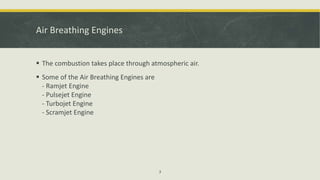
Air Breathing Engines
 The combustion takes place through atmospheric air.
 Some of the Air Breathing Engines are
- Ramjet Engine
- Pulsejet Engine
- Turbojet Engine
- Scramjet Engine
3
Principle
 Newton’s Third Law : For every action, there’s an equal and opposite reaction
4
Section of Air Breathing Engines
Cold Section
 Air Intake
 Compressor
 Diffuser
 Shaft
 Bypass Ducts
Hot Section
 Combustion Chamber
 Turbine
 Afterburner
 Exhaust Nozzle
 Supersonic Nozzle
5
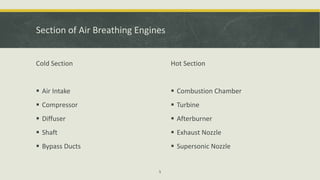
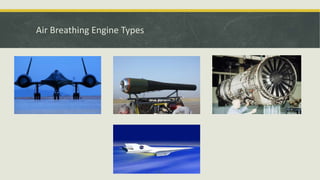
Air Breathing Engine Types
6
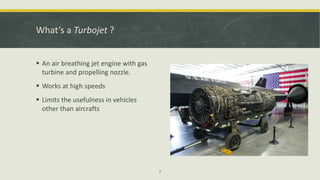
What’s a Turbojet ?
 An air breathing jet engine with gas
turbine and propelling nozzle.
 Works at high speeds
 Limits the usefulness in vehicles
other than aircrafts
7
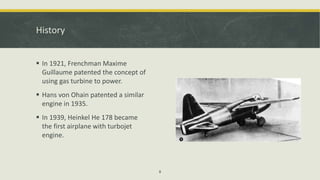
History
 In 1921, Frenchman Maxime
Guillaume patented the concept of
using gas turbine to power.
 Hans von Ohain patented a similar
engine in 1935.
 In 1939, Heinkel He 178 became
the first airplane with turbojet
engine.
8
Breakdown of a Turbojet
 The major working components of a turbojet are
 Diffuser
 Rotary Compressor
 Combustor
 Turbine
 Exhaust Nozzle
9
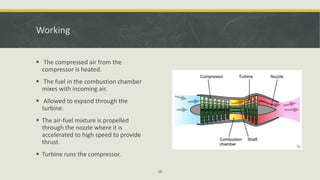
Working
 The compressed air from the
compressor is heated.
 The fuel in the combustion chamber
mixes with incoming air.
 Allowed to expand through the
turbine.
 The air-fuel mixture is propelled
through the nozzle where it is
accelerated to high speed to provide
thrust.
 Turbine runs the compressor.
10
Merits and Demerits
+
 It runs smoothly because of
continuous thrust .
 Low grade fuels such as kerosene,
paraffin can be used.
 High efficiency at greater speeds
-
 Turboprops replace Turbojets for
low speeds.
 Noisier
 High Range-Specific fuel
consumption.
 Sudden decrease of speed is
difficult.
11
Applications
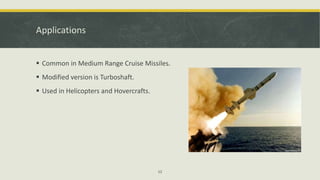
 Common in Medium Range Cruise Missiles.
 Modified version is Turboshaft.
 Used in Helicopters and Hovercrafts.
12
What’s a Scramjet?
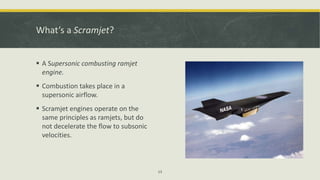
 A Supersonic combusting ramjet
engine.
 Combustion takes place in a
supersonic airflow.
 Scramjet engines operate on the
same principles as ramjets, but do
not decelerate the flow to subsonic
velocities.
13
History
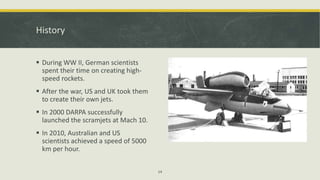
 During WW II, German scientists
spent their time on creating high-
speed rockets.
 After the war, US and UK took them
to create their own jets.
 In 2000 DARPA successfully
launched the scramjets at Mach 10.
 In 2010, Australian and US
scientists achieved a speed of 5000
km per hour.
14
Breakdown of a Scramjet
 The major working components are
 Converging Inlet
 Combustor
 Diverging Nozzle
15
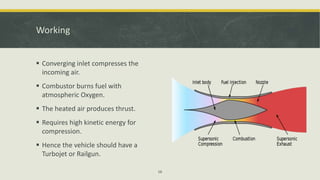
Working
 Converging inlet compresses the
incoming air.
 Combustor burns fuel with
atmospheric Oxygen.
 The heated air produces thrust.
 Requires high kinetic energy for
compression.
 Hence the vehicle should have a
Turbojet or Railgun.
16
Why is it different?
 Does not use any rotating components like Fans, Propellers or Turbines.
 Speed itself compresses the air.
 Airflow in scramjet is supersonic along all the components
 Efficient at high speeds.
17
Merits and Demerits
+
 No rotating components
 Easy Manufacturing
 Less weight
 Can go up to Mach 10
-
 High Cost
 Good Insulation needed
 Special Cooling needed
 Doesn’t operate at atmospheric
pressure
18
Applications
 Dramatically reduces time – 90 mins to orbit earth
 Proposed for tethering with International Space Station
 Can place the satellites in their respective orbits
19
THANK YOU
Venkatesan Krishnamurthy

Jet propulsion

  • 1.
    JET PROPULSION Principle –Working – Applications
  • 2.
    Air Breathing Engines The combustion takes place through atmospheric air.  Some of the Air Breathing Engines are - Ramjet Engine - Pulsejet Engine - Turbojet Engine - Scramjet Engine 3
  • 3.
    Principle  Newton’s ThirdLaw : For every action, there’s an equal and opposite reaction 4
  • 4.
    Section of AirBreathing Engines Cold Section  Air Intake  Compressor  Diffuser  Shaft  Bypass Ducts Hot Section  Combustion Chamber  Turbine  Afterburner  Exhaust Nozzle  Supersonic Nozzle 5
  • 5.
  • 6.
    What’s a Turbojet?  An air breathing jet engine with gas turbine and propelling nozzle.  Works at high speeds  Limits the usefulness in vehicles other than aircrafts 7
  • 7.
    History  In 1921,Frenchman Maxime Guillaume patented the concept of using gas turbine to power.  Hans von Ohain patented a similar engine in 1935.  In 1939, Heinkel He 178 became the first airplane with turbojet engine. 8
  • 8.
    Breakdown of aTurbojet  The major working components of a turbojet are  Diffuser  Rotary Compressor  Combustor  Turbine  Exhaust Nozzle 9
  • 9.
    Working  The compressedair from the compressor is heated.  The fuel in the combustion chamber mixes with incoming air.  Allowed to expand through the turbine.  The air-fuel mixture is propelled through the nozzle where it is accelerated to high speed to provide thrust.  Turbine runs the compressor. 10
  • 10.
    Merits and Demerits + It runs smoothly because of continuous thrust .  Low grade fuels such as kerosene, paraffin can be used.  High efficiency at greater speeds -  Turboprops replace Turbojets for low speeds.  Noisier  High Range-Specific fuel consumption.  Sudden decrease of speed is difficult. 11
  • 11.
    Applications  Common inMedium Range Cruise Missiles.  Modified version is Turboshaft.  Used in Helicopters and Hovercrafts. 12
  • 12.
    What’s a Scramjet? A Supersonic combusting ramjet engine.  Combustion takes place in a supersonic airflow.  Scramjet engines operate on the same principles as ramjets, but do not decelerate the flow to subsonic velocities. 13
  • 13.
    History  During WWII, German scientists spent their time on creating high- speed rockets.  After the war, US and UK took them to create their own jets.  In 2000 DARPA successfully launched the scramjets at Mach 10.  In 2010, Australian and US scientists achieved a speed of 5000 km per hour. 14
  • 14.
    Breakdown of aScramjet  The major working components are  Converging Inlet  Combustor  Diverging Nozzle 15
  • 15.
    Working  Converging inletcompresses the incoming air.  Combustor burns fuel with atmospheric Oxygen.  The heated air produces thrust.  Requires high kinetic energy for compression.  Hence the vehicle should have a Turbojet or Railgun. 16
  • 16.
    Why is itdifferent?  Does not use any rotating components like Fans, Propellers or Turbines.  Speed itself compresses the air.  Airflow in scramjet is supersonic along all the components  Efficient at high speeds. 17
  • 17.
    Merits and Demerits + No rotating components  Easy Manufacturing  Less weight  Can go up to Mach 10 -  High Cost  Good Insulation needed  Special Cooling needed  Doesn’t operate at atmospheric pressure 18
  • 18.
    Applications  Dramatically reducestime – 90 mins to orbit earth  Proposed for tethering with International Space Station  Can place the satellites in their respective orbits 19
  • 19.