Kinetic Energy
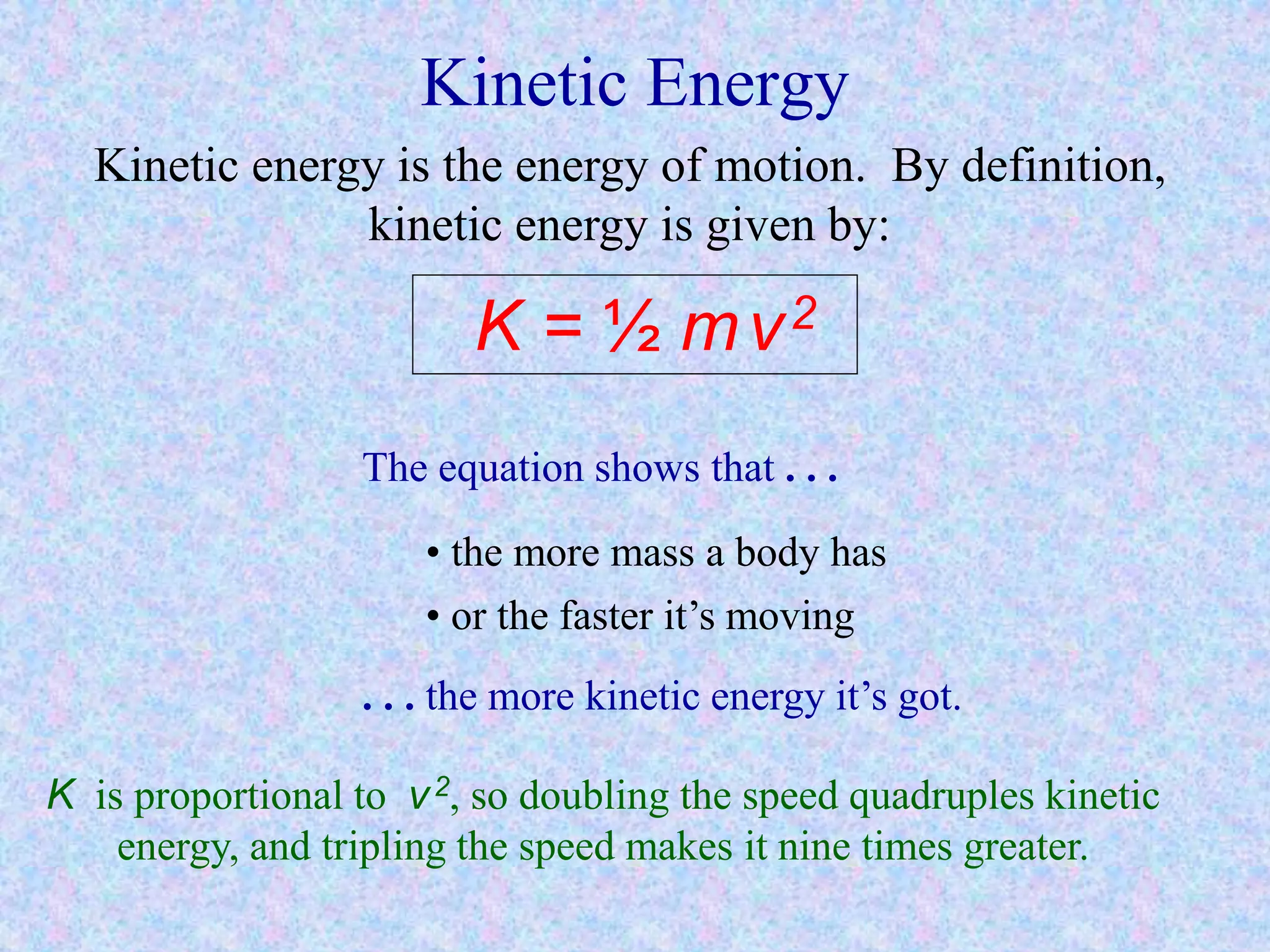
Kinetic energy is the energy of motion. By definition,
kinetic energy is given by:

K = ½ mv2
The equation shows that . . .
• the more mass a body has
• or the faster it’s moving

. . . the more kinetic energy it’s got.
K is proportional to v 2, so doubling the speed quadruples kinetic
energy, and tripling the speed makes it nine times greater.
Energy Units
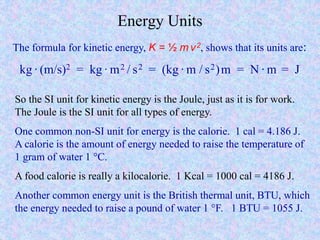
The formula for kinetic energy, K = ½ m v 2, shows that its units are:

kg · (m/s)2 = kg · m 2 / s 2 = (kg · m / s 2 ) m = N · m = J
So the SI unit for kinetic energy is the Joule, just as it is for work.
The Joule is the SI unit for all types of energy.
One common non-SI unit for energy is the calorie. 1 cal = 4.186 J.
A calorie is the amount of energy needed to raise the temperature of
1 gram of water 1 C.

A food calorie is really a kilocalorie. 1 Kcal = 1000 cal = 4186 J.
Another common energy unit is the British thermal unit, BTU, which
the energy needed to raise a pound of water 1 F. 1 BTU = 1055 J.
Kinetic Energy Example
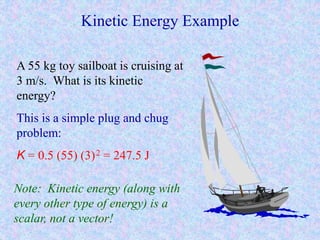
A 55 kg toy sailboat is cruising at
3 m/s. What is its kinetic
energy?
This is a simple plug and chug
problem:
K = 0.5 (55) (3) 2 = 247.5 J
Note: Kinetic energy (along with
every other type of energy) is a
scalar, not a vector!
Gravitational Potential Energy
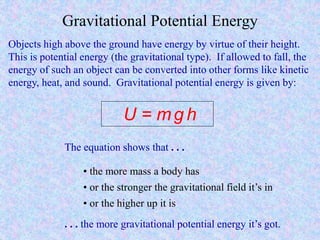
Objects high above the ground have energy by virtue of their height.
This is potential energy (the gravitational type). If allowed to fall, the
energy of such an object can be converted into other forms like kinetic
energy, heat, and sound. Gravitational potential energy is given by:

U = mgh
The equation shows that . . .
• the more mass a body has
• or the stronger the gravitational field it’s in
• or the higher up it is
. . . the more gravitational potential energy it’s got.
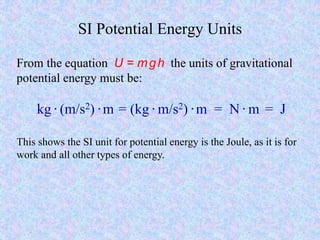
SI Potential Energy Units
From the equation U = m g h the units of gravitational
potential energy must be:

kg · (m/s2) ·m = (kg · m/s2) ·m = N · m = J
This shows the SI unit for potential energy is the Joule, as it is for
work and all other types of energy.
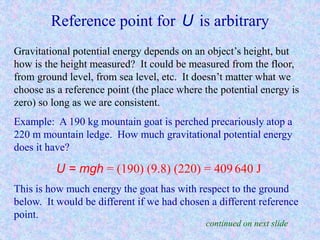
Reference point for U is arbitrary
Gravitational potential energy depends on an object’s height, but
how is the height measured? It could be measured from the floor,
from ground level, from sea level, etc. It doesn’t matter what we
choose as a reference point (the place where the potential energy is
zero) so long as we are consistent.

Example: A 190 kg mountain goat is perched precariously atop a
220 m mountain ledge. How much gravitational potential energy
does it have?

U = mgh = (190) (9.8) (220) = 409 640 J
This is how much energy the goat has with respect to the ground
below. It would be different if we had chosen a different reference
point.
continued on next slide
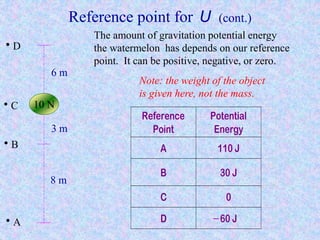
Reference point for U

The amount of gravitation potential energy
the watermelon has depends on our reference
point. It can be positive, negative, or zero.

D

6m
C

(cont.)

10 N

Note: the weight of the object
is given here, not the mass.

8m

A

110 J

B

30 J

C

B

Potential
Energy

A

3m

Reference
Point

0

D

60 J
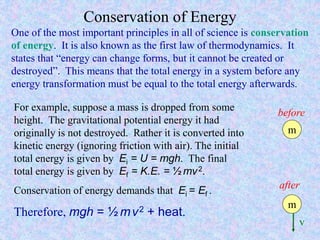
Conservation of Energy
One of the most important principles in all of science is conservation
of energy. It is also known as the first law of thermodynamics. It
states that “energy can change forms, but it cannot be created or
destroyed”. This means that the total energy in a system before any
energy transformation must be equal to the total energy afterwards.
For example, suppose a mass is dropped from some
height. The gravitational potential energy it had
originally is not destroyed. Rather it is converted into
kinetic energy (ignoring friction with air). The initial
total energy is given by Ei = U = mgh. The final
total energy is given by Ef = K.E. = ½ mv 2.

before

Conservation of energy demands that Ei = Ef .

after

Therefore, mgh =

½ m v2

+ heat.

m

m
v

Mechanical energy for 9th grade physics, chapter 6

  • 1.
    Kinetic Energy Kinetic energyis the energy of motion. By definition, kinetic energy is given by: K = ½ mv2 The equation shows that . . . • the more mass a body has • or the faster it’s moving . . . the more kinetic energy it’s got. K is proportional to v 2, so doubling the speed quadruples kinetic energy, and tripling the speed makes it nine times greater.
  • 2.
    Energy Units The formulafor kinetic energy, K = ½ m v 2, shows that its units are: kg · (m/s)2 = kg · m 2 / s 2 = (kg · m / s 2 ) m = N · m = J So the SI unit for kinetic energy is the Joule, just as it is for work. The Joule is the SI unit for all types of energy. One common non-SI unit for energy is the calorie. 1 cal = 4.186 J. A calorie is the amount of energy needed to raise the temperature of 1 gram of water 1 C. A food calorie is really a kilocalorie. 1 Kcal = 1000 cal = 4186 J. Another common energy unit is the British thermal unit, BTU, which the energy needed to raise a pound of water 1 F. 1 BTU = 1055 J.
  • 3.
    Kinetic Energy Example A55 kg toy sailboat is cruising at 3 m/s. What is its kinetic energy? This is a simple plug and chug problem: K = 0.5 (55) (3) 2 = 247.5 J Note: Kinetic energy (along with every other type of energy) is a scalar, not a vector!
  • 4.
    Gravitational Potential Energy Objectshigh above the ground have energy by virtue of their height. This is potential energy (the gravitational type). If allowed to fall, the energy of such an object can be converted into other forms like kinetic energy, heat, and sound. Gravitational potential energy is given by: U = mgh The equation shows that . . . • the more mass a body has • or the stronger the gravitational field it’s in • or the higher up it is . . . the more gravitational potential energy it’s got.
  • 5.
    SI Potential EnergyUnits From the equation U = m g h the units of gravitational potential energy must be: kg · (m/s2) ·m = (kg · m/s2) ·m = N · m = J This shows the SI unit for potential energy is the Joule, as it is for work and all other types of energy.
  • 6.
    Reference point forU is arbitrary Gravitational potential energy depends on an object’s height, but how is the height measured? It could be measured from the floor, from ground level, from sea level, etc. It doesn’t matter what we choose as a reference point (the place where the potential energy is zero) so long as we are consistent. Example: A 190 kg mountain goat is perched precariously atop a 220 m mountain ledge. How much gravitational potential energy does it have? U = mgh = (190) (9.8) (220) = 409 640 J This is how much energy the goat has with respect to the ground below. It would be different if we had chosen a different reference point. continued on next slide
  • 7.
    Reference point forU The amount of gravitation potential energy the watermelon has depends on our reference point. It can be positive, negative, or zero. D 6m C (cont.) 10 N Note: the weight of the object is given here, not the mass. 8m A 110 J B 30 J C B Potential Energy A 3m Reference Point 0 D 60 J
  • 8.
    Conservation of Energy Oneof the most important principles in all of science is conservation of energy. It is also known as the first law of thermodynamics. It states that “energy can change forms, but it cannot be created or destroyed”. This means that the total energy in a system before any energy transformation must be equal to the total energy afterwards. For example, suppose a mass is dropped from some height. The gravitational potential energy it had originally is not destroyed. Rather it is converted into kinetic energy (ignoring friction with air). The initial total energy is given by Ei = U = mgh. The final total energy is given by Ef = K.E. = ½ mv 2. before Conservation of energy demands that Ei = Ef . after Therefore, mgh = ½ m v2 + heat. m m v