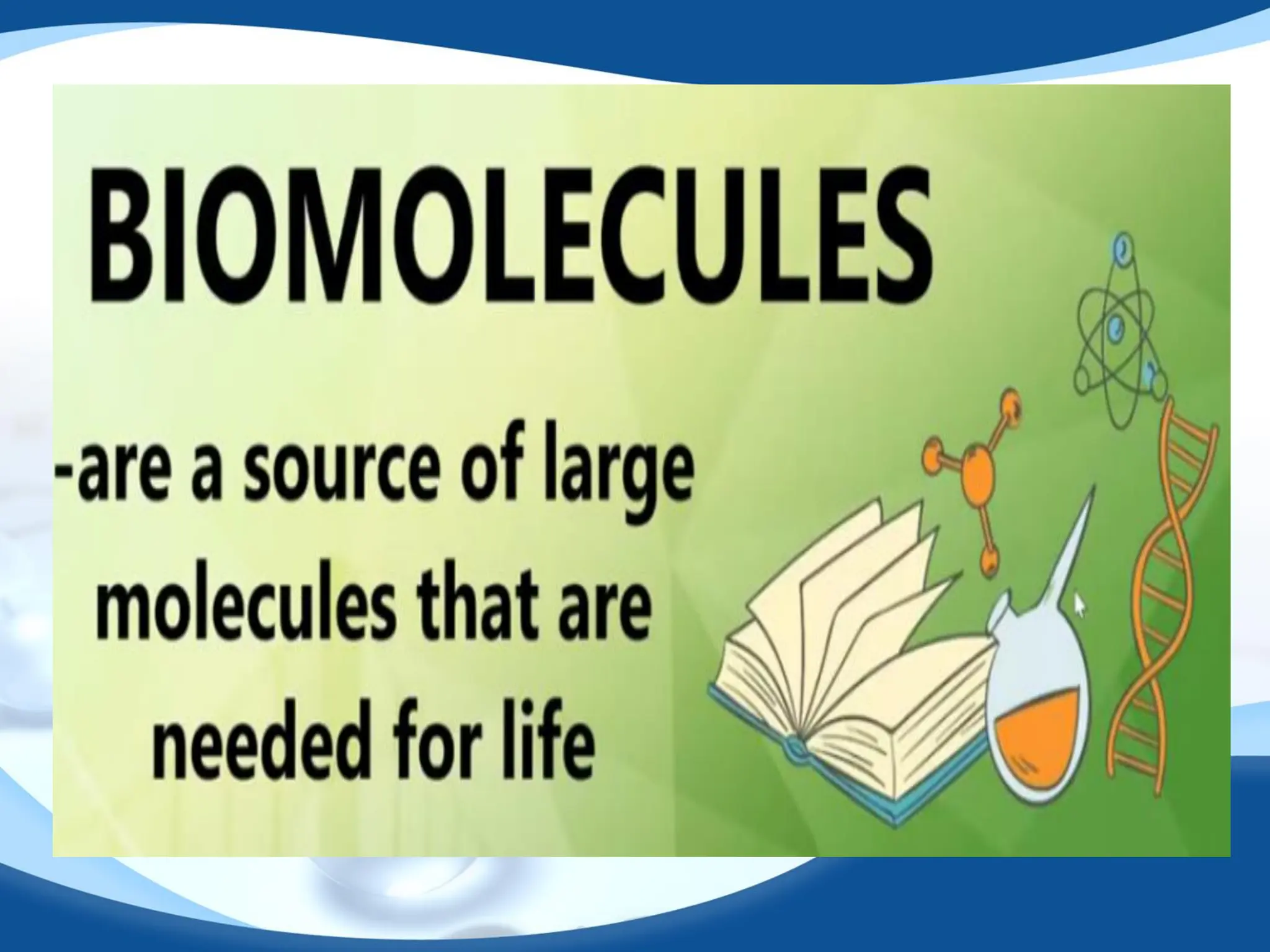
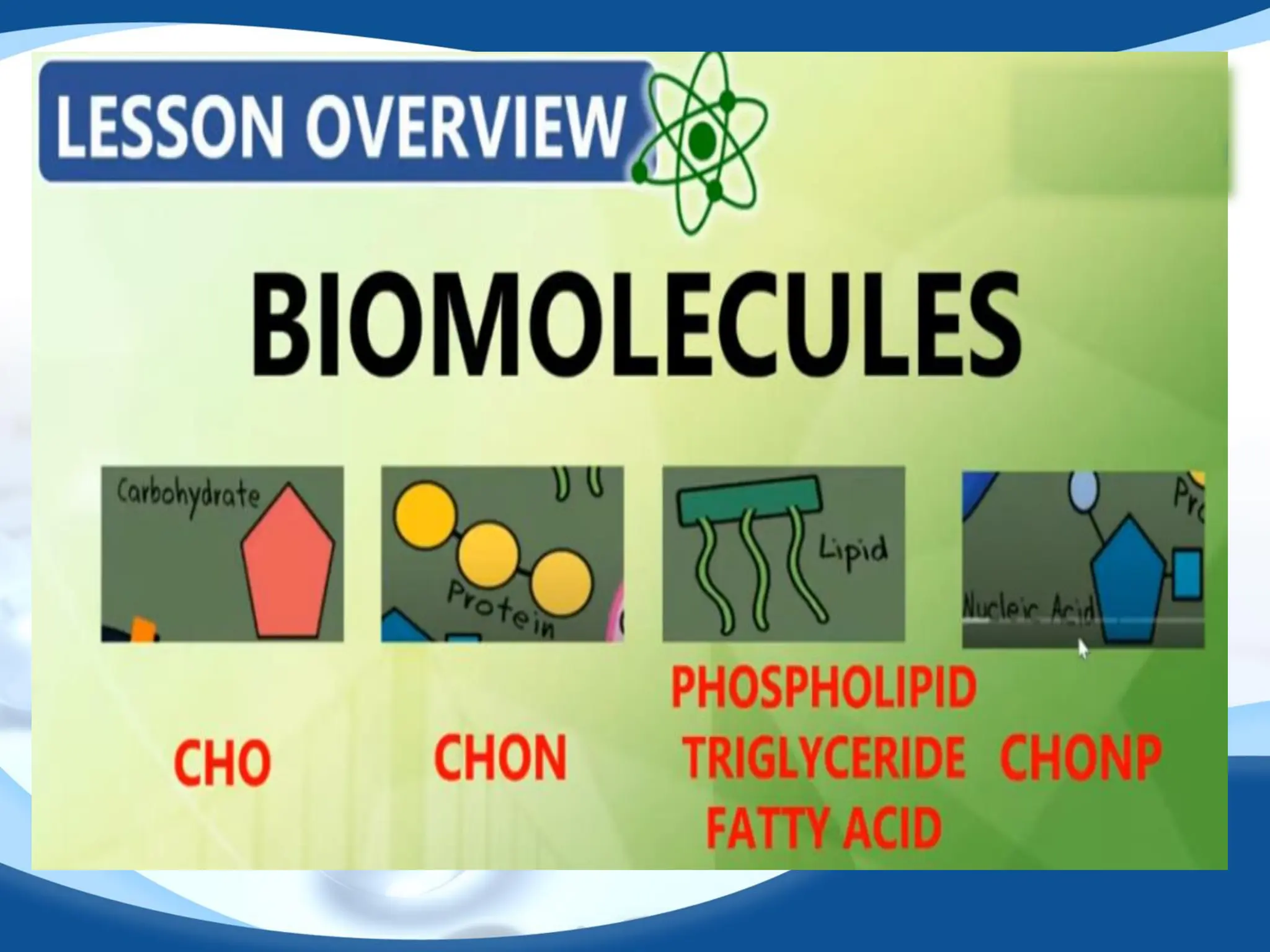
BIOMOLECULES
MOST ESSENTIAL
LEARNING COMPETENCY
Explain how the structures
of biological
macromolecules such as
carbohydrates, lipids,
nucleic acid, and proteins
determine their properties
and function
LEVELS OF ORGANIZATION…
We will be repeating these ALL year!
Yesterday:
Atoms  Molecules  Macromolecules…
Today we will dig into the four macromolecules
that are essential for life to exist.
RECALL
1. Differentiate the 2 types of
forces or Attraction?
2. What are the types of
Intramolecular forces?
3. What are the types of
Intermolecular forces?
What are the 4 biomolecules?
• Carbohydrates
• Lipids
• Nucleic Acids
• Proteins
TODAY
TOMORROW
WE TYPICALLY GET BIOMOLECULES FROM FOOD…
THIS IS WHY WE MUST EAT IN THE FIRST PLACE!
THE BIOMOLECULES SERVE TO KEEP ORGANISMS ALIVE.
#1: CARBOHYDRATES
ARE SUGARS!
We get 4 kilocalories per gram
of carb that we eat!
What are Carbohydrates?
 Most common organic molecule
 Also know as saccharide
 This term is derived from the Latin word saccharum
referring to a sugar– a common carbohydrates.
 Function: Primary energy source our body needs
 Elements present: C, H, O (1:2:1 ratio)
 Monomer (building block):
Monosaccharides (Glucose is most common)
 Polymer: Polysaccharides (starch, Glycogen, Cellulose,
Chitin)
 Examples: Chocolate, Bread, Pasta, Fruits, Vegetables
(ALL FROM PLANTS!!!)
IMPORTANT!
Sugars that make up Carbs
 Single sugar: monosaccharide
 Ex: glucose , fructose (in fruits)
 2 monosaccharides: disaccharide
 Ex: maltose, sucrose, lactose
 3+ monosaccharides: polysaccharide
 Ex: Starch, Glycogen, Cellulose, and Chitin
I am a
polysaccharide!
1. Glucose- Blood sugar, or glucose,
is the main sugar found in your
blood. It comes from the food you
eat, and is your body's main source
of energy. Your blood carries
glucose to all of your body's cells to
use for energy. Diabetes is a disease
in which your blood sugar levels are
too high.
2. Fructose- Fructose is a type of
sugar known as a monosaccharide.
Like other sugars, fructose provides
four calories per gram. Fructose is
also known as “fruit sugar” because it
primarily occurs naturally in many
fruits. It also occurs naturally in other
plant foods such as honey, sugar
beets, sugar cane and vegetables
1. Maltose- Maltose is a sugar that
tastes less sweet than table sugar. It is
found naturally in a range of different
foods (like cooked sweet potato,
pears and honey, for example) and
also in a variety of manufactured food
stuffs like beer, bread, breakfast cereals
and high-maltose corn syrup
2. Sucrose- Sucrose is a molecule
composed of two monosaccharides,
namely glucose and fructose. This
non-reducing disaccharide has a
chemical formula of C12H22O11.
Sucrose is commonly referred to as
table sugar or cane sugar. In a
C12H22O11 molecule,
3. Lactose- Lactose is milk
sugar and some people have
problems digesting this due to the
absence of the lactase enzyme,
which is essential for its digestion.
Undigested lactose is the main
cause of discomforts in the small
and large intestines suffered by
lactose intolerant people
Types of polysaccharides
 Starch:
 Used for energy storage in plants
 Potatoes, pasta and rice are starches
 They provide a quick form of energy for the
body
Glycogen:
• Used for energy storage in animals
I am
formed in
the Liver!
More Polysaccharides
Cellulose:
• Provides structural
support in plants (found
in the cell wall)
Chitin:
• Found in exoskeletens of
arthropods (insects,
spiders)
• Found in cell wall of
some fungi
GIVES US FIBER!!!
Structure of Carbohydrates
• Remember: Elements are C, H, and O
• Primarily in a Ring shape (but not always)
Take a minute to find the word that
does NOT belong. Raise your hand,
do not shout out!
#2: LIPIDS
ARE FATS
We get 9 kcals per gram
Of fat that we consume.
Lipids
 Function: Store energy, Insulates
your body, and make up the cell
membrane!
 Elements: C-H-O
 Monomer (Building blocks):
glycerol & 3 fatty acids
 Polymer: Phospholipids,
triglycerides
 Example: Steroids, cholesterol, fats,
Oils, Nuts, Waxes, and make up part
of the cell membrane!
Lipids
Lipids are Hydrophobic (water fearing) and do
not dissolve in water!
• Lipids can be:
• Saturated: The bonds between all the carbons
are single bonds.
•Solid at room temperature
•Mainly animal fats (bacon grease, lard)
• Unsaturated: There is at least one double or
triple bond between carbons present.
•Liquid at room temperature
•Mainly plant based fats (olive oil, peanut oil) as well as
oily fish (Tuna, Sardines)
Important!
Lipid Structure
 Remember:
Elements
present are
C, H, O
 Long strands
of Carbon
and
Hydrogen
Unsaturated Fats
Saturated Fats
CALLED
HYDROCARBONS!
Take a minute to find the word that
does NOT belong. Raise your hand,
do not shout out!
BIOMOLECULES PART 2
PROTEINS AND NUCLEIC ACIDS!
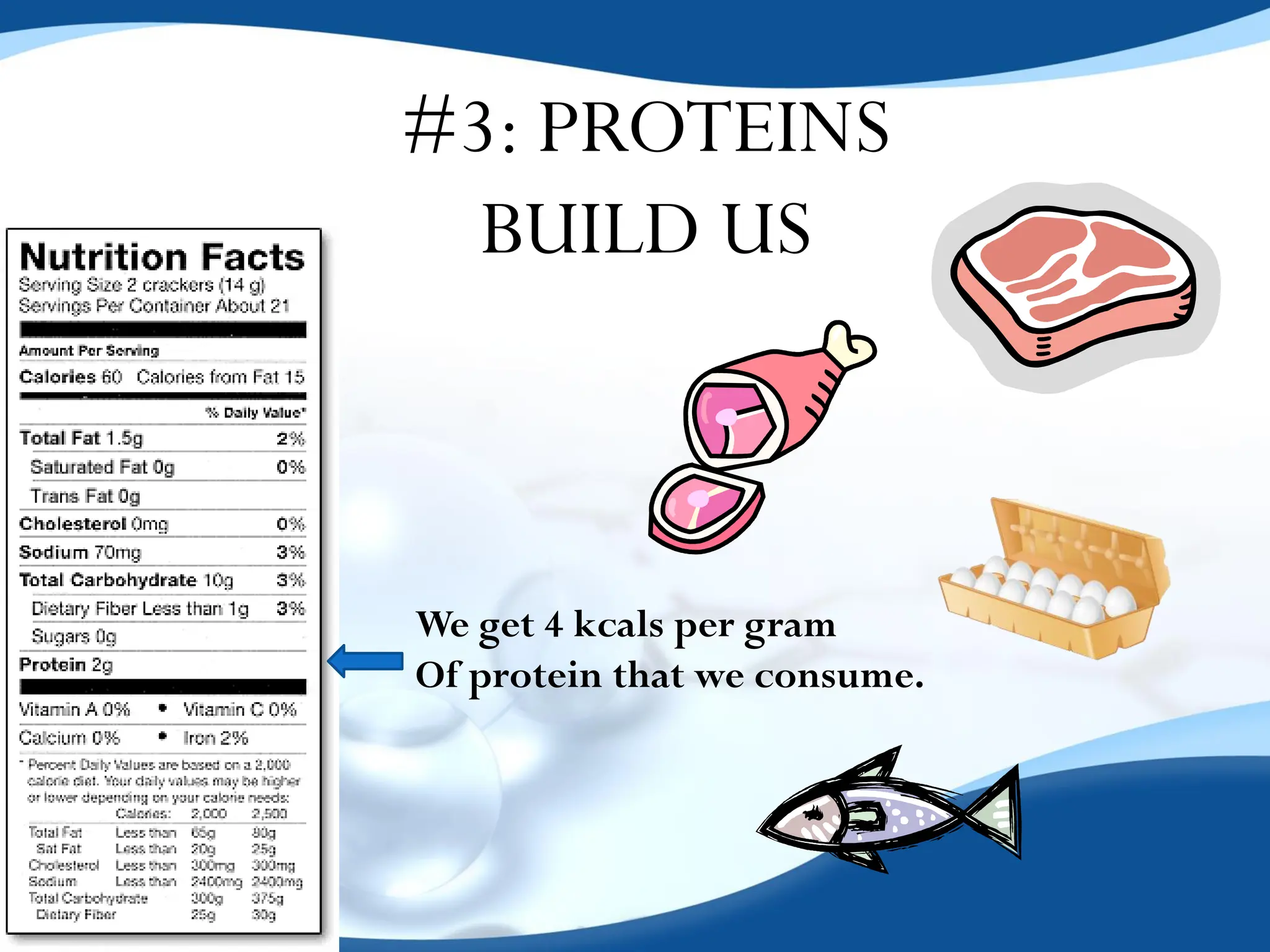
#3: PROTEINS
BUILD US
We get 4 kcals per gram
Of protein that we consume.
Proteins
• Function of proteins
• Transport molecules in and out of the cell
• Control the speed of chemical reactions
• Used for growth and repair
Proteins make up the structure of living things…
Hair, nails, skin, bones, muscle, etc are all built by protein!
Proteins
 Elements: C-H-O-N
 Monomer (Building Block):
amino acids (20 different
ones!)
 Polymer: proteins (tons)
 Examples of proteins:
hemoglobin in red blood
cells, albumin in eggs,
enzymes that control
reactions in the body, and
antibodies
 Found in: fish, eggs, meat
NITROGEN IS PRESENT, NOW!
Protein Structure
 Remember: Elements are C, H, O, and N
 “R” groups represent one of the 20 Amino
Acids! (so, each amino acid has something
different in that spot)
Why are amino acids important?
• When groups of amino acids are joined
together a protein is formed
• There are 20 kinds of amino acids
• They consist of a carboxyl group (COOH)
and an amino group NH2
• Peptide bonds form between amino acids
(polypeptide = many peptide bonds = protein!)
Take a minute to find the word that
does NOT belong. Raise your hand,
do not shout out!
#4: NUCLEICACIDS
These biomolecules are not
necessarily from food
Nucleic acids
Function:
• Provide our genetic information
• Holds the instructions to make proteins.
Elements: C-H-O-N-P
Monomer : nucleotides
• A nucleotide is made up of:
• Sugar
• Phosphate
• Nitrogen Base: A, T, G, C, or U
Polymer: DNA, RNA and ATP
Genetic
code! Recipe for
proteins
Energy
carrier
Structure of Nucleic Acid
Take a minute to find the word
that does NOT belong. Raise your
hand, do not shout out!

BIOMOLECULES.pdf lesson 1.1 (Physical Science Subject)

  • 1.
  • 2.
    MOST ESSENTIAL LEARNING COMPETENCY Explainhow the structures of biological macromolecules such as carbohydrates, lipids, nucleic acid, and proteins determine their properties and function
  • 3.
    LEVELS OF ORGANIZATION… Wewill be repeating these ALL year! Yesterday: Atoms  Molecules  Macromolecules… Today we will dig into the four macromolecules that are essential for life to exist.
  • 5.
    RECALL 1. Differentiate the2 types of forces or Attraction? 2. What are the types of Intramolecular forces? 3. What are the types of Intermolecular forces?
  • 9.
    What are the4 biomolecules? • Carbohydrates • Lipids • Nucleic Acids • Proteins TODAY TOMORROW WE TYPICALLY GET BIOMOLECULES FROM FOOD… THIS IS WHY WE MUST EAT IN THE FIRST PLACE! THE BIOMOLECULES SERVE TO KEEP ORGANISMS ALIVE.
  • 11.
    #1: CARBOHYDRATES ARE SUGARS! Weget 4 kilocalories per gram of carb that we eat!
  • 12.
    What are Carbohydrates? Most common organic molecule  Also know as saccharide  This term is derived from the Latin word saccharum referring to a sugar– a common carbohydrates.  Function: Primary energy source our body needs  Elements present: C, H, O (1:2:1 ratio)  Monomer (building block): Monosaccharides (Glucose is most common)  Polymer: Polysaccharides (starch, Glycogen, Cellulose, Chitin)  Examples: Chocolate, Bread, Pasta, Fruits, Vegetables (ALL FROM PLANTS!!!) IMPORTANT!
  • 13.
    Sugars that makeup Carbs  Single sugar: monosaccharide  Ex: glucose , fructose (in fruits)  2 monosaccharides: disaccharide  Ex: maltose, sucrose, lactose  3+ monosaccharides: polysaccharide  Ex: Starch, Glycogen, Cellulose, and Chitin I am a polysaccharide!
  • 14.
    1. Glucose- Bloodsugar, or glucose, is the main sugar found in your blood. It comes from the food you eat, and is your body's main source of energy. Your blood carries glucose to all of your body's cells to use for energy. Diabetes is a disease in which your blood sugar levels are too high.
  • 15.
    2. Fructose- Fructoseis a type of sugar known as a monosaccharide. Like other sugars, fructose provides four calories per gram. Fructose is also known as “fruit sugar” because it primarily occurs naturally in many fruits. It also occurs naturally in other plant foods such as honey, sugar beets, sugar cane and vegetables
  • 16.
    1. Maltose- Maltoseis a sugar that tastes less sweet than table sugar. It is found naturally in a range of different foods (like cooked sweet potato, pears and honey, for example) and also in a variety of manufactured food stuffs like beer, bread, breakfast cereals and high-maltose corn syrup
  • 17.
    2. Sucrose- Sucroseis a molecule composed of two monosaccharides, namely glucose and fructose. This non-reducing disaccharide has a chemical formula of C12H22O11. Sucrose is commonly referred to as table sugar or cane sugar. In a C12H22O11 molecule,
  • 18.
    3. Lactose- Lactoseis milk sugar and some people have problems digesting this due to the absence of the lactase enzyme, which is essential for its digestion. Undigested lactose is the main cause of discomforts in the small and large intestines suffered by lactose intolerant people
  • 19.
    Types of polysaccharides Starch:  Used for energy storage in plants  Potatoes, pasta and rice are starches  They provide a quick form of energy for the body Glycogen: • Used for energy storage in animals I am formed in the Liver!
  • 20.
    More Polysaccharides Cellulose: • Providesstructural support in plants (found in the cell wall) Chitin: • Found in exoskeletens of arthropods (insects, spiders) • Found in cell wall of some fungi GIVES US FIBER!!!
  • 21.
    Structure of Carbohydrates •Remember: Elements are C, H, and O • Primarily in a Ring shape (but not always)
  • 22.
    Take a minuteto find the word that does NOT belong. Raise your hand, do not shout out!
  • 23.
    #2: LIPIDS ARE FATS Weget 9 kcals per gram Of fat that we consume.
  • 24.
    Lipids  Function: Storeenergy, Insulates your body, and make up the cell membrane!  Elements: C-H-O  Monomer (Building blocks): glycerol & 3 fatty acids  Polymer: Phospholipids, triglycerides  Example: Steroids, cholesterol, fats, Oils, Nuts, Waxes, and make up part of the cell membrane!
  • 25.
    Lipids Lipids are Hydrophobic(water fearing) and do not dissolve in water! • Lipids can be: • Saturated: The bonds between all the carbons are single bonds. •Solid at room temperature •Mainly animal fats (bacon grease, lard) • Unsaturated: There is at least one double or triple bond between carbons present. •Liquid at room temperature •Mainly plant based fats (olive oil, peanut oil) as well as oily fish (Tuna, Sardines) Important!
  • 27.
    Lipid Structure  Remember: Elements presentare C, H, O  Long strands of Carbon and Hydrogen Unsaturated Fats Saturated Fats CALLED HYDROCARBONS!
  • 28.
    Take a minuteto find the word that does NOT belong. Raise your hand, do not shout out!
  • 29.
    BIOMOLECULES PART 2 PROTEINSAND NUCLEIC ACIDS!
  • 30.
    #3: PROTEINS BUILD US Weget 4 kcals per gram Of protein that we consume.
  • 31.
    Proteins • Function ofproteins • Transport molecules in and out of the cell • Control the speed of chemical reactions • Used for growth and repair Proteins make up the structure of living things… Hair, nails, skin, bones, muscle, etc are all built by protein!
  • 32.
    Proteins  Elements: C-H-O-N Monomer (Building Block): amino acids (20 different ones!)  Polymer: proteins (tons)  Examples of proteins: hemoglobin in red blood cells, albumin in eggs, enzymes that control reactions in the body, and antibodies  Found in: fish, eggs, meat NITROGEN IS PRESENT, NOW!
  • 33.
    Protein Structure  Remember:Elements are C, H, O, and N  “R” groups represent one of the 20 Amino Acids! (so, each amino acid has something different in that spot)
  • 34.
    Why are aminoacids important? • When groups of amino acids are joined together a protein is formed • There are 20 kinds of amino acids • They consist of a carboxyl group (COOH) and an amino group NH2 • Peptide bonds form between amino acids (polypeptide = many peptide bonds = protein!)
  • 35.
    Take a minuteto find the word that does NOT belong. Raise your hand, do not shout out!
  • 36.
    #4: NUCLEICACIDS These biomoleculesare not necessarily from food
  • 37.
    Nucleic acids Function: • Provideour genetic information • Holds the instructions to make proteins. Elements: C-H-O-N-P Monomer : nucleotides • A nucleotide is made up of: • Sugar • Phosphate • Nitrogen Base: A, T, G, C, or U Polymer: DNA, RNA and ATP Genetic code! Recipe for proteins Energy carrier
  • 38.
  • 39.
    Take a minuteto find the word that does NOT belong. Raise your hand, do not shout out!