Launch: 1/7
  Grab your binder and immediately take a seat!
  Place launch paper and HW (practice questions) on your
  desk.
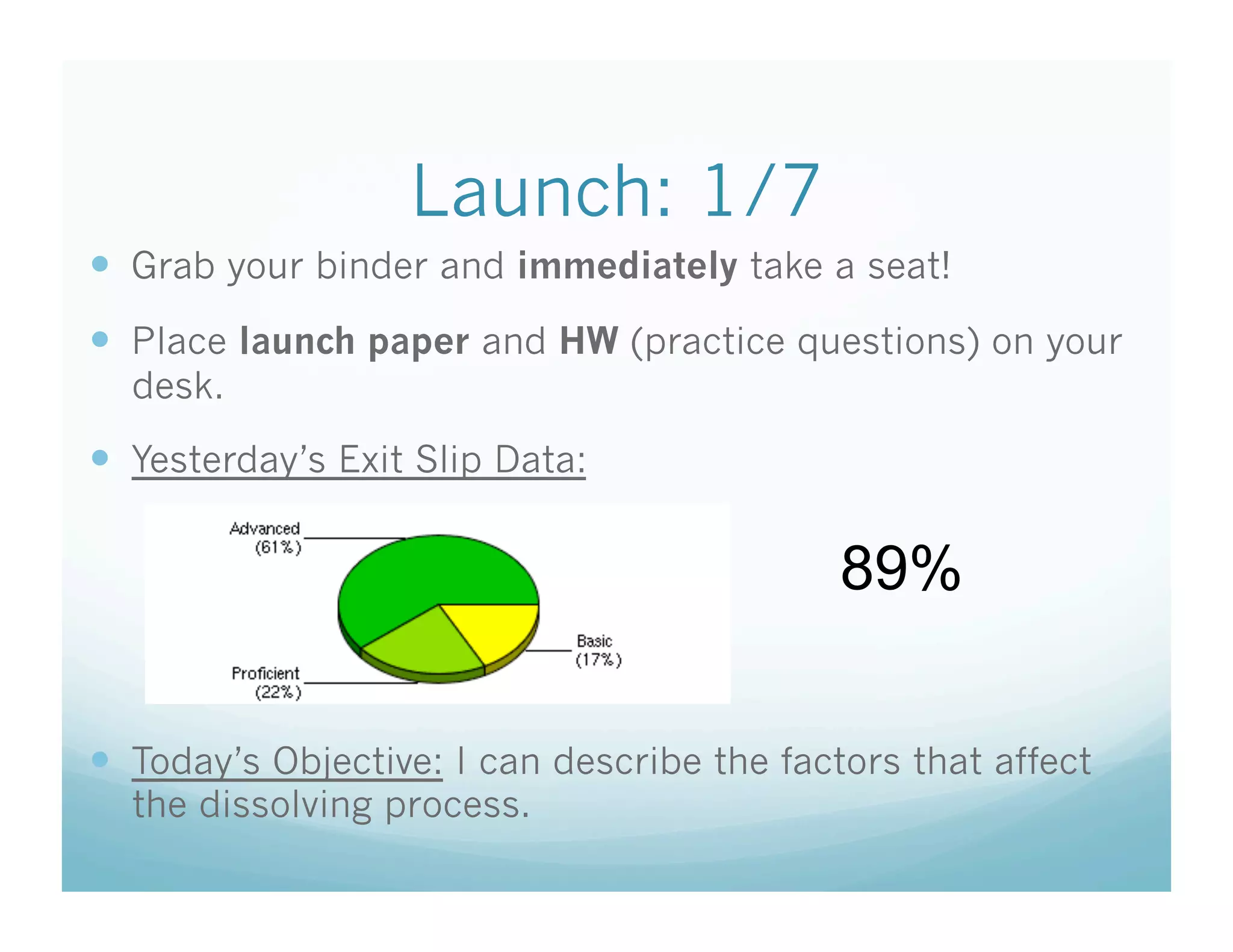
  Yesterday’s Exit Slip Data:

                                            89%

  Today’s Objective: I can describe the factors that affect
  the dissolving process.
Launch: 1/7
  Grab your binder and immediately take a seat!
  Place launch paper and HW (practice questions) on your
  desk.
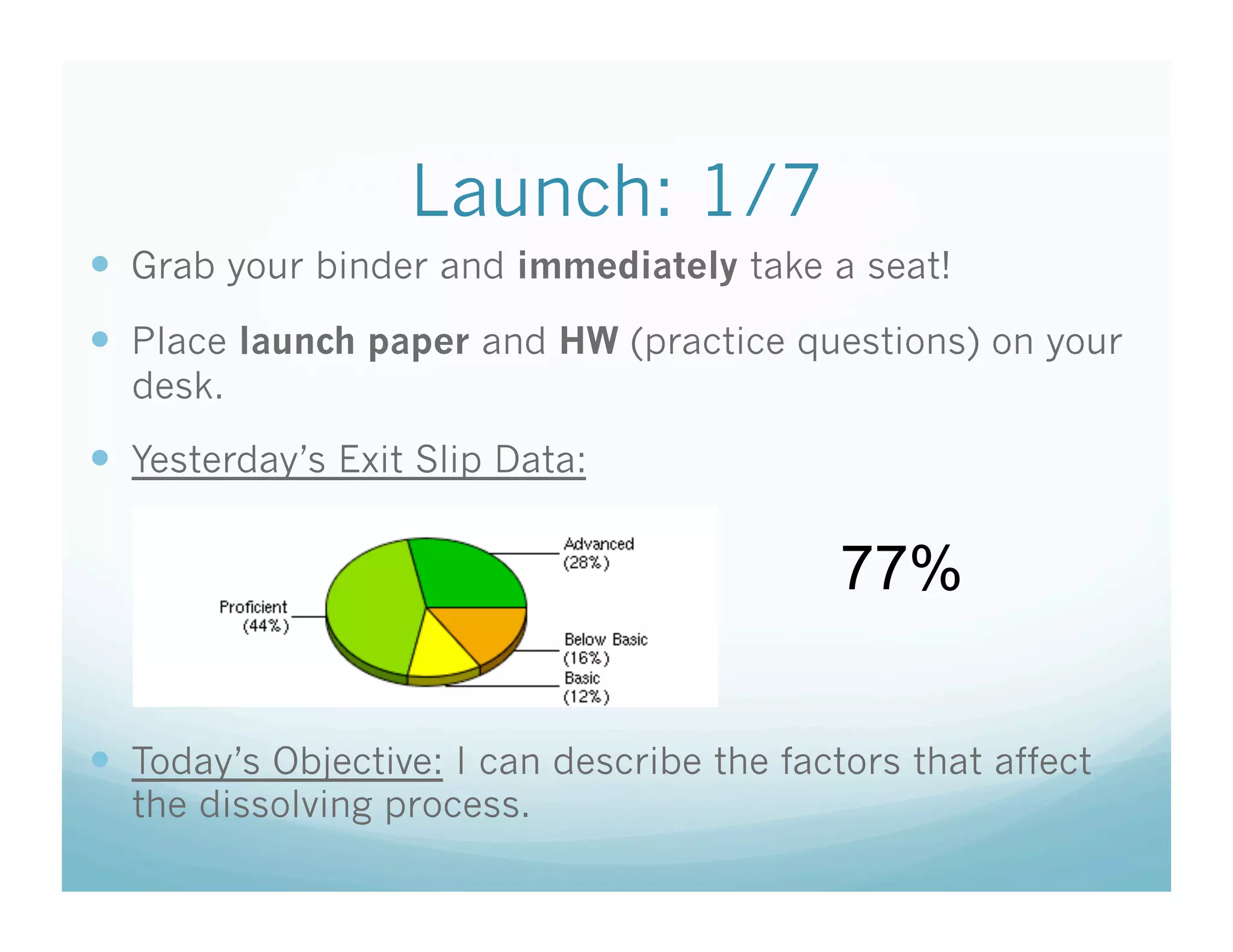
  Yesterday’s Exit Slip Data:

                                            77%

  Today’s Objective: I can describe the factors that affect
  the dissolving process.
Launch: 1/7
  Grab your binder and immediately take a seat!
  Place launch paper and HW (practice questions) on your
  desk.
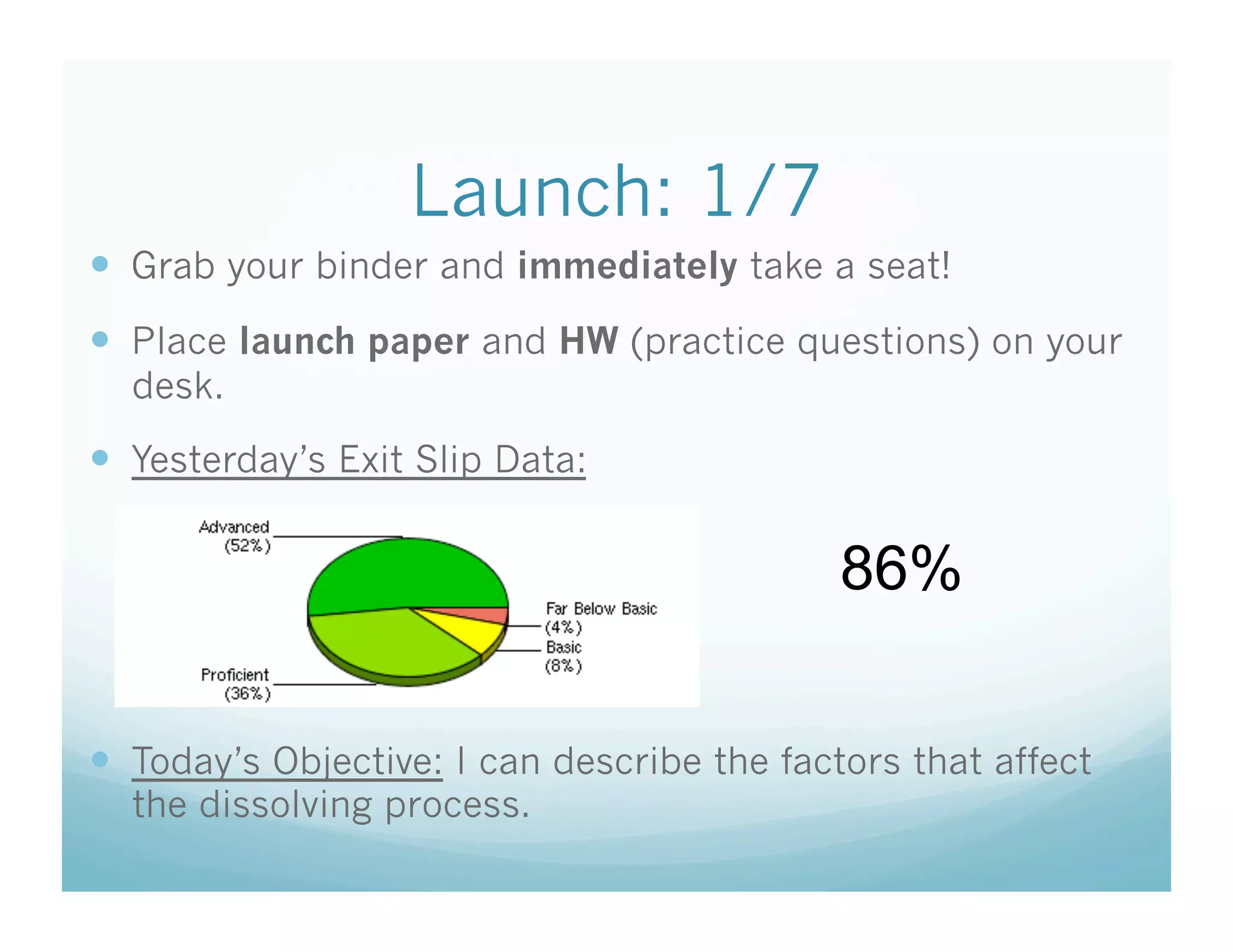
  Yesterday’s Exit Slip Data:

                                            86%

  Today’s Objective: I can describe the factors that affect
  the dissolving process.
Launch: 1/7
  Grab your binder and immediately take a seat!
  Place launch paper and HW (practice questions) on your
  desk.
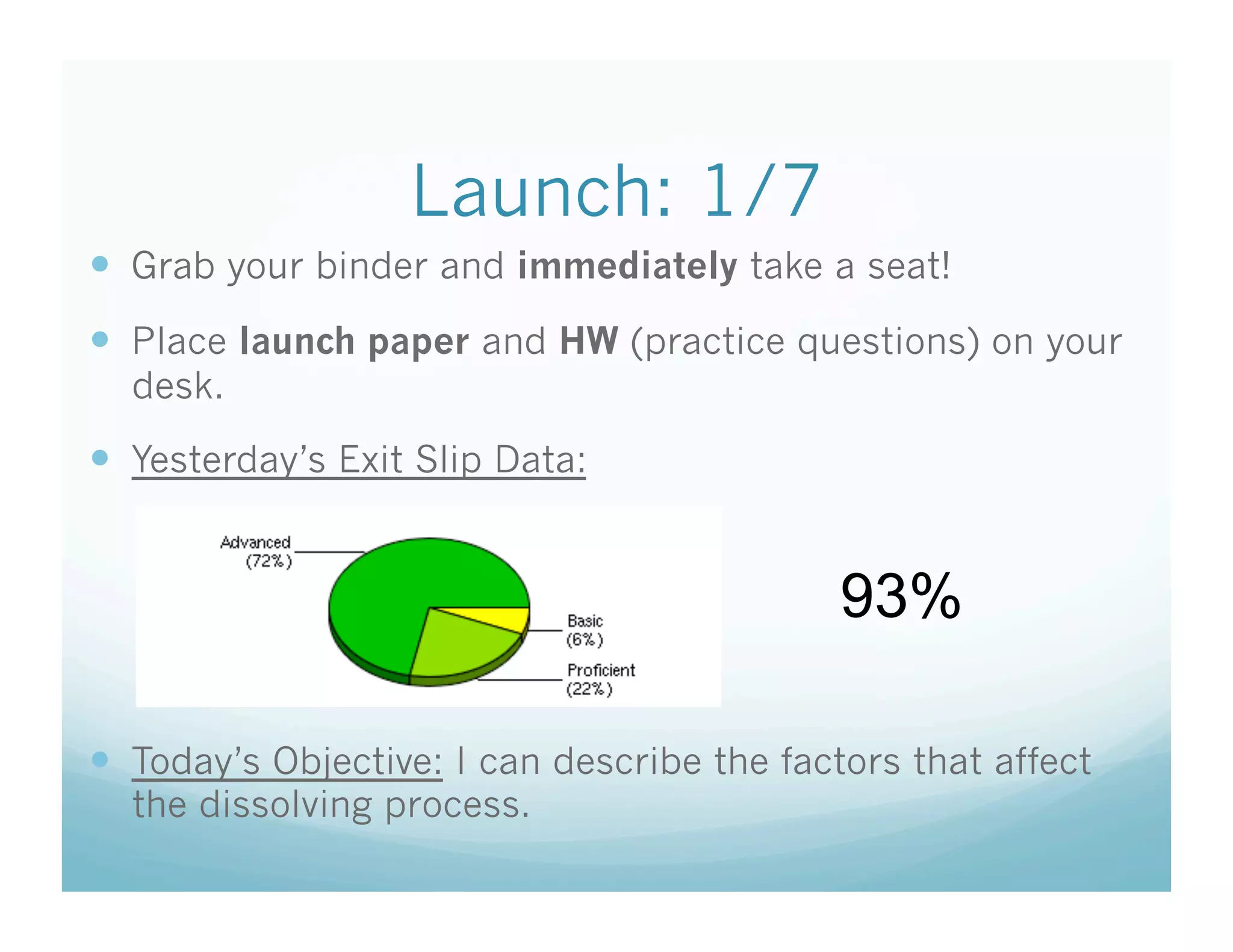
  Yesterday’s Exit Slip Data:


                                            93%

  Today’s Objective: I can describe the factors that affect
  the dissolving process.
Launch 1/7
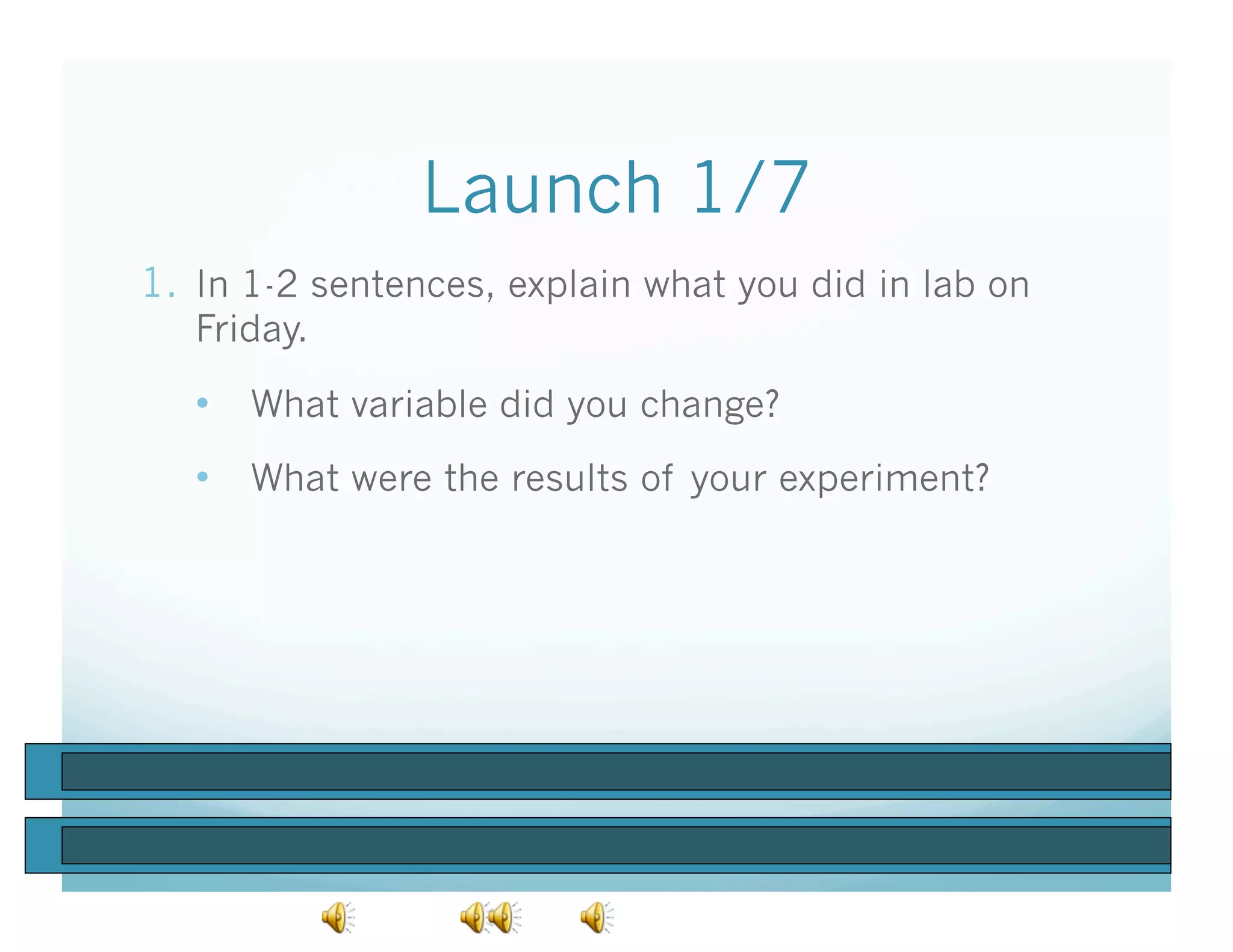
1.  In 1-2 sentences, explain what you did in lab on
   Friday.

   •  What variable did you change?
   •  What were the results of your experiment?
Launch 1/7
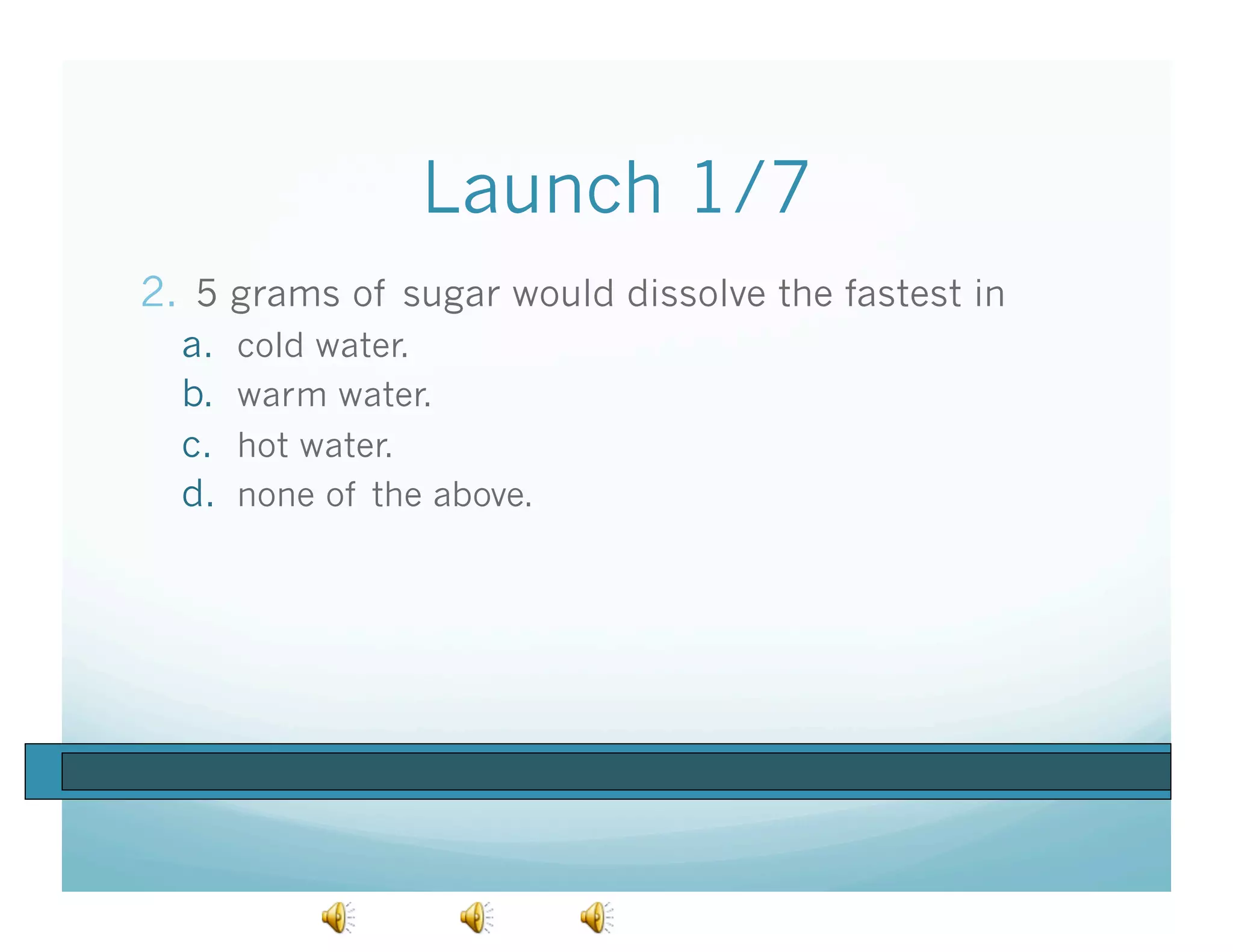
2.  5 grams of sugar would dissolve the fastest in
  a.    cold water.
  b.    warm water.
  c.    hot water.
  d.    none of the above.
Launch 1/7
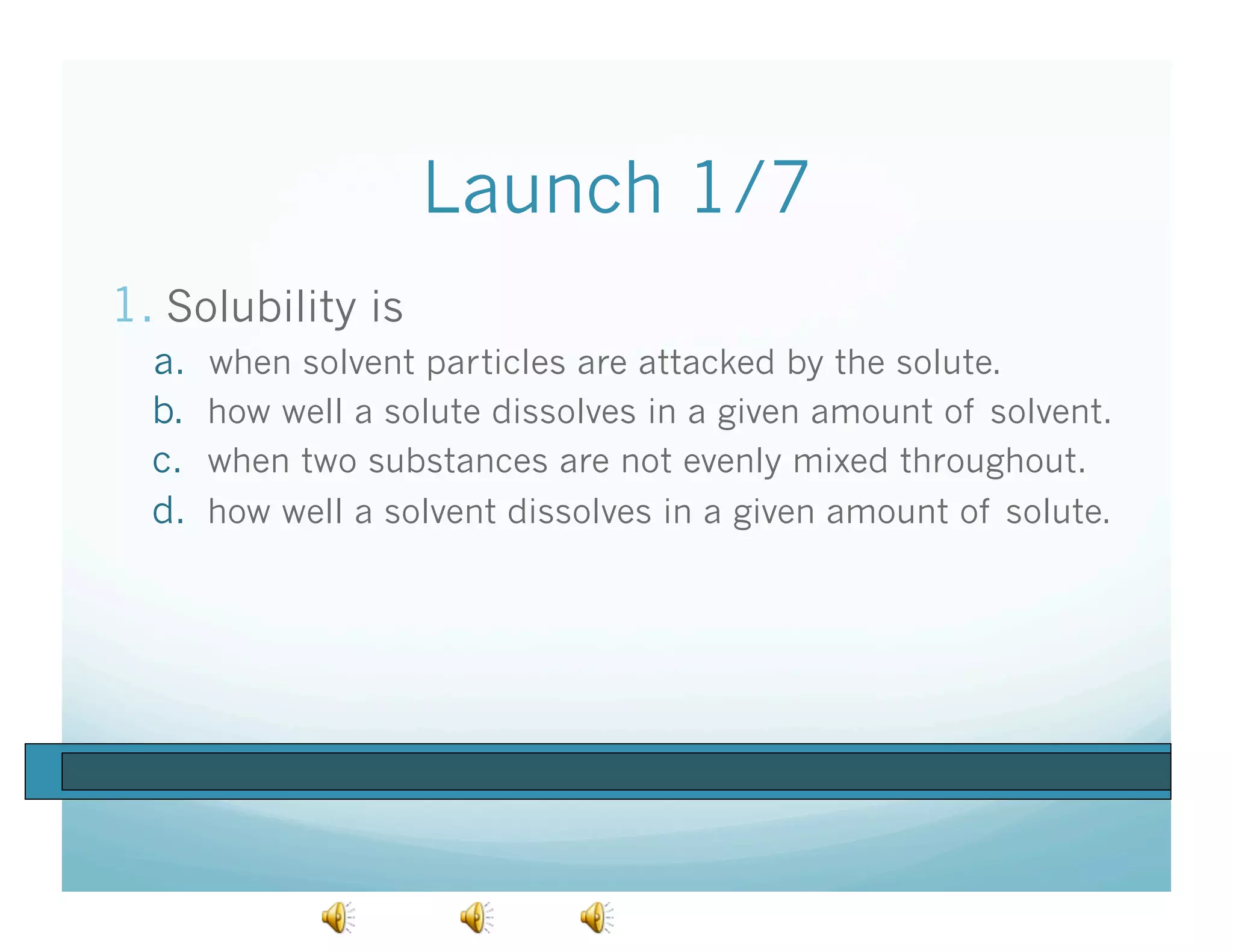
1.  Solubility is
  a.    when solvent particles are attacked by the solute.
  b.    how well a solute dissolves in a given amount of solvent.
  c.    when two substances are not evenly mixed throughout.
  d.    how well a solvent dissolves in a given amount of solute.
New Changes for the New Year!
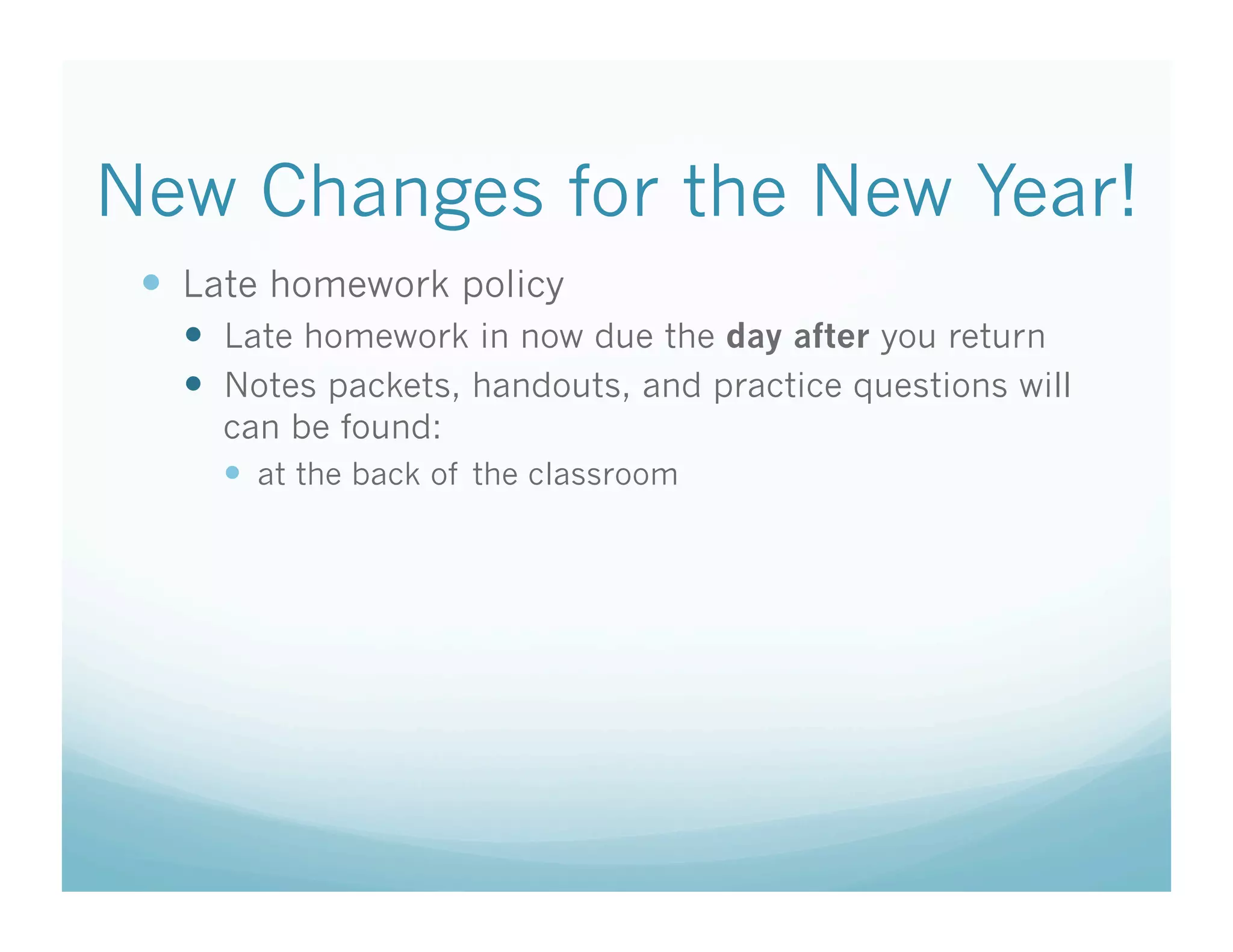
   Late homework policy
     Late homework in now due the day after you return
     Notes packets, handouts, and practice questions will
     can be found:
       at the back of the classroom
New Changes for the New Year!
   Class consequences
   1.    Name on board
   2.    Take a break
   3.    Call home
   4.    Sent to Mr. Wandera

   Rules: still the same 7
January Calendar
What is concentration?
        Mr. Heffner
         1/11/10
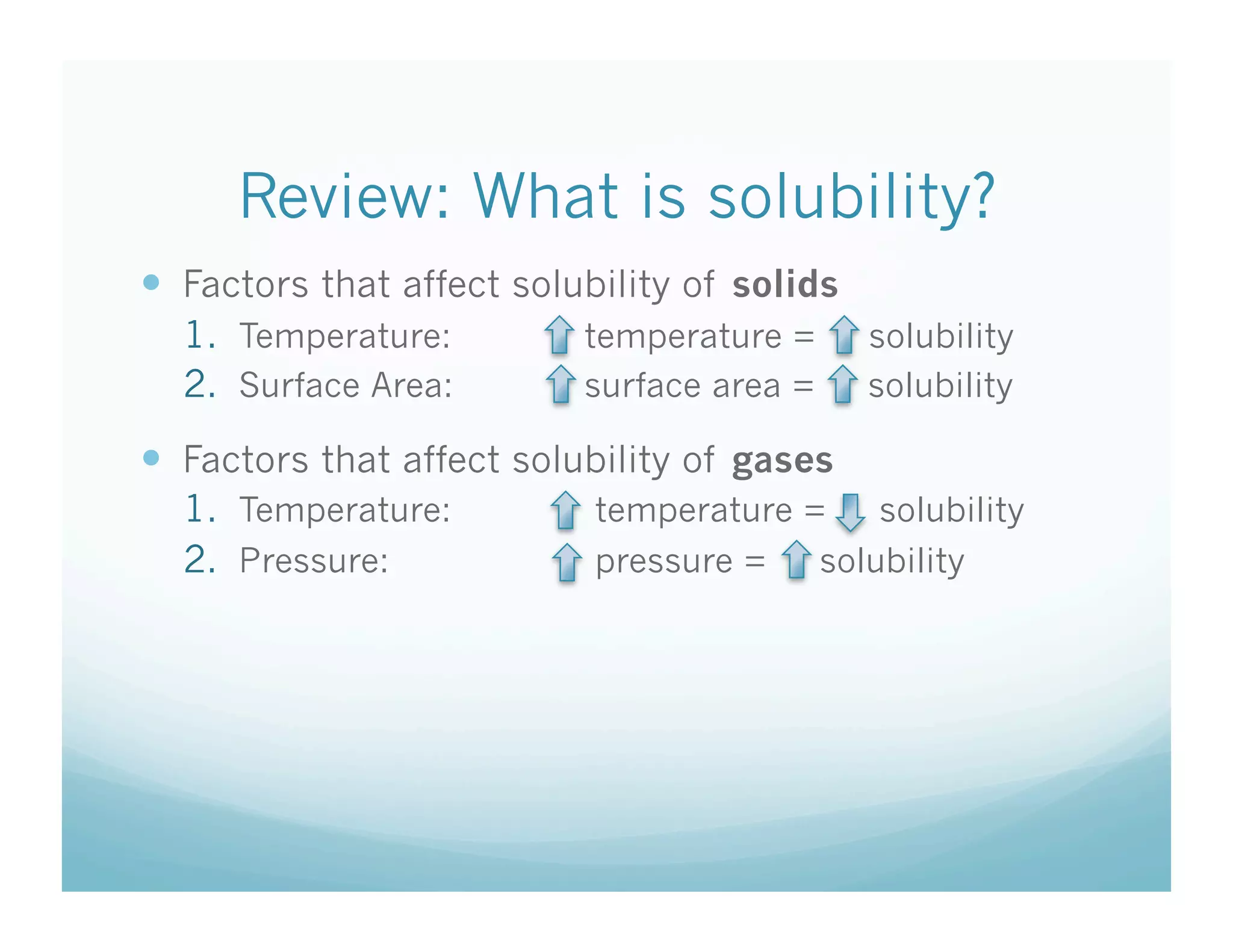
Review: What is solubility?
  Factors that affect solubility of solids
  1.  Temperature:         temperature =       solubility
  2.  Surface Area:        surface area =      solubility

  Factors that affect solubility of gases
  1.  Temperature:         temperature =        solubility
  2.  Pressure:            pressure =       solubility
What is concentration?
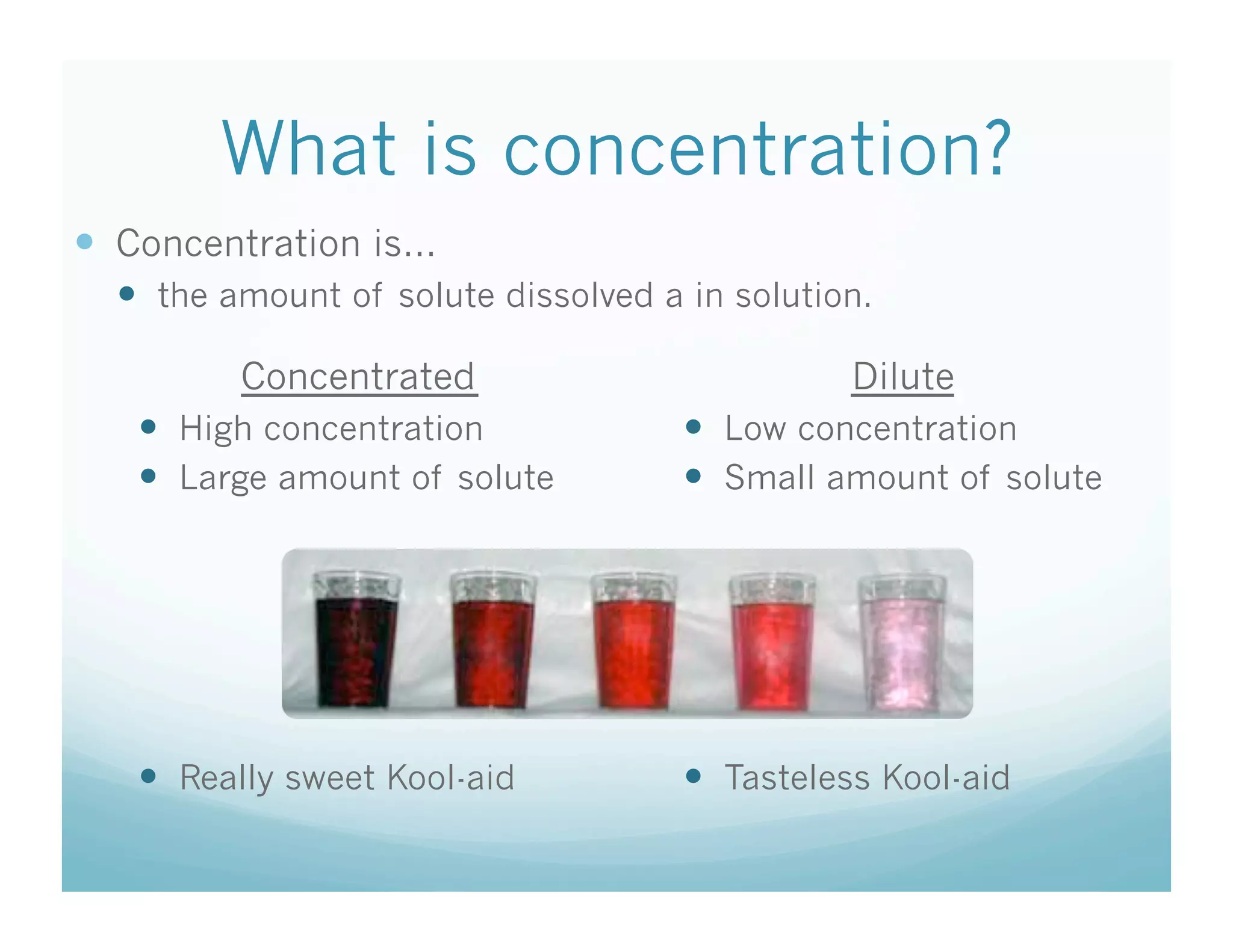
  Concentration is…
    the amount of solute dissolved a in solution.

         Concentrated                           Dilute
     High concentration               Low concentration
     Large amount of solute           Small amount of solute


     Really sweet Kool-aid            Tasteless Kool-aid
What is concentration?
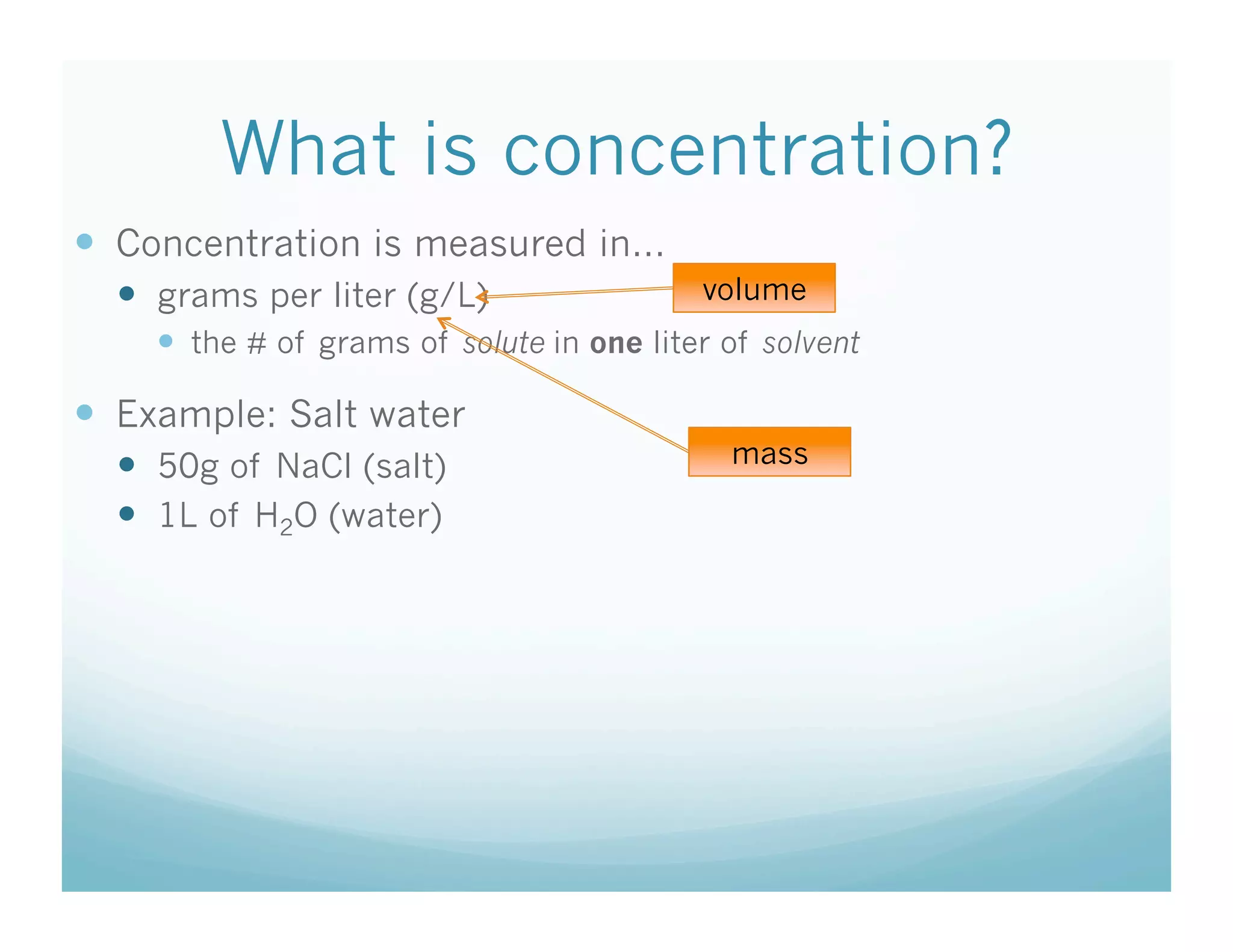
  Concentration is measured in…
    grams per liter (g/L)                 volume
      the # of grams of solute in one liter of solvent

  Example: Salt water
    50g of NaCl (salt)                      mass

    1L of H2O (water)
Examples
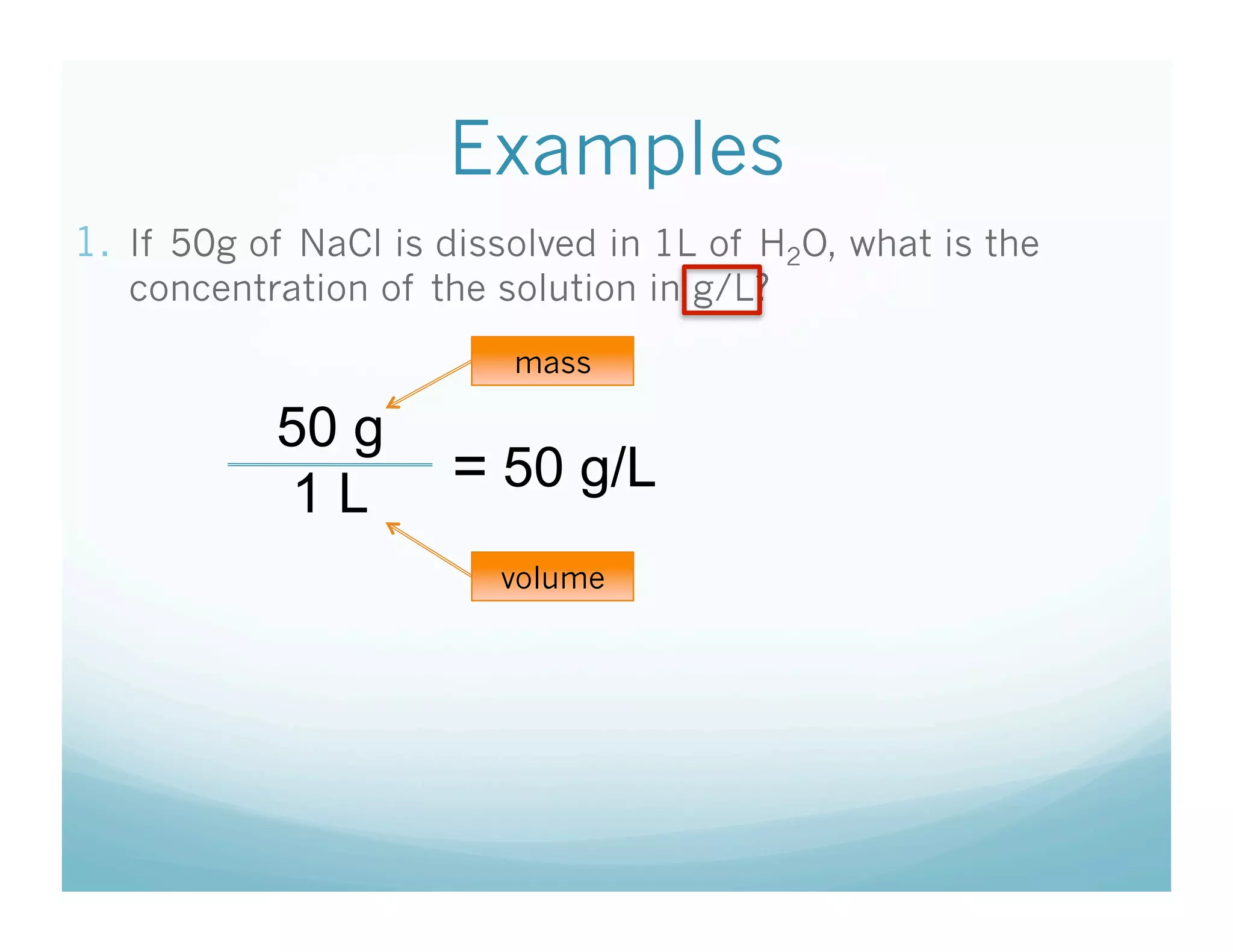
1.  If 50g of NaCl is dissolved in 1L of H2O, what is the
   concentration of the solution in g/L?
                         mass

           50 g
            1L        = 50 g/L
                         volume
Examples
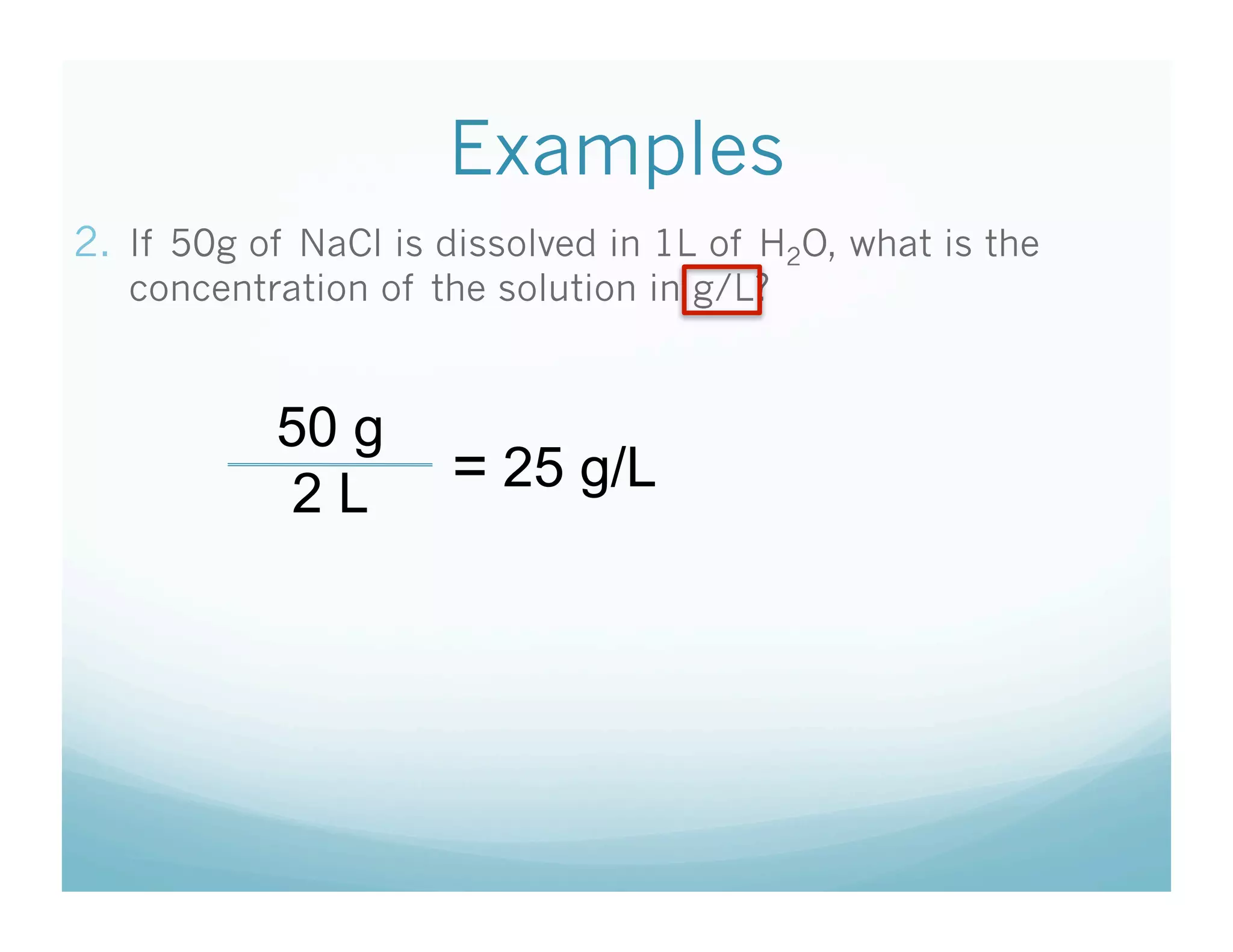
2.  If 50g of NaCl is dissolved in 1L of H2O, what is the
   concentration of the solution in g/L?


           50 g
            2L        = 25 g/L
Examples
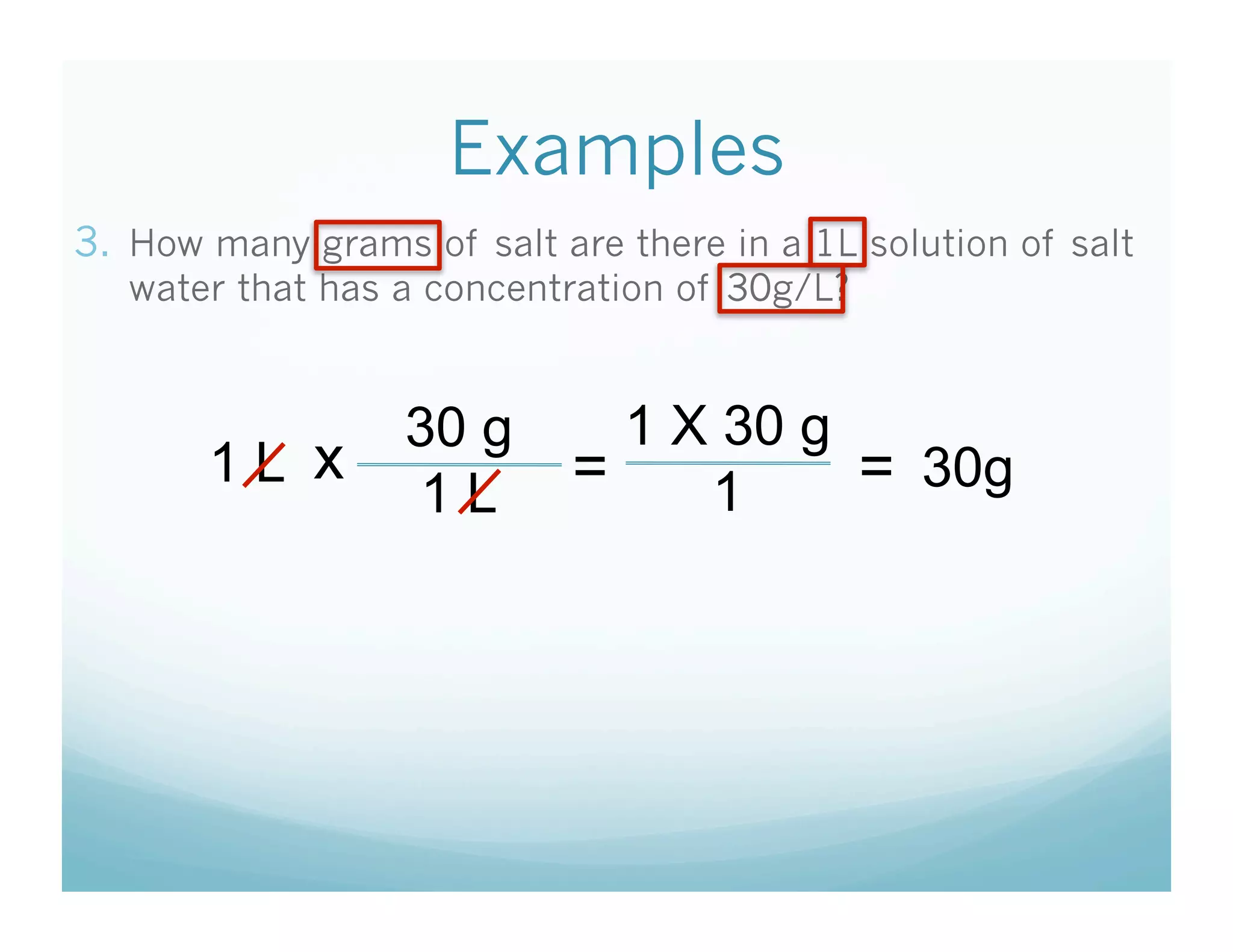
3.  How many grams of salt are there in a 1L solution of salt
   water that has a concentration of 30g/L?


                   30 g       1 X 30 g
       1L x                 =          = 30g
                    1L           1
Examples
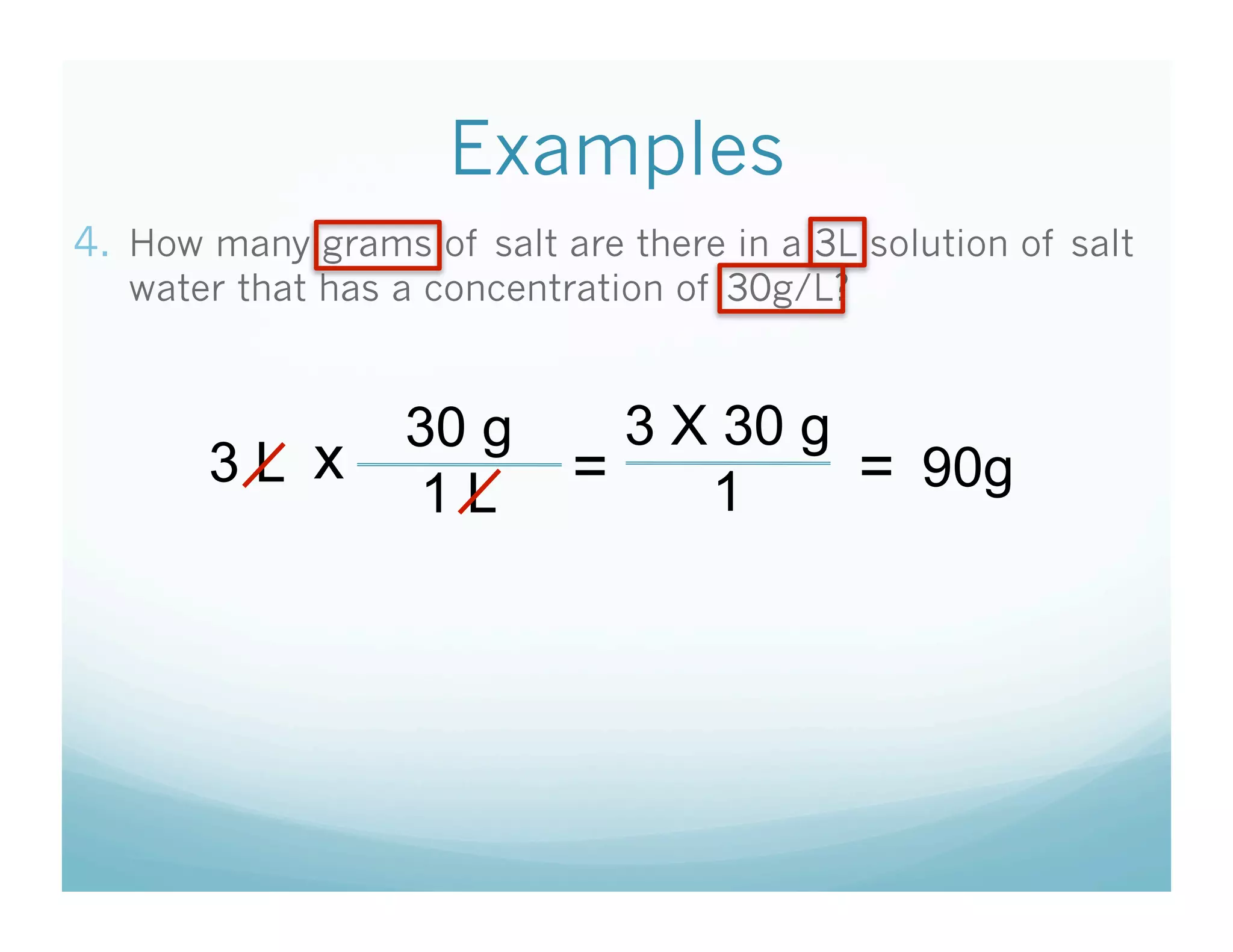
4.  How many grams of salt are there in a 3L solution of salt
   water that has a concentration of 30g/L?


                   30 g       3 X 30 g
       3L x                 =          = 90g
                    1L           1
Whiteboards
  Work in pairs
    Trade-off marker every question
  Partner without the marker should be checking
  work at each step!

  You have 60 seconds to solve the question
    Show all of your work!
    Don’t forget units!
  Lift board only when prompted
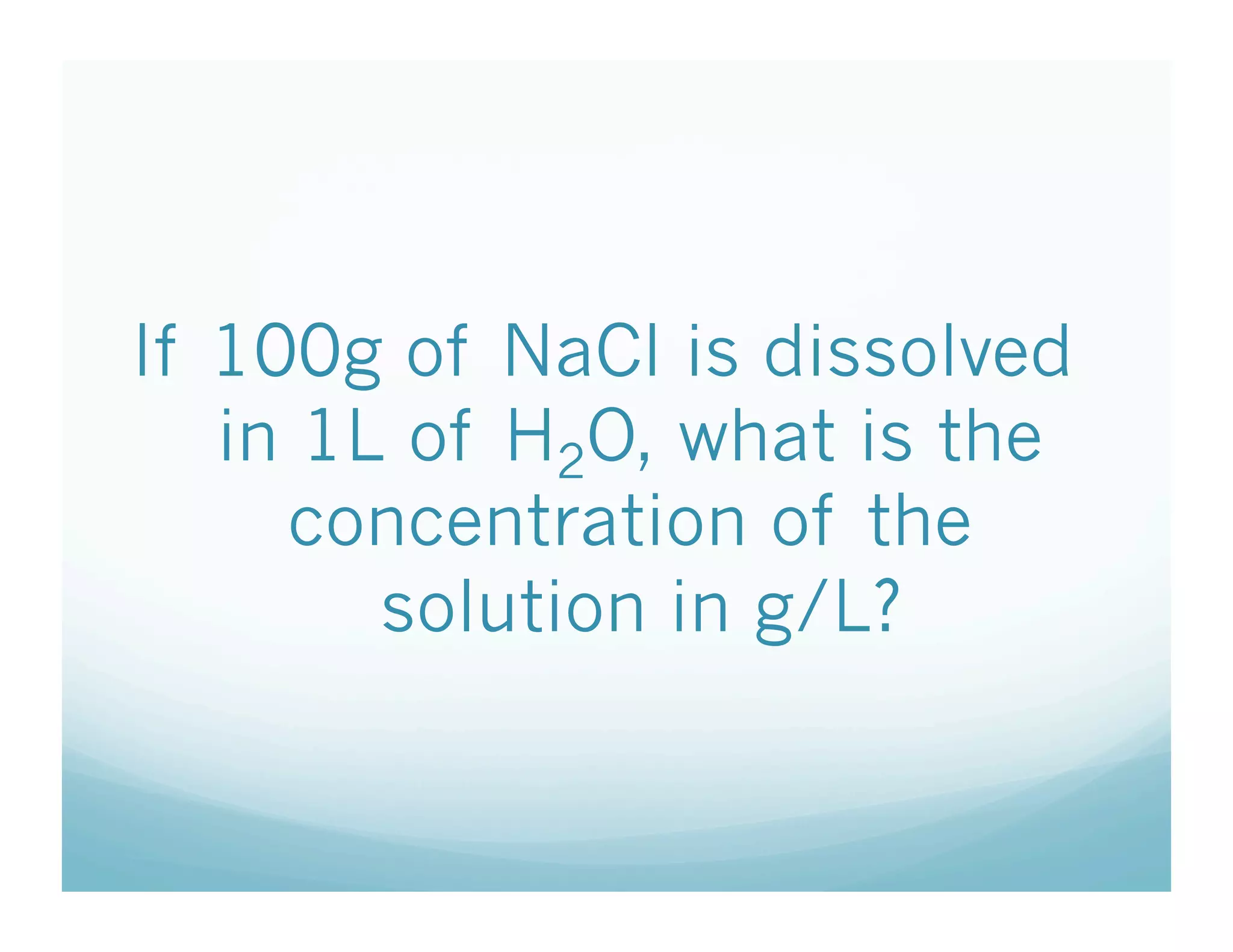
If 100g of NaCl is dissolved
   in 1L of H2O, what is the
     concentration of the
        solution in g/L?
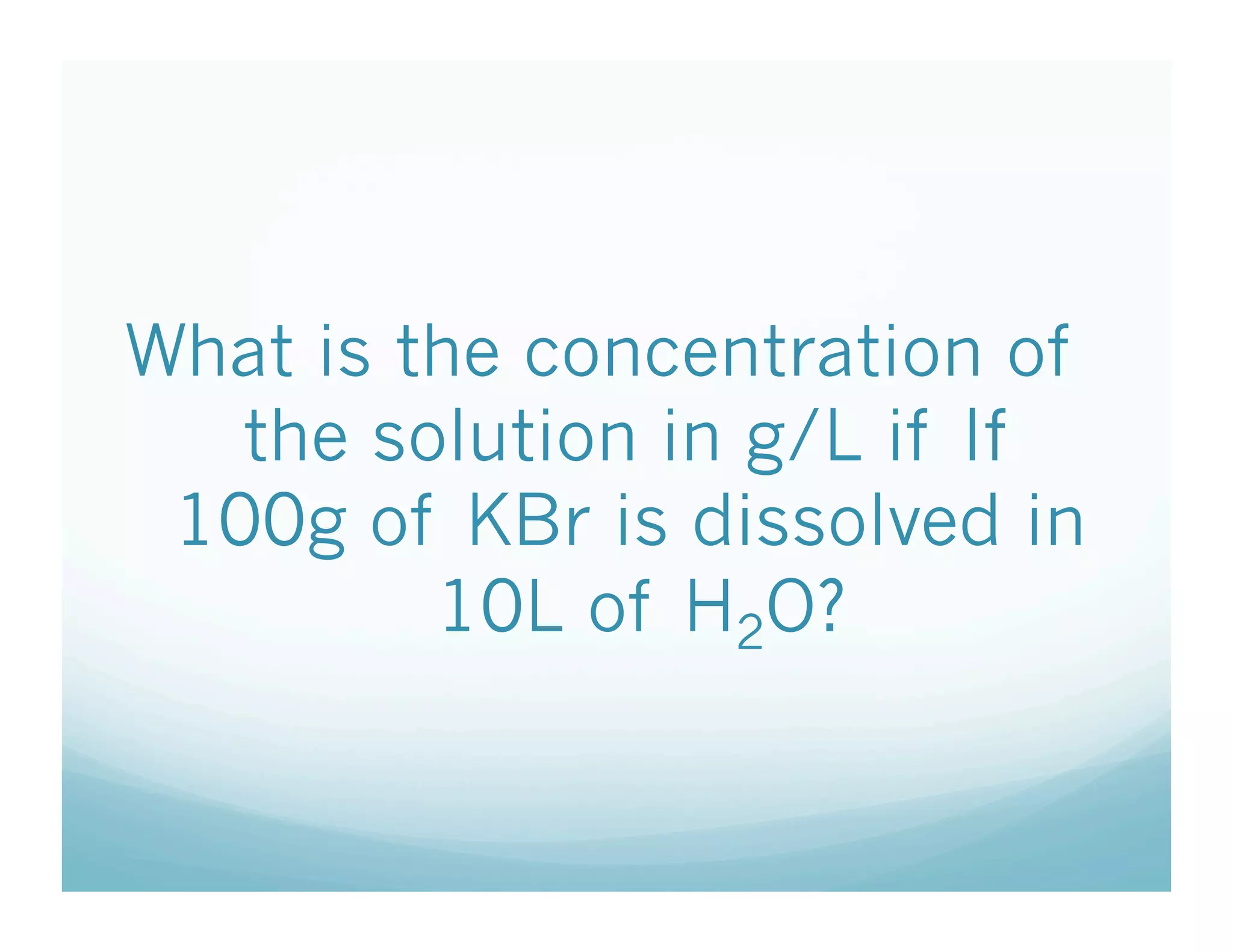
What is the concentration of
   the solution in g/L if If
 100g of KBr is dissolved in
         10L of H2O?
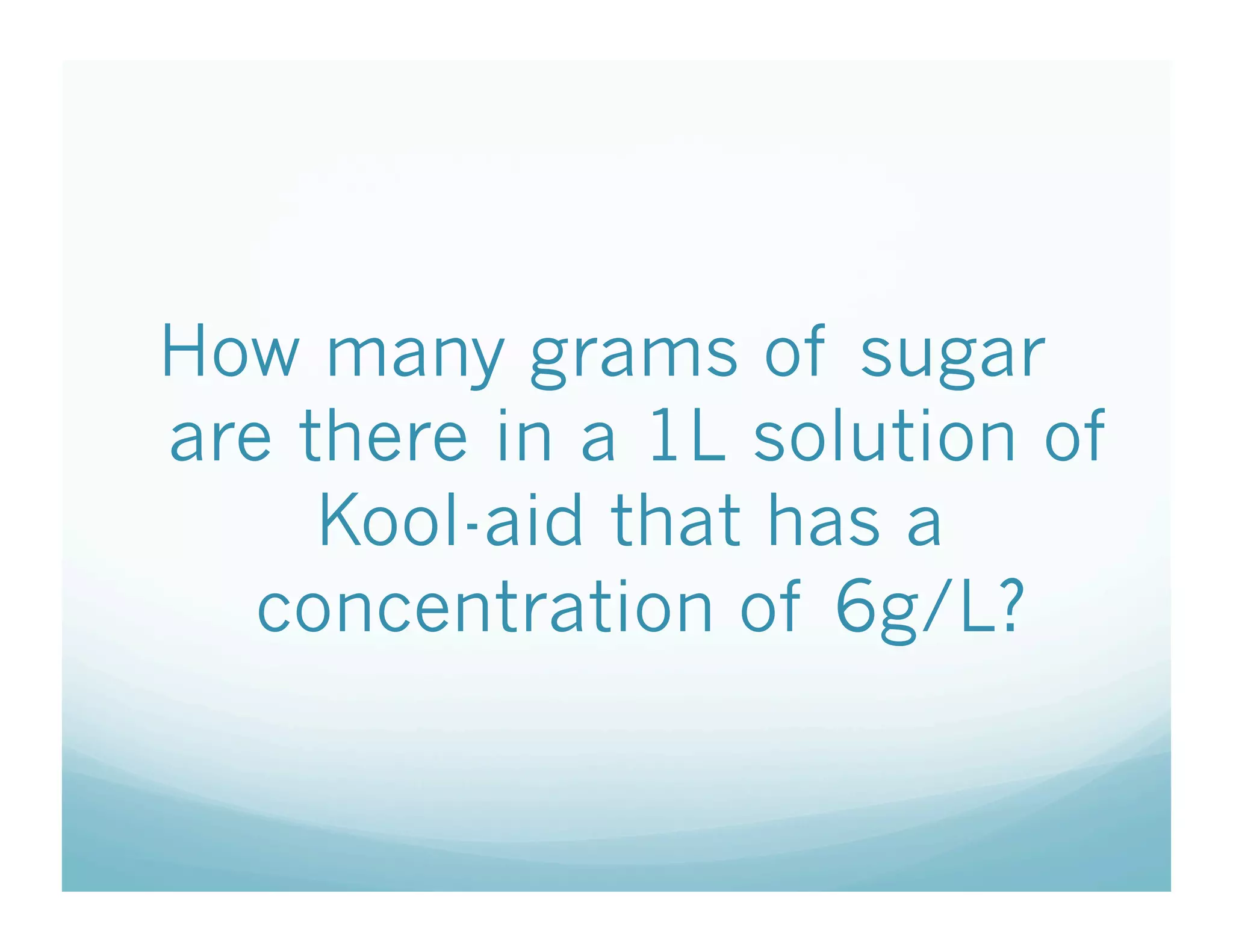
How many grams of sugar
are there in a 1L solution of
     Kool-aid that has a
   concentration of 6g/L?
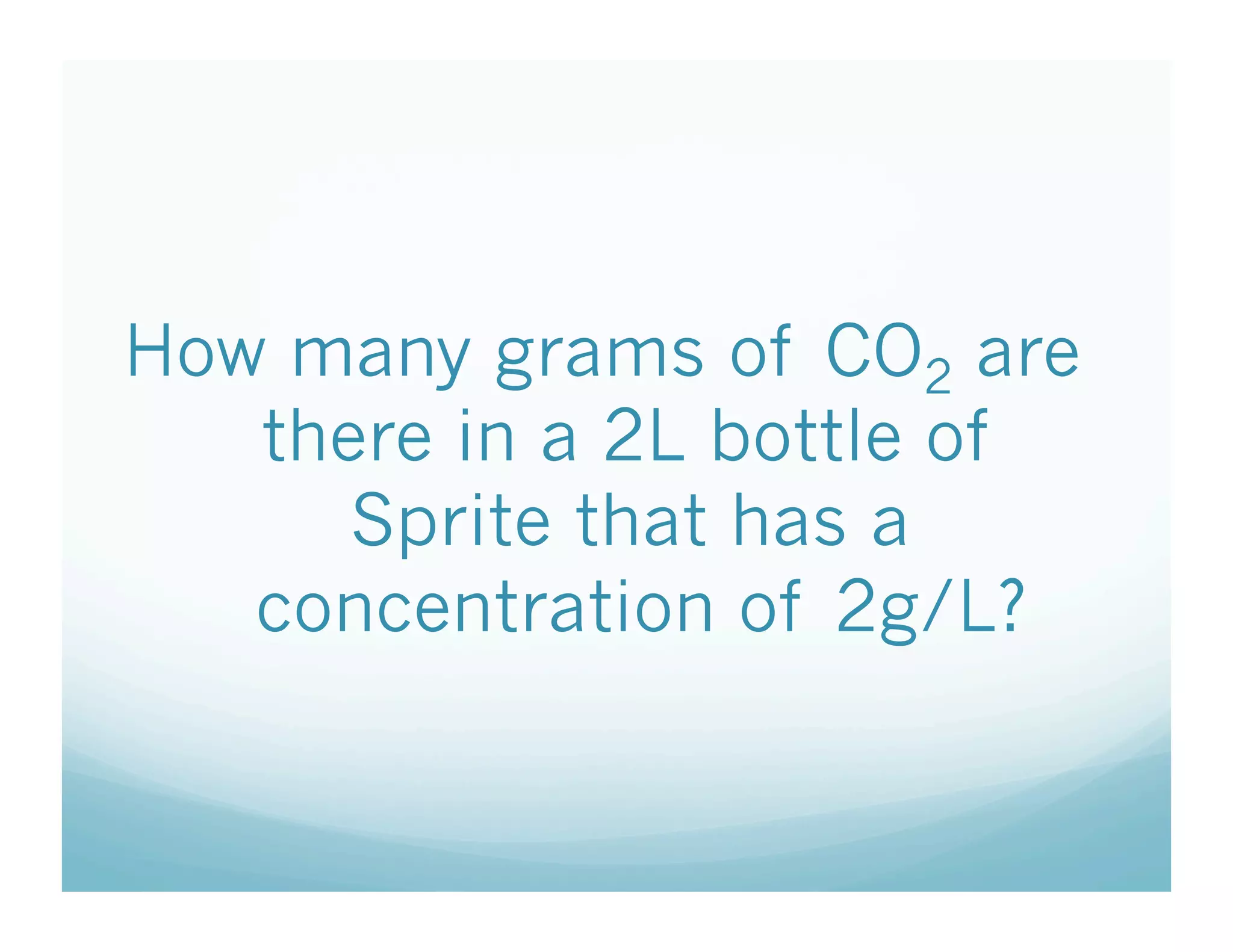
How many grams of CO2 are
   there in a 2L bottle of
      Sprite that has a
   concentration of 2g/L?
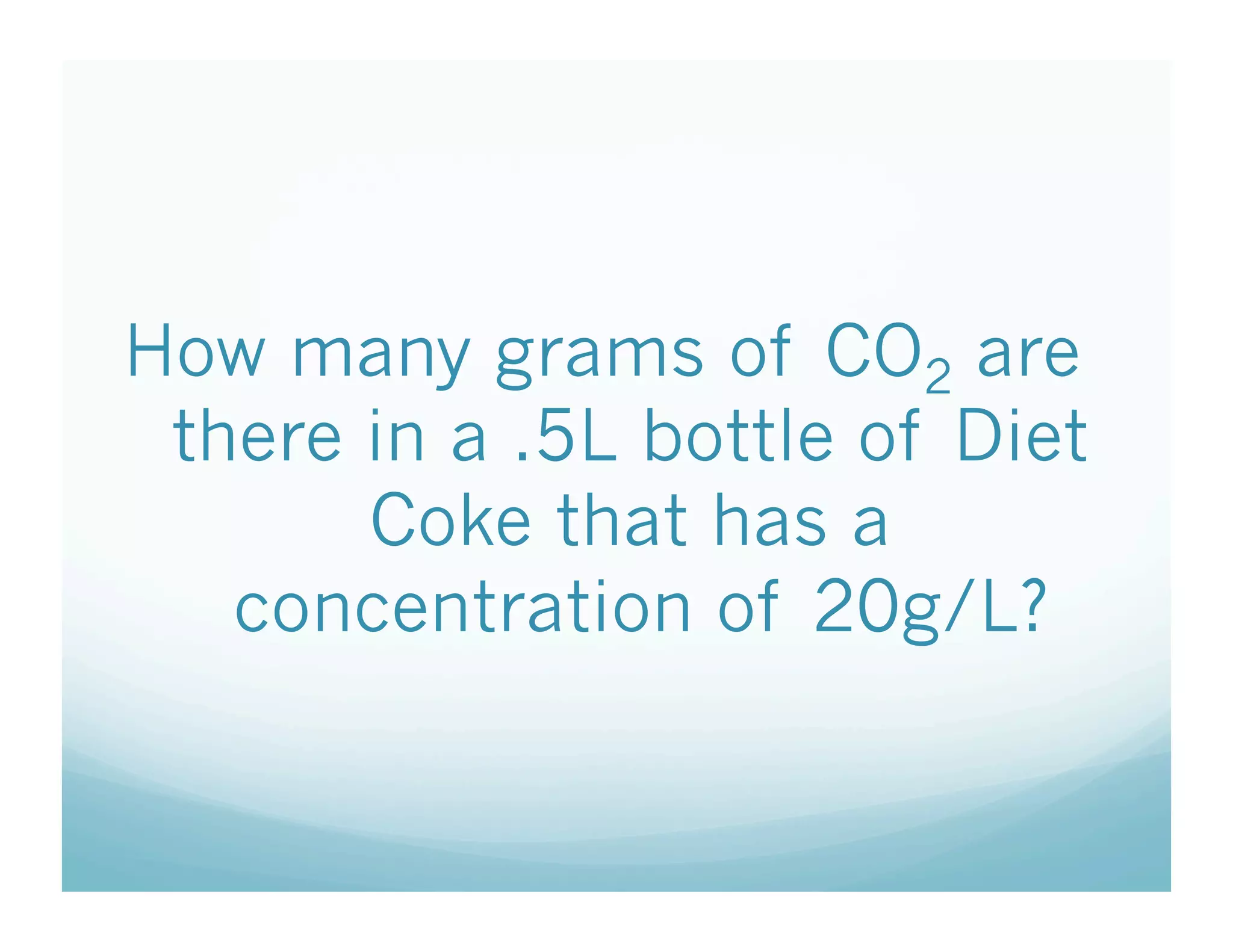
How many grams of CO2 are
 there in a .5L bottle of Diet
       Coke that has a
   concentration of 20g/L?
Practice Questions
  Practice question worksheet
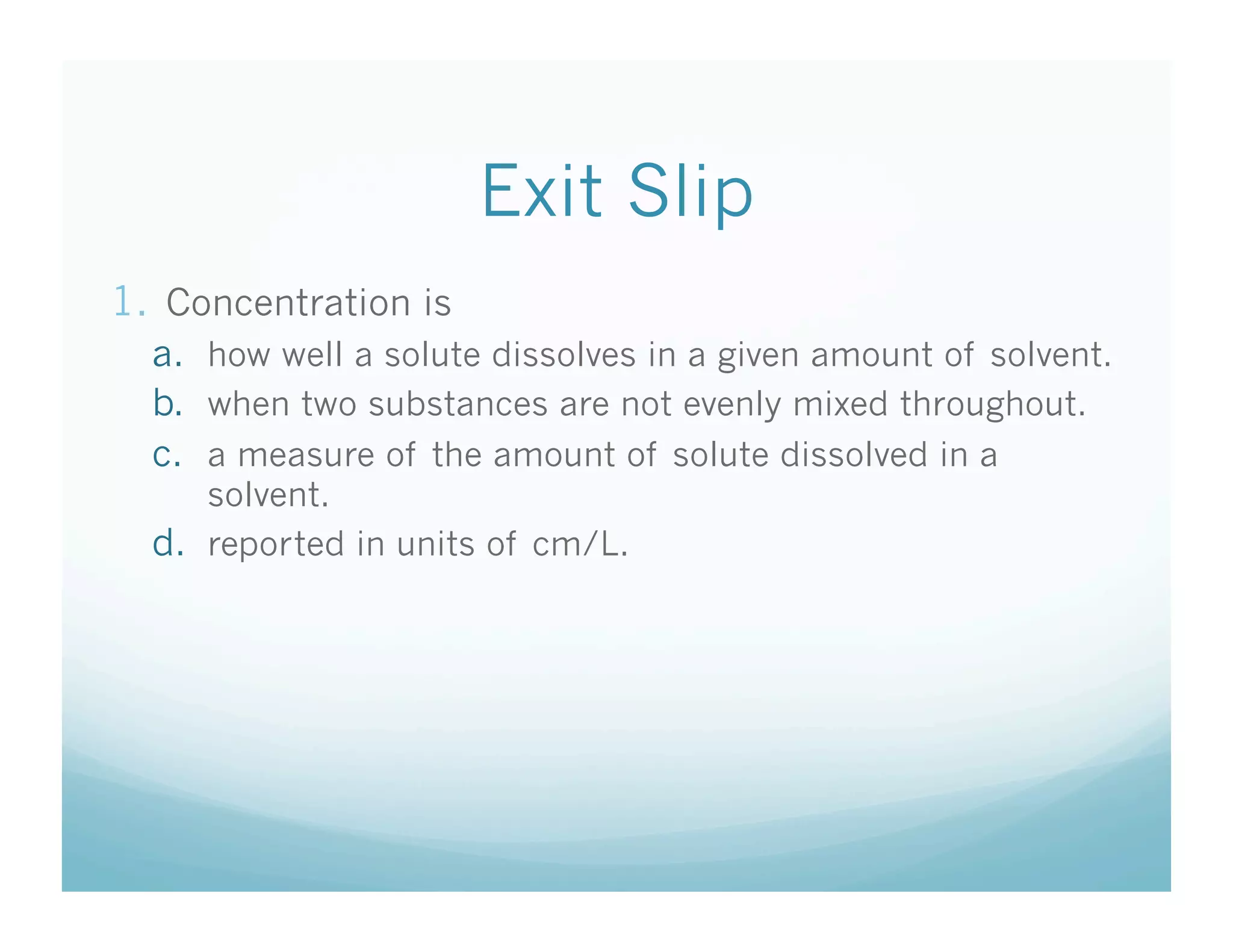
Exit Slip
1.  Concentration is
  a.  how well a solute dissolves in a given amount of solvent.
  b.  when two substances are not evenly mixed throughout.
  c.  a measure of the amount of solute dissolved in a
      solvent.
  d.  reported in units of cm/L.
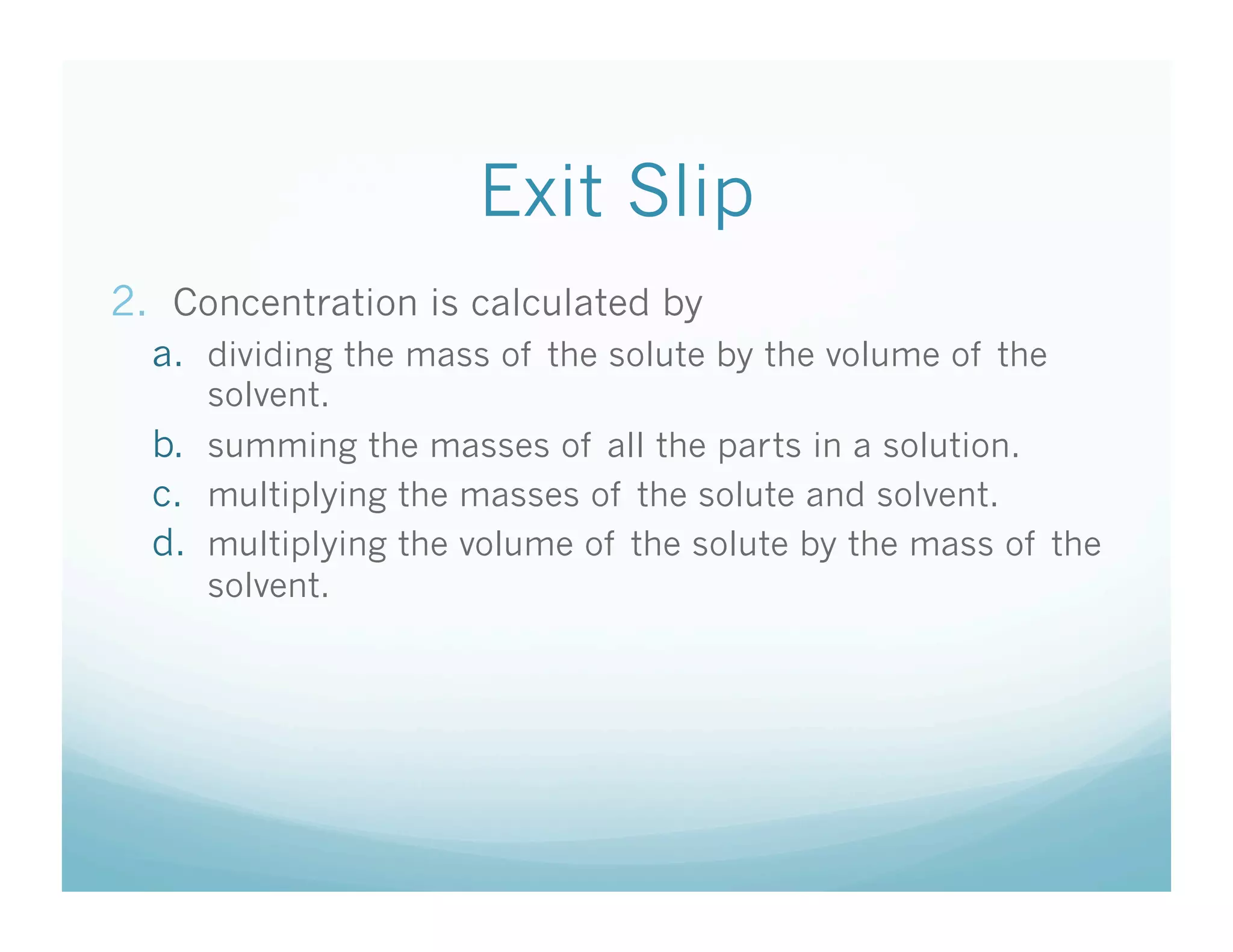
Exit Slip
2.  Concentration is calculated by
  a.  dividing the mass of the solute by the volume of the
      solvent.
  b.  summing the masses of all the parts in a solution.
  c.  multiplying the masses of the solute and solvent.
  d.  multiplying the volume of the solute by the mass of the
      solvent.
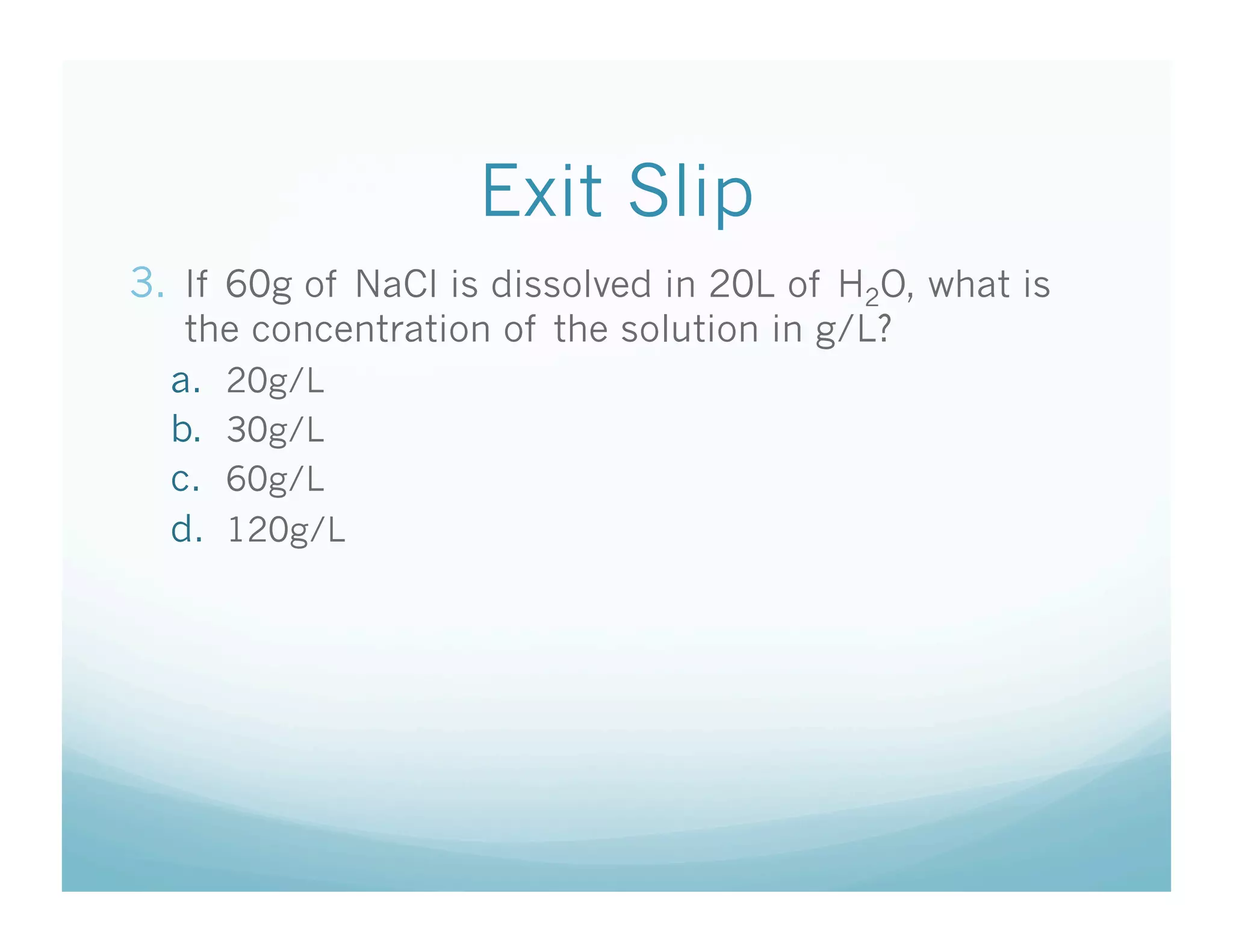
Exit Slip
3.  If 60g of NaCl is dissolved in 20L of H2O, what is
   the concentration of the solution in g/L?
  a.  20g/L
  b.  30g/L
  c.  60g/L
  d.  120g/L
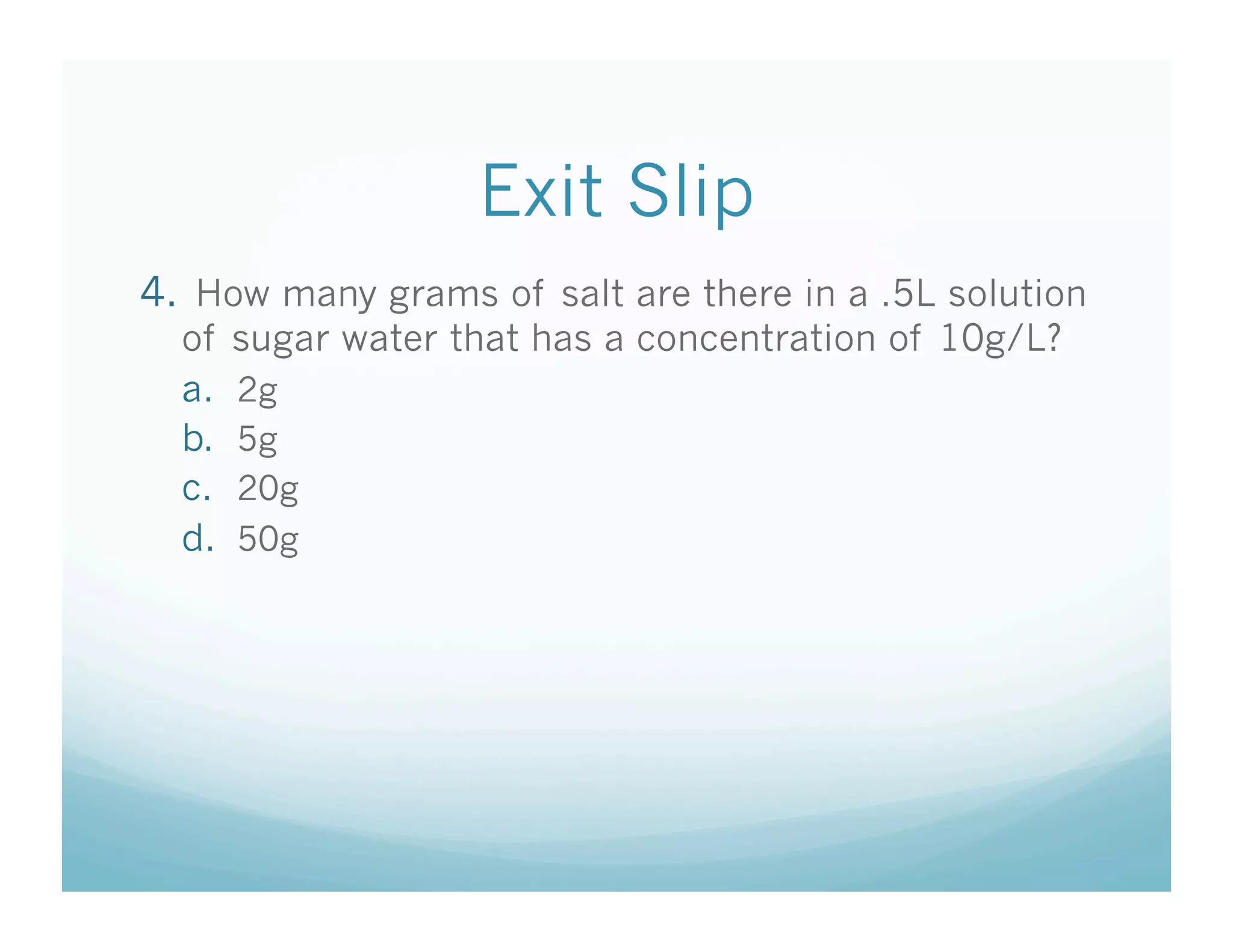
Exit Slip
4.  How many grams of salt are there in a .5L solution
  of sugar water that has a concentration of 10g/L?
  a.  2g
  b.  5g
  c.  20g
  d.  50g
Exit Slip
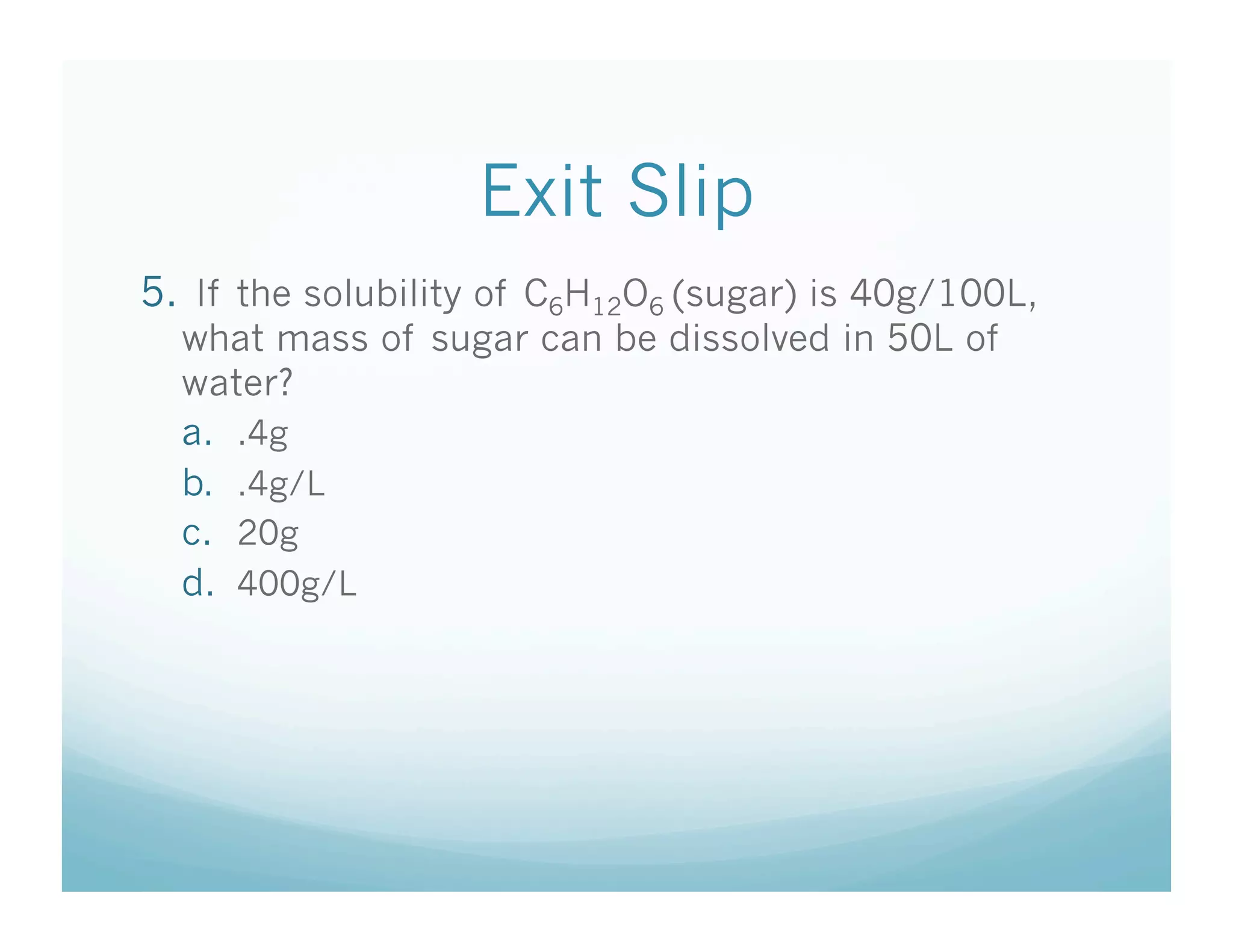
5.  If the solubility of C6H12O6 (sugar) is 40g/100L,
  what mass of sugar can be dissolved in 50L of
  water?
  a.  .4g
  b.  .4g/L
  c.  20g
  d.  400g/L
Homework
  Finish practice questions

1 11 What Is Concentration

  • 1.
    Launch: 1/7   Grabyour binder and immediately take a seat!   Place launch paper and HW (practice questions) on your desk.   Yesterday’s Exit Slip Data: 89%   Today’s Objective: I can describe the factors that affect the dissolving process.
  • 2.
    Launch: 1/7   Grabyour binder and immediately take a seat!   Place launch paper and HW (practice questions) on your desk.   Yesterday’s Exit Slip Data: 77%   Today’s Objective: I can describe the factors that affect the dissolving process.
  • 3.
    Launch: 1/7   Grabyour binder and immediately take a seat!   Place launch paper and HW (practice questions) on your desk.   Yesterday’s Exit Slip Data: 86%   Today’s Objective: I can describe the factors that affect the dissolving process.
  • 4.
    Launch: 1/7   Grabyour binder and immediately take a seat!   Place launch paper and HW (practice questions) on your desk.   Yesterday’s Exit Slip Data: 93%   Today’s Objective: I can describe the factors that affect the dissolving process.
  • 5.
    Launch 1/7 1.  In1-2 sentences, explain what you did in lab on Friday. •  What variable did you change? •  What were the results of your experiment?
  • 6.
    Launch 1/7 2.  5grams of sugar would dissolve the fastest in a.  cold water. b.  warm water. c.  hot water. d.  none of the above.
  • 7.
    Launch 1/7 1.  Solubilityis a.  when solvent particles are attacked by the solute. b.  how well a solute dissolves in a given amount of solvent. c.  when two substances are not evenly mixed throughout. d.  how well a solvent dissolves in a given amount of solute.
  • 8.
    New Changes forthe New Year!   Late homework policy   Late homework in now due the day after you return   Notes packets, handouts, and practice questions will can be found:   at the back of the classroom
  • 9.
    New Changes forthe New Year!   Class consequences 1.  Name on board 2.  Take a break 3.  Call home 4.  Sent to Mr. Wandera   Rules: still the same 7
  • 10.
  • 11.
    What is concentration? Mr. Heffner 1/11/10
  • 12.
    Review: What issolubility?   Factors that affect solubility of solids 1.  Temperature: temperature = solubility 2.  Surface Area: surface area = solubility   Factors that affect solubility of gases 1.  Temperature: temperature = solubility 2.  Pressure: pressure = solubility
  • 13.
    What is concentration?  Concentration is…   the amount of solute dissolved a in solution. Concentrated Dilute   High concentration   Low concentration   Large amount of solute   Small amount of solute   Really sweet Kool-aid   Tasteless Kool-aid
  • 14.
    What is concentration?  Concentration is measured in…   grams per liter (g/L) volume   the # of grams of solute in one liter of solvent   Example: Salt water   50g of NaCl (salt) mass   1L of H2O (water)
  • 15.
    Examples 1.  If 50gof NaCl is dissolved in 1L of H2O, what is the concentration of the solution in g/L? mass 50 g 1L = 50 g/L volume
  • 16.
    Examples 2.  If 50gof NaCl is dissolved in 1L of H2O, what is the concentration of the solution in g/L? 50 g 2L = 25 g/L
  • 17.
    Examples 3.  How manygrams of salt are there in a 1L solution of salt water that has a concentration of 30g/L? 30 g 1 X 30 g 1L x = = 30g 1L 1
  • 18.
    Examples 4.  How manygrams of salt are there in a 3L solution of salt water that has a concentration of 30g/L? 30 g 3 X 30 g 3L x = = 90g 1L 1
  • 19.
    Whiteboards   Work inpairs   Trade-off marker every question   Partner without the marker should be checking work at each step!   You have 60 seconds to solve the question   Show all of your work!   Don’t forget units!   Lift board only when prompted
  • 20.
    If 100g ofNaCl is dissolved in 1L of H2O, what is the concentration of the solution in g/L?
  • 21.
    What is theconcentration of the solution in g/L if If 100g of KBr is dissolved in 10L of H2O?
  • 22.
    How many gramsof sugar are there in a 1L solution of Kool-aid that has a concentration of 6g/L?
  • 23.
    How many gramsof CO2 are there in a 2L bottle of Sprite that has a concentration of 2g/L?
  • 24.
    How many gramsof CO2 are there in a .5L bottle of Diet Coke that has a concentration of 20g/L?
  • 25.
  • 26.
    Exit Slip 1.  Concentrationis a.  how well a solute dissolves in a given amount of solvent. b.  when two substances are not evenly mixed throughout. c.  a measure of the amount of solute dissolved in a solvent. d.  reported in units of cm/L.
  • 27.
    Exit Slip 2.  Concentrationis calculated by a.  dividing the mass of the solute by the volume of the solvent. b.  summing the masses of all the parts in a solution. c.  multiplying the masses of the solute and solvent. d.  multiplying the volume of the solute by the mass of the solvent.
  • 28.
    Exit Slip 3.  If60g of NaCl is dissolved in 20L of H2O, what is the concentration of the solution in g/L? a.  20g/L b.  30g/L c.  60g/L d.  120g/L
  • 29.
    Exit Slip 4.  Howmany grams of salt are there in a .5L solution of sugar water that has a concentration of 10g/L? a.  2g b.  5g c.  20g d.  50g
  • 30.
    Exit Slip 5.  Ifthe solubility of C6H12O6 (sugar) is 40g/100L, what mass of sugar can be dissolved in 50L of water? a.  .4g b.  .4g/L c.  20g d.  400g/L
  • 31.