Launch: 2/10
  Grab your binder and immediately take a seat!
  Place launch paper on your desk.
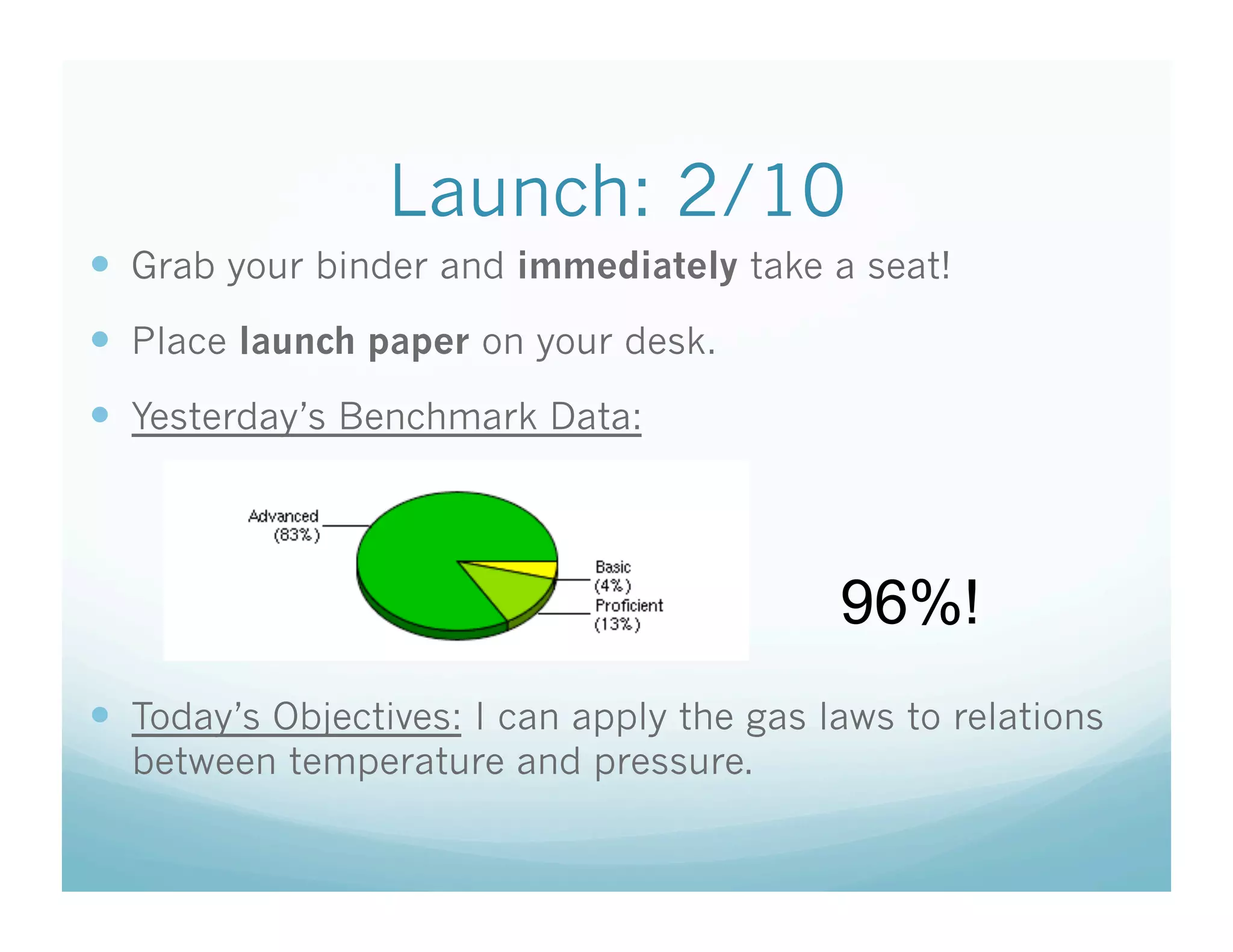
  Yesterday’s Benchmark Data:


                                            96%!
  Today’s Objectives: I can apply the gas laws to relations
  between temperature and pressure.
Launch 2/10
1.  What is the equation for converting
   between the Celcius and Kelvin scales?
   Label the variables.
Launch 2/10
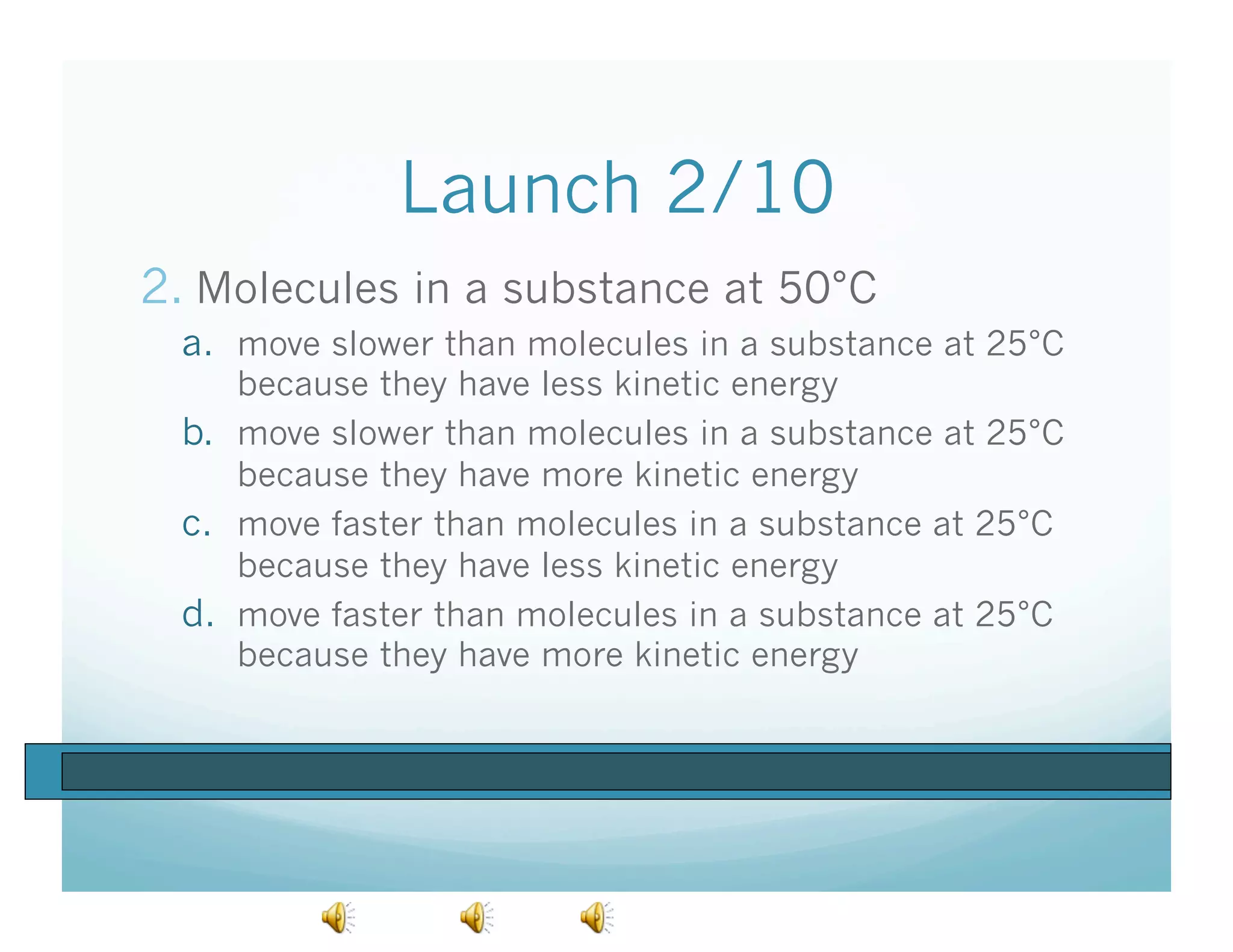
2.  Molecules in a substance at 50°C
  a.  move slower than molecules in a substance at 25°C
      because they have less kinetic energy
  b.  move slower than molecules in a substance at 25°C
      because they have more kinetic energy
  c.  move faster than molecules in a substance at 25°C
      because they have less kinetic energy
  d.  move faster than molecules in a substance at 25°C
      because they have more kinetic energy
Launch 2/10
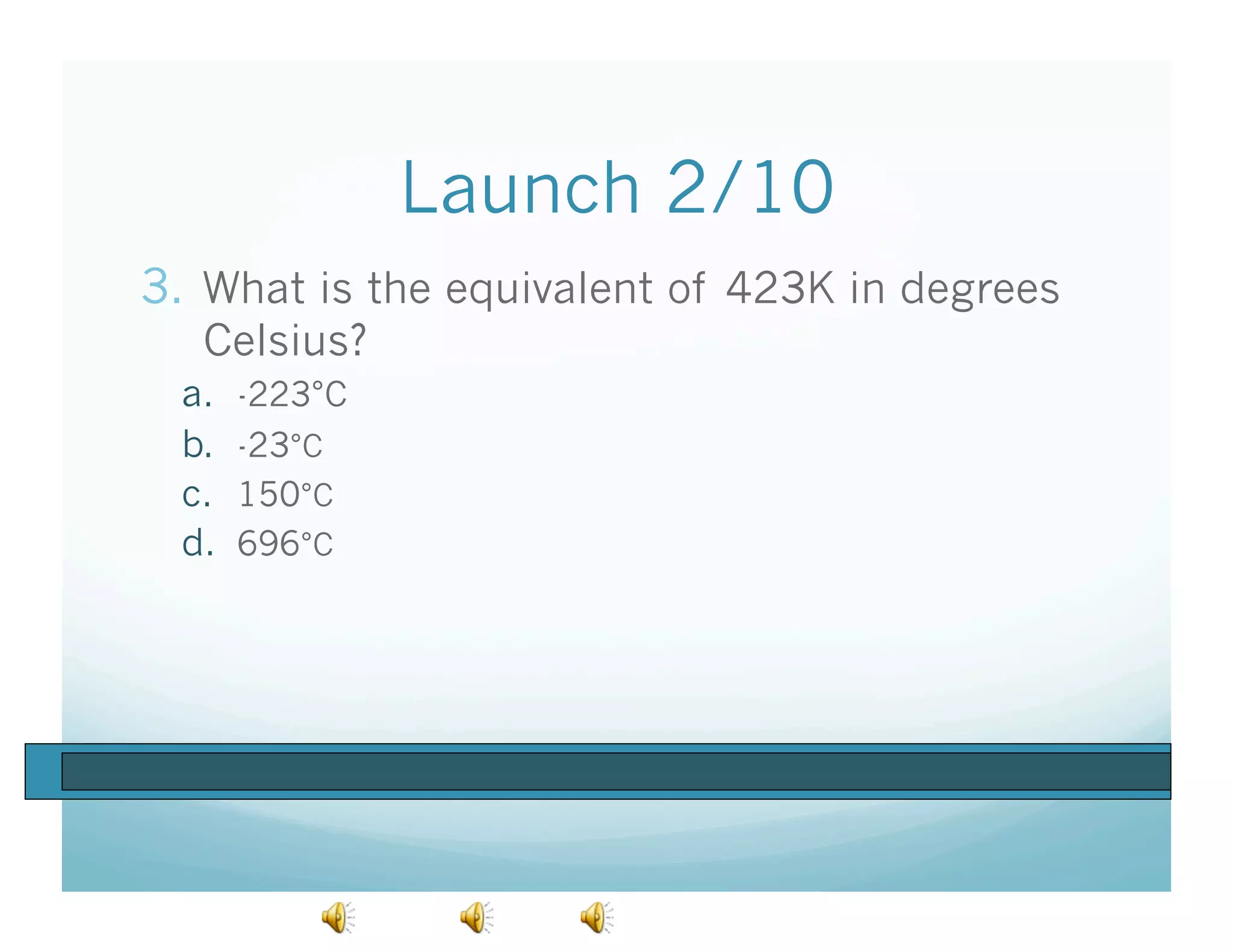
3.  What is the equivalent of 423K in degrees
   Celsius?
  a.    -223°C
  b.    -23°C
  c.    150°C
  d.    696°C
Launch 2/10
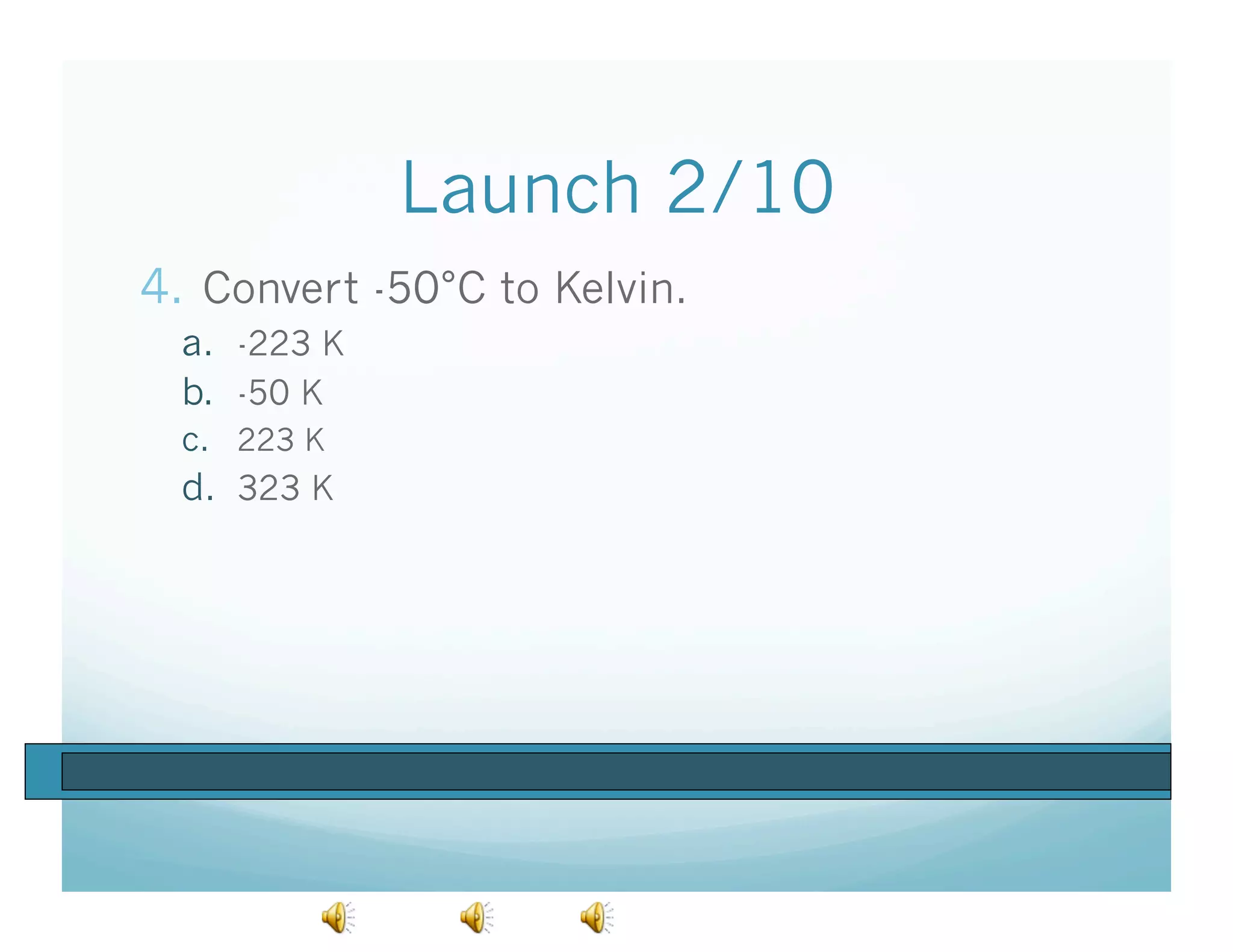
4.  Convert -50°C to Kelvin.
  a.  -223 K
  b.  -50 K
  c.  223 K
  d.  323 K
Announcements
  Great job yesterday!
  No quiz on Friday
  Class points end on Friday
  Only 3 days until break…
    Let’s finish strong
February Calendar

                        Quiz!


       Today           No quiz!


               Exam!
Opening
  Today’s Objective: I can apply the gas laws to
  relations between temperature and pressure.
    Standard – CH.4.c
  Today’s Questions: How are P and T related?
How are P & T related?
        Mr. Heffner
         2/10/10
How are P & T related?
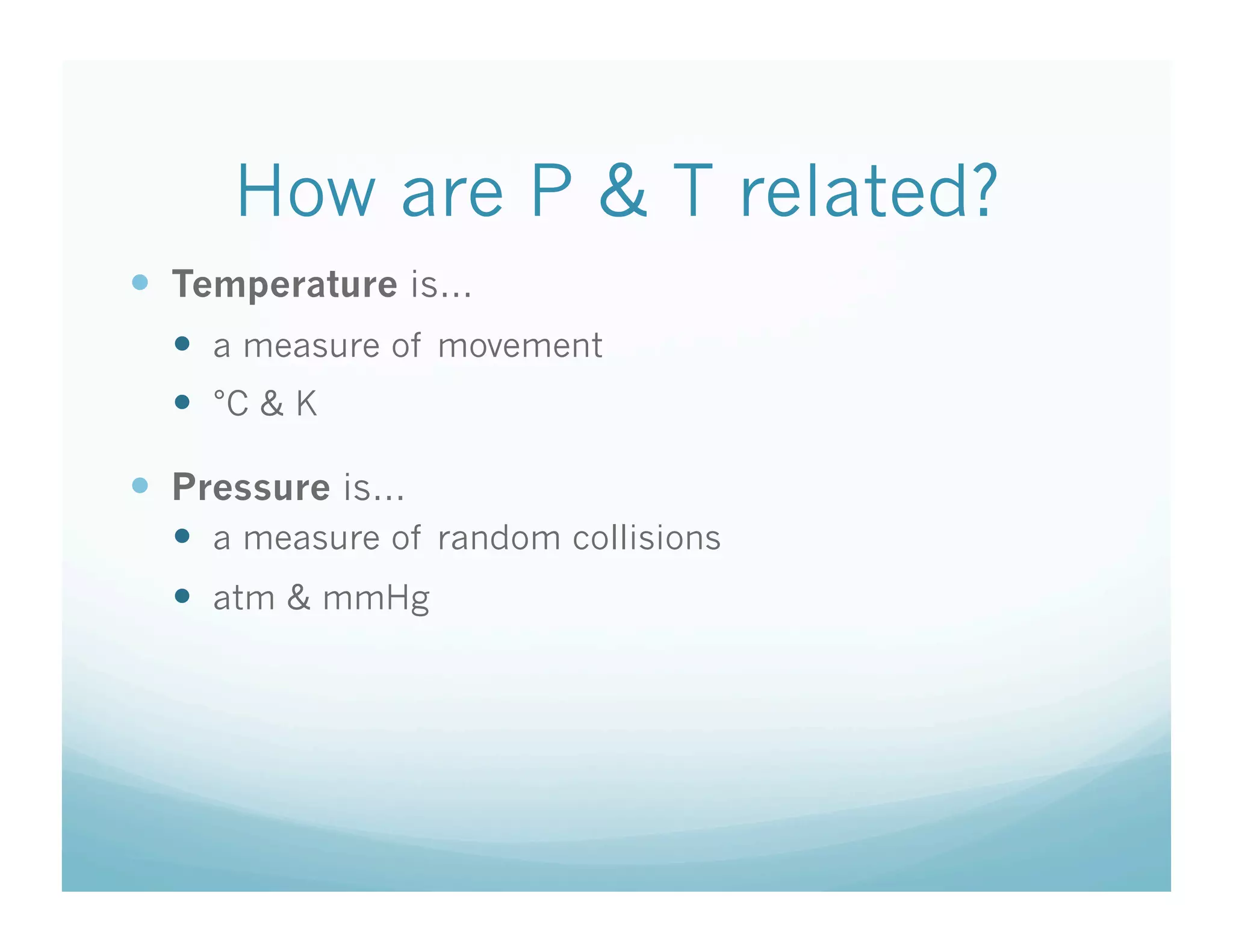
  Temperature is…
    a measure of movement
    °C & K

  Pressure is…
    a measure of random collisions
    atm & mmHg
How are P & T related?

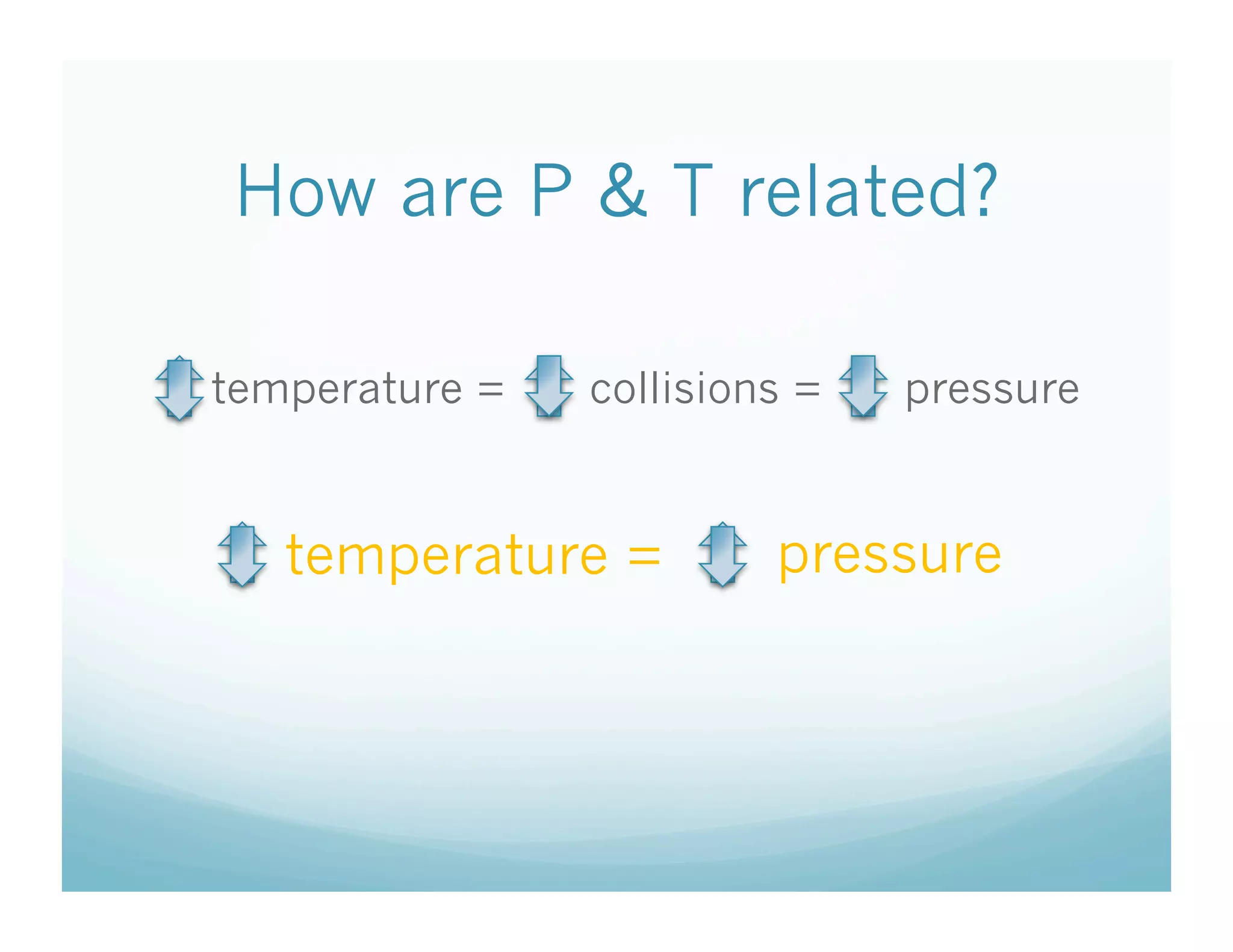
temperature =   collisions =   pressure


   temperature =         pressure
How are P & T related?
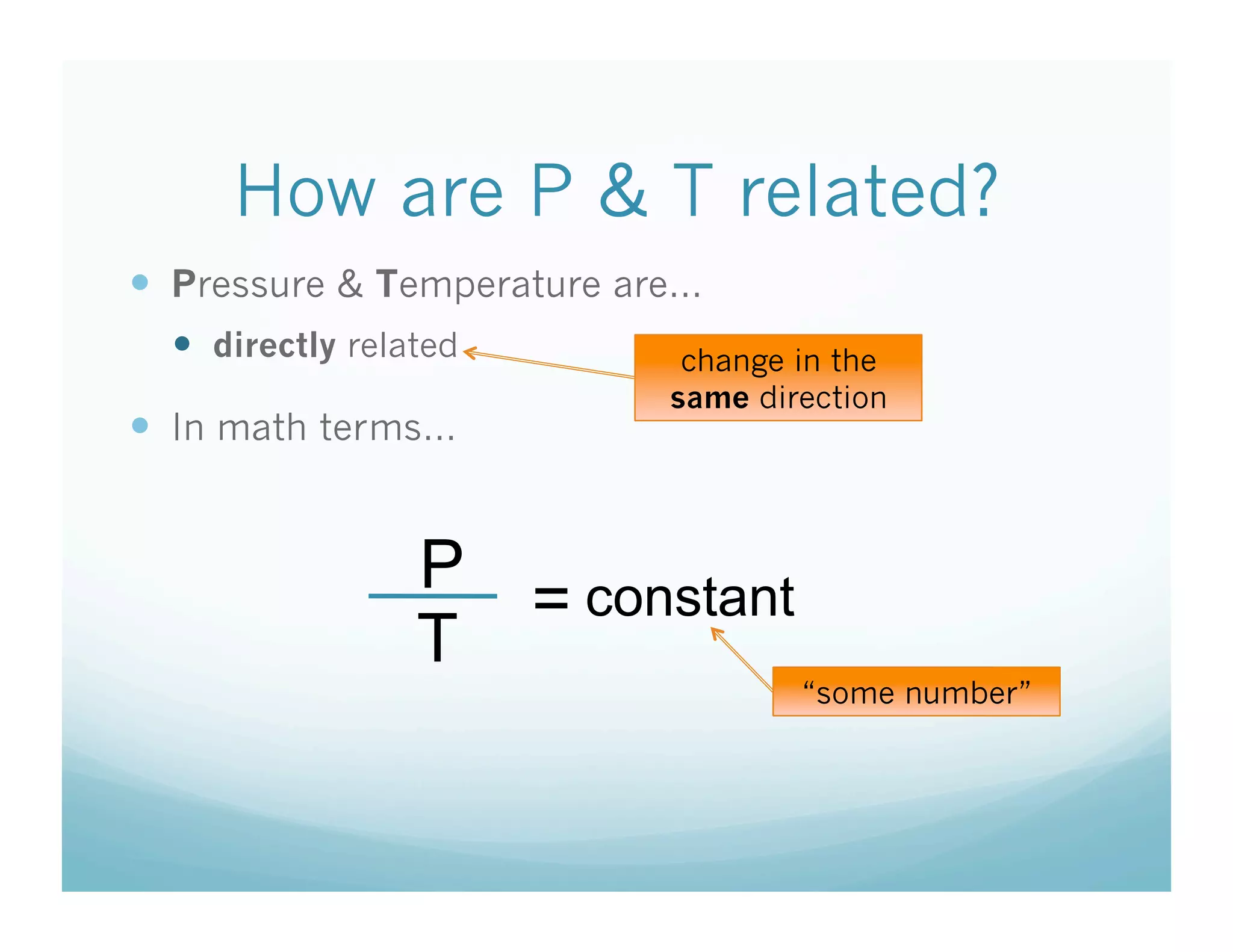
  Pressure & Temperature are…
    directly related        change in the
                            same direction
  In math terms…


                  P
                    = constant
                  T
                                    “some number”
How are P & T related?
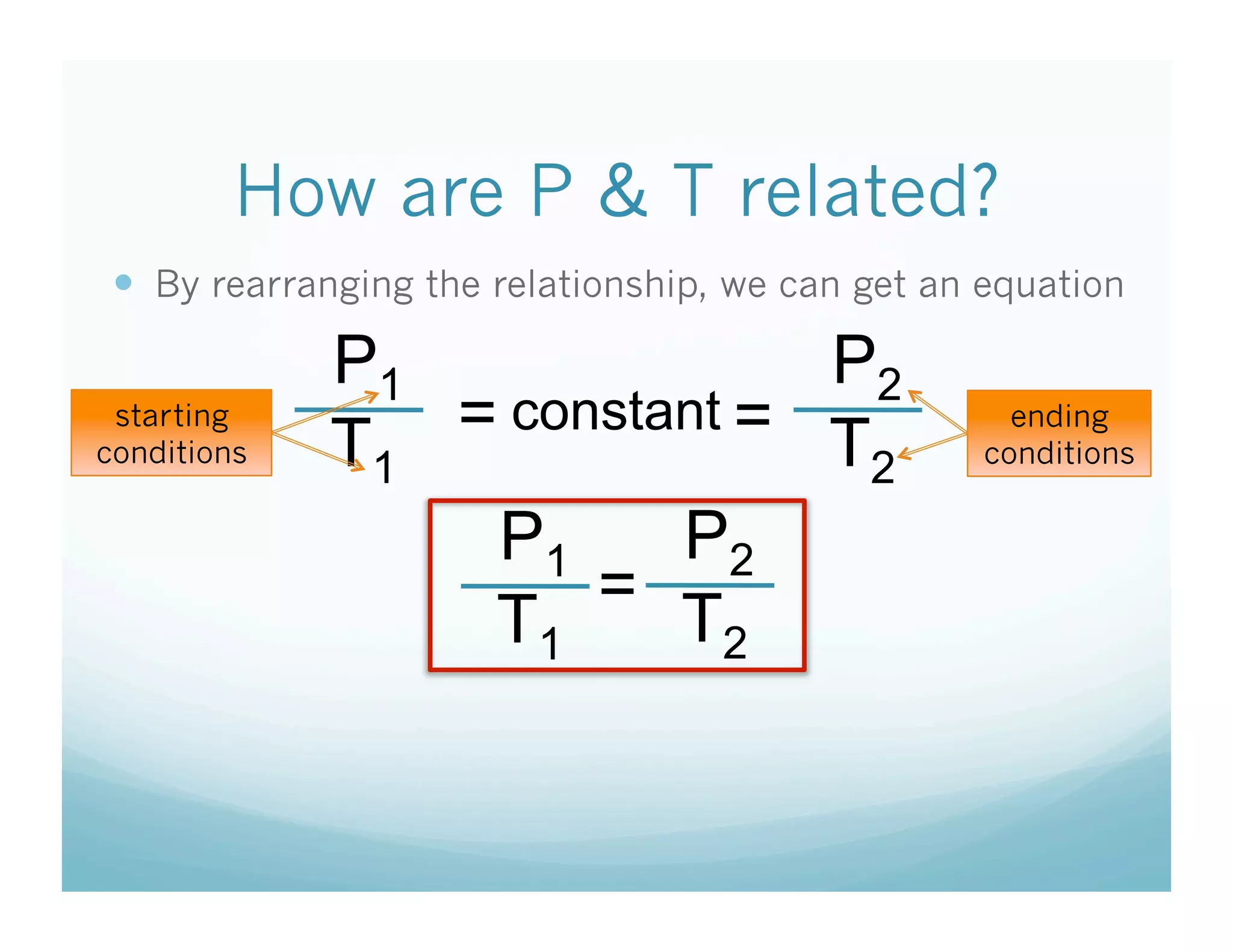
   By rearranging the relationship, we can get an equation

             P1              P2
 starting
conditions   T1 = constant = T                      ending
                                                  conditions
                              2
                 P1     P2
                     =
                 T1     T2
How are P & T related?
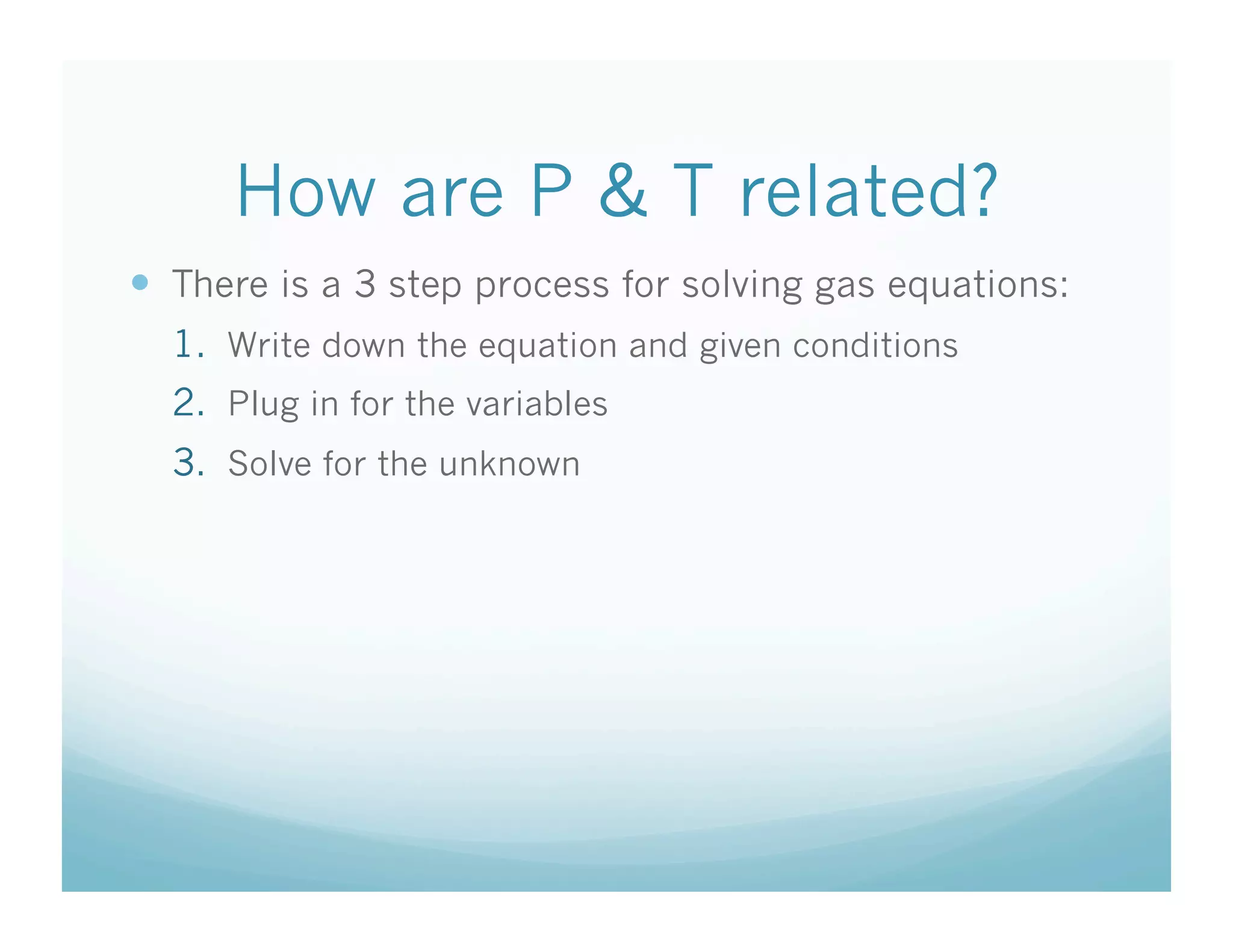
  There is a 3 step process for solving gas equations:
  1.  Write down the equation and given conditions
  2.  Plug in for the variables
  3.  Solve for the unknown
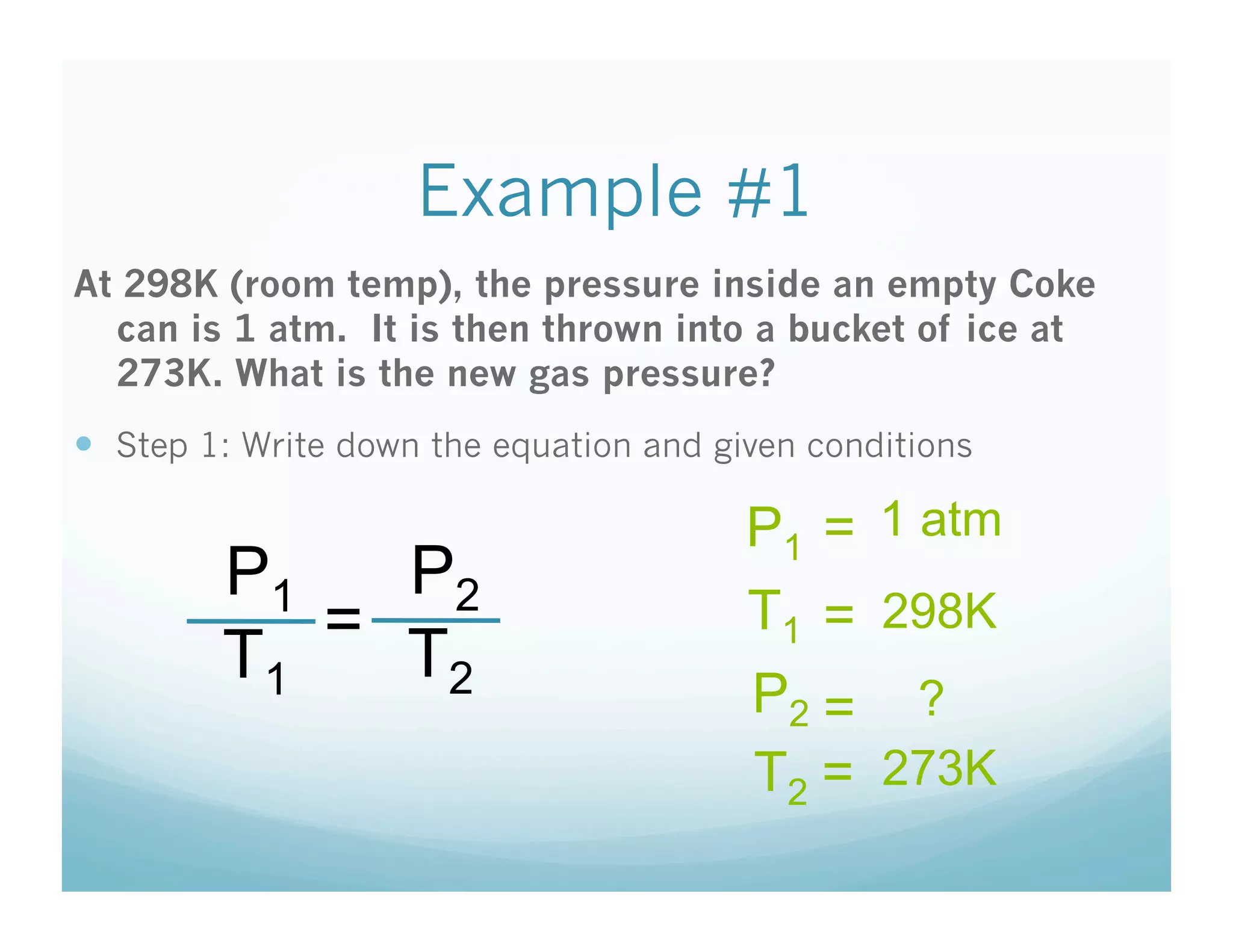
Example #1
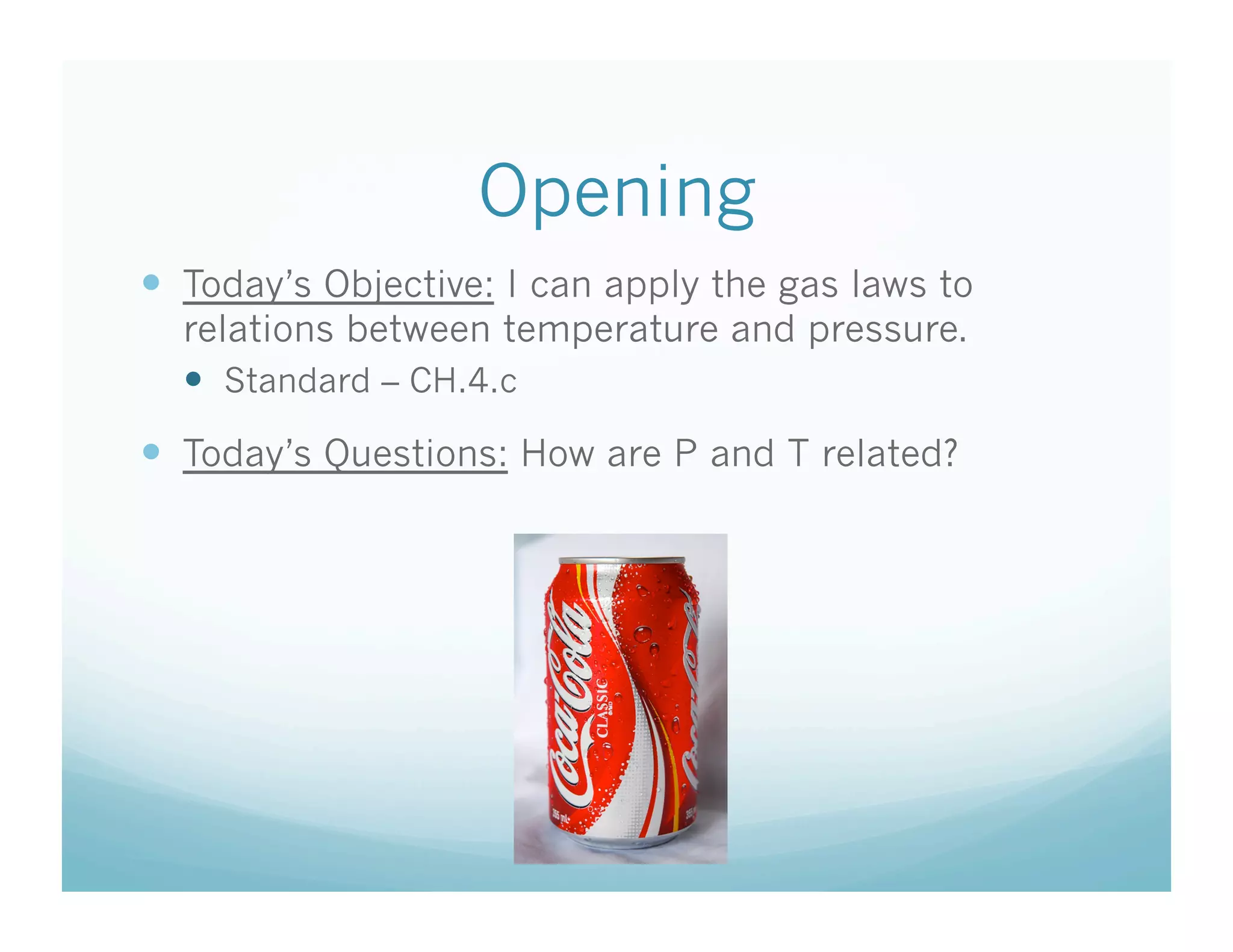
At 298K (room temp), the pressure inside an empty Coke
  can is 1 atm. It is then thrown into a bucket of ice at
  273K. What is the new gas pressure?
  Step 1: Write down the equation and given conditions

                                         P1 = 1 atm
         P1   P2
            =                            T1 = 298K
         T1   T2
                                         P2 = ?
                                         T2 = 273K
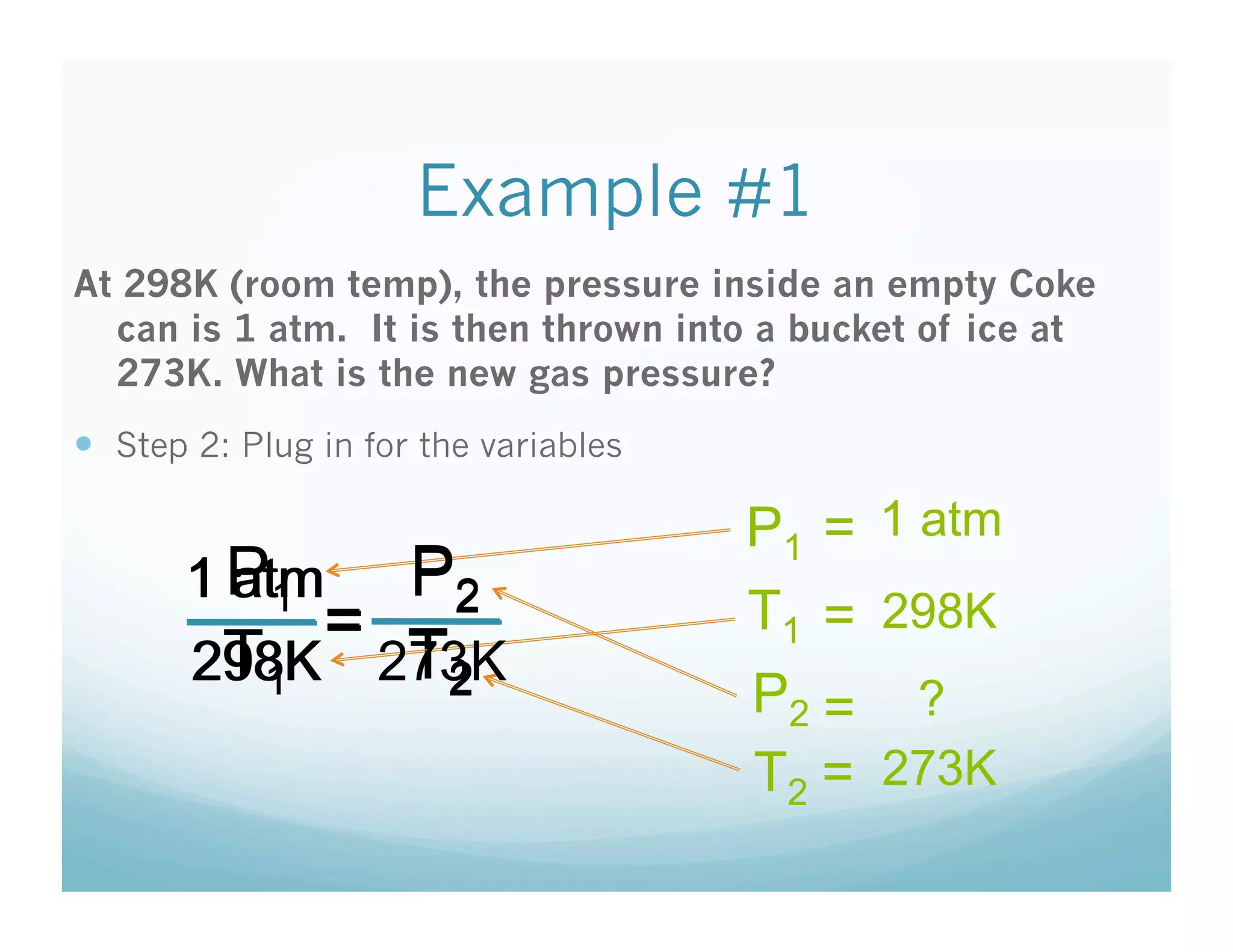
Example #1
At 298K (room temp), the pressure inside an empty Coke
  can is 1 atm. It is then thrown into a bucket of ice at
  273K. What is the new gas pressure?
  Step 2: Plug in for the variables

                                       P1 = 1 atm
       1 P1
         atm   P2
             =                         T1 = 298K
         T1    T2
       298K 273K
                                       P2 = ?
                                       T2 = 273K
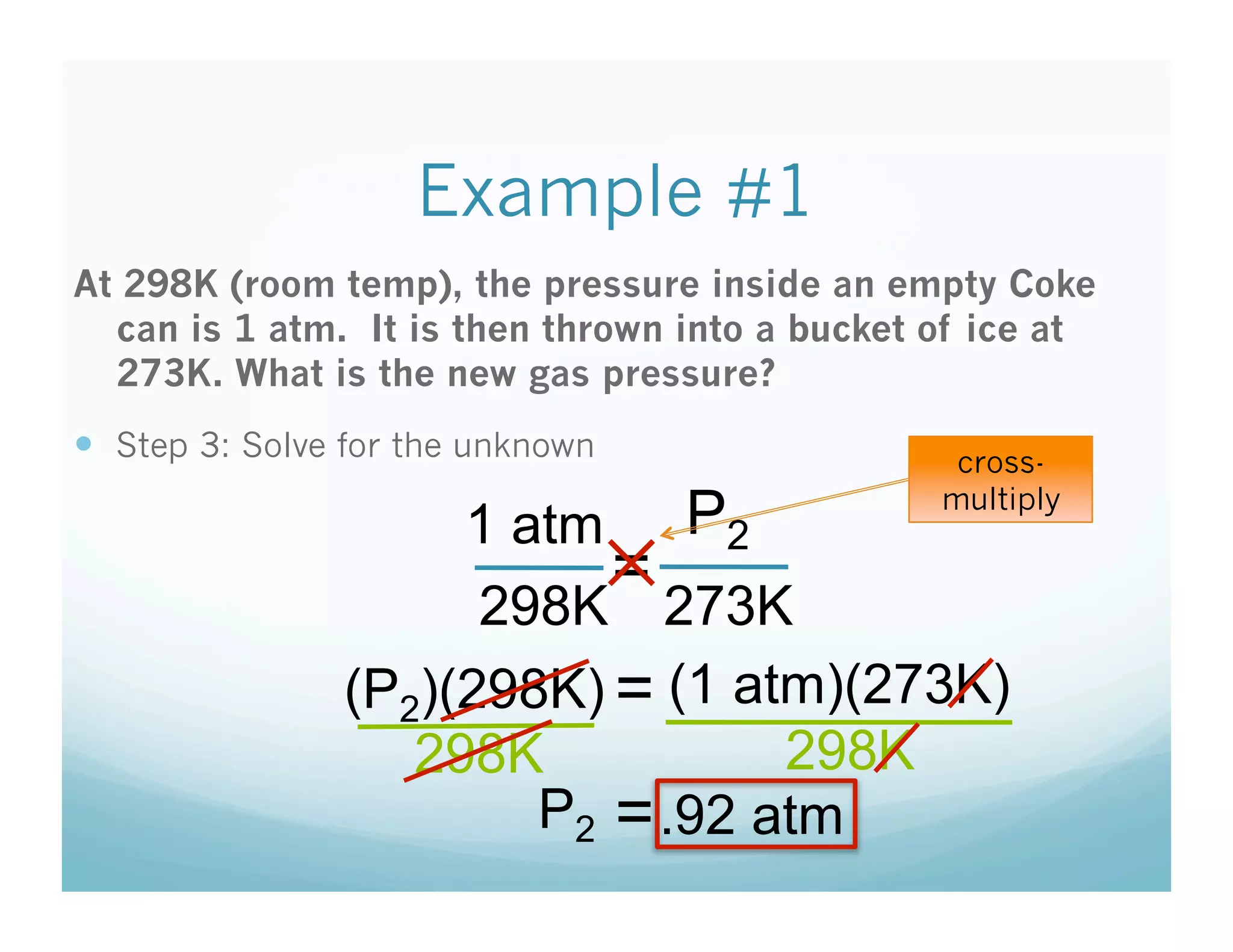
Example #1
At 298K (room temp), the pressure inside an empty Coke
  can is 1 atm. It is then thrown into a bucket of ice at
  273K. What is the new gas pressure?
  Step 3: Solve for the unknown                 cross-

                     1 atm P2
                                                multiply

                           =
                           ✕
                      298K 273K
                (P2)(298K) = (1 atm)(273K)
                   298K           298K
                        P2 = .92 atm
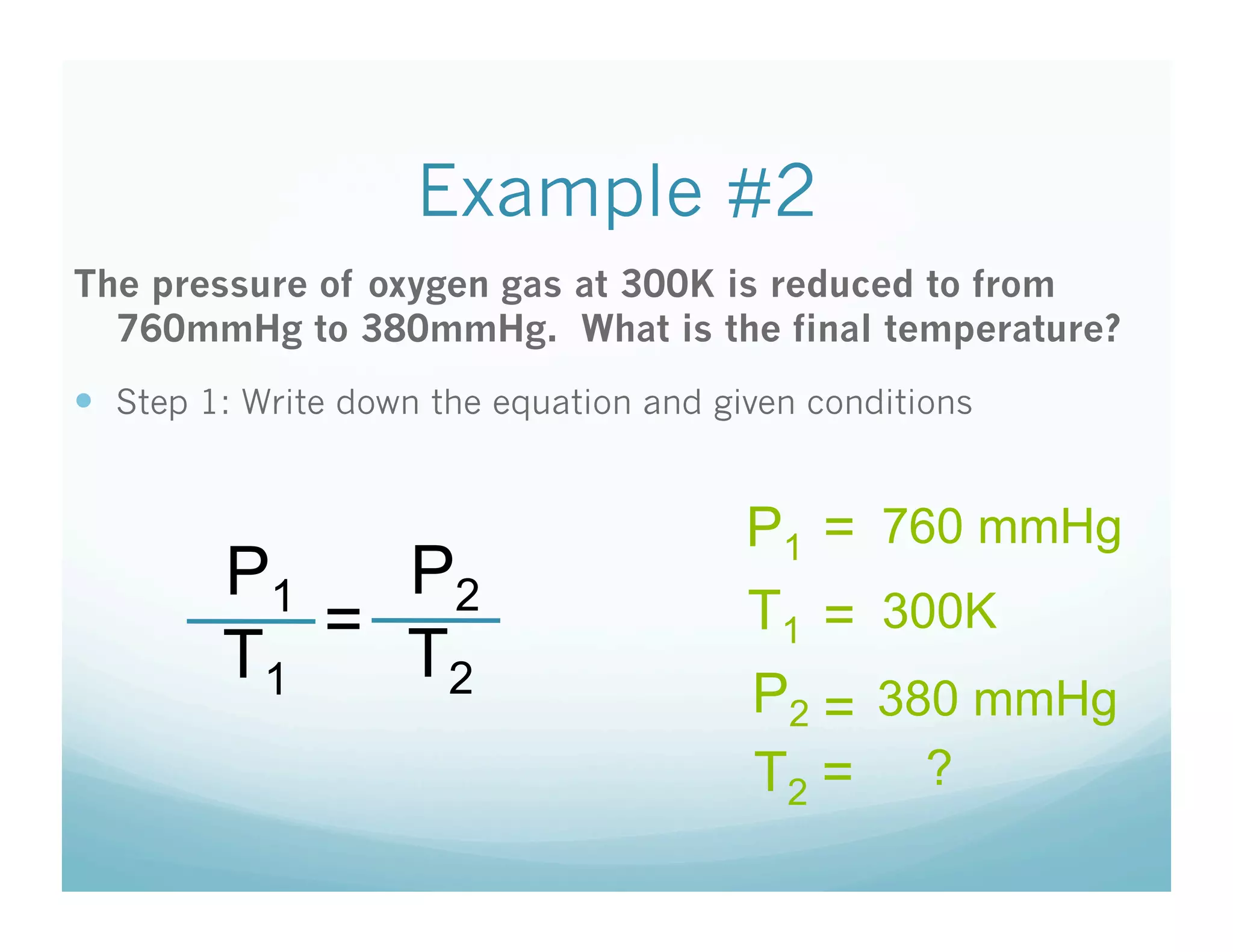
Example #2
The pressure of oxygen gas at 300K is reduced to from
  760mmHg to 380mmHg. What is the final temperature?
  Step 1: Write down the equation and given conditions


                                         P1 = 760 mmHg
         P1   P2
            =                            T1 = 300K
         T1   T2
                                         P2 = 380 mmHg
                                         T2 = ?
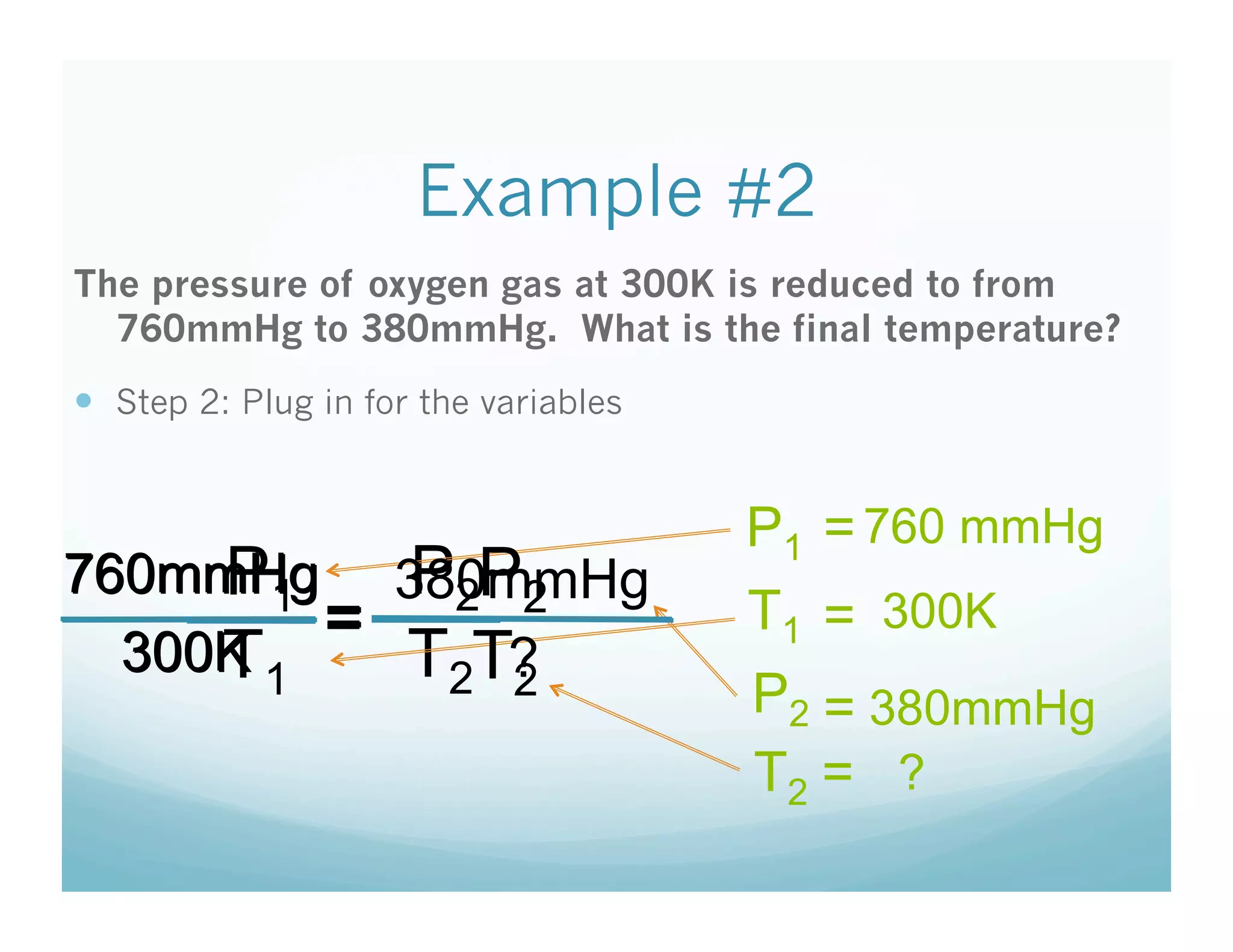
Example #2
The pressure of oxygen gas at 300K is reduced to from
  760mmHg to 380mmHg. What is the final temperature?
  Step 2: Plug in for the variables


                                       P1 = 760 mmHg
     P1    P2P2
760mmHg 380mmHg
         =                             T1 = 300K
     T
  300K 1   T2T?
              2                        P2 = 380mmHg
                                       T2 = ?
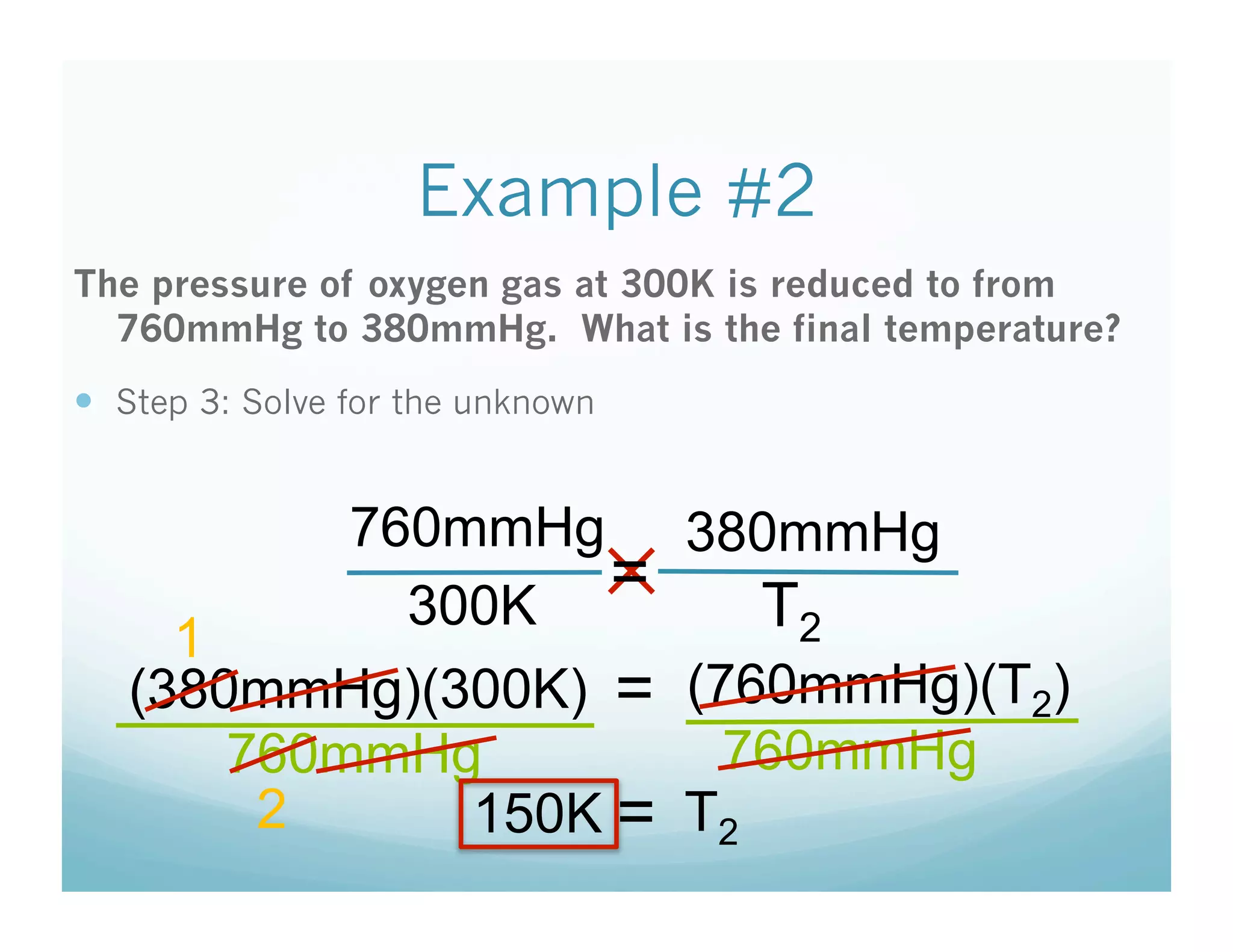
Example #2
The pressure of oxygen gas at 300K is reduced to from
  760mmHg to 380mmHg. What is the final temperature?
  Step 3: Solve for the unknown


           760mmHg 380mmHg
             300K
                   ✕=    T2
     1
   (380mmHg)(300K) = (760mmHg)(T2)
       760mmHg         760mmHg
        2      150K = T2
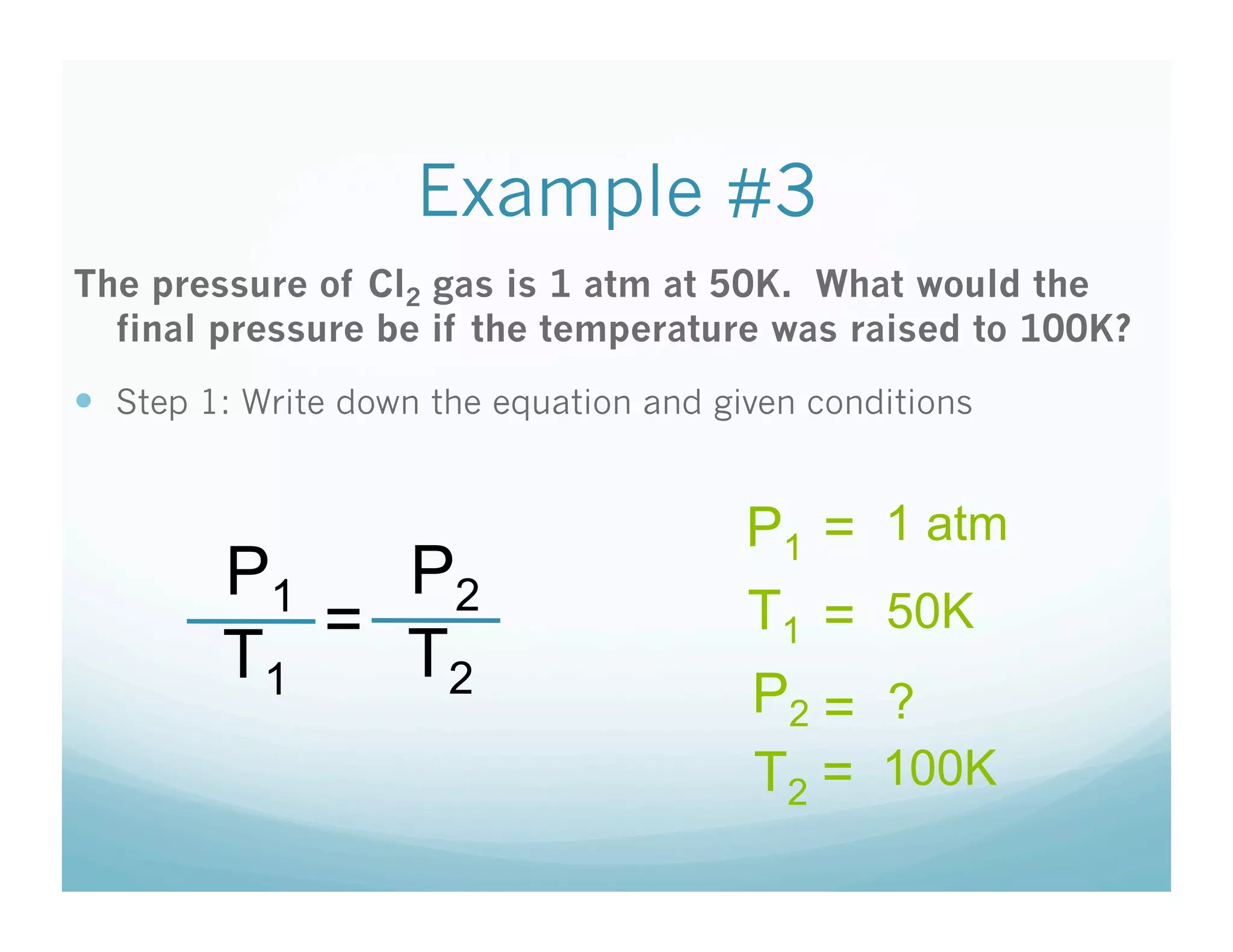
Example #3
The pressure of Cl2 gas is 1 atm at 50K. What would the
  final pressure be if the temperature was raised to 100K?
  Step 1: Write down the equation and given conditions


                                         P1 =    1 atm
         P1   P2
            =                            T1 =    50K
         T1   T2
                                         P2 =    ?
                                         T2 =    100K
Whiteboards
  Work in pairs
    Trade-off marker every question
  You have 60 seconds to calculate the answer
    Show all of your work!
    Don’t forget units!

  Lift board only when prompted
The temperature of a gas is
  raised by 50K. Draw an
 arrow (up/down) to show
   how pressure would be
          affected.
The pressure of a gas is
lowered to .5 atm from STP .
  Draw an arrow showing
 what would happen to the
       temperature.
A gas is sealed in a bottle at
  400K and 2 atm. If put
into a freezer at 200K, what
 would the new pressure be?
The pressure of CH4
 (methane) gas at 10K is
increased from 2 atm to
10 atm. What is the new
        pressure?
Closing
  Today’s Objective: I can describe how the random
  collisions between gas molecules creates pressure
  on a surface.
    Standard – CH.4.a


             Molecular Motion Applet
Exit Slip
1.  What is pressure?
  a.  a force that comes from the interaction of molecules in
      a chemical bond
  b.  the amount of kinetic energy in a substance
  c.  a quantity that can be measured in mm
  d.  the force that a gas exerts on an object
Exit Slip
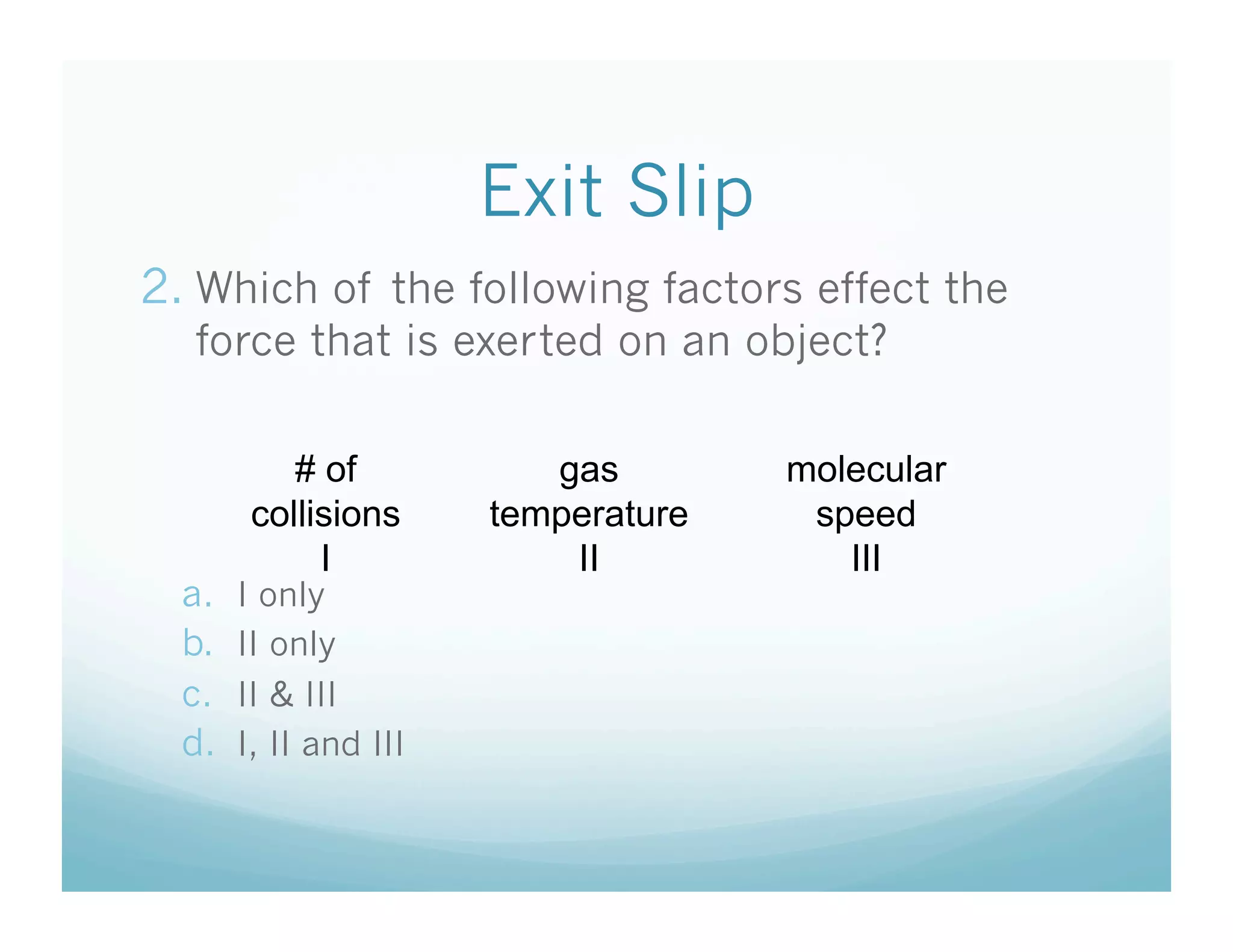
2.  Which of the following factors effect the
   force that is exerted on an object?

            # of           gas        molecular
         collisions     temperature    speed
              I             II           III
  a.    I only
  b.    II only
  c.    II & III
  d.    I, II and III
Exit Slip
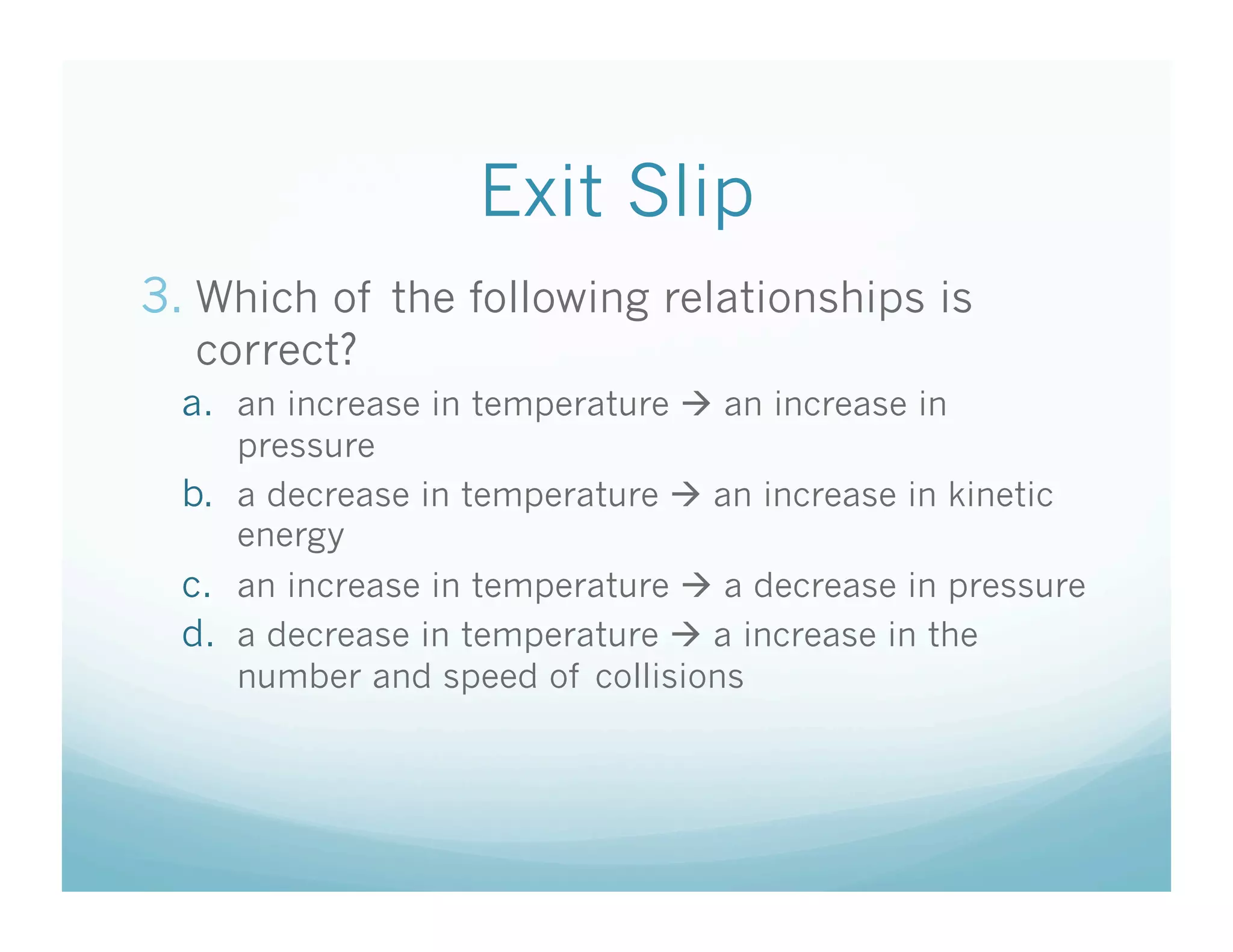
3.  Which of the following relationships is
  correct?
  a.  an increase in temperature  an increase in
      pressure
  b.  a decrease in temperature  an increase in kinetic
      energy
  c.  an increase in temperature  a decrease in pressure
  d.  a decrease in temperature  a increase in the
     number and speed of collisions
Exit Slip
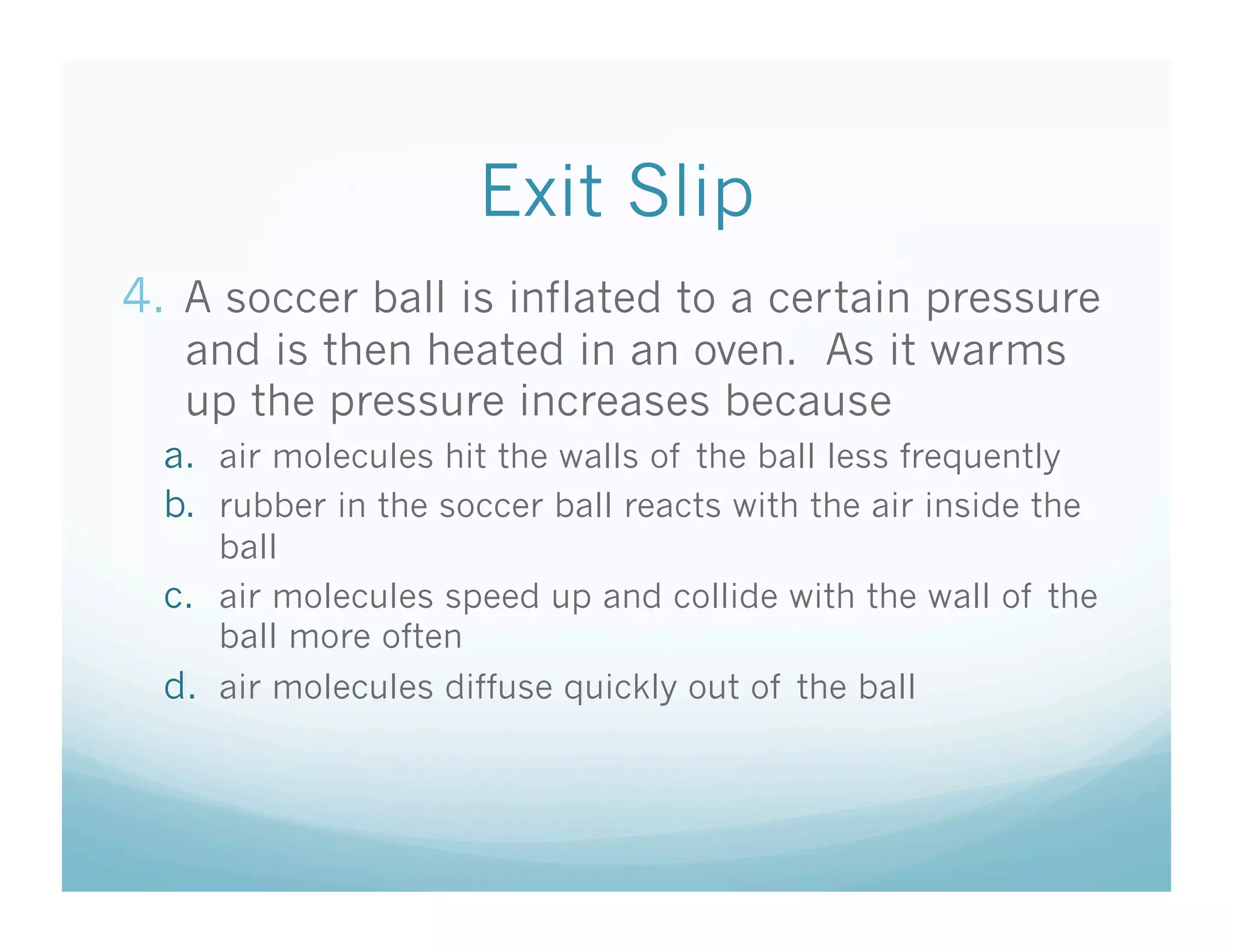
4.  A soccer ball is inflated to a certain pressure
   and is then heated in an oven. As it warms
   up the pressure increases because
  a.  air molecules hit the walls of the ball less frequently
  b.  rubber in the soccer ball reacts with the air inside the
      ball
  c.  air molecules speed up and collide with the wall of the
      ball more often
  d.  air molecules diffuse quickly out of the ball
Exit Slip
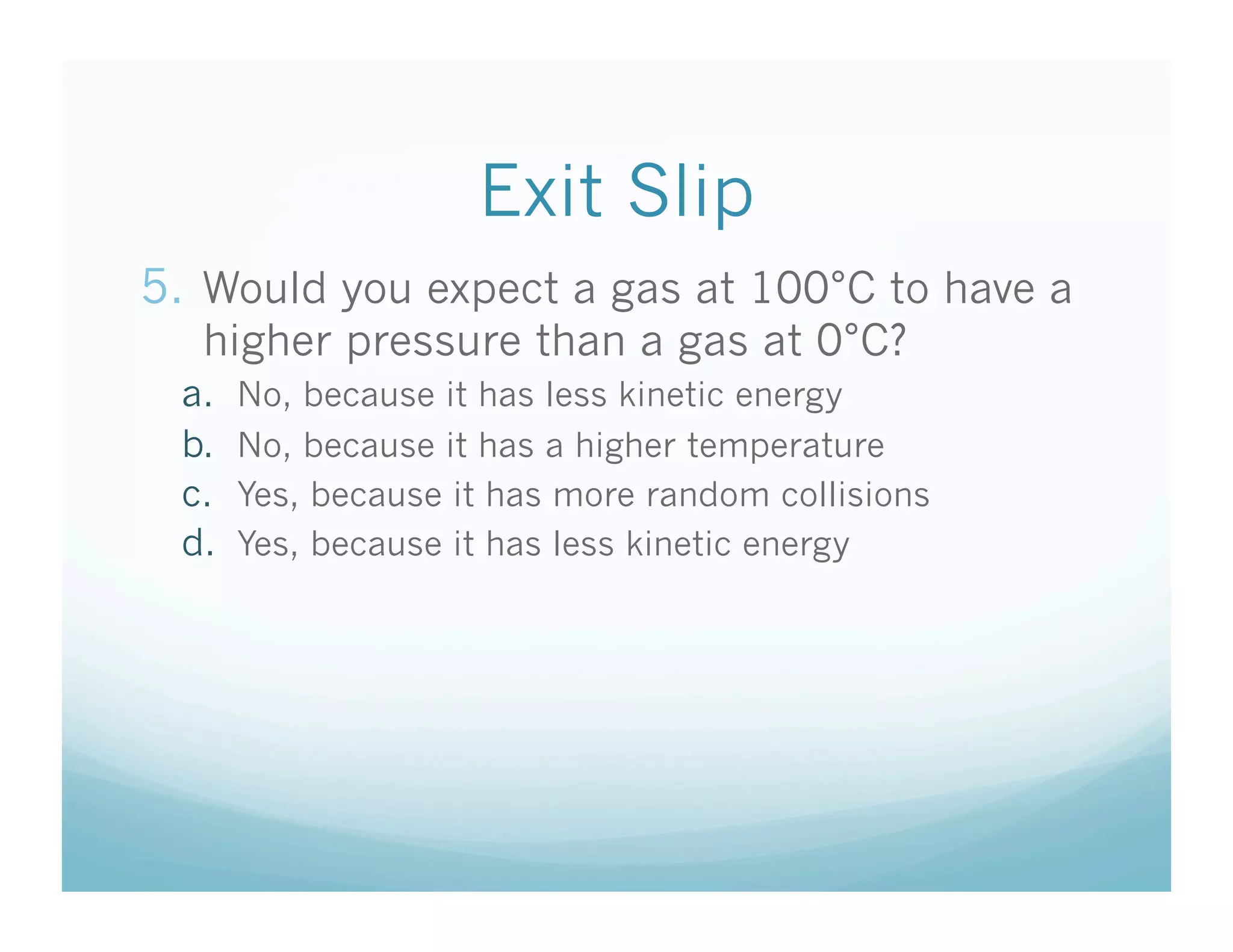
5.  Would you expect a gas at 100°C to have a
   higher pressure than a gas at 0°C?
  a.    No, because it has less kinetic energy
  b.    No, because it has a higher temperature
  c.    Yes, because it has more random collisions
  d.    Yes, because it has less kinetic energy
Homework
  Finish practice questions
  Study for the quiz!

2 10 How Are P And T Related

  • 1.
    Launch: 2/10   Grabyour binder and immediately take a seat!   Place launch paper on your desk.   Yesterday’s Benchmark Data: 96%!   Today’s Objectives: I can apply the gas laws to relations between temperature and pressure.
  • 2.
    Launch 2/10 1.  Whatis the equation for converting between the Celcius and Kelvin scales? Label the variables.
  • 3.
    Launch 2/10 2.  Moleculesin a substance at 50°C a.  move slower than molecules in a substance at 25°C because they have less kinetic energy b.  move slower than molecules in a substance at 25°C because they have more kinetic energy c.  move faster than molecules in a substance at 25°C because they have less kinetic energy d.  move faster than molecules in a substance at 25°C because they have more kinetic energy
  • 4.
    Launch 2/10 3.  Whatis the equivalent of 423K in degrees Celsius? a.  -223°C b.  -23°C c.  150°C d.  696°C
  • 5.
    Launch 2/10 4.  Convert-50°C to Kelvin. a.  -223 K b.  -50 K c.  223 K d.  323 K
  • 6.
    Announcements   Great jobyesterday!   No quiz on Friday   Class points end on Friday   Only 3 days until break…   Let’s finish strong
  • 7.
    February Calendar Quiz! Today No quiz! Exam!
  • 8.
    Opening   Today’s Objective:I can apply the gas laws to relations between temperature and pressure.   Standard – CH.4.c   Today’s Questions: How are P and T related?
  • 9.
    How are P& T related? Mr. Heffner 2/10/10
  • 10.
    How are P& T related?   Temperature is…   a measure of movement   °C & K   Pressure is…   a measure of random collisions   atm & mmHg
  • 11.
    How are P& T related? temperature = collisions = pressure temperature = pressure
  • 12.
    How are P& T related?   Pressure & Temperature are…   directly related change in the same direction   In math terms… P = constant T “some number”
  • 13.
    How are P& T related?   By rearranging the relationship, we can get an equation P1 P2 starting conditions T1 = constant = T ending conditions 2 P1 P2 = T1 T2
  • 14.
    How are P& T related?   There is a 3 step process for solving gas equations: 1.  Write down the equation and given conditions 2.  Plug in for the variables 3.  Solve for the unknown
  • 15.
    Example #1 At 298K(room temp), the pressure inside an empty Coke can is 1 atm. It is then thrown into a bucket of ice at 273K. What is the new gas pressure?   Step 1: Write down the equation and given conditions P1 = 1 atm P1 P2 = T1 = 298K T1 T2 P2 = ? T2 = 273K
  • 16.
    Example #1 At 298K(room temp), the pressure inside an empty Coke can is 1 atm. It is then thrown into a bucket of ice at 273K. What is the new gas pressure?   Step 2: Plug in for the variables P1 = 1 atm 1 P1 atm P2 = T1 = 298K T1 T2 298K 273K P2 = ? T2 = 273K
  • 17.
    Example #1 At 298K(room temp), the pressure inside an empty Coke can is 1 atm. It is then thrown into a bucket of ice at 273K. What is the new gas pressure?   Step 3: Solve for the unknown cross- 1 atm P2 multiply = ✕ 298K 273K (P2)(298K) = (1 atm)(273K) 298K 298K P2 = .92 atm
  • 18.
    Example #2 The pressureof oxygen gas at 300K is reduced to from 760mmHg to 380mmHg. What is the final temperature?   Step 1: Write down the equation and given conditions P1 = 760 mmHg P1 P2 = T1 = 300K T1 T2 P2 = 380 mmHg T2 = ?
  • 19.
    Example #2 The pressureof oxygen gas at 300K is reduced to from 760mmHg to 380mmHg. What is the final temperature?   Step 2: Plug in for the variables P1 = 760 mmHg P1 P2P2 760mmHg 380mmHg = T1 = 300K T 300K 1 T2T? 2 P2 = 380mmHg T2 = ?
  • 20.
    Example #2 The pressureof oxygen gas at 300K is reduced to from 760mmHg to 380mmHg. What is the final temperature?   Step 3: Solve for the unknown 760mmHg 380mmHg 300K ✕= T2 1 (380mmHg)(300K) = (760mmHg)(T2) 760mmHg 760mmHg 2 150K = T2
  • 21.
    Example #3 The pressureof Cl2 gas is 1 atm at 50K. What would the final pressure be if the temperature was raised to 100K?   Step 1: Write down the equation and given conditions P1 = 1 atm P1 P2 = T1 = 50K T1 T2 P2 = ? T2 = 100K
  • 22.
    Whiteboards   Work inpairs   Trade-off marker every question   You have 60 seconds to calculate the answer   Show all of your work!   Don’t forget units!   Lift board only when prompted
  • 23.
    The temperature ofa gas is raised by 50K. Draw an arrow (up/down) to show how pressure would be affected.
  • 24.
    The pressure ofa gas is lowered to .5 atm from STP . Draw an arrow showing what would happen to the temperature.
  • 25.
    A gas issealed in a bottle at 400K and 2 atm. If put into a freezer at 200K, what would the new pressure be?
  • 26.
    The pressure ofCH4 (methane) gas at 10K is increased from 2 atm to 10 atm. What is the new pressure?
  • 27.
    Closing   Today’s Objective:I can describe how the random collisions between gas molecules creates pressure on a surface.   Standard – CH.4.a Molecular Motion Applet
  • 28.
    Exit Slip 1.  Whatis pressure? a.  a force that comes from the interaction of molecules in a chemical bond b.  the amount of kinetic energy in a substance c.  a quantity that can be measured in mm d.  the force that a gas exerts on an object
  • 29.
    Exit Slip 2.  Whichof the following factors effect the force that is exerted on an object? # of gas molecular collisions temperature speed I II III a.  I only b.  II only c.  II & III d.  I, II and III
  • 30.
    Exit Slip 3.  Whichof the following relationships is correct? a.  an increase in temperature  an increase in pressure b.  a decrease in temperature  an increase in kinetic energy c.  an increase in temperature  a decrease in pressure d.  a decrease in temperature  a increase in the number and speed of collisions
  • 31.
    Exit Slip 4.  Asoccer ball is inflated to a certain pressure and is then heated in an oven. As it warms up the pressure increases because a.  air molecules hit the walls of the ball less frequently b.  rubber in the soccer ball reacts with the air inside the ball c.  air molecules speed up and collide with the wall of the ball more often d.  air molecules diffuse quickly out of the ball
  • 32.
    Exit Slip 5.  Wouldyou expect a gas at 100°C to have a higher pressure than a gas at 0°C? a.  No, because it has less kinetic energy b.  No, because it has a higher temperature c.  Yes, because it has more random collisions d.  Yes, because it has less kinetic energy
  • 33.
    Homework   Finish practicequestions   Study for the quiz!