Becoming A World Power. Chapter Four-1898. Growing imperialism: Manifest Destiny and Anglo-Saxonism. “White man’s burden.” Need for international markets. Alfred Mahan-Sea power. U.S. became the first non-European country to become a top tier power.
Expansion In The Pacific. Com. Matthew Perry ordered to MAKE Japan trade with the U.S. 1853. Why was Japan voluntary closed off from the rest of the world? Annexed Hawaii-1898. Hawaii was/is the most important naval base in Pacific!
Building A Modern Navy. Alfred T. Mahan. Expand or die. America needed new overseas markets. America had to have merchant ships for trade. We also needed a navy to protect these ships and overseas possessions.  “Rimland” theory of being a world power.
Cuban Rebellion. Cuba was one of Spain’s oldest colonies. Jose Marti was the leader of rebels who wanted to oust Spain. U.S. and Cuba become linked economically-Sugar. Spain’s/Cuba’s problems becomes our problem too.
Yellow Journalism=War! William Randolph Hearst and John Pulitzer were fierce newspaper competitors.  Papers made up a lot of whoppers about events in Cuba in order to sell papers. Photographer sent to Cuba found little going on their.
U.S.S. Maine Blows Up In Havana Harbor. Of the 354 sailors, 266 were killed in the blast. Because of “Yellow” journalism, many Americans believed that Spain had planted a mine. Years later, it was determined that it was an accident. Oh well….
Jingoism: Aggressive Nationalism. 1898 war is declared on Spain.  McKinley is forced by public opinion and Cuban investors to ask Congress for war. Spain’s navy is very old and out dated. U.S. has the brand new Great White Fleet.
Where The Battles Took Place. Cuba was invaded by a mostly amateur and voluntary American army. The Spanish though were not motivated to fight. Teddy Roosevelt became famous for taking San Juan Hill in Cuba. “The Rough Riders.” No horses?
Philippines. Com. George Dewey Hunts down the Spanish fleet in the Pacific and then sinks it. The war ends with the U.S. getting control of: Cuba, Guam, and the Philippines. They are annexed. With the addition of Hawaii, the U.S. is now the major Pacific power.
America Expands Abroad Key Terms: Imperialism Protectorate Anglo-saxonism Pan-Americanism
Causes of American Imperialism Nationalism: By the end of the 19 th  century the U.S. had conquered the West Manifest Destiny had been realized Many Americans felt the U.S. should still expand By 1898 many Americans were supporting the idea of  Anglo-Saxonism
Anglo-Saxonism and Nationalism American imperialists argued defended imperialism with Social Darwinism:  international competition only the strongest would survive A nation with a superior military and economy had a right to conquer weaker nations
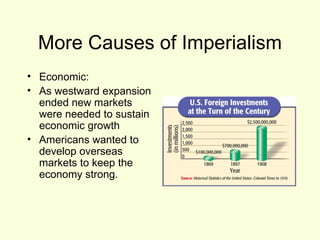
More Causes of Imperialism Economic: As westward expansion ended new markets were needed to sustain economic growth  Americans wanted to develop overseas markets to keep the economy strong.
More Causes of Imperialism Humanitarian/Religious: American missionaries linked missionary work to Anglo-Saxonism Missionaries went to foreign nations and set up schools and hospitals The earliest forms of American influence in these countries were often missionaries
More Causes of Imperialism Military: In order to compete with other world powers America needed a strong navy In order to support a strong modern navy the U.S. needed overseas ports The farther away American ports were the farther the Navy could travel
Countries affected by Imperialism Japan: Refused to trade with the U.S. Feared contact with the West would destroy their culture In 1853 America forced its way into Japan By 1868 Japan had an internal revolution and began to westernize
Countries affected by Imperialism Hawaii: In 1820 American missionaries settled in Hawaii As more Americans settled there they began setting up sugar plantations Over time these planters sought more power  In 1891 American planters and Marines overthrew the Hawaiian government
Latin America (cont.) U.S. wanted to reduce tariffs with these countries and create a system to solve disputes Latin American leaders saw both these proposals as a threat to their independence
Countries Affected by Imperialism Latin America: Americans wanted uncontested influence in Central and South America The U.S. proposed  Pan-Americanism  Argued Latin America and the U.S. should work together
1898.  Watershed Year. There are dates in history that signify a great change. Why was 1898 a watershed year for the U.S.A. and the rest of the world?
Election Of 1900. McKinley reelected president with Teddy Roosevelt as V.P. McKinley assassinated by anarchist. Roosevelt becomes youngest ever president at age 42. Critics: “Loose cannon is now president.”
Open Door Policy-1894. Foreign powers cut up China like a piece of pie for economic gain. These were called “Sphere’s of influence.”  The countries that exploited China were: U.S., Britain, Japan, Germany, Russia, and France.
Boxer Rebellion-1900. Chinese people tried to kick out the foreigners by force. They resented the economic exploitation and Christian missionaries. The occupiers put down the rebellion. Open Door policy was continued.
Growing U.S. Presence In The Caribbean. “Speak softy, but carry a big stick.” Teddy Roosevelt. U.S. instigated a revolt in Columbia in order to create the country of Panama. The canal could now be build.  A short cut of 8,000 nautical miles!
Roosevelt Corollary-1904. The U.S. would intervene when necessary to maintain stability in the Caribbean, Central, and South America. This was a vast expansion of the Monroe Doctrine. Taft and Dollar Diplomacy.

USH Chap. 4

  • 1.
    Becoming A WorldPower. Chapter Four-1898. Growing imperialism: Manifest Destiny and Anglo-Saxonism. “White man’s burden.” Need for international markets. Alfred Mahan-Sea power. U.S. became the first non-European country to become a top tier power.
  • 2.
    Expansion In ThePacific. Com. Matthew Perry ordered to MAKE Japan trade with the U.S. 1853. Why was Japan voluntary closed off from the rest of the world? Annexed Hawaii-1898. Hawaii was/is the most important naval base in Pacific!
  • 3.
    Building A ModernNavy. Alfred T. Mahan. Expand or die. America needed new overseas markets. America had to have merchant ships for trade. We also needed a navy to protect these ships and overseas possessions. “Rimland” theory of being a world power.
  • 4.
    Cuban Rebellion. Cubawas one of Spain’s oldest colonies. Jose Marti was the leader of rebels who wanted to oust Spain. U.S. and Cuba become linked economically-Sugar. Spain’s/Cuba’s problems becomes our problem too.
  • 5.
    Yellow Journalism=War! WilliamRandolph Hearst and John Pulitzer were fierce newspaper competitors. Papers made up a lot of whoppers about events in Cuba in order to sell papers. Photographer sent to Cuba found little going on their.
  • 6.
    U.S.S. Maine BlowsUp In Havana Harbor. Of the 354 sailors, 266 were killed in the blast. Because of “Yellow” journalism, many Americans believed that Spain had planted a mine. Years later, it was determined that it was an accident. Oh well….
  • 7.
    Jingoism: Aggressive Nationalism.1898 war is declared on Spain. McKinley is forced by public opinion and Cuban investors to ask Congress for war. Spain’s navy is very old and out dated. U.S. has the brand new Great White Fleet.
  • 8.
    Where The BattlesTook Place. Cuba was invaded by a mostly amateur and voluntary American army. The Spanish though were not motivated to fight. Teddy Roosevelt became famous for taking San Juan Hill in Cuba. “The Rough Riders.” No horses?
  • 9.
    Philippines. Com. GeorgeDewey Hunts down the Spanish fleet in the Pacific and then sinks it. The war ends with the U.S. getting control of: Cuba, Guam, and the Philippines. They are annexed. With the addition of Hawaii, the U.S. is now the major Pacific power.
  • 10.
    America Expands AbroadKey Terms: Imperialism Protectorate Anglo-saxonism Pan-Americanism
  • 11.
    Causes of AmericanImperialism Nationalism: By the end of the 19 th century the U.S. had conquered the West Manifest Destiny had been realized Many Americans felt the U.S. should still expand By 1898 many Americans were supporting the idea of Anglo-Saxonism
  • 12.
    Anglo-Saxonism and NationalismAmerican imperialists argued defended imperialism with Social Darwinism: international competition only the strongest would survive A nation with a superior military and economy had a right to conquer weaker nations
  • 13.
    More Causes ofImperialism Economic: As westward expansion ended new markets were needed to sustain economic growth Americans wanted to develop overseas markets to keep the economy strong.
  • 14.
    More Causes ofImperialism Humanitarian/Religious: American missionaries linked missionary work to Anglo-Saxonism Missionaries went to foreign nations and set up schools and hospitals The earliest forms of American influence in these countries were often missionaries
  • 15.
    More Causes ofImperialism Military: In order to compete with other world powers America needed a strong navy In order to support a strong modern navy the U.S. needed overseas ports The farther away American ports were the farther the Navy could travel
  • 16.
    Countries affected byImperialism Japan: Refused to trade with the U.S. Feared contact with the West would destroy their culture In 1853 America forced its way into Japan By 1868 Japan had an internal revolution and began to westernize
  • 17.
    Countries affected byImperialism Hawaii: In 1820 American missionaries settled in Hawaii As more Americans settled there they began setting up sugar plantations Over time these planters sought more power In 1891 American planters and Marines overthrew the Hawaiian government
  • 18.
    Latin America (cont.)U.S. wanted to reduce tariffs with these countries and create a system to solve disputes Latin American leaders saw both these proposals as a threat to their independence
  • 19.
    Countries Affected byImperialism Latin America: Americans wanted uncontested influence in Central and South America The U.S. proposed Pan-Americanism Argued Latin America and the U.S. should work together
  • 20.
    1898. WatershedYear. There are dates in history that signify a great change. Why was 1898 a watershed year for the U.S.A. and the rest of the world?
  • 21.
    Election Of 1900.McKinley reelected president with Teddy Roosevelt as V.P. McKinley assassinated by anarchist. Roosevelt becomes youngest ever president at age 42. Critics: “Loose cannon is now president.”
  • 22.
    Open Door Policy-1894.Foreign powers cut up China like a piece of pie for economic gain. These were called “Sphere’s of influence.” The countries that exploited China were: U.S., Britain, Japan, Germany, Russia, and France.
  • 23.
    Boxer Rebellion-1900. Chinesepeople tried to kick out the foreigners by force. They resented the economic exploitation and Christian missionaries. The occupiers put down the rebellion. Open Door policy was continued.
  • 24.
    Growing U.S. PresenceIn The Caribbean. “Speak softy, but carry a big stick.” Teddy Roosevelt. U.S. instigated a revolt in Columbia in order to create the country of Panama. The canal could now be build. A short cut of 8,000 nautical miles!
  • 25.
    Roosevelt Corollary-1904. TheU.S. would intervene when necessary to maintain stability in the Caribbean, Central, and South America. This was a vast expansion of the Monroe Doctrine. Taft and Dollar Diplomacy.