Multiple Access
Komunikasi Data

Adapted from lecture slides by Behrouz A. Forouzan
© The McGraw-Hill Companies, Inc. All rights reserved

Anhar, ST., MT
anhar19@gmail.com
http://anhar.staff.unri.ac.id
Jurusan Teknik Elektro
Univ. Riau
Outline





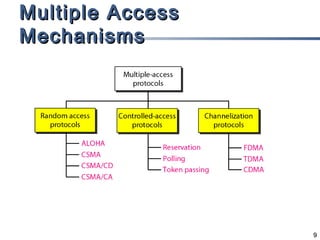
Multiple access mechanisms
Random access
Controlled access
Channelization

2
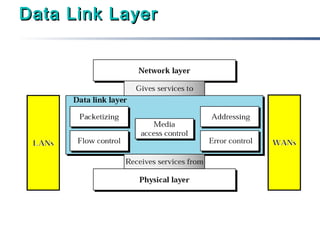
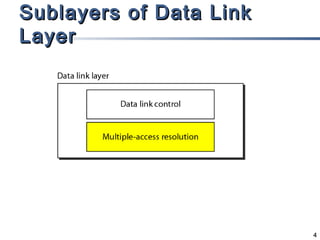
Data Link Layer
Sublayers of Data Link
Layer

4
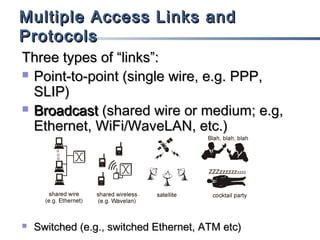
Multiple Access Links and
Protocols
Three types of “links”:
 Point-to-point (single wire, e.g. PPP,
SLIP)
 Broadcast (shared wire or medium; e.g,
Ethernet, WiFi/WaveLAN, etc.)



Switched (e.g., switched Ethernet, ATM etc)
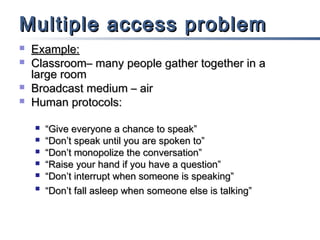
Multiple access problem





Example:
Classroom– many people gather together in a
large room
Broadcast medium – air
Human protocols:







“Give everyone a chance to speak”
“Don’t speak until you are spoken to”
“Don’t monopolize the conversation”
“Raise your hand if you have a question”
“Don’t interrupt when someone is speaking”
“Don’t fall asleep when someone else is talking”
Multiple access protocols







In LANs, WiFi, satellite networks
If more than 2 users send @ the same time collision
All collided packets are lost -> waste of bandwidth
Ideally, the MAC protocol for a broadcast channel
with the bit-rate R bps should satisfy:






if only 1 node is sending than the throughput is R
when M nodes have data to send than the throughput is
R/M
decentralized protocol – no master
simple & inexpensive to implement
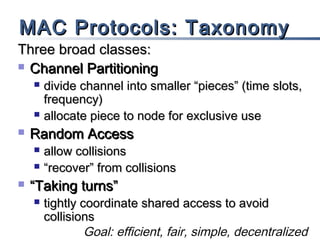
MAC Protocols: Taxonomy

Three broad classes:
 Channel Partitioning






Random Access





divide channel into smaller “pieces” (time slots,
frequency)
allocate piece to node for exclusive use
allow collisions
“recover” from collisions

“Taking turns”


tightly coordinate shared access to avoid
collisions
Goal: efficient, fair, simple, decentralized
Multiple Access
Mechanisms

9
Random Access
Random Access



Also called contention-based access
No station is assigned to control another

11
Random Access Protocols


In random access or contention methods,
no station is superior to another station
and none is assigned the control over
another. No station permits, or does not
permit, another station to send. At each
instance, a station that has data to send
uses a procedure defined by the protocol
to make a decision on whether or not to
send.
Random Access




1.
2.
3.

4.

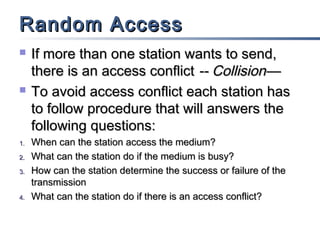
If more than one station wants to send,
there is an access conflict -- Collision—
To avoid access conflict each station has
to follow procedure that will answers the
following questions:
When can the station access the medium?
What can the station do if the medium is busy?
How can the station determine the success or failure of the
transmission
What can the station do if there is an access conflict?
ALOHA Network


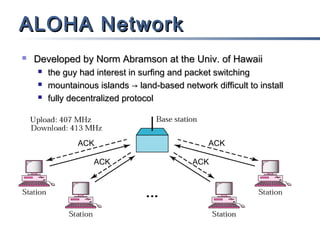
Developed by Norm Abramson at the Univ. of Hawaii




the guy had interest in surfing and packet switching
mountainous islands → land-based network difficult to install
fully decentralized protocol

ACK
ACK

ACK
ACK
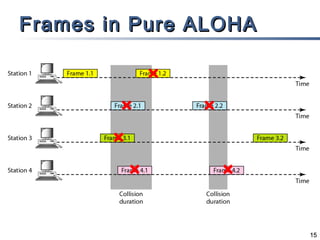
Frames in Pure ALOHA

15
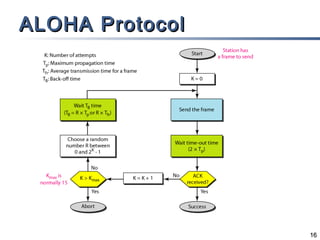
ALOHA Protocol

16
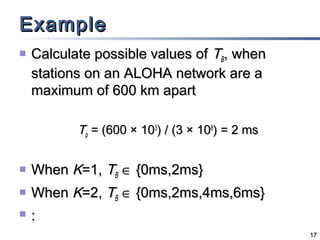
Example


Calculate possible values of TB, when
stations on an ALOHA network are a
maximum of 600 km apart
Tp = (600 × 103) / (3 × 10⁸) = 2 ms



When K=1, TB ∈ {0ms,2ms}



When K=2, TB ∈ {0ms,2ms,4ms,6ms}



:
17
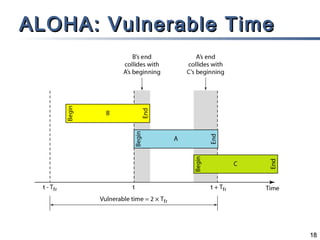
ALOHA: Vulnerable Time

18
ALOHA: Throughput






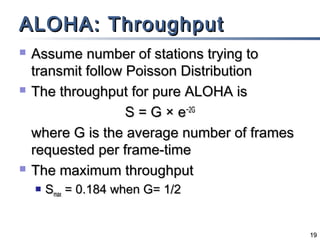
Assume number of stations trying to
transmit follow Poisson Distribution
The throughput for pure ALOHA is
S = G × e−2G
where G is the average number of frames
requested per frame-time
The maximum throughput


Smax = 0.184 when G= 1/2

19
Example


A pure ALOHA network transmits 200-bit
frames on a shared channel of 200 kbps.
What is the throughput if the system (all
stations together) produces




1000 frames per second
500 frames per second
250 frames per second

20
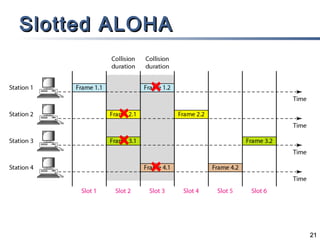
Slotted ALOHA

21
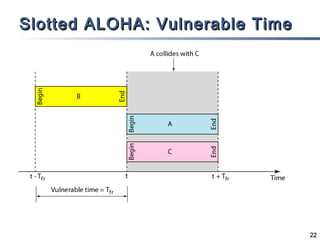
Slotted ALOHA: Vulnerable Time

22
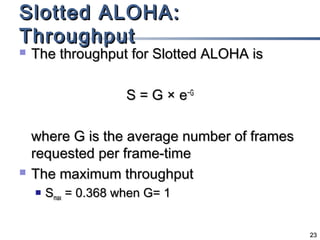
Slotted ALOHA:
Throughput


The throughput for Slotted ALOHA is
S = G × e−G



where G is the average number of frames
requested per frame-time
The maximum throughput


Smax = 0.368 when G= 1
23
Example


A Slotted ALOHA network transmits 200bit frames on a shared channel of 200
kbps. What is the throughput if the system
(all stations together) produces




1000 frames per second
500 frames per second
250 frames per second

24
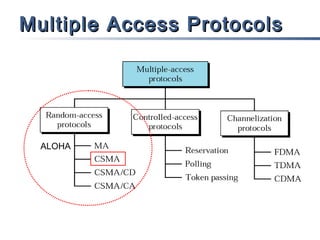
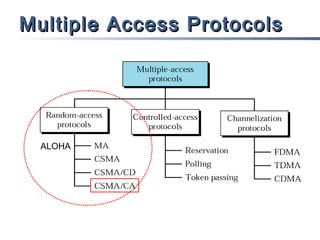
Multiple Access Protocols

ALOHA
CSMA


C arrier S ense M ultiple A ccess




"Listen before talk"

Reduce the possibility of collision


But cannot completely eliminate it

26
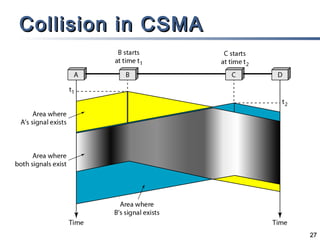
Collision in CSMA

27
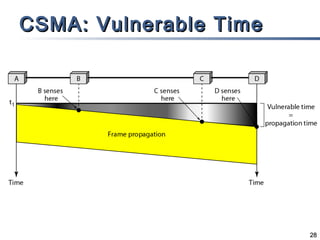
CSMA: Vulnerable Time

28
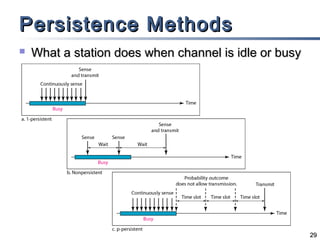
Persistence Methods


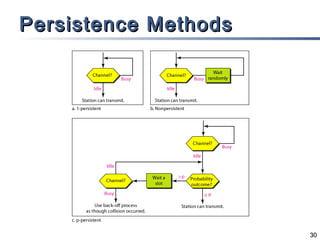
What a station does when channel is idle or busy

29
Persistence Methods

30
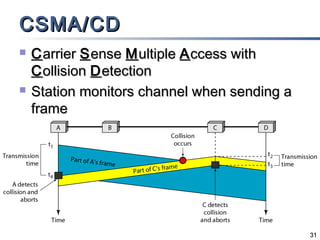
CSMA/CD




C arrier S ense M ultiple A ccess with
C ollision D etection
Station monitors channel when sending a
frame

31
Carrier Sensing Multiple Access with
Collision detection (CSMA-CD)


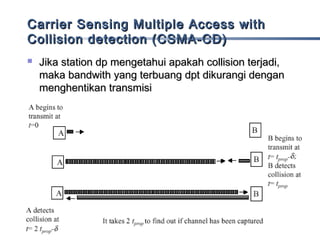
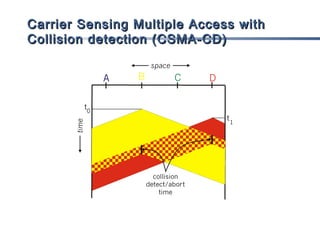
Jika station dp mengetahui apakah collision terjadi,
maka bandwith yang terbuang dpt dikurangi dengan
menghentikan transmisi
Carrier Sensing Multiple Access with
Collision detection (CSMA-CD)
Carrier Sensing Multiple Access with
Collision detection (CSMA-CD)






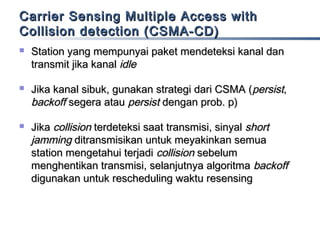
Station yang mempunyai paket mendeteksi kanal dan
transmit jika kanal idle
Jika kanal sibuk, gunakan strategi dari CSMA (persist,
backoff segera atau persist dengan prob. p)
Jika collision terdeteksi saat transmisi, sinyal short
jamming ditransmisikan untuk meyakinkan semua
station mengetahui terjadi collision sebelum
menghentikan transmisi, selanjutnya algoritma backoff
digunakan untuk rescheduling waktu resensing
Carrier Sensing Multiple Access with
Collision detection (CSMA-CD)


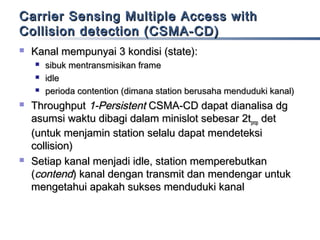
Kanal mempunyai 3 kondisi (state):








sibuk mentransmisikan frame
idle
perioda contention (dimana station berusaha menduduki kanal)

Throughput 1-Persistent CSMA-CD dapat dianalisa dg
asumsi waktu dibagi dalam minislot sebesar 2tprop det
(untuk menjamin station selalu dapat mendeteksi
collision)
Setiap kanal menjadi idle, station memperebutkan
(contend) kanal dengan transmit dan mendengar untuk
mengetahui apakah sukses menduduki kanal
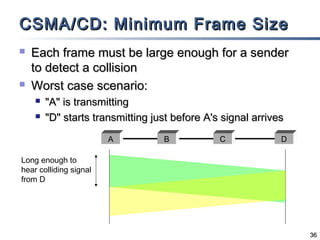
CSMA/CD: Minimum Frame Size




Each frame must be large enough for a sender
to detect a collision
Worst case scenario:



"A" is transmitting
"D" starts transmitting just before A's signal arrives
A

B

C

D

Long enough to
hear colliding signal
from D

36
Example


A CSMA/CD network has a bandwidth of
10 Mbps. If the maximum propagation
time is 25.6 μs, what is the minimum size
of the frame?

37
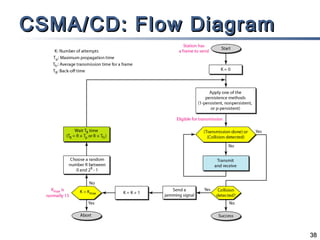
CSMA/CD: Flow Diagram

38
Multiple Access Protocols

ALOHA
CSMA/CA




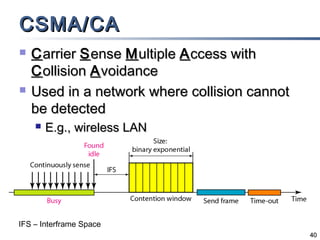
C arrier S ense M ultiple A ccess with
C ollision A voidance
Used in a network where collision cannot
be detected


E.g., wireless LAN

IFS – Interframe Space
40
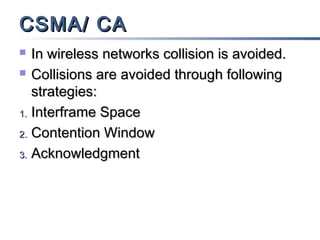
CSMA/ CA
In wireless networks collision is avoided.
 Collisions are avoided through following
strategies:
1. Interframe Space
2. Contention Window
3. Acknowledgment

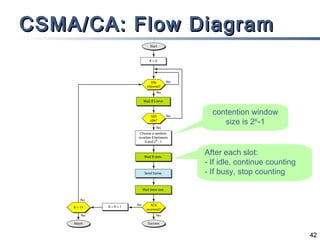
CSMA/CA: Flow Diagram

contention window
size is 2K-1

After each slot:
- If idle, continue counting
- If busy, stop counting

42
Controlled Access
Control Access




A station must be authorized by someone
(e.g., other stations) before transmitting
Three common methods:




Reservation
Polling
Token passing

44
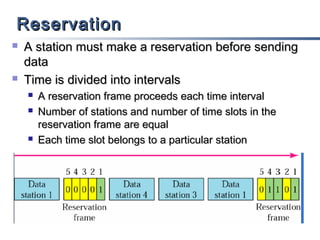
Reservation




A station must make a reservation before sending
data
Time is divided into intervals





A reservation frame proceeds each time interval
Number of stations and number of time slots in the
reservation frame are equal
Each time slot belongs to a particular station
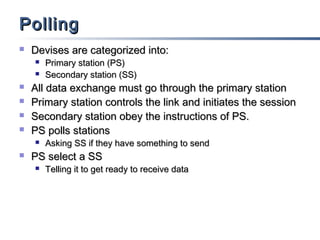
Polling


Devises are categorized into:








All data exchange must go through the primary station
Primary station controls the link and initiates the session
Secondary station obey the instructions of PS.
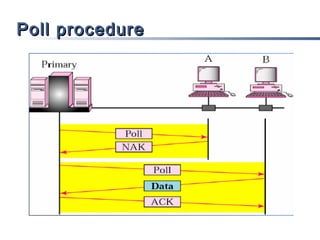
PS polls stations




Primary station (PS)
Secondary station (SS)

Asking SS if they have something to send

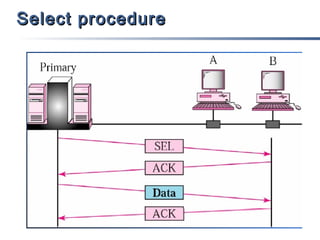
PS select a SS


Telling it to get ready to receive data
Poll procedure
Select procedure
Token passing










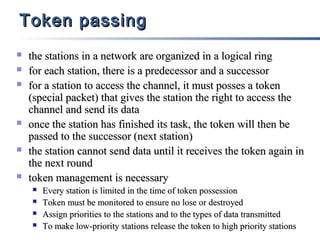
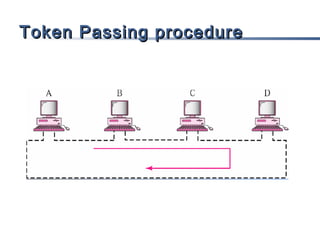
the stations in a network are organized in a logical ring
for each station, there is a predecessor and a successor
for a station to access the channel, it must posses a token
(special packet) that gives the station the right to access the
channel and send its data
once the station has finished its task, the token will then be
passed to the successor (next station)
the station cannot send data until it receives the token again in
the next round
token management is necessary





Every station is limited in the time of token possession
Token must be monitored to ensure no lose or destroyed
Assign priorities to the stations and to the types of data transmitted
To make low-priority stations release the token to high priority stations
Token Passing procedure
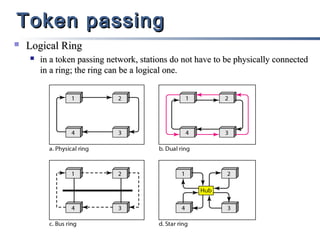
Token passing


Logical Ring


in a token passing network, stations do not have to be physically connected
in a ring; the ring can be a logical one.
Channelization
Channelization



Similar to multiplexing
Three schemes




Frequency-Division Multiple Access (FDMA)
Time-Division Multiple Access (TDMA)
Code-Division Multiple Access (CDMA)

53

9 multiple access

  • 1.
    Multiple Access Komunikasi Data Adaptedfrom lecture slides by Behrouz A. Forouzan © The McGraw-Hill Companies, Inc. All rights reserved Anhar, ST., MT anhar19@gmail.com http://anhar.staff.unri.ac.id Jurusan Teknik Elektro Univ. Riau
  • 2.
    Outline     Multiple access mechanisms Randomaccess Controlled access Channelization 2
  • 3.
  • 4.
    Sublayers of DataLink Layer 4
  • 5.
    Multiple Access Linksand Protocols Three types of “links”:  Point-to-point (single wire, e.g. PPP, SLIP)  Broadcast (shared wire or medium; e.g, Ethernet, WiFi/WaveLAN, etc.)  Switched (e.g., switched Ethernet, ATM etc)
  • 6.
    Multiple access problem     Example: Classroom–many people gather together in a large room Broadcast medium – air Human protocols:       “Give everyone a chance to speak” “Don’t speak until you are spoken to” “Don’t monopolize the conversation” “Raise your hand if you have a question” “Don’t interrupt when someone is speaking” “Don’t fall asleep when someone else is talking”
  • 7.
    Multiple access protocols     InLANs, WiFi, satellite networks If more than 2 users send @ the same time collision All collided packets are lost -> waste of bandwidth Ideally, the MAC protocol for a broadcast channel with the bit-rate R bps should satisfy:     if only 1 node is sending than the throughput is R when M nodes have data to send than the throughput is R/M decentralized protocol – no master simple & inexpensive to implement
  • 8.
    MAC Protocols: Taxonomy Threebroad classes:  Channel Partitioning    Random Access    divide channel into smaller “pieces” (time slots, frequency) allocate piece to node for exclusive use allow collisions “recover” from collisions “Taking turns”  tightly coordinate shared access to avoid collisions Goal: efficient, fair, simple, decentralized
  • 9.
  • 10.
  • 11.
    Random Access   Also calledcontention-based access No station is assigned to control another 11
  • 12.
    Random Access Protocols  Inrandom access or contention methods, no station is superior to another station and none is assigned the control over another. No station permits, or does not permit, another station to send. At each instance, a station that has data to send uses a procedure defined by the protocol to make a decision on whether or not to send.
  • 13.
    Random Access   1. 2. 3. 4. If morethan one station wants to send, there is an access conflict -- Collision— To avoid access conflict each station has to follow procedure that will answers the following questions: When can the station access the medium? What can the station do if the medium is busy? How can the station determine the success or failure of the transmission What can the station do if there is an access conflict?
  • 14.
    ALOHA Network  Developed byNorm Abramson at the Univ. of Hawaii    the guy had interest in surfing and packet switching mountainous islands → land-based network difficult to install fully decentralized protocol ACK ACK ACK ACK
  • 15.
  • 16.
  • 17.
    Example  Calculate possible valuesof TB, when stations on an ALOHA network are a maximum of 600 km apart Tp = (600 × 103) / (3 × 10⁸) = 2 ms  When K=1, TB ∈ {0ms,2ms}  When K=2, TB ∈ {0ms,2ms,4ms,6ms}  : 17
  • 18.
  • 19.
    ALOHA: Throughput    Assume numberof stations trying to transmit follow Poisson Distribution The throughput for pure ALOHA is S = G × e−2G where G is the average number of frames requested per frame-time The maximum throughput  Smax = 0.184 when G= 1/2 19
  • 20.
    Example  A pure ALOHAnetwork transmits 200-bit frames on a shared channel of 200 kbps. What is the throughput if the system (all stations together) produces    1000 frames per second 500 frames per second 250 frames per second 20
  • 21.
  • 22.
  • 23.
    Slotted ALOHA: Throughput  The throughputfor Slotted ALOHA is S = G × e−G  where G is the average number of frames requested per frame-time The maximum throughput  Smax = 0.368 when G= 1 23
  • 24.
    Example  A Slotted ALOHAnetwork transmits 200bit frames on a shared channel of 200 kbps. What is the throughput if the system (all stations together) produces    1000 frames per second 500 frames per second 250 frames per second 24
  • 25.
  • 26.
    CSMA  C arrier Sense M ultiple A ccess   "Listen before talk" Reduce the possibility of collision  But cannot completely eliminate it 26
  • 27.
  • 28.
  • 29.
    Persistence Methods  What astation does when channel is idle or busy 29
  • 30.
  • 31.
    CSMA/CD   C arrier Sense M ultiple A ccess with C ollision D etection Station monitors channel when sending a frame 31
  • 32.
    Carrier Sensing MultipleAccess with Collision detection (CSMA-CD)  Jika station dp mengetahui apakah collision terjadi, maka bandwith yang terbuang dpt dikurangi dengan menghentikan transmisi
  • 33.
    Carrier Sensing MultipleAccess with Collision detection (CSMA-CD)
  • 34.
    Carrier Sensing MultipleAccess with Collision detection (CSMA-CD)    Station yang mempunyai paket mendeteksi kanal dan transmit jika kanal idle Jika kanal sibuk, gunakan strategi dari CSMA (persist, backoff segera atau persist dengan prob. p) Jika collision terdeteksi saat transmisi, sinyal short jamming ditransmisikan untuk meyakinkan semua station mengetahui terjadi collision sebelum menghentikan transmisi, selanjutnya algoritma backoff digunakan untuk rescheduling waktu resensing
  • 35.
    Carrier Sensing MultipleAccess with Collision detection (CSMA-CD)  Kanal mempunyai 3 kondisi (state):      sibuk mentransmisikan frame idle perioda contention (dimana station berusaha menduduki kanal) Throughput 1-Persistent CSMA-CD dapat dianalisa dg asumsi waktu dibagi dalam minislot sebesar 2tprop det (untuk menjamin station selalu dapat mendeteksi collision) Setiap kanal menjadi idle, station memperebutkan (contend) kanal dengan transmit dan mendengar untuk mengetahui apakah sukses menduduki kanal
  • 36.
    CSMA/CD: Minimum FrameSize   Each frame must be large enough for a sender to detect a collision Worst case scenario:   "A" is transmitting "D" starts transmitting just before A's signal arrives A B C D Long enough to hear colliding signal from D 36
  • 37.
    Example  A CSMA/CD networkhas a bandwidth of 10 Mbps. If the maximum propagation time is 25.6 μs, what is the minimum size of the frame? 37
  • 38.
  • 39.
  • 40.
    CSMA/CA   C arrier Sense M ultiple A ccess with C ollision A voidance Used in a network where collision cannot be detected  E.g., wireless LAN IFS – Interframe Space 40
  • 41.
    CSMA/ CA In wirelessnetworks collision is avoided.  Collisions are avoided through following strategies: 1. Interframe Space 2. Contention Window 3. Acknowledgment 
  • 42.
    CSMA/CA: Flow Diagram contentionwindow size is 2K-1 After each slot: - If idle, continue counting - If busy, stop counting 42
  • 43.
  • 44.
    Control Access   A stationmust be authorized by someone (e.g., other stations) before transmitting Three common methods:    Reservation Polling Token passing 44
  • 45.
    Reservation   A station mustmake a reservation before sending data Time is divided into intervals    A reservation frame proceeds each time interval Number of stations and number of time slots in the reservation frame are equal Each time slot belongs to a particular station
  • 46.
    Polling  Devises are categorizedinto:       All data exchange must go through the primary station Primary station controls the link and initiates the session Secondary station obey the instructions of PS. PS polls stations   Primary station (PS) Secondary station (SS) Asking SS if they have something to send PS select a SS  Telling it to get ready to receive data
  • 47.
  • 48.
  • 49.
    Token passing       the stationsin a network are organized in a logical ring for each station, there is a predecessor and a successor for a station to access the channel, it must posses a token (special packet) that gives the station the right to access the channel and send its data once the station has finished its task, the token will then be passed to the successor (next station) the station cannot send data until it receives the token again in the next round token management is necessary     Every station is limited in the time of token possession Token must be monitored to ensure no lose or destroyed Assign priorities to the stations and to the types of data transmitted To make low-priority stations release the token to high priority stations
  • 50.
  • 51.
    Token passing  Logical Ring  ina token passing network, stations do not have to be physically connected in a ring; the ring can be a logical one.
  • 52.
  • 53.
    Channelization   Similar to multiplexing Threeschemes    Frequency-Division Multiple Access (FDMA) Time-Division Multiple Access (TDMA) Code-Division Multiple Access (CDMA) 53