Multiple Access
01204325: Data Communication
and Computer Networks
Asst. Prof. Chaiporn Jaikaeo, Ph.D.
chaiporn.j@ku.ac.th
http://www.cpe.ku.ac.th/~cpj
Computer Engineering Department
Kasetsart University, Bangkok, Thailand
Adapted from lecture slides by Behrouz A. Forouzan
© The McGraw-Hill Companies, Inc. All rights reserved
2
Outline
 Multiple access mechanisms
 Random access
 Controlled access
 Channelization
3
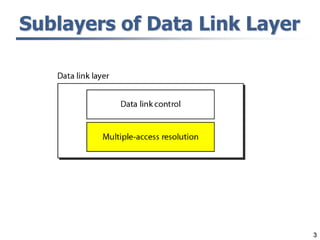
Sublayers of Data Link Layer
4
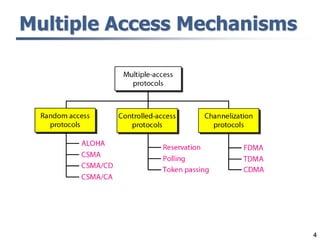
Multiple Access Mechanisms
Random Access
6
Random Access
 Also called contention-based access
 No station is assigned to control another
7
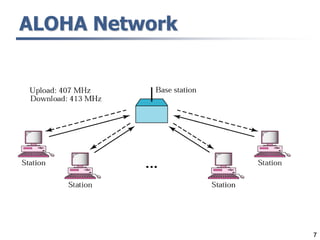
ALOHA Network
8
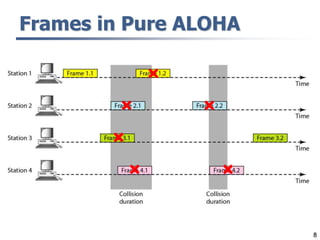
Frames in Pure ALOHA
9
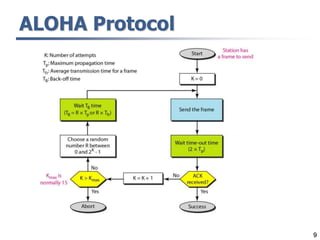
ALOHA Protocol
10
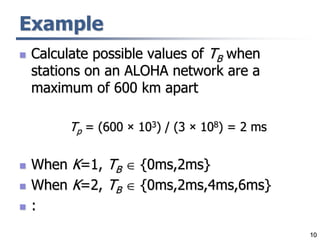
Example
 Calculate possible values of TB when
stations on an ALOHA network are a
maximum of 600 km apart
Tp = (600 × 103) / (3 × 10⁸) = 2 ms
 When K=1, TB  {0ms,2ms}
 When K=2, TB  {0ms,2ms,4ms,6ms}
 :
11
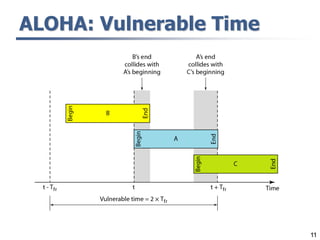
ALOHA: Vulnerable Time
12
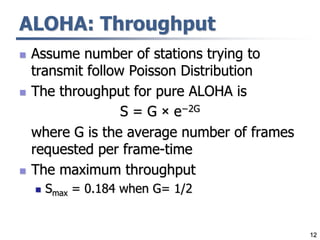
ALOHA: Throughput
 Assume number of stations trying to
transmit follow Poisson Distribution
 The throughput for pure ALOHA is
S = G × e−2G
where G is the average number of frames
requested per frame-time
 The maximum throughput
 Smax = 0.184 when G= 1/2
13
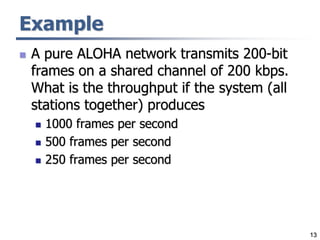
Example
 A pure ALOHA network transmits 200-bit
frames on a shared channel of 200 kbps.
What is the throughput if the system (all
stations together) produces
 1000 frames per second
 500 frames per second
 250 frames per second
14
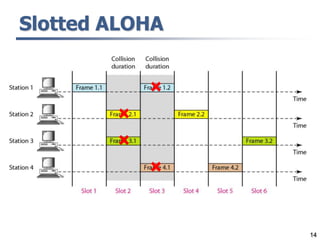
Slotted ALOHA
15
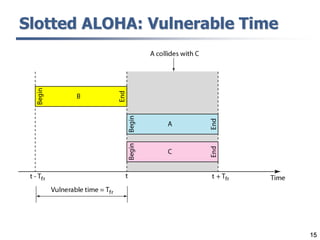
Slotted ALOHA: Vulnerable Time
16
Slotted ALOHA: Throughput
 The throughput for Slotted ALOHA is
S = G × e−G
where G is the average number of frames
requested per frame-time
 The maximum throughput
 Smax = 0.368 when G= 1
17
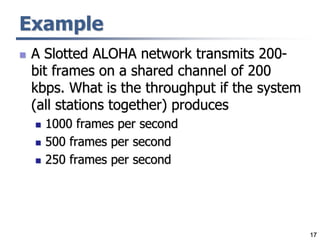
Example
 A Slotted ALOHA network transmits 200-
bit frames on a shared channel of 200
kbps. What is the throughput if the system
(all stations together) produces
 1000 frames per second
 500 frames per second
 250 frames per second
18
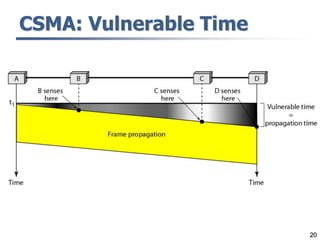
CSMA
 Carrier Sense Multiple Access
 "Listen before talk"
 Reduce the possibility of collision
 But cannot completely eliminate it
19
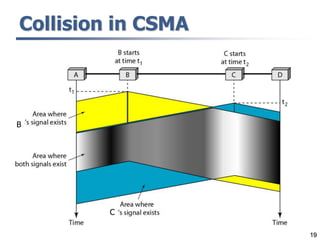
Collision in CSMA
B
C
20
CSMA: Vulnerable Time
21
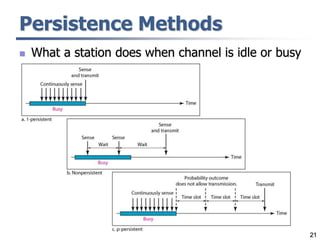
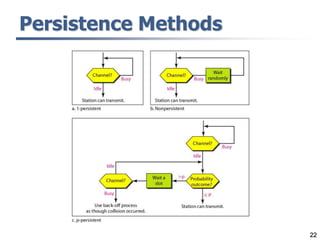
Persistence Methods
 What a station does when channel is idle or busy
22
Persistence Methods
23
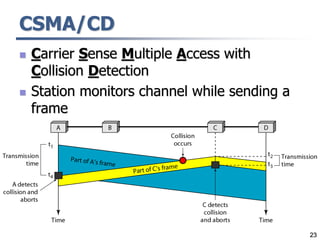
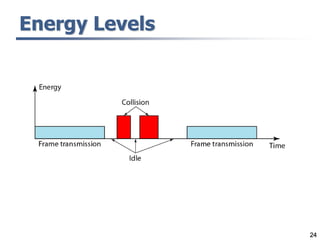
CSMA/CD
 Carrier Sense Multiple Access with
Collision Detection
 Station monitors channel while sending a
frame
24
Energy Levels
25
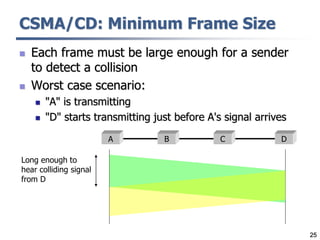
CSMA/CD: Minimum Frame Size
 Each frame must be large enough for a sender
to detect a collision
 Worst case scenario:
 "A" is transmitting
 "D" starts transmitting just before A's signal arrives
A B C D
Long enough to
hear colliding signal
from D
26
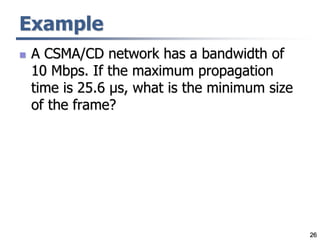
Example
 A CSMA/CD network has a bandwidth of
10 Mbps. If the maximum propagation
time is 25.6 μs, what is the minimum size
of the frame?
27
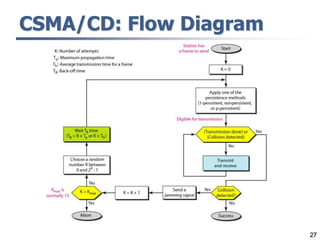
CSMA/CD: Flow Diagram
28
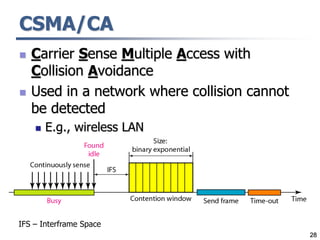
CSMA/CA
 Carrier Sense Multiple Access with
Collision Avoidance
 Used in a network where collision cannot
be detected
 E.g., wireless LAN
IFS – Interframe Space
29
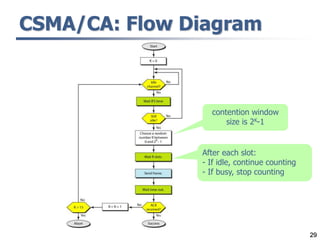
CSMA/CA: Flow Diagram
contention window
size is 2K-1
After each slot:
- If idle, continue counting
- If busy, stop counting
Controlled Access
31
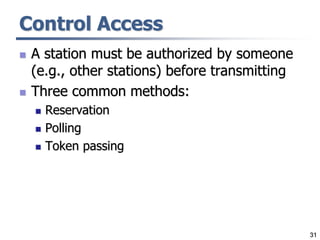
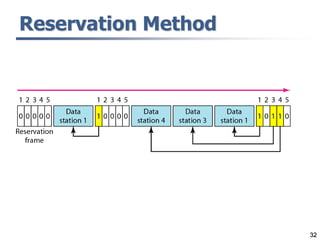
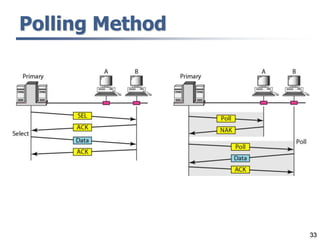
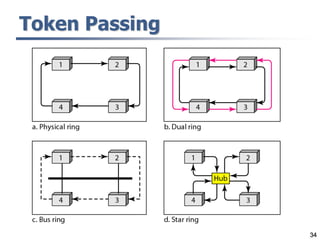
Control Access
 A station must be authorized by someone
(e.g., other stations) before transmitting
 Three common methods:
 Reservation
 Polling
 Token passing
32
Reservation Method
33
Polling Method
34
Token Passing
Channelization
36
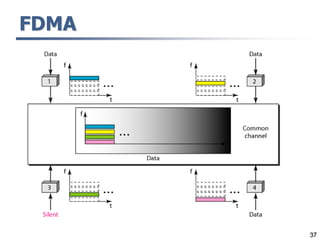
Channelization
 Similar to multiplexing
 Three schemes
 Frequency-Division Multiple Access (FDMA)
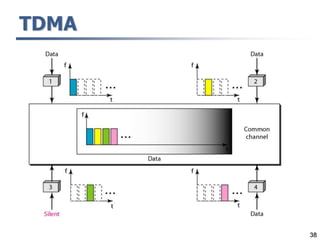
 Time-Division Multiple Access (TDMA)
 Code-Division Multiple Access (CDMA)
37
FDMA
38
TDMA
39
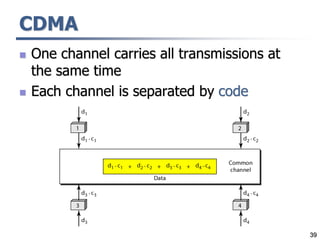
CDMA
 One channel carries all transmissions at
the same time
 Each channel is separated by code
40
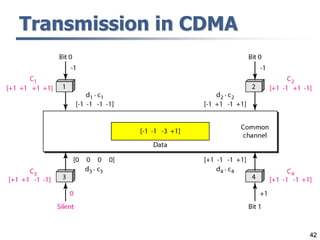
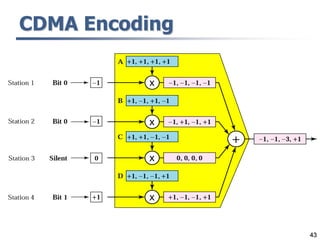
CDMA: Chip Sequences
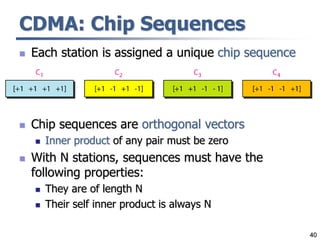
 Each station is assigned a unique chip sequence
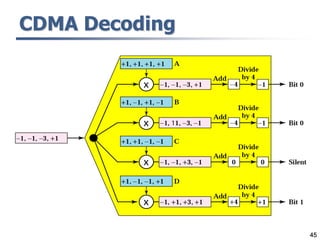
 Chip sequences are orthogonal vectors
 Inner product of any pair must be zero
 With N stations, sequences must have the
following properties:
 They are of length N
 Their self inner product is always N
41
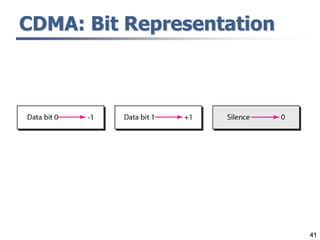
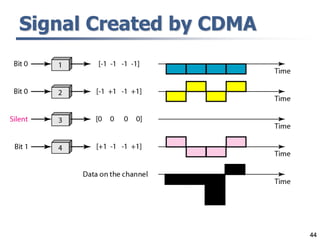
CDMA: Bit Representation
42
Transmission in CDMA
43
CDMA Encoding
44
Signal Created by CDMA
45
CDMA Decoding
46
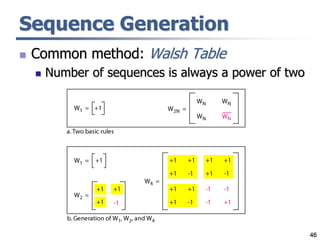
Sequence Generation
 Common method: Walsh Table
 Number of sequences is always a power of two
47
Example: Walsh Table
 Find chip sequences for eight stations
48
Example: Walsh Table
 There are 80 stations in a CDMA network.
What is the length of the sequences
generated by Walsh Table?

MultipleAccess.ppt