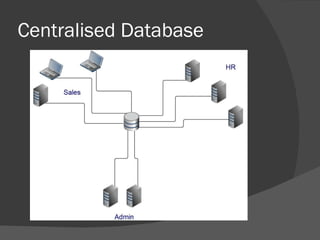
Centralised Database
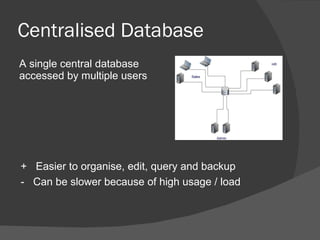
Centralised Database A single central database accessed by multiple users +  Easier to organise, edit, query and backup -  Can be slower because of high usage / load
Distributed Database
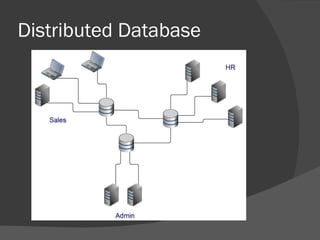
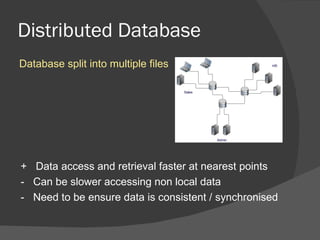
Distributed Database Database split into multiple files +  Data access and retrieval faster at nearest points -  Can be slower accessing non local data -  Need to be ensure data is consistent / synchronised
Distributed Database Vertical Partitioning Split the database to improve speed Group commonly queried fields together Physically closer together therefore faster to retrieve
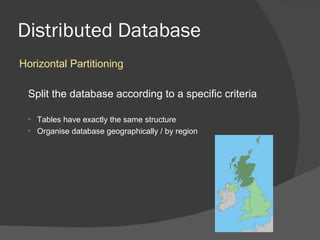
Distributed Database Horizontal Partitioning Split the database according to a specific criteria Tables have exactly the same structure Organise database geographically / by region
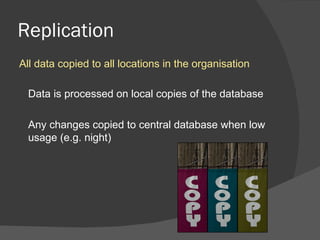
Replication All data copied to all locations in the organisation Data is processed on local copies of the database Any changes copied to central database when low usage (e.g. night)
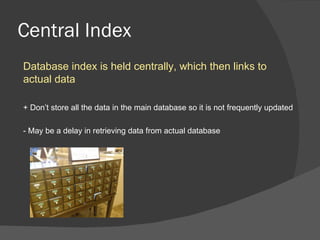
Central Index Database index is held centrally, which then links to actual data + Don’t store all the data in the main database so it is not frequently updated - May be a delay in retrieving data from actual database
Data Warehouse / Data Mining Investigate What is meant by a data warehouse What is meant by data mining
Credits Higher Information Systems – Using Information – Centralised and Distributed Databases Produced by M. Cunningham for the City of Edinburgh Council 2010 All images licenced under Creative Commons 3.0 Working by Aldo Gonzalez The Speed of Silence by Millicent Bystander British Isles United Kingdom by UKPhoenix79 Copy Copy Copy by David Goehring Manchester Central Library card index drawers by Frankie Roberto Old Wool Warehouse, Deal Street, Halifax by Tim Green John King Mining Monument Pinxton by Duncan Harris

Centralised and distributed databases

  • 1.
  • 2.
  • 3.
    Centralised Database Asingle central database accessed by multiple users + Easier to organise, edit, query and backup - Can be slower because of high usage / load
  • 4.
  • 5.
    Distributed Database Databasesplit into multiple files + Data access and retrieval faster at nearest points - Can be slower accessing non local data - Need to be ensure data is consistent / synchronised
  • 6.
    Distributed Database VerticalPartitioning Split the database to improve speed Group commonly queried fields together Physically closer together therefore faster to retrieve
  • 7.
    Distributed Database HorizontalPartitioning Split the database according to a specific criteria Tables have exactly the same structure Organise database geographically / by region
  • 8.
    Replication All datacopied to all locations in the organisation Data is processed on local copies of the database Any changes copied to central database when low usage (e.g. night)
  • 9.
    Central Index Databaseindex is held centrally, which then links to actual data + Don’t store all the data in the main database so it is not frequently updated - May be a delay in retrieving data from actual database
  • 10.
    Data Warehouse /Data Mining Investigate What is meant by a data warehouse What is meant by data mining
  • 11.
    Credits Higher InformationSystems – Using Information – Centralised and Distributed Databases Produced by M. Cunningham for the City of Edinburgh Council 2010 All images licenced under Creative Commons 3.0 Working by Aldo Gonzalez The Speed of Silence by Millicent Bystander British Isles United Kingdom by UKPhoenix79 Copy Copy Copy by David Goehring Manchester Central Library card index drawers by Frankie Roberto Old Wool Warehouse, Deal Street, Halifax by Tim Green John King Mining Monument Pinxton by Duncan Harris