LOCK BASED PROTOCOL
LOCK BASED PROTOCOLS
 A lock is a mechanism to control concurrent access to a data item
 Data items can be locked in two modes :
1. exclusive (X) mode. Data item can be both read as well as
written. X-lock is requested using lock-X instruction.
2. shared (S) mode. Data item can only be read. S-lock is
requested using lock-S instruction.
 Lock requests are made to the concurrency-control manager by the
programmer. Transaction can proceed only after request is granted.
LOCK BASED PROTOCOL(CONTD)
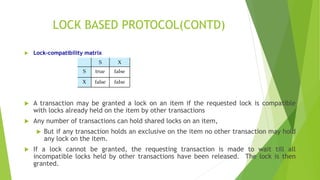
 Lock-compatibility matrix
 A transaction may be granted a lock on an item if the requested lock is compatible
with locks already held on the item by other transactions
 Any number of transactions can hold shared locks on an item,
 But if any transaction holds an exclusive on the item no other transaction may hold
any lock on the item.
 If a lock cannot be granted, the requesting transaction is made to wait till all
incompatible locks held by other transactions have been released. The lock is then
granted.
LOCK BASED PROTOCOL(CONTD)
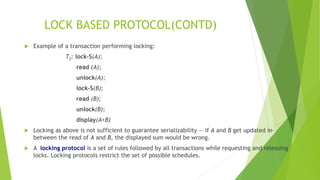
 Example of a transaction performing locking:
T2: lock-S(A);
read (A);
unlock(A);
lock-S(B);
read (B);
unlock(B);
display(A+B)
 Locking as above is not sufficient to guarantee serializability — if A and B get updated in-
between the read of A and B, the displayed sum would be wrong.
 A locking protocol is a set of rules followed by all transactions while requesting and releasing
locks. Locking protocols restrict the set of possible schedules.
TWO PHASE LOCKING PROTOCOL
 This protocol ensures conflict-serializable schedules.
 Phase 1: Growing Phase
 Transaction may obtain locks
 Transaction may not release locks
 Phase 2: Shrinking Phase
 Transaction may release locks
 Transaction may not obtain locks
 The protocol assures serializability. It can be proved that the transactions can
be serialized in the order of their lock points (i.e., the point where a
transaction acquired its final lock).
TWO PHASE LOCKING
PROTOCOL(CONTD)
 There can be conflict serializable schedules that cannot be obtained if two-
phase locking is used.
 However, in the absence of extra information (e.g., ordering of access to
data), two-phase locking is needed for conflict serializability in the following
sense:
 Given a transaction Ti that does not follow two-phase locking, we can find a
transaction Tj that uses two-phase locking, and a schedule for Ti and Tj that is not
conflict serializable.
THANK YOU

Lock based protocols

  • 1.
  • 2.
    LOCK BASED PROTOCOLS A lock is a mechanism to control concurrent access to a data item  Data items can be locked in two modes : 1. exclusive (X) mode. Data item can be both read as well as written. X-lock is requested using lock-X instruction. 2. shared (S) mode. Data item can only be read. S-lock is requested using lock-S instruction.  Lock requests are made to the concurrency-control manager by the programmer. Transaction can proceed only after request is granted.
  • 3.
    LOCK BASED PROTOCOL(CONTD) Lock-compatibility matrix  A transaction may be granted a lock on an item if the requested lock is compatible with locks already held on the item by other transactions  Any number of transactions can hold shared locks on an item,  But if any transaction holds an exclusive on the item no other transaction may hold any lock on the item.  If a lock cannot be granted, the requesting transaction is made to wait till all incompatible locks held by other transactions have been released. The lock is then granted.
  • 4.
    LOCK BASED PROTOCOL(CONTD) Example of a transaction performing locking: T2: lock-S(A); read (A); unlock(A); lock-S(B); read (B); unlock(B); display(A+B)  Locking as above is not sufficient to guarantee serializability — if A and B get updated in- between the read of A and B, the displayed sum would be wrong.  A locking protocol is a set of rules followed by all transactions while requesting and releasing locks. Locking protocols restrict the set of possible schedules.
  • 5.
    TWO PHASE LOCKINGPROTOCOL  This protocol ensures conflict-serializable schedules.  Phase 1: Growing Phase  Transaction may obtain locks  Transaction may not release locks  Phase 2: Shrinking Phase  Transaction may release locks  Transaction may not obtain locks  The protocol assures serializability. It can be proved that the transactions can be serialized in the order of their lock points (i.e., the point where a transaction acquired its final lock).
  • 6.
    TWO PHASE LOCKING PROTOCOL(CONTD) There can be conflict serializable schedules that cannot be obtained if two- phase locking is used.  However, in the absence of extra information (e.g., ordering of access to data), two-phase locking is needed for conflict serializability in the following sense:  Given a transaction Ti that does not follow two-phase locking, we can find a transaction Tj that uses two-phase locking, and a schedule for Ti and Tj that is not conflict serializable.
  • 7.