The LDAP Protocol…
Amrish Kaushik
Graduate Student
USC – Computer Science (CN)
Agenda
 Background and Motivation
 Understanding LDAP
 Information Structure
 Naming
 Functions/Operations
 Security
 Protocol Model
 Mapping onto Transport Services
 Protocol Element Encoding
 Discussion
Background and Motivation
 Increased reliance on networked
computers
 Need in information
 Functionality
 Ease-of-Use
 Administration (Application specific dirs)
 Clear and consistent organization
 Integrity
 Confidentiality
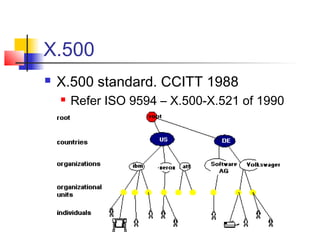
X.500
 X.500 standard. CCITT 1988
 Refer ISO 9594 – X.500-X.521 of 1990
X.500
 Organizes directory entries into a
hierarchical namespace
 Powerful search capabilities
 Often used for interfacing incompatible
directory services
 Used DAP for c/s communication
 DAP (App. Layer) requires ENTIRE OSI
stack to operate
 Too heavy for small environments
What is LDAP?
 Lightweight Directory Access Protocol
 Used to access and update information
in a directory built on the X.500 model
 Specification defines the content of
messages between the client and the
server
 Includes operations to establish and
disconnect a session from the server
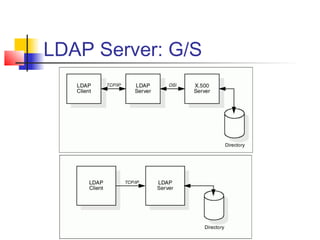
LDAP Server: G/S
Understanding LDAP
 Lightweight alternative to DAP
 Uses TCP/IP instead of OSI stack
 Simplifies certain functions and omits
others…
 Uses strings rather than DAP’s ASN.1
notation to represent data.
LDAP
 Information
 Structure of information stored in an LDAP
directory.
 Naming
 How information is organized and identified.
 Functional / Operations
 Describes what operations can be performed on
the information stored in an LDAP directory.
 Security
 Describes how the information can be protected
from unauthorized access.
LDAP Information Storage
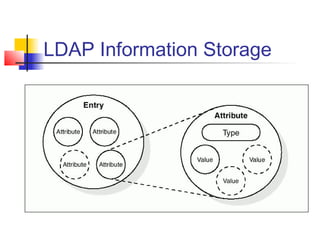
 Each attribute has a type/syntax and a
value
 Can define how values behave during
searches/directory operations
 Syntax: bin, ces, cis, tel, dn etc.
 Usage limits: ssn – only one, jpegPhoto
– 10K
LDAP Information Storage
 Each ‘entry’ describes an object (Class)
 Person, Server, Printer etc.
 Example Entry:
 InetOrgPerson(cn, sn, ObjectClass)
 Example Attributes:
 cn (cis), sn (cis), telephoneNumber (tel), ou
(cis), owner (dn), jpegPhoto (bin)
LDAP Naming
 DNs consist of sequence of Relative DN
 cn=John Smith,ou=Austin,o=IBM,c=US
(Leaf 2 Root) (~use  for special)
 Directory Information Tree (DIT)
 Follow geographical or organizational
scheme
 Aliases: Tree-like,
 Aliases can link non-leaf nodes
LDAP Naming
 Referrals: May not store entire DIT (v3)
 Referrals
 objectClass=referral, attribute=ref,
value=LDAPurl
 Implementation differs
 Refferals/Chaining (vendor)

RFC 1777: server chaining is expected.
LDAP Naming
 Schema
 Defines what object classes allowed
 Where they are stored
 What attributes they have (objectClass)
 Which attributes are optional (objectClass)
 Type/syntax of each attribute (objectClass)
 Query server for info: zero-length DN
 LDAP schema must be readable by the
client
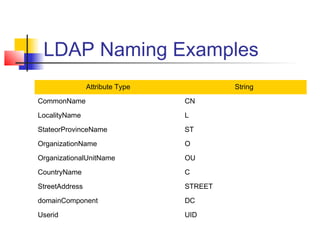
LDAP Naming Examples
Attribute Type String
CommonName CN
LocalityName L
StateorProvinceName ST
OrganizationName O
OrganizationalUnitName OU
CountryName C
StreetAddress STREET
domainComponent DC
Userid UID
LDAP Functions/Operations
 Authentication
 BIND/UNBIND
 ABANDON
 Query
 Search
 Compare entry
 Update
 Add an entry
 Delete an entry (Only Leaf nodes, no aliases)
 Modify an entry, Modify DN/RDN
Client and Server Interaction
 Client establishes session with server (BIND)
 Hostname/IP and port number
 Security

User-id/password based authentication

Anonymous connection - default access rights

Encryption/Kerberos also supported
 Client performs operations
 Read/Update/Search
 SELECT X,Y,Z FROM PART_OF_DIRECTORY
 Client ends the session (UNBIND)
 Client can ABANDON the session
BIND/UNBIND/ABANDON
 Request includes LDAP version, the name
the client wants to bind as, authentication
type
 Simple (clear text passwords, anonymous)
 Kerberos v4 to the LDAP server (krbv42LDAP)
 Kerberos v4 to the DSA server (krbv42DSA)
 Server responds with a status indication
 UNBIND: Terminates a protocol session
 UnbindRequest ::= [APPLICATION 2] NULL
 ABANDON:
Search/Compare
 Request includes
 baseObject: an LDAPDN
 Scope: how many levels to be searched
 derefAliases: handling of aliases
 sizeLimit: max number of entries returned
 timeLimit: max time allowed for search
 attrsOnly: return attribute types OR values also
 Filter: cond. to be fulfilled when searching
 Attributes: List of entry’s attributes to be returned
 Read and List implemented as searches
 Compare: similar to search but returns T/F
ADD/MODIFY/DELETE
 ADD request
 Entry: LDAPDN
 List of Attributes and values (or sets of values)
 MODIFY request
 Used to add, delete, modify attributes
 Request includes

Object: LDAPDN

List of modifications (atomic)
 Add, Delete, Replace
 DELETE request
 Object: LDAPDN
 MODIFY RDN: LDAPDN, newRDN,
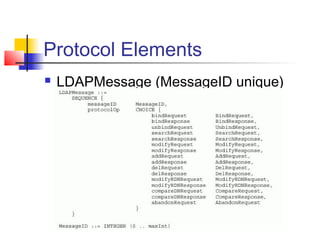
Protocol Elements
 LDAPMessage (MessageID unique)
Protocol Elements
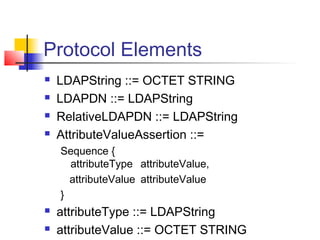
 LDAPString ::= OCTET STRING
 LDAPDN ::= LDAPString
 RelativeLDAPDN ::= LDAPString
 AttributeValueAssertion ::=
Sequence {
attributeType attributeValue,
attributeValue attributeValue
}
 attributeType ::= LDAPString
 attributeValue ::= OCTET STRING
Protocol Elements
 LDAP Result
 Errors
 Truncated DIT
RDN sequence is
sent

noSuchObject

aliasProblem

invalidDNSyntax

isLeaf etc.
LDAP Security
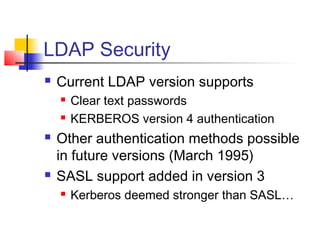
 Current LDAP version supports
 Clear text passwords
 KERBEROS version 4 authentication
 Other authentication methods possible
in future versions (March 1995)
 SASL support added in version 3
 Kerberos deemed stronger than SASL…
LDAP Security
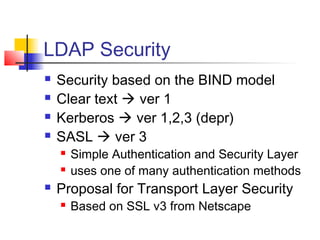
 Security based on the BIND model
 Clear text  ver 1
 Kerberos  ver 1,2,3 (depr)
 SASL  ver 3
 Simple Authentication and Security Layer
 uses one of many authentication methods
 Proposal for Transport Layer Security
 Based on SSL v3 from Netscape
LDAP Security
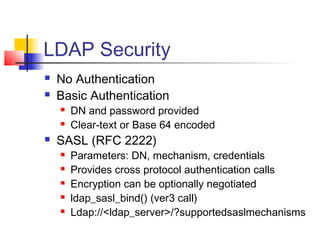
 No Authentication
 Basic Authentication
 DN and password provided
 Clear-text or Base 64 encoded
 SASL (RFC 2222)
 Parameters: DN, mechanism, credentials
 Provides cross protocol authentication calls
 Encryption can be optionally negotiated
 ldap_sasl_bind() (ver3 call)
 Ldap://<ldap_server>/?supportedsaslmechanisms
LDAP Security
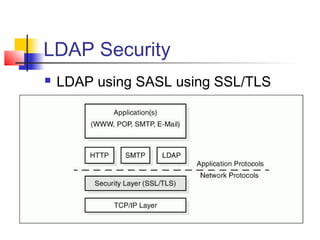
 LDAP using SASL using SSL/TLS
LDAP Security
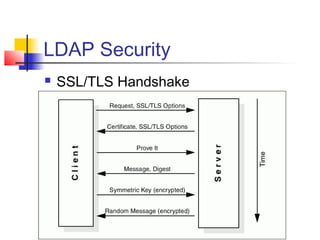
 SSL/TLS Handshake
Agenda
 Background and Motivation
 Understanding LDAP
 Information Structure
 Naming
 Functions/Operations
 Security
 Protocol Model
 Mapping onto Transport Services
 Protocol Element Encoding
 Discussion
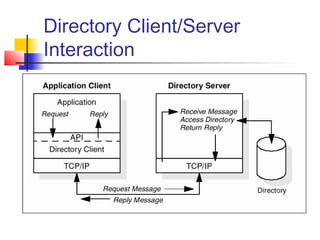
Protocol Model
 Clients performing protocol operations
against servers
 Client sends protocol request to server
 Server performs operation on directory
 Server returns response (results/errors)
 Asynchronous Server Behavior
Directory Client/Server
Interaction
Mapping onto Transport
 Uses Connection-oriented, reliable transport
 TCP
 LDAPMessage PDU mapped onto TCP byte
stream
 LDAP listener on port 389
 Connection Oriented Transport Service
(COTS)
 LDAP PDU is mapped directly onto T-Data
Protocol Element Encoding
 Encoded for Exchange using BER
(Basic Encoding Rules)
 BER defined in Abstract Syntax
Notation One (ASN.1)
 High Overhead for BER
 Restrictions imposed to improve perf.

Definite form of length encoding only

Bit Strings/ Octet Strings and all character
string types encoded in primitive form only
LDAP Implementations
 C Library API
 LDAPv2 - RFC 1823 ‘The LDAP API’
 LDAPv3 – In Internet Draft stage
 Java JNDI
 LDAP v3 uses the UTF-8 encoding of
the Unicode character set.
 HTTP to LDAP gateway
 LDAP to X.500 gateway – ldapd
Version 2 v/s Version 3
 Referrals
 A server that does not store the requested data
can refer the client to another server.
 Security
 Extensible authentication using Simple
Authentication and Security Layer (SASL)
 Internationalization
 UTF-8 support for international characters.
 Extensibility
 New object types and operations can be
dynamically defined and schema published in a
standard manner.

LDAP

  • 1.
    The LDAP Protocol… AmrishKaushik Graduate Student USC – Computer Science (CN)
  • 2.
    Agenda  Background andMotivation  Understanding LDAP  Information Structure  Naming  Functions/Operations  Security  Protocol Model  Mapping onto Transport Services  Protocol Element Encoding  Discussion
  • 3.
    Background and Motivation Increased reliance on networked computers  Need in information  Functionality  Ease-of-Use  Administration (Application specific dirs)  Clear and consistent organization  Integrity  Confidentiality
  • 4.
    X.500  X.500 standard.CCITT 1988  Refer ISO 9594 – X.500-X.521 of 1990
  • 5.
    X.500  Organizes directoryentries into a hierarchical namespace  Powerful search capabilities  Often used for interfacing incompatible directory services  Used DAP for c/s communication  DAP (App. Layer) requires ENTIRE OSI stack to operate  Too heavy for small environments
  • 6.
    What is LDAP? Lightweight Directory Access Protocol  Used to access and update information in a directory built on the X.500 model  Specification defines the content of messages between the client and the server  Includes operations to establish and disconnect a session from the server
  • 7.
  • 8.
    Understanding LDAP  Lightweightalternative to DAP  Uses TCP/IP instead of OSI stack  Simplifies certain functions and omits others…  Uses strings rather than DAP’s ASN.1 notation to represent data.
  • 9.
    LDAP  Information  Structureof information stored in an LDAP directory.  Naming  How information is organized and identified.  Functional / Operations  Describes what operations can be performed on the information stored in an LDAP directory.  Security  Describes how the information can be protected from unauthorized access.
  • 10.
  • 11.
    LDAP Information Storage Each attribute has a type/syntax and a value  Can define how values behave during searches/directory operations  Syntax: bin, ces, cis, tel, dn etc.  Usage limits: ssn – only one, jpegPhoto – 10K
  • 12.
    LDAP Information Storage Each ‘entry’ describes an object (Class)  Person, Server, Printer etc.  Example Entry:  InetOrgPerson(cn, sn, ObjectClass)  Example Attributes:  cn (cis), sn (cis), telephoneNumber (tel), ou (cis), owner (dn), jpegPhoto (bin)
  • 13.
    LDAP Naming  DNsconsist of sequence of Relative DN  cn=John Smith,ou=Austin,o=IBM,c=US (Leaf 2 Root) (~use for special)  Directory Information Tree (DIT)  Follow geographical or organizational scheme  Aliases: Tree-like,  Aliases can link non-leaf nodes
  • 14.
    LDAP Naming  Referrals:May not store entire DIT (v3)  Referrals  objectClass=referral, attribute=ref, value=LDAPurl  Implementation differs  Refferals/Chaining (vendor)  RFC 1777: server chaining is expected.
  • 15.
    LDAP Naming  Schema Defines what object classes allowed  Where they are stored  What attributes they have (objectClass)  Which attributes are optional (objectClass)  Type/syntax of each attribute (objectClass)  Query server for info: zero-length DN  LDAP schema must be readable by the client
  • 16.
    LDAP Naming Examples AttributeType String CommonName CN LocalityName L StateorProvinceName ST OrganizationName O OrganizationalUnitName OU CountryName C StreetAddress STREET domainComponent DC Userid UID
  • 17.
    LDAP Functions/Operations  Authentication BIND/UNBIND  ABANDON  Query  Search  Compare entry  Update  Add an entry  Delete an entry (Only Leaf nodes, no aliases)  Modify an entry, Modify DN/RDN
  • 18.
    Client and ServerInteraction  Client establishes session with server (BIND)  Hostname/IP and port number  Security  User-id/password based authentication  Anonymous connection - default access rights  Encryption/Kerberos also supported  Client performs operations  Read/Update/Search  SELECT X,Y,Z FROM PART_OF_DIRECTORY  Client ends the session (UNBIND)  Client can ABANDON the session
  • 19.
    BIND/UNBIND/ABANDON  Request includesLDAP version, the name the client wants to bind as, authentication type  Simple (clear text passwords, anonymous)  Kerberos v4 to the LDAP server (krbv42LDAP)  Kerberos v4 to the DSA server (krbv42DSA)  Server responds with a status indication  UNBIND: Terminates a protocol session  UnbindRequest ::= [APPLICATION 2] NULL  ABANDON:
  • 20.
    Search/Compare  Request includes baseObject: an LDAPDN  Scope: how many levels to be searched  derefAliases: handling of aliases  sizeLimit: max number of entries returned  timeLimit: max time allowed for search  attrsOnly: return attribute types OR values also  Filter: cond. to be fulfilled when searching  Attributes: List of entry’s attributes to be returned  Read and List implemented as searches  Compare: similar to search but returns T/F
  • 21.
    ADD/MODIFY/DELETE  ADD request Entry: LDAPDN  List of Attributes and values (or sets of values)  MODIFY request  Used to add, delete, modify attributes  Request includes  Object: LDAPDN  List of modifications (atomic)  Add, Delete, Replace  DELETE request  Object: LDAPDN  MODIFY RDN: LDAPDN, newRDN,
  • 22.
  • 23.
    Protocol Elements  LDAPString::= OCTET STRING  LDAPDN ::= LDAPString  RelativeLDAPDN ::= LDAPString  AttributeValueAssertion ::= Sequence { attributeType attributeValue, attributeValue attributeValue }  attributeType ::= LDAPString  attributeValue ::= OCTET STRING
  • 24.
    Protocol Elements  LDAPResult  Errors  Truncated DIT RDN sequence is sent  noSuchObject  aliasProblem  invalidDNSyntax  isLeaf etc.
  • 25.
    LDAP Security  CurrentLDAP version supports  Clear text passwords  KERBEROS version 4 authentication  Other authentication methods possible in future versions (March 1995)  SASL support added in version 3  Kerberos deemed stronger than SASL…
  • 26.
    LDAP Security  Securitybased on the BIND model  Clear text  ver 1  Kerberos  ver 1,2,3 (depr)  SASL  ver 3  Simple Authentication and Security Layer  uses one of many authentication methods  Proposal for Transport Layer Security  Based on SSL v3 from Netscape
  • 27.
    LDAP Security  NoAuthentication  Basic Authentication  DN and password provided  Clear-text or Base 64 encoded  SASL (RFC 2222)  Parameters: DN, mechanism, credentials  Provides cross protocol authentication calls  Encryption can be optionally negotiated  ldap_sasl_bind() (ver3 call)  Ldap://<ldap_server>/?supportedsaslmechanisms
  • 28.
    LDAP Security  LDAPusing SASL using SSL/TLS
  • 29.
  • 30.
    Agenda  Background andMotivation  Understanding LDAP  Information Structure  Naming  Functions/Operations  Security  Protocol Model  Mapping onto Transport Services  Protocol Element Encoding  Discussion
  • 31.
    Protocol Model  Clientsperforming protocol operations against servers  Client sends protocol request to server  Server performs operation on directory  Server returns response (results/errors)  Asynchronous Server Behavior
  • 32.
  • 33.
    Mapping onto Transport Uses Connection-oriented, reliable transport  TCP  LDAPMessage PDU mapped onto TCP byte stream  LDAP listener on port 389  Connection Oriented Transport Service (COTS)  LDAP PDU is mapped directly onto T-Data
  • 34.
    Protocol Element Encoding Encoded for Exchange using BER (Basic Encoding Rules)  BER defined in Abstract Syntax Notation One (ASN.1)  High Overhead for BER  Restrictions imposed to improve perf.  Definite form of length encoding only  Bit Strings/ Octet Strings and all character string types encoded in primitive form only
  • 35.
    LDAP Implementations  CLibrary API  LDAPv2 - RFC 1823 ‘The LDAP API’  LDAPv3 – In Internet Draft stage  Java JNDI  LDAP v3 uses the UTF-8 encoding of the Unicode character set.  HTTP to LDAP gateway  LDAP to X.500 gateway – ldapd
  • 36.
    Version 2 v/sVersion 3  Referrals  A server that does not store the requested data can refer the client to another server.  Security  Extensible authentication using Simple Authentication and Security Layer (SASL)  Internationalization  UTF-8 support for international characters.  Extensibility  New object types and operations can be dynamically defined and schema published in a standard manner.